




Communication
Networks
- Introduction
Video Lecture for these slides are
available at
www.youtube.com/GURUKULA
Major Problems for students community in
setting up their career. (My Opinion)
• Don’t know what to study.
• Lack of SWOT Analysis.
• What is my interest?
• Whether my interest can become
a profession or start-up?
• How to setup a career in my field
of interest.
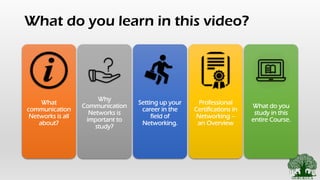
What do you learn in this video?
What
communication
Networks is all
about?
Why
Communication
Networks is
important to
study?
Professional
Certifications in
Networking –
an Overview
Setting up your
career in the
field of
Networking.
What do you
study in this
entire Course.
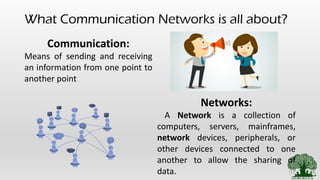
What Communication Networks is all about?
Communication:
Means of sending and receiving
an information from one point to
another point
Networks:
A Network is a collection of
computers, servers, mainframes,
network devices, peripherals, or
other devices connected to one
another to allow the sharing of
data.
Communication Networks
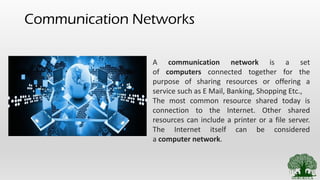
A communication network is a set
of computers connected together for the
purpose of sharing resources or offering a
service such as E Mail, Banking, Shopping Etc.,
The most common resource shared today is
connection to the Internet. Other shared
resources can include a printer or a file server.
The Internet itself can be considered
a computer network.
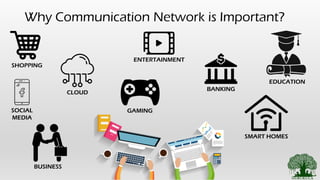
Why Communication Network is Important?
SHOPPING
SOCIAL
MEDIA
CLOUD
BUSINESS
GAMING
ENTERTAINMENT
BANKING
EDUCATION
SMART HOMES
One Internet Minute.
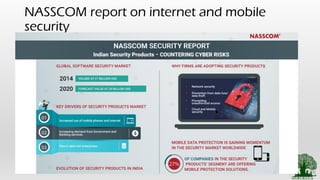
NASSCOM report on internet and mobile
security
NASSCOM report on new Technologies in
India 2020
https://www.nasscom.in/knowledge-center/publications/technology-sector-in-
india-2020-techade-strategic-review
Internet
❖We could clearly see that how the internet have changed the way
interact, shop, study, paly and even the life styles.
❖Internet have been used as an important tool for many start-ups to
reach more people.
If networking is so important, and seems
to have a tremendous growth in the
future… Why cant you set up a career in
this domain?
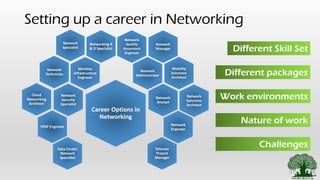
Setting up a career in Networking
Network
Specialist
Network
Technician
Network
Administrator
Network
Analyst
Network
Manager
Network
Engineer
Network
Solutions
Architect
Network
Security
Specialist
Cloud
Networking
Architect
Networking R
& D Specialist
Career Options in
Networking
Network
Quality
Assurance
Engineer
Wireless
Infrastructure
Engineer
Mobility
Solutions
Architect
VOIP Engineer
Telecom
Project
Manager
Data Center
Network
Specialist
Different Skill Set
Different packages
Work environments
Nature of work
Challenges
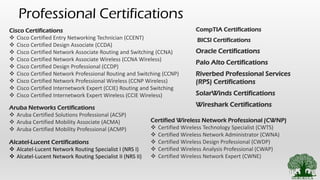
Professional Certifications
Alcatel-Lucent Certifications
❖ Alcatel-Lucent Network Routing Specialist I (NRS I)
❖ Alcatel-Lucent Network Routing Specialist II (NRS II)
Aruba Networks Certifications
❖ Aruba Certified Solutions Professional (ACSP)
❖ Aruba Certified Mobility Associate (ACMA)
❖ Aruba Certified Mobility Professional (ACMP)
BICSI Certifications
Cisco Certifications
❖ Cisco Certified Entry Networking Technician (CCENT)
❖ Cisco Certified Design Associate (CCDA)
❖ Cisco Certified Network Associate Routing and Switching (CCNA)
❖ Cisco Certified Network Associate Wireless (CCNA Wireless)
❖ Cisco Certified Design Professional (CCDP)
❖ Cisco Certified Network Professional Routing and Switching (CCNP)
❖ Cisco Certified Network Professional Wireless (CCNP Wireless)
❖ Cisco Certified Internetwork Expert (CCIE) Routing and Switching
❖ Cisco Certified Internetwork Expert Wireless (CCIE Wireless)
CompTIA Certifications
Certified Wireless Network Professional (CWNP)
❖ Certified Wireless Technology Specialist (CWTS)
❖ Certified Wireless Network Administrator (CWNA)
❖ Certified Wireless Design Professional (CWDP)
❖ Certified Wireless Analysis Professional (CWAP)
❖ Certified Wireless Network Expert (CWNE)
Oracle Certifications
Palo Alto Certifications
Riverbed Professional Services
(RPS) Certifications
SolarWinds Certifications
Wireshark Certifications
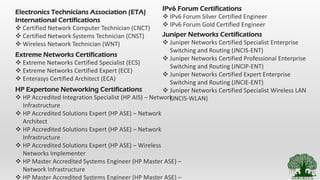
Electronics Technicians Association (ETA)
International Certifications
❖ Certified Network Computer Technician (CNCT)
❖ Certified Network Systems Technician (CNST)
❖ Wireless Network Technician (WNT)
Extreme Networks Certifications
❖ Extreme Networks Certified Specialist (ECS)
❖ Extreme Networks Certified Expert (ECE)
❖ Enterasys Certified Architect (ECA)
HP Expertone Networking Certifications
❖ HP Accredited Integration Specialist (HP AIS) – Network
Infrastructure
❖ HP Accredited Solutions Expert (HP ASE) – Network
Architect
❖ HP Accredited Solutions Expert (HP ASE) – Network
Infrastructure
❖ HP Accredited Solutions Expert (HP ASE) – Wireless
Networks Implementer
❖ HP Master Accredited Systems Engineer (HP Master ASE) –
Network Infrastructure
❖ HP Master Accredited Systems Engineer (HP Master ASE) –
IPv6 Forum Certifications
❖ IPv6 Forum Silver Certified Engineer
❖ IPv6 Forum Gold Certified Engineer
Juniper Networks Certifications
❖ Juniper Networks Certified Specialist Enterprise
Switching and Routing (JNCIS-ENT)
❖ Juniper Networks Certified Professional Enterprise
Switching and Routing (JNCIP-ENT)
❖ Juniper Networks Certified Expert Enterprise
Switching and Routing (JNCIE-ENT)
❖ Juniper Networks Certified Specialist Wireless LAN
(JNCIS-WLAN)
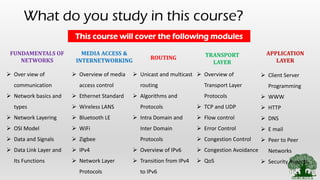
What do you study in this course?
This course will cover the following modules
TRANSPORT
LAYER
APPLICATION
LAYER
FUNDAMENTALS OF
NETWORKS
➢ Over view of
communication
➢ Network basics and
types
➢ Network Layering
➢ OSI Model
➢ Data and Signals
➢ Data Link Layer and
Its Functions
MEDIA ACCESS &
INTERNETWORKING
➢ Overview of media
access control
➢ Ethernet Standard
➢ Wireless LANS
➢ Bluetooth LE
➢ WiFi
➢ Zigbee
➢ IPv4
➢ Network Layer
Protocols
ROUTING
➢ Unicast and multicast
routing
➢ Algorithms and
Protocols
➢ Intra Domain and
Inter Domain
Protocols
➢ Overview of IPv6
➢ Transition from IPv4
to IPv6
➢ Overview of
Transport Layer
Protocols
➢ TCP and UDP
➢ Flow control
➢ Error Control
➢ Congestion Control
➢ Congestion Avoidance
➢ QoS
➢ Client Server
Programming
➢ WWW
➢ HTTP
➢ DNS
➢ E mail
➢ Peer to Peer
Networks
➢ Security Aspects
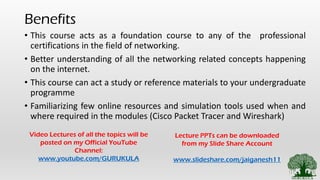
Benefits
• This course acts as a foundation course to any of the professional
certifications in the field of networking.
• Better understanding of all the networking related concepts happening
on the internet.
• This course can act a study or reference materials to your undergraduate
programme
• Familiarizing few online resources and simulation tools used when and
where required in the modules (Cisco Packet Tracer and Wireshark)
Video Lectures of all the topics will be
posted on my Official YouTube
Channel:
www.youtube.com/GURUKULA
Lecture PPTs can be downloaded
from my Slide Share Account
www.slideshare.com/jaiganesh11
References:
• Behrouz A. Forouzan, ―Data communication and Networking, Fifth
Edition, Tata McGraw – Hill, 2013
• Larry L. Peterson, Bruce S. Davie, ―Computer Networks: A Systems
Approach, Fifth Edition, Morgan Kaufmann Publishers, 2011.
• Few online References (Will be Mentioned in the description Section)
Thank You…

1. introduction to communication networks subject introduction

  • 1.
  • 2.
    Video Lecture forthese slides are available at www.youtube.com/GURUKULA
  • 3.
    Major Problems forstudents community in setting up their career. (My Opinion) • Don’t know what to study. • Lack of SWOT Analysis. • What is my interest? • Whether my interest can become a profession or start-up? • How to setup a career in my field of interest.
  • 4.
    What do youlearn in this video? What communication Networks is all about? Why Communication Networks is important to study? Professional Certifications in Networking – an Overview Setting up your career in the field of Networking. What do you study in this entire Course.
  • 5.
    What Communication Networksis all about? Communication: Means of sending and receiving an information from one point to another point Networks: A Network is a collection of computers, servers, mainframes, network devices, peripherals, or other devices connected to one another to allow the sharing of data.
  • 6.
    Communication Networks A communicationnetwork is a set of computers connected together for the purpose of sharing resources or offering a service such as E Mail, Banking, Shopping Etc., The most common resource shared today is connection to the Internet. Other shared resources can include a printer or a file server. The Internet itself can be considered a computer network.
  • 7.
    Why Communication Networkis Important? SHOPPING SOCIAL MEDIA CLOUD BUSINESS GAMING ENTERTAINMENT BANKING EDUCATION SMART HOMES
  • 8.
  • 9.
    NASSCOM report oninternet and mobile security
  • 10.
    NASSCOM report onnew Technologies in India 2020 https://www.nasscom.in/knowledge-center/publications/technology-sector-in- india-2020-techade-strategic-review
  • 11.
    Internet ❖We could clearlysee that how the internet have changed the way interact, shop, study, paly and even the life styles. ❖Internet have been used as an important tool for many start-ups to reach more people. If networking is so important, and seems to have a tremendous growth in the future… Why cant you set up a career in this domain?
  • 12.
    Setting up acareer in Networking Network Specialist Network Technician Network Administrator Network Analyst Network Manager Network Engineer Network Solutions Architect Network Security Specialist Cloud Networking Architect Networking R & D Specialist Career Options in Networking Network Quality Assurance Engineer Wireless Infrastructure Engineer Mobility Solutions Architect VOIP Engineer Telecom Project Manager Data Center Network Specialist Different Skill Set Different packages Work environments Nature of work Challenges
  • 13.
    Professional Certifications Alcatel-Lucent Certifications ❖Alcatel-Lucent Network Routing Specialist I (NRS I) ❖ Alcatel-Lucent Network Routing Specialist II (NRS II) Aruba Networks Certifications ❖ Aruba Certified Solutions Professional (ACSP) ❖ Aruba Certified Mobility Associate (ACMA) ❖ Aruba Certified Mobility Professional (ACMP) BICSI Certifications Cisco Certifications ❖ Cisco Certified Entry Networking Technician (CCENT) ❖ Cisco Certified Design Associate (CCDA) ❖ Cisco Certified Network Associate Routing and Switching (CCNA) ❖ Cisco Certified Network Associate Wireless (CCNA Wireless) ❖ Cisco Certified Design Professional (CCDP) ❖ Cisco Certified Network Professional Routing and Switching (CCNP) ❖ Cisco Certified Network Professional Wireless (CCNP Wireless) ❖ Cisco Certified Internetwork Expert (CCIE) Routing and Switching ❖ Cisco Certified Internetwork Expert Wireless (CCIE Wireless) CompTIA Certifications Certified Wireless Network Professional (CWNP) ❖ Certified Wireless Technology Specialist (CWTS) ❖ Certified Wireless Network Administrator (CWNA) ❖ Certified Wireless Design Professional (CWDP) ❖ Certified Wireless Analysis Professional (CWAP) ❖ Certified Wireless Network Expert (CWNE) Oracle Certifications Palo Alto Certifications Riverbed Professional Services (RPS) Certifications SolarWinds Certifications Wireshark Certifications
  • 14.
    Electronics Technicians Association(ETA) International Certifications ❖ Certified Network Computer Technician (CNCT) ❖ Certified Network Systems Technician (CNST) ❖ Wireless Network Technician (WNT) Extreme Networks Certifications ❖ Extreme Networks Certified Specialist (ECS) ❖ Extreme Networks Certified Expert (ECE) ❖ Enterasys Certified Architect (ECA) HP Expertone Networking Certifications ❖ HP Accredited Integration Specialist (HP AIS) – Network Infrastructure ❖ HP Accredited Solutions Expert (HP ASE) – Network Architect ❖ HP Accredited Solutions Expert (HP ASE) – Network Infrastructure ❖ HP Accredited Solutions Expert (HP ASE) – Wireless Networks Implementer ❖ HP Master Accredited Systems Engineer (HP Master ASE) – Network Infrastructure ❖ HP Master Accredited Systems Engineer (HP Master ASE) – IPv6 Forum Certifications ❖ IPv6 Forum Silver Certified Engineer ❖ IPv6 Forum Gold Certified Engineer Juniper Networks Certifications ❖ Juniper Networks Certified Specialist Enterprise Switching and Routing (JNCIS-ENT) ❖ Juniper Networks Certified Professional Enterprise Switching and Routing (JNCIP-ENT) ❖ Juniper Networks Certified Expert Enterprise Switching and Routing (JNCIE-ENT) ❖ Juniper Networks Certified Specialist Wireless LAN (JNCIS-WLAN)
  • 15.
    What do youstudy in this course? This course will cover the following modules TRANSPORT LAYER APPLICATION LAYER FUNDAMENTALS OF NETWORKS ➢ Over view of communication ➢ Network basics and types ➢ Network Layering ➢ OSI Model ➢ Data and Signals ➢ Data Link Layer and Its Functions MEDIA ACCESS & INTERNETWORKING ➢ Overview of media access control ➢ Ethernet Standard ➢ Wireless LANS ➢ Bluetooth LE ➢ WiFi ➢ Zigbee ➢ IPv4 ➢ Network Layer Protocols ROUTING ➢ Unicast and multicast routing ➢ Algorithms and Protocols ➢ Intra Domain and Inter Domain Protocols ➢ Overview of IPv6 ➢ Transition from IPv4 to IPv6 ➢ Overview of Transport Layer Protocols ➢ TCP and UDP ➢ Flow control ➢ Error Control ➢ Congestion Control ➢ Congestion Avoidance ➢ QoS ➢ Client Server Programming ➢ WWW ➢ HTTP ➢ DNS ➢ E mail ➢ Peer to Peer Networks ➢ Security Aspects
  • 16.
    Benefits • This courseacts as a foundation course to any of the professional certifications in the field of networking. • Better understanding of all the networking related concepts happening on the internet. • This course can act a study or reference materials to your undergraduate programme • Familiarizing few online resources and simulation tools used when and where required in the modules (Cisco Packet Tracer and Wireshark) Video Lectures of all the topics will be posted on my Official YouTube Channel: www.youtube.com/GURUKULA Lecture PPTs can be downloaded from my Slide Share Account www.slideshare.com/jaiganesh11
  • 17.
    References: • Behrouz A.Forouzan, ―Data communication and Networking, Fifth Edition, Tata McGraw – Hill, 2013 • Larry L. Peterson, Bruce S. Davie, ―Computer Networks: A Systems Approach, Fifth Edition, Morgan Kaufmann Publishers, 2011. • Few online References (Will be Mentioned in the description Section) Thank You…