BY
PRIYANGA RAJARAM,M.Sc(cs).,
NETWORK PROTOCOL
Overview
•What is Network Protocol?
•Types of Protocols
•Compare the Network Protocols
•Network Diagramming
•Network Protocol Overview
What is a Network Protocol
Network Definition
• A network can be defined as a group of computers and other devices
connected in some ways so as to be able to exchange data.
• Each of the devices on the network can be thought of as a node; each
node has a unique address
Network Protocol
• Rules of Network Protocol include guidelines that regulate the
following characteristics of a network: access method, allowed
physical topologies, types of cabling, and speed of data transfer.
Types of Network Protocol
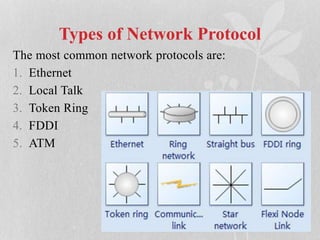
The most common network protocols are:
1. Ethernet
2. Local Talk
3. Token Ring
4. FDDI
5. ATM
Ethernet
• The Ethernet protocol is by far the most widely used one.
Ethernet uses an access method called CSMA/CD (Carrier Sense
Multiple Access/Collision Detection).
• This is a system where each computer listens to the cable before
sending anything through the network. If the network is clear, the
computer will transmit.
• If some other nodes have already transmitted on the cable, the
computer will wait and try again when the line is clear.
• Sometimes, two computers attempt to transmit at the same
instant. A collision occurs when this happens.
• Data can be transmitted over wireless access points, twisted pair,
coaxial, or fiber optic cable at a speed of 10 Mbps up to 1000
Mbps.
Local Talk
• The method used by Local Talk is called CSMA/CA (Carrier
Sense Multiple Access with Collision Avoidance).
• Local Talk adapters and special twisted pair cable can be used to
connect a series of computers through the serial port.
• The Macintosh operating system allows the establishment of a
peer-to-peer network without the need for additional software.
• The Local Talk protocol allows for linear bus, star, or tree
topologies using twisted pair cable.
• A primary disadvantage of Local Talk is low speed. Its speed of
transmission is only 230 Kbps.
Token Ring
• The computers are connected so that the signal travels around the
network from one computer to another in a logical ring.
• A single electronic token moves around the ring from one
computer to the next.
• If a computer does not have information to transmit, it simply
passes the token on to the next workstation.
• The Token Ring protocol requires a star-wired ring using twisted
pair or fiber optic cable.
• It can operate at transmission speeds of 4 Mbps or 16 Mbps.
• Due to the increasing popularity of Ethernet, the use of Token
Ring in school environments has decreased.
FDDI (Fiber Distributed Data Interface)
• Fiber Distributed Data Interface (FDDI) is a network protocol
that is used primarily to interconnect two or more local area
networks, often over large distances.
• The access method used by FDDI involves token-passing. FDDI
uses a dual ring physical topology.
• A major advantage of FDDI is high speed. It operates over fiber
optic cable at 100 Mbps.
ATM (Asynchronous Transfer Mode)
• Asynchronous Transfer Mode (ATM) is a network protocol that
transmits data at a speed of 155 Mbps and higher.
• ATM works by transmitting all data in small packets of a fixed
size; whereas, other protocols transfer variable length packets.
• ATM supports a variety of media such as video, CD-quality
audio, and imaging. ATM employs a star topology, which can
work with fiber optic as well as twisted pair cable.
• ATM is most often used to interconnect two or more local area
networks.
• It is also frequently used by Internet Service Providers to utilize
high-speed access to the Internet for their clients.
• As ATM technology becomes more cost-effective, it will provide
another solution for constructing faster local area networks.
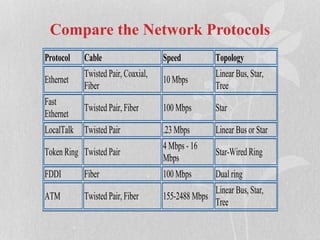
Compare the Network Protocols
Protocol Cable Speed Topology
Ethernet
Twisted Pair, Coaxial,
Fiber
10 Mbps
Linear Bus, Star,
Tree
Fast
Ethernet
Twisted Pair, Fiber 100 Mbps Star
LocalTalk Twisted Pair .23 Mbps Linear Bus or Star
Token Ring Twisted Pair
4 Mbps - 16
Mbps
Star-Wired Ring
FDDI Fiber 100 Mbps Dual ring
ATM Twisted Pair, Fiber 155-2488 Mbps
Linear Bus, Star,
Tree
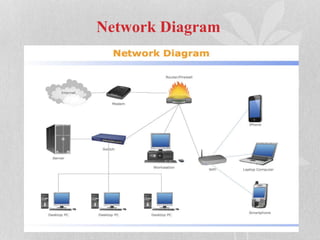
Network Diagram
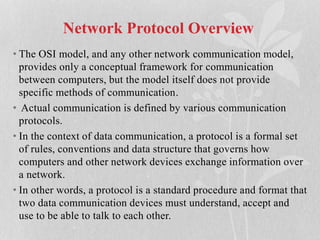
Network Protocol Overview
• The OSI model, and any other network communication model,
provides only a conceptual framework for communication
between computers, but the model itself does not provide
specific methods of communication.
• Actual communication is defined by various communication
protocols.
• In the context of data communication, a protocol is a formal set
of rules, conventions and data structure that governs how
computers and other network devices exchange information over
a network.
• In other words, a protocol is a standard procedure and format that
two data communication devices must understand, accept and
use to be able to talk to each other.
Network protocol

Network protocol

  • 1.
  • 2.
    Overview •What is NetworkProtocol? •Types of Protocols •Compare the Network Protocols •Network Diagramming •Network Protocol Overview
  • 3.
    What is aNetwork Protocol Network Definition • A network can be defined as a group of computers and other devices connected in some ways so as to be able to exchange data. • Each of the devices on the network can be thought of as a node; each node has a unique address Network Protocol • Rules of Network Protocol include guidelines that regulate the following characteristics of a network: access method, allowed physical topologies, types of cabling, and speed of data transfer.
  • 4.
    Types of NetworkProtocol The most common network protocols are: 1. Ethernet 2. Local Talk 3. Token Ring 4. FDDI 5. ATM
  • 5.
    Ethernet • The Ethernetprotocol is by far the most widely used one. Ethernet uses an access method called CSMA/CD (Carrier Sense Multiple Access/Collision Detection). • This is a system where each computer listens to the cable before sending anything through the network. If the network is clear, the computer will transmit. • If some other nodes have already transmitted on the cable, the computer will wait and try again when the line is clear. • Sometimes, two computers attempt to transmit at the same instant. A collision occurs when this happens. • Data can be transmitted over wireless access points, twisted pair, coaxial, or fiber optic cable at a speed of 10 Mbps up to 1000 Mbps.
  • 6.
    Local Talk • Themethod used by Local Talk is called CSMA/CA (Carrier Sense Multiple Access with Collision Avoidance). • Local Talk adapters and special twisted pair cable can be used to connect a series of computers through the serial port. • The Macintosh operating system allows the establishment of a peer-to-peer network without the need for additional software. • The Local Talk protocol allows for linear bus, star, or tree topologies using twisted pair cable. • A primary disadvantage of Local Talk is low speed. Its speed of transmission is only 230 Kbps.
  • 7.
    Token Ring • Thecomputers are connected so that the signal travels around the network from one computer to another in a logical ring. • A single electronic token moves around the ring from one computer to the next. • If a computer does not have information to transmit, it simply passes the token on to the next workstation. • The Token Ring protocol requires a star-wired ring using twisted pair or fiber optic cable. • It can operate at transmission speeds of 4 Mbps or 16 Mbps. • Due to the increasing popularity of Ethernet, the use of Token Ring in school environments has decreased.
  • 8.
    FDDI (Fiber DistributedData Interface) • Fiber Distributed Data Interface (FDDI) is a network protocol that is used primarily to interconnect two or more local area networks, often over large distances. • The access method used by FDDI involves token-passing. FDDI uses a dual ring physical topology. • A major advantage of FDDI is high speed. It operates over fiber optic cable at 100 Mbps.
  • 9.
    ATM (Asynchronous TransferMode) • Asynchronous Transfer Mode (ATM) is a network protocol that transmits data at a speed of 155 Mbps and higher. • ATM works by transmitting all data in small packets of a fixed size; whereas, other protocols transfer variable length packets. • ATM supports a variety of media such as video, CD-quality audio, and imaging. ATM employs a star topology, which can work with fiber optic as well as twisted pair cable. • ATM is most often used to interconnect two or more local area networks. • It is also frequently used by Internet Service Providers to utilize high-speed access to the Internet for their clients. • As ATM technology becomes more cost-effective, it will provide another solution for constructing faster local area networks.
  • 10.
    Compare the NetworkProtocols Protocol Cable Speed Topology Ethernet Twisted Pair, Coaxial, Fiber 10 Mbps Linear Bus, Star, Tree Fast Ethernet Twisted Pair, Fiber 100 Mbps Star LocalTalk Twisted Pair .23 Mbps Linear Bus or Star Token Ring Twisted Pair 4 Mbps - 16 Mbps Star-Wired Ring FDDI Fiber 100 Mbps Dual ring ATM Twisted Pair, Fiber 155-2488 Mbps Linear Bus, Star, Tree
  • 11.
  • 12.
    Network Protocol Overview •The OSI model, and any other network communication model, provides only a conceptual framework for communication between computers, but the model itself does not provide specific methods of communication. • Actual communication is defined by various communication protocols. • In the context of data communication, a protocol is a formal set of rules, conventions and data structure that governs how computers and other network devices exchange information over a network. • In other words, a protocol is a standard procedure and format that two data communication devices must understand, accept and use to be able to talk to each other.