Bluetooth
Bluetooth
• Bluetooth name comes from Danish king Harald Blatand
(Bluetooth), credited with uniting the Scandinavian people
during the 10th century.
• The idea was that Bluetooth wireless technology would unite
personal computing devices.
• Bluetooth™ is a trademark owned by the Bluetooth SIG, Inc.,
USA.
• The Bluetooth Special Industry Group (SIG) formed in winter of
1998 by Ericsson, IBM, Intel, Nokia, and Toshiba.
Goals
• low cost
• low power
• primarily a cable replacement (to connect mobile phones to
headsets)
– There are those who believe it can be used as a Wireless Personal
Area Network (WPAN), hence it was the basis for IEEE 802.15.
Using:
• short-range radio technology
• Ad-hoc networking
• Dynamic discovery of other Bluetooth devices & the services
they offer
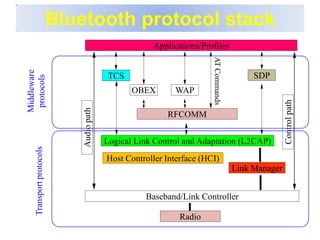
Bluetooth protocol stack
RFCOMM
OBEX WAP
ATCommands
Applications/Profiles
SDPTCS
Radio
Baseband/Link Controller
Link Manager
Host Controller Interface (HCI)
Logical Link Control and Adaptation (L2CAP)
Audiopath
Controlpath
Transportprotocols
Middleware
protocols
Physical Layer
• Uses 2.4 GHz unlicensed Industrial, Scientific, and Medical
(ISM) band (globally portions of this band are available)
• many other systems using the same spectrum
– interference to other systems
– interference from other systems
• 2.400-2.4835 GHz, i.e., 83.5 MHz divided into 79 channels with
carrier frequencies f = 2402 +k MHz, k = 0, … , 78; Channel
spacing is 1 MHz
• Gaussian Frequency Shift Keying (GFSK) modulation with one bit per symbol
• Uses fast (1600 hops/s) frequency hopping spread spectrum
(FHSS)
• 625 microsecond long time slots
• one hop per packet, but a packet can be 1 slot, 3 slots, or 5 slots long
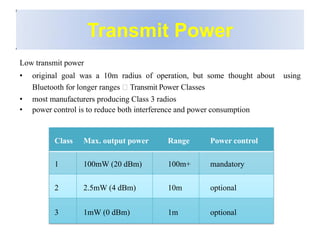
Transmit Power
Low transmit power
• original goal was a 10m radius of operation, but some thought about using
Bluetooth for longer ranges Transmit Power Classes
• most manufacturers producing Class 3 radios
• power control is to reduce both interference and power consumption
Class Max. output power Range Power control
1 100mW (20 dBm) 100m+ mandatory
2 2.5mW (4 dBm) 10m optional
3 1mW (0 dBm) 1m optional
Masters vs. Slaves
• Each Bluetooth device is a Master or Slave:
• master initiates exchange of data and the slave responds to the master in order to
communicate devices must use same sequence of frequency hops, hence slaves
synchronize to hop sequence of master
• master assigns an Active Member address (AM_ADDR) to the slaves
participating in active communications within the piconet
• Additional devices may be registered with the master and be invited to
become active as necessary -- their state is called “parked”
• Devices not currently associated with any piconet are in stand-by mode.
Frequency Hop Sequence
• Each device has a 48 bit IEEE MAC address (called a Bluetooth device
address (BD_ADDR)) and a local free-running 28-bit clock that ticks once
every 312.5 s (which corresponds to half the residence time in a frequency
when the radio hops at the nominal rate of 1,600 hops/sec.)
• Each slave receives master’s address and clock, then uses this to calculate
frequency hop sequence
Time Division Multiplexing (TDM)
• Divide the total bandwidth between Bluetooth devices using a
given hop sequence
• Master assigns time slots to slaves
• packets are joined together in transmit and receive pairs;
master and slaves alternate in time-division duplex (TDD)
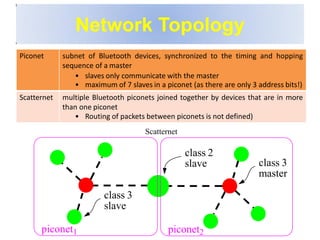
Network Topology
Piconet subnet of Bluetooth devices, synchronized to the timing and hopping
sequence of a master
• slaves only communicate with the master
• maximum of 7 slaves in a piconet (as there are only 3 address bits!)
Scatternet multiple Bluetooth piconets joined together by devices that are in more
than one piconet
• Routing of packets between piconets is not defined)
Scatternet
class 2
slave
class 3
slave
class 3
master
piconet1 piconet2
Scatternets
• If a device is present in more than one piconet, it must time-share, spending
a few slots in one piconet and a few slots in the other
• A device may not be master of two different piconets since all slaves in a
piconet are synchronized to the master’s hop sequence, thus if the slaves
were all synchronized with a single master -- they would be part of the
same piconet!
• This means that piconets making up a scatternet do not coordinate their
frequency hopping  unsynchronized piconets in an area will randomly
collide on the same frequency.
Voice + Data support
As an important application of Bluetooth was a cable replacement between
handset and headset and this was developed in a telecom company’s
development lab  synchronous voice support was the focus of the link
protocol design
• Synchronous Connection Oriented (SCO) links for voice
• circuit-switched connections - 64 kbps in each direction per voice channel (using their
own voice coding or) using reserved slots
• up to three voice channels active at one time (may be to 1, 2, or 3 slaves)
• ~78% overhead for data! (this is without FEC)
• Asynchronous Connectionless (ACL) links for data
• ACL Data Packets: 72-bit access code, 54-bit header, 16-bit Cyclic Redundancy
Checksum (CRC), and varying amount of data
• with largest packet (Data High rate, DH5, packet stretching over five slots)  maximum
data rate of ~650 kbps
• a best effort delivery service - maintains integrity by using retransmissions and
sequence members, as well as forward error correction (FEC) if necessary
• a master can have an ACL link to each of several slaves, but only one per slave
• Broadcast packets: packets that are not addressed to a specific Slave
Security
• Some think that the high speed, pseudo-random frequency hopping
algorithm makes it difficult to listen in on a connection - but of
course this is false, because once you know the master’s MAC
address and clock you can calculate the next hop too!
• Authentication and negotiation for link encrypting are both
part of the Link Manager Protocol (LMP) specification.
– authentication is based on a challenge/response mechanism based on a
common shared secret, a link key is generated through a
– user-provided PIN
– link level encryption using a public domain cipher algorithm SAFER+1
generates 128-bit cipher keys from 128-bit plain text
Link Manager
Translates commands from Host Controller Interface (HCI) into operations at
baseband level to implement the following operations:
• attaching Slaves to a piconet, and allocating active memberaddresses (AM addr)
• tearing down connections when slaves leave piconet
• configuring links, e.g., controlling Master/Slave switches
• establishing ACL and SCO links
• putting connections one of the low-power modes
• communicates with other LMs using the Link Management Protocol (LMP)
which is a set of messages, or Protocol Data Units (PDUs), whose payloads
contain the following fields:
• single bit Transaction Identifier equal to 0 (1) for PDU sent from Master (Slave)
• Operation Code (OpCode) defining type of message being sent
• message parameters
• PDUs sent as single slot packets on link management logical channel (L_CH =3)
Host Controller Interface (HCI)
• interface between a host and a Bluetooth module having a standard
interface enables Baseband and Link Manager to run on a processor in the
Bluetooth module while higher layers and applications running on host
• Bluetooth module can wake the host via a message across this interface
HCI Transport Layer
Three different transport interfaces are defined to transfer HCI packets from the host
to the Bluetooth module:
USB Universal Serial Bus
RS-232 serial interface with error correction
UART Universal Asynchronous Receiver Transmitter, a serial interface
without error correction
Logical Link Control and
AdaptationProtocol (L2CAP)
L2CAP only transfers data and all applications must use L2CAP to send data.
provides:
• multiplexing to allow several higher layer links to pass across a single ACL
connection
• segmentation and reassembly to allow transfer of packets larger than lower
layers support
• Quality of Service (QoS) management for higher layer protocols
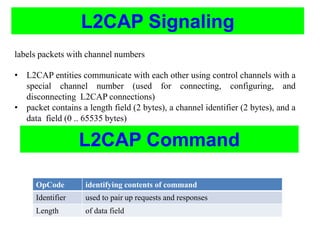
L2CAP Signaling
labels packets with channel numbers
• L2CAP entities communicate with each other using control channels with a
special channel number (used for connecting, configuring, and
disconnecting L2CAP connections)
• packet contains a length field (2 bytes), a channel identifier (2 bytes), and a
data field (0 .. 65535 bytes)
L2CAP Command
OpCode identifying contents of command
Identifier used to pair up requests and responses
Length of data field
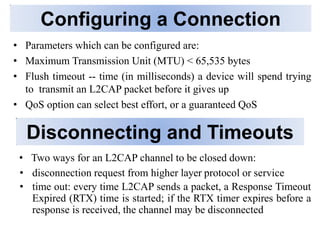
Disconnecting and Timeouts
• Two ways for an L2CAP channel to be closed down:
• disconnection request from higher layer protocol or service
• time out: every time L2CAP sends a packet, a Response Timeout
Expired (RTX) time is started; if the RTX timer expires before a
response is received, the channel may be disconnected
Configuring a Connection
• Parameters which can be configured are:
• Maximum Transmission Unit (MTU) < 65,535 bytes
• Flush timeout -- time (in milliseconds) a device will spend trying
to transmit an L2CAP packet before it gives up
• QoS option can select best effort, or a guaranteed QoS
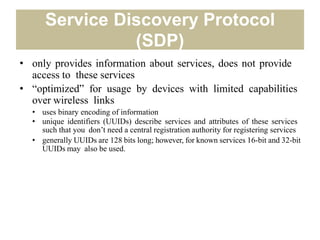
Service Discovery Protocol
(SDP)
• only provides information about services, does not provide
access to these services
• “optimized” for usage by devices with limited capabilities
over wireless links
• uses binary encoding of information
• unique identifiers (UUIDs) describe services and attributes of these services
such that you don’t need a central registration authority for registering services
• generally UUIDs are 128 bits long; however, for known services 16-bit and 32-bit
UUIDs may also be used.
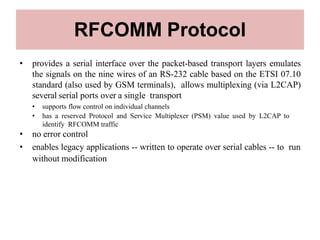
RFCOMM Protocol
• provides a serial interface over the packet-based transport layers emulates
the signals on the nine wires of an RS-232 cable based on the ETSI 07.10
standard (also used by GSM terminals), allows multiplexing (via L2CAP)
several serial ports over a single transport
• supports flow control on individual channels
• has a reserved Protocol and Service Multiplexer (PSM) value used by L2CAP to
identify RFCOMM traffic
• no error control
• enables legacy applications -- written to operate over serial cables -- to run
without modification
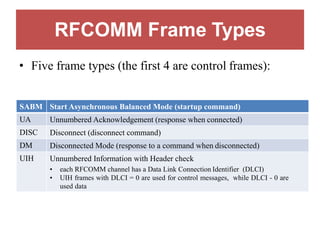
RFCOMM Frame Types
• Five frame types (the first 4 are control frames):
SABM Start Asynchronous Balanced Mode (startup command)
UA Unnumbered Acknowledgement (response when connected)
DISC Disconnect (disconnect command)
DM Disconnected Mode (response to a command when disconnected)
UIH Unnumbered Information with Header check
• each RFCOMM channel has a Data Link Connection Identifier (DLCI)
• UIH frames with DLCI = 0 are used for control messages, while DLCI - 0 are
used data
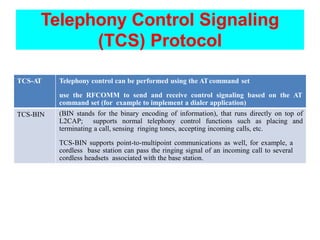
Telephony Control Signaling
(TCS) Protocol
TCS-AT Telephony control can be performed using the ATcommand set
use the RFCOMM to send and receive control signaling based on the AT
command set (for example to implement a dialer application)
TCS-BIN (BIN stands for the binary encoding of information), that runs directly on top of
L2CAP; supports normal telephony control functions such as placing and
terminating a call, sensing ringing tones, accepting incoming calls, etc.
TCS-BIN supports point-to-multipoint communications as well, for example, a
cordless base station can pass the ringing signal of an incoming call to several
cordless headsets associated with the base station.
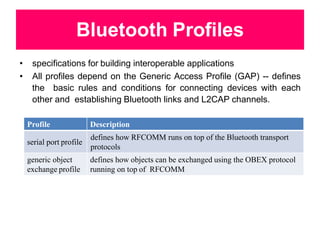
Bluetooth Profiles
• specifications for building interoperable applications
• All profiles depend on the Generic Access Profile (GAP) -- defines
the basic rules and conditions for connecting devices with each
other and establishing Bluetooth links and L2CAP channels.
Profile Description
serial port profile
defines how RFCOMM runs on top of the Bluetooth transport
protocols
generic object
exchange profile
defines how objects can be exchanged using the OBEX protocol
running on top of RFCOMM
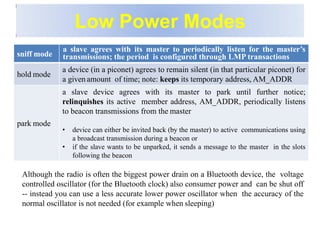
Low Power Modes
Although the radio is often the biggest power drain on a Bluetooth device, the voltage
controlled oscillator (for the Bluetooth clock) also consumer power and can be shut off
-- instead you can use a less accurate lower power oscillator when the accuracy of the
normal oscillator is not needed (for example when sleeping)
sniff mode
a slave agrees with its master to periodically listen for the master’s
transmissions; the period is configured through LMP transactions
hold mode
a device (in a piconet) agrees to remain silent (in that particular piconet) for
a given amount of time; note: keeps its temporary address, AM_ADDR
park mode
a slave device agrees with its master to park until further notice;
relinquishes its active member address, AM_ADDR, periodically listens
to beacon transmissions from the master
• device can either be invited back (by the master) to active communications using
a broadcast transmission during a beacon or
• if the slave wants to be unparked, it sends a message to the master in the slots
following the beacon

Bluetooth

  • 1.
  • 2.
    Bluetooth • Bluetooth namecomes from Danish king Harald Blatand (Bluetooth), credited with uniting the Scandinavian people during the 10th century. • The idea was that Bluetooth wireless technology would unite personal computing devices.
  • 3.
    • Bluetooth™ isa trademark owned by the Bluetooth SIG, Inc., USA. • The Bluetooth Special Industry Group (SIG) formed in winter of 1998 by Ericsson, IBM, Intel, Nokia, and Toshiba. Goals • low cost • low power • primarily a cable replacement (to connect mobile phones to headsets) – There are those who believe it can be used as a Wireless Personal Area Network (WPAN), hence it was the basis for IEEE 802.15. Using: • short-range radio technology • Ad-hoc networking • Dynamic discovery of other Bluetooth devices & the services they offer
  • 4.
    Bluetooth protocol stack RFCOMM OBEXWAP ATCommands Applications/Profiles SDPTCS Radio Baseband/Link Controller Link Manager Host Controller Interface (HCI) Logical Link Control and Adaptation (L2CAP) Audiopath Controlpath Transportprotocols Middleware protocols
  • 5.
    Physical Layer • Uses2.4 GHz unlicensed Industrial, Scientific, and Medical (ISM) band (globally portions of this band are available) • many other systems using the same spectrum – interference to other systems – interference from other systems • 2.400-2.4835 GHz, i.e., 83.5 MHz divided into 79 channels with carrier frequencies f = 2402 +k MHz, k = 0, … , 78; Channel spacing is 1 MHz • Gaussian Frequency Shift Keying (GFSK) modulation with one bit per symbol • Uses fast (1600 hops/s) frequency hopping spread spectrum (FHSS) • 625 microsecond long time slots • one hop per packet, but a packet can be 1 slot, 3 slots, or 5 slots long
  • 6.
    Transmit Power Low transmitpower • original goal was a 10m radius of operation, but some thought about using Bluetooth for longer ranges Transmit Power Classes • most manufacturers producing Class 3 radios • power control is to reduce both interference and power consumption Class Max. output power Range Power control 1 100mW (20 dBm) 100m+ mandatory 2 2.5mW (4 dBm) 10m optional 3 1mW (0 dBm) 1m optional
  • 7.
    Masters vs. Slaves •Each Bluetooth device is a Master or Slave: • master initiates exchange of data and the slave responds to the master in order to communicate devices must use same sequence of frequency hops, hence slaves synchronize to hop sequence of master • master assigns an Active Member address (AM_ADDR) to the slaves participating in active communications within the piconet • Additional devices may be registered with the master and be invited to become active as necessary -- their state is called “parked” • Devices not currently associated with any piconet are in stand-by mode.
  • 8.
    Frequency Hop Sequence •Each device has a 48 bit IEEE MAC address (called a Bluetooth device address (BD_ADDR)) and a local free-running 28-bit clock that ticks once every 312.5 s (which corresponds to half the residence time in a frequency when the radio hops at the nominal rate of 1,600 hops/sec.) • Each slave receives master’s address and clock, then uses this to calculate frequency hop sequence
  • 9.
    Time Division Multiplexing(TDM) • Divide the total bandwidth between Bluetooth devices using a given hop sequence • Master assigns time slots to slaves • packets are joined together in transmit and receive pairs; master and slaves alternate in time-division duplex (TDD)
  • 10.
    Network Topology Piconet subnetof Bluetooth devices, synchronized to the timing and hopping sequence of a master • slaves only communicate with the master • maximum of 7 slaves in a piconet (as there are only 3 address bits!) Scatternet multiple Bluetooth piconets joined together by devices that are in more than one piconet • Routing of packets between piconets is not defined) Scatternet class 2 slave class 3 slave class 3 master piconet1 piconet2
  • 11.
    Scatternets • If adevice is present in more than one piconet, it must time-share, spending a few slots in one piconet and a few slots in the other • A device may not be master of two different piconets since all slaves in a piconet are synchronized to the master’s hop sequence, thus if the slaves were all synchronized with a single master -- they would be part of the same piconet! • This means that piconets making up a scatternet do not coordinate their frequency hopping  unsynchronized piconets in an area will randomly collide on the same frequency.
  • 12.
    Voice + Datasupport As an important application of Bluetooth was a cable replacement between handset and headset and this was developed in a telecom company’s development lab  synchronous voice support was the focus of the link protocol design • Synchronous Connection Oriented (SCO) links for voice • circuit-switched connections - 64 kbps in each direction per voice channel (using their own voice coding or) using reserved slots • up to three voice channels active at one time (may be to 1, 2, or 3 slaves) • ~78% overhead for data! (this is without FEC) • Asynchronous Connectionless (ACL) links for data • ACL Data Packets: 72-bit access code, 54-bit header, 16-bit Cyclic Redundancy Checksum (CRC), and varying amount of data • with largest packet (Data High rate, DH5, packet stretching over five slots)  maximum data rate of ~650 kbps • a best effort delivery service - maintains integrity by using retransmissions and sequence members, as well as forward error correction (FEC) if necessary • a master can have an ACL link to each of several slaves, but only one per slave • Broadcast packets: packets that are not addressed to a specific Slave
  • 13.
    Security • Some thinkthat the high speed, pseudo-random frequency hopping algorithm makes it difficult to listen in on a connection - but of course this is false, because once you know the master’s MAC address and clock you can calculate the next hop too! • Authentication and negotiation for link encrypting are both part of the Link Manager Protocol (LMP) specification. – authentication is based on a challenge/response mechanism based on a common shared secret, a link key is generated through a – user-provided PIN – link level encryption using a public domain cipher algorithm SAFER+1 generates 128-bit cipher keys from 128-bit plain text
  • 14.
    Link Manager Translates commandsfrom Host Controller Interface (HCI) into operations at baseband level to implement the following operations: • attaching Slaves to a piconet, and allocating active memberaddresses (AM addr) • tearing down connections when slaves leave piconet • configuring links, e.g., controlling Master/Slave switches • establishing ACL and SCO links • putting connections one of the low-power modes • communicates with other LMs using the Link Management Protocol (LMP) which is a set of messages, or Protocol Data Units (PDUs), whose payloads contain the following fields: • single bit Transaction Identifier equal to 0 (1) for PDU sent from Master (Slave) • Operation Code (OpCode) defining type of message being sent • message parameters • PDUs sent as single slot packets on link management logical channel (L_CH =3)
  • 15.
    Host Controller Interface(HCI) • interface between a host and a Bluetooth module having a standard interface enables Baseband and Link Manager to run on a processor in the Bluetooth module while higher layers and applications running on host • Bluetooth module can wake the host via a message across this interface HCI Transport Layer Three different transport interfaces are defined to transfer HCI packets from the host to the Bluetooth module: USB Universal Serial Bus RS-232 serial interface with error correction UART Universal Asynchronous Receiver Transmitter, a serial interface without error correction
  • 16.
    Logical Link Controland AdaptationProtocol (L2CAP) L2CAP only transfers data and all applications must use L2CAP to send data. provides: • multiplexing to allow several higher layer links to pass across a single ACL connection • segmentation and reassembly to allow transfer of packets larger than lower layers support • Quality of Service (QoS) management for higher layer protocols
  • 17.
    L2CAP Signaling labels packetswith channel numbers • L2CAP entities communicate with each other using control channels with a special channel number (used for connecting, configuring, and disconnecting L2CAP connections) • packet contains a length field (2 bytes), a channel identifier (2 bytes), and a data field (0 .. 65535 bytes) L2CAP Command OpCode identifying contents of command Identifier used to pair up requests and responses Length of data field
  • 18.
    Disconnecting and Timeouts •Two ways for an L2CAP channel to be closed down: • disconnection request from higher layer protocol or service • time out: every time L2CAP sends a packet, a Response Timeout Expired (RTX) time is started; if the RTX timer expires before a response is received, the channel may be disconnected Configuring a Connection • Parameters which can be configured are: • Maximum Transmission Unit (MTU) < 65,535 bytes • Flush timeout -- time (in milliseconds) a device will spend trying to transmit an L2CAP packet before it gives up • QoS option can select best effort, or a guaranteed QoS
  • 19.
    Service Discovery Protocol (SDP) •only provides information about services, does not provide access to these services • “optimized” for usage by devices with limited capabilities over wireless links • uses binary encoding of information • unique identifiers (UUIDs) describe services and attributes of these services such that you don’t need a central registration authority for registering services • generally UUIDs are 128 bits long; however, for known services 16-bit and 32-bit UUIDs may also be used.
  • 20.
    RFCOMM Protocol • providesa serial interface over the packet-based transport layers emulates the signals on the nine wires of an RS-232 cable based on the ETSI 07.10 standard (also used by GSM terminals), allows multiplexing (via L2CAP) several serial ports over a single transport • supports flow control on individual channels • has a reserved Protocol and Service Multiplexer (PSM) value used by L2CAP to identify RFCOMM traffic • no error control • enables legacy applications -- written to operate over serial cables -- to run without modification
  • 21.
    RFCOMM Frame Types •Five frame types (the first 4 are control frames): SABM Start Asynchronous Balanced Mode (startup command) UA Unnumbered Acknowledgement (response when connected) DISC Disconnect (disconnect command) DM Disconnected Mode (response to a command when disconnected) UIH Unnumbered Information with Header check • each RFCOMM channel has a Data Link Connection Identifier (DLCI) • UIH frames with DLCI = 0 are used for control messages, while DLCI - 0 are used data
  • 22.
    Telephony Control Signaling (TCS)Protocol TCS-AT Telephony control can be performed using the ATcommand set use the RFCOMM to send and receive control signaling based on the AT command set (for example to implement a dialer application) TCS-BIN (BIN stands for the binary encoding of information), that runs directly on top of L2CAP; supports normal telephony control functions such as placing and terminating a call, sensing ringing tones, accepting incoming calls, etc. TCS-BIN supports point-to-multipoint communications as well, for example, a cordless base station can pass the ringing signal of an incoming call to several cordless headsets associated with the base station.
  • 23.
    Bluetooth Profiles • specificationsfor building interoperable applications • All profiles depend on the Generic Access Profile (GAP) -- defines the basic rules and conditions for connecting devices with each other and establishing Bluetooth links and L2CAP channels. Profile Description serial port profile defines how RFCOMM runs on top of the Bluetooth transport protocols generic object exchange profile defines how objects can be exchanged using the OBEX protocol running on top of RFCOMM
  • 24.
    Low Power Modes Althoughthe radio is often the biggest power drain on a Bluetooth device, the voltage controlled oscillator (for the Bluetooth clock) also consumer power and can be shut off -- instead you can use a less accurate lower power oscillator when the accuracy of the normal oscillator is not needed (for example when sleeping) sniff mode a slave agrees with its master to periodically listen for the master’s transmissions; the period is configured through LMP transactions hold mode a device (in a piconet) agrees to remain silent (in that particular piconet) for a given amount of time; note: keeps its temporary address, AM_ADDR park mode a slave device agrees with its master to park until further notice; relinquishes its active member address, AM_ADDR, periodically listens to beacon transmissions from the master • device can either be invited back (by the master) to active communications using a broadcast transmission during a beacon or • if the slave wants to be unparked, it sends a message to the master in the slots following the beacon