GENOME
ALTERATIONS
VPHY 241 PHYSIOLOGICAL BIOCHEMISTRY
MUTATION
 Mutations are changes in genetic
material; changes in the nucleotide
sequence of DNA.
 In gene mutations, the DNA code will
have a base (or more) missing, added, or
exchanged in a codon.
MUTATION
 It may involve large sections of
chromosomes or single base pairs
 Mutations can change the reading
frame of a gene transcript.
How common are mutations?
 Mutations occurs at a frequency of about
1 in every 1 billion base pairs.
 Mutations happen regularly
 Almost all mutations are neutral
 Chemicals & UV radiation cause
mutations
 Many mutations are repaired by enzymes
Manifestations of mutation
 Mutations are not always seen. The
affected gene may still function.
 Mutations may be harmful.
 Mutations may be beneficial.
 Mutations may have no effect on the
organism.
How do mutations affect the
population?
 Mutations are a major source of
genetic variation in a population
increasing biodiversity.
 Some variations may help them to
survive better.
How are mutations inherited?
 Only mutations in gametes are passed
onto offspring.
 Mutations in somatic cells only affect
the organism in which they occur and
are not passed onto offspring.
TYPES OF
MUTATIONS
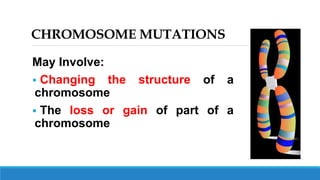
CHROMOSOME MUTATIONS
May Involve:
 Changing the structure of a
chromosome
 The loss or gain of part of a
chromosome
Chromosome Mutations
Five types exist:
1. Deletion
2. Inversion
3. Translocation
4. Nondisjunction
5. Duplication
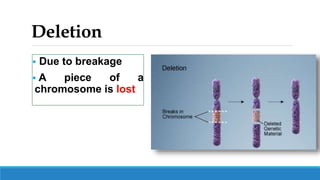
Deletion
 Due to breakage
 A piece of a
chromosome is lost
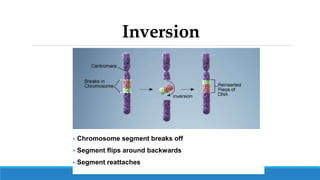
Inversion
 Chromosome segment breaks off
 Segment flips around backwards
 Segment reattaches
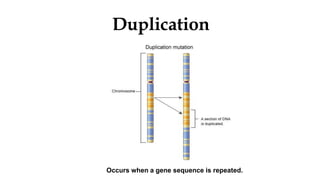
Duplication
Occurs when a gene sequence is repeated.
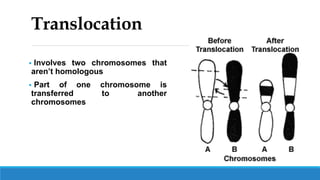
Translocation
 Involves two chromosomes that
aren’t homologous
 Part of one chromosome is
transferred to another
chromosomes
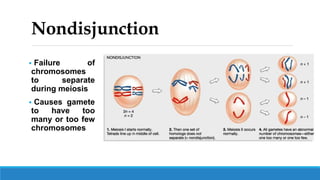
Nondisjunction
 Failure of
chromosomes
to separate
during meiosis
 Causes gamete
to have too
many or too few
chromosomes
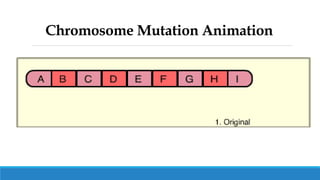
Chromosome Mutation Animation
GENE MUTATIONS
 Change in the nucleotide sequence of
a gene
 May only involve a single nucleotide
 May be due to copying errors,
chemicals, viruses, etc.
Types of Gene Mutations
 Point Mutation
 Substitution
 Insertion
 Deletion
POINT MUTATION
 Occurs when the base sequence of a
codon is changed.
There are 3 types:
1. Substitution
2. Deletion
3. Insertion
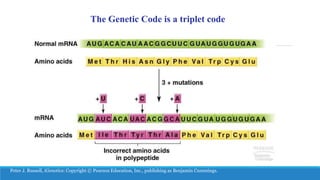
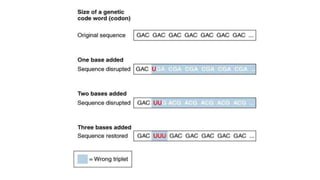
The Genetic Code is a triplet code
Peter J. Russell, iGenetics: Copyright © Pearson Education, Inc., publishing as Benjamin Cummings.
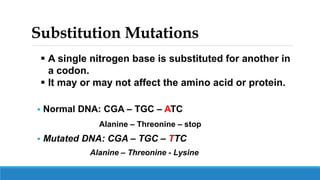
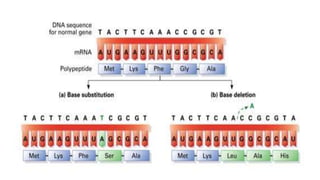
Substitution Mutations
 Normal DNA: CGA – TGC – ATC
Alanine – Threonine – stop
 Mutated DNA: CGA – TGC – TTC
Alanine – Threonine - Lysine
 A single nitrogen base is substituted for another in
a codon.
 It may or may not affect the amino acid or protein.
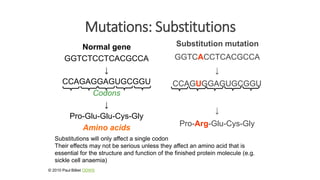
Mutations: Substitutions
Substitution mutation
GGTCACCTCACGCCA
↓
CCAGUGGAGUGCGGU
↓
Pro-Arg-Glu-Cys-Gly
Substitutions will only affect a single codon
Their effects may not be serious unless they affect an amino acid that is
essential for the structure and function of the finished protein molecule (e.g.
sickle cell anaemia)
Normal gene
GGTCTCCTCACGCCA
↓
CCAGAGGAGUGCGGU
Codons
↓
Pro-Glu-Glu-Cys-Gly
Amino acids
© 2010 Paul Billiet ODWS
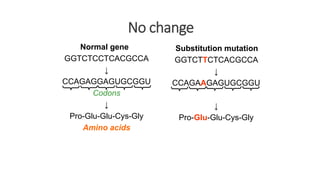
No change
Normal gene
GGTCTCCTCACGCCA
↓
CCAGAGGAGUGCGGU
Codons
↓
Pro-Glu-Glu-Cys-Gly
Amino acids
Substitution mutation
GGTCTTCTCACGCCA
↓
CCAGAAGAGUGCGGU
↓
Pro-Glu-Glu-Cys-Gly
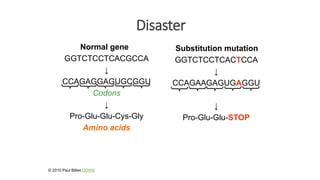
Disaster
Normal gene
GGTCTCCTCACGCCA
↓
CCAGAGGAGUGCGGU
Codons
↓
Pro-Glu-Glu-Cys-Gly
Amino acids
Substitution mutation
GGTCTCCTCACTCCA
↓
CCAGAAGAGUGAGGU
↓
Pro-Glu-Glu-STOP
© 2010 Paul Billiet ODWS
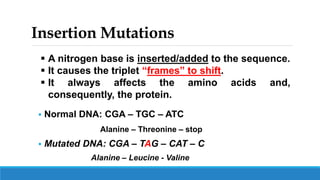
Insertion Mutations
 Normal DNA: CGA – TGC – ATC
Alanine – Threonine – stop
 Mutated DNA: CGA – TAG – CAT – C
Alanine – Leucine - Valine
 A nitrogen base is inserted/added to the sequence.
 It causes the triplet “frames” to shift.
 It always affects the amino acids and,
consequently, the protein.
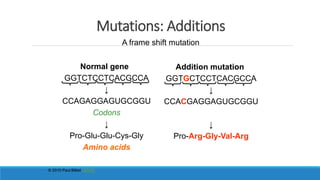
Mutations: Additions
Normal gene
GGTCTCCTCACGCCA
↓
CCAGAGGAGUGCGGU
Codons
↓
Pro-Glu-Glu-Cys-Gly
Amino acids
Addition mutation
GGTGCTCCTCACGCCA
↓
CCACGAGGAGUGCGGU
↓
Pro-Arg-Gly-Val-Arg
A frame shift mutation
© 2010 Paul Billiet ODWS
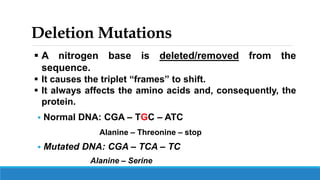
Deletion Mutations
 Normal DNA: CGA – TGC – ATC
Alanine – Threonine – stop
 Mutated DNA: CGA – TCA – TC
Alanine – Serine
 A nitrogen base is deleted/removed from the
sequence.
 It causes the triplet “frames” to shift.
 It always affects the amino acids and, consequently, the
protein.
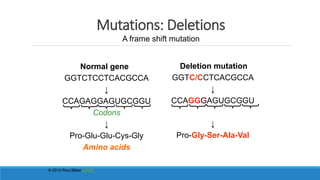
Mutations: Deletions
Normal gene
GGTCTCCTCACGCCA
↓
CCAGAGGAGUGCGGU
Codons
↓
Pro-Glu-Glu-Cys-Gly
Amino acids
Deletion mutation
GGTC/CCTCACGCCA
↓
CCAGGGAGUGCGGU
↓
Pro-Gly-Ser-Ala-Val
A frame shift mutation
© 2010 Paul Billiet ODWS
Point Mutations
 Substitution has the least effect because it
changes only one amino acid or it may
change no amino acid.
 Deletion or insertion mutations are most
disruptive because they change the reading
frame, causing a frame shift.
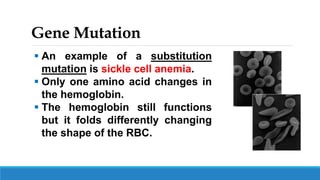
Gene Mutation
 An example of a substitution
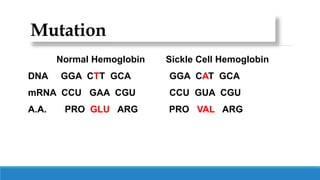
mutation is sickle cell anemia.
 Only one amino acid changes in
the hemoglobin.
 The hemoglobin still functions
but it folds differently changing
the shape of the RBC.
Mutation
Normal Hemoglobin Sickle Cell Hemoglobin
DNA GGA CTT GCA GGA CAT GCA
mRNA CCU GAA CGU CCU GUA CGU
A.A. PRO GLU ARG PRO VAL ARG
Gene Mutation
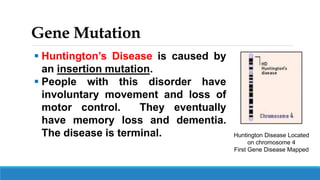
 Huntington’s Disease is caused by
an insertion mutation.
 People with this disorder have
involuntary movement and loss of
motor control. They eventually
have memory loss and dementia.
The disease is terminal. Huntington Disease Located
on chromosome 4
First Gene Disease Mapped
Gene Mutation
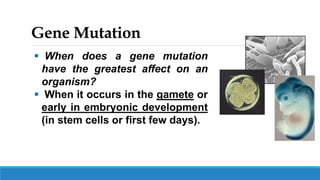
 When does a gene mutation
have the greatest affect on an
organism?
 When it occurs in the gamete or
early in embryonic development
(in stem cells or first few days). Four cell Zygote
What causes Mutations?
 Errors in DNA Replication
 Errors in chromosome crossover in meiosis
 Mutagens
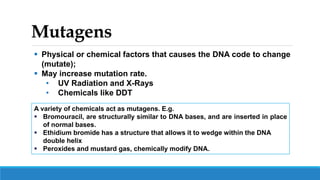
Mutagens
 Physical or chemical factors that causes the DNA code to change
(mutate);
 May increase mutation rate.
• UV Radiation and X-Rays
• Chemicals like DDT
A variety of chemicals act as mutagens. E.g.
 Bromouracil, are structurally similar to DNA bases, and are inserted in place
of normal bases.
 Ethidium bromide has a structure that allows it to wedge within the DNA
double helix
 Peroxides and mustard gas, chemically modify DNA.
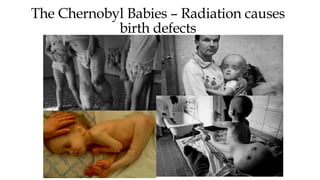
The Chernobyl Babies – Radiation causes
birth defects
38
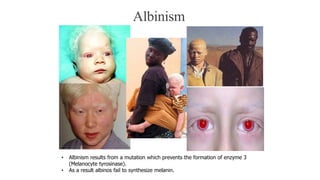
Albinism
• Albinism results from a mutation which prevents the formation of enzyme 3
(Melanocyte tyrosinase).
• As a result albinos fail to synthesize melanin.
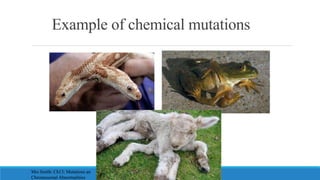
Example of chemical mutations
Mrs Smith: Ch13: Mutations an
Chromosomal Abnormalities

2.4. Alterations in Genome

Editor's Notes

  • #2 GENOME – the complete set of genes present in an organism; all the DNA contained in the cells of the body. It contains all the information that makes an individual.
  • #10 CHROMOSOME – microscopic threadlike part that carries hereditary information in the form of genes.
  • #20 DELETION & INSERTION are also called as FRAMESHIFT MUTATION.
  • #32 Insertion of 1st or 2nd bases in codon almost always changes the amino acid sequence. Insertion of three bases in a codon does not always change the amino acid sequence.