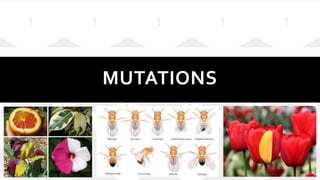
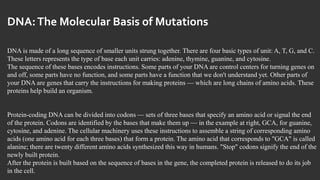
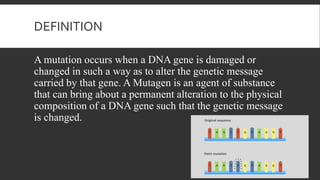
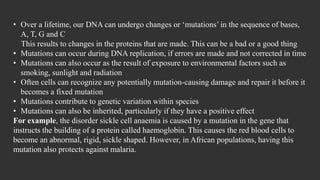
MUTATIONS
DNA:The Molecular Basis of Mutations
DNA is made of a long sequence of smaller units strung together. There are four basic types of unit: A, T, G, and C.
These letters represents the type of base each unit carries: adenine, thymine, guanine, and cytosine.
The sequence of these bases encodes instructions. Some parts of your DNA are control centers for turning genes on
and off, some parts have no function, and some parts have a function that we don't understand yet. Other parts of
your DNA are genes that carry the instructions for making proteins — which are long chains of amino acids. These
proteins help build an organism.
Protein-coding DNA can be divided into codons — sets of three bases that specify an amino acid or signal the end
of the protein. Codons are identified by the bases that make them up — in the example at right, GCA, for guanine,
cytosine, and adenine. The cellular machinery uses these instructions to assemble a string of corresponding amino
acids (one amino acid for each three bases) that form a protein. The amino acid that corresponds to "GCA" is called
alanine; there are twenty different amino acids synthesized this way in humans. "Stop" codons signify the end of the
newly built protein.
After the protein is built based on the sequence of bases in the gene, the completed protein is released to do its job
in the cell.
DEFINITION
A mutation occurs when a DNA gene is damaged or
changed in such a way as to alter the genetic message
carried by that gene. A Mutagen is an agent of substance
that can bring about a permanent alteration to the physical
composition of a DNA gene such that the genetic message
is changed.
• Over a lifetime, our DNA can undergo changes or ‘mutations’ in the sequence of bases,
A, T, G and C
This results to changes in the proteins that are made. This can be a bad or a good thing
• Mutations can occur during DNA replication, if errors are made and not corrected in time
• Mutations can also occur as the result of exposure to environmental factors such as
smoking, sunlight and radiation
• Often cells can recognize any potentially mutation-causing damage and repair it before it
becomes a fixed mutation
• Mutations contribute to genetic variation within species
• Mutations can also be inherited, particularly if they have a positive effect
For example, the disorder sickle cell anaemia is caused by a mutation in the gene that
instructs the building of a protein called haemoglobin. This causes the red blood cells to
become an abnormal, rigid, sickle shaped. However, in African populations, having this
mutation also protects against malaria.
TYPES OF MUTATIONS
Gene Mutation
 Point Mutation
 Frameshift Mutation
Chromosomal Mutation
 Deletion
 Duplication
 Inversion
 Translocation
 Nondisjunction
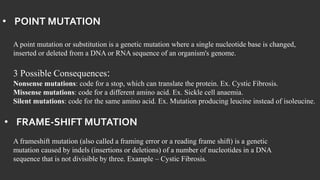
GENE MUTATION
A gene mutation is a permanent alteration in the
DNA sequence that makes up a gene, such that
the sequence differs from what is found in most
people. Mutations range in size; they can affect
anywhere from a single DNA building block
(base pair) to a large segment of a chromosome
that includes multiple genes
• POINT MUTATION
A point mutation or substitution is a genetic mutation where a single nucleotide base is changed,
inserted or deleted from a DNA or RNA sequence of an organism's genome.
3 Possible Consequences:
Nonsense mutations: code for a stop, which can translate the protein. Ex. Cystic Fibrosis.
Missense mutations: code for a different amino acid. Ex. Sickle cell anaemia.
Silent mutations: code for the same amino acid. Ex. Mutation producing leucine instead of isoleucine.
• FRAME-SHIFT MUTATION
A frameshift mutation (also called a framing error or a reading frame shift) is a genetic
mutation caused by indels (insertions or deletions) of a number of nucleotides in a DNA
sequence that is not divisible by three. Example – Cystic Fibrosis.
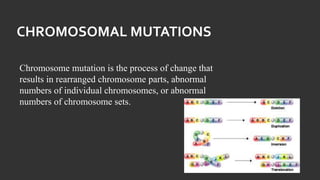
CHROMOSOMAL MUTATIONS
Chromosome mutation is the process of change that
results in rearranged chromosome parts, abnormal
numbers of individual chromosomes, or abnormal
numbers of chromosome sets.
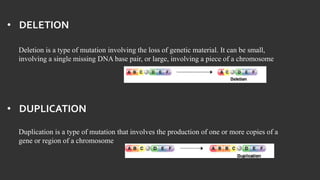
• DELETION
Deletion is a type of mutation involving the loss of genetic material. It can be small,
involving a single missing DNA base pair, or large, involving a piece of a chromosome
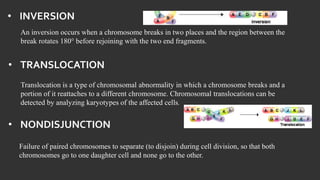
• DUPLICATION
Duplication is a type of mutation that involves the production of one or more copies of a
gene or region of a chromosome
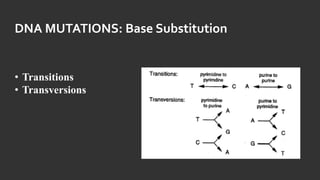
• INVERSION
An inversion occurs when a chromosome breaks in two places and the region between the
break rotates 180° before rejoining with the two end fragments.
• TRANSLOCATION
Translocation is a type of chromosomal abnormality in which a chromosome breaks and a
portion of it reattaches to a different chromosome. Chromosomal translocations can be
detected by analyzing karyotypes of the affected cells.
• NONDISJUNCTION
Failure of paired chromosomes to separate (to disjoin) during cell division, so that both
chromosomes go to one daughter cell and none go to the other.
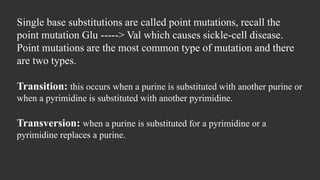
DNA MUTATIONS: Base Substitution
• Transitions
• Transversions
Single base substitutions are called point mutations, recall the
point mutation Glu -----> Val which causes sickle-cell disease.
Point mutations are the most common type of mutation and there
are two types.
Transition: this occurs when a purine is substituted with another purine or
when a pyrimidine is substituted with another pyrimidine.
Transversion: when a purine is substituted for a pyrimidine or a
pyrimidine replaces a purine.
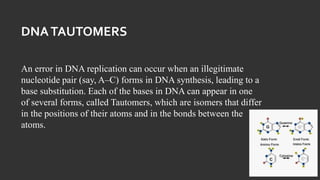
DNATAUTOMERS
An error in DNA replication can occur when an illegitimate
nucleotide pair (say, A–C) forms in DNA synthesis, leading to a
base substitution. Each of the bases in DNA can appear in one
of several forms, called Tautomers, which are isomers that differ
in the positions of their atoms and in the bonds between the
atoms.
REFERENCES
https://evolution.berkeley.edu/evolibrary/article/0_0_0/mutation
s_02
http://www2.csudh.edu/nsturm/CHEMXL153/DNAMutationRepair.
https://www.ncbi.nlm.nih.gov/books/NBK22525/
https://www.sciencedirect.com/topics/biochemistry-genetics-and-
molecular-biology/tautomerization
Mutations by Rashi Rathore

Mutations by Rashi Rathore

  • 1.
  • 2.
    DNA:The Molecular Basisof Mutations DNA is made of a long sequence of smaller units strung together. There are four basic types of unit: A, T, G, and C. These letters represents the type of base each unit carries: adenine, thymine, guanine, and cytosine. The sequence of these bases encodes instructions. Some parts of your DNA are control centers for turning genes on and off, some parts have no function, and some parts have a function that we don't understand yet. Other parts of your DNA are genes that carry the instructions for making proteins — which are long chains of amino acids. These proteins help build an organism. Protein-coding DNA can be divided into codons — sets of three bases that specify an amino acid or signal the end of the protein. Codons are identified by the bases that make them up — in the example at right, GCA, for guanine, cytosine, and adenine. The cellular machinery uses these instructions to assemble a string of corresponding amino acids (one amino acid for each three bases) that form a protein. The amino acid that corresponds to "GCA" is called alanine; there are twenty different amino acids synthesized this way in humans. "Stop" codons signify the end of the newly built protein. After the protein is built based on the sequence of bases in the gene, the completed protein is released to do its job in the cell.
  • 3.
    DEFINITION A mutation occurswhen a DNA gene is damaged or changed in such a way as to alter the genetic message carried by that gene. A Mutagen is an agent of substance that can bring about a permanent alteration to the physical composition of a DNA gene such that the genetic message is changed.
  • 4.
    • Over alifetime, our DNA can undergo changes or ‘mutations’ in the sequence of bases, A, T, G and C This results to changes in the proteins that are made. This can be a bad or a good thing • Mutations can occur during DNA replication, if errors are made and not corrected in time • Mutations can also occur as the result of exposure to environmental factors such as smoking, sunlight and radiation • Often cells can recognize any potentially mutation-causing damage and repair it before it becomes a fixed mutation • Mutations contribute to genetic variation within species • Mutations can also be inherited, particularly if they have a positive effect For example, the disorder sickle cell anaemia is caused by a mutation in the gene that instructs the building of a protein called haemoglobin. This causes the red blood cells to become an abnormal, rigid, sickle shaped. However, in African populations, having this mutation also protects against malaria.
  • 5.
    TYPES OF MUTATIONS GeneMutation  Point Mutation  Frameshift Mutation Chromosomal Mutation  Deletion  Duplication  Inversion  Translocation  Nondisjunction
  • 6.
    GENE MUTATION A genemutation is a permanent alteration in the DNA sequence that makes up a gene, such that the sequence differs from what is found in most people. Mutations range in size; they can affect anywhere from a single DNA building block (base pair) to a large segment of a chromosome that includes multiple genes
  • 7.
    • POINT MUTATION Apoint mutation or substitution is a genetic mutation where a single nucleotide base is changed, inserted or deleted from a DNA or RNA sequence of an organism's genome. 3 Possible Consequences: Nonsense mutations: code for a stop, which can translate the protein. Ex. Cystic Fibrosis. Missense mutations: code for a different amino acid. Ex. Sickle cell anaemia. Silent mutations: code for the same amino acid. Ex. Mutation producing leucine instead of isoleucine. • FRAME-SHIFT MUTATION A frameshift mutation (also called a framing error or a reading frame shift) is a genetic mutation caused by indels (insertions or deletions) of a number of nucleotides in a DNA sequence that is not divisible by three. Example – Cystic Fibrosis.
  • 8.
    CHROMOSOMAL MUTATIONS Chromosome mutationis the process of change that results in rearranged chromosome parts, abnormal numbers of individual chromosomes, or abnormal numbers of chromosome sets.
  • 9.
    • DELETION Deletion isa type of mutation involving the loss of genetic material. It can be small, involving a single missing DNA base pair, or large, involving a piece of a chromosome • DUPLICATION Duplication is a type of mutation that involves the production of one or more copies of a gene or region of a chromosome
  • 10.
    • INVERSION An inversionoccurs when a chromosome breaks in two places and the region between the break rotates 180° before rejoining with the two end fragments. • TRANSLOCATION Translocation is a type of chromosomal abnormality in which a chromosome breaks and a portion of it reattaches to a different chromosome. Chromosomal translocations can be detected by analyzing karyotypes of the affected cells. • NONDISJUNCTION Failure of paired chromosomes to separate (to disjoin) during cell division, so that both chromosomes go to one daughter cell and none go to the other.
  • 11.
    DNA MUTATIONS: BaseSubstitution • Transitions • Transversions
  • 12.
    Single base substitutionsare called point mutations, recall the point mutation Glu -----> Val which causes sickle-cell disease. Point mutations are the most common type of mutation and there are two types. Transition: this occurs when a purine is substituted with another purine or when a pyrimidine is substituted with another pyrimidine. Transversion: when a purine is substituted for a pyrimidine or a pyrimidine replaces a purine.
  • 13.
    DNATAUTOMERS An error inDNA replication can occur when an illegitimate nucleotide pair (say, A–C) forms in DNA synthesis, leading to a base substitution. Each of the bases in DNA can appear in one of several forms, called Tautomers, which are isomers that differ in the positions of their atoms and in the bonds between the atoms.
  • 14.