1
MutationMutation
Assay of MutagenesisAssay of Mutagenesis
~Dhaval Chaudhary
2
Contents
●
Mutation and Adoptation
●
Types of Mutation
●
Factor causing Mutation
●
Mutagenesis: Spontaneous Mutagenesis
Induced Mutagenesis
●
Ames Test
3
Mutation and Adaptation
●
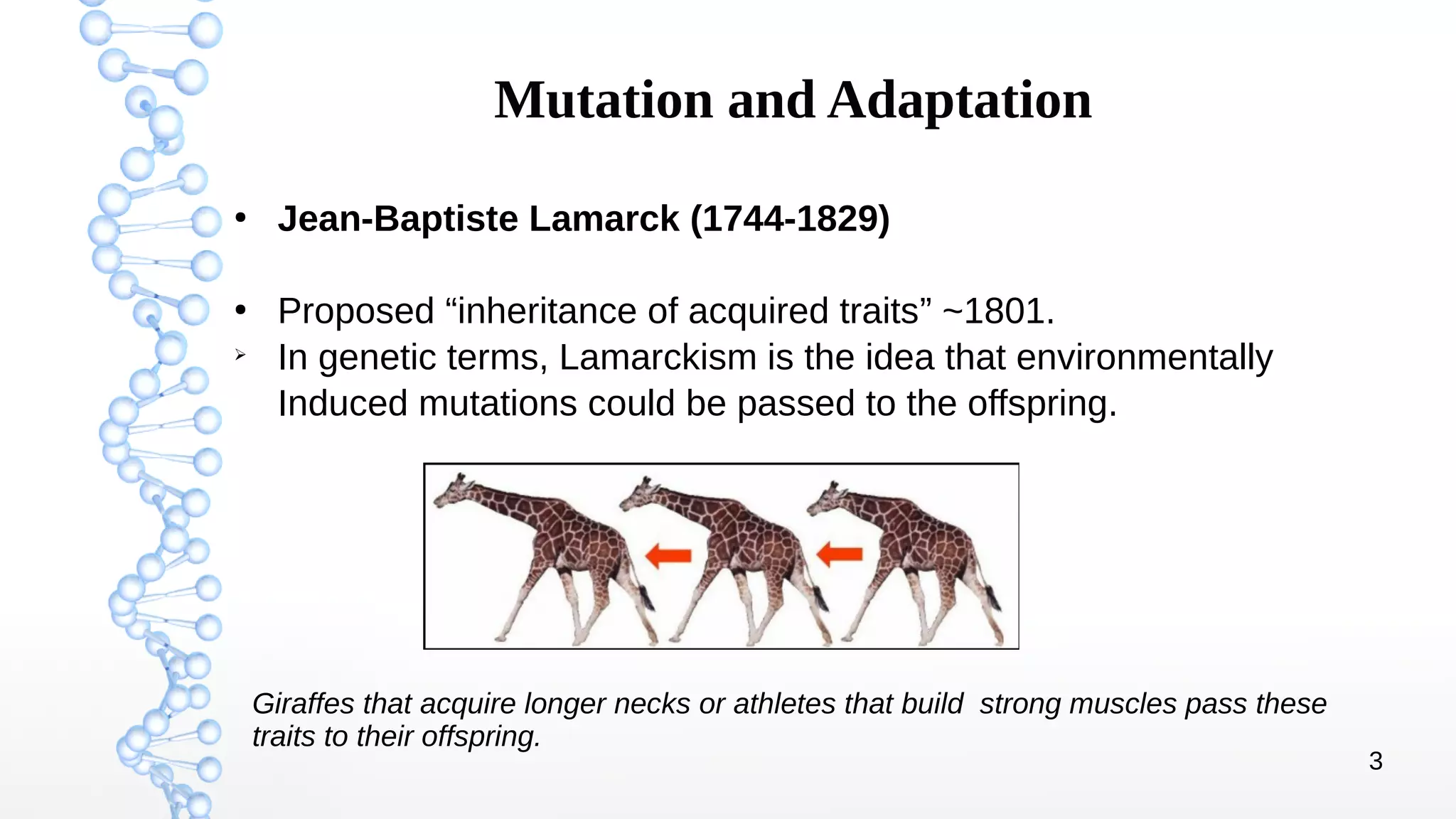
Jean-Baptiste Lamarck (1744-1829)
●
Proposed “inheritance of acquired traits” ~1801.
➢
In genetic terms, Lamarckism is the idea that environmentally
Induced mutations could be passed to the offspring.
Giraffes that acquire longer necks or athletes that build strong muscles pass these
traits to their offspring.
4
Epigenetics
●
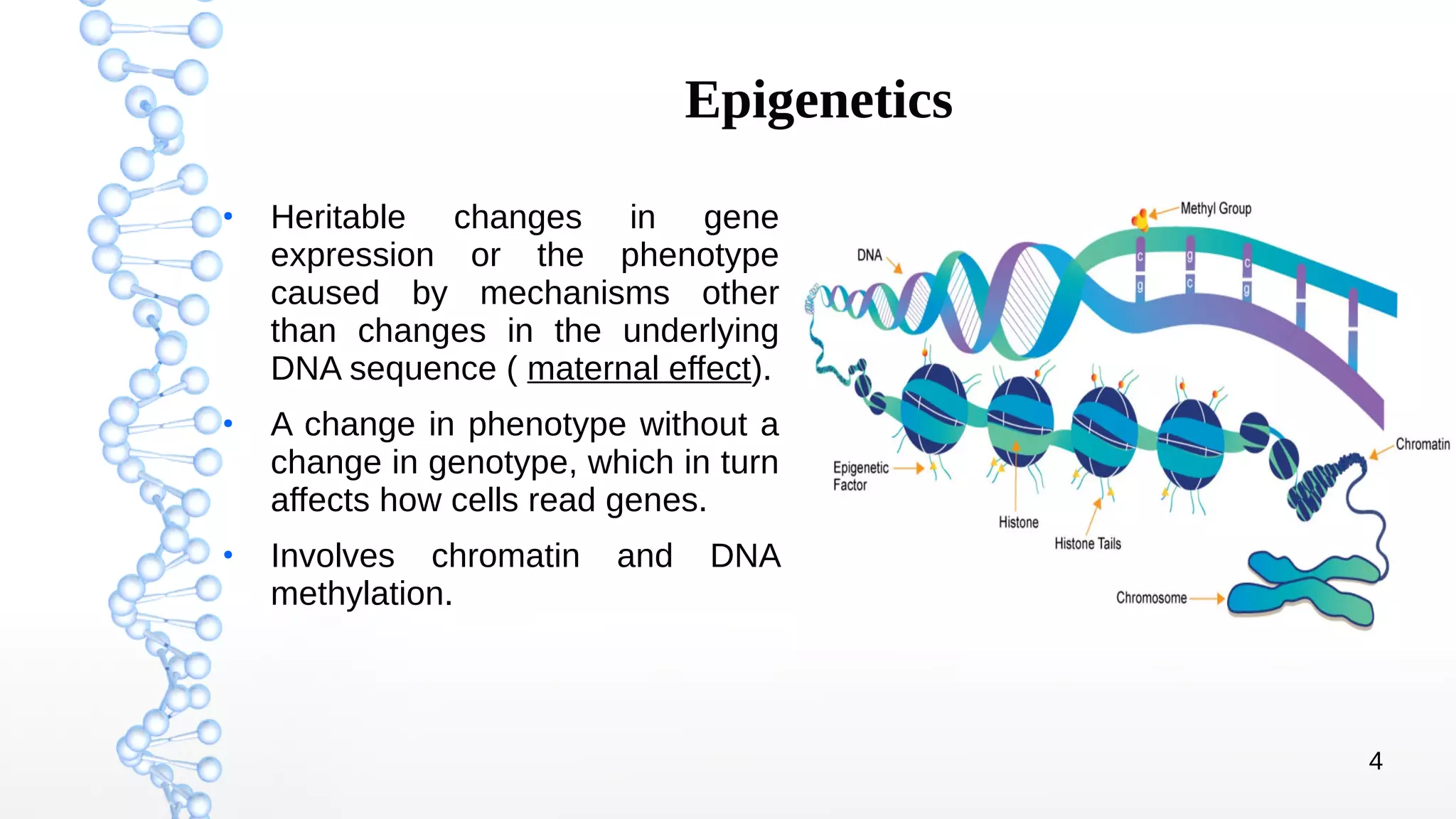
Heritable changes in gene
expression or the phenotype
caused by mechanisms other
than changes in the underlying
DNA sequence ( maternal effect).
●
A change in phenotype without a
change in genotype, which in turn
affects how cells read genes.
●
Involves chromatin and DNA
methylation.
5
●
Charles Darwin (1809-1882)
●
Heritable adaptive variation results from random mutation and
natural selection (1859, The Origin of Species).
●
Contrary to Larmarck,
✗
inheritance of adaptive traits does not result
from induction by environmental influences.
✔
But differential survival (selection) and heritable variation (arising
from mutation in the DNA sequence).
6
7
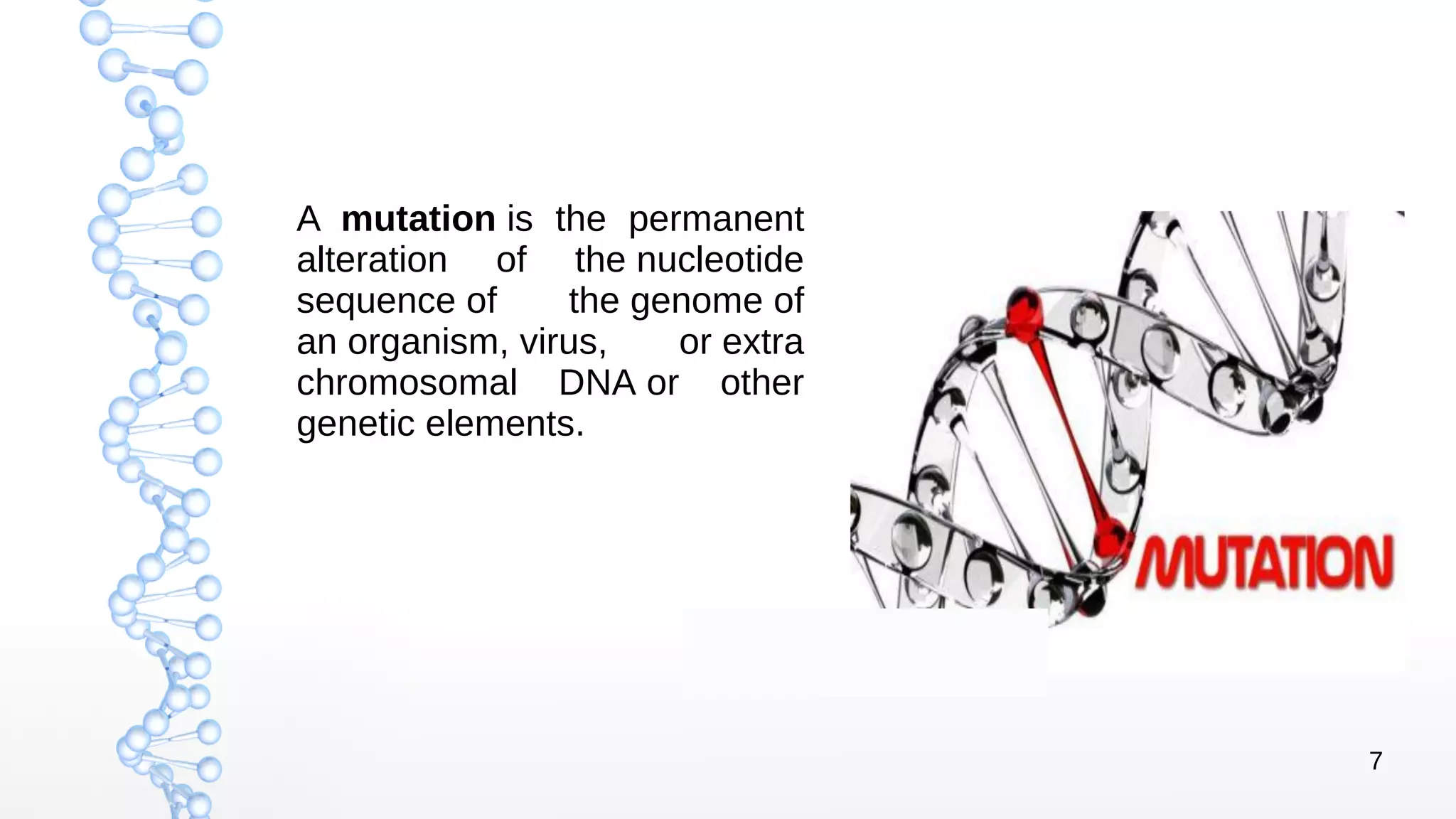
A mutation is the permanent
alteration of the nucleotide
sequence of the genome of
an organism, virus, or extra
chromosomal DNA or other
genetic elements.
8
Mutations are quantified in two ways:
1. Mutation rate = Probability of a particular type of mutation per
unit time (or generation).
2. Mutation frequency = Number of times a particular mutation occurs
in a population of cells or individuals.
9
Types of Mutation
●
Gene Mutation
●
Point Mutation
➔
Silent
➔
Missense
➔
Nonsense
●
Frameshift Mutation
➔
Addition
➔
Deletion
●
Chromosome Mutation
➔
Depletion
➔
Duplication
➔
Inversion
➔
Translocation
●
Genome Mutation
➔
Aneuploidy
➔
Polyploidy
➔
Autopolyploidy
➔
Allopolyploidy
10
Body and Gamete Mutation
●
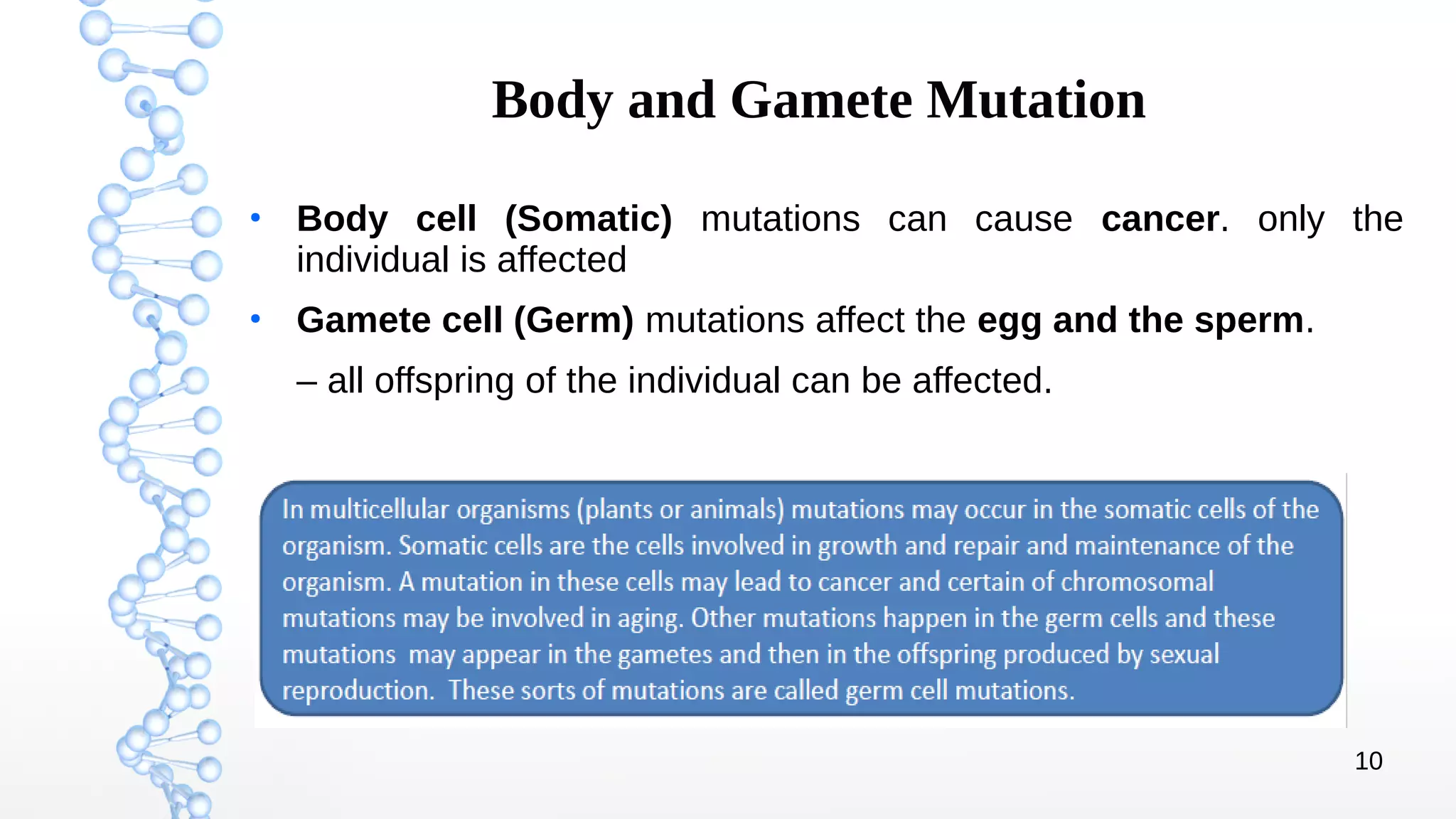
Body cell (Somatic) mutations can cause cancer. only the
individual is affected
●
Gamete cell (Germ) mutations affect the egg and the sperm.
– all offspring of the individual can be affected.
11
Gene Mutation
●
Involve insertion or removal of 1 or more base pairs.
●
Gene mutation is a change in single base pair within DNA
sequences
1) Point mutations - a one base change in DNA.
2) Frame Shift Mutations - the addition or deletion of 1 or more
bases.
●
These are due to powerful mutagens; chemical or physical.
12
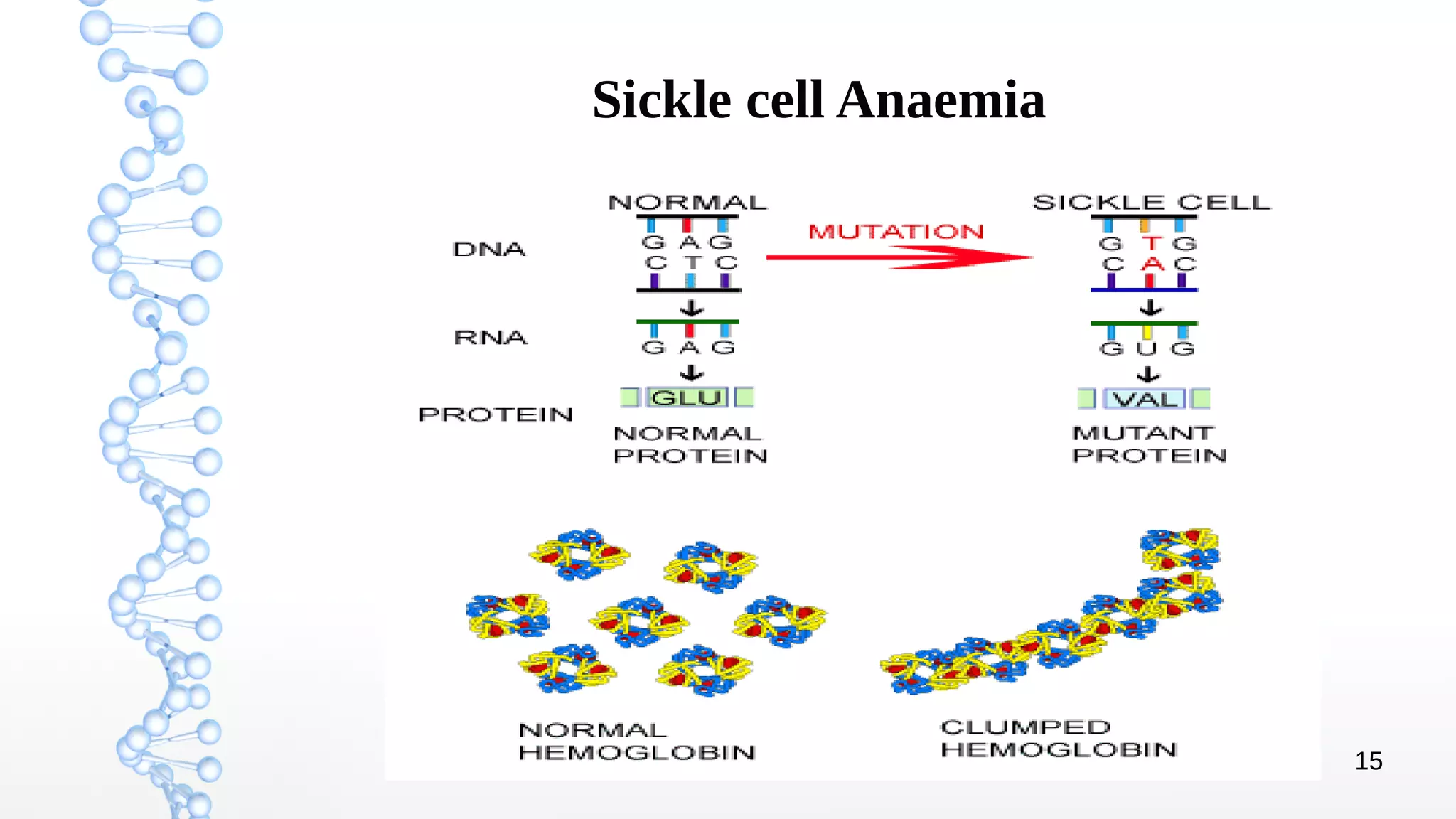
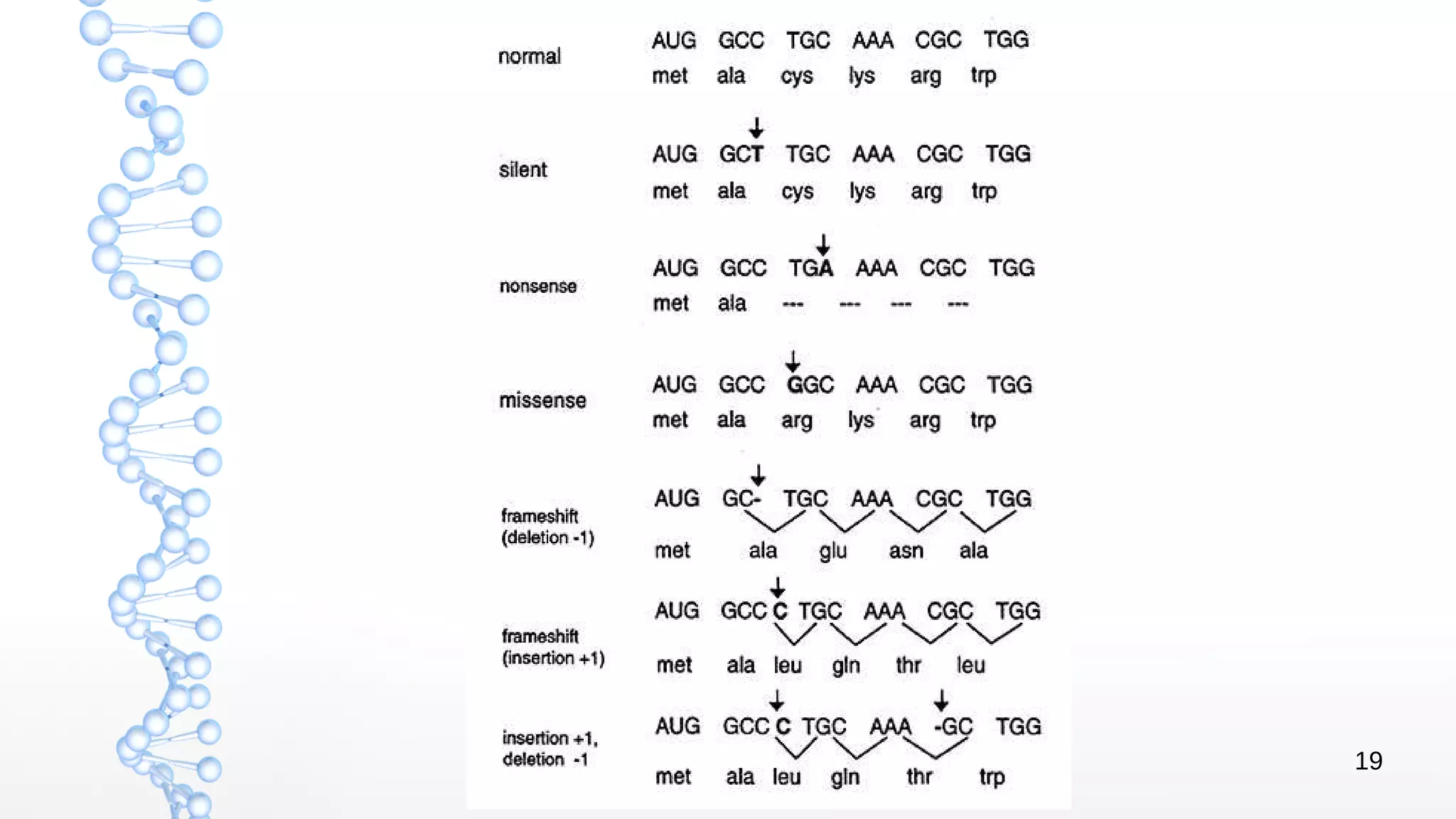
Point Mutation
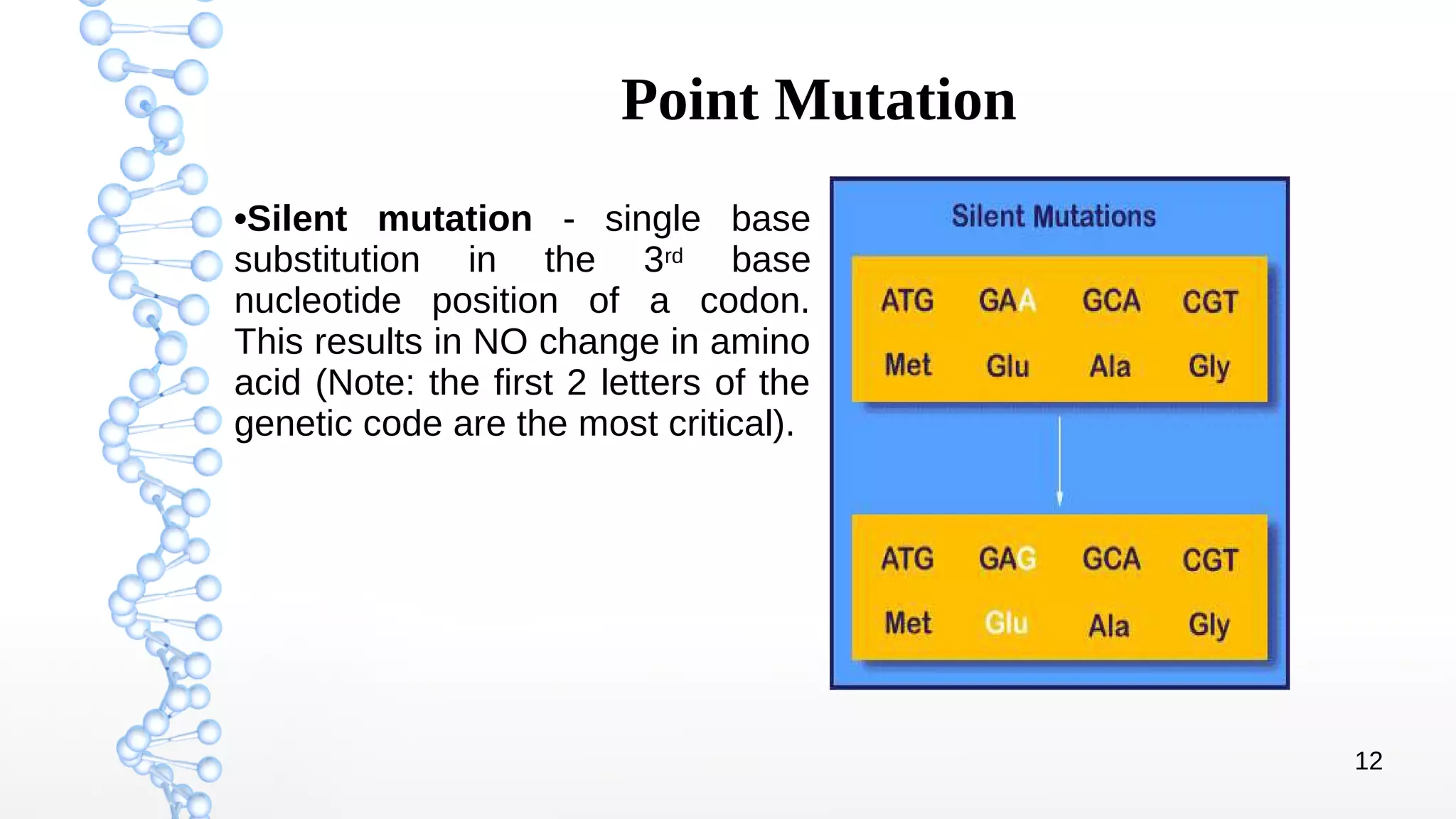
•Silent mutation - single base
substitution in the 3rd base
nucleotide position of a codon.
This results in NO change in amino
acid (Note: the first 2 letters of the
genetic code are the most critical).
13
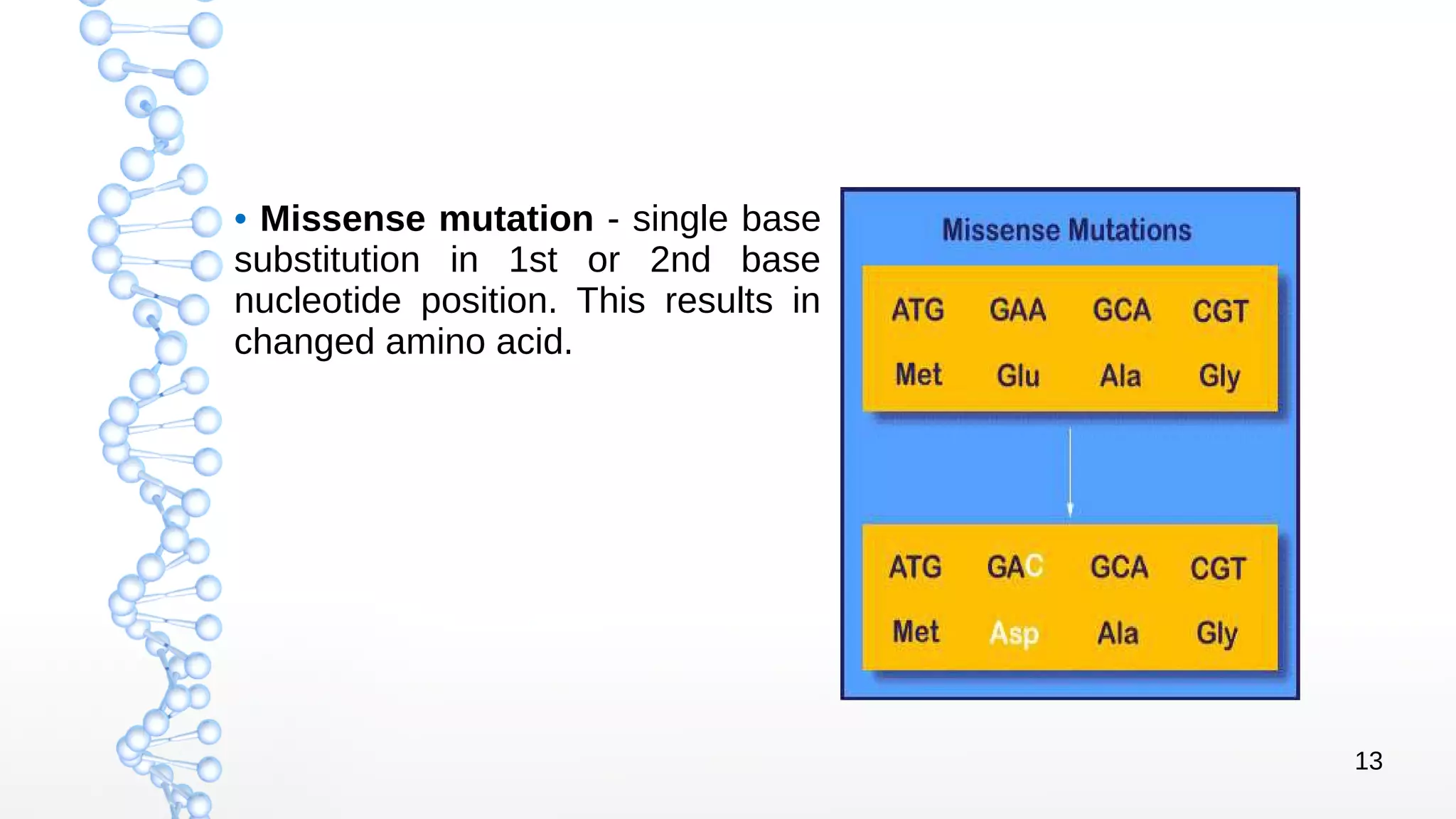
• Missense mutation - single base
substitution in 1st or 2nd base
nucleotide position. This results in
changed amino acid.
14
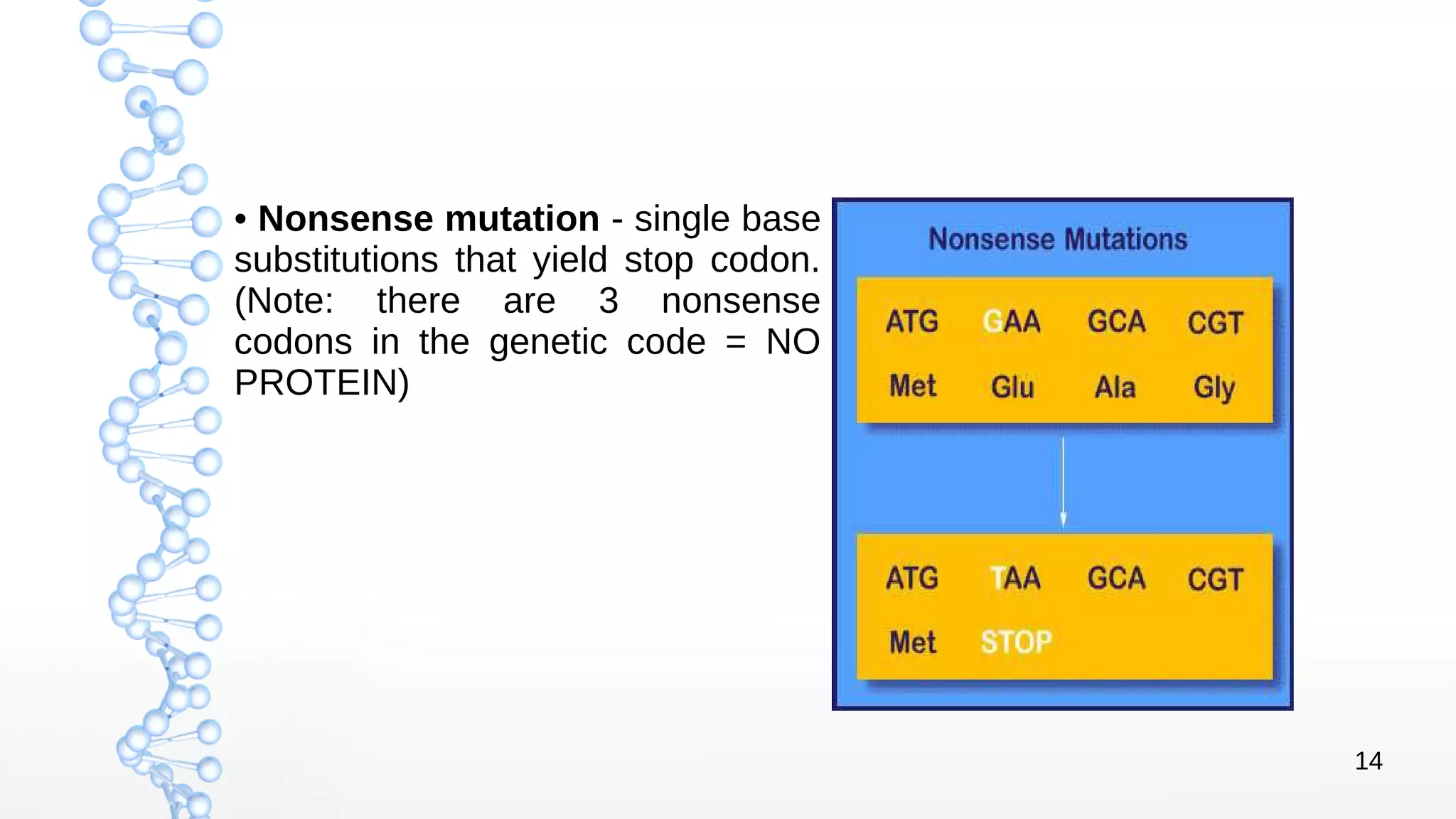
• Nonsense mutation - single base
substitutions that yield stop codon.
(Note: there are 3 nonsense
codons in the genetic code = NO
PROTEIN)
15
Sickle cell Anaemia
16
2. Frame Shift Mutation
●
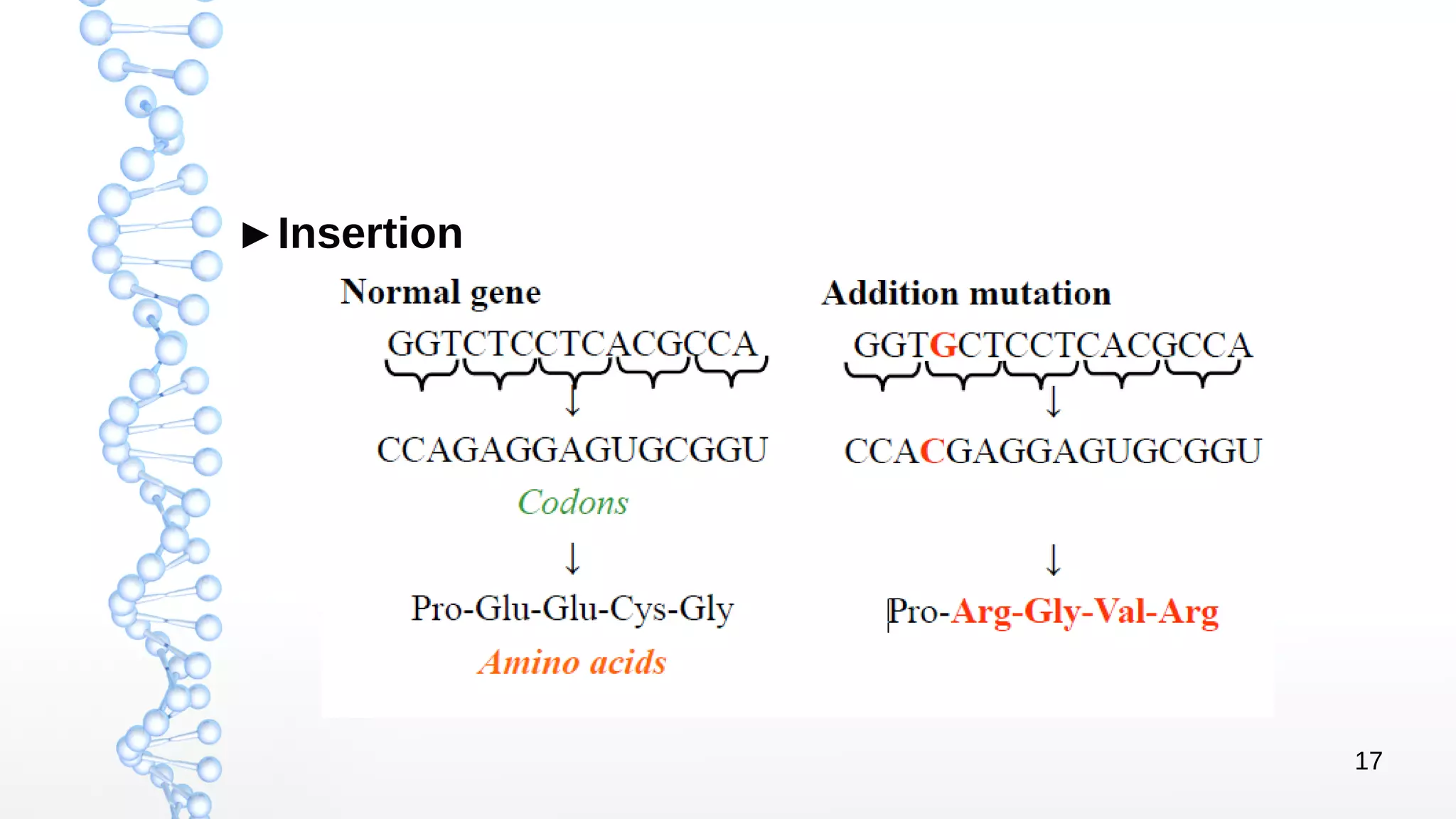
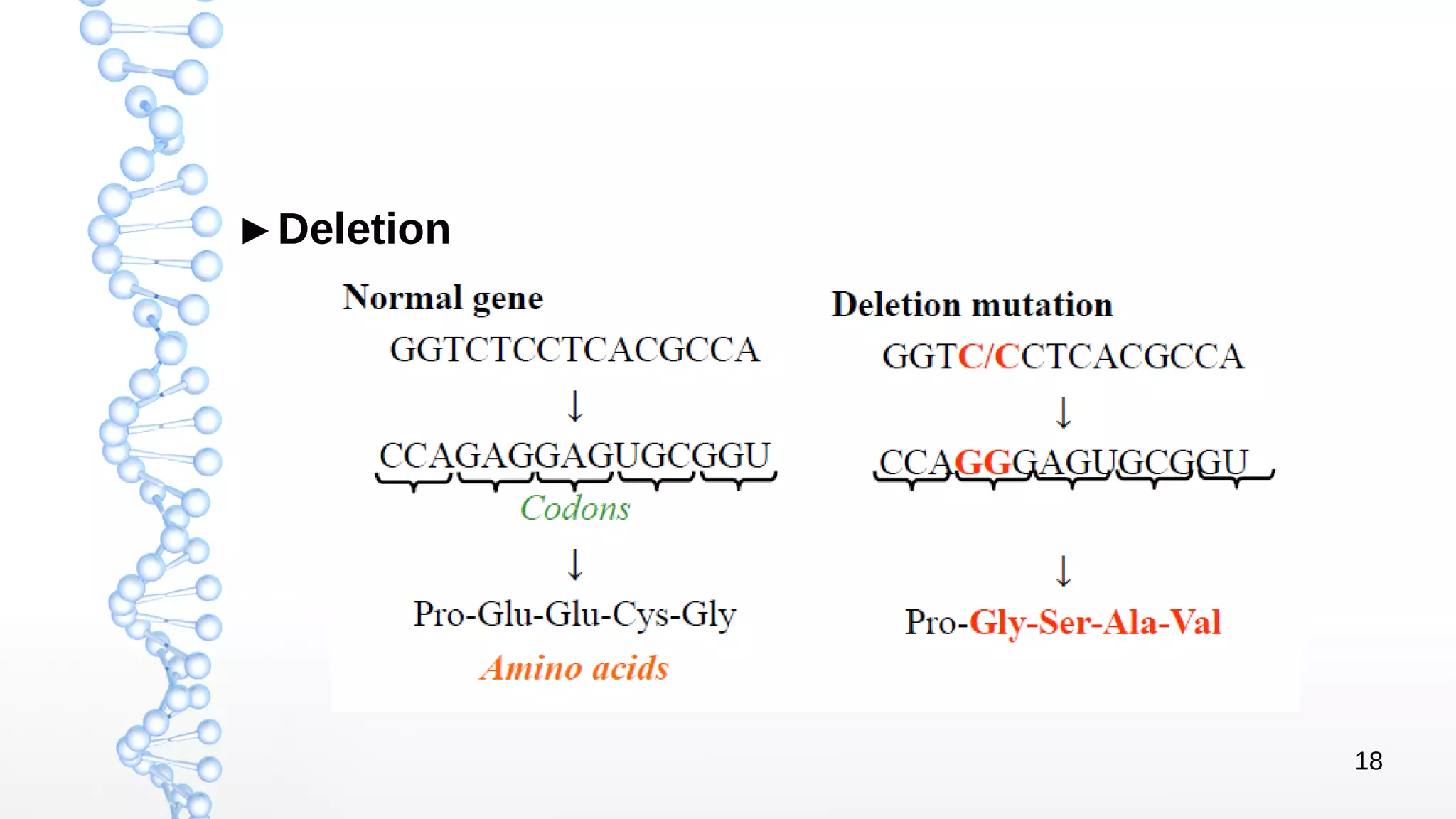
A frameshift mutation (also called a framing error or a reading
frame shift) is a genetic mutation caused by insertions or deletions
of a number of nucleotides in a DNA sequence that is not divisible
by three.
●
Due to the triplet nature of gene expression by codons, the
insertion or deletion can change the reading frame (the grouping of
the codons), resulting in a completely different translation from the
original.
17
►Insertion
18
►Deletion
19
20
CHROMOSOME MUTATION
Chromosome structure become influenced by;
►Change in amount of genetic information in chromosome because of
– Deletion
– Duplication
►Similar amount of genetic information but the materials are rearranged
– Inversion
– Translocation
21
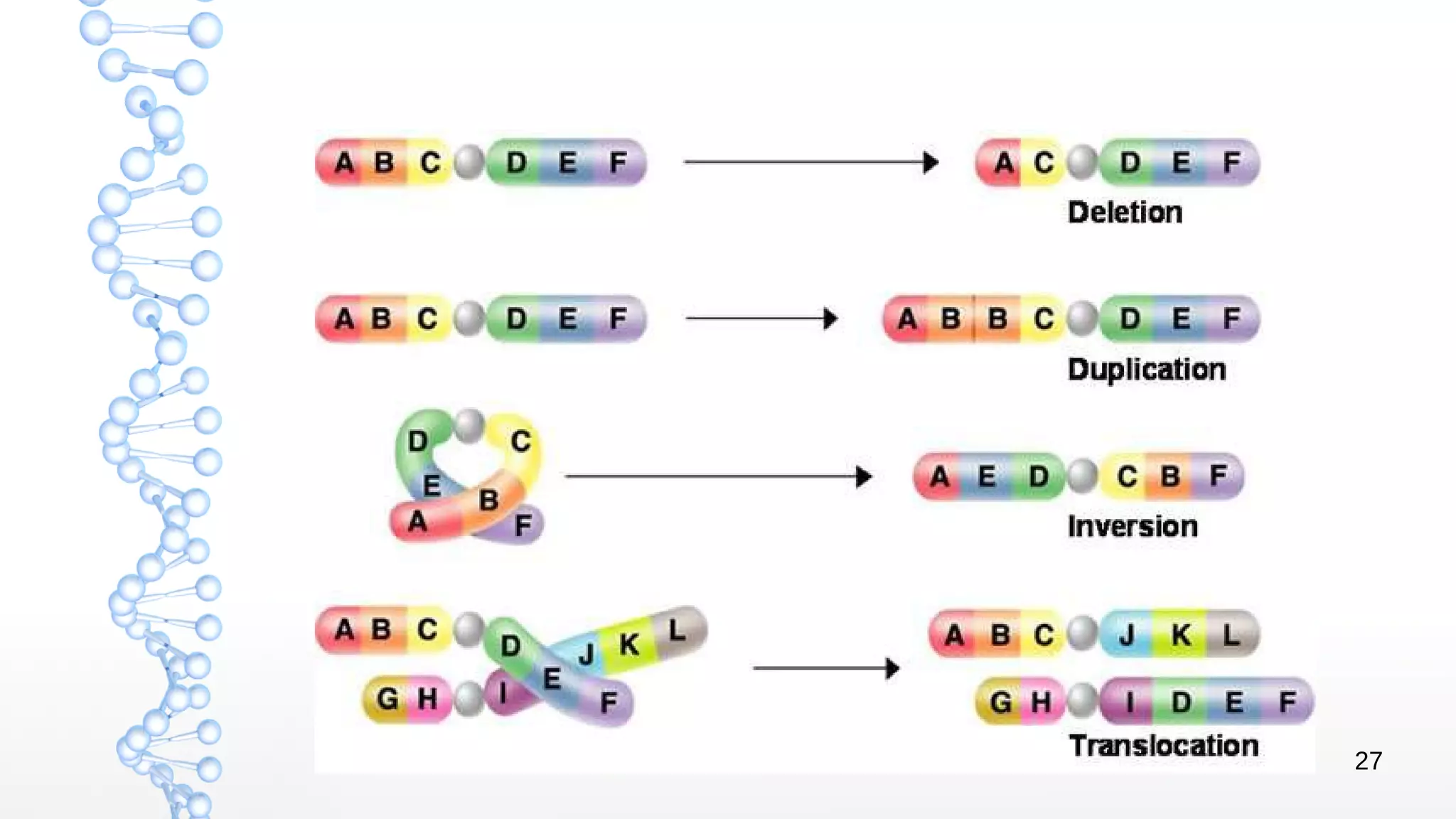
◙Deletion
Loss of chromosomal segment
◙Duplication
Repetition of chromosomal segment.
Gain of segment.
◙Inversion
A change in the direction of the
genetic material along a single
chromosome. Reversal of region.
◙Translocation
A segment of one chromosome
becomes attached to a different
chromosome
●
Simple translocation
One way transfer
●
Reciprocal translocation
Two way transfer
22
Deletion
●
It is a chromosomal mutation
involving loss or removal or
deletion of a chromosomal
segment from a chromosome
set.
23
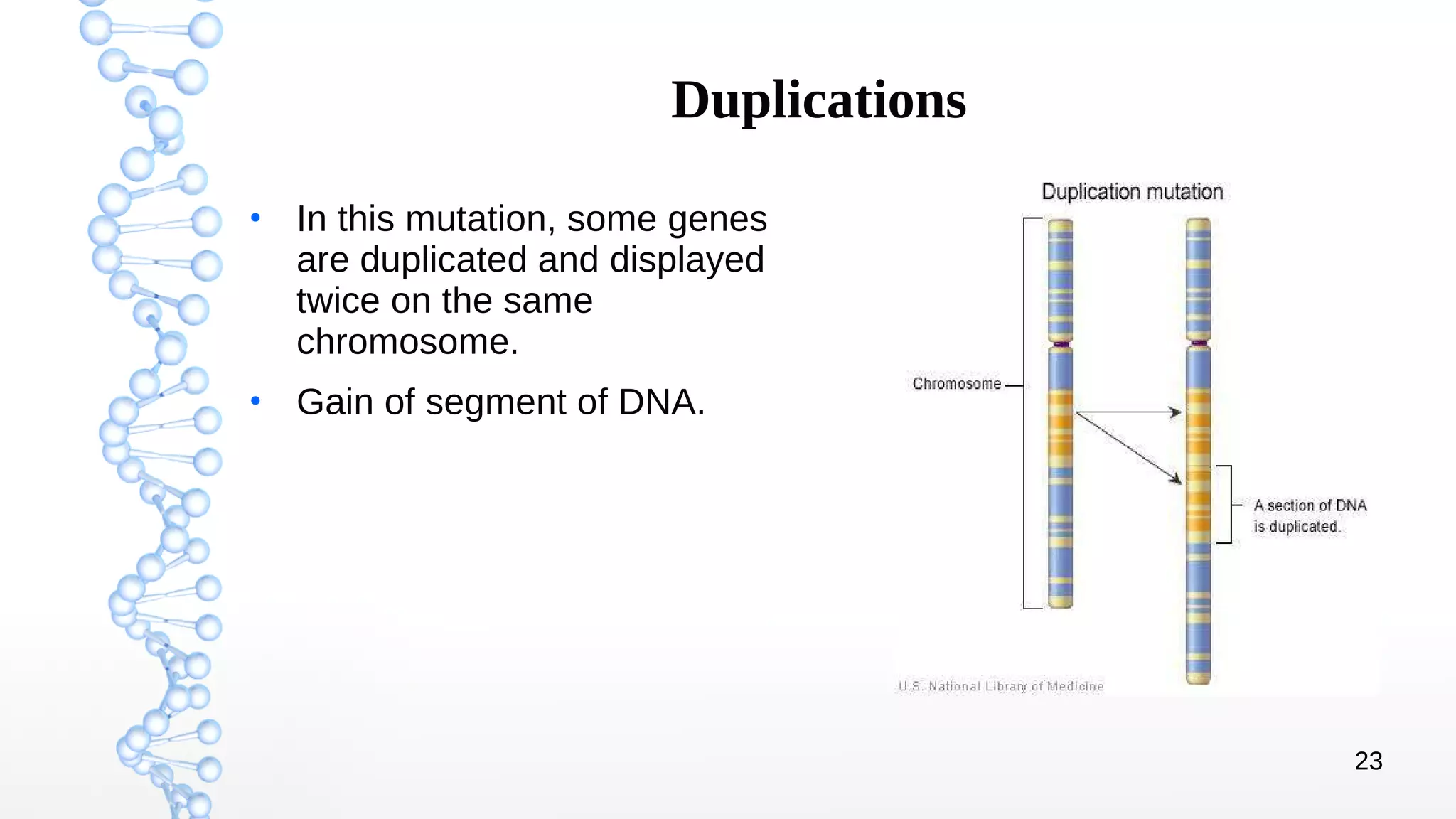
Duplications
●
In this mutation, some genes
are duplicated and displayed
twice on the same
chromosome.
●
Gain of segment of DNA.
24
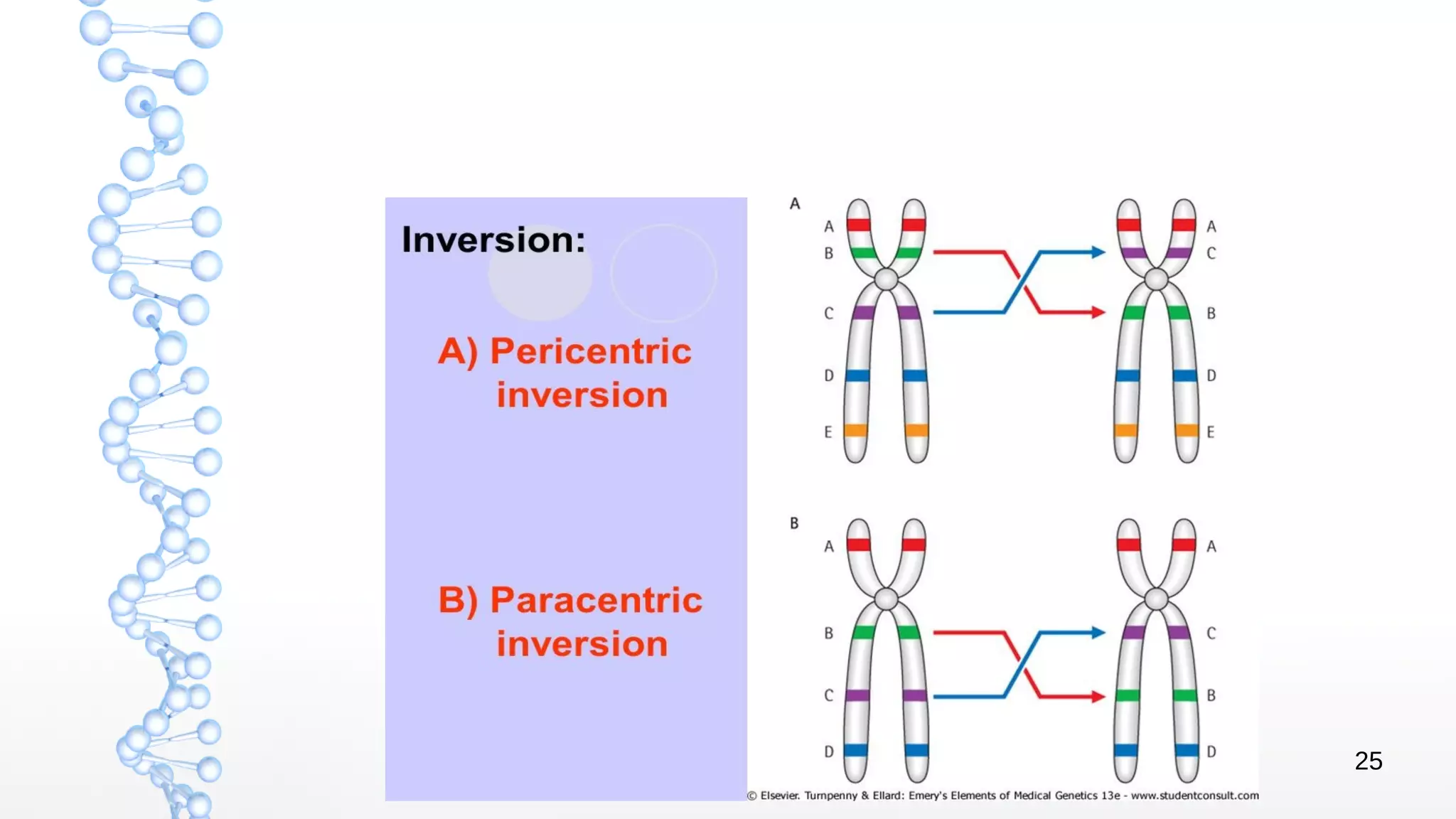
Inversion
●
Inversions happen when a
whole region of genes on a
chromosome gets flipped
around .

2 types of inversions.
1) Paracentric inversions the
centromere is not included in
the inversion.
2) Pericentric inversions, the
centromere is involved in the
inversion.
25
26
Translocation
●
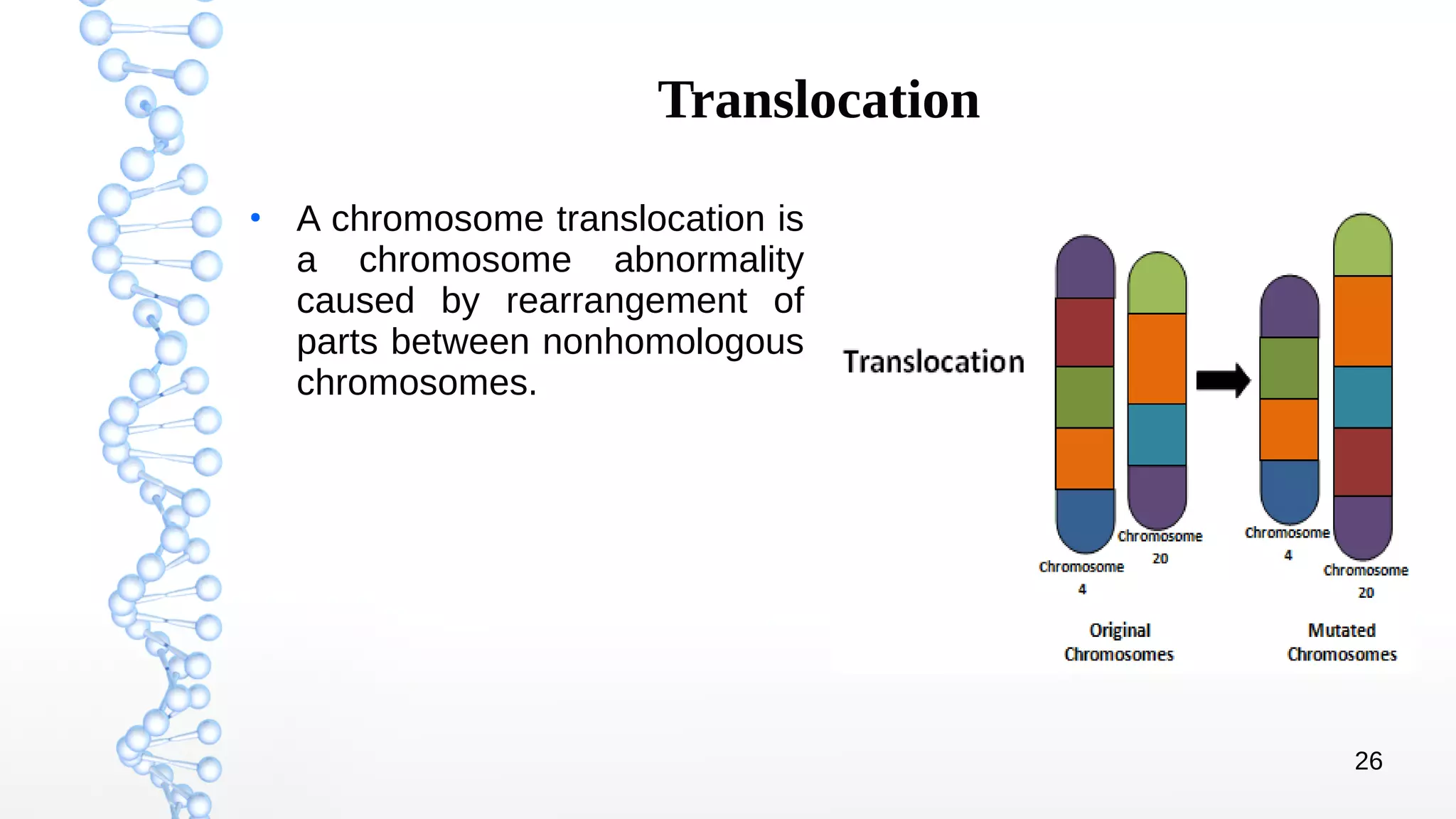
A chromosome translocation is
a chromosome abnormality
caused by rearrangement of
parts between nonhomologous
chromosomes.
27
28
Genome Mutation
Terminology for variations in chromosome numbers
29
30
Factor Causing Mutation
●
Factors that contribute to mutation
➔
Error in DNA replication.
➔
Damaging effects of mutagens
1) CHEMICALS: Alkylating agents like nitrosoguanidine, nitrosamine,
etc.
2) RADIATIONS: X-rays, U.V.rays, etc.
31
Mutagenesis
●
Mutagenesis is defined as the change in genetic information of an
organism in a stable manner by the use of physical and chemical
mutagens.
●
It was developed by Charlotte Auerbach. She was the first women
scientist to study on the effect of chemical mutagens.
32
Spontaneous Mutagenesis
➔
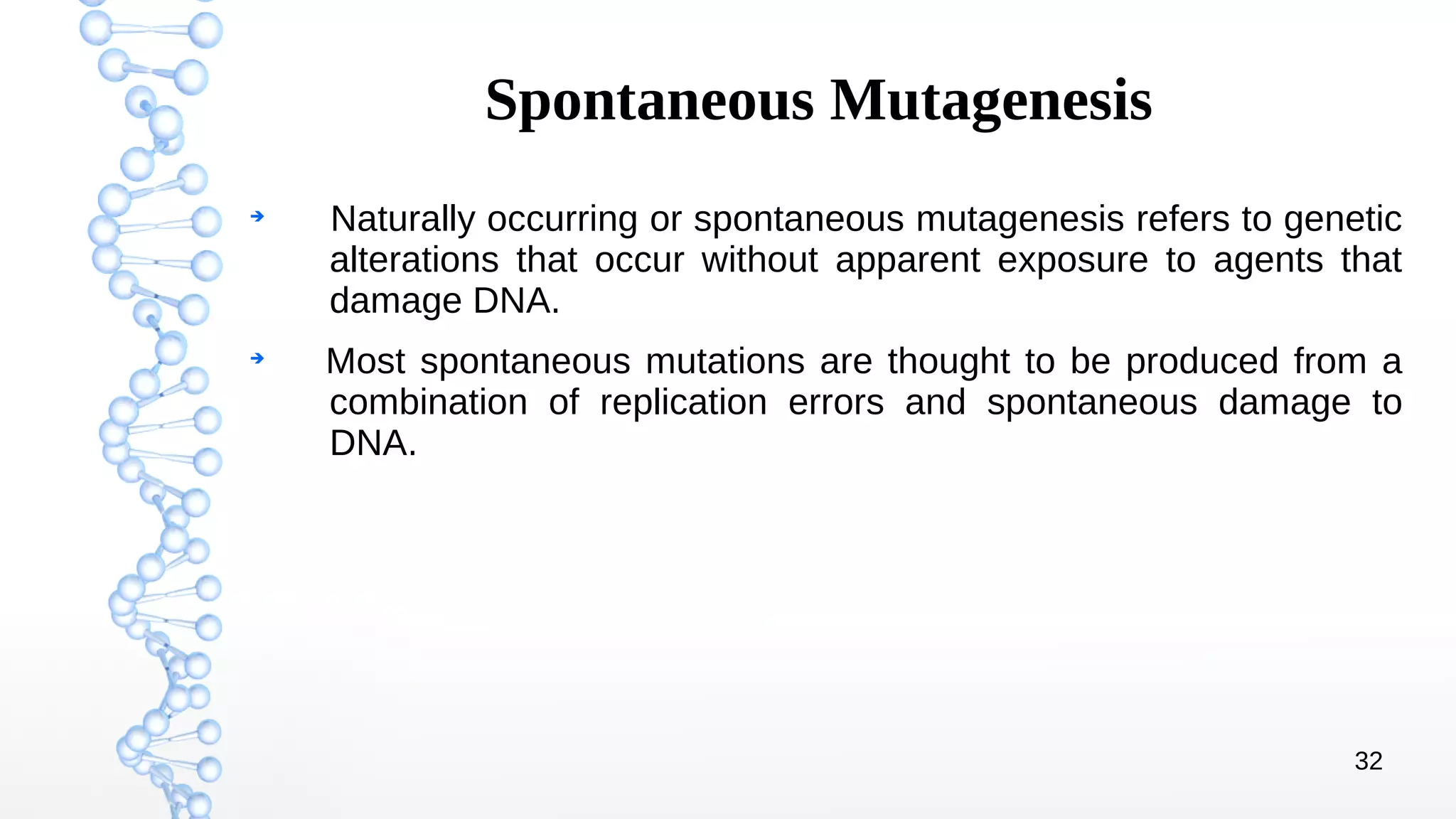
Naturally occurring or spontaneous mutagenesis refers to genetic
alterations that occur without apparent exposure to agents that
damage DNA.
➔
Most spontaneous mutations are thought to be produced from a
combination of replication errors and spontaneous damage to
DNA.
33
●
All types of point mutations can occur spontaneously,
●
During S, G1 and G2 phases of the cell cycle, or by the movement
of transposons.
●
The spontaneous mutation rate in eukaryotes is between 10-4 to 10-6
per gene per generation.
●
In bacteria and phages 10-5 to10 -7/gene/generation.
34
●
Caused mainly by: Spntaneous replication errors..
➔
Tautomeric shifts
➔
Wobble base pairing
➔
Spontaneous Chemical Changes : Depurination,
Deamination
35
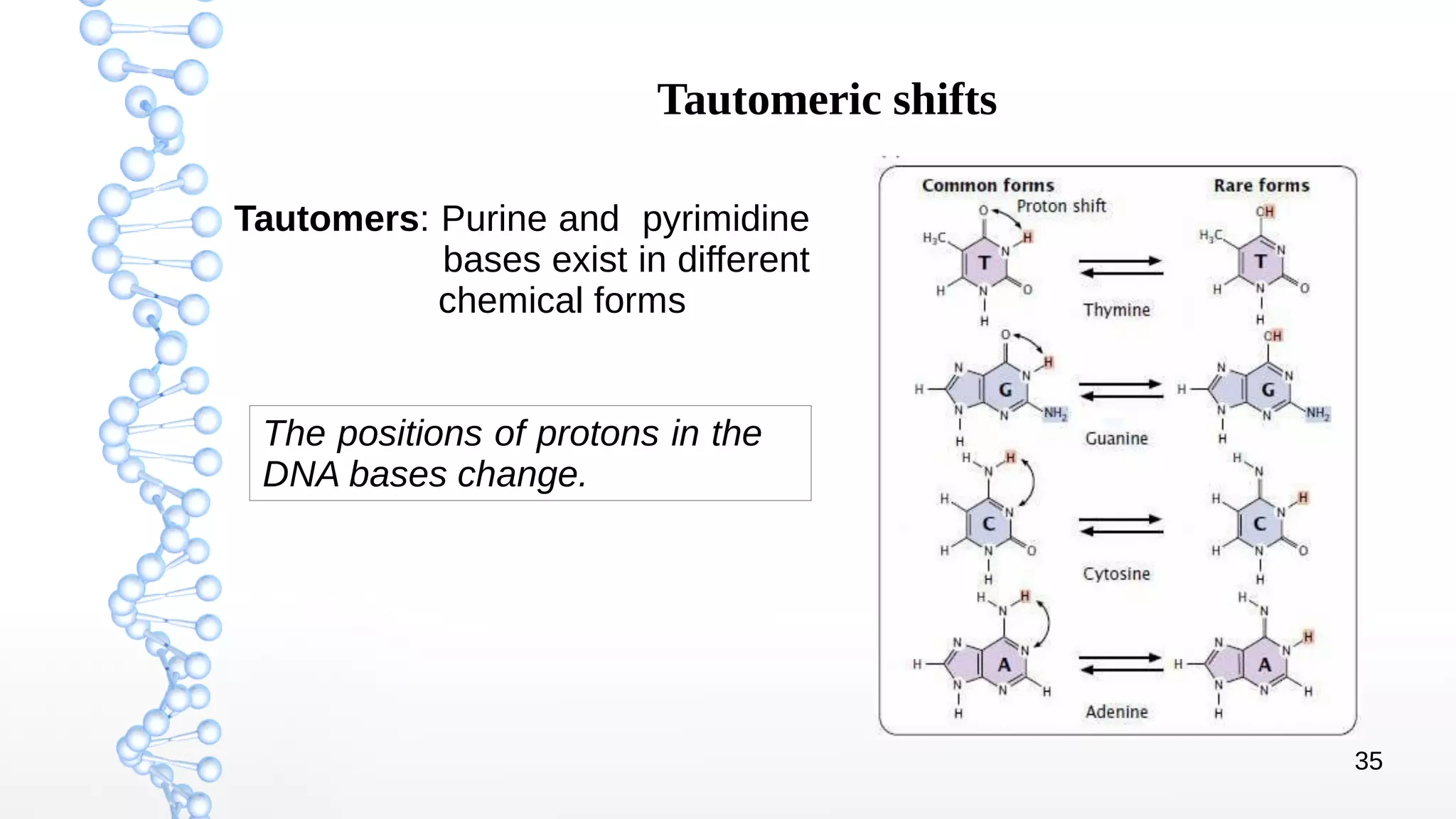
Tautomeric shifts
Tautomers: Purine and pyrimidine
bases exist in different
chemical forms
The positions of protons in the
DNA bases change.
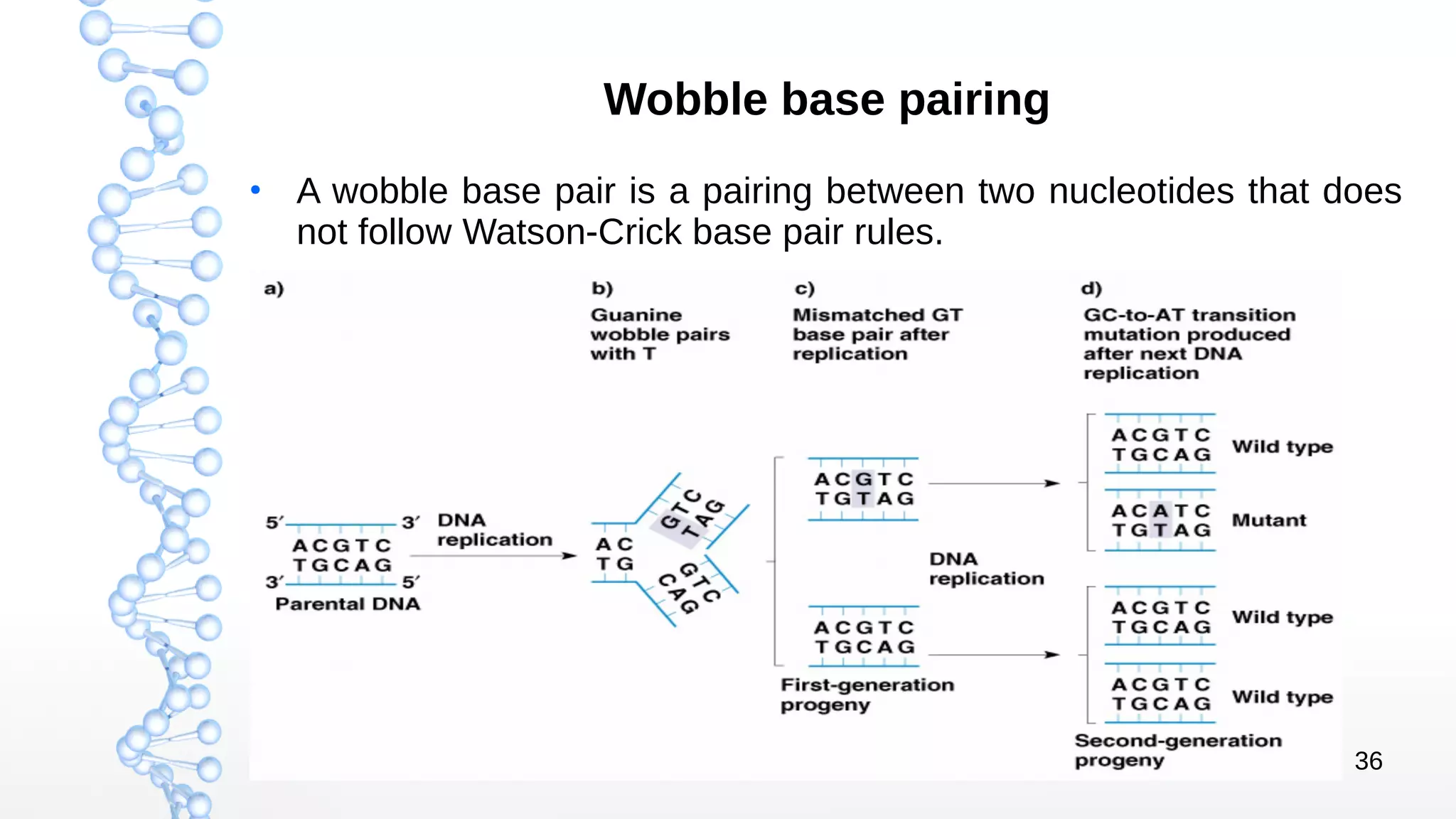
36
Wobble base pairing
●
A wobble base pair is a pairing between two nucleotides that does
not follow Watson-Crick base pair rules.
37
Spontaneous chemical changes
●
Depurination
Common; A or G are removed and replaced with a random base.
●
Deamination
Amino group is removed from a base (C → U); if not replaced U
pairs with A in next round of replication (CG → TA).
38
Deamination
39
Induced Mutagenesis
●
Mutations those that result from changes caused by environmental
chemicals or radiation are called as induced mutations.
●
A number of environmental agents are capable of damaging DNA
including certain chemicals and radiation.
●
Mutagen: Any environmental agent that significantly increases the
rate of mutation above the spontaneous rate.
40
Radiation (X-Ray, UV)
●
Ionizing radiation breaks covalent bonds including those in DNA
and is the leading cause of chromosome mutations.
●
Ionizing radiation has a cumulative effect and kills cells at high
doses.
●
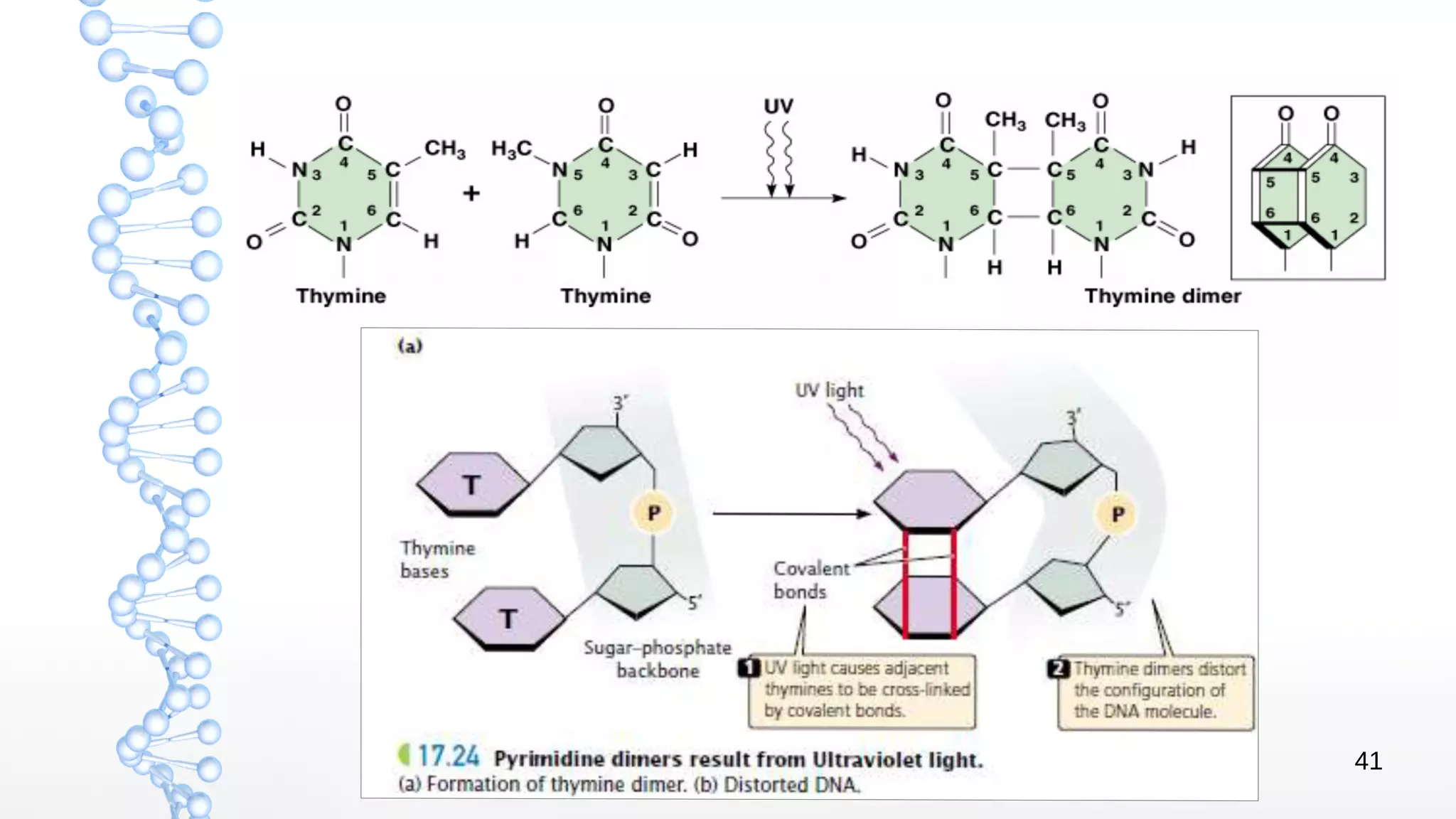
UV (254-260 nm) causes purines and pyrimidines to form abnormal
dimer bonds and bulges in the DNA strands.
41
Thymine dimers induced by UV light
42
Chemical mutagens
(1) Base analogues are structurally similar to bases; they have their
mutagenic effect by being incorporated into DNA and causing mis-pairing
during replication.
(2) Intercalating agents are generally flat molecules that can fit between
bases, producing helix distortions that can lead to replication errors.
(3) DNA-reacting chemicals, such as reactive oxygen, can directly modify
bases, changing coding groups and thereby allowing base pairing with
the wrong base .
(4) Alkylating agents bond covalently to DNA and result in the addition of
some organic group to the bases or possibly to the sugar–phosphate
backbone.
43
●
Base analogs
•Similar to normal bases, incorporated into DNA during replication.
•Some cause mis-pairing (e.g., 5-bromouracil).
•Not all are mutagenic.
44
●
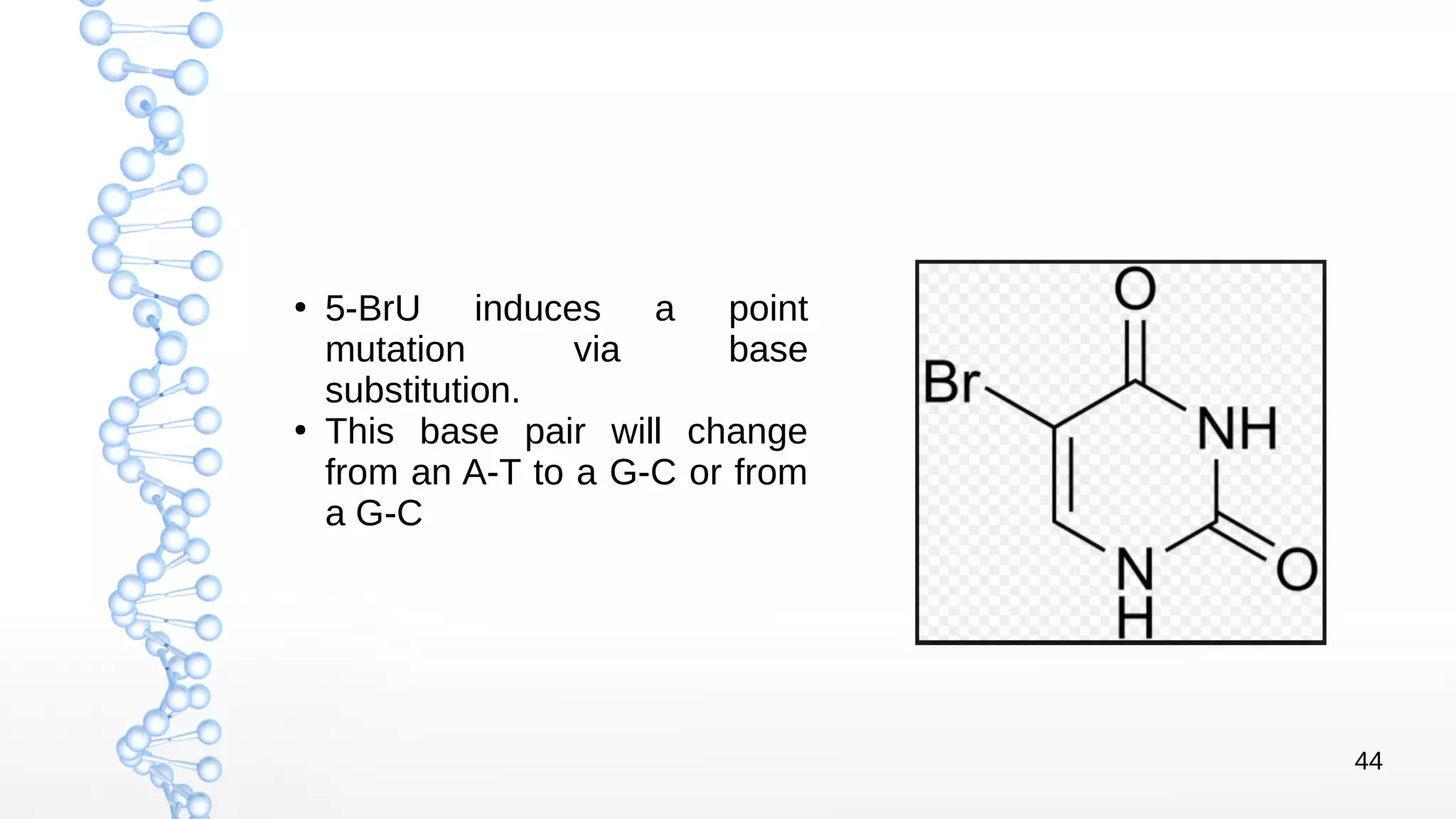
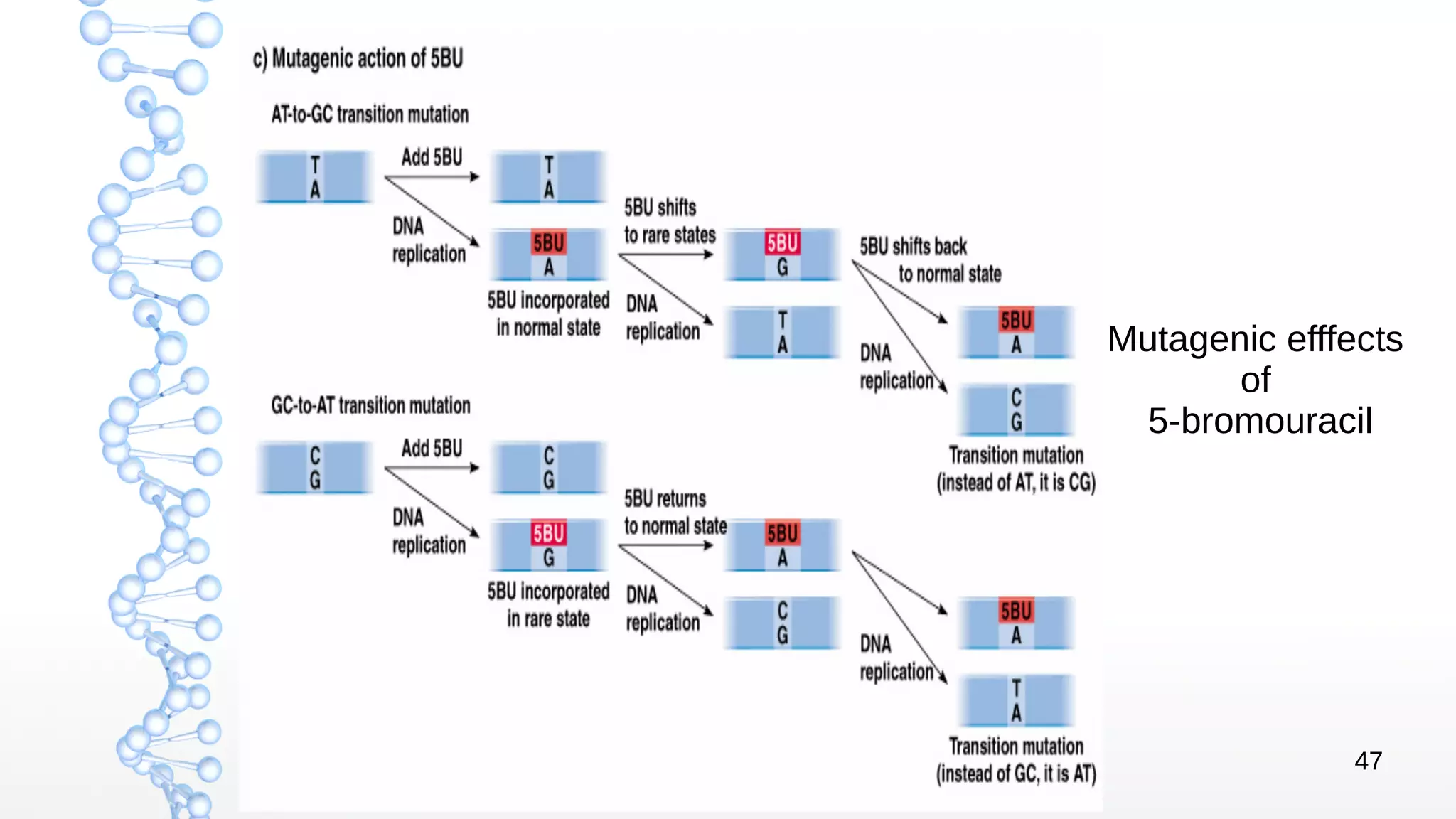
5-BrU induces a point
mutation via base
substitution.
●
This base pair will change
from an A-T to a G-C or from
a G-C
45
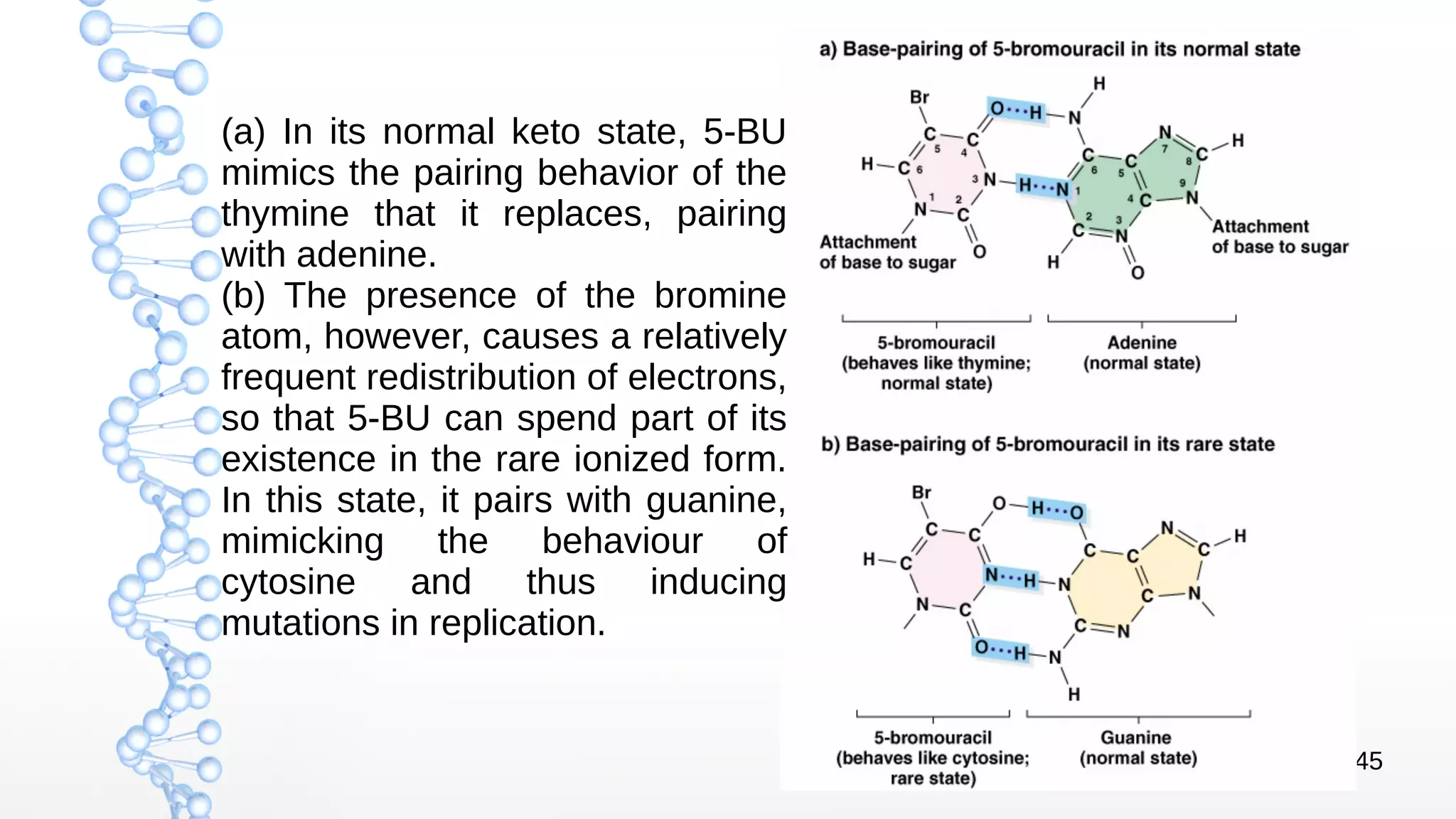
(a) In its normal keto state, 5-BU
mimics the pairing behavior of the
thymine that it replaces, pairing
with adenine.
(b) The presence of the bromine
atom, however, causes a relatively
frequent redistribution of electrons,
so that 5-BU can spend part of its
existence in the rare ionized form.
In this state, it pairs with guanine,
mimicking the behaviour of
cytosine and thus inducing
mutations in replication.
46
47
Mutagenic efffects
of
5-bromouracil
48
Base Modifying Agents
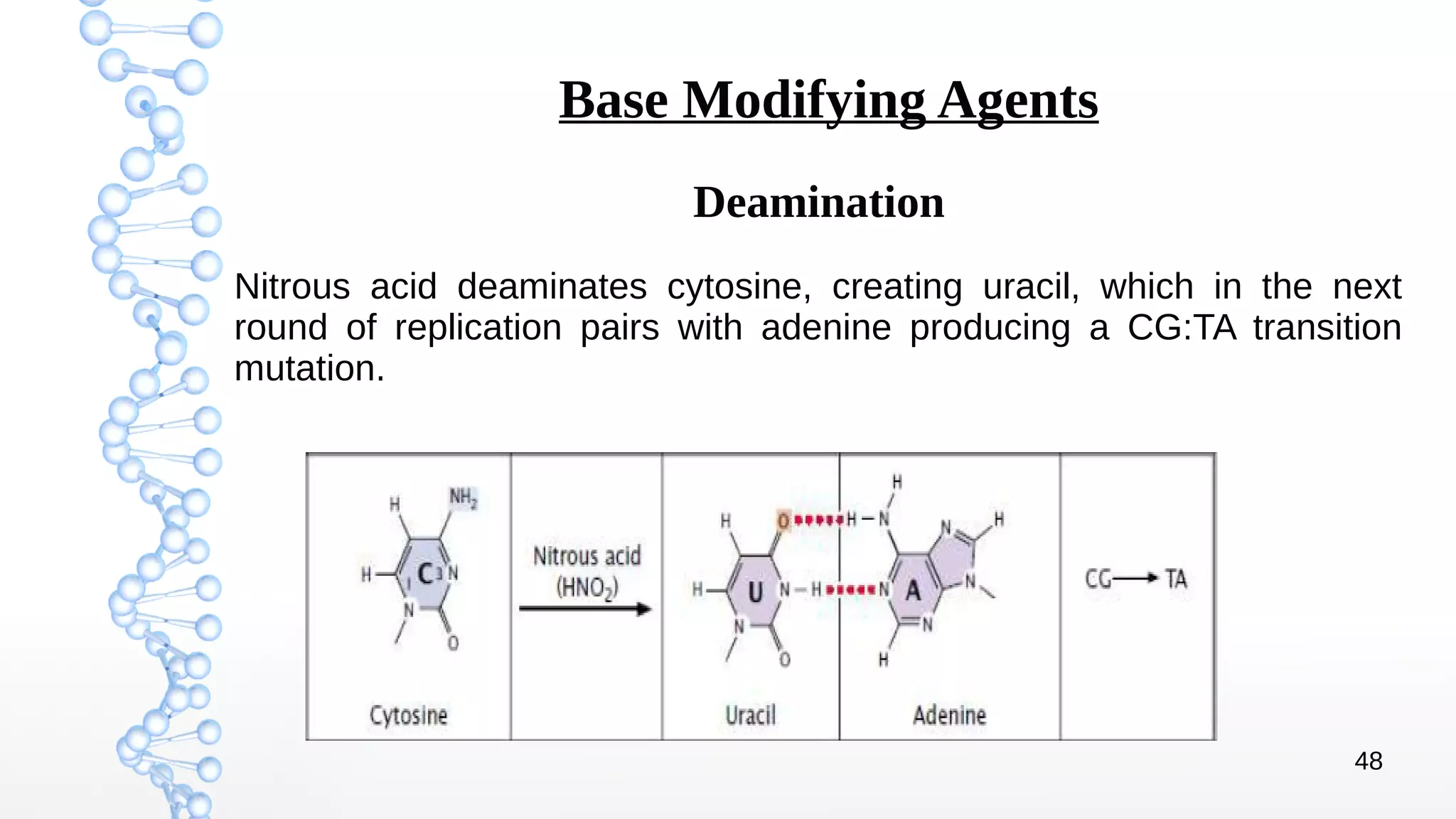
Nitrous acid deaminates cytosine, creating uracil, which in the next
round of replication pairs with adenine producing a CG:TA transition
mutation.
Deamination
49
Hydroxylamine
●
Hydroxylamine is a very specific base modifying mutagen that adds a
hydroxyl group to cytosine.
●
It converts cytosine into hydroxylaminocytosine .
●
This conversion increases the frequency of a rare tautomer.
●
The tautomer pairs with adenine instead of guanine and leads to CG:TA
Transitions.
●
Because hydroxylamine acts only on cytosine, it will not generate TA:CG
transitions.
50
Intercalating Agents
●
Thin, plate-like hydrophobic molecules insert themselves between
adjacent base-pairs,
●
Mutagenic intercalating agents cause insertions during DNA
replication.
●
Loss of intercalating agent can result in deletion.
●
Examples: proflavin, ethidium bromide
51
52
53
History of Ames Test
• Ames test was brought forward
by Bruce Ames in 1970.
• He is professor in university of
California, berkely.
54
●
Ames Test is an inexpensive method used to screen possible
carcinogens and mutagens.
●
Histidine auxotroph Salmonella typhimurium (requires Histidine to
grow) are mixed with rat liver enzymes and plated on media lacking
histidine.
●
Liver enzymes are required to detect mutagens that are converted to
carcinogenic forms by the liver (e.g., procarcinogens).
55
●
Test chemical is then added to medium.
●
Control plates show only a small no of revertants (bacteria cells
growing without histidine).
●
Plates innocculated with mutagens or procarcinogens show a larger
no of revertants.
●
Auxotroph will not grow without Histidine unless a mutation has
occurred.
56
57
58
59
Other tests involved...
➢
Mutagenicity testing with prokaryotic cell system:
1) Host mediated assay
2) Coliform assay
➢
Mutagenicity testing with eukaryotic cell system:
1) In vitro methods
2) In vivo methods
60
THANK YOU!!

Mutation and Assay of Mutagenesis

  • 1.
    1 MutationMutation Assay of MutagenesisAssayof Mutagenesis ~Dhaval Chaudhary
  • 2.
    2 Contents ● Mutation and Adoptation ● Typesof Mutation ● Factor causing Mutation ● Mutagenesis: Spontaneous Mutagenesis Induced Mutagenesis ● Ames Test
  • 3.
    3 Mutation and Adaptation ● Jean-BaptisteLamarck (1744-1829) ● Proposed “inheritance of acquired traits” ~1801. ➢ In genetic terms, Lamarckism is the idea that environmentally Induced mutations could be passed to the offspring. Giraffes that acquire longer necks or athletes that build strong muscles pass these traits to their offspring.
  • 4.
    4 Epigenetics ● Heritable changes ingene expression or the phenotype caused by mechanisms other than changes in the underlying DNA sequence ( maternal effect). ● A change in phenotype without a change in genotype, which in turn affects how cells read genes. ● Involves chromatin and DNA methylation.
  • 5.
    5 ● Charles Darwin (1809-1882) ● Heritableadaptive variation results from random mutation and natural selection (1859, The Origin of Species). ● Contrary to Larmarck, ✗ inheritance of adaptive traits does not result from induction by environmental influences. ✔ But differential survival (selection) and heritable variation (arising from mutation in the DNA sequence).
  • 6.
  • 7.
    7 A mutation is thepermanent alteration of the nucleotide sequence of the genome of an organism, virus, or extra chromosomal DNA or other genetic elements.
  • 8.
    8 Mutations are quantifiedin two ways: 1. Mutation rate = Probability of a particular type of mutation per unit time (or generation). 2. Mutation frequency = Number of times a particular mutation occurs in a population of cells or individuals.
  • 9.
    9 Types of Mutation ● GeneMutation ● Point Mutation ➔ Silent ➔ Missense ➔ Nonsense ● Frameshift Mutation ➔ Addition ➔ Deletion ● Chromosome Mutation ➔ Depletion ➔ Duplication ➔ Inversion ➔ Translocation ● Genome Mutation ➔ Aneuploidy ➔ Polyploidy ➔ Autopolyploidy ➔ Allopolyploidy
  • 10.
    10 Body and GameteMutation ● Body cell (Somatic) mutations can cause cancer. only the individual is affected ● Gamete cell (Germ) mutations affect the egg and the sperm. – all offspring of the individual can be affected.
  • 11.
    11 Gene Mutation ● Involve insertionor removal of 1 or more base pairs. ● Gene mutation is a change in single base pair within DNA sequences 1) Point mutations - a one base change in DNA. 2) Frame Shift Mutations - the addition or deletion of 1 or more bases. ● These are due to powerful mutagens; chemical or physical.
  • 12.
    12 Point Mutation •Silent mutation- single base substitution in the 3rd base nucleotide position of a codon. This results in NO change in amino acid (Note: the first 2 letters of the genetic code are the most critical).
  • 13.
    13 • Missense mutation- single base substitution in 1st or 2nd base nucleotide position. This results in changed amino acid.
  • 14.
    14 • Nonsense mutation- single base substitutions that yield stop codon. (Note: there are 3 nonsense codons in the genetic code = NO PROTEIN)
  • 15.
  • 16.
    16 2. Frame ShiftMutation ● A frameshift mutation (also called a framing error or a reading frame shift) is a genetic mutation caused by insertions or deletions of a number of nucleotides in a DNA sequence that is not divisible by three. ● Due to the triplet nature of gene expression by codons, the insertion or deletion can change the reading frame (the grouping of the codons), resulting in a completely different translation from the original.
  • 17.
  • 18.
  • 19.
  • 20.
    20 CHROMOSOME MUTATION Chromosome structurebecome influenced by; ►Change in amount of genetic information in chromosome because of – Deletion – Duplication ►Similar amount of genetic information but the materials are rearranged – Inversion – Translocation
  • 21.
    21 ◙Deletion Loss of chromosomalsegment ◙Duplication Repetition of chromosomal segment. Gain of segment. ◙Inversion A change in the direction of the genetic material along a single chromosome. Reversal of region. ◙Translocation A segment of one chromosome becomes attached to a different chromosome ● Simple translocation One way transfer ● Reciprocal translocation Two way transfer
  • 22.
    22 Deletion ● It is achromosomal mutation involving loss or removal or deletion of a chromosomal segment from a chromosome set.
  • 23.
    23 Duplications ● In this mutation,some genes are duplicated and displayed twice on the same chromosome. ● Gain of segment of DNA.
  • 24.
    24 Inversion ● Inversions happen whena whole region of genes on a chromosome gets flipped around .  2 types of inversions. 1) Paracentric inversions the centromere is not included in the inversion. 2) Pericentric inversions, the centromere is involved in the inversion.
  • 25.
  • 26.
    26 Translocation ● A chromosome translocationis a chromosome abnormality caused by rearrangement of parts between nonhomologous chromosomes.
  • 27.
  • 28.
    28 Genome Mutation Terminology forvariations in chromosome numbers
  • 29.
  • 30.
    30 Factor Causing Mutation ● Factorsthat contribute to mutation ➔ Error in DNA replication. ➔ Damaging effects of mutagens 1) CHEMICALS: Alkylating agents like nitrosoguanidine, nitrosamine, etc. 2) RADIATIONS: X-rays, U.V.rays, etc.
  • 31.
    31 Mutagenesis ● Mutagenesis is definedas the change in genetic information of an organism in a stable manner by the use of physical and chemical mutagens. ● It was developed by Charlotte Auerbach. She was the first women scientist to study on the effect of chemical mutagens.
  • 32.
    32 Spontaneous Mutagenesis ➔ Naturally occurringor spontaneous mutagenesis refers to genetic alterations that occur without apparent exposure to agents that damage DNA. ➔ Most spontaneous mutations are thought to be produced from a combination of replication errors and spontaneous damage to DNA.
  • 33.
    33 ● All types ofpoint mutations can occur spontaneously, ● During S, G1 and G2 phases of the cell cycle, or by the movement of transposons. ● The spontaneous mutation rate in eukaryotes is between 10-4 to 10-6 per gene per generation. ● In bacteria and phages 10-5 to10 -7/gene/generation.
  • 34.
    34 ● Caused mainly by:Spntaneous replication errors.. ➔ Tautomeric shifts ➔ Wobble base pairing ➔ Spontaneous Chemical Changes : Depurination, Deamination
  • 35.
    35 Tautomeric shifts Tautomers: Purineand pyrimidine bases exist in different chemical forms The positions of protons in the DNA bases change.
  • 36.
    36 Wobble base pairing ● Awobble base pair is a pairing between two nucleotides that does not follow Watson-Crick base pair rules.
  • 37.
    37 Spontaneous chemical changes ● Depurination Common;A or G are removed and replaced with a random base. ● Deamination Amino group is removed from a base (C → U); if not replaced U pairs with A in next round of replication (CG → TA).
  • 38.
  • 39.
    39 Induced Mutagenesis ● Mutations thosethat result from changes caused by environmental chemicals or radiation are called as induced mutations. ● A number of environmental agents are capable of damaging DNA including certain chemicals and radiation. ● Mutagen: Any environmental agent that significantly increases the rate of mutation above the spontaneous rate.
  • 40.
    40 Radiation (X-Ray, UV) ● Ionizingradiation breaks covalent bonds including those in DNA and is the leading cause of chromosome mutations. ● Ionizing radiation has a cumulative effect and kills cells at high doses. ● UV (254-260 nm) causes purines and pyrimidines to form abnormal dimer bonds and bulges in the DNA strands.
  • 41.
  • 42.
    42 Chemical mutagens (1) Baseanalogues are structurally similar to bases; they have their mutagenic effect by being incorporated into DNA and causing mis-pairing during replication. (2) Intercalating agents are generally flat molecules that can fit between bases, producing helix distortions that can lead to replication errors. (3) DNA-reacting chemicals, such as reactive oxygen, can directly modify bases, changing coding groups and thereby allowing base pairing with the wrong base . (4) Alkylating agents bond covalently to DNA and result in the addition of some organic group to the bases or possibly to the sugar–phosphate backbone.
  • 43.
    43 ● Base analogs •Similar tonormal bases, incorporated into DNA during replication. •Some cause mis-pairing (e.g., 5-bromouracil). •Not all are mutagenic.
  • 44.
    44 ● 5-BrU induces apoint mutation via base substitution. ● This base pair will change from an A-T to a G-C or from a G-C
  • 45.
    45 (a) In itsnormal keto state, 5-BU mimics the pairing behavior of the thymine that it replaces, pairing with adenine. (b) The presence of the bromine atom, however, causes a relatively frequent redistribution of electrons, so that 5-BU can spend part of its existence in the rare ionized form. In this state, it pairs with guanine, mimicking the behaviour of cytosine and thus inducing mutations in replication.
  • 46.
  • 47.
  • 48.
    48 Base Modifying Agents Nitrousacid deaminates cytosine, creating uracil, which in the next round of replication pairs with adenine producing a CG:TA transition mutation. Deamination
  • 49.
    49 Hydroxylamine ● Hydroxylamine is avery specific base modifying mutagen that adds a hydroxyl group to cytosine. ● It converts cytosine into hydroxylaminocytosine . ● This conversion increases the frequency of a rare tautomer. ● The tautomer pairs with adenine instead of guanine and leads to CG:TA Transitions. ● Because hydroxylamine acts only on cytosine, it will not generate TA:CG transitions.
  • 50.
    50 Intercalating Agents ● Thin, plate-likehydrophobic molecules insert themselves between adjacent base-pairs, ● Mutagenic intercalating agents cause insertions during DNA replication. ● Loss of intercalating agent can result in deletion. ● Examples: proflavin, ethidium bromide
  • 51.
  • 52.
  • 53.
    53 History of AmesTest • Ames test was brought forward by Bruce Ames in 1970. • He is professor in university of California, berkely.
  • 54.
    54 ● Ames Test isan inexpensive method used to screen possible carcinogens and mutagens. ● Histidine auxotroph Salmonella typhimurium (requires Histidine to grow) are mixed with rat liver enzymes and plated on media lacking histidine. ● Liver enzymes are required to detect mutagens that are converted to carcinogenic forms by the liver (e.g., procarcinogens).
  • 55.
    55 ● Test chemical isthen added to medium. ● Control plates show only a small no of revertants (bacteria cells growing without histidine). ● Plates innocculated with mutagens or procarcinogens show a larger no of revertants. ● Auxotroph will not grow without Histidine unless a mutation has occurred.
  • 56.
  • 57.
  • 58.
  • 59.
    59 Other tests involved... ➢ Mutagenicitytesting with prokaryotic cell system: 1) Host mediated assay 2) Coliform assay ➢ Mutagenicity testing with eukaryotic cell system: 1) In vitro methods 2) In vivo methods
  • 60.