Does your DNA define
you?
Overview of epigenetics and
its role in disease
Epigenetics
epi (Greek): on, above, in
addition to
The study of heritable changes in
gene expression without a
change in DNA sequence
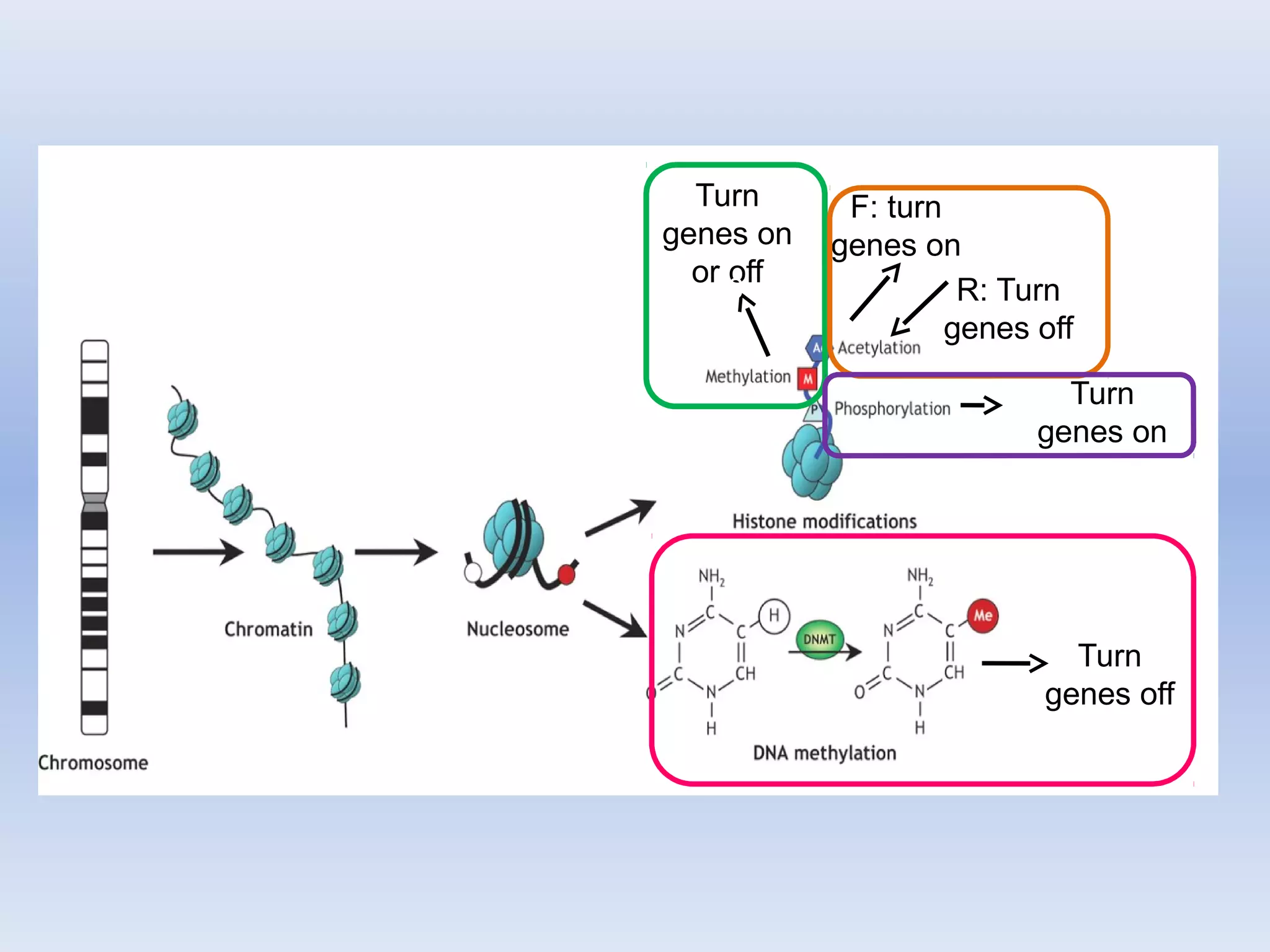
Image taken from Felsenfeld
and Groudine (2003) Controlling
the double helix
Nature 421, 448-453
Turn
genes on
or off
0
F: turn
genes on
Turn
genes on
Turn
genes off
R: Turn
genes off
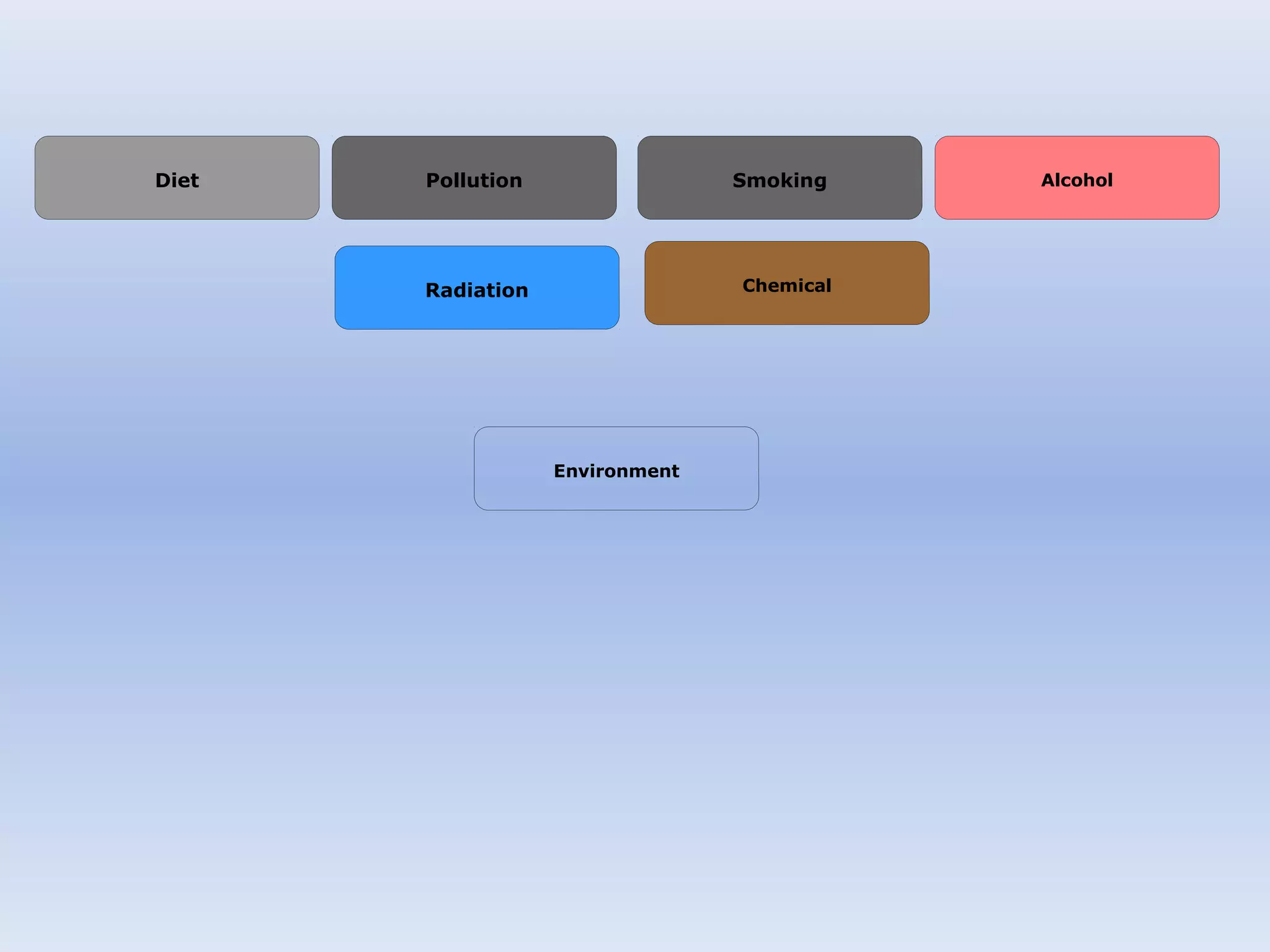
Environment
ChemicalRadiation
AlcoholSmokingPollutionDiet
Epigenetics and disease
• Epigenetics provides the missing link on how
the environment can change the cell without
causing mutation to cause disease
• Studies have shown that modifications can be
passed down from generation to generation
and can be associated with causing or
predisposing disease in offspring
Epigenetic therapy?
• The epigenome is dynamic with the modifications
reversible. Because of this, it is possible to modify
the gene expression of cells using drugs so abnormal
patterns become normalised
E.g. 5-azacytidine: DNA methylation inhibitor that
reactivates genes that have been silenced.
E.g. SAHA: HDAC inhibitor that blocks acetyl group
removal from histones to activate gene expression.
Turn
genes off
Turn
genes on
SAHA
Turn
genes on
5-
azacytidine
R: Turn
genes off

Overview of epigenetics and its role in disease

  • 1.
    Does your DNAdefine you? Overview of epigenetics and its role in disease
  • 2.
    Epigenetics epi (Greek): on,above, in addition to The study of heritable changes in gene expression without a change in DNA sequence
  • 3.
    Image taken fromFelsenfeld and Groudine (2003) Controlling the double helix Nature 421, 448-453
  • 4.
    Turn genes on or off 0 F:turn genes on Turn genes on Turn genes off R: Turn genes off
  • 6.
  • 7.
    Epigenetics and disease •Epigenetics provides the missing link on how the environment can change the cell without causing mutation to cause disease • Studies have shown that modifications can be passed down from generation to generation and can be associated with causing or predisposing disease in offspring
  • 9.
    Epigenetic therapy? • Theepigenome is dynamic with the modifications reversible. Because of this, it is possible to modify the gene expression of cells using drugs so abnormal patterns become normalised E.g. 5-azacytidine: DNA methylation inhibitor that reactivates genes that have been silenced. E.g. SAHA: HDAC inhibitor that blocks acetyl group removal from histones to activate gene expression.
  • 10.
    Turn genes off Turn genes on SAHA Turn geneson 5- azacytidine R: Turn genes off

Editor's Notes

  • #2 This presentation is meant as a brief overview to epigenetics, why scientists are interested in it and how it could be used to our advantage in the future in the treatment of a number of diseases including cancer. Most people have an understanding of genetics, that our characteristics such as eye colour are specified by genes encoded by the DNA sequence within our genome. However, not everything is that simple. Whilst the Human Genome Project provided the “blueprint for life, the epigenome will tell us how things are executed.” (David Allis). What this really means is there are other factors that are in play that determine what genes are on and off at certain times; this is known as the epigenome. <number>
  • #3 So what is the epigenome and how does it affect gene expression? The epigenome is a series of chemical modifications are superimposed on top of the genome that can either affect DNA directly such as DNA methylation or the proteins that are involved in the packaging of DNA into chromatin (known as histone proteins). These chemical tags are added by enzymes and act as markers that tell genes whether they should be active or inactive at given times, a little like a red or green traffic light. <number>
  • #4 In order for the roughly 2m of DNA to be contained in the nucleus of each cell, it must be compacted and packaged so that it becomes small enough. Initially, DNA is wrapped 1.7 times around a 8 core histone proteins (a H3-H4 tetramer and two H2A-H2B dimers) to create a nucleosome; arrays of nucleosomes are known as chromatin. It is the tails are histone proteins that are relatively free in this structure and become chemically tagged with marks that affect gene expression profiles. Following this, the nucleosome chromatin fibre is further compacted to create a 30nm wide fibre which becomes more condensed at each level of packaging before forming a 1400nm wide mitotic chromosome. <number>
  • #5 The addition of the epigenetic tags directly alters the interaction between negative DNA (due to the sugar-phosphate background) and the basic (positively charged) histone proteins. By altering the pattern of modifications, the overall structure of chromatin is changed meaning that areas that were previously condensed become decondensed and vice-versa meaning that genes can change between active and inactive states. There are two main types of epigenetic modification: histone modification and DNA methylation. DNA methylation is catalysed by enzymes known as DNA methyltransferases on position 5 (C5) of cytosine residues in the DNA sequence to form 5-methyl cytosine. This acts as a binding site for other enzymes which then modify histones. Histone modification is performed by multiple enzyme families. Histone acetylation is performed by histone acetyltransferases (HATs) which add an acetyl group to lysine residues in the histone tail. This masks the positive charge of the residue, loosening the interaction between DNA and histones allowing gene activation. This reaction is reversed through the action of histone deacetylases (HDACs) which remove the acetyl group, causing an increase in the attraction between DNA and histones and chromatin condensation, preventing gene activation. Methylation of histones can occur on lysine or arginine residues and can occur in three ways: mono- (one), di- (two) or tri- (three) methylation events. This mark doesn’t alter the charge of residues and tends to be associated with gene inactivation, although in some cases it can be associated with gene activation. Finally, phosphorylation can be performed by an enzyme family known as kinases which causes the addition of a phosphate group from ATP to be added to histone tails. Since phosphate is a negatively charged ion, this neutralises the positive charge of histones, reducing the interaction between DNA and the proteins, allowing gene activation. <number>
  • #8 Historically, it was through that disease was caused through direct mutation of the genome. However, there are very few diseases that have been shown to be associated with mutation meaning that the vast majority of diseases must be caused by other alterations. Environmental conditions can cause disease through changing the epigenome of individual cell types or the individual itself which would later cause disease. This means that epigenetics explains how the environment can change a cell without causing mutations to the genome to induce disease. Recent evidence suggests that epigenetic modifications can be passed down from generation to generation i.e. from parent to child to grandchild, in a process known as transgenerational inheritance. This has direct implications on health because it means disease could be caused in a person due to what their grandparents were exposed to, even if they weren’t directly exposed to it themselves. <number>
  • #9 In addition to this, the combination of epigenetic marks has been shown to predispose an individual to certain disease states such as diabetes, cancer, cardiovascular disease and obesity. For example, the environment you were exposed to in the uterus (poor maternal diet, maternal smoking, high stress levels, pollution etc.) directly affects the epigenome (blue box). Those epigenetic marks can be associated with particular condition, for example obesity (red box) hence epigenetic modification act as mediators or risk factors (green box) showing the interconnected relationship between the environment and disease. <number>
  • #10 So how can our knowledge of epigenetics be used to our advantage? Since the epigenome is dynamic and the modifications are reversible, it is possible to use a number of drugs to cause gene expression to be altered so that genes are active or inactive when they should be. For example, SAHA is a HDAC inhibitor which is used in the treatment of cutaneous T cell lymphoma. By blocking the action of this family of enzymes, acetyl groups remain on histone tails when they previously would have been removed, allowing the activation of genes. Similarly, 5-azacytidine acts to inhibit DNA methylation. The drug is similar to the nucleotide cytosine and becomes incorporated into DNA during replication. Once incorporated, DNA methyltransferase activity is blocked, inhibiting DNA methylation which can help to reactivate genes that have been silenced. <number>
  • #11 In a pathway, SAHA is shown in the top right by blocking the reverse reaction in histone acetylation whereas 5-azacytidine is shown in the bottom left inhibiting DNA methylation. <number>