WHAT IS MUTATION ?
 Mutations are the changes in the genetic material , therefore
change in the Gene segment .
 In a gene mutations, the DNA code will have a base missing ,
added or exchanged in the codon .
 Mutation is a need for evolution because it is not always
harmful .
 Causes of mutation :-
Spontaneous – DNA goes chemical change , Replcation error
Induced – Mutagens,carcinogen,Radiation,chemicals etc.
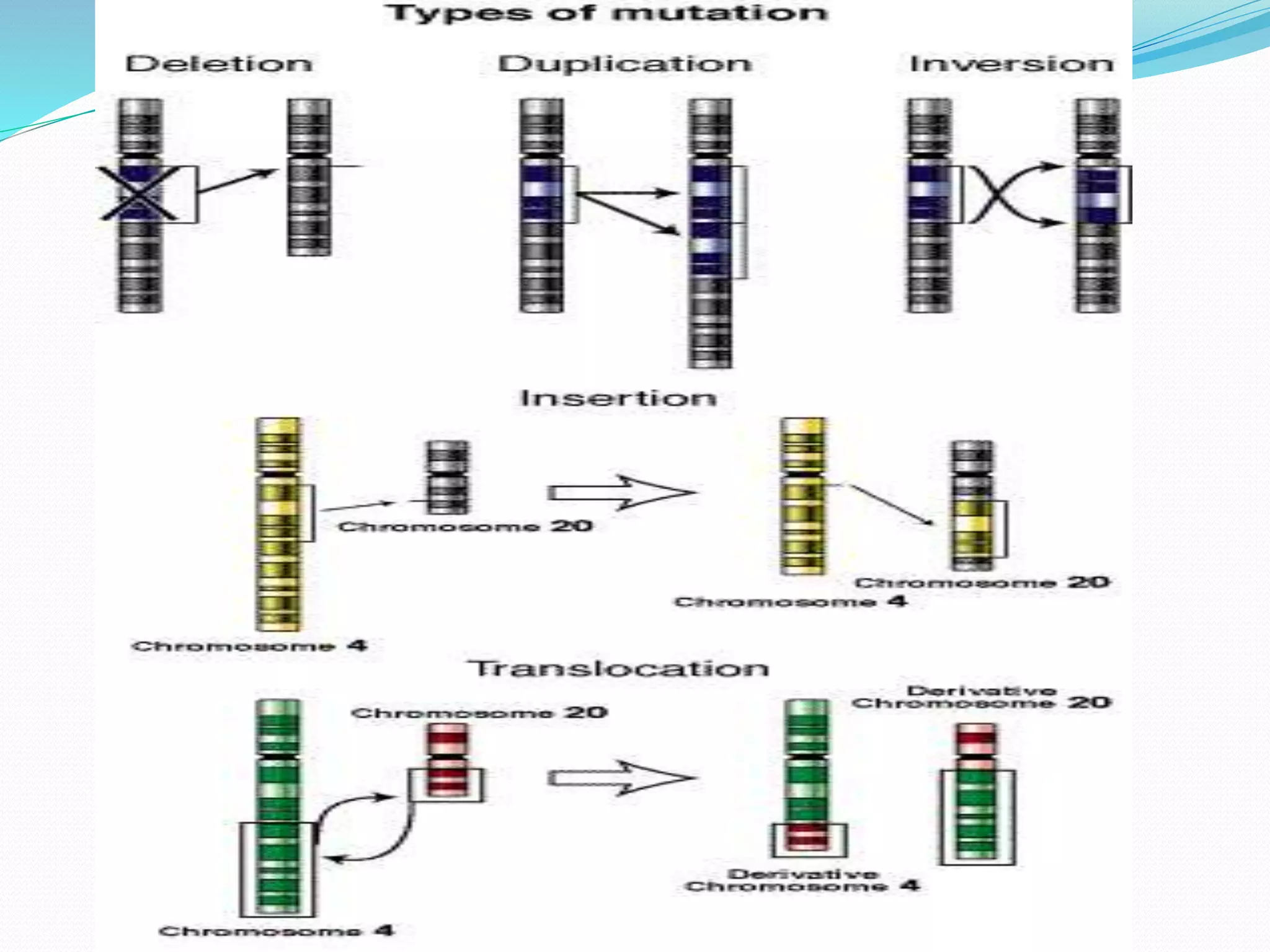
 Mutation can be of two types :-
 Chromosomal mutation
 Gene mutation
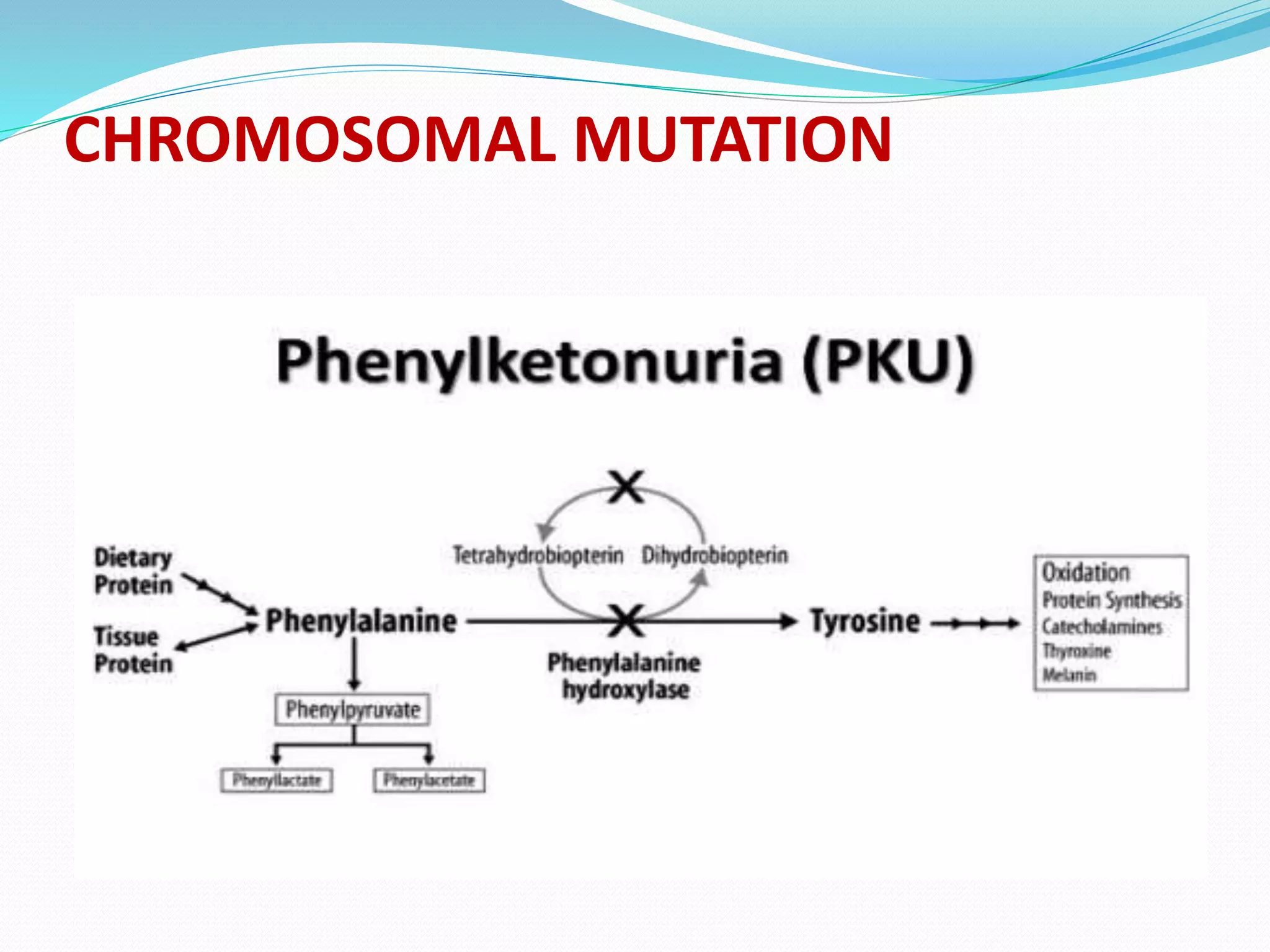
CHROMOSOMAL MUTATION
GENE MUTATION
 It is the change in the particular segment of the
gene which leads to the change of the sequence .
 Gene mutations on the basis of occurence:-
i. Hereditary mutations are inherited from a parent and are present
throughout a person’s life in virtually every cell in the body
ii. Acquired (or somatic) mutations occur at some time during a
person’s life and are present only in certain cells, not in every cell
in the body
 Gene mutation is of two types :-
i. Point mutation
ii. Frameshift mutation
POINT MUTATION
 One or more bases are inserted into the orignal DNA base sequence
 This is sometime called as frameshift mutation because it shifts the
codon reading frame
 Substitution mutation comes under point mutation and the most
common example of it is sickle cell anemia .
SUSTITUTION MUTATION
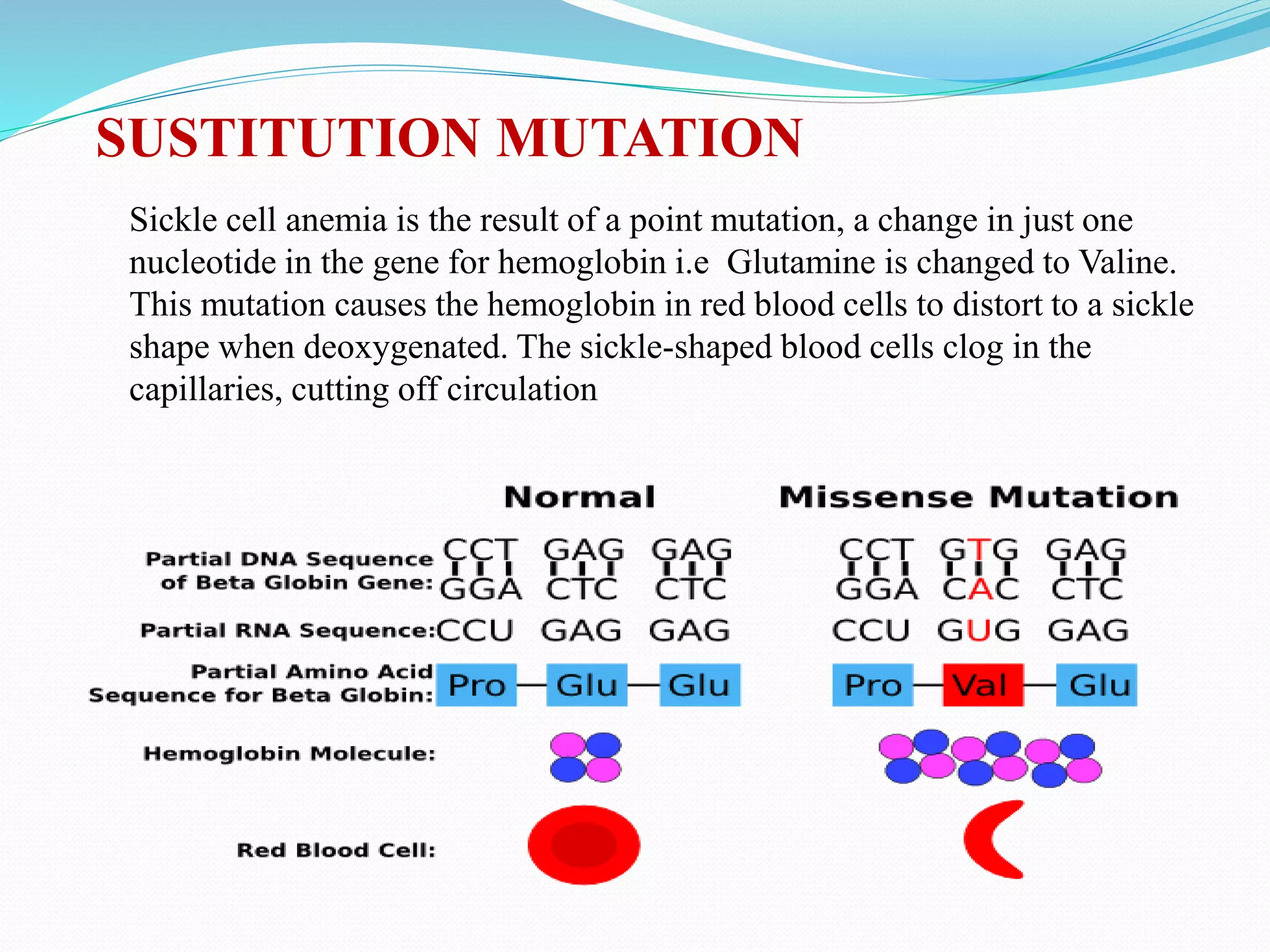
Sickle cell anemia is the result of a point mutation, a change in just one
nucleotide in the gene for hemoglobin i.e Glutamine is changed to Valine.
This mutation causes the hemoglobin in red blood cells to distort to a sickle
shape when deoxygenated. The sickle-shaped blood cells clog in the
capillaries, cutting off circulation
INSERTION
 An insertion changes the number of DNA bases in a
gene by adding a base to DNA. As a result, the protein
made by the gene may not function properly.
DELETION
 A deletion changes the number of DNA bases by
removing a base of DNA. Small deletions may remove
one or a few base pairs within a gene,
Single Nucleotide Polymorphism
 Each SNP represents a
difference in a
single DNA building block,
called a nucleotide.
 Most commonly, these
variations are found in
the DNA between genes.
 List of SNPs causing genes
can be found in SNP
database developed by
NCBI
SYNONYMOUS MUTATION
 Synonymous mutations are point mutations, they are just a miscopied DNA
nucleotide that only changes one base pair in the RNA copy of the DNA.
 A codon in RNA is a set of three nucleotides that encode a specific amino
acid. Most amino acids have several RNA codons that translate into that
particular amino acid.
 Most of the time, if the third nucleotide is the one with the mutation, it will
result in coding for the same amino acid. This is called a synonymous
mutation
 Synonymous mutations do not change anything and no changes are made.
That means they have no real role in the evolution of species since the gene
or protein is not changed in any way. Like - GAT or GAC both codes for
aspartic acid ; GAA or GAG both code for Glutamic acid .
SILENT MUTATION
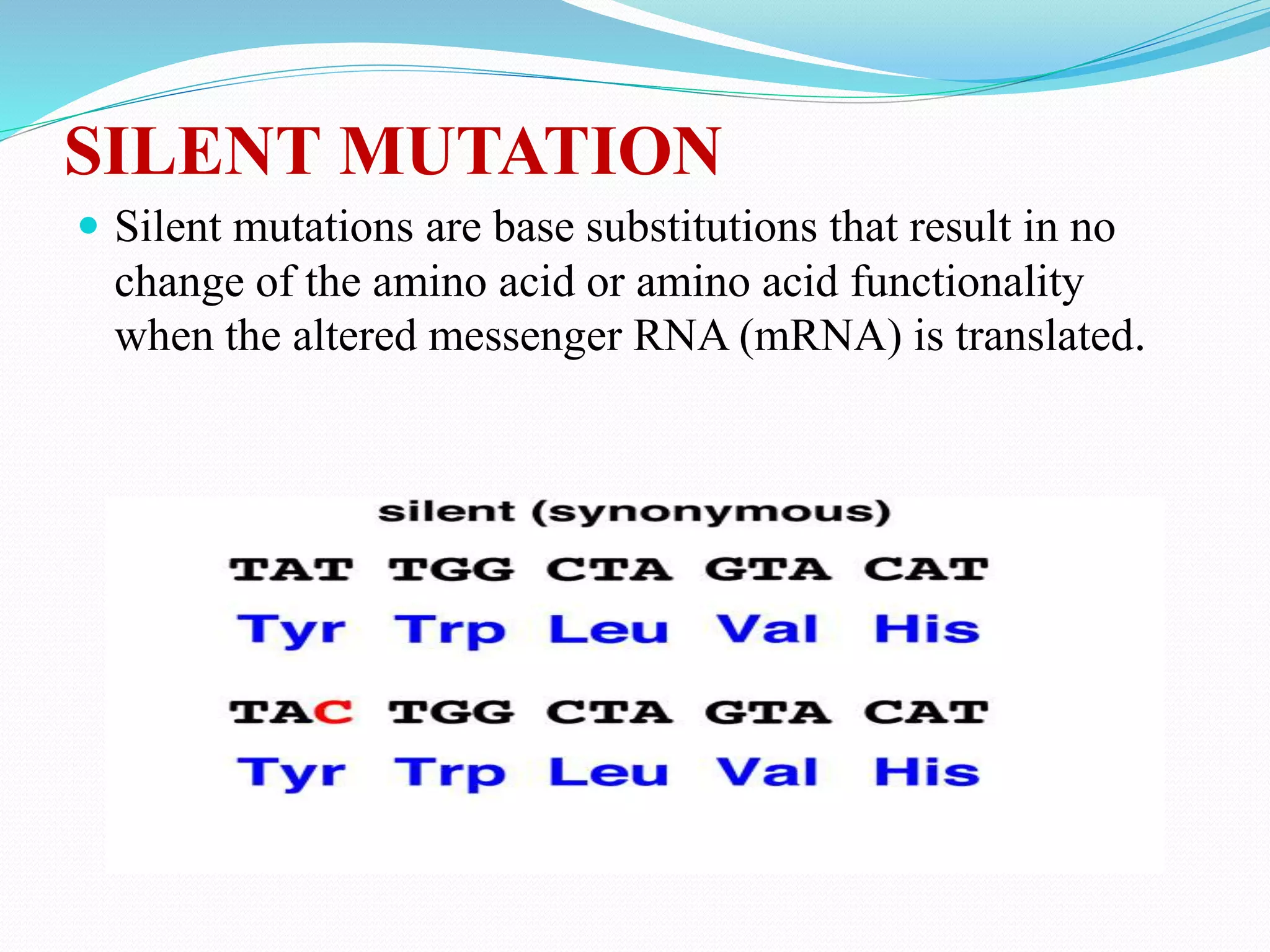
 Silent mutations are base substitutions that result in no
change of the amino acid or amino acid functionality
when the altered messenger RNA (mRNA) is translated.
NON –SYNONYMOUS MUTATION
 Non-synonymous mutations have a much greater effect on an individual
than a synonymous mutation. In a non-synonymous mutation, there is
usually an insertion or deletion of a single nucleotide in the sequence during
transcription when the messenger RNA is copying the DNA.
 This single missing or added nucleotide causes a frameshift mutation which
throws off the entire reading frame of the amino acid sequence and mixes
up the codons. This usually affect the amino acids that are coded for and
change the resulting protein that is expressed.
 The severity of this kind of mutation depends on how early in the amino
acid sequence it happens. If it happens near the beginning and the entire
protein is changed, this could become a lethal mutation.
 Another way a non-synonymous mutation can occur is if the point mutation
changes the single nucleotide into a codon that does not translate into the
same amino acid . Like – GGA (glycine) to AGA (arginine) ; CAA
(Glutamine) to CAC (Histidine) .
MIS SENSE MUTATION
 This type of mutation is a change in one DNA
base pair that results in the substitution of one amino acid
for another in the protein made by a gene.
NON SENSE MUTATION
 A non sense codon is the substitution of a stop codon
for original codon .
 It causes the termination of the Protein synthesis
 If it is near at the start causes whole loss of the gene
segment
FRAMESHIFT MUTATION
 Inserting or deleting one or more nucleotide
 Which changes the reading frame which leads to the formation
of the incorrect protein.
 INSERTION of the new base in the DNA sequence and
DELETION of the base in the DNA sequence leads to the shift
in the frame .
 A frameshift mutation is not same as the single nucleotide
polymorphism ,in which single nucleotide is replaced rather
than insertion or deletion .
INSERTION
 An insertion changes the number of DNA bases in a gene
by adding a piece of DNA. As a result, the whole
sequence changes and the protein made by the gene may
not function properly.
Before After
Tay sachs disease effect in brain corpus
callosum
DELETION
 A deletion changes the number of DNA bases by removing
a piece of DNA which results in removal of an entire gene
or several neighboring genes. The deleted DNA alter the
function of the resulting protein .
 Eg- cystic fibrosis
cystic fibrosis
STOP LOSS STOP GAIN
 A stop-loss mutation is the
loss of the
normal stop codon
by mutation to encode an
amino acid.
 This will result in the
extension of the carboxyl
terminus of the protein
until the next stop codon
is encountered
 Which cause a elongated
protein formation
 A stop-Gain mutation is
the gain of the
normal stop codon
by mutation .
 This will result in the
termination of the protein
chain early .
 Which cause a no protein
formation
GENETIC DISORDER
 Disorders are caused by changes to the genes and
chromosomes that result in the protein not being
expressed or the protein expressed not functioning
correctly . Examples :-
 Duchenne muscular dystrophy
Duchenne muscular dystrophy
• Huntington’s disease
Mutation
Mutation

Mutation

  • 2.
    WHAT IS MUTATION?  Mutations are the changes in the genetic material , therefore change in the Gene segment .  In a gene mutations, the DNA code will have a base missing , added or exchanged in the codon .  Mutation is a need for evolution because it is not always harmful .  Causes of mutation :- Spontaneous – DNA goes chemical change , Replcation error Induced – Mutagens,carcinogen,Radiation,chemicals etc.  Mutation can be of two types :-  Chromosomal mutation  Gene mutation
  • 5.
  • 6.
    GENE MUTATION  Itis the change in the particular segment of the gene which leads to the change of the sequence .  Gene mutations on the basis of occurence:- i. Hereditary mutations are inherited from a parent and are present throughout a person’s life in virtually every cell in the body ii. Acquired (or somatic) mutations occur at some time during a person’s life and are present only in certain cells, not in every cell in the body  Gene mutation is of two types :- i. Point mutation ii. Frameshift mutation
  • 7.
    POINT MUTATION  Oneor more bases are inserted into the orignal DNA base sequence  This is sometime called as frameshift mutation because it shifts the codon reading frame  Substitution mutation comes under point mutation and the most common example of it is sickle cell anemia .
  • 8.
    SUSTITUTION MUTATION Sickle cellanemia is the result of a point mutation, a change in just one nucleotide in the gene for hemoglobin i.e Glutamine is changed to Valine. This mutation causes the hemoglobin in red blood cells to distort to a sickle shape when deoxygenated. The sickle-shaped blood cells clog in the capillaries, cutting off circulation
  • 9.
    INSERTION  An insertionchanges the number of DNA bases in a gene by adding a base to DNA. As a result, the protein made by the gene may not function properly.
  • 10.
    DELETION  A deletionchanges the number of DNA bases by removing a base of DNA. Small deletions may remove one or a few base pairs within a gene,
  • 11.
    Single Nucleotide Polymorphism Each SNP represents a difference in a single DNA building block, called a nucleotide.  Most commonly, these variations are found in the DNA between genes.  List of SNPs causing genes can be found in SNP database developed by NCBI
  • 12.
    SYNONYMOUS MUTATION  Synonymousmutations are point mutations, they are just a miscopied DNA nucleotide that only changes one base pair in the RNA copy of the DNA.  A codon in RNA is a set of three nucleotides that encode a specific amino acid. Most amino acids have several RNA codons that translate into that particular amino acid.  Most of the time, if the third nucleotide is the one with the mutation, it will result in coding for the same amino acid. This is called a synonymous mutation  Synonymous mutations do not change anything and no changes are made. That means they have no real role in the evolution of species since the gene or protein is not changed in any way. Like - GAT or GAC both codes for aspartic acid ; GAA or GAG both code for Glutamic acid .
  • 13.
    SILENT MUTATION  Silentmutations are base substitutions that result in no change of the amino acid or amino acid functionality when the altered messenger RNA (mRNA) is translated.
  • 14.
    NON –SYNONYMOUS MUTATION Non-synonymous mutations have a much greater effect on an individual than a synonymous mutation. In a non-synonymous mutation, there is usually an insertion or deletion of a single nucleotide in the sequence during transcription when the messenger RNA is copying the DNA.  This single missing or added nucleotide causes a frameshift mutation which throws off the entire reading frame of the amino acid sequence and mixes up the codons. This usually affect the amino acids that are coded for and change the resulting protein that is expressed.  The severity of this kind of mutation depends on how early in the amino acid sequence it happens. If it happens near the beginning and the entire protein is changed, this could become a lethal mutation.  Another way a non-synonymous mutation can occur is if the point mutation changes the single nucleotide into a codon that does not translate into the same amino acid . Like – GGA (glycine) to AGA (arginine) ; CAA (Glutamine) to CAC (Histidine) .
  • 15.
    MIS SENSE MUTATION This type of mutation is a change in one DNA base pair that results in the substitution of one amino acid for another in the protein made by a gene.
  • 16.
    NON SENSE MUTATION A non sense codon is the substitution of a stop codon for original codon .  It causes the termination of the Protein synthesis  If it is near at the start causes whole loss of the gene segment
  • 18.
    FRAMESHIFT MUTATION  Insertingor deleting one or more nucleotide  Which changes the reading frame which leads to the formation of the incorrect protein.  INSERTION of the new base in the DNA sequence and DELETION of the base in the DNA sequence leads to the shift in the frame .  A frameshift mutation is not same as the single nucleotide polymorphism ,in which single nucleotide is replaced rather than insertion or deletion .
  • 20.
    INSERTION  An insertionchanges the number of DNA bases in a gene by adding a piece of DNA. As a result, the whole sequence changes and the protein made by the gene may not function properly.
  • 21.
    Before After Tay sachsdisease effect in brain corpus callosum
  • 22.
    DELETION  A deletionchanges the number of DNA bases by removing a piece of DNA which results in removal of an entire gene or several neighboring genes. The deleted DNA alter the function of the resulting protein .  Eg- cystic fibrosis
  • 23.
  • 24.
    STOP LOSS STOPGAIN  A stop-loss mutation is the loss of the normal stop codon by mutation to encode an amino acid.  This will result in the extension of the carboxyl terminus of the protein until the next stop codon is encountered  Which cause a elongated protein formation  A stop-Gain mutation is the gain of the normal stop codon by mutation .  This will result in the termination of the protein chain early .  Which cause a no protein formation
  • 25.
    GENETIC DISORDER  Disordersare caused by changes to the genes and chromosomes that result in the protein not being expressed or the protein expressed not functioning correctly . Examples :-  Duchenne muscular dystrophy
  • 26.
  • 27.