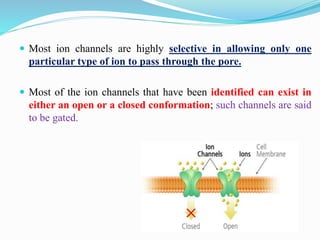
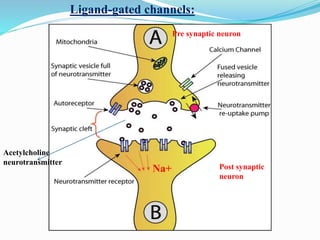
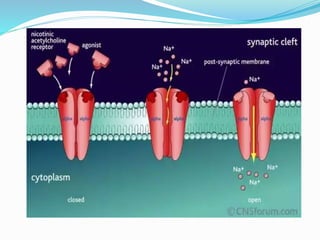
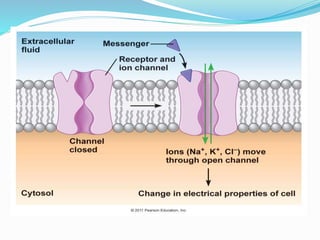
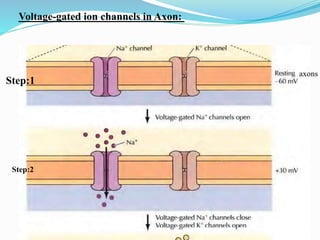
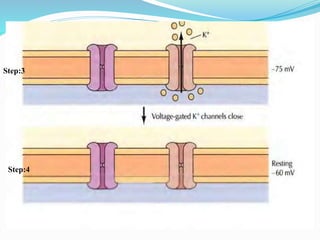
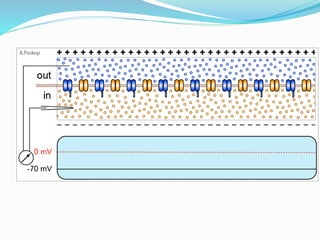



Ion channels are membrane proteins that allow ions to pass through their pore, regulating ion flow and electrical signals. There are two main types of gated ion channels: ligand-gated channels, which open when neurotransmitters bind, and voltage-gated channels, which open in response to changes in membrane potential. Ligand-gated channels allow sodium influx upon acetylcholine binding, depolarizing the membrane and triggering action potentials. Voltage-gated channels maintain the resting potential and enable action potential propagation along axons by selectively transporting sodium, potassium, calcium, and chloride ions in response to changes in voltage.


