have fun learningthe following:
1. Explain how mutations may
cause changes in the structure
and function of a protein
(S10LTIIIe-38).
3.
Directions: Read eachquestion
carefully. Choose the letter of
the correct answer. Use a
separate sheet of paper for your
answers.
4.
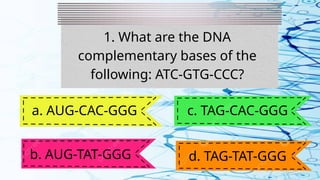
1. What arethe DNA
complementary bases of the
following: ATC-GTG-CCC?
a. AUG-CAC-GGG
b. AUG-TAT-GGG
c. TAG-CAC-GGG
d. TAG-TAT-GGG
5.
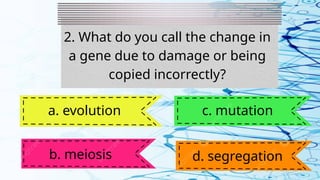
2. What doyou call the change in
a gene due to damage or being
copied incorrectly?
a. evolution
b. meiosis
c. mutation
d. segregation
6.
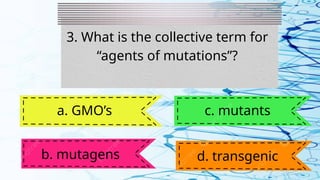
3. What isthe collective term for
“agents of mutations”?
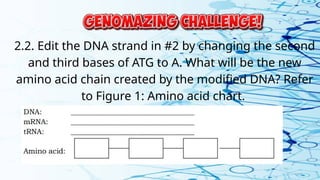
a. GMO’s
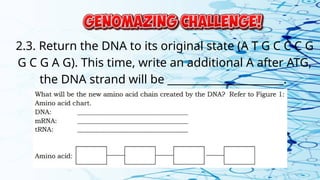
b. mutagens
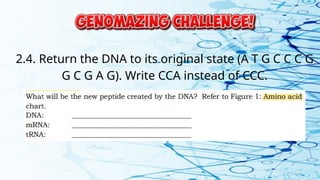
c. mutants
d. transgenic
7.
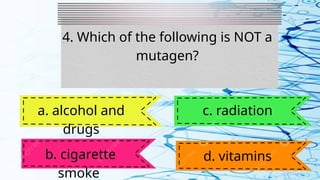
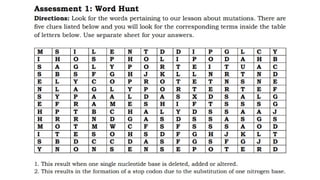
4. Which ofthe following is NOT a
mutagen?
a. alcohol and
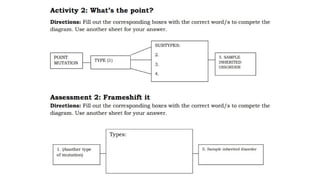
drugs
b. cigarette
smoke
c. radiation
d. vitamins
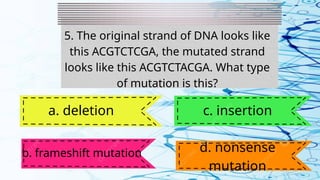
8.
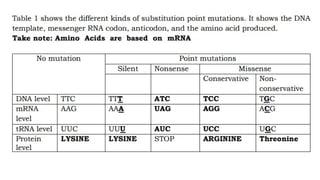
5. The originalstrand of DNA looks like
this ACGTCTCGA, the mutated strand
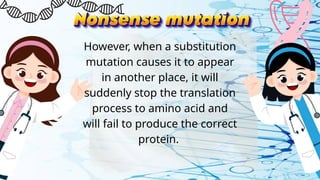
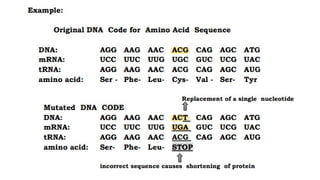
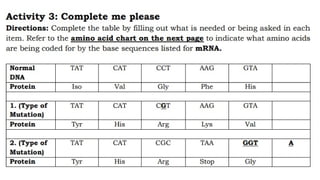
looks like this ACGTCTACGA. What type
of mutation is this?
a. deletion
b. frameshift mutation
c. insertion
d. nonsense
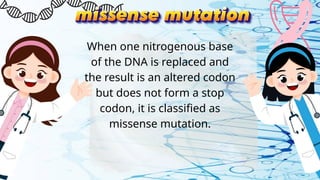
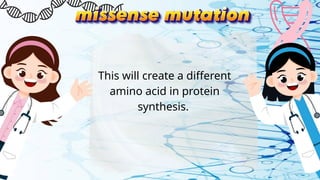
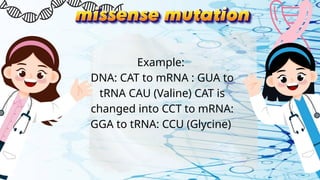
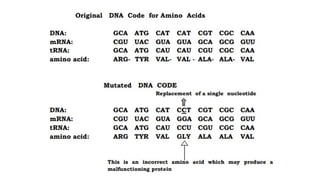
mutation
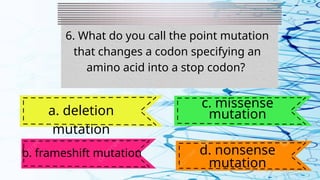
9.
6. What doyou call the point mutation
that changes a codon specifying an
amino acid into a stop codon?
a. deletion
mutation
b. frameshift mutation
c. missense
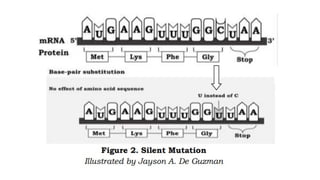
mutation
d. nonsense
mutation
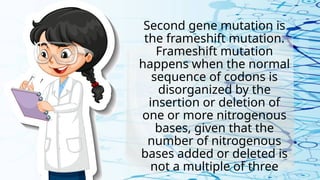
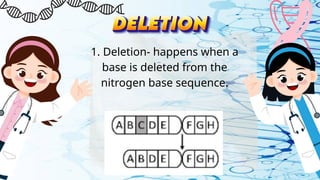
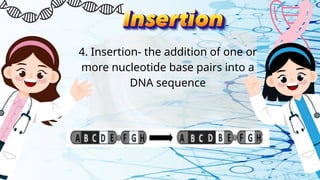
10.
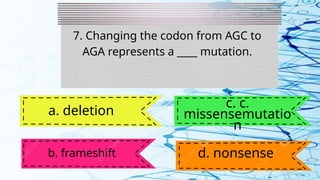
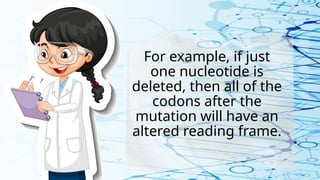
7. Changing thecodon from AGC to
AGA represents a ____ mutation.
a. deletion
b. frameshift
c. c.
missensemutatio
n
d. nonsense
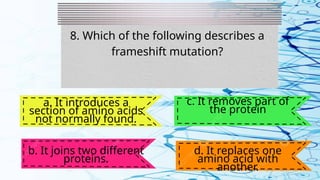
11.
8. Which ofthe following describes a
frameshift mutation?
a. It introduces a
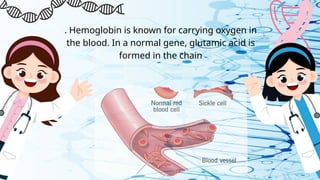
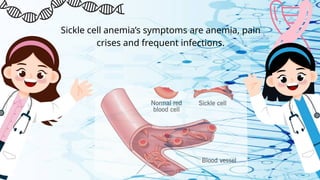
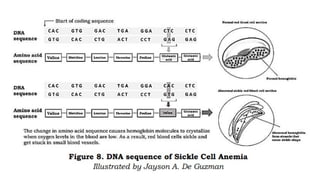
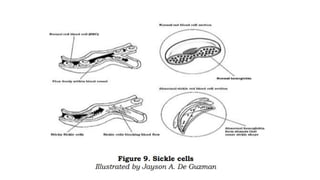
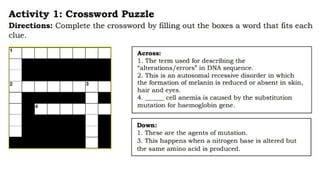
section of amino acids
not normally found.
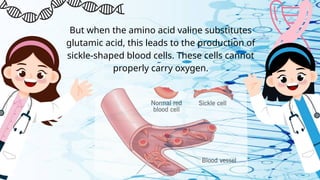
b. It joins two different
proteins.
c. It removes part of
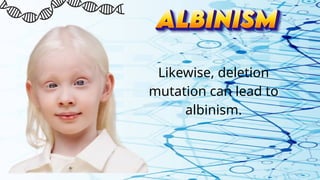
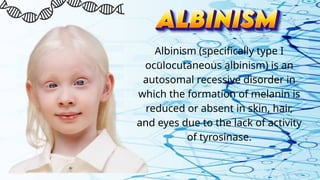
the protein
d. It replaces one
amino acid with
another.
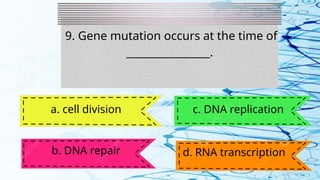
12.
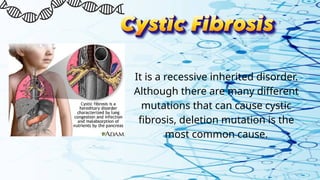
9. Gene mutationoccurs at the time of
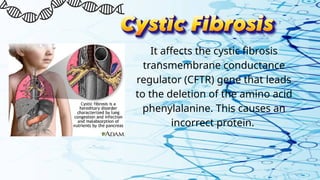
________________.
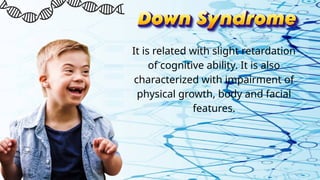
a. cell division
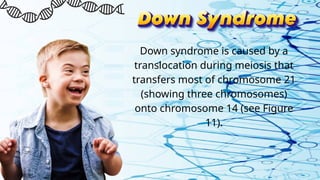
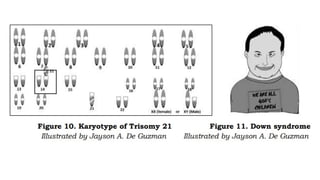
b. DNA repair
c. DNA replication
d. RNA transcription
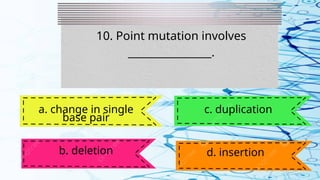
13.
10. Point mutationinvolves
________________.
a. change in single
base pair
b. deletion
c. duplication
d. insertion
14.
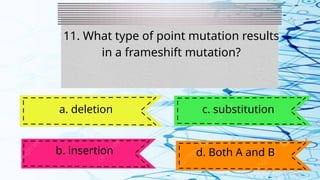
11. What typeof point mutation results
in a frameshift mutation?
a. deletion
b. insertion
c. substitution
d. Both A and B
15.
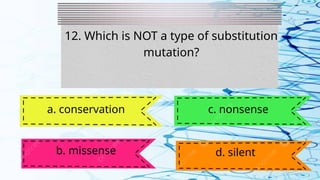
12. Which isNOT a type of substitution
mutation?
a. conservation
b. missense
c. nonsense
d. silent
16.
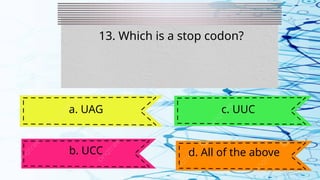
13. Which isa stop codon?
a. UAG
b. UCC
c. UUC
d. All of the above
17.
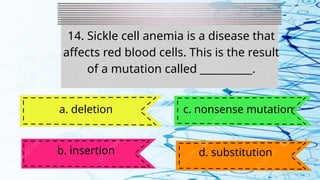
14. Sickle cellanemia is a disease that
affects red blood cells. This is the result
of a mutation called __________.
a. deletion
b. insertion
c. nonsense mutation
d. substitution
18.
15. Cystic Fibrosis(CF) is a recessive inherited
disorder that is associated with thick, sticky mucus in
the lungs and trouble breathing, salty sweat,
infertility in certain individuals, and a shortened life
expectancy. This is the result of a mutation called
a. deletion
b. insertion
c. nonsense mutation
d. substitution
19.
The DNA isused to complete the
process of protein synthesis.
Protein synthesis has two stages
which are called transcription
and translation.
20.
During protein synthesisat the
ribosome, messenger RNA
sequences are read and
translated into amino acids.
These amino acids will form
21.
These amino acidsare specified by
codons carried by mRNA. If the
mRNA is copied incorrectly during
transcription stage, there will be an
anomaly in the genes. This is called
22.
A mutation isa change that occurs in
our DNA sequence, either due to
mistakes when the DNA is copied or
as the result of environmental
factors such as UV light and cigarette
What you haveto
do:
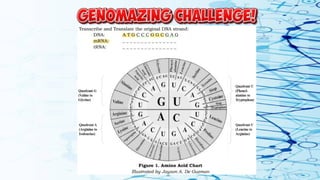
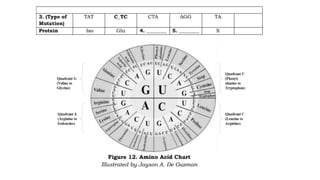
1. Study Figure 1 (amino
acid chart) and the DNA
sequences carefully, and
read the captions very
well.
27.
What you haveto
do:
Get a sheet of paper for your
answers and observation. Do not
copy the questions, just write
down your answer or
observations.
2. Study the following DNA
strand:
29.
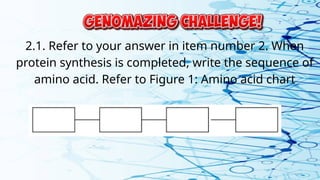
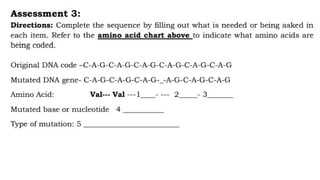
2.1. Refer toyour answer in item number 2. When
protein synthesis is completed, write the sequence of
amino acid. Refer to Figure 1: Amino acid chart
30.
2.2. Edit theDNA strand in #2 by changing the second
and third bases of ATG to A. What will be the new
amino acid chain created by the modified DNA? Refer
to Figure 1: Amino acid chart.
31.
2.3. Return theDNA to its original state (A T G C C C G
G C G A G). This time, write an additional A after ATG,
the DNA strand will be ______________________.
32.
2.4. Return theDNA to its original state (A T G C C C G
G C G A G). Write CCA instead of CCC.
35.
MUTATION
Mutations are changesto
a DNA sequence. Just like
the information in DNA as
a group of sentences,
mutations are mistakes in
spelling of the words that
form those sentences.
36.
Mutagens
are agents thatcause
alteration in the DNA and
can lead to permanent
mutations in the DNA
sequence depending on
the ability of an organism
to repair the damage.
37.
Mutagens
Examples of mutagensare
radioactive substances, x-
rays, ultraviolet radiation,
and certain chemicals or
drugs.
38.
There are differenttypes
of mutations that you
have explored in the
previous activity. These
are POINT mutation and
FRAMESHIFT mutation.
The second mutationyou
explored is a FRAMESHIFT
mutation. Lastly, the third
mutation you determined
is a special type of point
mutation called a SILENT
mutation.
41.
Let’s take alook on the
definitions and
descriptions about the
types of mutation.
POINT MUTATION
It isthe type mutation in
DNA or RNA wherein one
single nucleotide base is
deleted, added or altered.
This can lead to
substitution mutation.
44.
POINT MUTATION
There arethree types of
substitution mutation.
These are nonsense,
missense and silent
mutation
46.
Nonsense mutation resultsin
the formation of a stop codon
due to the substitution of one
nitrogenous base.
47.
Remember, stop codonsare
special nitrogenous bases that
stop the translation stage in
protein synthesis.
48.
These are ATC,ATT, or ACT
in DNA, and UAG, UAA, or
UGA in mRNA.
49.
They are usuallylocated at
the end of messenger RNA
nucleotide base sequence.
50.
However, when asubstitution
mutation causes it to appear
in another place, it will
suddenly stop the translation
process to amino acid and
will fail to produce the correct
protein.
52.
When one nitrogenousbase
of the DNA is replaced and
the result is an altered codon
but does not form a stop
codon, it is classified as
missense mutation.
Remember, many codonscan
code for the same amino
acid. Example: GGC and GGU
can both code for glycine.
61.
If C ischanged to an U, the
same amino acid will be
produced and therefore, the
amino acid will not be
changed.
64.
Second gene mutationis
the frameshift mutation.
Frameshift mutation
happens when the normal
sequence of codons is
disorganized by the
insertion or deletion of
one or more nitrogenous
bases, given that the
number of nitrogenous
bases added or deleted is
not a multiple of three
65.
For example, ifjust
one nucleotide is
deleted, then all of the
codons after the
mutation will have an
altered reading frame.
66.
This can leadto the
possible change of
many amino acids that
may affect the amino
acid chain produced
incorporation of many
changes in amino
acids into the protein.
67.
In contrary, when
threenitrogenous
bases are deleted or
inserted, there will be
no shift in the codon
reading frame but,
there will be either an
extra or a missing
amino acid in the
protein.
68.
Therefore, frameshift
mutations leadto the
abnormal protein with
an improper amino
acid sequence that
can be either longer
or shorter than the
normal protein.
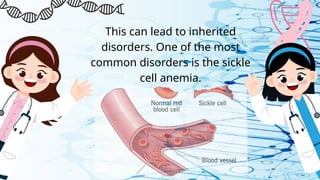
This can leadto inherited
disorders. One of the most
common disorders is the sickle
cell anemia.
77.
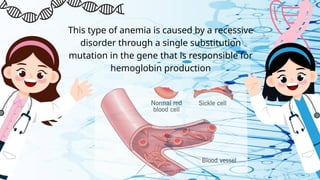
This type ofanemia is caused by a recessive
disorder through a single substitution
mutation in the gene that is responsible for
hemoglobin production
78.
. Hemoglobin isknown for carrying oxygen in
the blood. In a normal gene, glutamic acid is
formed in the chain
79.
But when theamino acid valine substitutes
glutamic acid, this leads to the production of
sickle-shaped blood cells. These cells cannot
properly carry oxygen.
Albinism (specifically typeI
oculocutaneous albinism) is an
autosomal recessive disorder in
which the formation of melanin is
reduced or absent in skin, hair,
and eyes due to the lack of activity
of tyrosinase.
It is arecessive inherited disorder.
Although there are many different
mutations that can cause cystic
fibrosis, deletion mutation is the
most common cause.
88.
It affects thecystic fibrosis
transmembrane conductance
regulator (CFTR) gene that leads
to the deletion of the amino acid
phenylalanine. This causes an
incorrect protein.
89.
It is relatedwith slight retardation
of cognitive ability. It is also
characterized with impairment of
physical growth, body and facial
features.
90.
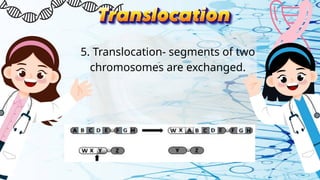
Down syndrome iscaused by a
translocation during meiosis that
transfers most of chromosome 21
(showing three chromosomes)
onto chromosome 14 (see Figure
11).
93.
Since you haveaccepted
and conquered the
“Genomazing challenge” a
while ago, here are some
enrichment activities for
you to work on to
strengthen the basic
concepts you have learned
from our mini-lesson and
to validate your
6. When onenitrogen base of the
DNA is replaced, and the result is
an altered codon formation but
does not form a stop codon, it is
classified as (nonsense,
missense) mutation.
108.
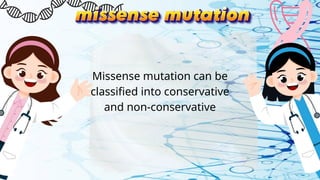
7. (Missense, Silent)mutation can
be classified into conservative
and nonconservative.
109.
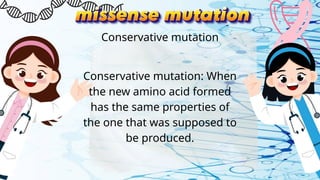
8. (Conservative, Non-
conservative)mutation happens
when the same properties of
amino acid were formed to the
one that was supposed to be
produced.
10. (Missense, Silent)mutation
happens when a nitrogen base is
altered, but the same amino acid
is produced. Remember, many
codons can code for the same
amino acid.
112.
11. (Point, Frameshift)mutation
happens when the normal sequence
of codons is disorganized by the
insertion or deletion of one or more
nitrogen bases, given that the
number of nitrogen bases added or
deleted is not a multiple of three.
113.
12. (Cystic Fibrosis,Albinism) is a
recessive inherited disorder caused
by the deletion of the amino acid
phenylalanine.
114.
13. (Cystic Fibrosis,Sickle cell anemia)
is caused by a recessive disorder
through a single substitution
mutation in the gene that is
responsible for hemoglobin
production.
It is alsocharacterized with
impairment of physical growth, body
and facial features. It is caused by a
(substitution, translocation) during
meiosis that transfers most of
chromosome 21 onto chromosome
14.





![Lesson 2 Structure of an Atom [Autosaved].pptx](https://cdn.slidesharecdn.com/ss_thumbnails/lesson2structureofanatomautosaved-260202051705-8f8baabf-thumbnail.jpg?width=640&height=640&fit=bounds)


