DNA CLONING
VPHY 241
What Does It Mean: “To Clone”?
Clone: a collection of molecules or cells, all identical to
an original molecule or cell.
• To “clone a gene” is to make many copies of it –
e.g., by replicating it in a culture of bacteria.
• Cloned gene can be a normal copy of a gene (=
“wild type”).
• Cloned gene can be an altered version of a gene (=
“mutant”).
• Recombinant DNA technology makes
manipulating genes possible.
DNA CLONING
• The process of making multiple, identical
copies of a particular piece of DNA.
• This is the first stage of most of the genetic
engineering experiments:
– production of DNA libraries
– PCR
– DNA sequencing
DNA CLONING
• A single DNA molecule can be amplified
allowing it to be:
–Studied – sequenced
–Manipulated – mutagenized or
engineered
–Expressed – generation of protein
DNA CLONING
• It can be achieved by two different
approaches:
–Cell-based
–using polymerase chain reaction
(PCR)
DNA Cloning
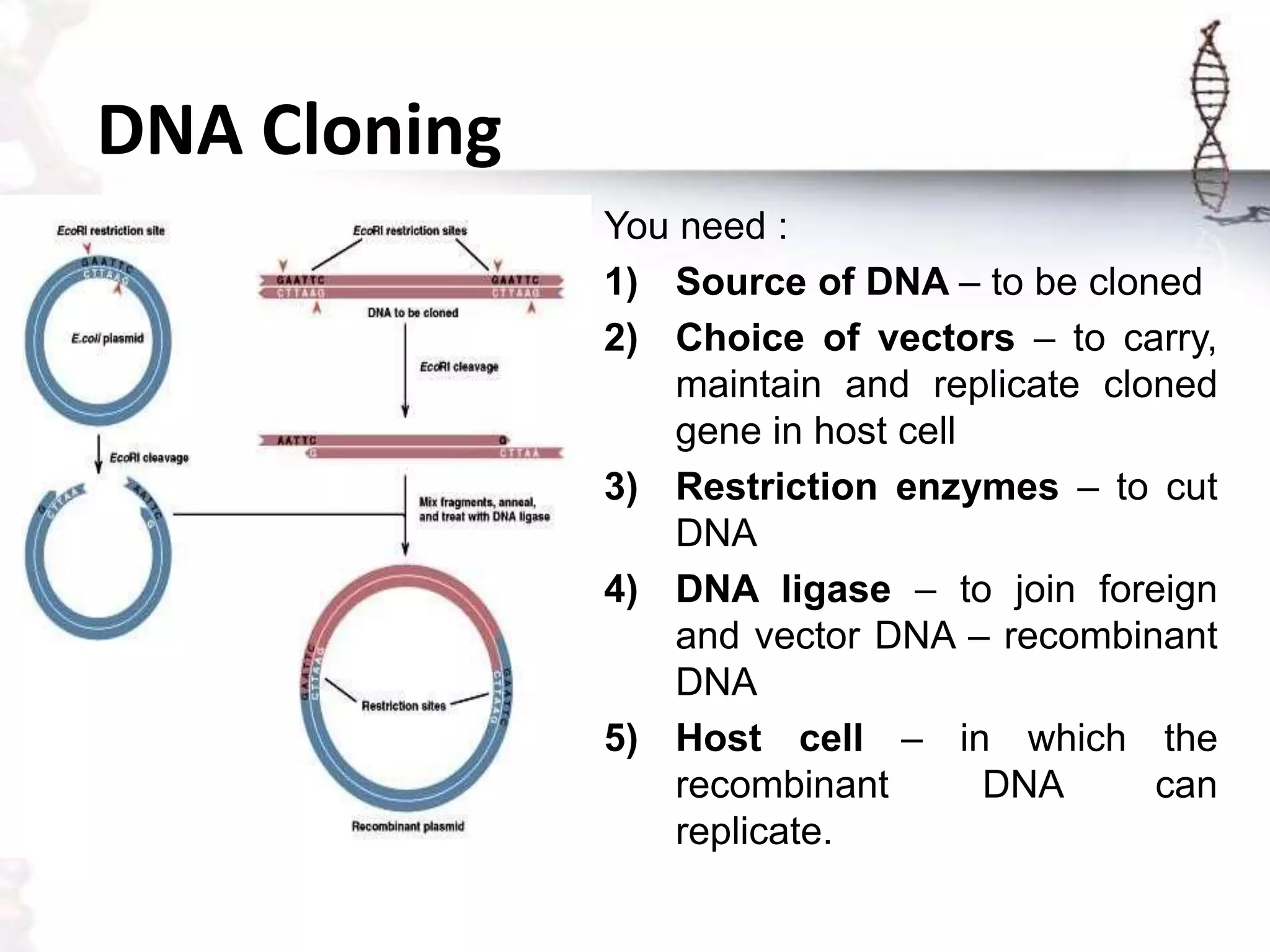
You need :
1) Source of DNA – to be cloned
2) Choice of vectors – to carry,
maintain and replicate cloned
gene in host cell
3) Restriction enzymes – to cut
DNA
4) DNA ligase – to join foreign
and vector DNA – recombinant
DNA
5) Host cell – in which the
recombinant DNA can
replicate.
Involves five steps:
 Enzyme restriction digest of DNA sample.
 Enzyme restriction digest of DNA plasmid
vector.
 Ligation of DNA sample products and plasmid
vector.
 Transformation with the ligation products.
 Growth on agar plates with selection for
antibiotic resistance.
Cell-based Cloning
 Genomic DNA
 DNA extracted from cells and purified
 cDNA
 by reverse transcription of mRNA
 Amplified DNA
 using Polymerase Chain Reaction
 Synthetic DNA
 DNA made artificially using a machine
1) Source of DNA
• To carry the ligated foreign gene into the
host cell
• Maintain the foreign gene in the host cell
• Replicate
• Express the cloned foreign gene to make a
protein.
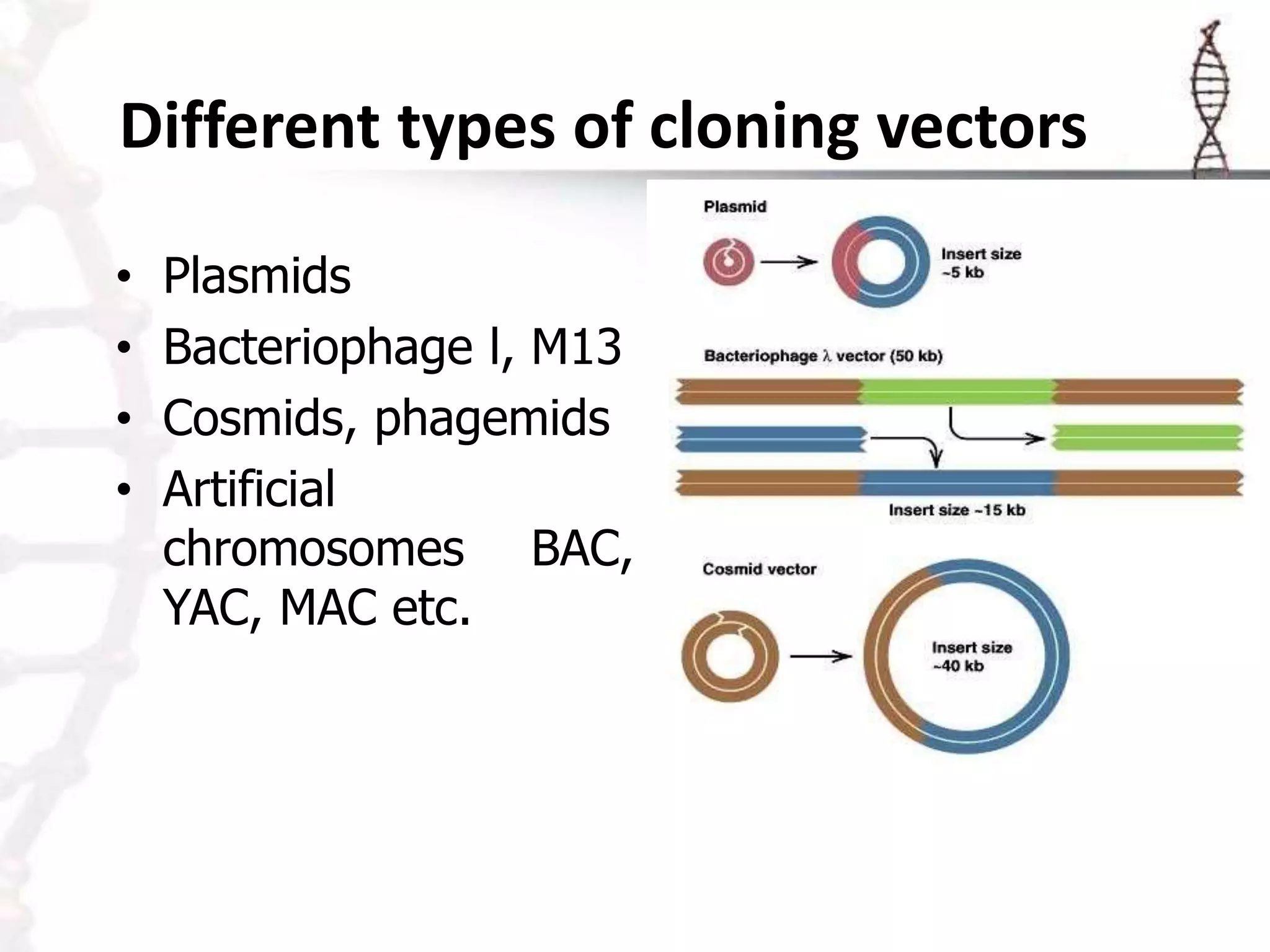
2) Vector
• Plasmids
• Bacteriophage l, M13
• Cosmids, phagemids
• Artificial
chromosomes BAC,
YAC, MAC etc.
Different types of cloning vectors
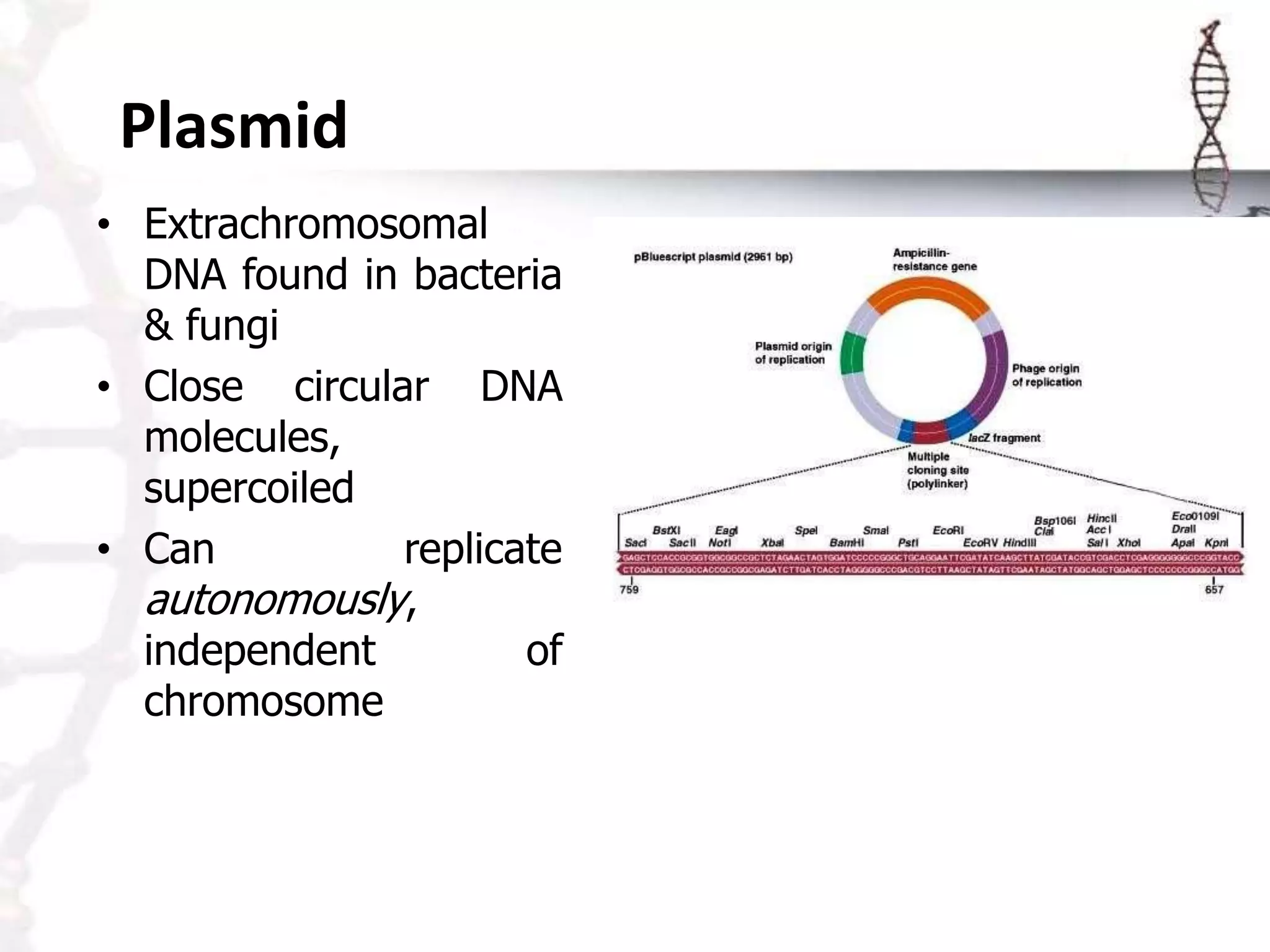
• Extrachromosomal
DNA found in bacteria
& fungi
• Close circular DNA
molecules,
supercoiled
• Can replicate
autonomously,
independent of
chromosome
Plasmid
Some plasmids are present in multiple
copies in the cell
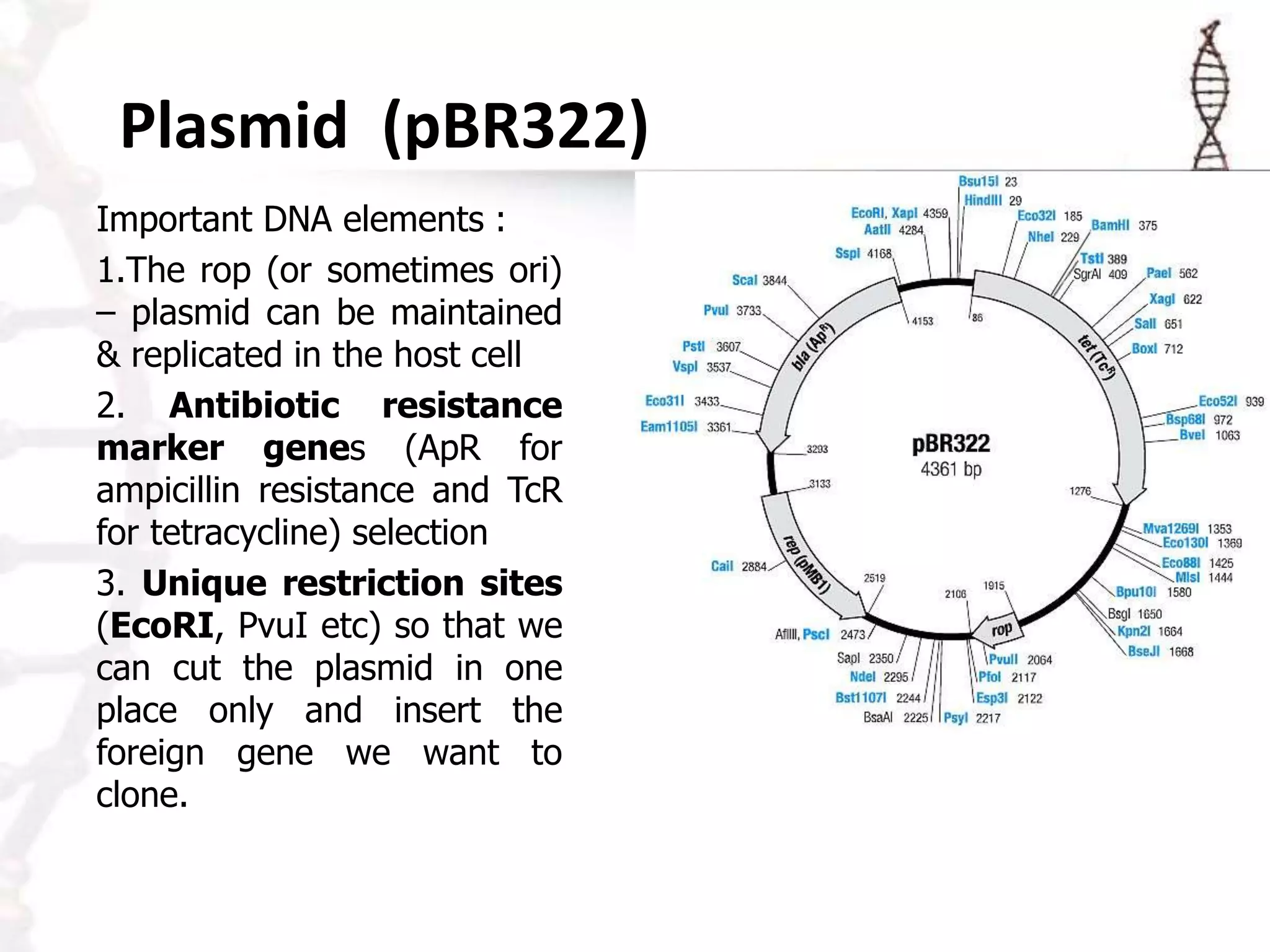
Important DNA elements :
1.The rop (or sometimes ori)
– plasmid can be maintained
& replicated in the host cell
2. Antibiotic resistance
marker genes (ApR for
ampicillin resistance and TcR
for tetracycline) selection
3. Unique restriction sites
(EcoRI, PvuI etc) so that we
can cut the plasmid in one
place only and insert the
foreign gene we want to
clone.
Plasmid (pBR322)
Type II Restriction endonuclease
• Recognizes very specific short sequences
of DNA
• Cuts DNA in very specific manner
• Technically – one Unit of RE will completely
digest 1 ug of substrate DNA in a 50 ul
reaction volume in 60 minutes.
Restriction enzyme
• Restriction enzymes cut
DNA at very specific
sequences.
• Formation of hairpin loops
Restriction enzyme
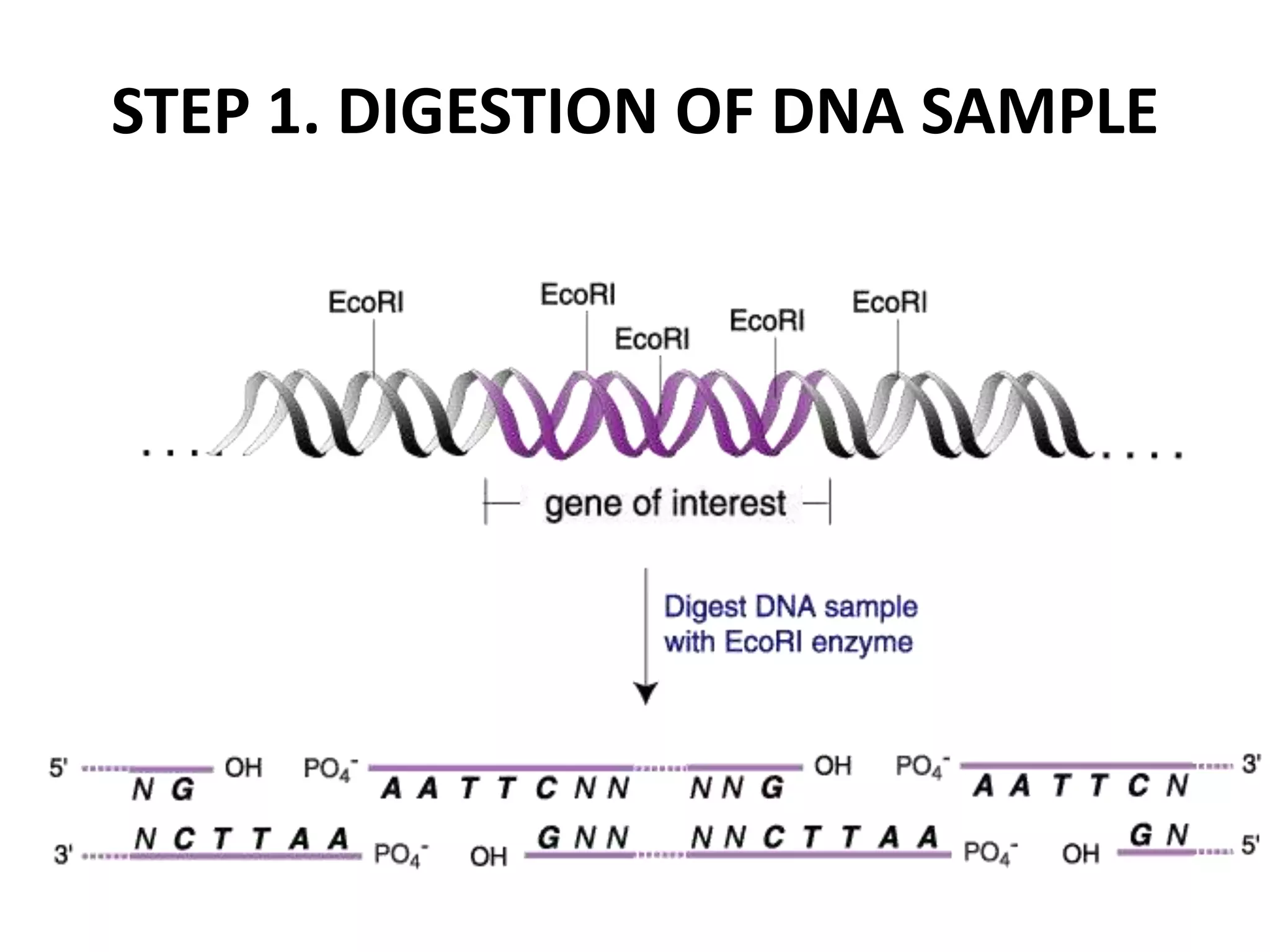
STEP 1. DIGESTION OF DNA SAMPLE
STEP 2. DIGESTION OF PLASMID DNA
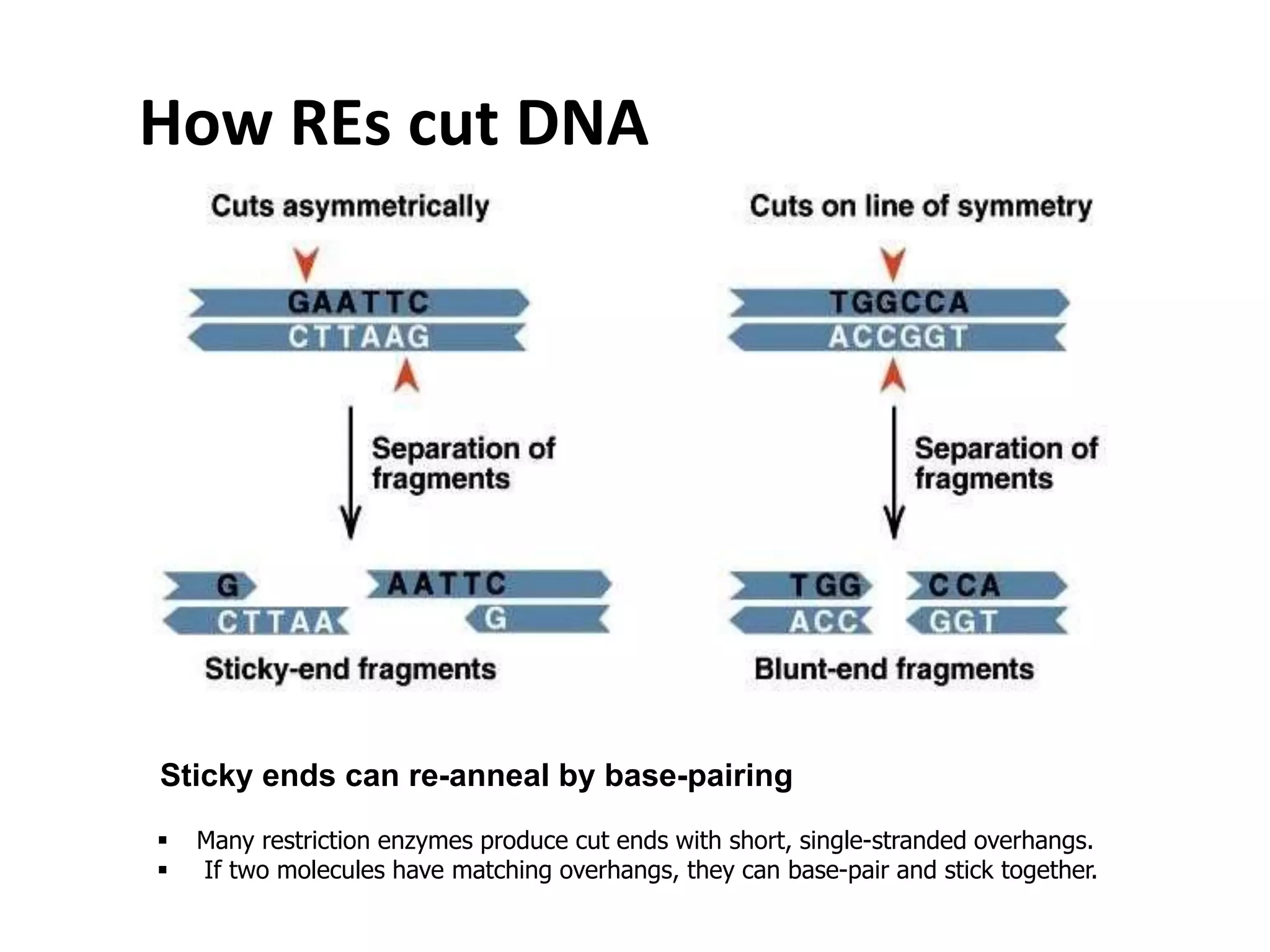
How REs cut DNA
Sticky ends can re-anneal by base-pairing
 Many restriction enzymes produce cut ends with short, single-stranded overhangs.
 If two molecules have matching overhangs, they can base-pair and stick together.
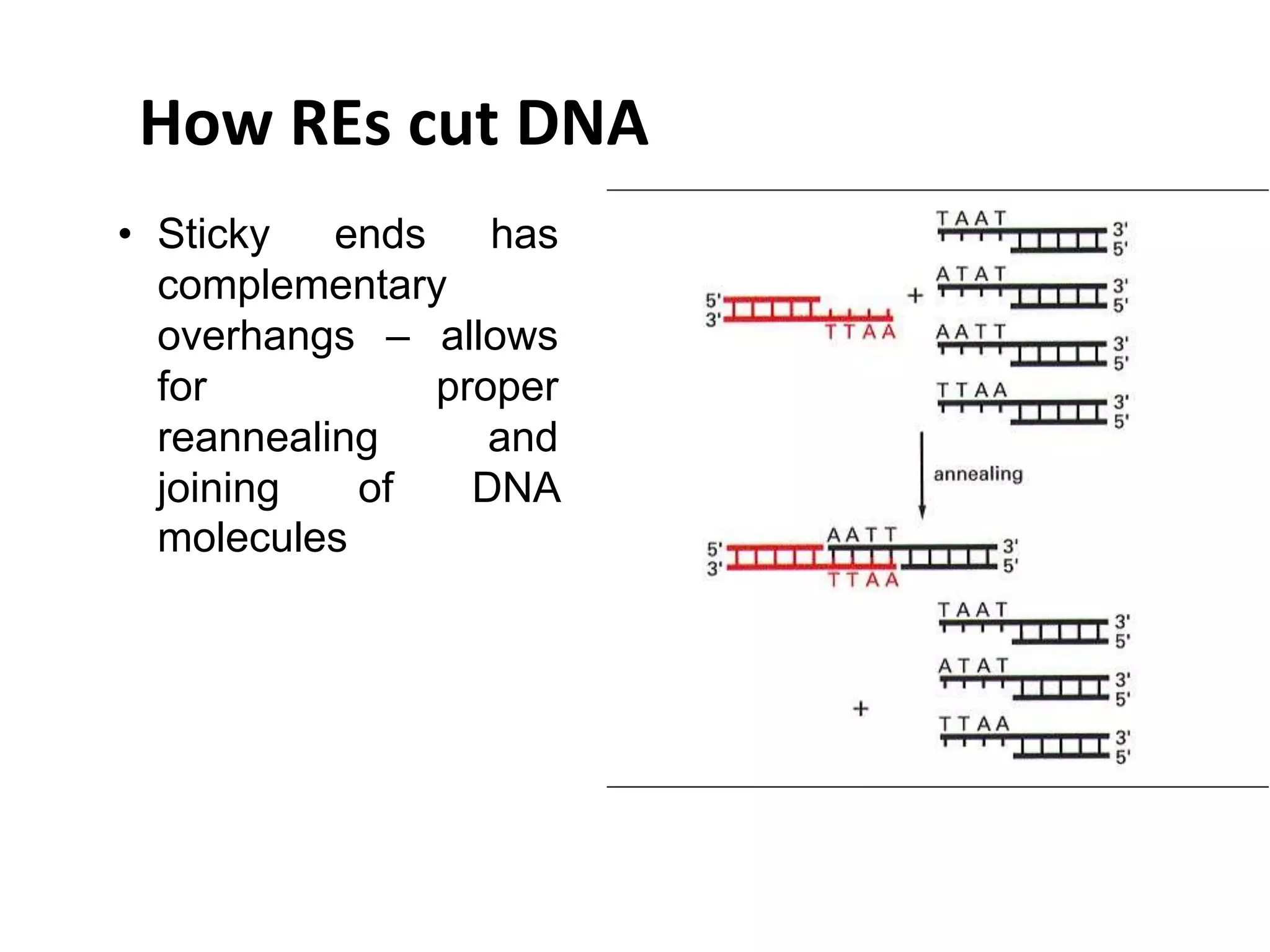
How REs cut DNA
• Sticky ends has
complementary
overhangs – allows
for proper
reannealing and
joining of DNA
molecules
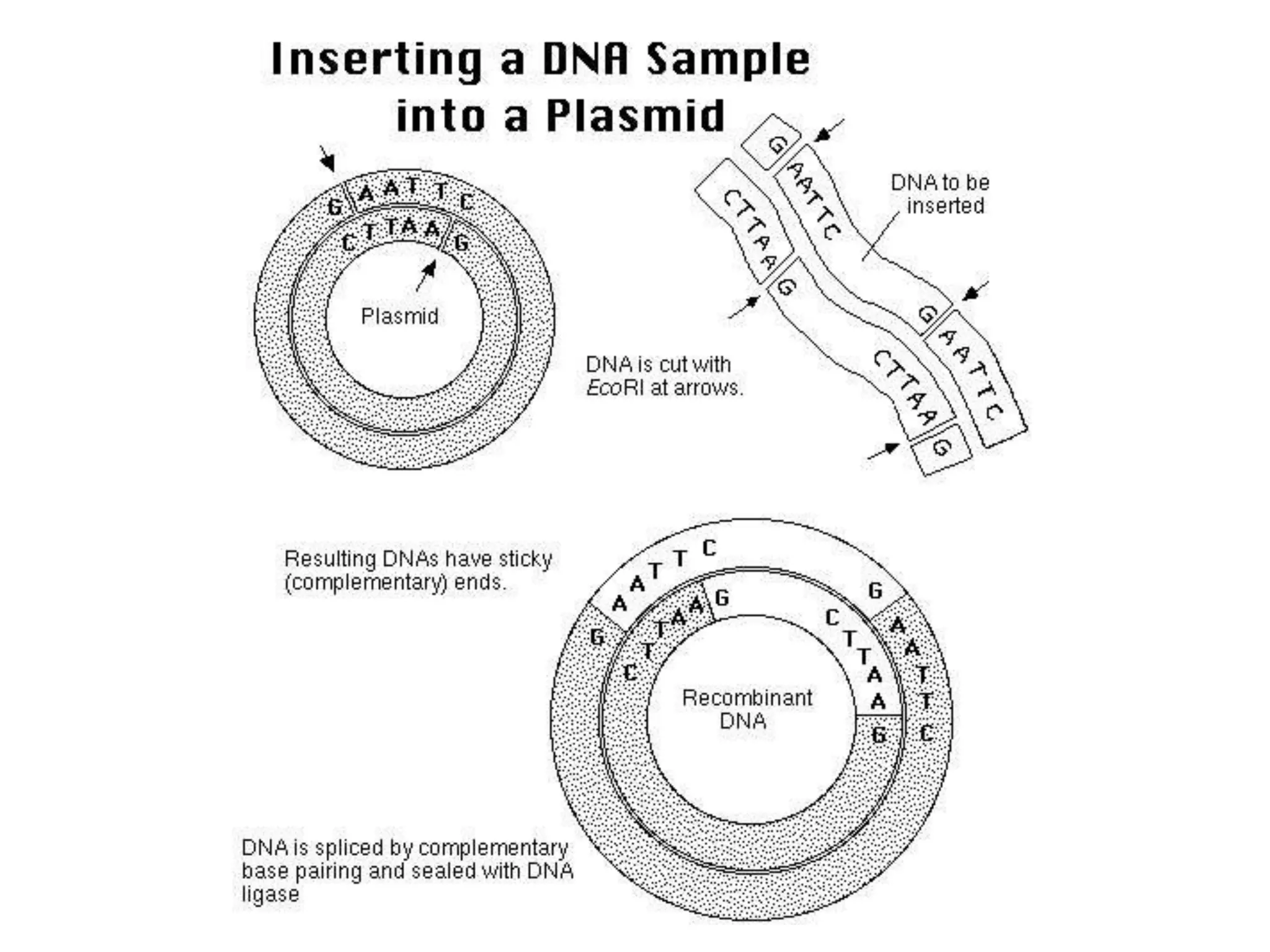
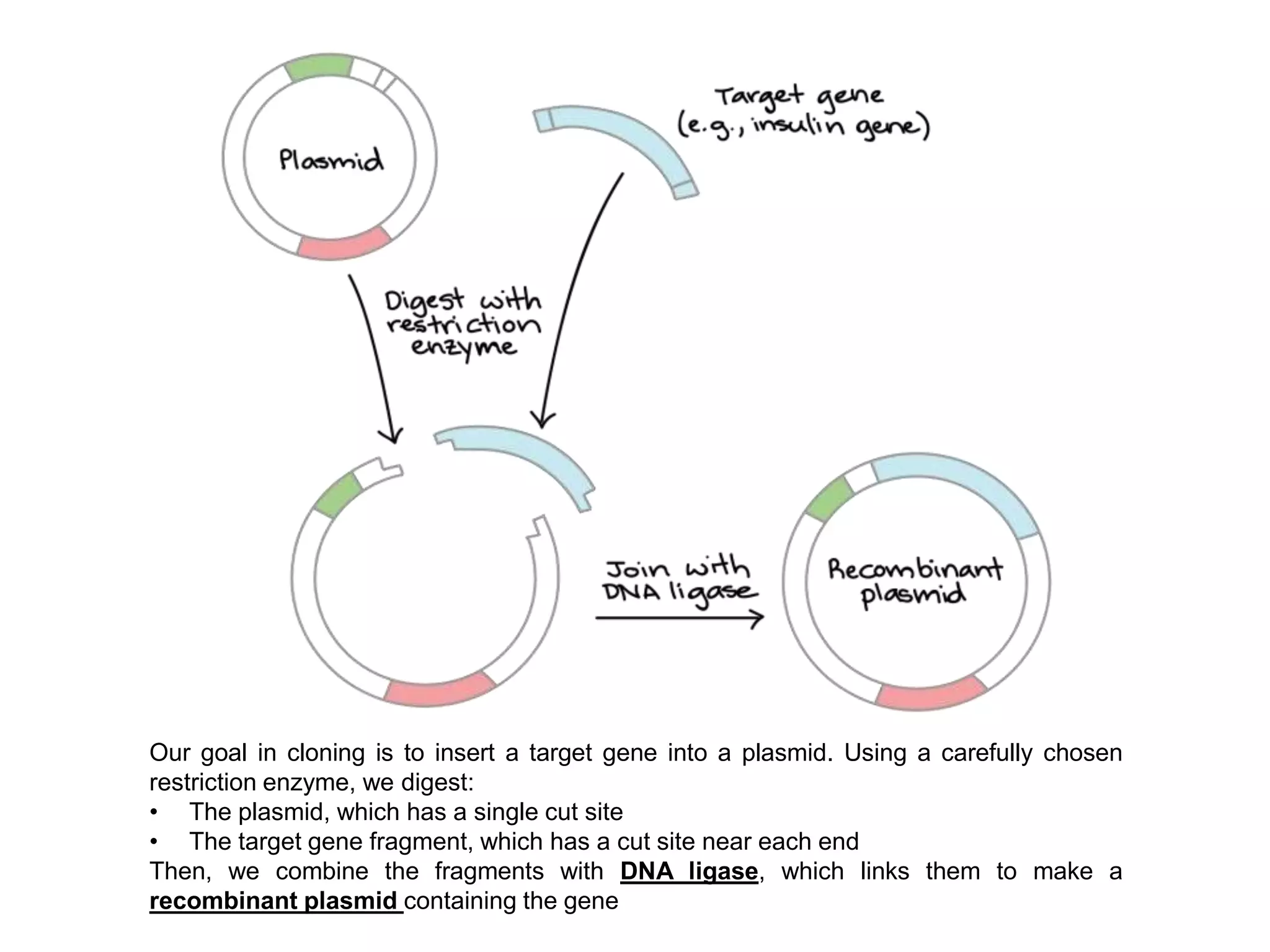
Our goal in cloning is to insert a target gene into a plasmid. Using a carefully chosen
restriction enzyme, we digest:
• The plasmid, which has a single cut site
• The target gene fragment, which has a cut site near each end
Then, we combine the fragments with DNA ligase, which links them to make a
recombinant plasmid containing the gene
STEP 3. LIGATION OF DNA SAMPLE AND
PLASMID DNA
STEP 4. TRANSFORMATION OF
LIGATION PRODUCTS
 Plasmids and other DNA can be introduced into
bacteria, such as the harmless E. coli used in
labs, in a process called transformation.
 During transformation, specially prepared
bacterial cells are given a heat shock that
encourages them to take up foreign DNA.
Transformation
• The recombinant DNA enters into the host cell and
proliferates.
CHEMICAL TRANSFORMATION WITH
CALCIUM CHLORIDE
• The DNA produced by ligation is added to bacteria.
• The bacteria are given a heat shock, which makes them more apt
to take up DNA by transformation.
• However, only a tiny minority of the bacteria will successfully take
up a plasmid.
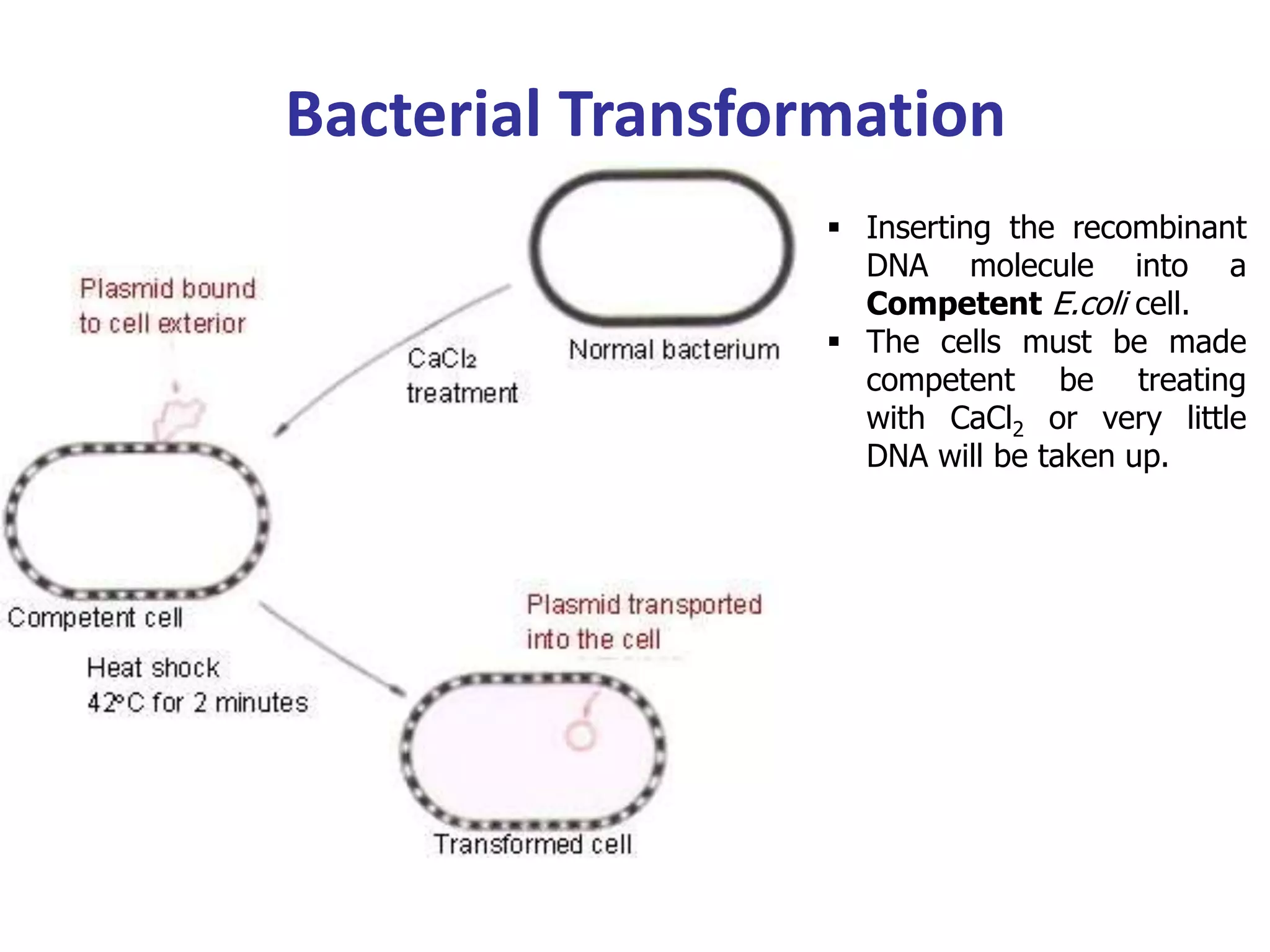
 Inserting the recombinant
DNA molecule into a
Competent E.coli cell.
 The cells must be made
competent be treating
with CaCl2 or very little
DNA will be taken up.
Bacterial Transformation
STEP 5. GROWTH ON AGAR PLATES
 A plasmid typically contains an antibiotic resistance gene, which allows
bacteria to survive in the presence of a specific antibiotic.
 Bacteria that took up the plasmid can be selected on nutrient plates
containing the antibiotic.
PRODUCTION OF PROTEIN
 After finding the bacterial colony with the right plasmid, then we can grow a large culture
of plasmid-bearing bacteria.
 The bacteria can then be given a chemical signal that instructs them to make the target
protein.
 The bacteria serve as miniature “factories," churning out large amounts of protein.
• Biopharmaceuticals
– DNA cloning can be used to make human
proteins with biomedical applications (e.g.,
insulin, growth hormone).
• Gene therapy
– Gene therapy attempts to provide a
normal copy of the gene to the cells of a
patient’s body.
USES OF DNA CLONING
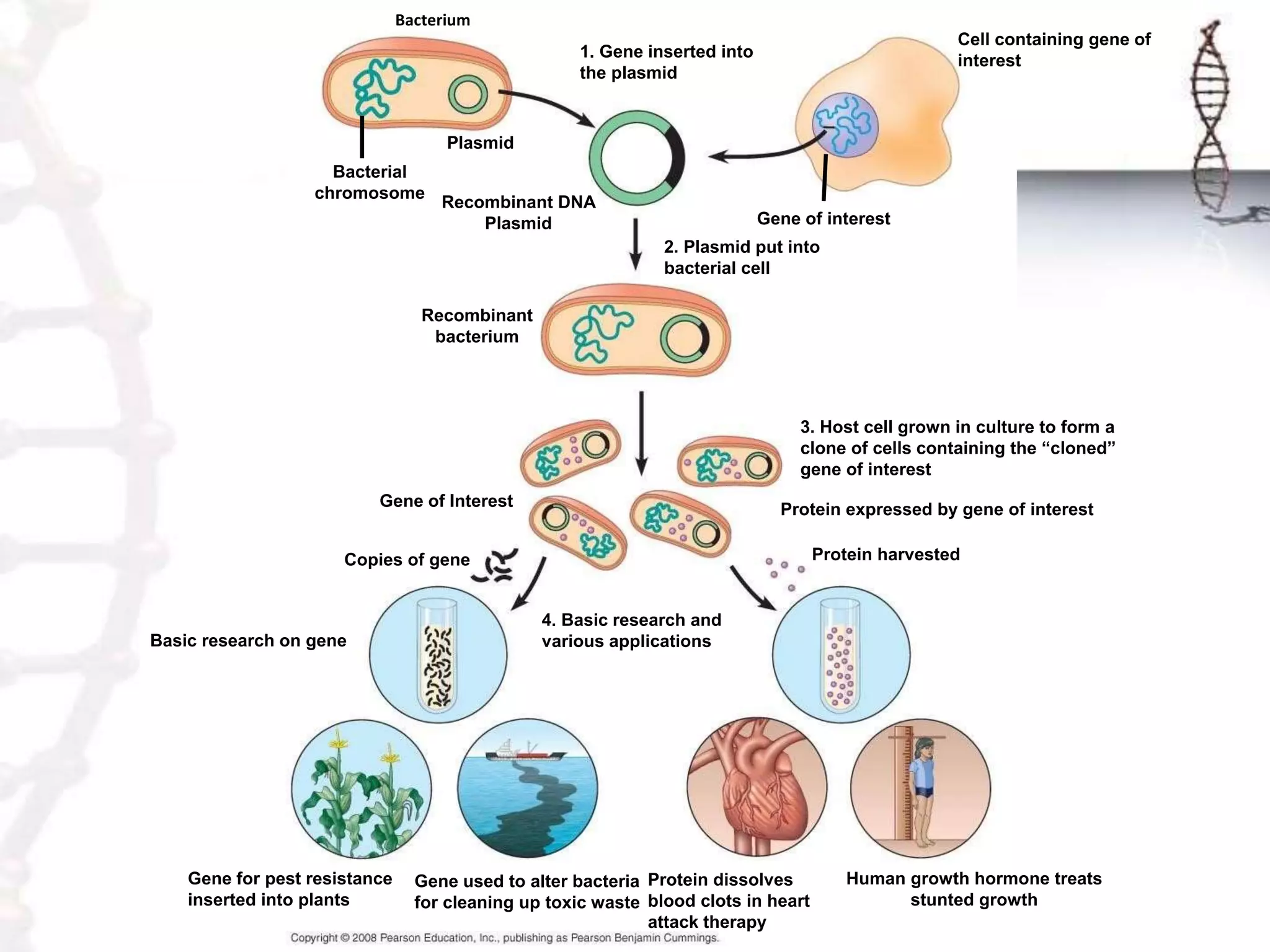
Bacterium
Bacterial
chromosome
Plasmid
Cell containing gene of
interest
Gene of interest
Recombinant DNA
Plasmid
1. Gene inserted into
the plasmid
2. Plasmid put into
bacterial cell
Recombinant
bacterium
3. Host cell grown in culture to form a
clone of cells containing the “cloned”
gene of interest
Protein expressed by gene of interest
Protein harvested
4. Basic research and
various applications
Human growth hormone treats
stunted growth
Protein dissolves
blood clots in heart
attack therapy
Gene used to alter bacteria
for cleaning up toxic waste
Gene for pest resistance
inserted into plants
Basic research on gene
Gene of Interest
Copies of gene

Introduction to DNA Cloning

  • 1.
  • 2.
    What Does ItMean: “To Clone”? Clone: a collection of molecules or cells, all identical to an original molecule or cell. • To “clone a gene” is to make many copies of it – e.g., by replicating it in a culture of bacteria. • Cloned gene can be a normal copy of a gene (= “wild type”). • Cloned gene can be an altered version of a gene (= “mutant”). • Recombinant DNA technology makes manipulating genes possible.
  • 3.
    DNA CLONING • Theprocess of making multiple, identical copies of a particular piece of DNA. • This is the first stage of most of the genetic engineering experiments: – production of DNA libraries – PCR – DNA sequencing
  • 4.
    DNA CLONING • Asingle DNA molecule can be amplified allowing it to be: –Studied – sequenced –Manipulated – mutagenized or engineered –Expressed – generation of protein
  • 5.
    DNA CLONING • Itcan be achieved by two different approaches: –Cell-based –using polymerase chain reaction (PCR)
  • 6.
    DNA Cloning You need: 1) Source of DNA – to be cloned 2) Choice of vectors – to carry, maintain and replicate cloned gene in host cell 3) Restriction enzymes – to cut DNA 4) DNA ligase – to join foreign and vector DNA – recombinant DNA 5) Host cell – in which the recombinant DNA can replicate.
  • 7.
    Involves five steps: Enzyme restriction digest of DNA sample.  Enzyme restriction digest of DNA plasmid vector.  Ligation of DNA sample products and plasmid vector.  Transformation with the ligation products.  Growth on agar plates with selection for antibiotic resistance. Cell-based Cloning
  • 8.
     Genomic DNA DNA extracted from cells and purified  cDNA  by reverse transcription of mRNA  Amplified DNA  using Polymerase Chain Reaction  Synthetic DNA  DNA made artificially using a machine 1) Source of DNA
  • 9.
    • To carrythe ligated foreign gene into the host cell • Maintain the foreign gene in the host cell • Replicate • Express the cloned foreign gene to make a protein. 2) Vector
  • 10.
    • Plasmids • Bacteriophagel, M13 • Cosmids, phagemids • Artificial chromosomes BAC, YAC, MAC etc. Different types of cloning vectors
  • 11.
    • Extrachromosomal DNA foundin bacteria & fungi • Close circular DNA molecules, supercoiled • Can replicate autonomously, independent of chromosome Plasmid
  • 12.
    Some plasmids arepresent in multiple copies in the cell
  • 13.
    Important DNA elements: 1.The rop (or sometimes ori) – plasmid can be maintained & replicated in the host cell 2. Antibiotic resistance marker genes (ApR for ampicillin resistance and TcR for tetracycline) selection 3. Unique restriction sites (EcoRI, PvuI etc) so that we can cut the plasmid in one place only and insert the foreign gene we want to clone. Plasmid (pBR322)
  • 14.
    Type II Restrictionendonuclease • Recognizes very specific short sequences of DNA • Cuts DNA in very specific manner • Technically – one Unit of RE will completely digest 1 ug of substrate DNA in a 50 ul reaction volume in 60 minutes. Restriction enzyme
  • 15.
    • Restriction enzymescut DNA at very specific sequences. • Formation of hairpin loops Restriction enzyme
  • 16.
    STEP 1. DIGESTIONOF DNA SAMPLE
  • 17.
    STEP 2. DIGESTIONOF PLASMID DNA
  • 18.
    How REs cutDNA Sticky ends can re-anneal by base-pairing  Many restriction enzymes produce cut ends with short, single-stranded overhangs.  If two molecules have matching overhangs, they can base-pair and stick together.
  • 19.
    How REs cutDNA • Sticky ends has complementary overhangs – allows for proper reannealing and joining of DNA molecules
  • 22.
    Our goal incloning is to insert a target gene into a plasmid. Using a carefully chosen restriction enzyme, we digest: • The plasmid, which has a single cut site • The target gene fragment, which has a cut site near each end Then, we combine the fragments with DNA ligase, which links them to make a recombinant plasmid containing the gene
  • 23.
    STEP 3. LIGATIONOF DNA SAMPLE AND PLASMID DNA
  • 24.
    STEP 4. TRANSFORMATIONOF LIGATION PRODUCTS  Plasmids and other DNA can be introduced into bacteria, such as the harmless E. coli used in labs, in a process called transformation.  During transformation, specially prepared bacterial cells are given a heat shock that encourages them to take up foreign DNA. Transformation • The recombinant DNA enters into the host cell and proliferates.
  • 25.
  • 26.
    • The DNAproduced by ligation is added to bacteria. • The bacteria are given a heat shock, which makes them more apt to take up DNA by transformation. • However, only a tiny minority of the bacteria will successfully take up a plasmid.
  • 27.
     Inserting therecombinant DNA molecule into a Competent E.coli cell.  The cells must be made competent be treating with CaCl2 or very little DNA will be taken up. Bacterial Transformation
  • 28.
    STEP 5. GROWTHON AGAR PLATES  A plasmid typically contains an antibiotic resistance gene, which allows bacteria to survive in the presence of a specific antibiotic.  Bacteria that took up the plasmid can be selected on nutrient plates containing the antibiotic.
  • 29.
    PRODUCTION OF PROTEIN After finding the bacterial colony with the right plasmid, then we can grow a large culture of plasmid-bearing bacteria.  The bacteria can then be given a chemical signal that instructs them to make the target protein.  The bacteria serve as miniature “factories," churning out large amounts of protein.
  • 30.
    • Biopharmaceuticals – DNAcloning can be used to make human proteins with biomedical applications (e.g., insulin, growth hormone). • Gene therapy – Gene therapy attempts to provide a normal copy of the gene to the cells of a patient’s body. USES OF DNA CLONING
  • 31.
    Bacterium Bacterial chromosome Plasmid Cell containing geneof interest Gene of interest Recombinant DNA Plasmid 1. Gene inserted into the plasmid 2. Plasmid put into bacterial cell Recombinant bacterium 3. Host cell grown in culture to form a clone of cells containing the “cloned” gene of interest Protein expressed by gene of interest Protein harvested 4. Basic research and various applications Human growth hormone treats stunted growth Protein dissolves blood clots in heart attack therapy Gene used to alter bacteria for cleaning up toxic waste Gene for pest resistance inserted into plants Basic research on gene Gene of Interest Copies of gene

Editor's Notes

  • #12 Can be transferred to other cells by conjugation Can be integrated into the chromosome.
  • #29 Not all colonies will necessarily contain the right plasmid. That’s because, during a ligation, DNA fragments don’t always get “pasted” in exactly the way we intend. Instead, we must collect DNA from several colonies and see whether each one contain the right plasmid.
  • #32 A preview of gene cloning and some uses of cloned genes