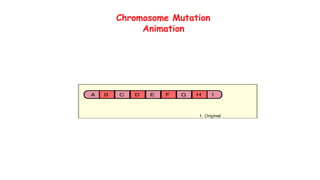
What is agene mutation?
Mutations are changes in genetic material – changes in
DNA code – thus a change in a gene(s)
In gene mutations, the DNA code will have a base (or more)
missing, added, or exchanged in a codon.
2
3.
How common aremutations?
Mutations occurs at a frequency of about 1 in every 1 billion base
pairs
Everybody has about 6 mutations in each cell in their body!
4.
Classification of mutation
A.Based on the survival of an individual:
1.Lethal mutation – when mutation causes death of all individuals
undergoing mutation are known as lethal
2.Sub lethal mutation - causes death of 90% individuals
3.Vital mutation - when mutation don’t affect the survival of an individual are
known as vital
4.Supervital mutation – This kind of mutation enhances the
survival of individual
5.
5
B. Based oncauses of mutation:
1.Spontaneous mutation-
Spontaneous mutation occurs naturally without any cause. The rate of spontaneous mutation is very
slow eg- Methylation followed by deamination of cytosine.
Rate of spontaneous mutation is higher in eukaryotes than prokaryotes.
Eg. UV light of sunlight causing mutation in bacteria.
2.Induced Mutation-
Mutations produced due to treatment with either a chemical or physical agent are called induced
mutation .
The agents capable of inducing such mutations are known as mutagen. use of induced mutation for
crop improvement program is known as mutation breeding.
Eg. X- rays causing mutation in cereals
6.
C. Based ontissue of origin
1.Somatic mutation-
A mutation occurring in somatic cell is called somatic mutation.
In asexually reproducing species somatic mutations transmits from one
progeny to the next progeny
2.Germinal Mutation-
When mutation occur in gametic cells or reproductive cells are known as
germinal mutation.
In sexually reproductive species only germinal mutation are
transmitted to the next generation
7.
Mutations are amajor source of genetic
variation in a population increasing
biodiversity.
Some variations may help them to
survive better.
How do mutations affect a population?
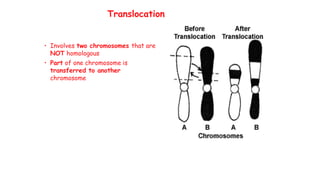
Translocation
• Involves twochromosomes that are
NOT homologous
• Part of one chromosome is
transferred to another
chromosome
15.
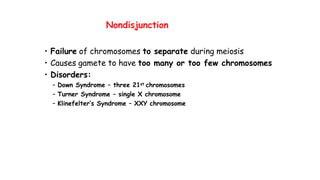
Nondisjunction
• Failure ofchromosomes to separate during meiosis
• Causes gamete to have too many or too few chromosomes
• Disorders:
– Down Syndrome – three 21st chromosomes
– Turner Syndrome – single X chromosome
– Klinefelter’s Syndrome – XXY chromosome
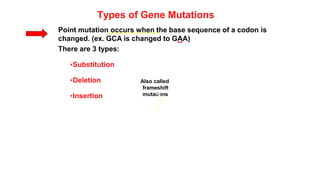
Types of GeneMutations
Point mutation occurs when the base sequence of a codon is
changed. (ex. GCA is changed to GAA)
There are 3 types:
•Substitution
•Deletion
•Insertion
Also called
frameshift
mutations
19.
Substitution Mutations
Mutated DNA:CGA – TGC – TTC
Normal DNA: CGA – TGC – ATC
Alanine – Threonine - stop
Alanine – Threonine - Lysine
What has happened to the DNA?
20.
Substitution Mutations
Alanine –Threonine - Lysine
Mutated DNA: CGA – TGC – TTC
This is a substitution mutation.
A single nitrogen base is substituted for
another in a codon.
It may or may not affect the amino acid or
protein.
Normal DNA: CGA – TGC – ATC
Alanine – Threonine - stop
20
21.
Substitution Mutations
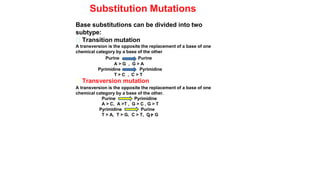
Base substitutionscan be divided into two
subtype:
Transition mutation
A transversion is the opposite the replacement of a base of one
chemical category by a base of the other
Purine Purine
A > G , G > A
Pyrimidine Pyrimidine
T > C , C > T
Transversion mutation
A transversion is the opposite the replacement of a base of one
chemical category by a base of the other.
Purine Pyrimidine
A > C, A >T , G > C , G > T
Pyrimidine Purine
T > A, T > G, C > T, C
21
> G
22.
Insertion Mutations
Normal DNA:CGA – TGC – ATC
Alanine – Threonine – stop
Mutated DNA: CGA – TAG – CAT – C
Alanine – Isoleucine – Valine
23.
Insertion Mutations
Mutated DNA:CGA – TAG – CAT – C
Alanine
23– Leucine - Valine
This is an insertion mutation.
A nitrogen base is inserted/added to
the sequence.
It causes the triplet “frames to shift”.
It always affects the amino acids and
consequently the protein.
Normal DNA: CGA – TGC – ATC
Alanine – Threonine - stop
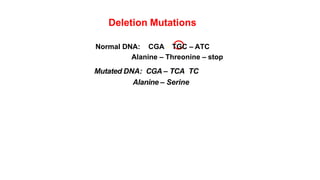
Deletion Mutations
This isa deletion mutation.
A nitrogen base is deleted/removed from the sequence.
It causes the triplet “frames to shift
It always affects the amino acids and consequently the protein.
Normal DNA: CGA – TGC – ATC
Alanine – Threonine – stop
Mutated DNA: CGA – TCA- TC
Alan2
in
5 e – Serine
26.
Frameshift Mutation
Insertingor deleting one or more nucleotides
Changes the “reading frame” like changing a sentence
Proteins built incorrectly
27.
CLASSIFICATION OF POINTMUTATIONS
DEPENDING ON EFFECTS
MUTATION:
• Missense mutation
• Silent mutation
• Non-sense mutation
28.
MISSENSE MUTATION:
• Thenew codon causes an incorrect AMINO ACID to be inserted into
the protein.
• This effect on the function of the protein depend on what is inserted in
place of normal amino acid.
28
30.
NON-SENSE MUTATION:
When abase substitution results in a stop codon
ultimately truncating translation and most likely
leading to a nonfunctional protein.
32.
SILENT MUTATION:
Silent mutationdoes not causes any change in amino acid.
(Silent mutation codes for same amino acid)
DNA:
mRNA:
> TTC
AAG
TTT
AAA -
Lysine - Lysine