Clustering in Data mining
By
S.Archana
Synopsis
• Introduction
• Clustering
• Why Clustering?
• Several working definitions of clustering
• Methods of clustering
• Applications of clustering
Introduction
• Defined as extracting the information from the
huge set of data.
• Extracting set of patterns from the data set.
Clustering
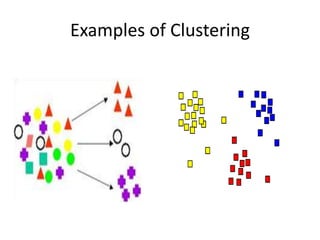
• Clustering means grouping the objects based on the
information found in the data describing the objects or their
relationships.
• The goal is that the objects in a group will be similar (or
related) to one other and different from (or unrelated to) the
objects in other groups.
• grouped according to logical relationships or consumer
preferences.
• unsupervised learning no target field,
• bottom-up approach.
• originated in anthropology by Driver and Kroeber in 1932 and
introduced to psychology by Zubin in 1938 and Robert
tryon in 1939 and famously used by Cattell beginning in 1943
for trait theory classification in personality psychology.
Examples of Clustering
Why clustering?
• High dimensionality - The clustering algorithm
should not only be able to handle low- dimensional
data but also the high dimensional space.
• Ability to deal with noisy data - Databases contain
noisy, missing or erroneous data. Some algorithms
are sensitive to such data and may lead to poor
quality clusters.
• Interpretability - The clustering results should be
interpretable, comprehensible and usable.
Cont…
• Scalability - We need highly scalable clustering
algorithms to deal with large databases.
• Ability to deal with different kind of attributes -
Algorithms should be capable to be applied on any
kind of data such as interval based (numerical) data,
categorical, binary data.
• Discovery of clusters with attribute shape - The
clustering algorithm should be capable of detect
cluster of arbitrary shape. It should not be bounded to
only distance measures that tend to find spherical
cluster of small size.
Several working definitions of
clustering
• Well separated cluster definition
• Centre based cluster definition
• Contiguous cluster definition(Nearest
neighbour or transitive clustering)
• Similarity based cluster definition
• Density based cluster definition
Methods in Clustering
• Partitioning Method
• Hierarchical Method
• Density-based Method
• Grid-Based Method
• Model-Based Method
• Constraint-based Method
Partitioning Method
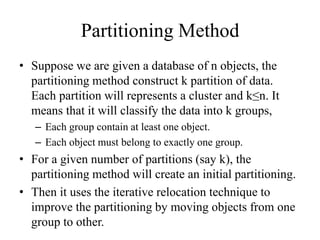
• Suppose we are given a database of n objects, the
partitioning method construct k partition of data.
Each partition will represents a cluster and k≤n. It
means that it will classify the data into k groups,
– Each group contain at least one object.
– Each object must belong to exactly one group.
• For a given number of partitions (say k), the
partitioning method will create an initial partitioning.
• Then it uses the iterative relocation technique to
improve the partitioning by moving objects from one
group to other.
Hierarchical Method
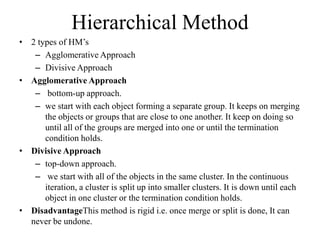
• 2 types of HM’s
– Agglomerative Approach
– Divisive Approach
• Agglomerative Approach
– bottom-up approach.
– we start with each object forming a separate group. It keeps on merging
the objects or groups that are close to one another. It keep on doing so
until all of the groups are merged into one or until the termination
condition holds.
• Divisive Approach
– top-down approach.
– we start with all of the objects in the same cluster. In the continuous
iteration, a cluster is split up into smaller clusters. It is down until each
object in one cluster or the termination condition holds.
• DisadvantageThis method is rigid i.e. once merge or split is done, It can
never be undone.
Density based Method
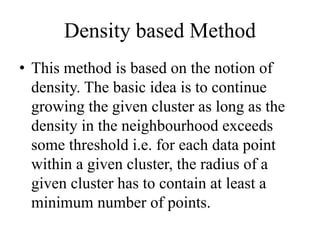
• This method is based on the notion of
density. The basic idea is to continue
growing the given cluster as long as the
density in the neighbourhood exceeds
some threshold i.e. for each data point
within a given cluster, the radius of a
given cluster has to contain at least a
minimum number of points.
Grid based Method
• In this the objects together from a grid. The
object space is quantized into finite number of
cells that form a grid structure.
• AdvantageThe major advantage of this method
is fast processing time.
• It is dependent only on the number of cells in
each dimension in the quantized space.
Model based Method
• In this method a model is hypothesize for each
cluster and find the best fit of data to the given
model. This method locate the clusters by
clustering the density function. This reflects
spatial distribution of the data points.
• This method also serve a way of automatically
determining number of clusters based on standard
statistics , taking outlier or noise into account. It
therefore yield robust clustering methods.
Constraint based Method
• In this method the clustering is performed by
incorporation of user or application oriented
constraints. The constraint refers to the user
expectation or the properties of desired
clustering results. The constraint give us the
interactive way of communication with the
clustering process. The constraint can be
specified by the user or the application
requirement.
Applications
• Pattern Recognition
• Spatial Data Analysis:
• Image Processing
• Economic Science (especially market research)
• Crime analysis
• Bio informatics
• Medical Imaging
• Robotics
• Climatology
Thank you!!

Clustering in Data Mining

  • 1.
    Clustering in Datamining By S.Archana
  • 2.
    Synopsis • Introduction • Clustering •Why Clustering? • Several working definitions of clustering • Methods of clustering • Applications of clustering
  • 3.
    Introduction • Defined asextracting the information from the huge set of data. • Extracting set of patterns from the data set.
  • 4.
    Clustering • Clustering meansgrouping the objects based on the information found in the data describing the objects or their relationships. • The goal is that the objects in a group will be similar (or related) to one other and different from (or unrelated to) the objects in other groups. • grouped according to logical relationships or consumer preferences. • unsupervised learning no target field, • bottom-up approach. • originated in anthropology by Driver and Kroeber in 1932 and introduced to psychology by Zubin in 1938 and Robert tryon in 1939 and famously used by Cattell beginning in 1943 for trait theory classification in personality psychology.
  • 5.
  • 6.
    Why clustering? • Highdimensionality - The clustering algorithm should not only be able to handle low- dimensional data but also the high dimensional space. • Ability to deal with noisy data - Databases contain noisy, missing or erroneous data. Some algorithms are sensitive to such data and may lead to poor quality clusters. • Interpretability - The clustering results should be interpretable, comprehensible and usable.
  • 7.
    Cont… • Scalability -We need highly scalable clustering algorithms to deal with large databases. • Ability to deal with different kind of attributes - Algorithms should be capable to be applied on any kind of data such as interval based (numerical) data, categorical, binary data. • Discovery of clusters with attribute shape - The clustering algorithm should be capable of detect cluster of arbitrary shape. It should not be bounded to only distance measures that tend to find spherical cluster of small size.
  • 8.
    Several working definitionsof clustering • Well separated cluster definition • Centre based cluster definition • Contiguous cluster definition(Nearest neighbour or transitive clustering) • Similarity based cluster definition • Density based cluster definition
  • 9.
    Methods in Clustering •Partitioning Method • Hierarchical Method • Density-based Method • Grid-Based Method • Model-Based Method • Constraint-based Method
  • 10.
    Partitioning Method • Supposewe are given a database of n objects, the partitioning method construct k partition of data. Each partition will represents a cluster and k≤n. It means that it will classify the data into k groups, – Each group contain at least one object. – Each object must belong to exactly one group. • For a given number of partitions (say k), the partitioning method will create an initial partitioning. • Then it uses the iterative relocation technique to improve the partitioning by moving objects from one group to other.
  • 11.
    Hierarchical Method • 2types of HM’s – Agglomerative Approach – Divisive Approach • Agglomerative Approach – bottom-up approach. – we start with each object forming a separate group. It keeps on merging the objects or groups that are close to one another. It keep on doing so until all of the groups are merged into one or until the termination condition holds. • Divisive Approach – top-down approach. – we start with all of the objects in the same cluster. In the continuous iteration, a cluster is split up into smaller clusters. It is down until each object in one cluster or the termination condition holds. • DisadvantageThis method is rigid i.e. once merge or split is done, It can never be undone.
  • 12.
    Density based Method •This method is based on the notion of density. The basic idea is to continue growing the given cluster as long as the density in the neighbourhood exceeds some threshold i.e. for each data point within a given cluster, the radius of a given cluster has to contain at least a minimum number of points.
  • 13.
    Grid based Method •In this the objects together from a grid. The object space is quantized into finite number of cells that form a grid structure. • AdvantageThe major advantage of this method is fast processing time. • It is dependent only on the number of cells in each dimension in the quantized space.
  • 14.
    Model based Method •In this method a model is hypothesize for each cluster and find the best fit of data to the given model. This method locate the clusters by clustering the density function. This reflects spatial distribution of the data points. • This method also serve a way of automatically determining number of clusters based on standard statistics , taking outlier or noise into account. It therefore yield robust clustering methods.
  • 15.
    Constraint based Method •In this method the clustering is performed by incorporation of user or application oriented constraints. The constraint refers to the user expectation or the properties of desired clustering results. The constraint give us the interactive way of communication with the clustering process. The constraint can be specified by the user or the application requirement.
  • 16.
    Applications • Pattern Recognition •Spatial Data Analysis: • Image Processing • Economic Science (especially market research) • Crime analysis • Bio informatics • Medical Imaging • Robotics • Climatology
  • 17.