Physics Quality Assurance  Varian 21EX  Linear Accelerator (LINAC)
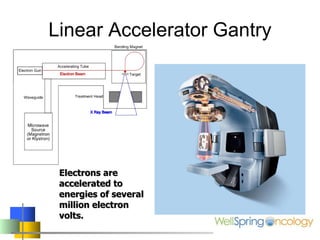
Linear Accelerator Gantry Electrons are accelerated to energies of several million electron volts.
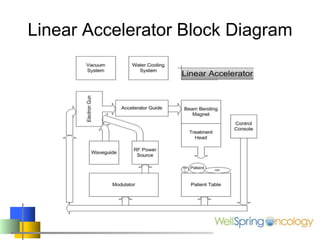
Linear Accelerator Block Diagram
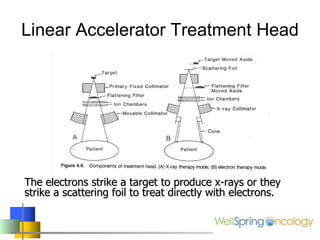
Linear Accelerator Treatment Head The electrons strike a target to produce x-rays or they strike a scattering foil to treat directly with electrons.
Varian 21EX Linear Accelerator X-ray energies (used to treat target areas located more than a few cm below the skin surface 6 and 10 MV energies Electron energies (used to treat lesions on the surface of the skin) 6, 9, 12, 16, and 20 MeV energies
Fields can be shaped by using custom made blocks or multileaf collimators attached to the treatment head l
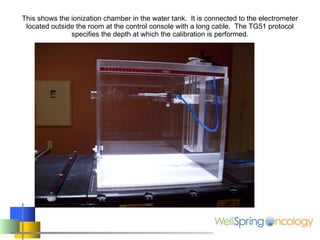
Linear Accelerator Quality Assurance Absolute dose calibration is performed according to the AAPM TG51 protocol using  water phantom ,  ionization chamber  and  electrometer
This shows the ionization chamber in the water tank.  It is connected to the electrometer located outside the room at the control console with a long cable.  The TG51 protocol specifies the depth at which the calibration is performed.
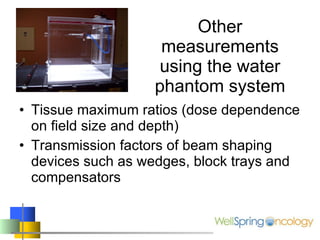
Other measurements using the water phantom system Tissue maximum ratios (dose dependence on field size and depth) Transmission factors of beam shaping devices such as wedges, block trays and compensators
In-air measurements using a build-up cap on the ion chamber Collimator scatter factors Output dependence on gantry angle Inverse square factor Collimator transmission Dose rate dependence Output linearity MU end effect
LINAC Mechanical Tests Light field (used to set up patients) Properly centered Congruent with radiation field Does not “walk out” when collimator is rotated Accurate over full range of field sizes
LINAC Mechanical Tests (cont) Crosshairs (used to set up patients) Properly centered Do not “walk out” when collimator is rotated Optical distance indicator accuracy  (used to measure the distance from the target to the patient – if this changes during the treatment course, patient may have gained or lost weight and a new calculation and/or treatment plan would be done) Readout devices Gantry, collimator and couch angles Field size for both independent jaws
LINAC Mechanical Tests (cont) Gantry axis of rotation – center of radiation field stable when gantry is rotated Collimator axis of rotation – center of radiation field stable when collimator is rotated
LINAC Safety Tests Communication devices Video Audio Beam termination  Radiation off button Emergency off buttons Main power circuit breaker Time delay  - when LINAC is powered up filaments must be warmed up Emergency couch pendant – couch can be moved out and down when all power is lost to LINAC Backup mechanical counter – displays dose given if power is lost during a treatment
LINAC Safety Tests (cont) Motions controlled by hand pendant Gantry rotation Collimator rotation Upper and lower jaws Couch rotation, vertical, lateral and longitudinal movements Safety checks Motion enable switch functional Limit switches functional Motor reversal can be initiated quickly Timer – terminates radiation if not stopped by preset MU Secondary dosimetry – terminates radiation if not stopped by primary MU setting
Other Tests of LINAC Components Multileaf collimator Digital portal imager
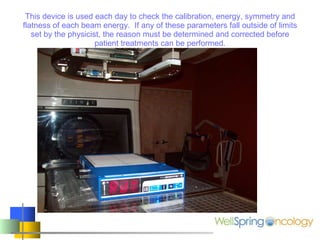
This device is used each day to check the calibration, energy, symmetry and flatness of each beam energy.  If any of these parameters fall outside of limits set by the physicist, the reason must be determined and corrected before patient treatments can be performed.
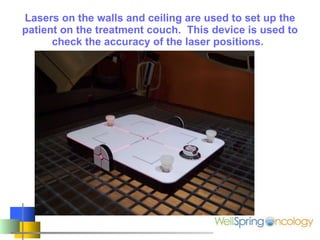
Lasers on the walls and ceiling are used to set up the patient on the treatment couch.  This device is used to check the accuracy of the laser positions.
Physics Quality Assurance Documentation and Analysis Tolerance limits are set for all parameters If any measurement exceeds the tolerance, adjustments are made by the physicist or engineer All measurements are carefully documented Inspectors from Florida Radiation Control review the documents at least once a year

21 Ex Qa

  • 1.
    Physics Quality Assurance Varian 21EX Linear Accelerator (LINAC)
  • 2.
    Linear Accelerator GantryElectrons are accelerated to energies of several million electron volts.
  • 3.
  • 4.
    Linear Accelerator TreatmentHead The electrons strike a target to produce x-rays or they strike a scattering foil to treat directly with electrons.
  • 5.
    Varian 21EX LinearAccelerator X-ray energies (used to treat target areas located more than a few cm below the skin surface 6 and 10 MV energies Electron energies (used to treat lesions on the surface of the skin) 6, 9, 12, 16, and 20 MeV energies
  • 6.
    Fields can beshaped by using custom made blocks or multileaf collimators attached to the treatment head l
  • 7.
    Linear Accelerator QualityAssurance Absolute dose calibration is performed according to the AAPM TG51 protocol using water phantom , ionization chamber and electrometer
  • 8.
    This shows theionization chamber in the water tank. It is connected to the electrometer located outside the room at the control console with a long cable. The TG51 protocol specifies the depth at which the calibration is performed.
  • 9.
    Other measurements usingthe water phantom system Tissue maximum ratios (dose dependence on field size and depth) Transmission factors of beam shaping devices such as wedges, block trays and compensators
  • 10.
    In-air measurements usinga build-up cap on the ion chamber Collimator scatter factors Output dependence on gantry angle Inverse square factor Collimator transmission Dose rate dependence Output linearity MU end effect
  • 11.
    LINAC Mechanical TestsLight field (used to set up patients) Properly centered Congruent with radiation field Does not “walk out” when collimator is rotated Accurate over full range of field sizes
  • 12.
    LINAC Mechanical Tests(cont) Crosshairs (used to set up patients) Properly centered Do not “walk out” when collimator is rotated Optical distance indicator accuracy (used to measure the distance from the target to the patient – if this changes during the treatment course, patient may have gained or lost weight and a new calculation and/or treatment plan would be done) Readout devices Gantry, collimator and couch angles Field size for both independent jaws
  • 13.
    LINAC Mechanical Tests(cont) Gantry axis of rotation – center of radiation field stable when gantry is rotated Collimator axis of rotation – center of radiation field stable when collimator is rotated
  • 14.
    LINAC Safety TestsCommunication devices Video Audio Beam termination Radiation off button Emergency off buttons Main power circuit breaker Time delay - when LINAC is powered up filaments must be warmed up Emergency couch pendant – couch can be moved out and down when all power is lost to LINAC Backup mechanical counter – displays dose given if power is lost during a treatment
  • 15.
    LINAC Safety Tests(cont) Motions controlled by hand pendant Gantry rotation Collimator rotation Upper and lower jaws Couch rotation, vertical, lateral and longitudinal movements Safety checks Motion enable switch functional Limit switches functional Motor reversal can be initiated quickly Timer – terminates radiation if not stopped by preset MU Secondary dosimetry – terminates radiation if not stopped by primary MU setting
  • 16.
    Other Tests ofLINAC Components Multileaf collimator Digital portal imager
  • 17.
    This device isused each day to check the calibration, energy, symmetry and flatness of each beam energy. If any of these parameters fall outside of limits set by the physicist, the reason must be determined and corrected before patient treatments can be performed.
  • 18.
    Lasers on thewalls and ceiling are used to set up the patient on the treatment couch. This device is used to check the accuracy of the laser positions.
  • 19.
    Physics Quality AssuranceDocumentation and Analysis Tolerance limits are set for all parameters If any measurement exceeds the tolerance, adjustments are made by the physicist or engineer All measurements are carefully documented Inspectors from Florida Radiation Control review the documents at least once a year