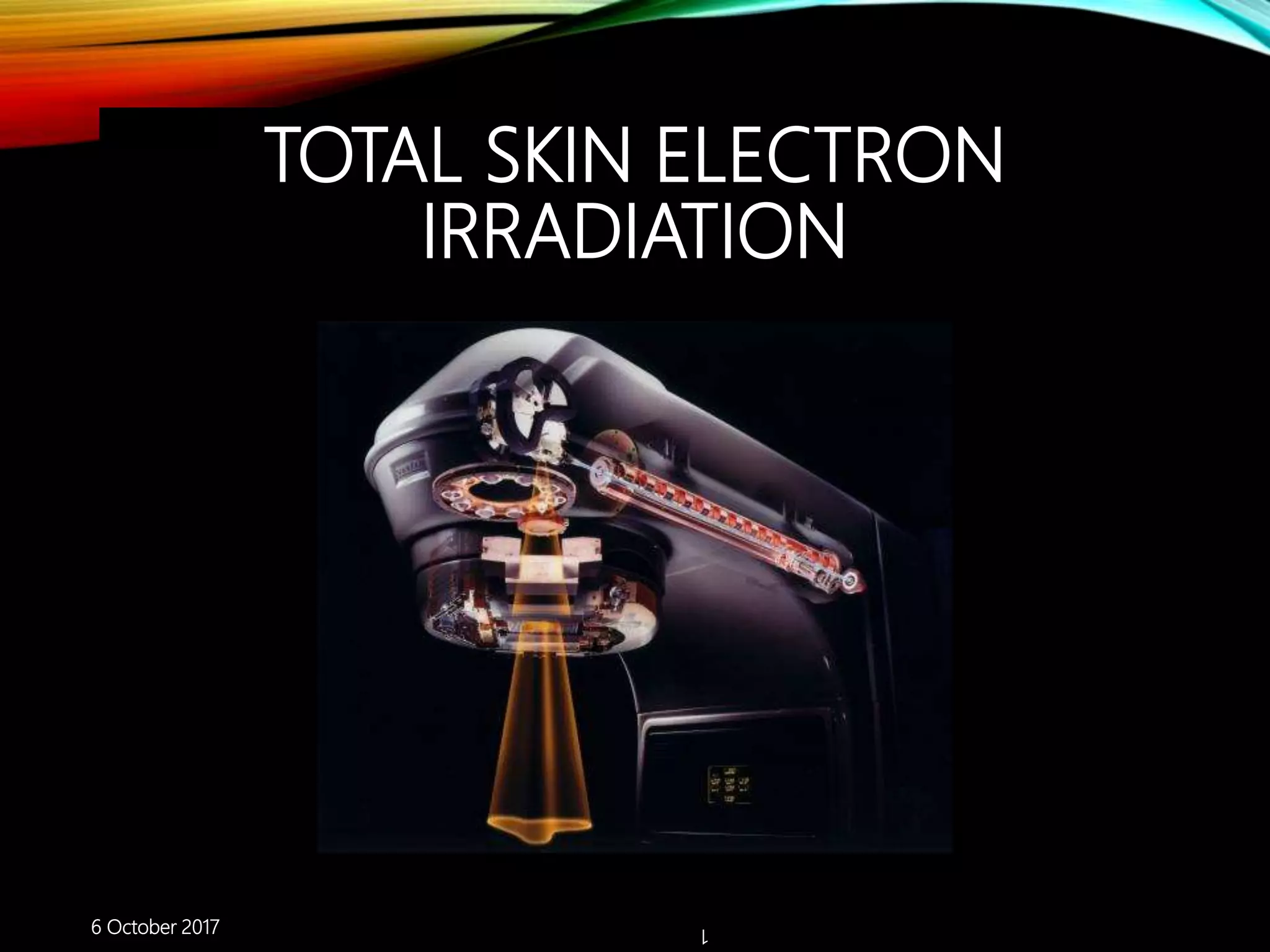
TOTAL SKIN ELECTRON
IRRADIATION
6 October 2017 1
 What Is Total Skin Electron Irradiation ?
Total skin electron irradiation (TSEI) is a
special radiotherapeutic technique that
aims to irradiate the patient’s whole skin
with the prescribed radiation dose while
sparing all other organs from any
appreciable radiation dose.
6 October 2017 2
Why Using Total Skin Electron
Irradiation ?
• TSEI technique is available only in major radiotherapy
centres.
• All contemporary TSEI procedures are based on
electron linacs.
• Uniform and High surface dose.
• Certain areas of the patient’s skin as well as some
organs (such as nails and eyes) may have to be
shielded in order to avoid treatment morbidity.
• The typical dose/fractionation regimen for TSEI is 40
Gy in 20 fractions.
6 October 2017 3
Physical And Clinical Requirements For (TSEI)
-
1.Physical specification of the large stationary electron field-
• Nominal SSD
• Electron Beam energy
• Field at treatment position and dose distribution
• Dose rate and photon contamination
2. A physical specification of the distribution resulting from the
super-position of multiple stationary electron fields-
• Dose distribution and dose rate for dose from electron and
photon .
3.Clinical Specification-
• Arise dose prescription
• Dose fractionation
• Boost field for underdose area
• Shielding design
6 October 2017 4
Total Skin Electron Irradiation
Techniques-
• Translational Techniques -
• In which the patient is
translated on a
stretcher through an
electron beam of
sufficient width to
cover the patient’s
transverse
dimensions.
6 October 2017 5
Total Skin Electron Irradiation Techniques-
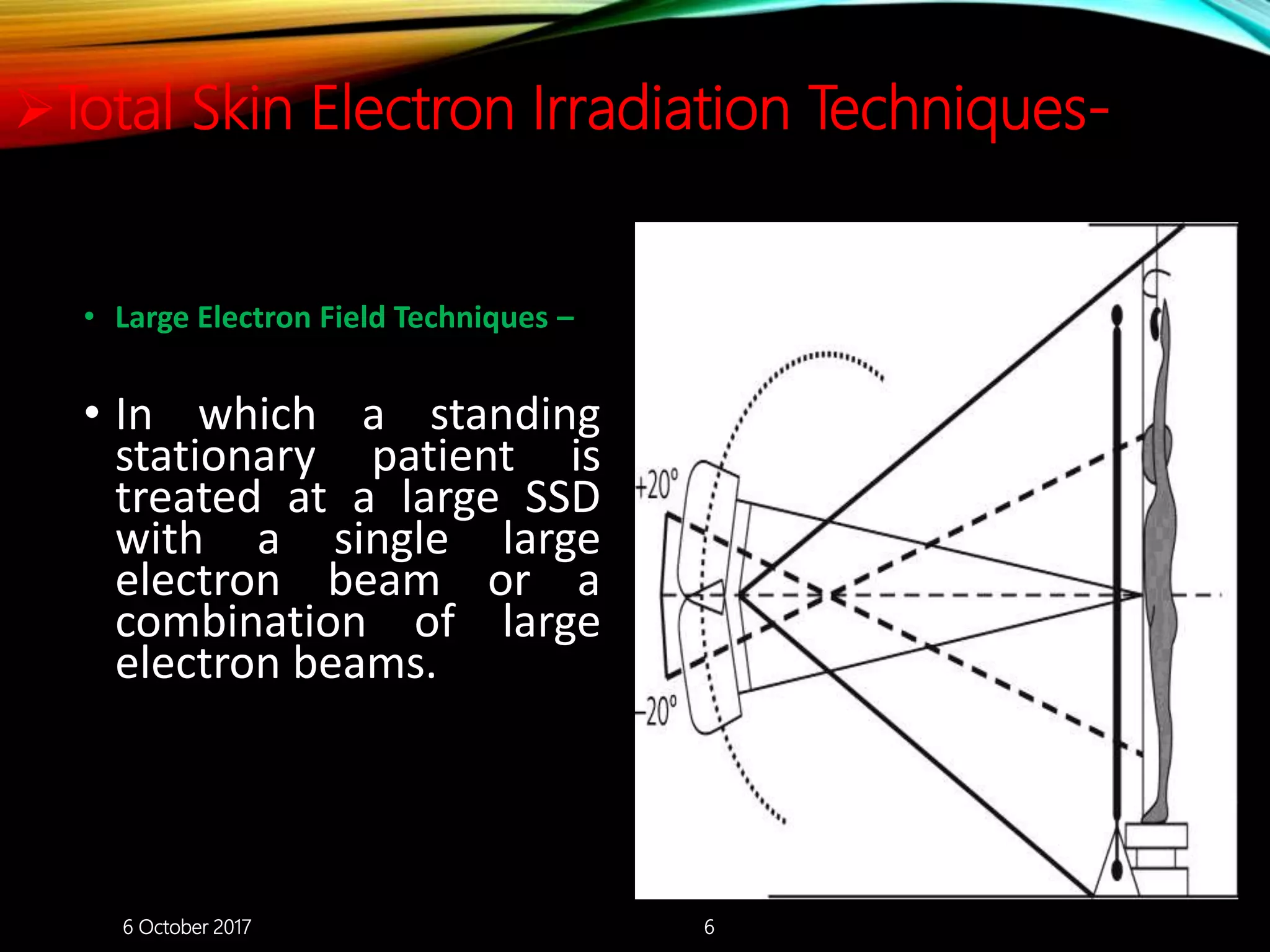
• Large Electron Field Techniques –
• In which a standing
stationary patient is
treated at a large SSD
with a single large
electron beam or a
combination of large
electron beams.
6 October 2017 6
Total Skin Electron Irradiation Techniques-
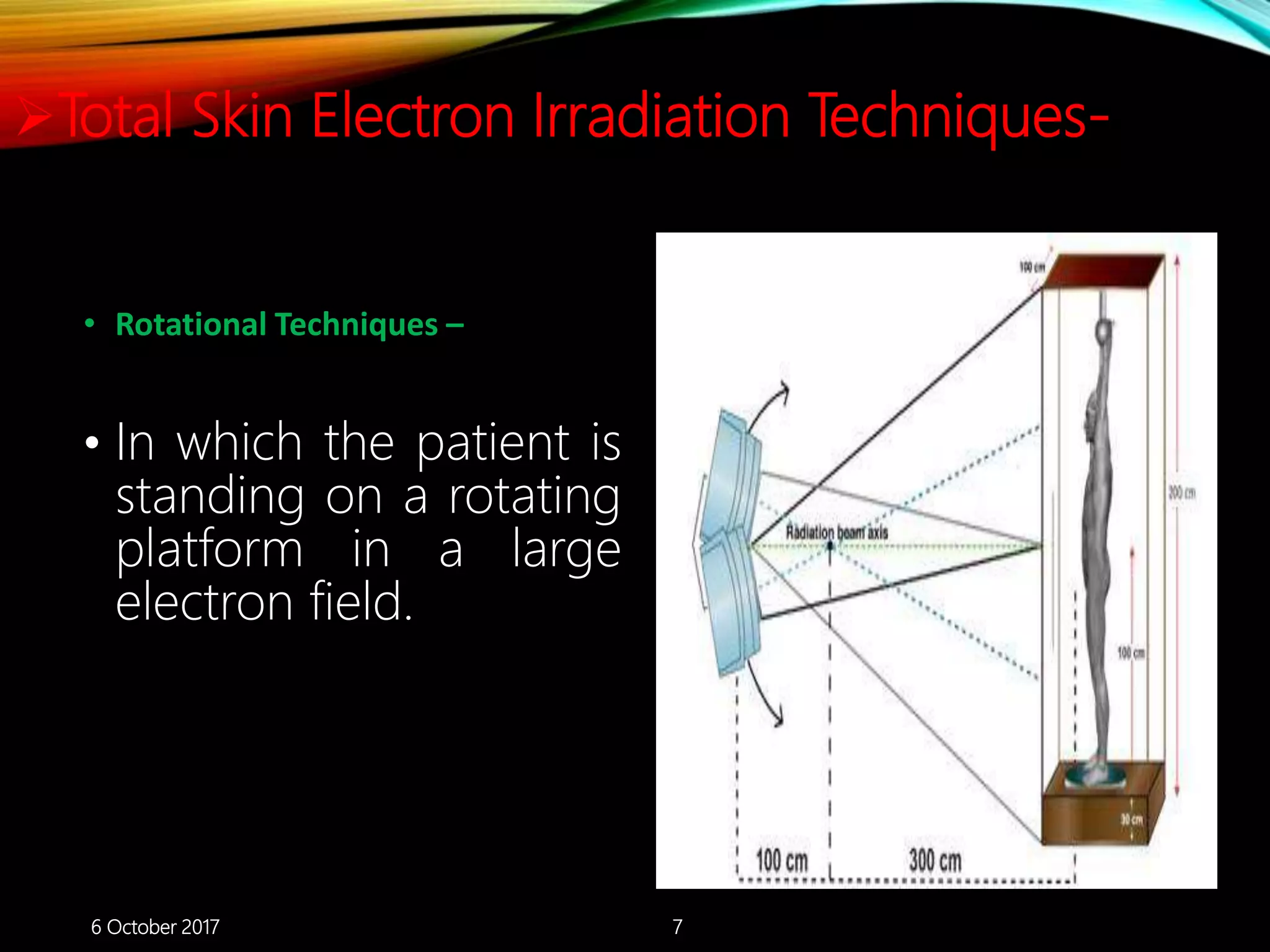
• Rotational Techniques –
• In which the patient is
standing on a rotating
platform in a large
electron field.
6 October 2017 7
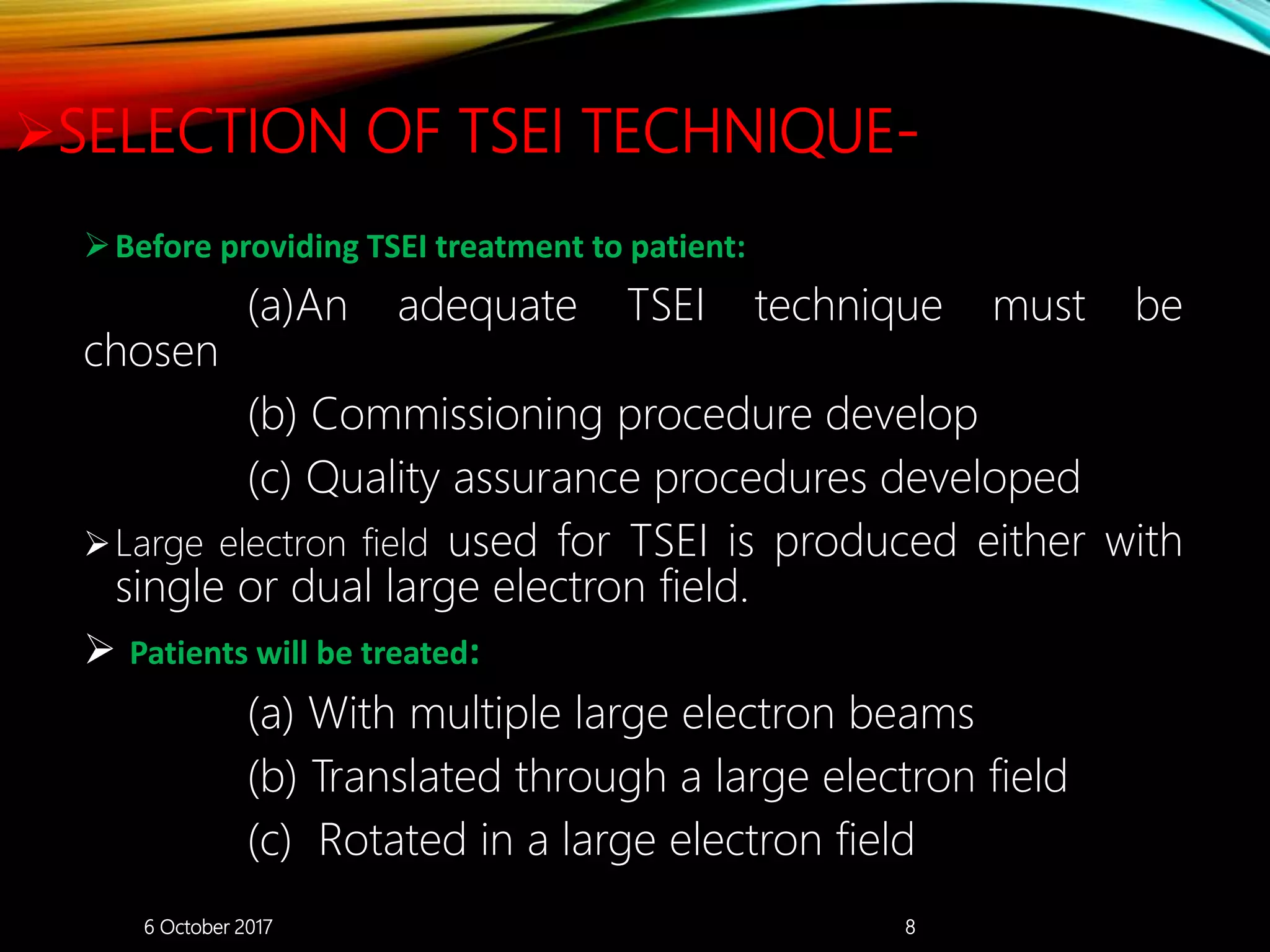
SELECTION OF TSEI TECHNIQUE-
Before providing TSEI treatment to patient:
(a)An adequate TSEI technique must be
chosen
(b) Commissioning procedure develop
(c) Quality assurance procedures developed
Large electron field used for TSEI is produced either with
single or dual large electron field.
 Patients will be treated:
(a) With multiple large electron beams
(b) Translated through a large electron field
(c) Rotated in a large electron field
6 October 2017 8
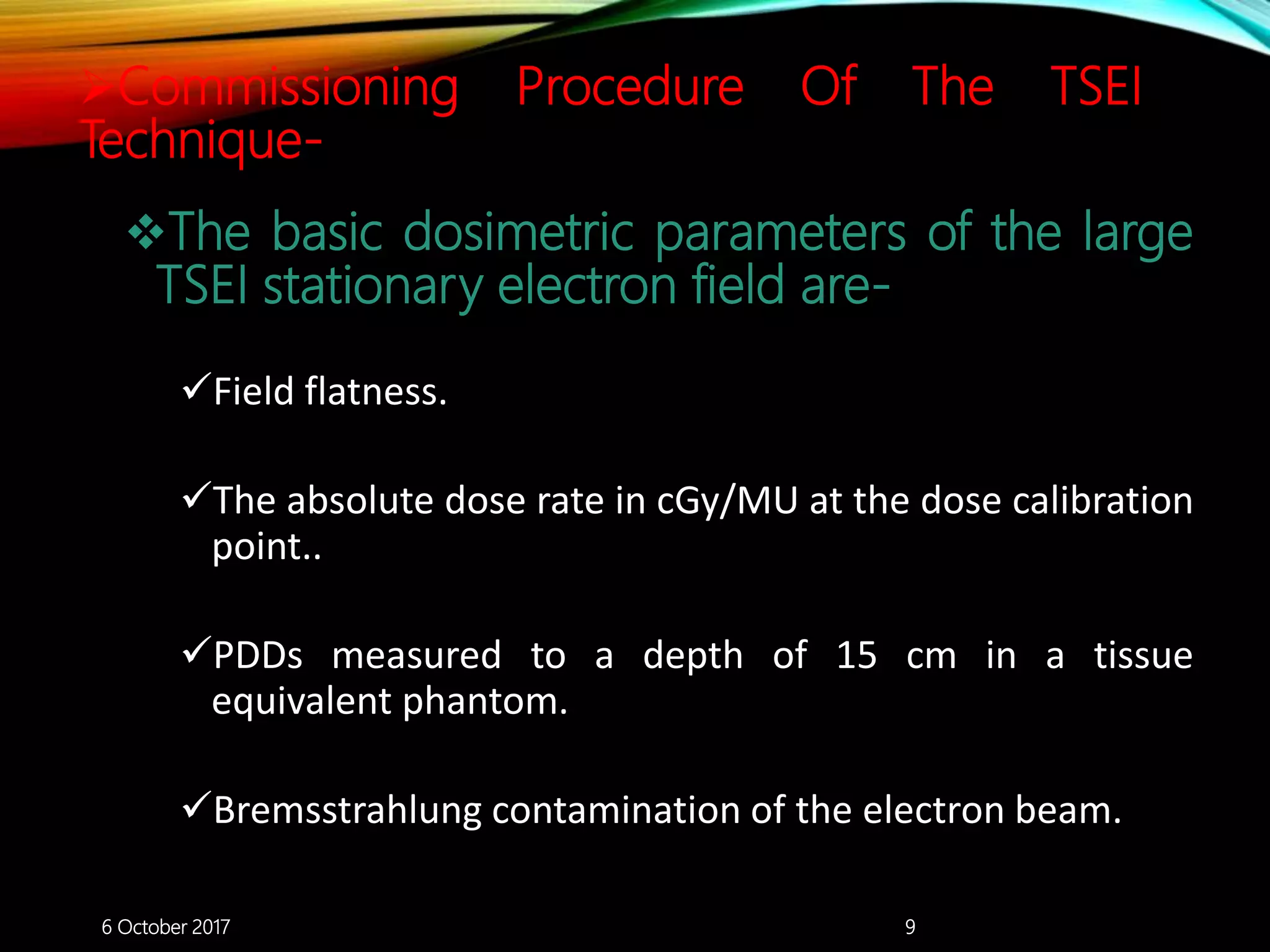
Commissioning Procedure Of The TSEI
Technique-
The basic dosimetric parameters of the large
TSEI stationary electron field are-
Field flatness.
The absolute dose rate in cGy/MU at the dose calibration
point..
PDDs measured to a depth of 15 cm in a tissue
equivalent phantom.
Bremsstrahlung contamination of the electron beam.
6 October 2017 9
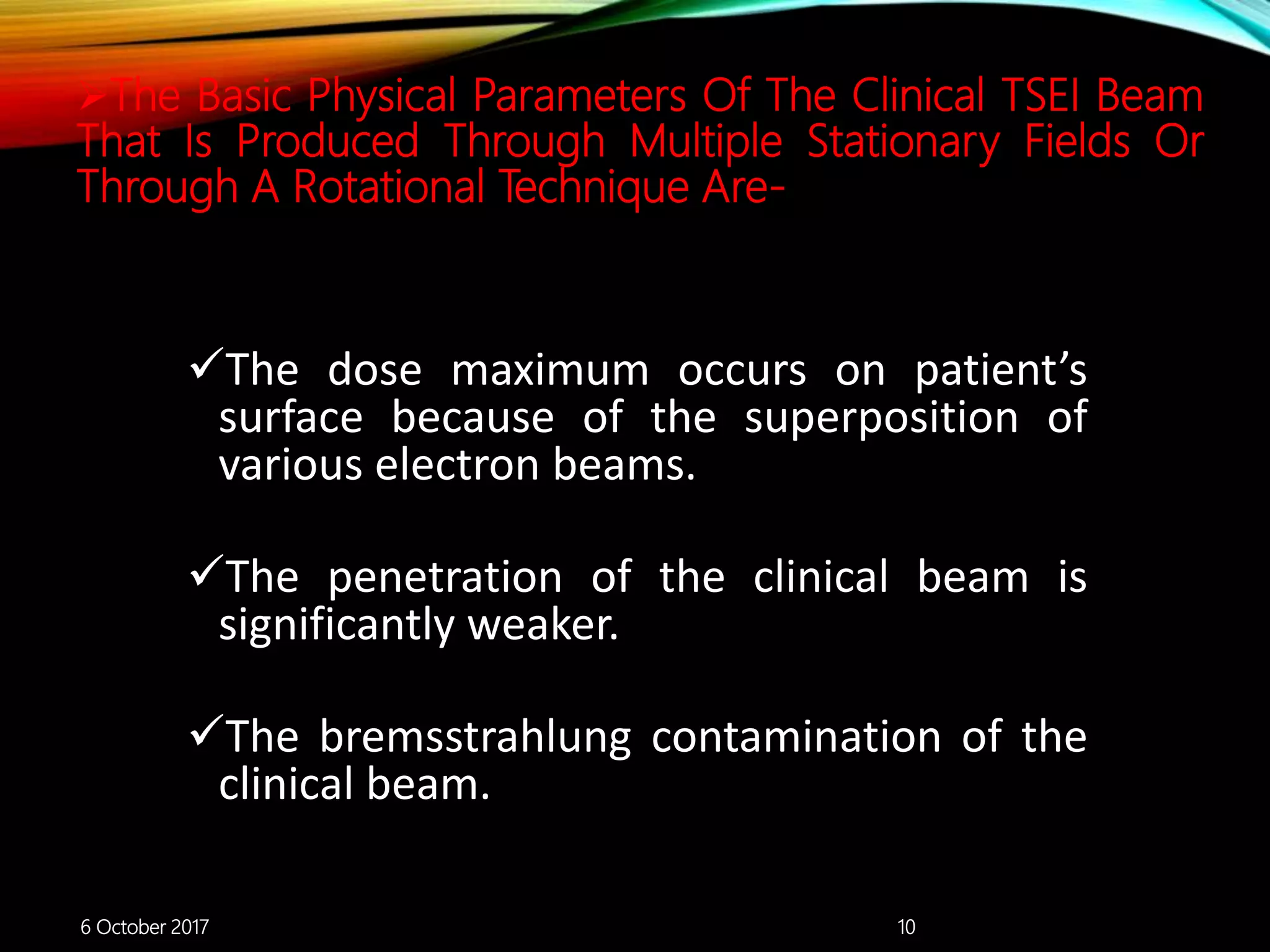
The Basic Physical Parameters Of The Clinical TSEI Beam
That Is Produced Through Multiple Stationary Fields Or
Through A Rotational Technique Are-
The dose maximum occurs on patient’s
surface because of the superposition of
various electron beams.
The penetration of the clinical beam is
significantly weaker.
The bremsstrahlung contamination of the
clinical beam.
6 October 2017 10
PDD For Photon Contamination-
• The PDD of the clinical
beam is shallower than
that of the stationary
electron beam.
• The dose maximum
occurs on patient’s
surface.
6 October 2017 11
Measurement Of Stationary And Clinical TSEI
Beams-
• Equipment required for calibration of the TSEI stationary and clinical
electron beams consists of-
• Various phantoms:
(a) Water equivalent slab phantoms
(b) Cylindrical phantoms
(c) Anthropomorphic body and head phantoms
• Various dosimeters:
(a) Cylindrical and parallel-plate ionization chambers
(b) Thermoluminescent dosimeters
(c) radiographic films and radiochromic films.
6 October 2017 12
Quality Assurance In Total Skin Electron
Irradiation-
Quality assurance in total skin electron irradiation
requires a strict adherence to quality assurance
protocols.
Quality assurance protocols in TSEI fall in three
categories:
(a) Basic quality assurance protocol
(b) Pre-treatment quality assurance protocol
(c) Treatment quality assurance protocol
6 October
2017
13
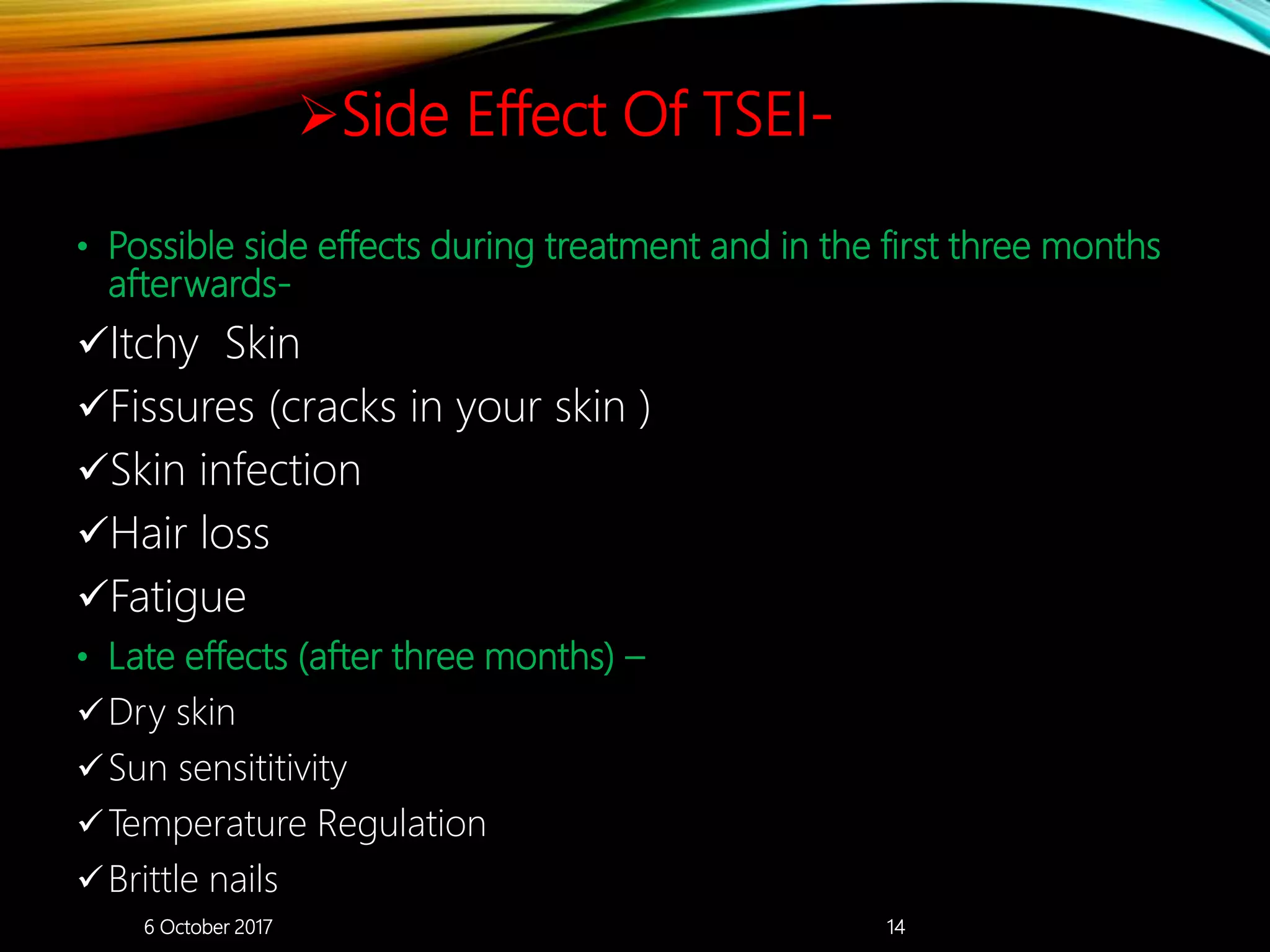
Side Effect Of TSEI-
• Possible side effects during treatment and in the first three months
afterwards-
Itchy Skin
Fissures (cracks in your skin )
Skin infection
Hair loss
Fatigue
• Late effects (after three months) –
Dry skin
Sun sensititivity
Temperature Regulation
Brittle nails
6 October 2017 14
Conclusion-
All the techniques employed for TSEI are specialized
and time-consuming, requiring extensive
development and careful dosimetry, planning,
execution, and quality control.
Referral to centres specialising in TSEI is often the
preferred option, thus balancing the effort required
to implement and maintain such techniques against
the number of patients for which it is provided
6 October 2017 15
Reference Book-
• Radiation oncology physice,E.B podgorsak,IAEA,2005
• Total skin electron theraphy, The Clatterbridge Cancer
Centre,journal
• www.slideshare.net/tsei
• Total skin electron irradiation, Northern Centre for Cancer
Care (NCCH).
6 October 2017
16
6 October 2017 17

Total skin electron irradiation

  • 1.
  • 2.
     What IsTotal Skin Electron Irradiation ? Total skin electron irradiation (TSEI) is a special radiotherapeutic technique that aims to irradiate the patient’s whole skin with the prescribed radiation dose while sparing all other organs from any appreciable radiation dose. 6 October 2017 2
  • 3.
    Why Using TotalSkin Electron Irradiation ? • TSEI technique is available only in major radiotherapy centres. • All contemporary TSEI procedures are based on electron linacs. • Uniform and High surface dose. • Certain areas of the patient’s skin as well as some organs (such as nails and eyes) may have to be shielded in order to avoid treatment morbidity. • The typical dose/fractionation regimen for TSEI is 40 Gy in 20 fractions. 6 October 2017 3
  • 4.
    Physical And ClinicalRequirements For (TSEI) - 1.Physical specification of the large stationary electron field- • Nominal SSD • Electron Beam energy • Field at treatment position and dose distribution • Dose rate and photon contamination 2. A physical specification of the distribution resulting from the super-position of multiple stationary electron fields- • Dose distribution and dose rate for dose from electron and photon . 3.Clinical Specification- • Arise dose prescription • Dose fractionation • Boost field for underdose area • Shielding design 6 October 2017 4
  • 5.
    Total Skin ElectronIrradiation Techniques- • Translational Techniques - • In which the patient is translated on a stretcher through an electron beam of sufficient width to cover the patient’s transverse dimensions. 6 October 2017 5
  • 6.
    Total Skin ElectronIrradiation Techniques- • Large Electron Field Techniques – • In which a standing stationary patient is treated at a large SSD with a single large electron beam or a combination of large electron beams. 6 October 2017 6
  • 7.
    Total Skin ElectronIrradiation Techniques- • Rotational Techniques – • In which the patient is standing on a rotating platform in a large electron field. 6 October 2017 7
  • 8.
    SELECTION OF TSEITECHNIQUE- Before providing TSEI treatment to patient: (a)An adequate TSEI technique must be chosen (b) Commissioning procedure develop (c) Quality assurance procedures developed Large electron field used for TSEI is produced either with single or dual large electron field.  Patients will be treated: (a) With multiple large electron beams (b) Translated through a large electron field (c) Rotated in a large electron field 6 October 2017 8
  • 9.
    Commissioning Procedure OfThe TSEI Technique- The basic dosimetric parameters of the large TSEI stationary electron field are- Field flatness. The absolute dose rate in cGy/MU at the dose calibration point.. PDDs measured to a depth of 15 cm in a tissue equivalent phantom. Bremsstrahlung contamination of the electron beam. 6 October 2017 9
  • 10.
    The Basic PhysicalParameters Of The Clinical TSEI Beam That Is Produced Through Multiple Stationary Fields Or Through A Rotational Technique Are- The dose maximum occurs on patient’s surface because of the superposition of various electron beams. The penetration of the clinical beam is significantly weaker. The bremsstrahlung contamination of the clinical beam. 6 October 2017 10
  • 11.
    PDD For PhotonContamination- • The PDD of the clinical beam is shallower than that of the stationary electron beam. • The dose maximum occurs on patient’s surface. 6 October 2017 11
  • 12.
    Measurement Of StationaryAnd Clinical TSEI Beams- • Equipment required for calibration of the TSEI stationary and clinical electron beams consists of- • Various phantoms: (a) Water equivalent slab phantoms (b) Cylindrical phantoms (c) Anthropomorphic body and head phantoms • Various dosimeters: (a) Cylindrical and parallel-plate ionization chambers (b) Thermoluminescent dosimeters (c) radiographic films and radiochromic films. 6 October 2017 12
  • 13.
    Quality Assurance InTotal Skin Electron Irradiation- Quality assurance in total skin electron irradiation requires a strict adherence to quality assurance protocols. Quality assurance protocols in TSEI fall in three categories: (a) Basic quality assurance protocol (b) Pre-treatment quality assurance protocol (c) Treatment quality assurance protocol 6 October 2017 13
  • 14.
    Side Effect OfTSEI- • Possible side effects during treatment and in the first three months afterwards- Itchy Skin Fissures (cracks in your skin ) Skin infection Hair loss Fatigue • Late effects (after three months) – Dry skin Sun sensititivity Temperature Regulation Brittle nails 6 October 2017 14
  • 15.
    Conclusion- All the techniquesemployed for TSEI are specialized and time-consuming, requiring extensive development and careful dosimetry, planning, execution, and quality control. Referral to centres specialising in TSEI is often the preferred option, thus balancing the effort required to implement and maintain such techniques against the number of patients for which it is provided 6 October 2017 15
  • 16.
    Reference Book- • Radiationoncology physice,E.B podgorsak,IAEA,2005 • Total skin electron theraphy, The Clatterbridge Cancer Centre,journal • www.slideshare.net/tsei • Total skin electron irradiation, Northern Centre for Cancer Care (NCCH). 6 October 2017 16
  • 17.