RECENT ADVANCES IN LINEAR
ACCELERATORS
DR. UPASNA SAXENA
HCG CANCER CENTRE, BORIVALI[MUMBAI]
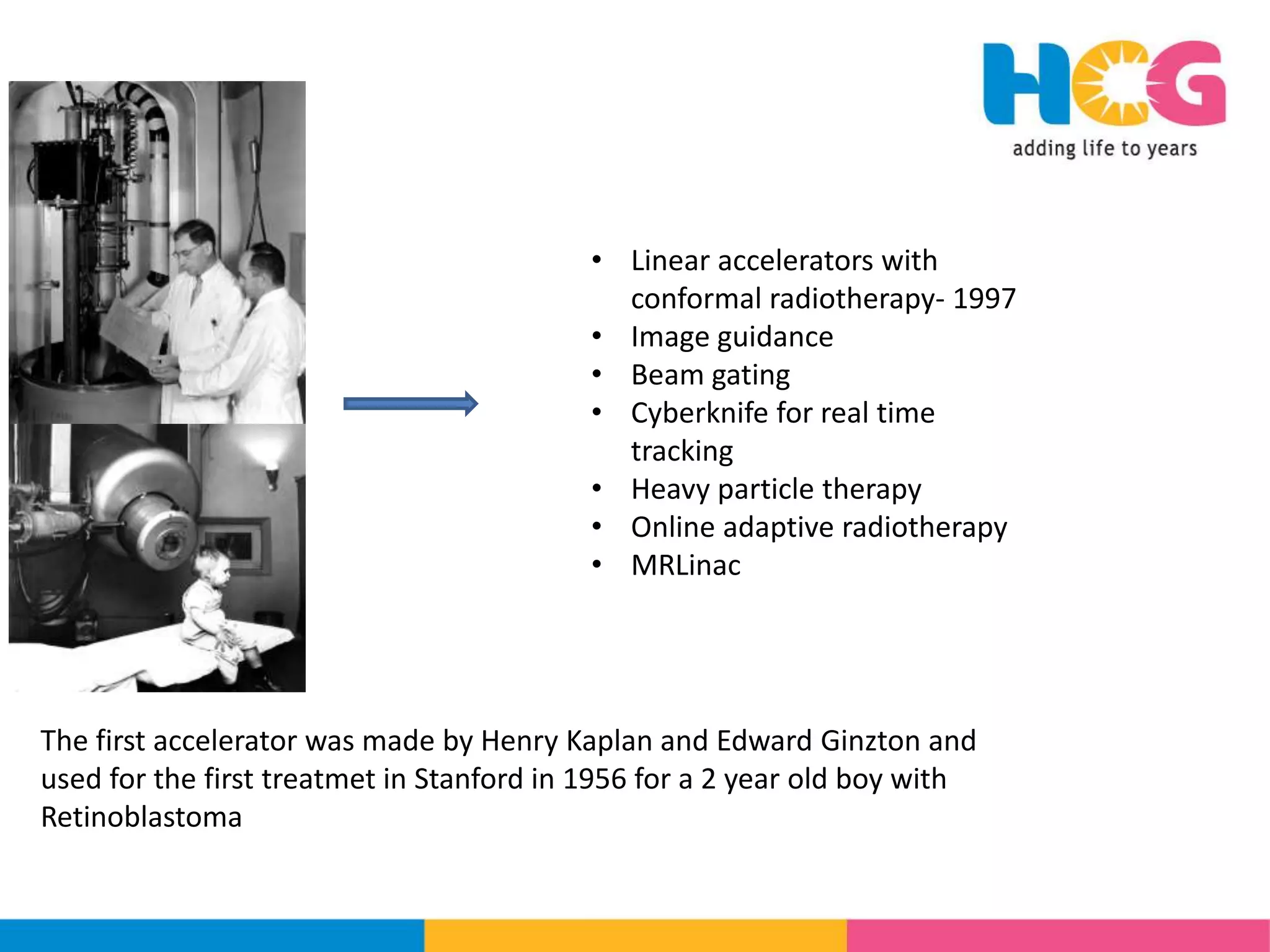
The first accelerator was made by Henry Kaplan and Edward Ginzton and
used for the first treatmet in Stanford in 1956 for a 2 year old boy with
Retinoblastoma
• Linear accelerators with
conformal radiotherapy- 1997
• Image guidance
• Beam gating
• Cyberknife for real time
tracking
• Heavy particle therapy
• Online adaptive radiotherapy
• MRLinac
ADVANCES IN LINAC
TECHNOLOGY
• Treatment planning
• Beam constituents (energy type)
• Beam shaping
• Treatment delivery
• Treatment verification
• Online adaptive radiotherapy
• MRLinac
• Under evaluation – mobile linac units, biology
guided radiotherapy platforms
TREATMENT PLANNING
• Evolved from 3DCRT to IMRT/IGRT/VMAT/SBRT
• Multileaf collimators
• Leaf width – 1 cm to
1mm
• Single stack or double
stack
• Revolutionary discovery of
FFF [Flattening free filters]
• Multiple fine beams
generate a plan
• The fine beam sizes
depends on the iris
Daijiro Kobayashi et al, 2021
Highly conformal plan on cyber knife
BEAM CONSTITUENTS
• Orinigally only photons and electrons
• Expanded to use of heavier particles like –
protons, carbon ions, neutrons
• Protons are the most commonly used
• Particles are accelerated using cyclotrons, and the
speed decides depth of penetration
• The Bragg’s peak is the point of maximum dose
deposition, beyond which the dose is zero or
nearly zero
• The first proton centre was in Clatterbridge centre
of oncology, UK in 1989
• By 2013, close to 1 lakh patients had been treated
with proton and 13,000 by carbon ion
• By 2020, there were 89 proton centres across the
world and nearly 200000 patients treated with
protons
• Five manufacturers make proton beam therapy-
Mevion medical systems, Ion Beam Applications,
Hitachi, Protom International and Varian Medical
systems
Bragg’s peak
Heavy particle therapy is essentially found useful in
• Paediatric malignancies
• Skull base malignancies
• Prostatic cancers
• Gastrointestinal malignancies
• Reirradiation
• Its being used in other sites as well and data is
being established
PROTON THERAPY
• Very expensive setup
• Expensive treatment
TREATMENT DELIVERY
• Cone beam CT scan
• Six dimensional positional correction on the
treatment couch
• 4 dimensional image acquisition and
treatment
• Intrafraction imaging
MOTION MANAGEMENT
• It is the management of motion due to bodily
functions like breathing, swallowing etc.
• Respiration is managed by [- Edward Brandner et al, Medical Physics
2017]
– Margins to account for the motion - ITV
– Motion mitigation – abdominal compression
– Gating of beams
– Breath hold using ABC [active breath coordinator]
– Real time tracking
– Surface guided radiotherapy [SGRT]
ITV generation - Edward Brandner et al,
Medical Physics 2017
Respiratory gating using Varian RPM,
Changzi et al, 2012, Giraud et al 2010
Respiratory mitigation compression
plate or belt Active breath coordinator – breath control valve and
spirometer with beam on during breath hold
Surface guided radiotherapy – using
Align RT
Real time tumour
tracking cyber knife
6D Skull tracking
X-sight spine tracking
Fiducial tracking – most accurate
Synchrony vest, fibre optic beacons tracking
Cyber knife 7
TREATMENT VERIFICATION
• Surface marking to 2 D imaging to using EPID
• To 3D imaging  MVCT, KVCT
• Fiducial tracking
• CINE imaging
• Intrafraction imaging
• Online adaptive therapy
ONLINE ADAPTIVE RADIOTHERAPY
IN LINEAR ACCELERATOR
The challenges involved in delivering on-couch adaptive
therapy are addressed, in the Ethos system,through a replanning workflow
that has been reduced to well-defined
and predictable clinical decision points in order to lower the
cognitive load of the clinician.
ARTIFICIAL INTELLIGENCE BASED
ONLINE ADAPTIVE RADIOTHERAPY
FOUR Decision points
• Accepting the image
• Assessing and modifying the ‘influencer’ structures or OARs
• Assessing and modifying the target organs – creating the session model
• Selecting the plan – scheduled or adapted
• Deep learning convolutional neural network [CNN]
and hyperparameters in these models are used
• Uses the acquired 3D iCBCT as input to the neural
network and gives a similar output that the
clinician can assess and accept
• Once image is approved, deformable registration is used by the system to
make an image S-CBCT that conforms with the CBCT
• Then the IOE (Intelligent optimization engine) generates IMRT/VMAT plans
with
 high degree of dose conformity
 Due significance to OAR doses
 intelligent trade off clinically
• The IOE works by having Q-functions [quality functions] laid down before
hand for the planning purpose
 Target upper dose [TUD] goal
 Target lower dose [TUD] goal
 Organ upper dose [OUD] goal
• Artificial intelligence makes multiple plans to choose from, approval of
clinician to move ahead and a very fast process
• It works by making
physics volumes,
reiterations, more
control functions
Automated dose accumulation is calculated. This
– Demonstrates the intended dose is delivered
– Provides understanding and doucumentation of
the process
– Identifying need to resimulation
• Assessed ART in 39 pelvic patients on Ethos [varian] in the preclinical phase
• 75% patients needed either minimal editing or no editing
• Adaptive plans showed similar PTV coverage, 88% plans were actually better – IMRT being better than VMAT
• Other plan evaluation parameters were similar, MUs were occasionally higher. Infact CI, HI were superior for
adaptive plans
• They also met the QA satisfactorily
• Single dose plans needed one iteration while SIB plans needed 2-3 review plans
• Time from CBCT approval to starting treatment – 17.6 min
• Reduced V45 to bowel bag 24-30%
• Adaptive plan generation was found superior to plan library approach – possibly due to reduction of margins, the
high dose PTV volume was reduced even upto 42%
As compared to MRLinac
PROS
• Training requirements are lesser on CT based oART- workflow training is essential
• On couch time is similar to MRogRT
• logistically and financially the CT based systems for oART are superior in feasibility
CONS
• Delineation is superior for soft tissue in MR based systems
• Automated influencer contour generation might not be possible in certain clinical
situations [post prostatectomy, urinary catheter in situ etc]
• The intrafraction imaging is not yet incorporated in the CT based systems [like 3D cine
MRI in the MR based systems]
• oART using 3mm CTV to
PTV made a significant
improvement
• Total time should be upto
18 mins for relevance of
adaptive online planning
MRLINAC
MRSim & MRLinac
• MR-Sim is a diagnostic MRI like the CT sim that is a hybrid of MR and CT
• helps in contouring targets and OARs for radiotherapy planning.1 using electron density allocatoin
• MR Sim may or may not be used for planning purpose with a MR Linac
• MR CT coregistration for contouring can cause errors of 1-2mm17
• Combined use of MR Sim and MR Linac holds promise for better delineation and accturate delivery
• MR Sim has features like [J Applied Clin Med Physics. 2015;16(2):218-240., Phys Med Biol. 2015;60(22):R323-361.]
• coil bridges to prevent deformation of the patient’s body contour
• MRI compatible mobilization devices to minimize patient movement
• rigid flat table top
• laser positioning system
• wider bore
• patient imaged in treatment (as opposed to imaging) position
• dedicated scan protocols.
MRLinac
• MR linac is a hybrid device with a linear accelerator to deliver radiotherapy and a MRI
scanner [somewhat like the CBCT acquisition in other linacs]
• It allow for online real time MR imaging for customization and high-precision adaptive
radiotherapy.Termed as MR guided radiotherapy [MRgRT]
• MR-linac systems offer real-time tumour tracking and beam gating.
• The first MR based treatment was done in 2014 in Siteman Cancer Centre, Cleaveland,
on the Co60 based MRIdian
• The first MRLinac based treatment was done in 2017 at the Henry Ford Cancer Institute,
Detroit on MRIdian MR Linac of Viewray
• Two main models are available for clinical practice, the Unity by Elekta and the MRIdian
MR Linac of Viewray
• (CADTH rapid response report: summary with critical
appraisal). Ottawa (ON): CADTH; 2019
• Radiol Oncol. 2019;132.
MR Linac configurations
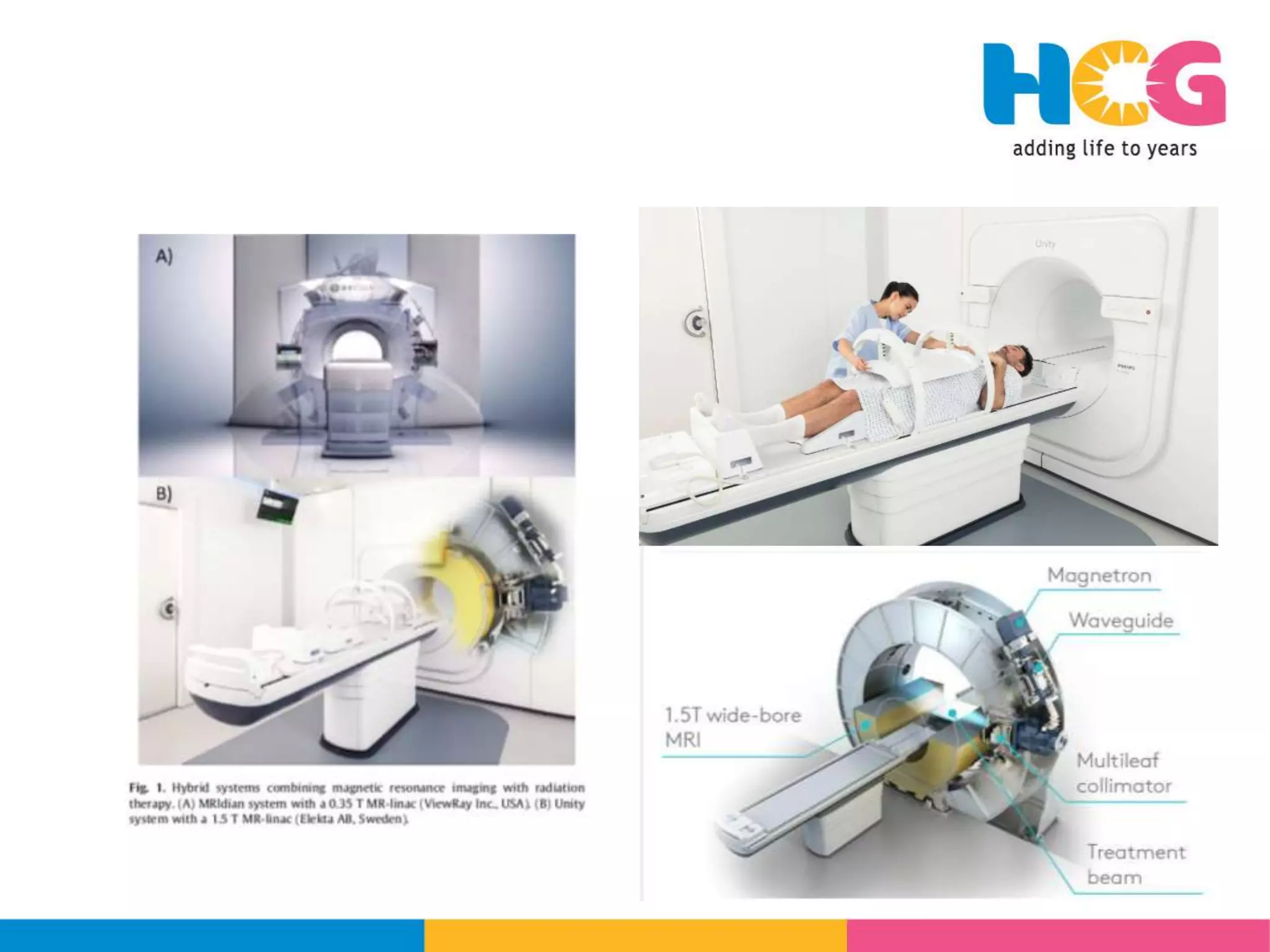
MRIdian
• 0.35 Tesla MRI with split magnets and
field aligned along craniocaudal axis
of patient
• It has two models - Co60 [MRIdian]
and 6 MV linac [MRIdian Linac]
• The beam does not pass between
magnetic field
• By ViewRay
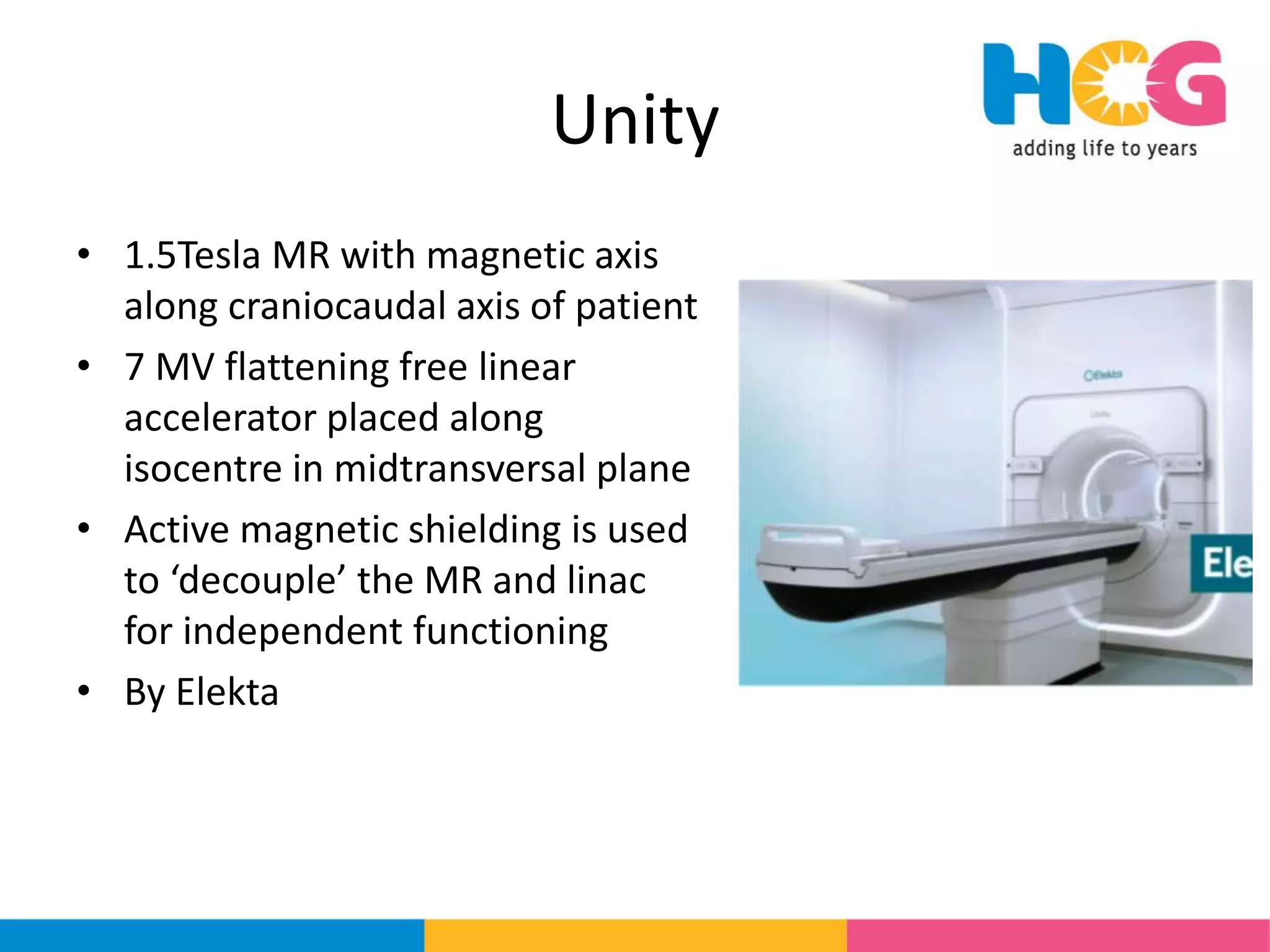
Unity
• 1.5Tesla MR with magnetic axis
along craniocaudal axis of patient
• 7 MV flattening free linear
accelerator placed along
isocentre in midtransversal plane
• Active magnetic shielding is used
to ‘decouple’ the MR and linac
for independent functioning
• By Elekta
• Beam is collimated by a ‘double focused stacked multileaf
collimator’- so the length is 11 cm [5.5 cm for each MLC]
• The beam passes only through a 5 mm thick fibre glass
between the split magents, NOT through the magnetic field
due to split magnets
• Use reference plan dosimetry to assess the need to replan
BENEFITS FROM MR LINAC
• Superior in imaging soft tissue – target and OAR
• Precise contouring enables margin reduction and if needed dose
escalation- which could promise better control rates [Br J
Radiol. 2019;92(1094):20180505.]
• Multiple imaging is not associated with radiation dose escalation
• Regular imaging helps in response assessment, need of plan adaptation or
change of treatment objective [J Med Imag Radiation Sci. 2019;50(2):195-198].
• Differential response can be used to assess genomics related biological aspects
like hypoxia and resistance
• Multiple studies evaluating outcomes in lung, prostate and pancreatic cancers have shown
– No increase in lung toxicity. . (CADTH rapid response report: summary with critical appraisal). Ottawa (ON): CADTH;
2019
– Improved OS in pancreatic cancer - Stereotactic MRI-guided On-table Adaptive Radiation Therapy
(SMART) study - Physics Imaging Rad Oncol. 2019;9.
– Similar study for prostatic cancer, concluded that MR-linac was feasible and well-tolerated. Cancer
Med. 2019;8(5).
• Multiple studies are ongoing for technical feasibility and assessment of outcomes for
different sites using MRgRT
Workflow includes
Image acquisition after MRI safety checks
Recontouring of targets and OARs
Plan generation/selection and treatment
delivery
PREPARATION PRIOR TO USING
oMRgRT (online MR guide RT)
• Training mainly includes
– MRI safety training
– Vendor specific training of machine
– Role specific training of RTT/Physicist/dosimetrist/radiation oncologist
• Adequate training of positing, hard ware, soft ware, image accquisition and dry runs prior to
initiation of treatment at the facility
• The P-FMEA mode is a useful structured framework to enhance quality and safety – process failure
mode and effect analysis. It involves 3 steps
– FIRST -Establishing workflow
– SECOND - Predicting failures – their risk/rate of occurrence, risks involved, severity, detectability
– THIRD - Mitigation strategies and SOP generation
SAFETY CONCERNS
• Safety issues related to the projectile capabilities of metallic objects in the strong magnetic field
– Screen patients for contraindications such as aneurysm clips, cardiac bypass surgery, some heart valves, embedded wires, stimulators, batteries,
implanted electrodes, shunts, pumps, pacemakers, and some penile implants.Med Phys. 2012;39(11)
– Even non magnetic metallic implants may cause artefacts in the MR images, such as signal loss, intense areas of signal accumulation, and
distortion in areas near the implant.35
– Changing into gowns and removal of all metallic accessories can be followed by use of hand held metal detector
• The loud knocking noise - can be a deterrant, need ear protection, can cause peripheral nerve stimulation
• Thermal effects of radiofrequency can cause heating of the body
• Emergency training – use of magnetic quench and evacuation procedure
• Clear instructions and emergency handling instructions must be readily available at the area
• Use MRLinac specific setup accessories and QA equipment only
• Safe handling and proper usage of magnetic coil - for minimal image deterioration and dose attenuation
ROLE SPECIFIC TRAINING
• Selection of people for the work and conducting training
• Assessment and resolution of technical factors
– electron density assessment
– contour generation
– Planning
– Verification
– adaptation
• quality assurance training of physicist
• Training for RTT
• Clinical aspects of MR training is essential for radiation oncologist/physicist/RTT/dosimetrist by –
– Internship
– Fellowship
– professional board certification
– training by ESTRO assigned centres
Often responsibilities cross traditional roles/ responsibilities – the overlap degree must be
well defined in the SOP
New treatment planning systems
MR safety, patient screening
MR-based anatomy — image assessment on MRI
versus cone beam CT versus CT
MR image quality, formation, scan optimization and
interpretation
Multimodality image registration
Contour/modify organs at risk for adaptive
radiotherapy
Adaptive radiotherapy strategies and
methodologies
Novel radiotherapy delivery techniques
Daily/weekly quality assurance and quality control
requirements.
TREATMENT IMPLEMENTATION
IMAGE ACCQUISITION AND APPROVAL
CONTOURING/PLAN ASSESSMENT AND DELIVERY
• A gold standard contouring with quality checks– using either rigid or deformable registration
– Partial recontouring of OARs [2-3 cm around target volume]
• Plan generation and approval – about 15 minutes
• Repeat MRI to check for changes
• Initiate treatment
• Cine MRI checks for any geographical miss, and manually stopping if present
– MRIdian - 8 frames of saggital images per second
– unity images in all three planes
• The complete process from beginning to end could extend to 15-30 mins or if complete replanning is needed, could take upto 60 minutes
• MRIdian permits gating and breath hold [duty cycle efficiency 67%-87%]
• Unity compiles daily data each day for composite treatment at end and offline analysis
• Phantom based QA in not possible since moving the patient invalidates adaptive workflow- hence Monte Carlo based tool in
PATIENT SELECTION
• Clinical parameters
– Physically unsuitable – implants/pacemakers
– Clinically unsuitable – severe psychological issues, severe claustrophobia, inability to
understand instructions
– Borderline unsuitable – mild claustrophobia- attempt anesthesia/counselling/
medicines/music/aromatherapy
– Suitable
• Oncology criteria – prostate, head and neck, pancreas/upper abdomen, pelvic
treatments, reirradiation, SRS/SBRT. Others cervix, breast, esophagus, brain,
rectum [international MR-linac Consortium ]
• Soft criteria
– Elderly / Frail patient
– Obese [BMI>40] – due to bore size, imaging artifacts
– Chachexic[WEIGHT<40Kg] – due to body heating
Unsuitable patients to be shifted without delay to other CT based linear accelerator
COST CONCERNS WITH MR
LINACS
• Its anticipated that by the nextdecade it will be standard practice to use MR Linac
• Concerns - longer on couch time and higher cost of installation
• The equipement and installation cost
– 8.5-10 million dollars for the Elekta MR Linac Unity
– 8-10 million dollars for ViewRay MRIdian
• Other cost factors would be
– Vault construction – lesser for MRIdian system due to ‘split magnet’ design
– Additional staff and their training
– Dedicated staff at the console
Lamb et al, 2017
CAUSES OF EXTENDED TIME –Lamb et al, 2017
1. Planner or physician not responding to pages promptly
2. Planner or physician unfamiliar with online planning tools
3. Contouring more than necessary or in more details than necessary
4. Contouring error made and observed during adaptive plan evaluation
5. Making in depth plan parameters changes
ADDITIONAL TARGETS FOR BENEFITS
1. Faster and user friendly interface for plan selection
2. Optimisation engine that makes multiple plans parallelly to choose from
3. Faster automation and better image quality
4. Decision support tool for clinicians
• MRIdian linac detailing
• The system [MR+CT] has a localization accuracy of 1+/-0.1 mm [Wen et al]
• Due to small bore of 70 cm,
– Lateral shift at high couch positon is +/-7cm.
– Lesser for lower couch position
• Beam is 6MV – FFF delivered at SAD 90 cm
• Two stacks of MLC [5.5 cm each so total 11 mm total height].
• Total 138 leaves
• Leaf width at isocentre 8.3 mm
• Field size – Bohoudi et al
– Smallest – 0.2x0.415 cm 2
– Largest – 27.4x24.2 cm2
• Six shielding compartments[known as buckets] are mounted on the gantry to
house the parts of linac – gun, magnetron, MLC as shown in image]
• The shielding has
– Ferromagnetic cylinders to block magnetic fields from reaching linac
– Radiofrequency shields [with copper reflectors and carbon absorption to prevent RF noise
from disturbing magnetic field]
• Registration - rigid or deformable
• Contouring – with or without CT/MRI registration
• Plan options – 3DCRT & IMRT
• If MR is used to contour and plan, bulk electron density allocation is done
– using six pre-decided densities
– custom density allocation.
• Average time patient in to plan approval on cobalt MRIdian
– 12+/-4.5 mins by Bohoudi et al
– 24 mins by Lamb et al
• Cine MRI deformable registration with reference image
• allows for gating of the beam [in both free breathing and breath hold]
• Post treatment system generates a report of MU and MLC positions, recalculations and composite
of treatment delivered can also be generated and viewed.
• Cai et al and Lamb et al have also developed an in house automated system for plan evaluation and
quality checks
• Adaptive gated MRLinac based SBRT required slots upto 90-120 minutes [from
patient in to out]- Lamb et al 2017- MEDIAN TIME TO BEAM COMMENCEMENT WAS 55
MINS [34-99 MINS]
ONGOING TRIALS
Technical feasibility of
MRLinac. Started in 2020
By the MRLinac consortium.
Started in 2019
• IJROBP, poster Q&A session, 2020
• Zhang et al and Peronie et al described feasibility of MrgoART, however
the validation had not been done previously as has veen addressed here
by Mittauer et al
• Abdominal deformable phantoms [with material compatibility for CT and
MRI] and dose delivered with replanning was assessed using dosimeters
• The dose vector fields [DVF] were with in 5 mm which is in the acceptable
limits as per TG132
• Accumulated maximum dose variation was 0.21 Gy for arithmetic
calculation and 0.31 Gy for deformed calculation – for a plan of 25Gy/5#
NEWER HORIZONS
-BIOLOGY GUIDED RADIOTHERAPY
MOBILE LINEAR ACCELERATORS
REFLEXION X1
• First biology guided SBRT
• Incorporates PET scanner
• Phase I study underway
ADVANCED CONCEPT COMPACT
ELECTRON LINEAR-ACCELERATOR
(ACCEL)
• ACCELprogram’s goal -develop a powerful, deployable electron
LINAC.
• Energy up to 35 mega-electron volts (MeV)
• Weight < 75 kilograms
• Dimensions – housed in cylinder -1-meter long, 0.4-meter diameter
• It could be used for
– medical treatments in locales without advanced hospitals,
– remote detonation of improvised explosive devices (IEDs)
– mobile imaging or inspection of shipping containers’ contents to counter
chem-bio and radiological threat
– Sterilisation in civil functions
THANKYOU

Rrecent advances in linear accelerators [MR linac]

  • 1.
    RECENT ADVANCES INLINEAR ACCELERATORS DR. UPASNA SAXENA HCG CANCER CENTRE, BORIVALI[MUMBAI]
  • 2.
    The first acceleratorwas made by Henry Kaplan and Edward Ginzton and used for the first treatmet in Stanford in 1956 for a 2 year old boy with Retinoblastoma • Linear accelerators with conformal radiotherapy- 1997 • Image guidance • Beam gating • Cyberknife for real time tracking • Heavy particle therapy • Online adaptive radiotherapy • MRLinac
  • 3.
    ADVANCES IN LINAC TECHNOLOGY •Treatment planning • Beam constituents (energy type) • Beam shaping • Treatment delivery • Treatment verification • Online adaptive radiotherapy • MRLinac • Under evaluation – mobile linac units, biology guided radiotherapy platforms
  • 4.
    TREATMENT PLANNING • Evolvedfrom 3DCRT to IMRT/IGRT/VMAT/SBRT • Multileaf collimators • Leaf width – 1 cm to 1mm • Single stack or double stack • Revolutionary discovery of FFF [Flattening free filters]
  • 5.
    • Multiple finebeams generate a plan • The fine beam sizes depends on the iris Daijiro Kobayashi et al, 2021 Highly conformal plan on cyber knife
  • 6.
    BEAM CONSTITUENTS • Orinigallyonly photons and electrons • Expanded to use of heavier particles like – protons, carbon ions, neutrons • Protons are the most commonly used • Particles are accelerated using cyclotrons, and the speed decides depth of penetration • The Bragg’s peak is the point of maximum dose deposition, beyond which the dose is zero or nearly zero • The first proton centre was in Clatterbridge centre of oncology, UK in 1989 • By 2013, close to 1 lakh patients had been treated with proton and 13,000 by carbon ion • By 2020, there were 89 proton centres across the world and nearly 200000 patients treated with protons • Five manufacturers make proton beam therapy- Mevion medical systems, Ion Beam Applications, Hitachi, Protom International and Varian Medical systems Bragg’s peak
  • 7.
    Heavy particle therapyis essentially found useful in • Paediatric malignancies • Skull base malignancies • Prostatic cancers • Gastrointestinal malignancies • Reirradiation • Its being used in other sites as well and data is being established
  • 8.
    PROTON THERAPY • Veryexpensive setup • Expensive treatment
  • 9.
    TREATMENT DELIVERY • Conebeam CT scan • Six dimensional positional correction on the treatment couch • 4 dimensional image acquisition and treatment • Intrafraction imaging
  • 10.
    MOTION MANAGEMENT • Itis the management of motion due to bodily functions like breathing, swallowing etc. • Respiration is managed by [- Edward Brandner et al, Medical Physics 2017] – Margins to account for the motion - ITV – Motion mitigation – abdominal compression – Gating of beams – Breath hold using ABC [active breath coordinator] – Real time tracking – Surface guided radiotherapy [SGRT]
  • 11.
    ITV generation -Edward Brandner et al, Medical Physics 2017 Respiratory gating using Varian RPM, Changzi et al, 2012, Giraud et al 2010 Respiratory mitigation compression plate or belt Active breath coordinator – breath control valve and spirometer with beam on during breath hold Surface guided radiotherapy – using Align RT
  • 12.
    Real time tumour trackingcyber knife 6D Skull tracking X-sight spine tracking Fiducial tracking – most accurate Synchrony vest, fibre optic beacons tracking Cyber knife 7
  • 13.
    TREATMENT VERIFICATION • Surfacemarking to 2 D imaging to using EPID • To 3D imaging  MVCT, KVCT • Fiducial tracking • CINE imaging • Intrafraction imaging • Online adaptive therapy
  • 14.
  • 15.
    The challenges involvedin delivering on-couch adaptive therapy are addressed, in the Ethos system,through a replanning workflow that has been reduced to well-defined and predictable clinical decision points in order to lower the cognitive load of the clinician. ARTIFICIAL INTELLIGENCE BASED ONLINE ADAPTIVE RADIOTHERAPY
  • 16.
    FOUR Decision points •Accepting the image • Assessing and modifying the ‘influencer’ structures or OARs • Assessing and modifying the target organs – creating the session model • Selecting the plan – scheduled or adapted
  • 17.
    • Deep learningconvolutional neural network [CNN] and hyperparameters in these models are used • Uses the acquired 3D iCBCT as input to the neural network and gives a similar output that the clinician can assess and accept
  • 18.
    • Once imageis approved, deformable registration is used by the system to make an image S-CBCT that conforms with the CBCT • Then the IOE (Intelligent optimization engine) generates IMRT/VMAT plans with  high degree of dose conformity  Due significance to OAR doses  intelligent trade off clinically • The IOE works by having Q-functions [quality functions] laid down before hand for the planning purpose  Target upper dose [TUD] goal  Target lower dose [TUD] goal  Organ upper dose [OUD] goal • Artificial intelligence makes multiple plans to choose from, approval of clinician to move ahead and a very fast process
  • 19.
    • It worksby making physics volumes, reiterations, more control functions
  • 20.
    Automated dose accumulationis calculated. This – Demonstrates the intended dose is delivered – Provides understanding and doucumentation of the process – Identifying need to resimulation
  • 21.
    • Assessed ARTin 39 pelvic patients on Ethos [varian] in the preclinical phase • 75% patients needed either minimal editing or no editing • Adaptive plans showed similar PTV coverage, 88% plans were actually better – IMRT being better than VMAT • Other plan evaluation parameters were similar, MUs were occasionally higher. Infact CI, HI were superior for adaptive plans • They also met the QA satisfactorily • Single dose plans needed one iteration while SIB plans needed 2-3 review plans • Time from CBCT approval to starting treatment – 17.6 min • Reduced V45 to bowel bag 24-30% • Adaptive plan generation was found superior to plan library approach – possibly due to reduction of margins, the high dose PTV volume was reduced even upto 42%
  • 22.
    As compared toMRLinac PROS • Training requirements are lesser on CT based oART- workflow training is essential • On couch time is similar to MRogRT • logistically and financially the CT based systems for oART are superior in feasibility CONS • Delineation is superior for soft tissue in MR based systems • Automated influencer contour generation might not be possible in certain clinical situations [post prostatectomy, urinary catheter in situ etc] • The intrafraction imaging is not yet incorporated in the CT based systems [like 3D cine MRI in the MR based systems]
  • 25.
    • oART using3mm CTV to PTV made a significant improvement • Total time should be upto 18 mins for relevance of adaptive online planning
  • 26.
  • 27.
    MRSim & MRLinac •MR-Sim is a diagnostic MRI like the CT sim that is a hybrid of MR and CT • helps in contouring targets and OARs for radiotherapy planning.1 using electron density allocatoin • MR Sim may or may not be used for planning purpose with a MR Linac • MR CT coregistration for contouring can cause errors of 1-2mm17 • Combined use of MR Sim and MR Linac holds promise for better delineation and accturate delivery • MR Sim has features like [J Applied Clin Med Physics. 2015;16(2):218-240., Phys Med Biol. 2015;60(22):R323-361.] • coil bridges to prevent deformation of the patient’s body contour • MRI compatible mobilization devices to minimize patient movement • rigid flat table top • laser positioning system • wider bore • patient imaged in treatment (as opposed to imaging) position • dedicated scan protocols.
  • 28.
    MRLinac • MR linacis a hybrid device with a linear accelerator to deliver radiotherapy and a MRI scanner [somewhat like the CBCT acquisition in other linacs] • It allow for online real time MR imaging for customization and high-precision adaptive radiotherapy.Termed as MR guided radiotherapy [MRgRT] • MR-linac systems offer real-time tumour tracking and beam gating. • The first MR based treatment was done in 2014 in Siteman Cancer Centre, Cleaveland, on the Co60 based MRIdian • The first MRLinac based treatment was done in 2017 at the Henry Ford Cancer Institute, Detroit on MRIdian MR Linac of Viewray • Two main models are available for clinical practice, the Unity by Elekta and the MRIdian MR Linac of Viewray • (CADTH rapid response report: summary with critical appraisal). Ottawa (ON): CADTH; 2019 • Radiol Oncol. 2019;132.
  • 29.
  • 30.
    MRIdian • 0.35 TeslaMRI with split magnets and field aligned along craniocaudal axis of patient • It has two models - Co60 [MRIdian] and 6 MV linac [MRIdian Linac] • The beam does not pass between magnetic field • By ViewRay
  • 31.
    Unity • 1.5Tesla MRwith magnetic axis along craniocaudal axis of patient • 7 MV flattening free linear accelerator placed along isocentre in midtransversal plane • Active magnetic shielding is used to ‘decouple’ the MR and linac for independent functioning • By Elekta
  • 33.
    • Beam iscollimated by a ‘double focused stacked multileaf collimator’- so the length is 11 cm [5.5 cm for each MLC] • The beam passes only through a 5 mm thick fibre glass between the split magents, NOT through the magnetic field due to split magnets • Use reference plan dosimetry to assess the need to replan
  • 34.
    BENEFITS FROM MRLINAC • Superior in imaging soft tissue – target and OAR • Precise contouring enables margin reduction and if needed dose escalation- which could promise better control rates [Br J Radiol. 2019;92(1094):20180505.] • Multiple imaging is not associated with radiation dose escalation • Regular imaging helps in response assessment, need of plan adaptation or change of treatment objective [J Med Imag Radiation Sci. 2019;50(2):195-198]. • Differential response can be used to assess genomics related biological aspects like hypoxia and resistance
  • 35.
    • Multiple studiesevaluating outcomes in lung, prostate and pancreatic cancers have shown – No increase in lung toxicity. . (CADTH rapid response report: summary with critical appraisal). Ottawa (ON): CADTH; 2019 – Improved OS in pancreatic cancer - Stereotactic MRI-guided On-table Adaptive Radiation Therapy (SMART) study - Physics Imaging Rad Oncol. 2019;9. – Similar study for prostatic cancer, concluded that MR-linac was feasible and well-tolerated. Cancer Med. 2019;8(5). • Multiple studies are ongoing for technical feasibility and assessment of outcomes for different sites using MRgRT
  • 36.
    Workflow includes Image acquisitionafter MRI safety checks Recontouring of targets and OARs Plan generation/selection and treatment delivery
  • 37.
    PREPARATION PRIOR TOUSING oMRgRT (online MR guide RT) • Training mainly includes – MRI safety training – Vendor specific training of machine – Role specific training of RTT/Physicist/dosimetrist/radiation oncologist • Adequate training of positing, hard ware, soft ware, image accquisition and dry runs prior to initiation of treatment at the facility • The P-FMEA mode is a useful structured framework to enhance quality and safety – process failure mode and effect analysis. It involves 3 steps – FIRST -Establishing workflow – SECOND - Predicting failures – their risk/rate of occurrence, risks involved, severity, detectability – THIRD - Mitigation strategies and SOP generation
  • 38.
    SAFETY CONCERNS • Safetyissues related to the projectile capabilities of metallic objects in the strong magnetic field – Screen patients for contraindications such as aneurysm clips, cardiac bypass surgery, some heart valves, embedded wires, stimulators, batteries, implanted electrodes, shunts, pumps, pacemakers, and some penile implants.Med Phys. 2012;39(11) – Even non magnetic metallic implants may cause artefacts in the MR images, such as signal loss, intense areas of signal accumulation, and distortion in areas near the implant.35 – Changing into gowns and removal of all metallic accessories can be followed by use of hand held metal detector • The loud knocking noise - can be a deterrant, need ear protection, can cause peripheral nerve stimulation • Thermal effects of radiofrequency can cause heating of the body • Emergency training – use of magnetic quench and evacuation procedure • Clear instructions and emergency handling instructions must be readily available at the area • Use MRLinac specific setup accessories and QA equipment only • Safe handling and proper usage of magnetic coil - for minimal image deterioration and dose attenuation
  • 39.
    ROLE SPECIFIC TRAINING •Selection of people for the work and conducting training • Assessment and resolution of technical factors – electron density assessment – contour generation – Planning – Verification – adaptation • quality assurance training of physicist • Training for RTT • Clinical aspects of MR training is essential for radiation oncologist/physicist/RTT/dosimetrist by – – Internship – Fellowship – professional board certification – training by ESTRO assigned centres Often responsibilities cross traditional roles/ responsibilities – the overlap degree must be well defined in the SOP New treatment planning systems MR safety, patient screening MR-based anatomy — image assessment on MRI versus cone beam CT versus CT MR image quality, formation, scan optimization and interpretation Multimodality image registration Contour/modify organs at risk for adaptive radiotherapy Adaptive radiotherapy strategies and methodologies Novel radiotherapy delivery techniques Daily/weekly quality assurance and quality control requirements.
  • 40.
    TREATMENT IMPLEMENTATION IMAGE ACCQUISITIONAND APPROVAL CONTOURING/PLAN ASSESSMENT AND DELIVERY • A gold standard contouring with quality checks– using either rigid or deformable registration – Partial recontouring of OARs [2-3 cm around target volume] • Plan generation and approval – about 15 minutes • Repeat MRI to check for changes • Initiate treatment • Cine MRI checks for any geographical miss, and manually stopping if present – MRIdian - 8 frames of saggital images per second – unity images in all three planes • The complete process from beginning to end could extend to 15-30 mins or if complete replanning is needed, could take upto 60 minutes • MRIdian permits gating and breath hold [duty cycle efficiency 67%-87%] • Unity compiles daily data each day for composite treatment at end and offline analysis • Phantom based QA in not possible since moving the patient invalidates adaptive workflow- hence Monte Carlo based tool in
  • 41.
    PATIENT SELECTION • Clinicalparameters – Physically unsuitable – implants/pacemakers – Clinically unsuitable – severe psychological issues, severe claustrophobia, inability to understand instructions – Borderline unsuitable – mild claustrophobia- attempt anesthesia/counselling/ medicines/music/aromatherapy – Suitable • Oncology criteria – prostate, head and neck, pancreas/upper abdomen, pelvic treatments, reirradiation, SRS/SBRT. Others cervix, breast, esophagus, brain, rectum [international MR-linac Consortium ] • Soft criteria – Elderly / Frail patient – Obese [BMI>40] – due to bore size, imaging artifacts – Chachexic[WEIGHT<40Kg] – due to body heating Unsuitable patients to be shifted without delay to other CT based linear accelerator
  • 42.
    COST CONCERNS WITHMR LINACS • Its anticipated that by the nextdecade it will be standard practice to use MR Linac • Concerns - longer on couch time and higher cost of installation • The equipement and installation cost – 8.5-10 million dollars for the Elekta MR Linac Unity – 8-10 million dollars for ViewRay MRIdian • Other cost factors would be – Vault construction – lesser for MRIdian system due to ‘split magnet’ design – Additional staff and their training – Dedicated staff at the console
  • 43.
  • 44.
    CAUSES OF EXTENDEDTIME –Lamb et al, 2017 1. Planner or physician not responding to pages promptly 2. Planner or physician unfamiliar with online planning tools 3. Contouring more than necessary or in more details than necessary 4. Contouring error made and observed during adaptive plan evaluation 5. Making in depth plan parameters changes ADDITIONAL TARGETS FOR BENEFITS 1. Faster and user friendly interface for plan selection 2. Optimisation engine that makes multiple plans parallelly to choose from 3. Faster automation and better image quality 4. Decision support tool for clinicians
  • 45.
    • MRIdian linacdetailing • The system [MR+CT] has a localization accuracy of 1+/-0.1 mm [Wen et al] • Due to small bore of 70 cm, – Lateral shift at high couch positon is +/-7cm. – Lesser for lower couch position • Beam is 6MV – FFF delivered at SAD 90 cm • Two stacks of MLC [5.5 cm each so total 11 mm total height]. • Total 138 leaves • Leaf width at isocentre 8.3 mm • Field size – Bohoudi et al – Smallest – 0.2x0.415 cm 2 – Largest – 27.4x24.2 cm2
  • 46.
    • Six shieldingcompartments[known as buckets] are mounted on the gantry to house the parts of linac – gun, magnetron, MLC as shown in image] • The shielding has – Ferromagnetic cylinders to block magnetic fields from reaching linac – Radiofrequency shields [with copper reflectors and carbon absorption to prevent RF noise from disturbing magnetic field]
  • 47.
    • Registration -rigid or deformable • Contouring – with or without CT/MRI registration • Plan options – 3DCRT & IMRT • If MR is used to contour and plan, bulk electron density allocation is done – using six pre-decided densities – custom density allocation. • Average time patient in to plan approval on cobalt MRIdian – 12+/-4.5 mins by Bohoudi et al – 24 mins by Lamb et al • Cine MRI deformable registration with reference image • allows for gating of the beam [in both free breathing and breath hold] • Post treatment system generates a report of MU and MLC positions, recalculations and composite of treatment delivered can also be generated and viewed. • Cai et al and Lamb et al have also developed an in house automated system for plan evaluation and quality checks • Adaptive gated MRLinac based SBRT required slots upto 90-120 minutes [from patient in to out]- Lamb et al 2017- MEDIAN TIME TO BEAM COMMENCEMENT WAS 55 MINS [34-99 MINS]
  • 48.
    ONGOING TRIALS Technical feasibilityof MRLinac. Started in 2020 By the MRLinac consortium. Started in 2019
  • 49.
    • IJROBP, posterQ&A session, 2020
  • 51.
    • Zhang etal and Peronie et al described feasibility of MrgoART, however the validation had not been done previously as has veen addressed here by Mittauer et al • Abdominal deformable phantoms [with material compatibility for CT and MRI] and dose delivered with replanning was assessed using dosimeters • The dose vector fields [DVF] were with in 5 mm which is in the acceptable limits as per TG132 • Accumulated maximum dose variation was 0.21 Gy for arithmetic calculation and 0.31 Gy for deformed calculation – for a plan of 25Gy/5#
  • 52.
    NEWER HORIZONS -BIOLOGY GUIDEDRADIOTHERAPY MOBILE LINEAR ACCELERATORS
  • 53.
    REFLEXION X1 • Firstbiology guided SBRT • Incorporates PET scanner • Phase I study underway
  • 54.
    ADVANCED CONCEPT COMPACT ELECTRONLINEAR-ACCELERATOR (ACCEL) • ACCELprogram’s goal -develop a powerful, deployable electron LINAC. • Energy up to 35 mega-electron volts (MeV) • Weight < 75 kilograms • Dimensions – housed in cylinder -1-meter long, 0.4-meter diameter • It could be used for – medical treatments in locales without advanced hospitals, – remote detonation of improvised explosive devices (IEDs) – mobile imaging or inspection of shipping containers’ contents to counter chem-bio and radiological threat – Sterilisation in civil functions
  • 55.