DR: OMER HASHIM
RADIATION ONCOLOGIST
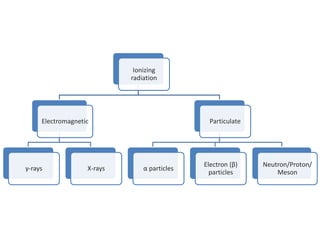
Ionizing
radiation
Electromagnetic
ฮณ-rays X-rays
Particulate
ฮฑ particles
Electron (ฮฒ)
particles
Neutron/Proton/
Meson
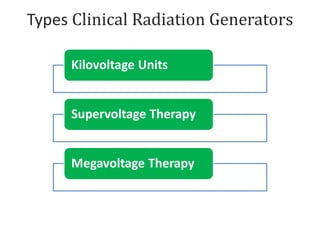
Types Clinical Radiation Generators
Kilovoltage Units
Supervoltage Therapy
Megavoltage Therapy
Kilovoltage Units
Up to about 1950, most of the external beam radiotherapy was carried out with x-rays
generated at voltages up to 300 kVp.
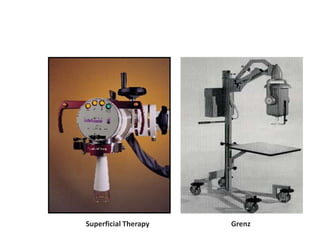
Grenz-ray > 20 kv
Contact Therapy >
50 kv
Superficial Therapy
50โ€”150 kv
Orthovoltage 200---
300 kv Supervoltage therapy
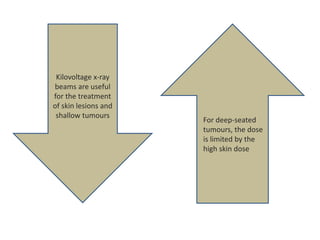
Kilovoltage x-ray
beams are useful
for the treatment
of skin lesions and
shallow tumours
For deep-seated
tumours, the dose
is limited by the
high skin dose
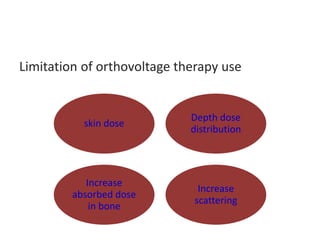
Limitation of orthovoltage therapy use
skin dose
Depth dose
distribution
Increase
absorbed dose
in bone
Increase
scattering
Grenz
Superficial Therapy
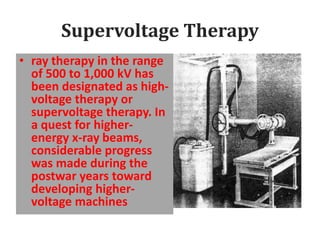
Supervoltage Therapy
โ€ข ray therapy in the range
of 500 to 1,000 kV has
been designated as high-
voltage therapy or
supervoltage therapy. In
a quest for higher-
energy x-ray beams,
considerable progress
was made during the
postwar years toward
developing higher-
voltage machines
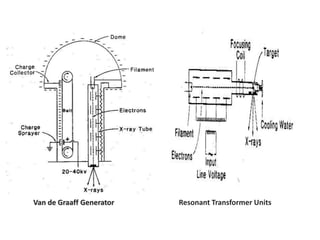
Resonant Transformer Units
Van de Graaff Generator
โ€ข Megavoltage Therapy:-
X-ray beams of energy 1 MV or greater can be
classified as megavoltage beams. Although the
term strictly applies to the x-ray beams, the ฮณ-
ray beams produced by radionuclides are also
commonly included in this category
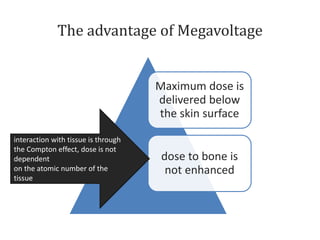
The advantage of Megavoltage
Maximum dose is
delivered below
the skin surface
dose to bone is
not enhanced
interaction with tissue is through
the Compton effect, dose is not
dependent
on the atomic number of the
tissue
Linear Accelerator
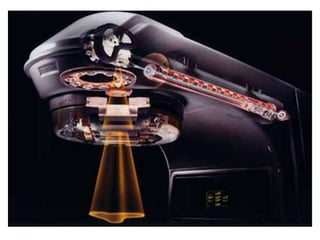
The linear accelerator (linac) is a device that uses high-frequency electromagnetic waves to
accelerate charged particles such as electrons to high energies through a linear tube. The
high-energy electron beam itself can be used for treating superficial tumors, or it can be
made to strike a target to produce x-rays for treating deep-seated tumors.
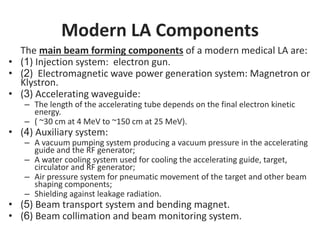
Modern LA Components
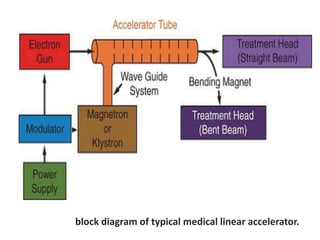
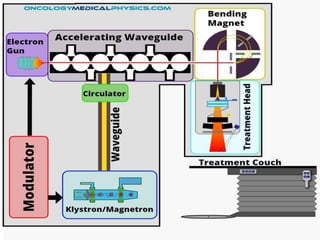
The main beam forming components of a modern medical LA are:
โ€ข (1) Injection system: electron gun.
โ€ข (2) Electromagnetic wave power generation system: Magnetron or
Klystron.
โ€ข (3) Accelerating waveguide:
โ€“ The length of the accelerating tube depends on the final electron kinetic
energy.
โ€“ ( ~30 cm at 4 MeV to ~150 cm at 25 MeV).
โ€ข (4) Auxiliary system:
โ€“ A vacuum pumping system producing a vacuum pressure in the accelerating
guide and the RF generator;
โ€“ A water cooling system used for cooling the accelerating guide, target,
circulator and RF generator;
โ€“ Air pressure system for pneumatic movement of the target and other beam
shaping components;
โ€“ Shielding against leakage radiation.
โ€ข (5) Beam transport system and bending magnet.
โ€ข (6) Beam collimation and beam monitoring system.
Types of linear accelerator designs:-
traveling electromagnetic waves
stationary electromagnetic waves
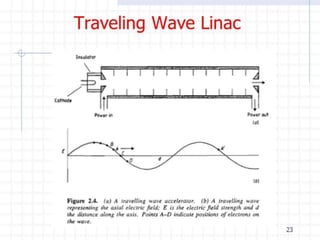
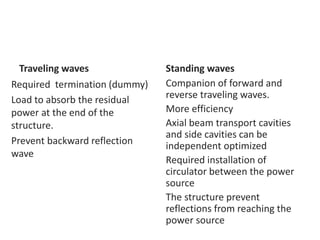
Traveling waves
Required termination (dummy)
Load to absorb the residual
power at the end of the
structure.
Prevent backward reflection
wave
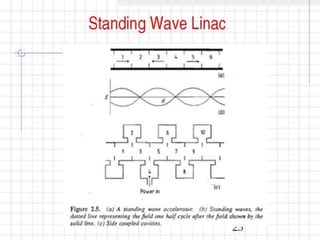
Standing waves
Companion of forward and
reverse traveling waves.
More efficiency
Axial beam transport cavities
and side cavities can be
independent optimized
Required installation of
circulator between the power
source
The structure prevent
reflections from reaching the
power source
block diagram of typical medical linear accelerator.
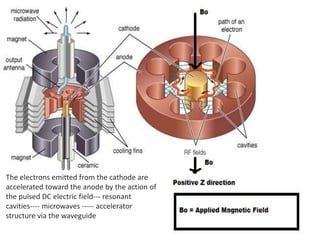
The Magnetron
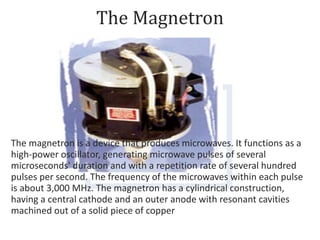
The magnetron is a device that produces microwaves. It functions as a
high-power oscillator, generating microwave pulses of several
microseconds' duration and with a repetition rate of several hundred
pulses per second. The frequency of the microwaves within each pulse
is about 3,000 MHz. The magnetron has a cylindrical construction,
having a central cathode and an outer anode with resonant cavities
machined out of a solid piece of copper
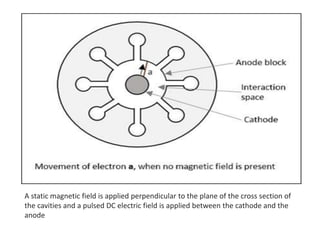
A static magnetic field is applied perpendicular to the plane of the cross section of
the cavities and a pulsed DC electric field is applied between the cathode and the
anode
The electrons emitted from the cathode are
accelerated toward the anode by the action of
the pulsed DC electric field--- resonant
cavities---- microwaves ----- accelerator
structure via the waveguide
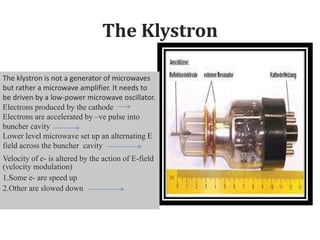
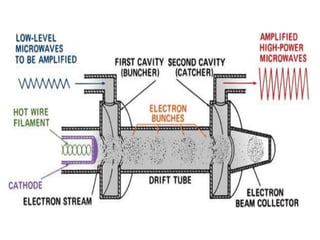
The Klystron
The klystron is not a generator of microwaves
but rather a microwave amplifier. It needs to
be driven by a low-power microwave oscillator.
Electrons produced by the cathode
Electrons are accelerated by โ€“ve pulse into
buncher cavity
Lower level microwave set up an alternating E
field across the buncher cavity
Velocity of e- is altered by the action of E-field
(velocity modulation)
1.Some e- are speed up
2.Other are slowed down
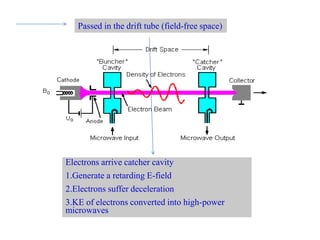
Passed in the drift tube (field-free space)
Electrons arrive catcher cavity
1.Generate a retarding E-field
2.Electrons suffer deceleration
3.KE of electrons converted into high-power
microwaves
The Linac X-Ray Beam
โ€ข Production of x-rays
โ€“ Electrons are incident on a target of a high-Z material (e.g. tungsten)
โ€“ Target โ€“ need water cooled & thick enough to absorb most of the
incident electrons
โ€“ Bremsstrahlung interactions
โ€ข Electrons energy is converted into a spectrum of x-rays energies
โ€ข Max energy of x-rays = energy of incident energy of electrons
โ€ข Average photon energy = 1/3 of max energy of x-rays
โ€ข Designation of energy of electron beam and x-rays
โ€“ Electron beam - MeV (million electron volts, monoenergetic)
โ€“ X-ray beam โ€“ MV (megavolts, voltage across an x-ray tube,
heterogeneous in energy)
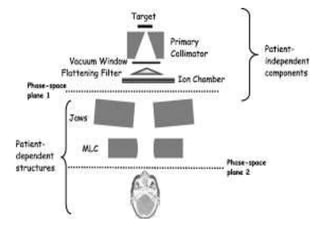
Treatment Head
โ€ข The treatment head consists of a thick shell of
high-density shielding material such as lead,
tungsten, or lead-tungsten alloy. It contains an x-
ray target, scattering foil, flattening filter, ion
chamber, fixed and movable collimator, and light
localizer system. The head provides sufficient
shielding against leakage radiation in accordance
with radiation protection guidelines (see Chapter
16).
โ€ข
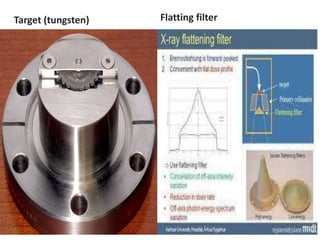
Target and Flattening Filter
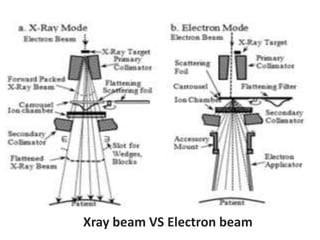
Target is made of high Z material tungsten to react with inject electrons
(megavoltage range) and with Bremsstrahlung interactions to give x ray in
forward direction
Flattening filter is made of lead or less commonly with tungsten, uranium,
steel, aluminum, or a combination and use To make the beam intensity
uniform across the field
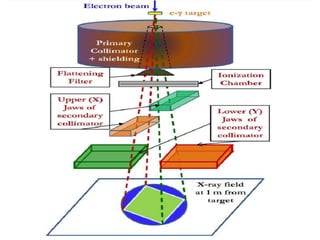
Beam Collimation and Monitoring
The treatment beam is first collimated by a fixed primary collimator located
immediately beyond the x-ray target. then passes through the flattening filter.
The flattened x-ray beam or the electron beam is incident on the dose
monitoring chambers which consists of several ion chambers, The function of
the ion chamber is to monitor dose rate, integrated dose, and
field symmetry.
After passing through the ion chambers, the beam is further collimated by a
continuously movable x-ray collimator. This collimator consists of two pairs of
lead or tungsten blocks (jaws) that provide a rectangular opening from 0 ร— 0
to the maximum field size (40 ร— 40 cm or a little less) projected at a standard
distance such as 100 cm from the x-ray source (focal spot on the target).
( this for x-ray while in electron the same but remove of target and flattening
flatter and position of electron applicators)
Target (tungsten) Flatting filter
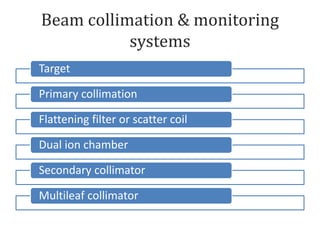
Beam collimation & monitoring
systems
Target
Primary collimation
Flattening filter or scatter coil
Dual ion chamber
Secondary collimator
Multileaf collimator
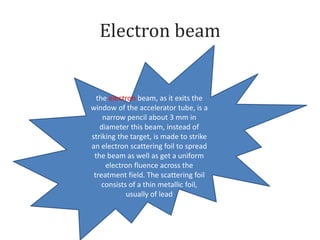
Electron beam
the electron beam, as it exits the
window of the accelerator tube, is a
narrow pencil about 3 mm in
diameter this beam, instead of
striking the target, is made to strike
an electron scattering foil to spread
the beam as well as get a uniform
electron fluence across the
treatment field. The scattering foil
consists of a thin metallic foil,
usually of lead
The thickness of the foil is such that most of
the electrons are scattered instead of suffering
bremsstrahlung. However, a small fraction of
the total energy is still converted into
bremsstrahlung and appears as x-ray
contamination of the electron beam.
Xray beam VS Electron beam
Linear accelerator.pptx

Linear accelerator.pptx

  • 1.
  • 2.
  • 3.
    Types Clinical RadiationGenerators Kilovoltage Units Supervoltage Therapy Megavoltage Therapy
  • 4.
    Kilovoltage Units Up toabout 1950, most of the external beam radiotherapy was carried out with x-rays generated at voltages up to 300 kVp. Grenz-ray > 20 kv Contact Therapy > 50 kv Superficial Therapy 50โ€”150 kv Orthovoltage 200--- 300 kv Supervoltage therapy
  • 5.
    Kilovoltage x-ray beams areuseful for the treatment of skin lesions and shallow tumours For deep-seated tumours, the dose is limited by the high skin dose
  • 6.
    Limitation of orthovoltagetherapy use skin dose Depth dose distribution Increase absorbed dose in bone Increase scattering
  • 7.
  • 8.
    Supervoltage Therapy โ€ข raytherapy in the range of 500 to 1,000 kV has been designated as high- voltage therapy or supervoltage therapy. In a quest for higher- energy x-ray beams, considerable progress was made during the postwar years toward developing higher- voltage machines
  • 9.
    Resonant Transformer Units Vande Graaff Generator
  • 10.
    โ€ข Megavoltage Therapy:- X-raybeams of energy 1 MV or greater can be classified as megavoltage beams. Although the term strictly applies to the x-ray beams, the ฮณ- ray beams produced by radionuclides are also commonly included in this category
  • 11.
    The advantage ofMegavoltage Maximum dose is delivered below the skin surface dose to bone is not enhanced interaction with tissue is through the Compton effect, dose is not dependent on the atomic number of the tissue
  • 12.
    Linear Accelerator The linearaccelerator (linac) is a device that uses high-frequency electromagnetic waves to accelerate charged particles such as electrons to high energies through a linear tube. The high-energy electron beam itself can be used for treating superficial tumors, or it can be made to strike a target to produce x-rays for treating deep-seated tumors.
  • 14.
    Modern LA Components Themain beam forming components of a modern medical LA are: โ€ข (1) Injection system: electron gun. โ€ข (2) Electromagnetic wave power generation system: Magnetron or Klystron. โ€ข (3) Accelerating waveguide: โ€“ The length of the accelerating tube depends on the final electron kinetic energy. โ€“ ( ~30 cm at 4 MeV to ~150 cm at 25 MeV). โ€ข (4) Auxiliary system: โ€“ A vacuum pumping system producing a vacuum pressure in the accelerating guide and the RF generator; โ€“ A water cooling system used for cooling the accelerating guide, target, circulator and RF generator; โ€“ Air pressure system for pneumatic movement of the target and other beam shaping components; โ€“ Shielding against leakage radiation. โ€ข (5) Beam transport system and bending magnet. โ€ข (6) Beam collimation and beam monitoring system.
  • 15.
    Types of linearaccelerator designs:- traveling electromagnetic waves stationary electromagnetic waves
  • 18.
    Traveling waves Required termination(dummy) Load to absorb the residual power at the end of the structure. Prevent backward reflection wave Standing waves Companion of forward and reverse traveling waves. More efficiency Axial beam transport cavities and side cavities can be independent optimized Required installation of circulator between the power source The structure prevent reflections from reaching the power source
  • 19.
    block diagram oftypical medical linear accelerator.
  • 22.
    The Magnetron The magnetronis a device that produces microwaves. It functions as a high-power oscillator, generating microwave pulses of several microseconds' duration and with a repetition rate of several hundred pulses per second. The frequency of the microwaves within each pulse is about 3,000 MHz. The magnetron has a cylindrical construction, having a central cathode and an outer anode with resonant cavities machined out of a solid piece of copper
  • 23.
    A static magneticfield is applied perpendicular to the plane of the cross section of the cavities and a pulsed DC electric field is applied between the cathode and the anode
  • 24.
    The electrons emittedfrom the cathode are accelerated toward the anode by the action of the pulsed DC electric field--- resonant cavities---- microwaves ----- accelerator structure via the waveguide
  • 25.
    The Klystron The klystronis not a generator of microwaves but rather a microwave amplifier. It needs to be driven by a low-power microwave oscillator. Electrons produced by the cathode Electrons are accelerated by โ€“ve pulse into buncher cavity Lower level microwave set up an alternating E field across the buncher cavity Velocity of e- is altered by the action of E-field (velocity modulation) 1.Some e- are speed up 2.Other are slowed down
  • 26.
    Passed in thedrift tube (field-free space) Electrons arrive catcher cavity 1.Generate a retarding E-field 2.Electrons suffer deceleration 3.KE of electrons converted into high-power microwaves
  • 28.
    The Linac X-RayBeam โ€ข Production of x-rays โ€“ Electrons are incident on a target of a high-Z material (e.g. tungsten) โ€“ Target โ€“ need water cooled & thick enough to absorb most of the incident electrons โ€“ Bremsstrahlung interactions โ€ข Electrons energy is converted into a spectrum of x-rays energies โ€ข Max energy of x-rays = energy of incident energy of electrons โ€ข Average photon energy = 1/3 of max energy of x-rays โ€ข Designation of energy of electron beam and x-rays โ€“ Electron beam - MeV (million electron volts, monoenergetic) โ€“ X-ray beam โ€“ MV (megavolts, voltage across an x-ray tube, heterogeneous in energy)
  • 29.
    Treatment Head โ€ข Thetreatment head consists of a thick shell of high-density shielding material such as lead, tungsten, or lead-tungsten alloy. It contains an x- ray target, scattering foil, flattening filter, ion chamber, fixed and movable collimator, and light localizer system. The head provides sufficient shielding against leakage radiation in accordance with radiation protection guidelines (see Chapter 16). โ€ข
  • 30.
    Target and FlatteningFilter Target is made of high Z material tungsten to react with inject electrons (megavoltage range) and with Bremsstrahlung interactions to give x ray in forward direction Flattening filter is made of lead or less commonly with tungsten, uranium, steel, aluminum, or a combination and use To make the beam intensity uniform across the field
  • 31.
    Beam Collimation andMonitoring The treatment beam is first collimated by a fixed primary collimator located immediately beyond the x-ray target. then passes through the flattening filter. The flattened x-ray beam or the electron beam is incident on the dose monitoring chambers which consists of several ion chambers, The function of the ion chamber is to monitor dose rate, integrated dose, and field symmetry. After passing through the ion chambers, the beam is further collimated by a continuously movable x-ray collimator. This collimator consists of two pairs of lead or tungsten blocks (jaws) that provide a rectangular opening from 0 ร— 0 to the maximum field size (40 ร— 40 cm or a little less) projected at a standard distance such as 100 cm from the x-ray source (focal spot on the target). ( this for x-ray while in electron the same but remove of target and flattening flatter and position of electron applicators)
  • 32.
  • 33.
    Beam collimation &monitoring systems Target Primary collimation Flattening filter or scatter coil Dual ion chamber Secondary collimator Multileaf collimator
  • 36.
    Electron beam the electronbeam, as it exits the window of the accelerator tube, is a narrow pencil about 3 mm in diameter this beam, instead of striking the target, is made to strike an electron scattering foil to spread the beam as well as get a uniform electron fluence across the treatment field. The scattering foil consists of a thin metallic foil, usually of lead
  • 37.
    The thickness ofthe foil is such that most of the electrons are scattered instead of suffering bremsstrahlung. However, a small fraction of the total energy is still converted into bremsstrahlung and appears as x-ray contamination of the electron beam.
  • 38.
    Xray beam VSElectron beam

Editor's Notes

  • #6ย advantage
  • #19ย the structure prevent reflections from reaching the power source