Types of Radiations


                      X-rays•        α-particles•       neutrons•
                      γ-rays•      β-particles•
                                   β+-particles•
                                       Protons•

                         Carry enough energy which if deposited
                                    in matter can produce ions
Radiation therapy idea


Selective cell destruction (cancer)
      How it can be done?
By destroying the cell using Energy
High energy particles damage a cell by altering it’s atom
Cause the atom’s electron to become excited and then ionized
Enzymes            repair this damage
   • But cancer cell slower than healthy cell
So, the end results (during radiation exposure )
More cancer cell end up dying more than healthy cell
Reminder


• Absorbed dose D is the energy (joules) deposited per
  unit mass (kg) of target material, D = dE/dm.
• The special unit of absorbed dose D is the Gray (Gy)
  ≡ 1 Joule/kg
• In biological systems
• Radiation       Biologic effects   dependent on “the
  spatial distribution of energy deposition” (LET)
Linear Energy Transfer is energy deposited per unit path
  length = dE/dx with units ev/cm
Overview of presentation


•   Photon therapy (briefly)
•   Proton therapy (in detailed)
•   How it works ?
•   The remarkable phenomenon of physics “Bragg peak”
•   Delivery of the beam (how it can be useful )
•   How it can be produced ? (synchrotron)
•   RBE of protons .
•   Proton therapy Vs Photon therapy .(summary)
The desirable goal


In order to treat cancer :
The main goal is to delivers a defined dose distribution
  within the target volume and none out side it.
                           Now
     Let’s see what type of radiation
               would be the
                  Best??
Treatment options


              1) Photon therapy.


                    2) Proton therapy.
Interactions of Photons

There are 3 modes:

• Photo-electric effect.
Entire energy transfer from
  photon to an atomic electron .


• Compton effect.
Fraction of energy transferred to
  Compton electrons.


• Pair production.
What happen when a beam
    of photon entering
        a tissue ?
Exponential behaviour


• It falls exponentially
    E  E o exp( en x)
• Number of photon gets
  attenuated
 as depth increases .
• As their number decreases,
  the dose that they deposit
  decreases also
  (proportionately ).
Photon’s therapy failure


• Based on “how radiation
  interacts with matter”
The failure is :
 Most of the radiation is
  deposited on healthy tissue.
Cause of failure !!
• They are not easy to control
            Why ?
(low mass & high energy)
     “Low LET”
Treatment options


                    1) Photon therapy


              2) Proton therapy.
Did Proton therapy has the solution ?

 What can Proton therapy provide ?
Short story


• “A man with a vision “
In 1946 Harvard physicist ,
Robert Wilson suggested:

• Protons can be used clinically .
• Maximum radiation dose can
  be placed into the tumor .
• Proton therapy provides
  sparing of healthy tissues .
Characteristics of protons


                              • Subatomic particle .
                              • Stable , positively charged .
                              • Heavy particle with mass 1800
                                that of electron.
                              • Very little scattered as they
                                travel through tissue .
                              • Travel in straight lines.
                                           Which leads to very
Mp=1.672621636(83)×10−27 kg
Me= 9.10938215(45)×10−31 kg       different modes of interactions
                                            with matter .
                                        Let’s see!!!!!!
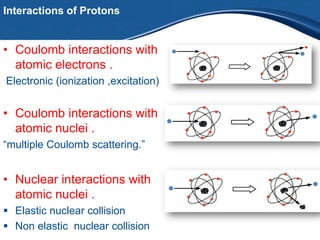
Interactions of Protons


• Coulomb interactions with
  atomic electrons .
Electronic (ionization ,excitation)


• Coulomb interactions with
  atomic nuclei .
“multiple Coulomb scattering.”


• Nuclear interactions with
  atomic nuclei .
 Elastic nuclear collision
 Non elastic nuclear collision
Key fact


  Different modes of interactions

             Means
  Different dose distributions
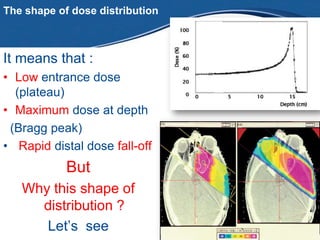
The shape of dose distribution


It means that :
• Low entrance dose
  (plateau)
• Maximum dose at depth
 (Bragg peak)
• Rapid distal dose fall-off
            But
   Why this shape of
     distribution ?
      Let’s see
Remarkable phenomena
“Bragg peak”


Protons have the ability of
  loosing little energy when
  entering tissue .
 But depositing more and
  more as they slow
  down…..
Finally, depositing a heavy
  dose of radiation just
  before they stop ,
giving rise to the
so-called Bragg peak
Energy loss “dE/dx profiles


• a proton’s linear rate of
  energy loss “linear energy
  transfer” (LET)
• is given by the Bethe-
  Block formula:
Bragg Peak like (skiing)
Bragg peak dependence on
energy


• The range is( the depth
   of penetration
from the front surface to the
   distal point on the Bragg
   peak)
• Bragg peak
depends on the initial
energy of the protons so
the greater the energy, the
   greater the range
There is a problem


Is the current shape of
  Bragg peak could provide
  the tumor with uniform
  dose ?
         No, it can’t.
          Because
The Bragg peak is too narrow
  to fit the shape & depth of
            the tumor
Is there a solution ?


  So, how to make the beam of proton useful for
                    treatment?


  Is it possible to shape the beam to fit the
              shape of the tumor ?


                        Let’s see!!!!!
Smart Idea


• The spread-out Bragg peak
  (SOBP):
• Extending the dose in depth
             means
An extension in depth can be
                                  Superposition of Bragg-peaks by
  achieved by proton beams        energy variation
  of successively
delivering not just one, but
  many Bragg peaks each
  with different range (energy)
                                     energy variation
Beam delivery system Nozzle


 There are two main approaches
   ( techniques) for shaping the
    beam : (both laterally and in
              depth)
     1) passive scattering.
       2)Scanned beam.
passive scattering.
Shaping the beam Laterally


The beam is spread
 laterally to clinically
 useful size by
double – scatterer
and compensator
Tailoring the beam in depth:
the range modulator (fan like


The modulator spins
  around in front of the
  proton beam pulling the
  beam back and forward
  causing a flat topped
  dose distribution

providing the tumor with a
  uniform dose.
Scanned beam


• Expand the lateral
  dimensions of a proton
  beam by using the
  electromagnetic
technique to scan the beam
  laterally & in shape .
Synchrotrons The engine)

• What is Synchrotron
  mission ?
• They produce the proton
  beam .
• It is a modified Cyclotrons.
synchrotron provides energy
  variation by extracting the
protons when they have
  reached the desired
  energy.
Hardware components


• Proton accelerator
• Beam transport
  system
• Treatment Rooms
• Gantry
• Standard table
A word about Treatment plane


How do you know what
to include and what to
exclude in treating
deep –seated tumors
with radiation?
By using number of
imaging tools
(CT,MRI,PET….)
Gives ability to see
To image
To map
Relative Biological Effectiveness
of proton

RBE is the ratio of the dose of reference radiation beam
  (e.g., photons) to that of test beam (e.g., protons)
  required to produce a defined biological response .
• Is used to compare the biologic effects of various
  radiation sources .
Protons has exactly the same biologic effects as X-rays!!
Because the calculated RBE is 1.1
The bottom line is that the only difference between
  protons and standard X-rays lies in the physical
  properties of the beam and not in the biologic effects
  in tissue.
SUMMARY


• Photon therapy                      Proton therapy
the interactions are stochastic .   they are deterministic events .
 they not easy to control .         They easier to control .
                         At point of entrance,
It receive large amount of dose.    It receive very small dose .
                       As they reached the tumor,
Continue to pass through tissue a sharp burst of energy released
                                   at tumor and none beyond it.
Used for treat superficial tumors. ideal for tumors in or near
                                   critical structures (brain, heart,
                                    eye) pediatric cancers.
References and sites


• Radiation Oncology A Physicist's-Eye View: Michael
  Goitein .
• Radiation therapy physics: William R Hendee &
  Geoffrey .
• Sites:
• www.wikipedia.org
• Loma Linda University Medical Center
www.llu.edu
• www.mpri.org
• www.proton-therapy.org
• http://www.varian.com/
proton therapy
proton therapy

proton therapy

  • 2.
    Types of Radiations X-rays• α-particles• neutrons• γ-rays• β-particles• β+-particles• Protons• Carry enough energy which if deposited in matter can produce ions
  • 4.
    Radiation therapy idea Selectivecell destruction (cancer) How it can be done? By destroying the cell using Energy High energy particles damage a cell by altering it’s atom Cause the atom’s electron to become excited and then ionized Enzymes repair this damage • But cancer cell slower than healthy cell So, the end results (during radiation exposure ) More cancer cell end up dying more than healthy cell
  • 5.
    Reminder • Absorbed doseD is the energy (joules) deposited per unit mass (kg) of target material, D = dE/dm. • The special unit of absorbed dose D is the Gray (Gy) ≡ 1 Joule/kg • In biological systems • Radiation Biologic effects dependent on “the spatial distribution of energy deposition” (LET) Linear Energy Transfer is energy deposited per unit path length = dE/dx with units ev/cm
  • 6.
    Overview of presentation • Photon therapy (briefly) • Proton therapy (in detailed) • How it works ? • The remarkable phenomenon of physics “Bragg peak” • Delivery of the beam (how it can be useful ) • How it can be produced ? (synchrotron) • RBE of protons . • Proton therapy Vs Photon therapy .(summary)
  • 7.
    The desirable goal Inorder to treat cancer : The main goal is to delivers a defined dose distribution within the target volume and none out side it. Now Let’s see what type of radiation would be the Best??
  • 8.
    Treatment options 1) Photon therapy. 2) Proton therapy.
  • 9.
    Interactions of Photons Thereare 3 modes: • Photo-electric effect. Entire energy transfer from photon to an atomic electron . • Compton effect. Fraction of energy transferred to Compton electrons. • Pair production.
  • 10.
    What happen whena beam of photon entering a tissue ?
  • 11.
    Exponential behaviour • Itfalls exponentially E  E o exp( en x) • Number of photon gets attenuated as depth increases . • As their number decreases, the dose that they deposit decreases also (proportionately ).
  • 12.
    Photon’s therapy failure •Based on “how radiation interacts with matter” The failure is : Most of the radiation is deposited on healthy tissue. Cause of failure !! • They are not easy to control Why ? (low mass & high energy) “Low LET”
  • 13.
    Treatment options 1) Photon therapy 2) Proton therapy.
  • 14.
    Did Proton therapyhas the solution ? What can Proton therapy provide ?
  • 15.
    Short story • “Aman with a vision “ In 1946 Harvard physicist , Robert Wilson suggested: • Protons can be used clinically . • Maximum radiation dose can be placed into the tumor . • Proton therapy provides sparing of healthy tissues .
  • 16.
    Characteristics of protons • Subatomic particle . • Stable , positively charged . • Heavy particle with mass 1800 that of electron. • Very little scattered as they travel through tissue . • Travel in straight lines. Which leads to very Mp=1.672621636(83)×10−27 kg Me= 9.10938215(45)×10−31 kg different modes of interactions with matter . Let’s see!!!!!!
  • 17.
    Interactions of Protons •Coulomb interactions with atomic electrons . Electronic (ionization ,excitation) • Coulomb interactions with atomic nuclei . “multiple Coulomb scattering.” • Nuclear interactions with atomic nuclei .  Elastic nuclear collision  Non elastic nuclear collision
  • 18.
    Key fact Different modes of interactions Means Different dose distributions
  • 19.
    The shape ofdose distribution It means that : • Low entrance dose (plateau) • Maximum dose at depth (Bragg peak) • Rapid distal dose fall-off But Why this shape of distribution ? Let’s see
  • 20.
    Remarkable phenomena “Bragg peak” Protonshave the ability of loosing little energy when entering tissue . But depositing more and more as they slow down….. Finally, depositing a heavy dose of radiation just before they stop , giving rise to the so-called Bragg peak
  • 21.
    Energy loss “dE/dxprofiles • a proton’s linear rate of energy loss “linear energy transfer” (LET) • is given by the Bethe- Block formula:
  • 22.
  • 23.
    Bragg peak dependenceon energy • The range is( the depth of penetration from the front surface to the distal point on the Bragg peak) • Bragg peak depends on the initial energy of the protons so the greater the energy, the greater the range
  • 24.
    There is aproblem Is the current shape of Bragg peak could provide the tumor with uniform dose ? No, it can’t. Because The Bragg peak is too narrow to fit the shape & depth of the tumor
  • 25.
    Is there asolution ? So, how to make the beam of proton useful for treatment? Is it possible to shape the beam to fit the shape of the tumor ? Let’s see!!!!!
  • 26.
    Smart Idea • Thespread-out Bragg peak (SOBP): • Extending the dose in depth means An extension in depth can be Superposition of Bragg-peaks by achieved by proton beams energy variation of successively delivering not just one, but many Bragg peaks each with different range (energy) energy variation
  • 27.
    Beam delivery systemNozzle There are two main approaches ( techniques) for shaping the beam : (both laterally and in depth) 1) passive scattering. 2)Scanned beam.
  • 28.
  • 29.
    Shaping the beamLaterally The beam is spread laterally to clinically useful size by double – scatterer and compensator
  • 30.
    Tailoring the beamin depth: the range modulator (fan like The modulator spins around in front of the proton beam pulling the beam back and forward causing a flat topped dose distribution providing the tumor with a uniform dose.
  • 31.
    Scanned beam • Expandthe lateral dimensions of a proton beam by using the electromagnetic technique to scan the beam laterally & in shape .
  • 32.
    Synchrotrons The engine) •What is Synchrotron mission ? • They produce the proton beam . • It is a modified Cyclotrons. synchrotron provides energy variation by extracting the protons when they have reached the desired energy.
  • 33.
    Hardware components • Protonaccelerator • Beam transport system • Treatment Rooms • Gantry • Standard table
  • 34.
    A word aboutTreatment plane How do you know what to include and what to exclude in treating deep –seated tumors with radiation? By using number of imaging tools (CT,MRI,PET….) Gives ability to see To image To map
  • 35.
    Relative Biological Effectiveness ofproton RBE is the ratio of the dose of reference radiation beam (e.g., photons) to that of test beam (e.g., protons) required to produce a defined biological response . • Is used to compare the biologic effects of various radiation sources . Protons has exactly the same biologic effects as X-rays!! Because the calculated RBE is 1.1 The bottom line is that the only difference between protons and standard X-rays lies in the physical properties of the beam and not in the biologic effects in tissue.
  • 36.
    SUMMARY • Photon therapy Proton therapy the interactions are stochastic . they are deterministic events . they not easy to control . They easier to control . At point of entrance, It receive large amount of dose. It receive very small dose . As they reached the tumor, Continue to pass through tissue a sharp burst of energy released at tumor and none beyond it. Used for treat superficial tumors. ideal for tumors in or near critical structures (brain, heart, eye) pediatric cancers.
  • 37.
    References and sites •Radiation Oncology A Physicist's-Eye View: Michael Goitein . • Radiation therapy physics: William R Hendee & Geoffrey . • Sites: • www.wikipedia.org • Loma Linda University Medical Center www.llu.edu • www.mpri.org • www.proton-therapy.org • http://www.varian.com/