Beam direction Practice  & principles moderator  -  Mr. P. Goswami department of radiotherapy PGIMER, chandigarh
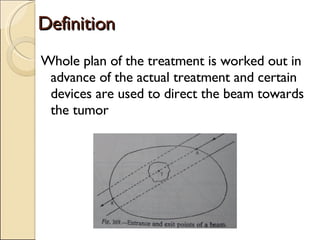
Definition Whole plan of the treatment is worked out in advance of the actual treatment and certain devices are used to direct the beam towards the tumor
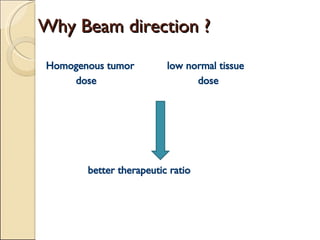
Why Beam direction ? Homogenous tumor  low normal tissue dose  dose better therapeutic ratio
Prerequisites for beam direction Patient factors: Early stage of disease Good general condition Good nutritional status Radical treatment intent (curative) Machine factors: Isocentric Non isocentric
Steps Localisation Positioning Immobilisation Field selection Dose distribution Calculations Execution & verification
LOCALISATION The target volume and critical normal tissues are delineated  with respect to  patient’s external surface contour. What  to localize? Tumor Organ  Methods? Clinical examination Imaging
Why Localize? Irradiate the tumor and spare the normal tissue. Allow calculations and beam balancing. Define radiation portals. Use the beam directing devices.
Clinical localization Advantages: Available everywhere.  Cheapest and quickest(?). Needs little additional equipment. Disadvantages: Error prone in the wrong hands. Accessible areas required. Volumetric data not easily obtained. Clinical localization is mandatory  despite  advanced imaging – need to know what to image!
Imaging Localization Imaging: X-rays: Plain  Contrast Studies CT scans MRI scans  USG scans PET scan Fusion imaging Type of study selected depends on: Precision desired. Cost considerations Time considerations Labour considerations
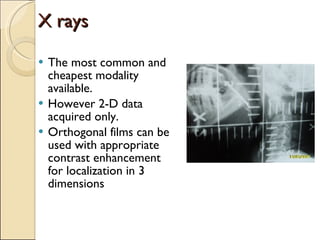
X rays The most common and cheapest modality available.  However 2-D data acquired only. Orthogonal films can be used with appropriate contrast enhancement for localization in 3 dimensions
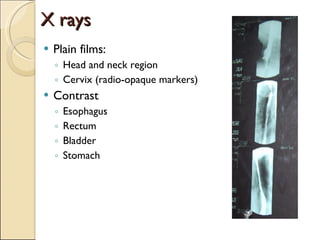
X rays Plain films: Head and neck region Cervix (radio-opaque markers) Contrast Esophagus Rectum Bladder Stomach
Estimation of depth From data gained by localization studies: CT / MRI – Accurate data Lateral height method Tube shift method Depth  estimation necessary for: Calculations Selection of beam energy
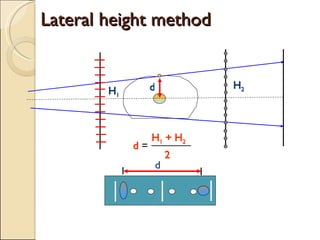
Lateral height method H 1 H 2 d d H 1  + H 2 2 d  =
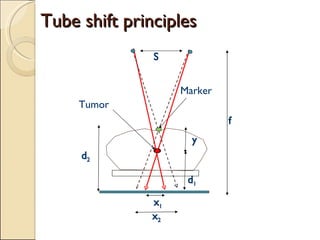
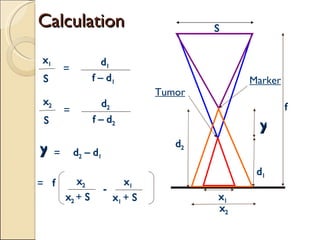
Tube shift method Image shift and tube shift are interrelated WHEN the tube to target distance remains constant. Goal : To obtain a graph of different object heights against the tube shift. Serial measurements of image shift measured (for same tube to film distance) while varying the height of the markers above the table.
Tube shift principles Marker d 2 y f S Tumor x 1 x 2 d 1
Calculation d 1 f y d 2 x 1 x 2 x 1 S = d 1 f – d 1 S x 2 S = d 2 f – d 2 y = d 2  – d 1 = f x 2   +  S x 2 - x 1   +  S x 1 Tumor Marker
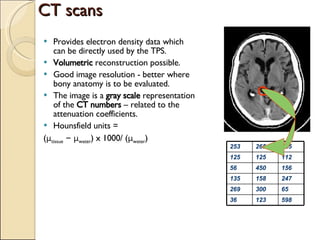
CT scans Provides electron density data which can be directly used by the TPS. Volumetric  reconstruction possible. Good image resolution - better where bony anatomy is to be evaluated. The image is a  gray scale  representation of the  CT numbers  – related to the attenuation coefficients. Hounsfield units =  ( μ tissue   –   μ water ) x 1000/ ( μ water ) 253 265 235 125 125 112 56 450 156 135 158 247 269 300 65 36 123 598
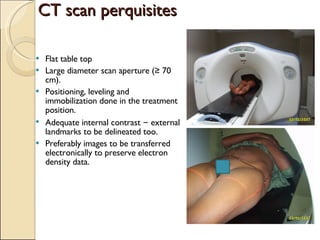
CT scan perquisites Flat table top  Large diameter scan aperture (≥ 70 cm). Positioning, leveling and immobilization done in the treatment position. Adequate internal contrast  –  external landmarks to be delineated too. Preferably images to be transferred electronically to preserve electron density data.
MRI scans Advantages: Imaging in multiple planes  without  formatting. Greater  tissue contrast – essential for proper target delineation in brain and head and neck No ionizing radiation involved. Disadvantages: Lower  spatial resolution Longer  scan times Inability to image calcification or bones.
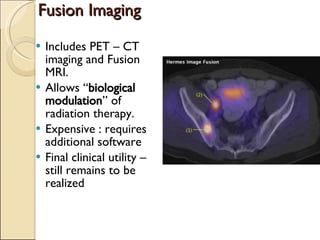
Fusion Imaging Includes PET – CT imaging and Fusion MRI. Allows “ biological modulation ” of radiation therapy. Expensive : requires additional software Final clinical utility – still remains to be realized
POSITIONING Patient positioning is the most vital and often the most  NEGLECTED  part of beam direction: Good  patient position is  ALWAYS : Stable. Comfortable. Minimizes movements. Reproducible.
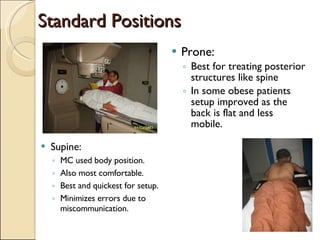
Standard Positions Supine: MC used body position. Also most comfortable. Best and quickest for setup. Minimizes errors due to miscommunication. Prone: Best for treating posterior structures like spine  In some obese patients setup improved as the back is flat and less mobile.
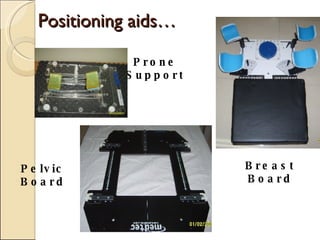
Positioning aids Help to maintain patients in non standard positions. These positions necessary to maximize therapeutic ratio. Accessories allow  manipulation  of the  non rigid  human body to allow a comfortable, reproducible and stable position.
Positioning aids… Pelvic Board Prone Support Breast Board
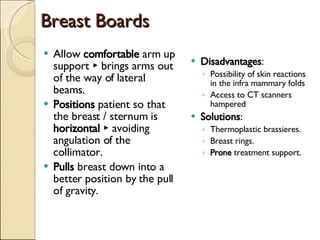
Breast Boards Disadvantages : Possibility of skin reactions in the infra mammary folds Access to CT scanners hampered Solutions : Thermoplastic brassieres. Breast rings. Prone  treatment support. Allow  comfortable  arm up support ► brings arms out of the way of lateral beams. Positions  patient so that the breast / sternum is  horizontal  ► avoiding angulation of the collimator. Pulls  breast down into a better position by the pull of gravity.
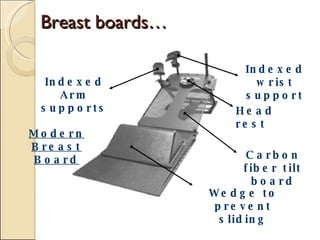
Breast boards… Modern Breast Board Indexed Arm supports Indexed wrist support Head rest Carbon fiber tilt board Wedge to prevent sliding
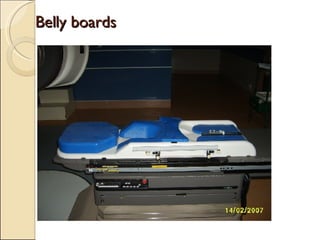
Belly boards
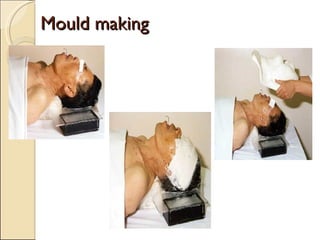
Mould making
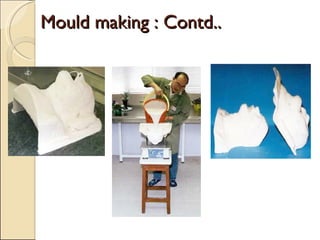
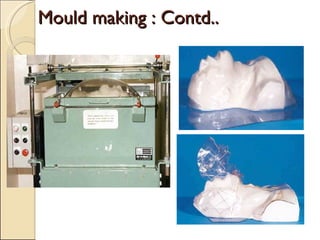
Mould making : Contd..
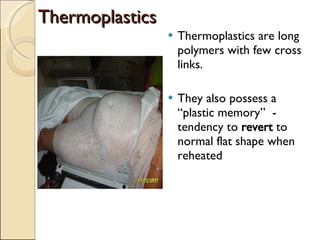
Thermoplastics Thermoplastics are long polymers with few cross links. They also possess a “plastic memory”  - tendency to  revert  to normal flat shape when reheated
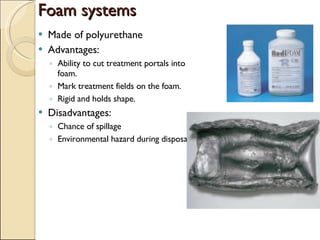
Foam systems Made of polyurethane Advantages: Ability to cut treatment portals into foam. Mark treatment fields on the foam. Rigid and holds shape. Disadvantages: Chance of spillage Environmental hazard during disposal
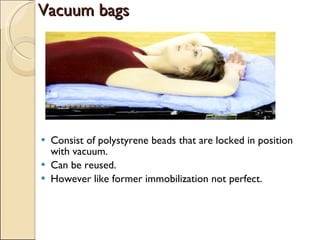
Vacuum bags Consist of polystyrene beads that are locked in position with vacuum. Can be reused. However like former immobilization not perfect.
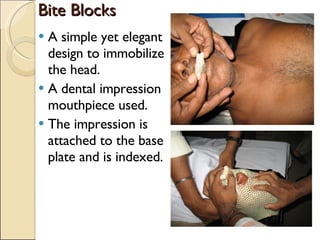
Bite Blocks A simple yet elegant design to immobilize the head. A dental impression mouthpiece used. The impression is attached to the base plate and is indexed.
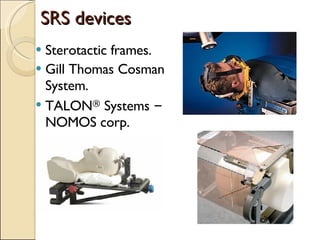
SRS devices Sterotactic frames. Gill Thomas Cosman System. TALON ®  Systems  –  NOMOS corp.
Patient Contouring Contour is the representation of external body outline. Methods: Plaster of Paris Lead wire Thermoplastic contouring material Flurographic method CT/MRI
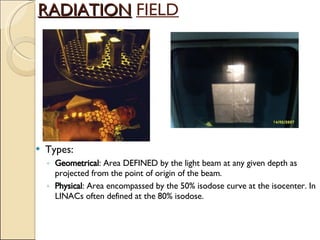
RADIATION   FIELD Types: Geometrical : Area DEFINED by the light beam at any given depth as projected from the point of origin of the beam. Physical : Area encompassed by the 50% isodose curve at the isocenter. In LINACs often defined at the 80% isodose.
Single Field Criteria for acceptability: Dose distribution to be uniform ( ±5% ) Maximum dose to tissues in beam ≤  110%. Critical structures don ’ t receive dose exceeding their normal tolerance. Situations used: Skin tumors CSI Supraclavicular region Palliative treatments
2 Field techniques Can be : Parallel opposed Angled Perpendicular Oblique Wedged pair Advantages: Simplicity Reproducibility Less chance of geometrical miss Homogenous dose Dose  homogeneity  depends on: Patient thickness Beam energy Beam “flatness”
Disadvantage of 2 field techniques -large amount of normal tissue gets radiation -if separation is more there is an arc like distribution so, in ca cx  if separation is >16 cm  four fields are used.
3 field techniques Used in -deep seated tumors -to save vital structures Example -ca esophaghus -ca lung -ca UB -ca nasopharynx with ant extention -ca maxilla with ethmoidal extention
4 field techniques Used in -ca cx -ca rectum
Multiple fields Used in 3DCRT & IMRT Used to obtain a “conformal” dose distribution in the modern radiotherapy techniques. Disadvantages: Integral dose increases Certain beam angles are prohibited due to proximity of critical structures. Setup accuracy better with parallel opposed arrangement.
Magna field Radical treatment of lymphoma(HD) Whole body irradiation Hemi body irradiation
DOSE DISTRIBUTION ANALYSIS Done manually or in the TPS. Manual distribution gives a hands on idea of what to expect with dose distributions. Inefficient and time consuming. Pros: Cheap Universally available Adequate for most clinical situations.
Calculations Techniques: SSD technique (PDD method) SAD technique Clarkson’s technique Computerized
PRESCRIPTION Mandatory statements: Dose to be delivered. Number of fractions Number of fractions per week
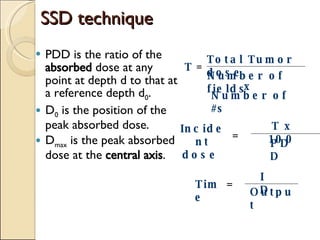
SSD technique PDD is the ratio of the  absorbed  dose at any point at depth d to that at a reference depth d 0 . D 0  is the position of the peak absorbed dose. D max  is the peak absorbed dose at the  central axis . Total Tumor dose Number of fields x Number of #s = T Incident dose   = T x 100 PDD Time = ID Output
SAD Technique Uses doses normalized at isocenter for calculation. In this technique the impact of setup variations is minimized. Setup is easier but manual planning difficult. Time taken for treatment reduced.
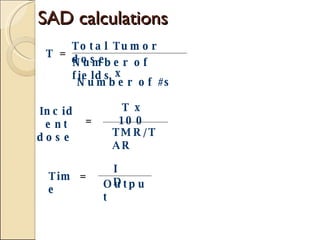
SAD calculations Total Tumor dose Number of fields x Number of #s = T Incident dose  = T x 100 TMR/TAR Time = ID Output
SSD vs SAD technique SSD treatments: Relatively less homogenous dose distribution Setup possible without requiring expensive aids e.g. Laser PDD charts can be used for simple dose calculations More skin reactions SAD treatments: Less number of MUs required Time taken is less Impact of setup inaccuracies is minimized in 2 field techniques Ease of setup reproducibility in multi field treatments.
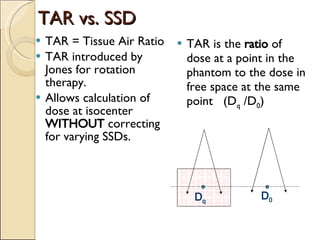
TAR vs. SSD TAR = Tissue Air Ratio TAR introduced by Jones for rotation therapy. Allows calculation of dose at isocenter  WITHOUT  correcting for varying SSDs. TAR is the  ratio  of dose at a point in the phantom to the dose in free space at the same point  (D q  /D 0 ) D q D 0
TAR TAR removes the influence of SSD as it is a ratio of two doses at the  SAME  point. However like PDD the TAR also varies with: Energy Depth Field Size Field Shape
EXECUTION & VERIFICATION Can be done using: Portal Films Electronic Portal images Cone Beam CT mounted on treatment machines (IGRT). Seen during treatment -CCTV camera -lead glass  -mirror  -infrared camera (in imrt)
Port films Cheapest. Legal necessity(?) But have several disadvantages.
Port film disadvantages Factors leading to poor image contrast: High beam energy (> 10 MV) Large source size ( Cobalt) Large patient thickness (> 20 cm) Slow acquisition times. Image enhancement not possible. Storage problems.
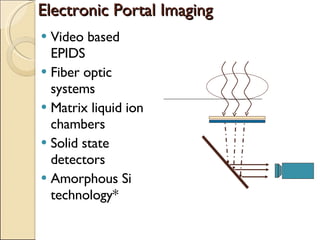
Electronic Portal Imaging Video based EPIDS Fiber optic systems Matrix liquid ion chambers Solid state detectors Amorphous Si technology*
BEAM DIRECTION DEVICES The main beam direction devices are: Collimators Front pointer / SSD indicator Back Pointer Pin and arc Isocentric mounting Lasers
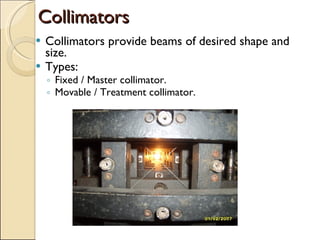
Collimators Collimators provide beams of desired shape and size. Types: Fixed / Master collimator. Movable / Treatment collimator.
Fixed Collimators Protects the patient from bulk of the radiation. Dictates the maximum field size for the machine. Maximum beam size is when exposure at periphery is  50%  of that of the center. In megavoltage radiotherapy beam angle used is  20° .
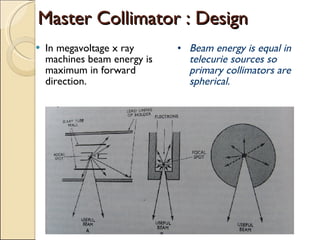
Master Collimator : Design In megavoltage x ray machines beam energy is maximum in forward direction. Beam energy is equal in telecurie sources so primary collimators are spherical.
Movable Collimators Define the required field size and shape. Placed below the master collimators results in trimming of the penumbra. Types: Applicators Jaws / Movable diaphragms
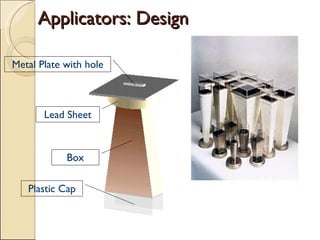
Applicators: Design Lead Sheet Box Plastic Cap Metal Plate with hole
Applicators  Advantages: Indicate  size  and  shape  of beam. Distance  maintained. Direction  shown. Plastic ends allow  compression . Compression allows  immobilization . Penumbra  minimized. Disadvantages: Useful for  low  energy only. Separate  sizes and shapes required. Costly. Shapes may change due frequent handling.
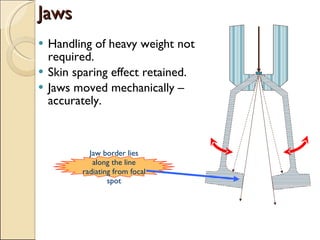
Jaws Handling of heavy weight not required. Skin sparing effect retained. Jaws moved mechanically – accurately. Jaw border lies along the line radiating from focal spot
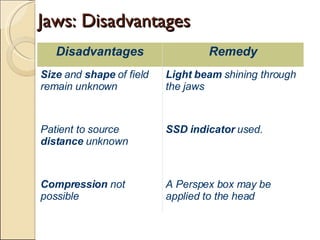
Jaws: Disadvantages Disadvantages Remedy Size  and  shape  of field remain unknown Light beam  shining through the jaws Patient to source  distance  unknown SSD indicator  used. Compression  not possible A Perspex box may be applied to the head
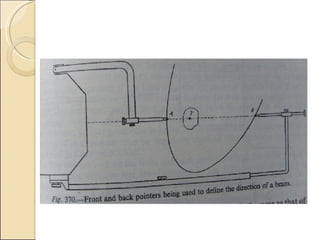
Front & back pointers This method requires the identification & marking on the patient’s surface, of two points lying on a line passing through the tumor centre. Entry point- A Tumor centre- T Exit point- B
 
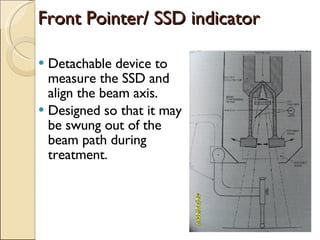
Front Pointer/ SSD indicator Detachable device to measure the SSD and align the beam axis. Designed so that it may be swung out of the beam path during treatment.
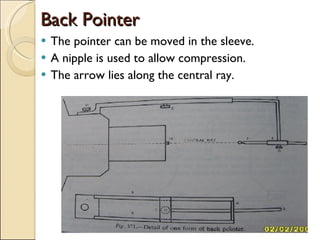
Back Pointer The pointer can be moved in the sleeve. A nipple is used to allow compression. The arrow lies along the central ray.
Sites used Front pointer and back pointer used in the following situations: Head and Neck Breast Brain tumors
Limitations Requires skin marks – inherently unreliable. Back pointer is unreliable when compression is desired. Both front and back points must be accessible. Accurate localization of tumor center is mandatory.
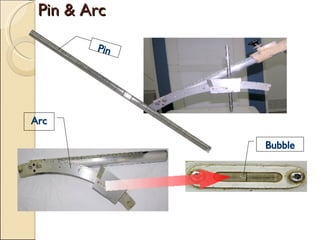
Pin & Arc Pin Arc Bubble
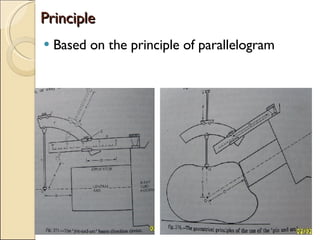
Principle  Based on the principle of parallelogram
How does it work? arrangement  of pin & arc is such that when pin is at it’s lowest position, it’s lower end is on the central axis of beam & on centre of curvature of arc. Depth of the tumor is already known. Pin is withdrawn the reqd. distance & it’s lower end is brought in contact with the surface mark.
So long as the pin is vertical the rest of equipment & applicator will rotate about the centre of tumor and central ray will always pass through it Thus keeping the pin vertical & in contact with surface mark any particular angle can be selected The oblique distance can be read off the scale or bar by applying principle of parallelogram.
Advantages of Pin & Arc Allows Isocentric treatment of  Deep  tumors. Eccentric  tumors. Can be used with  compression  e.g. in treating deep seated tumors. Can be used for manual  verification  of Isocentric placement of machines
Sites where used Mostly in midline tumors situated at a depth Esophagus Cervix Bladder  Rectum Vagina Lung sometimes
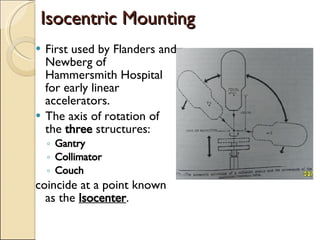
Isocentric Mounting First used by Flanders and Newberg of Hammersmith Hospital for early linear accelerators. The axis of rotation of the  three  structures: Gantry Collimator Couch coincide at a point known as the  Isocenter .
Why Isocentric Mounting? Enhances accuracy. Allows faster setup and is more accurate than older non isocentrically mounted machines. Makes setup transfer easy from the simulator to the treatment machine.
Lasers LASER  = Light Amplification Of stimulated Emission Of Radiation Typically  3 pairs  are provided with the machine and intersect at the isocenter. Also define: Beam Entry Beam Exit
Lasers Other uses : Checking the isocenter Reproducing the setup on the simulator at the treatment couch. Fallacies : Accurate setup depends on proper alignment of the lasers themselves Lasers known to move    frequent adjustments needed.
Conclusion Beam direction devices & methods are important part of radiotherapy which aids in accurate treatment. To neglect the extra accuracy that can be gained by beam direction is to throw away much of the value of the powerful and expensive apparatus now in use in radiotherapy.
Thank  you.

Beam Direction

  • 1.
    Beam direction Practice & principles moderator - Mr. P. Goswami department of radiotherapy PGIMER, chandigarh
  • 2.
    Definition Whole planof the treatment is worked out in advance of the actual treatment and certain devices are used to direct the beam towards the tumor
  • 3.
    Why Beam direction? Homogenous tumor low normal tissue dose dose better therapeutic ratio
  • 4.
    Prerequisites for beamdirection Patient factors: Early stage of disease Good general condition Good nutritional status Radical treatment intent (curative) Machine factors: Isocentric Non isocentric
  • 5.
    Steps Localisation PositioningImmobilisation Field selection Dose distribution Calculations Execution & verification
  • 6.
    LOCALISATION The targetvolume and critical normal tissues are delineated with respect to patient’s external surface contour. What to localize? Tumor Organ Methods? Clinical examination Imaging
  • 7.
    Why Localize? Irradiatethe tumor and spare the normal tissue. Allow calculations and beam balancing. Define radiation portals. Use the beam directing devices.
  • 8.
    Clinical localization Advantages:Available everywhere. Cheapest and quickest(?). Needs little additional equipment. Disadvantages: Error prone in the wrong hands. Accessible areas required. Volumetric data not easily obtained. Clinical localization is mandatory despite advanced imaging – need to know what to image!
  • 9.
    Imaging Localization Imaging:X-rays: Plain Contrast Studies CT scans MRI scans USG scans PET scan Fusion imaging Type of study selected depends on: Precision desired. Cost considerations Time considerations Labour considerations
  • 10.
    X rays Themost common and cheapest modality available. However 2-D data acquired only. Orthogonal films can be used with appropriate contrast enhancement for localization in 3 dimensions
  • 11.
    X rays Plainfilms: Head and neck region Cervix (radio-opaque markers) Contrast Esophagus Rectum Bladder Stomach
  • 12.
    Estimation of depthFrom data gained by localization studies: CT / MRI – Accurate data Lateral height method Tube shift method Depth estimation necessary for: Calculations Selection of beam energy
  • 13.
    Lateral height methodH 1 H 2 d d H 1 + H 2 2 d =
  • 14.
    Tube shift methodImage shift and tube shift are interrelated WHEN the tube to target distance remains constant. Goal : To obtain a graph of different object heights against the tube shift. Serial measurements of image shift measured (for same tube to film distance) while varying the height of the markers above the table.
  • 15.
    Tube shift principlesMarker d 2 y f S Tumor x 1 x 2 d 1
  • 16.
    Calculation d 1f y d 2 x 1 x 2 x 1 S = d 1 f – d 1 S x 2 S = d 2 f – d 2 y = d 2 – d 1 = f x 2 + S x 2 - x 1 + S x 1 Tumor Marker
  • 17.
    CT scans Provideselectron density data which can be directly used by the TPS. Volumetric reconstruction possible. Good image resolution - better where bony anatomy is to be evaluated. The image is a gray scale representation of the CT numbers – related to the attenuation coefficients. Hounsfield units = ( μ tissue – μ water ) x 1000/ ( μ water ) 253 265 235 125 125 112 56 450 156 135 158 247 269 300 65 36 123 598
  • 18.
    CT scan perquisitesFlat table top Large diameter scan aperture (≥ 70 cm). Positioning, leveling and immobilization done in the treatment position. Adequate internal contrast – external landmarks to be delineated too. Preferably images to be transferred electronically to preserve electron density data.
  • 19.
    MRI scans Advantages:Imaging in multiple planes without formatting. Greater tissue contrast – essential for proper target delineation in brain and head and neck No ionizing radiation involved. Disadvantages: Lower spatial resolution Longer scan times Inability to image calcification or bones.
  • 20.
    Fusion Imaging IncludesPET – CT imaging and Fusion MRI. Allows “ biological modulation ” of radiation therapy. Expensive : requires additional software Final clinical utility – still remains to be realized
  • 21.
    POSITIONING Patient positioningis the most vital and often the most NEGLECTED part of beam direction: Good patient position is ALWAYS : Stable. Comfortable. Minimizes movements. Reproducible.
  • 22.
    Standard Positions Supine:MC used body position. Also most comfortable. Best and quickest for setup. Minimizes errors due to miscommunication. Prone: Best for treating posterior structures like spine In some obese patients setup improved as the back is flat and less mobile.
  • 23.
    Positioning aids Helpto maintain patients in non standard positions. These positions necessary to maximize therapeutic ratio. Accessories allow manipulation of the non rigid human body to allow a comfortable, reproducible and stable position.
  • 24.
    Positioning aids… PelvicBoard Prone Support Breast Board
  • 25.
    Breast Boards Disadvantages: Possibility of skin reactions in the infra mammary folds Access to CT scanners hampered Solutions : Thermoplastic brassieres. Breast rings. Prone treatment support. Allow comfortable arm up support ► brings arms out of the way of lateral beams. Positions patient so that the breast / sternum is horizontal ► avoiding angulation of the collimator. Pulls breast down into a better position by the pull of gravity.
  • 26.
    Breast boards… ModernBreast Board Indexed Arm supports Indexed wrist support Head rest Carbon fiber tilt board Wedge to prevent sliding
  • 27.
  • 28.
  • 29.
  • 30.
  • 31.
    Thermoplastics Thermoplastics arelong polymers with few cross links. They also possess a “plastic memory” - tendency to revert to normal flat shape when reheated
  • 32.
    Foam systems Madeof polyurethane Advantages: Ability to cut treatment portals into foam. Mark treatment fields on the foam. Rigid and holds shape. Disadvantages: Chance of spillage Environmental hazard during disposal
  • 33.
    Vacuum bags Consistof polystyrene beads that are locked in position with vacuum. Can be reused. However like former immobilization not perfect.
  • 34.
    Bite Blocks Asimple yet elegant design to immobilize the head. A dental impression mouthpiece used. The impression is attached to the base plate and is indexed.
  • 35.
    SRS devices Sterotacticframes. Gill Thomas Cosman System. TALON ® Systems – NOMOS corp.
  • 36.
    Patient Contouring Contouris the representation of external body outline. Methods: Plaster of Paris Lead wire Thermoplastic contouring material Flurographic method CT/MRI
  • 37.
    RADIATION FIELD Types: Geometrical : Area DEFINED by the light beam at any given depth as projected from the point of origin of the beam. Physical : Area encompassed by the 50% isodose curve at the isocenter. In LINACs often defined at the 80% isodose.
  • 38.
    Single Field Criteriafor acceptability: Dose distribution to be uniform ( ±5% ) Maximum dose to tissues in beam ≤ 110%. Critical structures don ’ t receive dose exceeding their normal tolerance. Situations used: Skin tumors CSI Supraclavicular region Palliative treatments
  • 39.
    2 Field techniquesCan be : Parallel opposed Angled Perpendicular Oblique Wedged pair Advantages: Simplicity Reproducibility Less chance of geometrical miss Homogenous dose Dose homogeneity depends on: Patient thickness Beam energy Beam “flatness”
  • 40.
    Disadvantage of 2field techniques -large amount of normal tissue gets radiation -if separation is more there is an arc like distribution so, in ca cx if separation is >16 cm four fields are used.
  • 41.
    3 field techniquesUsed in -deep seated tumors -to save vital structures Example -ca esophaghus -ca lung -ca UB -ca nasopharynx with ant extention -ca maxilla with ethmoidal extention
  • 42.
    4 field techniquesUsed in -ca cx -ca rectum
  • 43.
    Multiple fields Usedin 3DCRT & IMRT Used to obtain a “conformal” dose distribution in the modern radiotherapy techniques. Disadvantages: Integral dose increases Certain beam angles are prohibited due to proximity of critical structures. Setup accuracy better with parallel opposed arrangement.
  • 44.
    Magna field Radicaltreatment of lymphoma(HD) Whole body irradiation Hemi body irradiation
  • 45.
    DOSE DISTRIBUTION ANALYSISDone manually or in the TPS. Manual distribution gives a hands on idea of what to expect with dose distributions. Inefficient and time consuming. Pros: Cheap Universally available Adequate for most clinical situations.
  • 46.
    Calculations Techniques: SSDtechnique (PDD method) SAD technique Clarkson’s technique Computerized
  • 47.
    PRESCRIPTION Mandatory statements:Dose to be delivered. Number of fractions Number of fractions per week
  • 48.
    SSD technique PDDis the ratio of the absorbed dose at any point at depth d to that at a reference depth d 0 . D 0 is the position of the peak absorbed dose. D max is the peak absorbed dose at the central axis . Total Tumor dose Number of fields x Number of #s = T Incident dose = T x 100 PDD Time = ID Output
  • 49.
    SAD Technique Usesdoses normalized at isocenter for calculation. In this technique the impact of setup variations is minimized. Setup is easier but manual planning difficult. Time taken for treatment reduced.
  • 50.
    SAD calculations TotalTumor dose Number of fields x Number of #s = T Incident dose = T x 100 TMR/TAR Time = ID Output
  • 51.
    SSD vs SADtechnique SSD treatments: Relatively less homogenous dose distribution Setup possible without requiring expensive aids e.g. Laser PDD charts can be used for simple dose calculations More skin reactions SAD treatments: Less number of MUs required Time taken is less Impact of setup inaccuracies is minimized in 2 field techniques Ease of setup reproducibility in multi field treatments.
  • 52.
    TAR vs. SSDTAR = Tissue Air Ratio TAR introduced by Jones for rotation therapy. Allows calculation of dose at isocenter WITHOUT correcting for varying SSDs. TAR is the ratio of dose at a point in the phantom to the dose in free space at the same point (D q /D 0 ) D q D 0
  • 53.
    TAR TAR removesthe influence of SSD as it is a ratio of two doses at the SAME point. However like PDD the TAR also varies with: Energy Depth Field Size Field Shape
  • 54.
    EXECUTION & VERIFICATIONCan be done using: Portal Films Electronic Portal images Cone Beam CT mounted on treatment machines (IGRT). Seen during treatment -CCTV camera -lead glass -mirror -infrared camera (in imrt)
  • 55.
    Port films Cheapest.Legal necessity(?) But have several disadvantages.
  • 56.
    Port film disadvantagesFactors leading to poor image contrast: High beam energy (> 10 MV) Large source size ( Cobalt) Large patient thickness (> 20 cm) Slow acquisition times. Image enhancement not possible. Storage problems.
  • 57.
    Electronic Portal ImagingVideo based EPIDS Fiber optic systems Matrix liquid ion chambers Solid state detectors Amorphous Si technology*
  • 58.
    BEAM DIRECTION DEVICESThe main beam direction devices are: Collimators Front pointer / SSD indicator Back Pointer Pin and arc Isocentric mounting Lasers
  • 59.
    Collimators Collimators providebeams of desired shape and size. Types: Fixed / Master collimator. Movable / Treatment collimator.
  • 60.
    Fixed Collimators Protectsthe patient from bulk of the radiation. Dictates the maximum field size for the machine. Maximum beam size is when exposure at periphery is 50% of that of the center. In megavoltage radiotherapy beam angle used is 20° .
  • 61.
    Master Collimator :Design In megavoltage x ray machines beam energy is maximum in forward direction. Beam energy is equal in telecurie sources so primary collimators are spherical.
  • 62.
    Movable Collimators Definethe required field size and shape. Placed below the master collimators results in trimming of the penumbra. Types: Applicators Jaws / Movable diaphragms
  • 63.
    Applicators: Design LeadSheet Box Plastic Cap Metal Plate with hole
  • 64.
    Applicators Advantages:Indicate size and shape of beam. Distance maintained. Direction shown. Plastic ends allow compression . Compression allows immobilization . Penumbra minimized. Disadvantages: Useful for low energy only. Separate sizes and shapes required. Costly. Shapes may change due frequent handling.
  • 65.
    Jaws Handling ofheavy weight not required. Skin sparing effect retained. Jaws moved mechanically – accurately. Jaw border lies along the line radiating from focal spot
  • 66.
    Jaws: Disadvantages DisadvantagesRemedy Size and shape of field remain unknown Light beam shining through the jaws Patient to source distance unknown SSD indicator used. Compression not possible A Perspex box may be applied to the head
  • 67.
    Front & backpointers This method requires the identification & marking on the patient’s surface, of two points lying on a line passing through the tumor centre. Entry point- A Tumor centre- T Exit point- B
  • 68.
  • 69.
    Front Pointer/ SSDindicator Detachable device to measure the SSD and align the beam axis. Designed so that it may be swung out of the beam path during treatment.
  • 70.
    Back Pointer Thepointer can be moved in the sleeve. A nipple is used to allow compression. The arrow lies along the central ray.
  • 71.
    Sites used Frontpointer and back pointer used in the following situations: Head and Neck Breast Brain tumors
  • 72.
    Limitations Requires skinmarks – inherently unreliable. Back pointer is unreliable when compression is desired. Both front and back points must be accessible. Accurate localization of tumor center is mandatory.
  • 73.
    Pin & ArcPin Arc Bubble
  • 74.
    Principle Basedon the principle of parallelogram
  • 75.
    How does itwork? arrangement of pin & arc is such that when pin is at it’s lowest position, it’s lower end is on the central axis of beam & on centre of curvature of arc. Depth of the tumor is already known. Pin is withdrawn the reqd. distance & it’s lower end is brought in contact with the surface mark.
  • 76.
    So long asthe pin is vertical the rest of equipment & applicator will rotate about the centre of tumor and central ray will always pass through it Thus keeping the pin vertical & in contact with surface mark any particular angle can be selected The oblique distance can be read off the scale or bar by applying principle of parallelogram.
  • 77.
    Advantages of Pin& Arc Allows Isocentric treatment of Deep tumors. Eccentric tumors. Can be used with compression e.g. in treating deep seated tumors. Can be used for manual verification of Isocentric placement of machines
  • 78.
    Sites where usedMostly in midline tumors situated at a depth Esophagus Cervix Bladder Rectum Vagina Lung sometimes
  • 79.
    Isocentric Mounting Firstused by Flanders and Newberg of Hammersmith Hospital for early linear accelerators. The axis of rotation of the three structures: Gantry Collimator Couch coincide at a point known as the Isocenter .
  • 80.
    Why Isocentric Mounting?Enhances accuracy. Allows faster setup and is more accurate than older non isocentrically mounted machines. Makes setup transfer easy from the simulator to the treatment machine.
  • 81.
    Lasers LASER = Light Amplification Of stimulated Emission Of Radiation Typically 3 pairs are provided with the machine and intersect at the isocenter. Also define: Beam Entry Beam Exit
  • 82.
    Lasers Other uses: Checking the isocenter Reproducing the setup on the simulator at the treatment couch. Fallacies : Accurate setup depends on proper alignment of the lasers themselves Lasers known to move  frequent adjustments needed.
  • 83.
    Conclusion Beam directiondevices & methods are important part of radiotherapy which aids in accurate treatment. To neglect the extra accuracy that can be gained by beam direction is to throw away much of the value of the powerful and expensive apparatus now in use in radiotherapy.
  • 84.