Produces radiation that is referred to as a high-
energy x-ray for patients with cancer
 In 1928, RWideroe demonstrated that
electrons could be accelerated through a tube by
applying a radio frequency voltage to sections
of the tube
The linear accelerator is an extension of
Wideroe’s idea
The name ‘linear accelerator’ comes from the
fact that electrons are produced in the machine
and accelerated in a straight line.
What a Linear Accelerator does
and how the idea was started
 Early Accelerators (1953-1961):
 Extremely large and bulky
 Limited gantry motion
 Second Generations (1962-1982):
 360 degree rotational
 Allow treatment to a patent from any gantry angle
 Improvement in accuracy and dose delivery
Accelerator Generations
 Third generation accelerators:
 Improved accelerator guide
 Magnet systems
 Beam-modifying systems to provide wide ranges of beam energy,
dose rate, field size
 Operating modes with improved beam characteristics
 Highly reliable
 Compact design
 May include: dual photon energies, multileaf collimation, several
electron energies & electronic portal verification systems
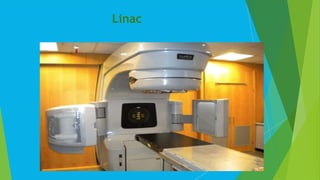
Linac
Used to treat all parts and organs of the body
 Uses microwave technology to accelerate
electrons in the part of the accelerator called the
wave guide, then allows these electrons to collide
with a heavy metal target
The high energy x-rays are shaped as they exit
the machine to conform to the shape of the
patient's tumor
How it works
X-ray treatments are designed in a way that destroy
the cancer cells while sparing the surrounding
normal tissue
High energy photons enter the patient's body and
aim to break the DNA in all the cells within the
treatment area
The good cells are able to mend themselves
The cancerous cells are unable to do this and
therefore die
How it works continued
Patient lies on a moveable treatment
couch which can move in any direction
 The beam comes out of a part of the
accelerator called a gantry, which can be
rotated around the patient
 Radiation is delivered to the tumor
from any angle by rotating the gantry and
moving the treatment couch
How it works continued
 Advantages: particles are able to reach very
high energies without the need for extremely
high voltages
 Linear accelerators attack the affected area
with higher doses of radiation than other
machines
Advantages
 Disadvantages: A linear accelerator can cost anywhere
between one million and three million dollars. Operating the
machine costs about $900,000 annually.
 The particles travel in a straight line, each accelerating segment
is used only once. The segments run in short pulses, limiting the
average current output and forcing the experimental detectors to
handle data coming in short bursts, thus increasing the
maintenance expense
THANK YOU

LINEAR ACCELERATOR

  • 2.
    Produces radiation thatis referred to as a high- energy x-ray for patients with cancer  In 1928, RWideroe demonstrated that electrons could be accelerated through a tube by applying a radio frequency voltage to sections of the tube The linear accelerator is an extension of Wideroe’s idea The name ‘linear accelerator’ comes from the fact that electrons are produced in the machine and accelerated in a straight line. What a Linear Accelerator does and how the idea was started
  • 3.
     Early Accelerators(1953-1961):  Extremely large and bulky  Limited gantry motion  Second Generations (1962-1982):  360 degree rotational  Allow treatment to a patent from any gantry angle  Improvement in accuracy and dose delivery Accelerator Generations
  • 4.
     Third generationaccelerators:  Improved accelerator guide  Magnet systems  Beam-modifying systems to provide wide ranges of beam energy, dose rate, field size  Operating modes with improved beam characteristics  Highly reliable  Compact design  May include: dual photon energies, multileaf collimation, several electron energies & electronic portal verification systems
  • 5.
  • 6.
    Used to treatall parts and organs of the body  Uses microwave technology to accelerate electrons in the part of the accelerator called the wave guide, then allows these electrons to collide with a heavy metal target The high energy x-rays are shaped as they exit the machine to conform to the shape of the patient's tumor How it works
  • 7.
    X-ray treatments aredesigned in a way that destroy the cancer cells while sparing the surrounding normal tissue High energy photons enter the patient's body and aim to break the DNA in all the cells within the treatment area The good cells are able to mend themselves The cancerous cells are unable to do this and therefore die How it works continued
  • 8.
    Patient lies ona moveable treatment couch which can move in any direction  The beam comes out of a part of the accelerator called a gantry, which can be rotated around the patient  Radiation is delivered to the tumor from any angle by rotating the gantry and moving the treatment couch How it works continued
  • 9.
     Advantages: particlesare able to reach very high energies without the need for extremely high voltages  Linear accelerators attack the affected area with higher doses of radiation than other machines Advantages
  • 10.
     Disadvantages: Alinear accelerator can cost anywhere between one million and three million dollars. Operating the machine costs about $900,000 annually.  The particles travel in a straight line, each accelerating segment is used only once. The segments run in short pulses, limiting the average current output and forcing the experimental detectors to handle data coming in short bursts, thus increasing the maintenance expense
  • 11.