IMRT: Treatment Planning and Dosimetry Nesrin Dogan, Ph.D Department of Radiation Oncology Virginia Commonwealth University Medical College of Virginia Hospitals Richmond, VA, USA
Fundamental Issues Beam Modeling Dose Calculation Inverse Planning IMRT QA
Beam Modeling For small fields, minor uncertainties due to approximations in dose calculation models, methods for determining MLC leaf sequences and other factors may form a large fraction of dose delivered, and lead to inaccuracies in delivered dose. 10 cm 1 cm 1 cm 1 cm 1 cm 1 cm 1 cm 1 cm 1 cm 1 cm 1 cm
Beam Modeling, cont. Dosimetric accuracy of the IMRT plan delivery depends on the accurate representation of   Accurate Beam Penumbra representation – MLC / collimator jaws. Adequate characterization and accounting of transmission and scattering properties of MLC leaves. Output factor for small field size. Accuracy of dose calculation algorithm. Approximations of leaf sequence generation algorithm. Leaf positioning accuracy.
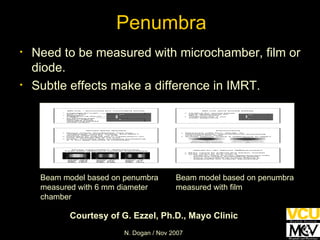
Penumbra Need to be measured with microchamber, film or diode. Subtle effects make a difference in IMRT. Beam model based on penumbra measured with 6 mm diameter chamber Beam model based on penumbra measured with film Courtesy of G. Ezzel, Ph.D., Mayo Clinic
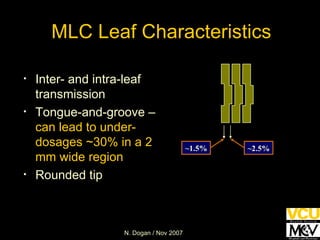
MLC Leaf Characteristics Inter- and intra-leaf transmission Tongue-and-groove –  can lead to under-dosages ~30% in a 2 mm wide region  Rounded tip ~12%  ~1%  ~1.5% ~2.5%
Radiation Field Offset for Rounded Leaf Ends Offset for between the light and radiation field edge = ~0.6 mm Measuring the offset 0.6 is best, i.e. subtract 0.6 mm from MLC settings -> TPS should take care of this Courtesy of G. Ezzel, Ph.D., Mayo Clinic
MLC Leaf Transmission and Scattering Leaf leakage transmission rounded leaf tip transmission MLC scatter Collimator scatter upstream from the MLC. Leakage through leaf ~2% Leakage between neighboring leaf ~5% Leakage through closed opposing leaf pair for rounded ends ~20% - leaves should be parked under the jaw Minimum gap between opposed leaves = 0.5 -0.6 mm to avoid collisions Courtesy of G. Ezzel, Ph.D., Mayo Clinic
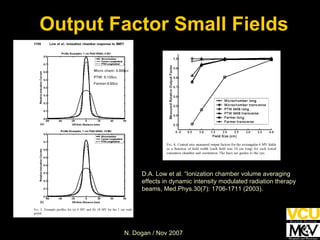
Output Factor Small Fields D.A. Low et al. “Ionization chamber volume averaging effects in dynamic intensity modulated radiation therapy beams, Med.Phys.30(7): 1706-1711 (2003). Micro cham: 0.009cc PTW: 0.125cc Farmer:0.65cc
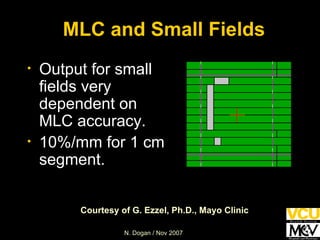
Courtesy of G. Ezzel, Ph.D., Mayo Clinic MLC and Small Fields Output for small fields very dependent on MLC accuracy. 10%/mm for 1 cm segment.
Which Detectors to Use? Need to determine energy dependence and angular response. Small field detectors required for small field characterization. Sensitive to position Detector should be smaller than homogeneous region of dose to be measured Assess electrometer response.
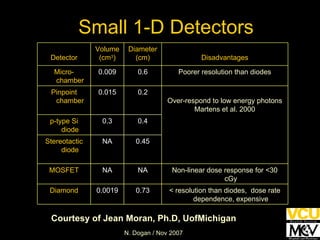
Courtesy of Jean Moran,  Ph.D,  UofMichigan Small 1-D Detectors 0.0019 NA NA 0.3 0.015 0.009 Volume (cm 3 ) 0.45 0.4 0.73 NA 0.2 0.6 Diameter (cm) < resolution than diodes,  dose rate dependence, expensive Diamond Non-linear dose response for <30 cGy MOSFET Stereotactic diode p-type Si diode Over-respond to low energy photons Martens et al. 2000 Pinpoint chamber Poorer resolution than diodes Micro-chamber Disadvantages Detector
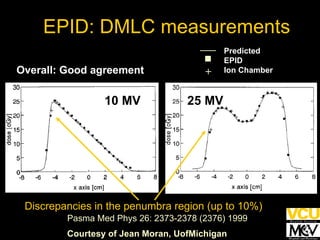
Pasma Med Phys 26: 2373-2378 (2376) 1999 Predicted EPID Ion Chamber + Discrepancies in the penumbra region (up to 10%) Overall: Good agreement 10 MV 25 MV EPID: DMLC measurements Courtesy of Jean Moran, UofMichigan
Dose Calculation Current IMRT systems use simplified dose calculations during plan optimization: e.g.,  pencil beam ->   uses very simple heterogeneity corrections, causing significant dose errors (10% or more non-IMRT cases) Final dose calculation is performed using a separate independent dose calculation that incorporate the influence of the MLC: e.g,  convolution / superposition; more accurate than Pencil beam; however, inaccuracies persist under certain circumstances
Conventional dose algorithms can be inaccurate for  Small fields Regions of dose gradients (radiation disequilibrium) Heterogeneous conditions IMRT is typically delivered through a sequence of small static fields or with a dynamically moving aperture with a small width.  Dose gradients are common place in IMRT fields.  For such fields, assumptions used in conventional algorithms regarding scatter equilibrium and output factor variation with field size typically break down.
Significant fraction of the dose within targets and organs at risk is due to scattered or leakage radiation calculated dose distributions have the greatest uncertainties due to approximations inherent in conventional methods of transforming intensities into MLC leaf sequences Experimental checks of IMRT fields routinely shows discrepancies between the planned  ( desired )  and actual. For IMRT
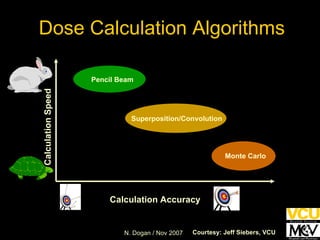
Dose Calculation Algorithms Calculation Speed Calculation Accuracy Pencil Beam Monte Carlo Superposition/Convolution Courtesy: Jeff Siebers, VCU
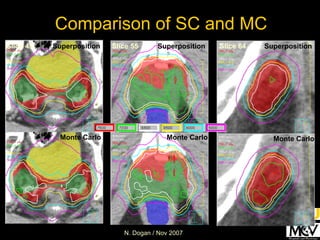
Comparison of SC and MC Comparison of a) Superposition-Convolution (SC) and b) MC dose calculations
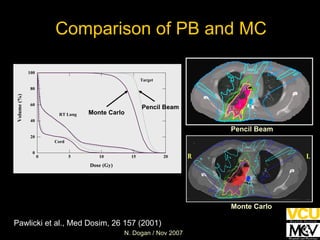
Monte Carlo Pencil Beam Pawlicki et al., Med Dosim, 26 157 (2001) Comparison of PB and MC Pencil Beam Monte Carlo
Superposition Monte Carlo Slice 45 Monte Carlo Slice 55 Monte Carlo Slice 64 Comparison of SC and MC Superposition Superposition
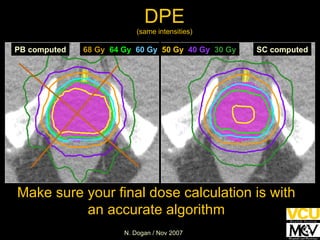
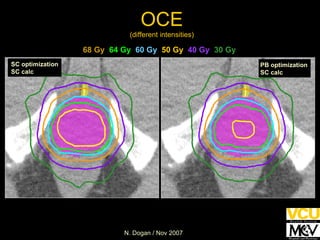
Consequences of Inaccuracy Dose Prediction Error (DPE) For a given intensity distribution, dose predicted differs from that actually delivered to the patient/phantom Can be avoided by performing  final calculation with accurate algorithm Optimization Convergence Error (OCE) Consequence of systematic error during optimization Optimization with an inaccurate algorithm results in different intensities than those predicted by an accurate algorithm  Actual dose is not optimal, a better solution exists  Can be avoided by  optimization with an accurate algorithm
DPE (same intensities) PB computed SC computed Make sure your final dose calculation is with an accurate algorithm 68 Gy   64 Gy   60 Gy   50 Gy   40 Gy   30 Gy
OCE (different intensities) SC optimization SC calc PB optimization  SC calc 68 Gy   64 Gy   60 Gy   50 Gy   40 Gy   30 Gy
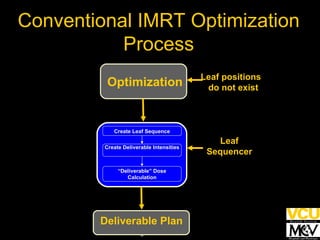
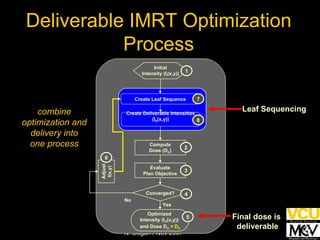
Conventional IMRT Optimization Process Create Leaf Sequence “ Deliverable” Dose Calculation Create Deliverable Intensities Optimization Leaf Sequencer Leaf positions  do not exist Deliverable Plan
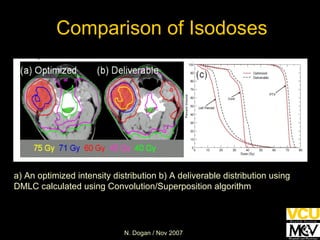
Problems with Conventional IMRT process Optimized plans are converted to deliverable plans through  leaf-sequencing process  that takes into account the limitations and effects  (leakage/scatter)  of the MLC The idealized optimal plan is replaced with  “deliverable”  plan Optimized and deliverable IMRT plans differ Different intensity distributions More complex the intensity distribution, the greater the deviation
Comparison of Isodoses a) An optimized intensity distribution b) A deliverable distribution using DMLC calculated using Convolution/Superposition algorithm
Final dose is  deliverable Deliverable IMRT Optimization Process combine optimization and delivery into one process Leaf Sequencing Initial Intensity (I I (x,y)) Evaluate Plan Objective Converged? Adjust I(x,y) Compute Dose (D O ) Optimized  Intensity (I O (x,y))  and Dose D O  = D D No Yes 1 3 4 5 2 Create Leaf Sequence 7 Create Deliverable Intensities (I D (x,y)) 8 6
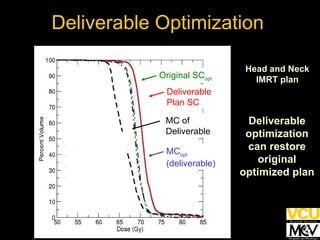
Deliverable Optimization  Deliverable optimization can restore original optimized plan Head and Neck IMRT plan Original SC opt Deliverable Plan SC MC of Deliverable MC opt  (deliverable)
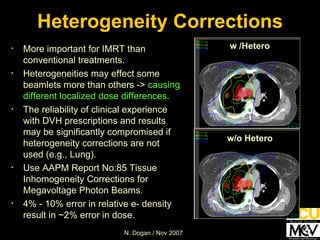
Heterogeneity Corrections More important for IMRT than conventional treatments. Heterogeneities may effect some beamlets more than others ->  causing different localized dose differences. The reliability of clinical experience with DVH prescriptions and results may be significantly compromised if heterogeneity corrections are not used (e.g., Lung). Use AAPM Report No:85 Tissue Inhomogeneity Corrections for Megavoltage Photon Beams. 4% - 10% error in relative e- density result in ~2% error in dose. w /Hetero w/o Hetero
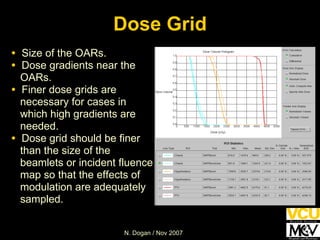
Size of the OARs. Dose gradients near the OARs. Finer dose grids are necessary for cases in which high gradients are needed. Dose grid should be finer than the size of the beamlets or incident fluence map so that the effects of  modulation are adequately sampled. Dose Grid
What do we do about differences? May need to adjust the beam model. May need to live with it. Take known deficiencies into account when evaluating plans May be important for OARs.
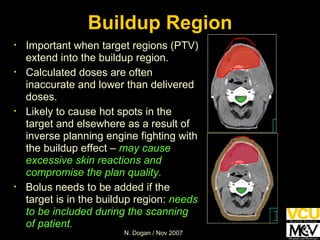
Buildup Region Important when target regions (PTV) extend into the buildup region. Calculated doses are often inaccurate and lower than delivered doses. Likely to cause hot spots in the target and elsewhere as a result of inverse planning engine fighting with the buildup effect –  may cause excessive skin reactions and compromise the plan quality. Bolus needs to be added if the target is in the buildup region:  needs to be included during the scanning of patient.
Definition of Target Volumes  GTV, CTV and PTV  need to be explicitly defined Consistent with the ICRU definitions (ICRU 50) Definition of OARs Planning OAR Volume (ICRU 62) Need to  Use contrast-enhanced CTs Image fusion (PET, MRI, preopt CTs, etc..)  Target and OARs
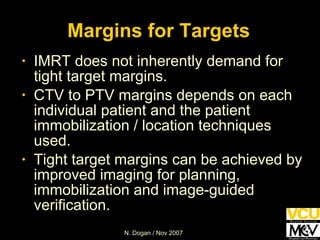
IMRT does not inherently demand for tight target margins. CTV to PTV margins depends on each individual patient and the patient immobilization / location techniques used. Tight target margins can be achieved by improved imaging for planning, immobilization and image-guided verification. Margins for Targets
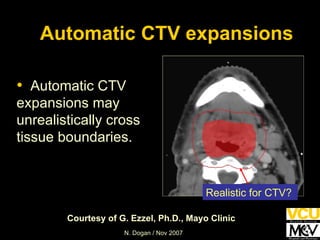
Realistic for CTV? Courtesy of G. Ezzel, Ph.D., Mayo Clinic Automatic CTV expansions may unrealistically cross tissue boundaries. Automatic CTV expansions
Margins for OARs ICRU 62 recommendations suggest the use of margins for OARs.  Generate expanded OARs if it is possible. e.g.; Cord Expand  = Cord + 5 mm Brainstem Expand  = Brainstem + 5 mm Create “ pseudo ” structures to achieve sparing at the desired areas.
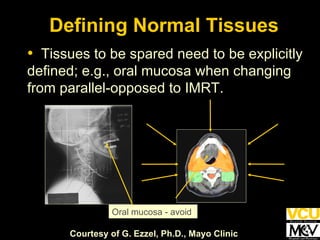
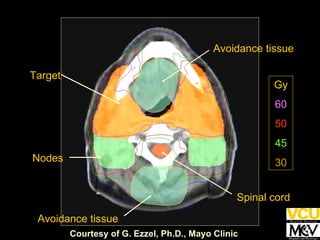
Oral mucosa - avoid Courtesy of G. Ezzel, Ph.D., Mayo Clinic Defining Normal Tissues Tissues to be spared need to be explicitly defined; e.g., oral mucosa when changing from parallel-opposed to IMRT.
Target Nodes Spinal cord Avoidance tissue Avoidance tissue Gy 60 50 45 30 Gy 60 50 45 30 Courtesy of G. Ezzel, Ph.D., Mayo Clinic
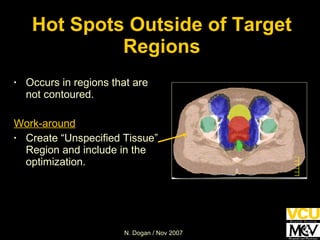
Hot Spots Outside of Target Regions Occurs in regions that are not contoured. Work-around Create “Unspecified Tissue” Region and include in the optimization.
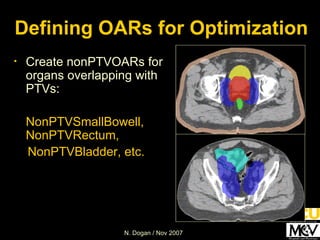
Defining OARs for Optimization Create nonPTVOARs for organs overlapping with PTVs:  NonPTVSmallBowell, NonPTVRectum,  NonPTVBladder, etc.
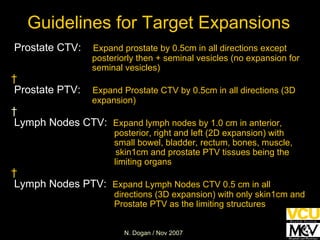
Guidelines for Target Expansions Prostate CTV:   Expand prostate by 0.5cm in all directions except  posteriorly then + seminal vesicles (no expansion for  seminal vesicles)   Prostate PTV:     Expand Prostate CTV by 0.5cm in all directions (3D  expansion)   Lymph Nodes CTV :   Expand lymph nodes by 1.0 cm in anterior,  posterior, right and left (2D expansion) with  small bowel, bladder, rectum, bones, muscle,   skin1cm and prostate PTV tissues being the limiting organs   Lymph Nodes PTV :   Expand Lymph Nodes CTV 0.5 cm in all directions (3D expansion) with only skin1cm and Prostate PTV as the limiting structures
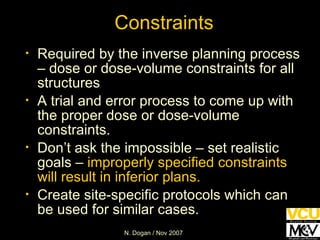
Required by the inverse planning process – dose or dose-volume constraints for all structures A trial and error process to come up with the proper dose or dose-volume constraints. Don’t ask the impossible – set realistic goals –  improperly specified constraints will result in inferior plans. Create site-specific protocols which can be used for similar cases. Constraints
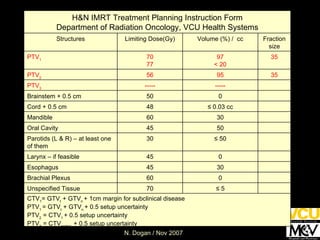
CTV 1 = GTV t  + GTV n  + 1cm margin for subclinical disease PTV 1  = GTV t  + GTV n  + 0.5 setup uncertainty PTV 2  = CTV 1  + 0.5 setup uncertainty PTV 3  = CTV nodes  + 0.5 setup uncertainty ≤  5 70 Unspecified Tissue 0 60 Brachial Plexus 30 45 Esophagus 0 45 Larynx – if feasible ≤  50 30 Parotids (L & R) – at least one of them 50 45 Oral Cavity 30 60 Mandible ≤  0.03 cc 48 Cord + 0.5 cm 0 50 Brainstem + 0.5 cm ----- ----- PTV 3 35 95 56 PTV 2 35 97 < 20 70 77 PTV 1 Fraction size Volume (%) /  cc Limiting Dose(Gy) Structures H&N IMRT Treatment Planning Instruction Form Department of Radiation Oncology, VCU Health Systems
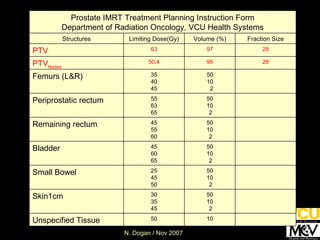
10 50 Unspecified Tissue 50 10 2 30 35 45 Skin1cm  50 10 2 25 45 50 Small Bowel 50 10 2 45 60 65 Bladder 50 10 2 45 55 60 Remaining rectum 50 10 2 55 63 65 Periprostatic rectum 50 10 2 35 40 45 Femurs (L&R)  28 95 50.4 PTV Nodes 28 97 63 PTV Fraction Size Volume (%) Limiting Dose(Gy) Structures Prostate IMRT Treatment Planning Instruction Form Department of Radiation Oncology, VCU Health Systems
General Principles for Beam Angle Selection
Beam Configurations General Principles It is useful to minimize the number of beams for practical reasons The minimum number of beams depends upon a complex combination of factors: Shape and size of target volume Locations, tolerances and tissue architecture of normal tissues Prescription dose (higher doses would normally require more beams) The optimum number may be determined for each class of radiotherapy problems by trial-and-error
Beam Configurations General Principles If sufficient number of beams are used,  the IMRT plan quality is relatively insensitive to beam angles The computer should be able to adjust the weights of rays to make up for modest imperfections in beam placement Beams may be placed at equiangular steps The larger the number of beams, the better the IMRT plan Rotational IMRT should be better Non-coplanar beams should provide additional benefit
Beam Configurations General Principles In general, if beam angles are optimized   the plan optimality should improve the number of beams required for equivalent dose distribution is smaller than if beams are placed at equi-angular steps Computer-aided optimization of the beam angles is a difficult and as yet inadequately solved problem Extremely large number of plans need to be compared
Choose shortest path to irradiate target(s) Avoid OARs Keep large beam separation if it is possible Beam angle may become important for tumors that are not centrally located. It depends on the optimizer Beam Configurations General Principles
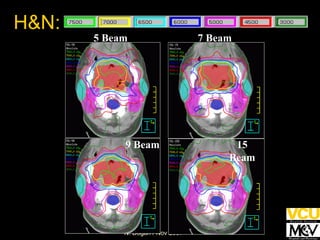
H&N: 5 Beam 9 Beam 7 Beam 15 Beam
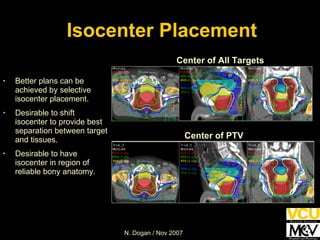
Isocenter Placement Better plans can be achieved by selective isocenter placement. Desirable to shift isocenter to provide best separation between target and tissues. Desirable to have isocenter in region of reliable bony anatomy. Center of All Targets Center of PTV
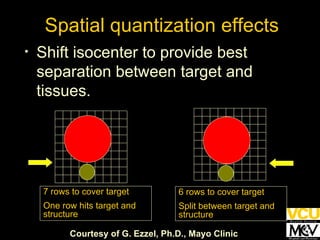
Spatial quantization effects Shift isocenter to provide best separation between target and tissues. Courtesy of G. Ezzel, Ph.D., Mayo Clinic 7 rows to cover target One row hits target and structure 6 rows to cover target Split between target and structure
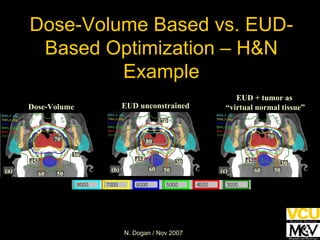
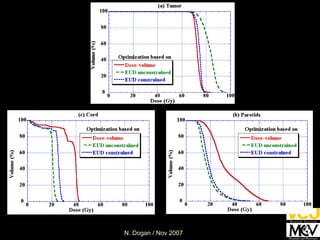
Dose-Volume Based vs. EUD-Based Optimization – H&N Example EUD + tumor as  “virtual normal tissue” 30 45 50 (c) 70 60 EUD unconstrained (b) 30 45 50 80 60 70 45 Dose-Volume (a) 30 50 60 70 45
 
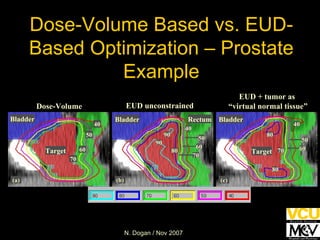
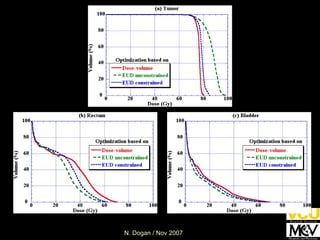
Dose-Volume Based vs. EUD-Based Optimization – Prostate Example 60 50 70 40 (a) 80 40 80 60 70 50 (c) 90 80 40 90 60 50 70 (b) Bladder Target Bladder Target Bladder Rectum Dose-Volume EUD unconstrained EUD + tumor as  “virtual normal tissue”
 
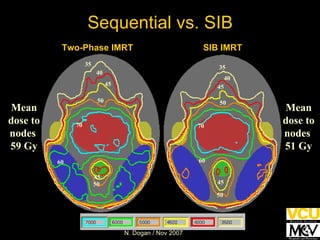
SIB IMRT Two-Phase IMRT Mean dose to nodes  59 Gy Mean dose to nodes  51 Gy Sequential vs. SIB  70 50 45 60 35 40 45 50 35 40 45 45 50 60 70 50
Non-Target Tissue Volumes Receiving Specified Dose
Minimize Number of Segments
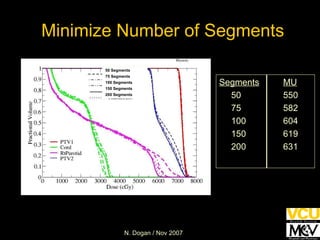
Minimize Number of Segments Segments MU   50 550 75 582 100 604 150 619 200 631 50 Segments 75 Segments 100 Segments 150 Segments 200 Segments
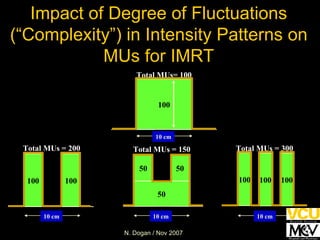
Impact of Degree of Fluctuations (“Complexity”) in Intensity Patterns on MUs for IMRT 100 Total MUs= 100 100 Total MUs = 300 100 100 10 cm 10 cm 100 100 Total MUs = 200 10 cm Total MUs = 150 50 50 50 10 cm
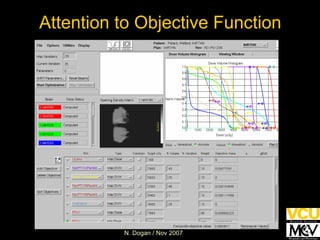
Attention to Objective Function
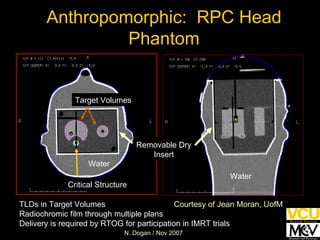
Target Volumes Critical Structure TLDs in Target Volumes Radiochromic film through multiple plans Delivery is required by RTOG for participation in IMRT trials Removable Dry Insert Water Water Anthropomorphic:  RPC Head Phantom Courtesy of Jean Moran, UofM
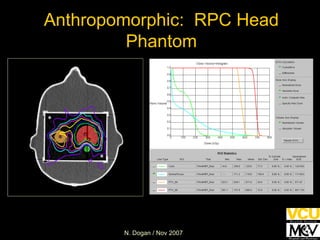
Anthropomorphic:  RPC Head Phantom
Examples
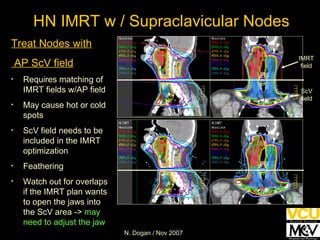
HN IMRT w / Supraclavicular Nodes Treat Nodes with AP ScV field Requires matching of IMRT fields w/AP field May cause hot or cold spots ScV field needs to be included in the IMRT optimization Feathering Watch out for overlaps if the IMRT plan wants to open the jaws into the ScV area ->  may need to adjust the jaw ScV field IMRT field
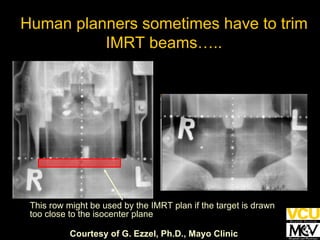
This row might be used by the IMRT plan if the target is drawn too close to the isocenter plane Courtesy of G. Ezzel, Ph.D., Mayo Clinic Human planners sometimes have to trim IMRT beams…..
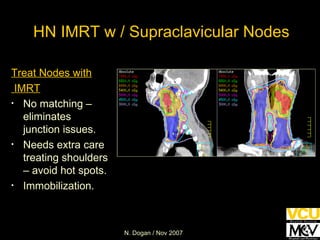
HN IMRT w / Supraclavicular Nodes Treat Nodes with IMRT No matching – eliminates junction issues. Needs extra care treating shoulders – avoid hot spots.  Immobilization.
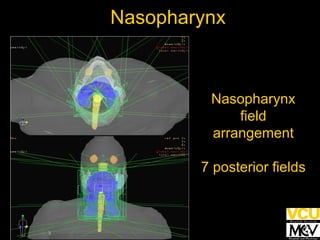
Nasopharynx Nasopharynx field arrangement 7 posterior fields
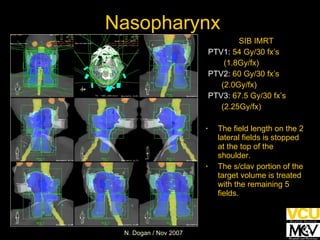
SIB IMRT PTV1:  54 Gy/30 fx’s (1.8Gy/fx) PTV2:  60 Gy/30 fx’s (2.0Gy/fx) PTV3:  67.5 Gy/30 fx’s  (2.25Gy/fx) The field length on the 2 lateral fields is stopped at the top of the shoulder. The s/clav portion of the target volume is treated with the remaining 5 fields. Nasopharynx
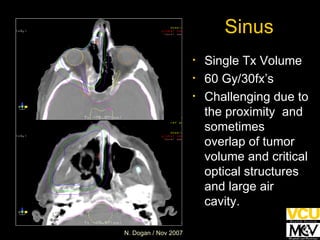
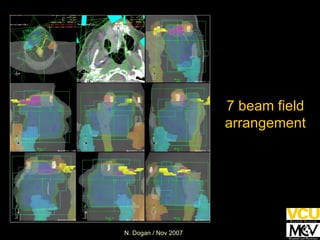
Sinus Single Tx Volume 60 Gy/30fx’s Challenging due to the proximity  and sometimes overlap of tumor volume and critical optical structures and large air cavity.
7 beam field arrangement
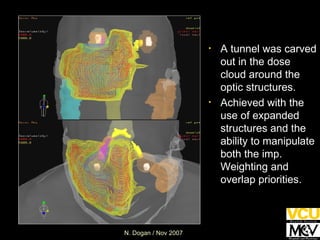
A tunnel was carved out in the dose cloud around the optic structures. Achieved with the use of expanded structures and the ability to manipulate both the imp. Weighting and overlap priorities.
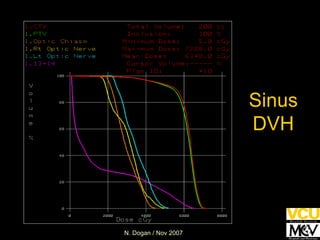
Sinus DVH
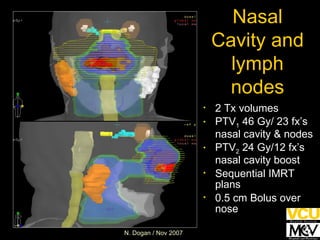
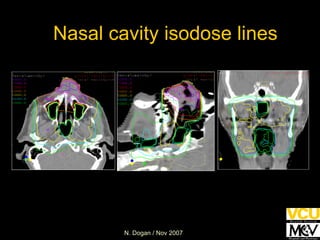
Nasal Cavity and lymph nodes 2 Tx volumes PTV 1  46 Gy/ 23 fx’s nasal cavity & nodes PTV 2  24 Gy/12 fx’s nasal cavity boost Sequential IMRT plans 0.5 cm Bolus over nose

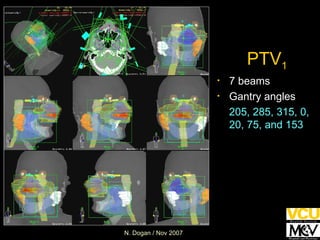
PTV 1 7 beams Gantry angles 205, 285, 315, 0, 20, 75, and 153
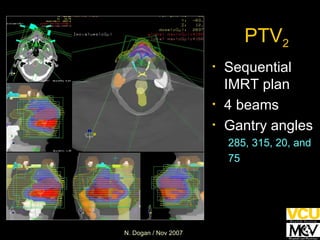
PTV 2 Sequential IMRT plan 4 beams Gantry angles 285, 315, 20, and 75
Nasal cavity isodose lines
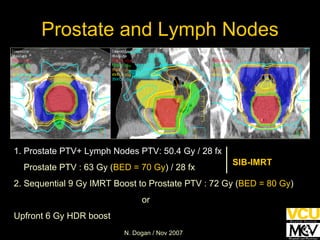
Prostate and Lymph Nodes 1. Prostate PTV+ Lymph Nodes PTV: 50.4 Gy / 28 fx Prostate PTV : 63 Gy ( BED = 70 Gy ) / 28 fx 2. Sequential 9 Gy IMRT Boost to Prostate PTV : 72 Gy ( BED = 80 Gy ) or Upfront 6 Gy HDR boost SIB-IMRT
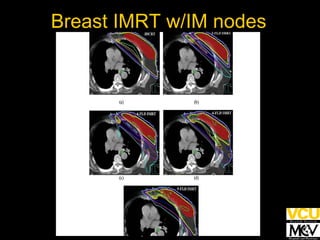
Heart IM nodes Heart IM nodes Breast IMRT w/IM nodes
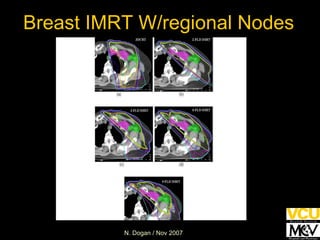
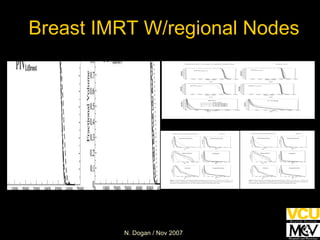
Breast IMRT W/regional Nodes
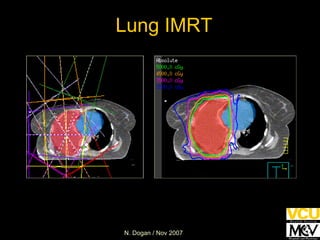
Lung IMRT
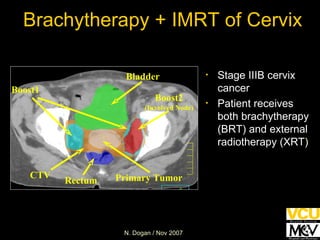
Boost1 Primary Tumor Bladder Rectum CTV Brachytherapy + IMRT of Cervix Stage IIIB cervix cancer Patient receives both brachytherapy (BRT) and external radiotherapy (XRT ) Boost2 (Involved Node)
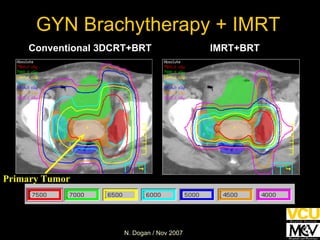
GYN Brachytherapy + IMRT IMRT+BRT Conventional 3DCRT+BRT Primary Tumor
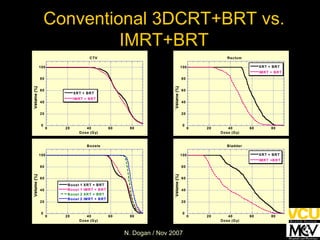
Conventional 3DCRT+BRT vs. IMRT+BRT
QA tasks for IMRT  Machine QA-   Acceptance and routine QA of the MLC for IMRT delivery  - dosimetric and geometric characteristics  Algorithm QA for IMRT  - QA of planning system and data consistency with machine Patient Specific QA – prove plan works 1D and 2D dosimetry of treatment components such IM beams and segments 3D dosimetry of entire treatment delivery Post Treatment QA Log-file analysis
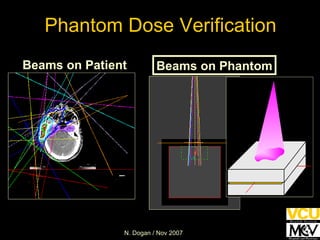
Phantom Dose Verification Beams on Patient Beams on Phantom
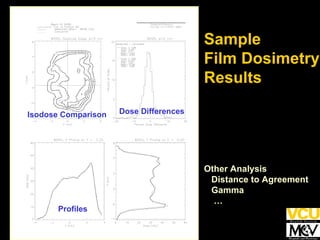
Sample Film Dosimetry  Results Other Analysis Distance to Agreement Gamma … Isodose Comparison Profiles Dose Differences
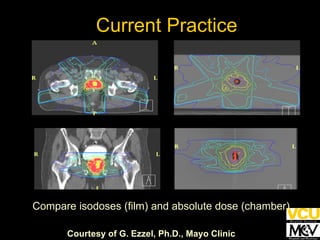
Compare isodoses (film) and absolute dose (chamber) Current Practice Courtesy of G. Ezzel, Ph.D., Mayo Clinic
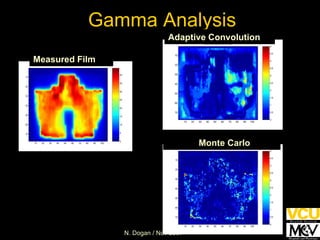
Gamma Analysis Measured Film Adaptive Convolution Monte Carlo
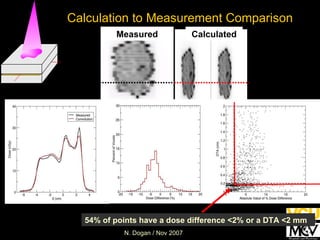
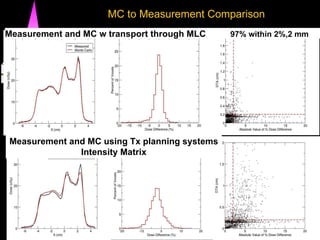
Calculation to Measurement Comparison (b) Measured Calculated 54% of points have a dose difference <2% or a DTA <2 mm
MC to Measurement Comparison (b) (c) Measured Calculated Measurement and MC w transport through MLC  97% within 2%,2 mm Measurement and MC using Tx planning systems Intensity Matrix
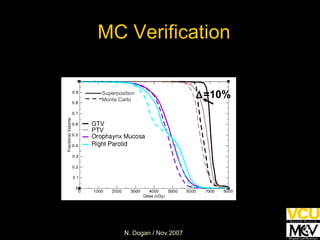
 =10% Superposition  Monte Carlo MC Verification
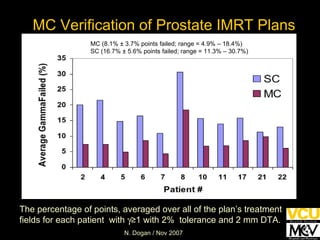
The percentage of points, averaged over all of the plan’s treatment fields for each patient  with   ≥ 1 with 2%  tolerance and 2 mm DTA.   MC (8.1% ± 3.7% points failed; range = 4.9% – 18.4%)   SC (16.7% ± 5.6% points failed; range = 11.3% –   30.7%) MC Verification of Prostate IMRT Plans
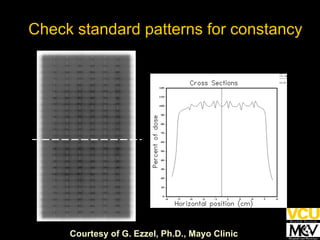
Courtesy of G. Ezzel, Ph.D., Mayo Clinic Check standard patterns for constancy
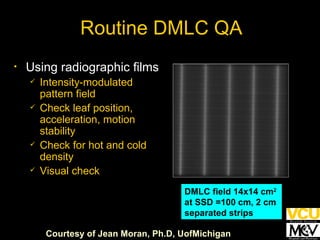
DMLC field 14x14 cm 2  at SSD =100 cm, 2 cm  separated strips  Using radiographic films Intensity-modulated pattern field Check leaf position, acceleration, motion stability  Check for hot and cold density  Visual check  Routine DMLC QA  Courtesy of Jean Moran,  Ph.D,  UofMichigan
Summary Inverse IMRT Planning is not intuitive – however, easy to establish protocols and class solutions for each specific site. Necessary to define realistic goals and constraints. Simplify IMRT plan as much as possible once you have acceptable solution. Know the limitations of your inverse treatment planning system.
Summary Need to characterize the MLC system for IMRT with special emphasis on penumbra, leaf leakage and transmission.  Need to know the limits of the mechanical systems and interactions with controller and accelerator software for delivery. Continued need for improvements to software for delivery system, measurement devices, phantoms, and dose analysis tools.
Acknowledgements Jeffrey Siebers –  VCU Gary Ezzel –  Mayo Clinic Mark Oldham –  Duke University Jean Moran –  U of Michigan Ivaylo Mihalov -  UofArkansas

Imrt Treatment Planning And Dosimetry

  • 1.
    IMRT: Treatment Planningand Dosimetry Nesrin Dogan, Ph.D Department of Radiation Oncology Virginia Commonwealth University Medical College of Virginia Hospitals Richmond, VA, USA
  • 2.
    Fundamental Issues BeamModeling Dose Calculation Inverse Planning IMRT QA
  • 3.
    Beam Modeling Forsmall fields, minor uncertainties due to approximations in dose calculation models, methods for determining MLC leaf sequences and other factors may form a large fraction of dose delivered, and lead to inaccuracies in delivered dose. 10 cm 1 cm 1 cm 1 cm 1 cm 1 cm 1 cm 1 cm 1 cm 1 cm 1 cm
  • 4.
    Beam Modeling, cont.Dosimetric accuracy of the IMRT plan delivery depends on the accurate representation of Accurate Beam Penumbra representation – MLC / collimator jaws. Adequate characterization and accounting of transmission and scattering properties of MLC leaves. Output factor for small field size. Accuracy of dose calculation algorithm. Approximations of leaf sequence generation algorithm. Leaf positioning accuracy.
  • 5.
    Penumbra Need tobe measured with microchamber, film or diode. Subtle effects make a difference in IMRT. Beam model based on penumbra measured with 6 mm diameter chamber Beam model based on penumbra measured with film Courtesy of G. Ezzel, Ph.D., Mayo Clinic
  • 6.
    MLC Leaf CharacteristicsInter- and intra-leaf transmission Tongue-and-groove – can lead to under-dosages ~30% in a 2 mm wide region Rounded tip ~12% ~1% ~1.5% ~2.5%
  • 7.
    Radiation Field Offsetfor Rounded Leaf Ends Offset for between the light and radiation field edge = ~0.6 mm Measuring the offset 0.6 is best, i.e. subtract 0.6 mm from MLC settings -> TPS should take care of this Courtesy of G. Ezzel, Ph.D., Mayo Clinic
  • 8.
    MLC Leaf Transmissionand Scattering Leaf leakage transmission rounded leaf tip transmission MLC scatter Collimator scatter upstream from the MLC. Leakage through leaf ~2% Leakage between neighboring leaf ~5% Leakage through closed opposing leaf pair for rounded ends ~20% - leaves should be parked under the jaw Minimum gap between opposed leaves = 0.5 -0.6 mm to avoid collisions Courtesy of G. Ezzel, Ph.D., Mayo Clinic
  • 9.
    Output Factor SmallFields D.A. Low et al. “Ionization chamber volume averaging effects in dynamic intensity modulated radiation therapy beams, Med.Phys.30(7): 1706-1711 (2003). Micro cham: 0.009cc PTW: 0.125cc Farmer:0.65cc
  • 10.
    Courtesy of G.Ezzel, Ph.D., Mayo Clinic MLC and Small Fields Output for small fields very dependent on MLC accuracy. 10%/mm for 1 cm segment.
  • 11.
    Which Detectors toUse? Need to determine energy dependence and angular response. Small field detectors required for small field characterization. Sensitive to position Detector should be smaller than homogeneous region of dose to be measured Assess electrometer response.
  • 12.
    Courtesy of JeanMoran, Ph.D, UofMichigan Small 1-D Detectors 0.0019 NA NA 0.3 0.015 0.009 Volume (cm 3 ) 0.45 0.4 0.73 NA 0.2 0.6 Diameter (cm) < resolution than diodes, dose rate dependence, expensive Diamond Non-linear dose response for <30 cGy MOSFET Stereotactic diode p-type Si diode Over-respond to low energy photons Martens et al. 2000 Pinpoint chamber Poorer resolution than diodes Micro-chamber Disadvantages Detector
  • 13.
    Pasma Med Phys26: 2373-2378 (2376) 1999 Predicted EPID Ion Chamber + Discrepancies in the penumbra region (up to 10%) Overall: Good agreement 10 MV 25 MV EPID: DMLC measurements Courtesy of Jean Moran, UofMichigan
  • 14.
    Dose Calculation CurrentIMRT systems use simplified dose calculations during plan optimization: e.g., pencil beam -> uses very simple heterogeneity corrections, causing significant dose errors (10% or more non-IMRT cases) Final dose calculation is performed using a separate independent dose calculation that incorporate the influence of the MLC: e.g, convolution / superposition; more accurate than Pencil beam; however, inaccuracies persist under certain circumstances
  • 15.
    Conventional dose algorithmscan be inaccurate for Small fields Regions of dose gradients (radiation disequilibrium) Heterogeneous conditions IMRT is typically delivered through a sequence of small static fields or with a dynamically moving aperture with a small width. Dose gradients are common place in IMRT fields. For such fields, assumptions used in conventional algorithms regarding scatter equilibrium and output factor variation with field size typically break down.
  • 16.
    Significant fraction ofthe dose within targets and organs at risk is due to scattered or leakage radiation calculated dose distributions have the greatest uncertainties due to approximations inherent in conventional methods of transforming intensities into MLC leaf sequences Experimental checks of IMRT fields routinely shows discrepancies between the planned ( desired ) and actual. For IMRT
  • 17.
    Dose Calculation AlgorithmsCalculation Speed Calculation Accuracy Pencil Beam Monte Carlo Superposition/Convolution Courtesy: Jeff Siebers, VCU
  • 18.
    Comparison of SCand MC Comparison of a) Superposition-Convolution (SC) and b) MC dose calculations
  • 19.
    Monte Carlo PencilBeam Pawlicki et al., Med Dosim, 26 157 (2001) Comparison of PB and MC Pencil Beam Monte Carlo
  • 20.
    Superposition Monte CarloSlice 45 Monte Carlo Slice 55 Monte Carlo Slice 64 Comparison of SC and MC Superposition Superposition
  • 21.
    Consequences of InaccuracyDose Prediction Error (DPE) For a given intensity distribution, dose predicted differs from that actually delivered to the patient/phantom Can be avoided by performing final calculation with accurate algorithm Optimization Convergence Error (OCE) Consequence of systematic error during optimization Optimization with an inaccurate algorithm results in different intensities than those predicted by an accurate algorithm Actual dose is not optimal, a better solution exists Can be avoided by optimization with an accurate algorithm
  • 22.
    DPE (same intensities)PB computed SC computed Make sure your final dose calculation is with an accurate algorithm 68 Gy 64 Gy 60 Gy 50 Gy 40 Gy 30 Gy
  • 23.
    OCE (different intensities)SC optimization SC calc PB optimization SC calc 68 Gy 64 Gy 60 Gy 50 Gy 40 Gy 30 Gy
  • 24.
    Conventional IMRT OptimizationProcess Create Leaf Sequence “ Deliverable” Dose Calculation Create Deliverable Intensities Optimization Leaf Sequencer Leaf positions do not exist Deliverable Plan
  • 25.
    Problems with ConventionalIMRT process Optimized plans are converted to deliverable plans through leaf-sequencing process that takes into account the limitations and effects (leakage/scatter) of the MLC The idealized optimal plan is replaced with “deliverable” plan Optimized and deliverable IMRT plans differ Different intensity distributions More complex the intensity distribution, the greater the deviation
  • 26.
    Comparison of Isodosesa) An optimized intensity distribution b) A deliverable distribution using DMLC calculated using Convolution/Superposition algorithm
  • 27.
    Final dose is deliverable Deliverable IMRT Optimization Process combine optimization and delivery into one process Leaf Sequencing Initial Intensity (I I (x,y)) Evaluate Plan Objective Converged? Adjust I(x,y) Compute Dose (D O ) Optimized Intensity (I O (x,y)) and Dose D O = D D No Yes 1 3 4 5 2 Create Leaf Sequence 7 Create Deliverable Intensities (I D (x,y)) 8 6
  • 28.
    Deliverable Optimization Deliverable optimization can restore original optimized plan Head and Neck IMRT plan Original SC opt Deliverable Plan SC MC of Deliverable MC opt (deliverable)
  • 29.
    Heterogeneity Corrections Moreimportant for IMRT than conventional treatments. Heterogeneities may effect some beamlets more than others -> causing different localized dose differences. The reliability of clinical experience with DVH prescriptions and results may be significantly compromised if heterogeneity corrections are not used (e.g., Lung). Use AAPM Report No:85 Tissue Inhomogeneity Corrections for Megavoltage Photon Beams. 4% - 10% error in relative e- density result in ~2% error in dose. w /Hetero w/o Hetero
  • 30.
    Size of theOARs. Dose gradients near the OARs. Finer dose grids are necessary for cases in which high gradients are needed. Dose grid should be finer than the size of the beamlets or incident fluence map so that the effects of modulation are adequately sampled. Dose Grid
  • 31.
    What do wedo about differences? May need to adjust the beam model. May need to live with it. Take known deficiencies into account when evaluating plans May be important for OARs.
  • 32.
    Buildup Region Importantwhen target regions (PTV) extend into the buildup region. Calculated doses are often inaccurate and lower than delivered doses. Likely to cause hot spots in the target and elsewhere as a result of inverse planning engine fighting with the buildup effect – may cause excessive skin reactions and compromise the plan quality. Bolus needs to be added if the target is in the buildup region: needs to be included during the scanning of patient.
  • 33.
    Definition of TargetVolumes GTV, CTV and PTV need to be explicitly defined Consistent with the ICRU definitions (ICRU 50) Definition of OARs Planning OAR Volume (ICRU 62) Need to Use contrast-enhanced CTs Image fusion (PET, MRI, preopt CTs, etc..) Target and OARs
  • 34.
    IMRT does notinherently demand for tight target margins. CTV to PTV margins depends on each individual patient and the patient immobilization / location techniques used. Tight target margins can be achieved by improved imaging for planning, immobilization and image-guided verification. Margins for Targets
  • 35.
    Realistic for CTV?Courtesy of G. Ezzel, Ph.D., Mayo Clinic Automatic CTV expansions may unrealistically cross tissue boundaries. Automatic CTV expansions
  • 36.
    Margins for OARsICRU 62 recommendations suggest the use of margins for OARs. Generate expanded OARs if it is possible. e.g.; Cord Expand = Cord + 5 mm Brainstem Expand = Brainstem + 5 mm Create “ pseudo ” structures to achieve sparing at the desired areas.
  • 37.
    Oral mucosa -avoid Courtesy of G. Ezzel, Ph.D., Mayo Clinic Defining Normal Tissues Tissues to be spared need to be explicitly defined; e.g., oral mucosa when changing from parallel-opposed to IMRT.
  • 38.
    Target Nodes Spinalcord Avoidance tissue Avoidance tissue Gy 60 50 45 30 Gy 60 50 45 30 Courtesy of G. Ezzel, Ph.D., Mayo Clinic
  • 39.
    Hot Spots Outsideof Target Regions Occurs in regions that are not contoured. Work-around Create “Unspecified Tissue” Region and include in the optimization.
  • 40.
    Defining OARs forOptimization Create nonPTVOARs for organs overlapping with PTVs: NonPTVSmallBowell, NonPTVRectum, NonPTVBladder, etc.
  • 41.
    Guidelines for TargetExpansions Prostate CTV: Expand prostate by 0.5cm in all directions except posteriorly then + seminal vesicles (no expansion for seminal vesicles)   Prostate PTV: Expand Prostate CTV by 0.5cm in all directions (3D expansion)   Lymph Nodes CTV : Expand lymph nodes by 1.0 cm in anterior, posterior, right and left (2D expansion) with small bowel, bladder, rectum, bones, muscle, skin1cm and prostate PTV tissues being the limiting organs   Lymph Nodes PTV : Expand Lymph Nodes CTV 0.5 cm in all directions (3D expansion) with only skin1cm and Prostate PTV as the limiting structures
  • 42.
    Required by theinverse planning process – dose or dose-volume constraints for all structures A trial and error process to come up with the proper dose or dose-volume constraints. Don’t ask the impossible – set realistic goals – improperly specified constraints will result in inferior plans. Create site-specific protocols which can be used for similar cases. Constraints
  • 43.
    CTV 1 =GTV t + GTV n + 1cm margin for subclinical disease PTV 1 = GTV t + GTV n + 0.5 setup uncertainty PTV 2 = CTV 1 + 0.5 setup uncertainty PTV 3 = CTV nodes + 0.5 setup uncertainty ≤ 5 70 Unspecified Tissue 0 60 Brachial Plexus 30 45 Esophagus 0 45 Larynx – if feasible ≤ 50 30 Parotids (L & R) – at least one of them 50 45 Oral Cavity 30 60 Mandible ≤ 0.03 cc 48 Cord + 0.5 cm 0 50 Brainstem + 0.5 cm ----- ----- PTV 3 35 95 56 PTV 2 35 97 < 20 70 77 PTV 1 Fraction size Volume (%) / cc Limiting Dose(Gy) Structures H&N IMRT Treatment Planning Instruction Form Department of Radiation Oncology, VCU Health Systems
  • 44.
    10 50 UnspecifiedTissue 50 10 2 30 35 45 Skin1cm 50 10 2 25 45 50 Small Bowel 50 10 2 45 60 65 Bladder 50 10 2 45 55 60 Remaining rectum 50 10 2 55 63 65 Periprostatic rectum 50 10 2 35 40 45 Femurs (L&R) 28 95 50.4 PTV Nodes 28 97 63 PTV Fraction Size Volume (%) Limiting Dose(Gy) Structures Prostate IMRT Treatment Planning Instruction Form Department of Radiation Oncology, VCU Health Systems
  • 45.
    General Principles forBeam Angle Selection
  • 46.
    Beam Configurations GeneralPrinciples It is useful to minimize the number of beams for practical reasons The minimum number of beams depends upon a complex combination of factors: Shape and size of target volume Locations, tolerances and tissue architecture of normal tissues Prescription dose (higher doses would normally require more beams) The optimum number may be determined for each class of radiotherapy problems by trial-and-error
  • 47.
    Beam Configurations GeneralPrinciples If sufficient number of beams are used, the IMRT plan quality is relatively insensitive to beam angles The computer should be able to adjust the weights of rays to make up for modest imperfections in beam placement Beams may be placed at equiangular steps The larger the number of beams, the better the IMRT plan Rotational IMRT should be better Non-coplanar beams should provide additional benefit
  • 48.
    Beam Configurations GeneralPrinciples In general, if beam angles are optimized the plan optimality should improve the number of beams required for equivalent dose distribution is smaller than if beams are placed at equi-angular steps Computer-aided optimization of the beam angles is a difficult and as yet inadequately solved problem Extremely large number of plans need to be compared
  • 49.
    Choose shortest pathto irradiate target(s) Avoid OARs Keep large beam separation if it is possible Beam angle may become important for tumors that are not centrally located. It depends on the optimizer Beam Configurations General Principles
  • 50.
    H&N: 5 Beam9 Beam 7 Beam 15 Beam
  • 51.
    Isocenter Placement Betterplans can be achieved by selective isocenter placement. Desirable to shift isocenter to provide best separation between target and tissues. Desirable to have isocenter in region of reliable bony anatomy. Center of All Targets Center of PTV
  • 52.
    Spatial quantization effectsShift isocenter to provide best separation between target and tissues. Courtesy of G. Ezzel, Ph.D., Mayo Clinic 7 rows to cover target One row hits target and structure 6 rows to cover target Split between target and structure
  • 53.
    Dose-Volume Based vs.EUD-Based Optimization – H&N Example EUD + tumor as “virtual normal tissue” 30 45 50 (c) 70 60 EUD unconstrained (b) 30 45 50 80 60 70 45 Dose-Volume (a) 30 50 60 70 45
  • 54.
  • 55.
    Dose-Volume Based vs.EUD-Based Optimization – Prostate Example 60 50 70 40 (a) 80 40 80 60 70 50 (c) 90 80 40 90 60 50 70 (b) Bladder Target Bladder Target Bladder Rectum Dose-Volume EUD unconstrained EUD + tumor as “virtual normal tissue”
  • 56.
  • 57.
    SIB IMRT Two-PhaseIMRT Mean dose to nodes 59 Gy Mean dose to nodes 51 Gy Sequential vs. SIB 70 50 45 60 35 40 45 50 35 40 45 45 50 60 70 50
  • 58.
    Non-Target Tissue VolumesReceiving Specified Dose
  • 59.
  • 60.
    Minimize Number ofSegments Segments MU 50 550 75 582 100 604 150 619 200 631 50 Segments 75 Segments 100 Segments 150 Segments 200 Segments
  • 61.
    Impact of Degreeof Fluctuations (“Complexity”) in Intensity Patterns on MUs for IMRT 100 Total MUs= 100 100 Total MUs = 300 100 100 10 cm 10 cm 100 100 Total MUs = 200 10 cm Total MUs = 150 50 50 50 10 cm
  • 62.
  • 63.
    Target Volumes CriticalStructure TLDs in Target Volumes Radiochromic film through multiple plans Delivery is required by RTOG for participation in IMRT trials Removable Dry Insert Water Water Anthropomorphic: RPC Head Phantom Courtesy of Jean Moran, UofM
  • 64.
  • 65.
  • 66.
    HN IMRT w/ Supraclavicular Nodes Treat Nodes with AP ScV field Requires matching of IMRT fields w/AP field May cause hot or cold spots ScV field needs to be included in the IMRT optimization Feathering Watch out for overlaps if the IMRT plan wants to open the jaws into the ScV area -> may need to adjust the jaw ScV field IMRT field
  • 67.
    This row mightbe used by the IMRT plan if the target is drawn too close to the isocenter plane Courtesy of G. Ezzel, Ph.D., Mayo Clinic Human planners sometimes have to trim IMRT beams…..
  • 68.
    HN IMRT w/ Supraclavicular Nodes Treat Nodes with IMRT No matching – eliminates junction issues. Needs extra care treating shoulders – avoid hot spots. Immobilization.
  • 69.
    Nasopharynx Nasopharynx fieldarrangement 7 posterior fields
  • 70.
    SIB IMRT PTV1: 54 Gy/30 fx’s (1.8Gy/fx) PTV2: 60 Gy/30 fx’s (2.0Gy/fx) PTV3: 67.5 Gy/30 fx’s (2.25Gy/fx) The field length on the 2 lateral fields is stopped at the top of the shoulder. The s/clav portion of the target volume is treated with the remaining 5 fields. Nasopharynx
  • 71.
    Sinus Single TxVolume 60 Gy/30fx’s Challenging due to the proximity and sometimes overlap of tumor volume and critical optical structures and large air cavity.
  • 72.
    7 beam fieldarrangement
  • 73.
    A tunnel wascarved out in the dose cloud around the optic structures. Achieved with the use of expanded structures and the ability to manipulate both the imp. Weighting and overlap priorities.
  • 74.
  • 75.
    Nasal Cavity andlymph nodes 2 Tx volumes PTV 1 46 Gy/ 23 fx’s nasal cavity & nodes PTV 2 24 Gy/12 fx’s nasal cavity boost Sequential IMRT plans 0.5 cm Bolus over nose
  • 76.
    PTV 1 7beams Gantry angles 205, 285, 315, 0, 20, 75, and 153
  • 77.
    PTV 2 SequentialIMRT plan 4 beams Gantry angles 285, 315, 20, and 75
  • 78.
  • 79.
    Prostate and LymphNodes 1. Prostate PTV+ Lymph Nodes PTV: 50.4 Gy / 28 fx Prostate PTV : 63 Gy ( BED = 70 Gy ) / 28 fx 2. Sequential 9 Gy IMRT Boost to Prostate PTV : 72 Gy ( BED = 80 Gy ) or Upfront 6 Gy HDR boost SIB-IMRT
  • 80.
    Heart IM nodesHeart IM nodes Breast IMRT w/IM nodes
  • 81.
  • 82.
  • 83.
  • 84.
    Boost1 Primary TumorBladder Rectum CTV Brachytherapy + IMRT of Cervix Stage IIIB cervix cancer Patient receives both brachytherapy (BRT) and external radiotherapy (XRT ) Boost2 (Involved Node)
  • 85.
    GYN Brachytherapy +IMRT IMRT+BRT Conventional 3DCRT+BRT Primary Tumor
  • 86.
  • 87.
    QA tasks forIMRT Machine QA- Acceptance and routine QA of the MLC for IMRT delivery - dosimetric and geometric characteristics Algorithm QA for IMRT - QA of planning system and data consistency with machine Patient Specific QA – prove plan works 1D and 2D dosimetry of treatment components such IM beams and segments 3D dosimetry of entire treatment delivery Post Treatment QA Log-file analysis
  • 88.
    Phantom Dose VerificationBeams on Patient Beams on Phantom
  • 89.
    Sample Film Dosimetry Results Other Analysis Distance to Agreement Gamma … Isodose Comparison Profiles Dose Differences
  • 90.
    Compare isodoses (film)and absolute dose (chamber) Current Practice Courtesy of G. Ezzel, Ph.D., Mayo Clinic
  • 91.
    Gamma Analysis MeasuredFilm Adaptive Convolution Monte Carlo
  • 92.
    Calculation to MeasurementComparison (b) Measured Calculated 54% of points have a dose difference <2% or a DTA <2 mm
  • 93.
    MC to MeasurementComparison (b) (c) Measured Calculated Measurement and MC w transport through MLC 97% within 2%,2 mm Measurement and MC using Tx planning systems Intensity Matrix
  • 94.
     =10% Superposition Monte Carlo MC Verification
  • 95.
    The percentage ofpoints, averaged over all of the plan’s treatment fields for each patient with  ≥ 1 with 2% tolerance and 2 mm DTA. MC (8.1% ± 3.7% points failed; range = 4.9% – 18.4%) SC (16.7% ± 5.6% points failed; range = 11.3% – 30.7%) MC Verification of Prostate IMRT Plans
  • 96.
    Courtesy of G.Ezzel, Ph.D., Mayo Clinic Check standard patterns for constancy
  • 97.
    DMLC field 14x14cm 2 at SSD =100 cm, 2 cm separated strips Using radiographic films Intensity-modulated pattern field Check leaf position, acceleration, motion stability Check for hot and cold density Visual check Routine DMLC QA Courtesy of Jean Moran, Ph.D, UofMichigan
  • 98.
    Summary Inverse IMRTPlanning is not intuitive – however, easy to establish protocols and class solutions for each specific site. Necessary to define realistic goals and constraints. Simplify IMRT plan as much as possible once you have acceptable solution. Know the limitations of your inverse treatment planning system.
  • 99.
    Summary Need tocharacterize the MLC system for IMRT with special emphasis on penumbra, leaf leakage and transmission. Need to know the limits of the mechanical systems and interactions with controller and accelerator software for delivery. Continued need for improvements to software for delivery system, measurement devices, phantoms, and dose analysis tools.
  • 100.
    Acknowledgements Jeffrey Siebers– VCU Gary Ezzel – Mayo Clinic Mark Oldham – Duke University Jean Moran – U of Michigan Ivaylo Mihalov - UofArkansas