Quality Management Systems
In Radiotherapy
Based on ISO 9001 principles
Val Antoff
Accreditation against the National Safety and
Quality Health Service (NSQHS) Standards will be
mandatory for all hospitals and day surgeries from 1
January 2013. In WA this includes both public and
private facilities.
Why do we need to know about
Quality Management Systems
(QMS)?
1. Definitions
2. Documentation requirements of QMS
3. Importance of organisation chart
4. Measuring quality
5. Making improvements
6. The documentation pyramid
7. Summary
Scope of this presentation
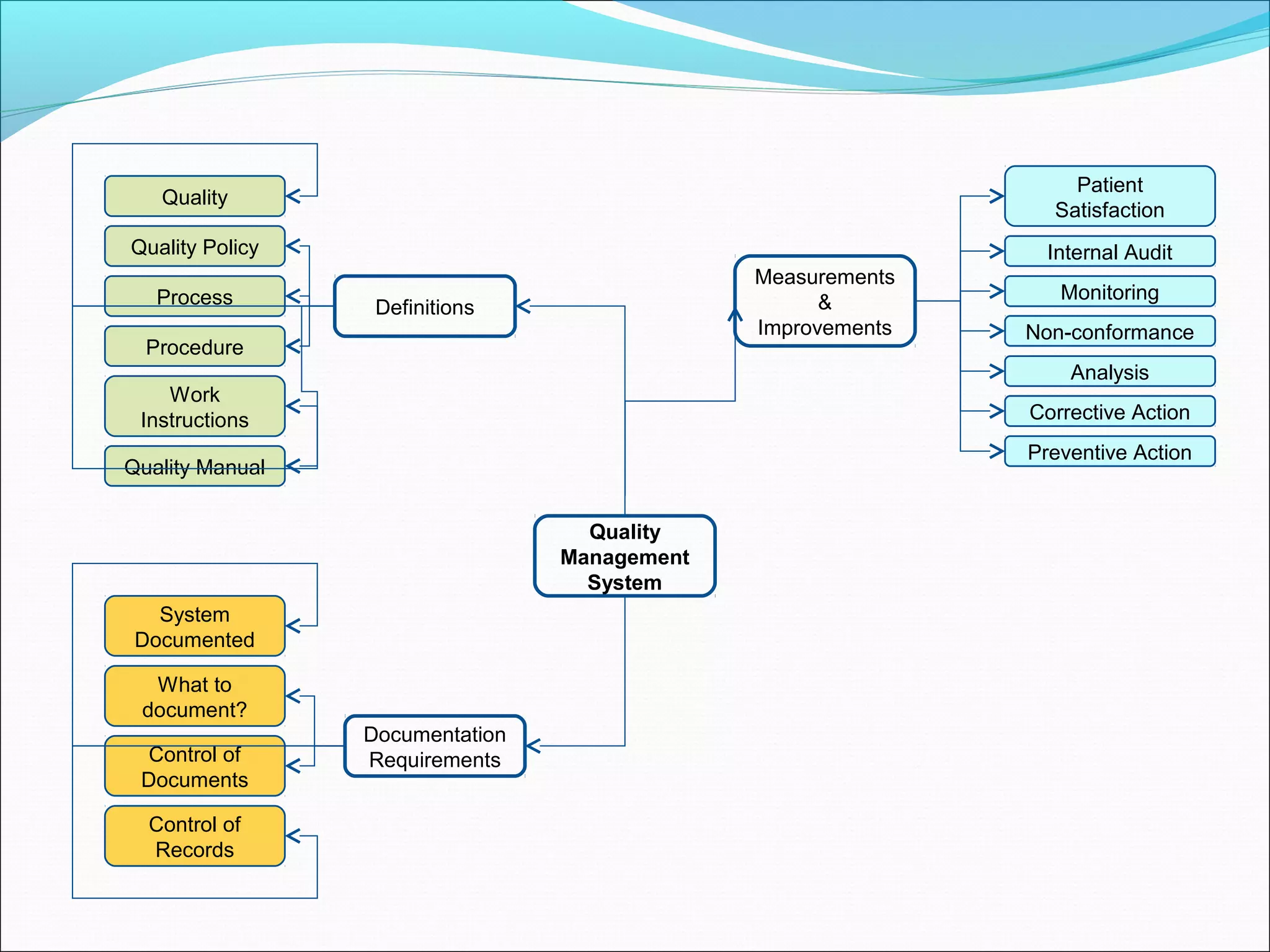
Quality
Management
System
Measurements
&
Improvements
Definitions
Documentation
Requirements
Procedure
Process
Quality Policy
Quality
Work
Instructions
Quality Manual
System
Documented
Control of
Records
Control of
Documents
Analysis
Monitoring
Internal Audit
Patient
Satisfaction
Corrective Action
Preventive Action
Non-conformance
What to
document?
Quality
“Quality is fitness for use“, the service should meet its specifications
Quality Policy
The quality policy is a general statement made by top management that it intends
to achieve quality as a result of the company's operation.
Process
A series of activities, actions or functions designed to bring about a specific result.
Definitions
Procedure
The procedure documents the step-by-step detail for the process activities and
actions that must be executed in the same manner in order to always obtain the
same result under the same circumstances.
They typically include what, when, where, and who should do the activity identified.
We are committed to Total Patient Satisfaction by
providing services which meet or exceed our patients
expectations.
It is our policy to ensure that all patients undergoing
simulation have a signed treatment consent.
Definitions
Quality Manual
The quality manual outlines the policies, procedures, work instructions
and requirements of the Quality Management System and describes the interaction
between the processes.
Work instruction
Whilst a procedure documents the step-by-step detail for the process, a work
instruction defines further details of one or several process step(s) that the
business has put in place.
Work instructions are for work performed in one area or function and typically tell
you “how” to do the activity.
“Without documentation, all your tasks, functions, processes, and procedures
the way that we habitually do everything – are nothing more than good
intentions. Processes that have not been documented are only rumours about
the way we do things”.
“If the process is not written down, how can you train others to create the same
results? How do you ensure that everyone does it the same way? How do you
know if that way is the best way? If it is not written down it did not happen”.
Michael Gerber
www.e-myth.com
System Documented
Why do we need to document our procedures and work
instructions?
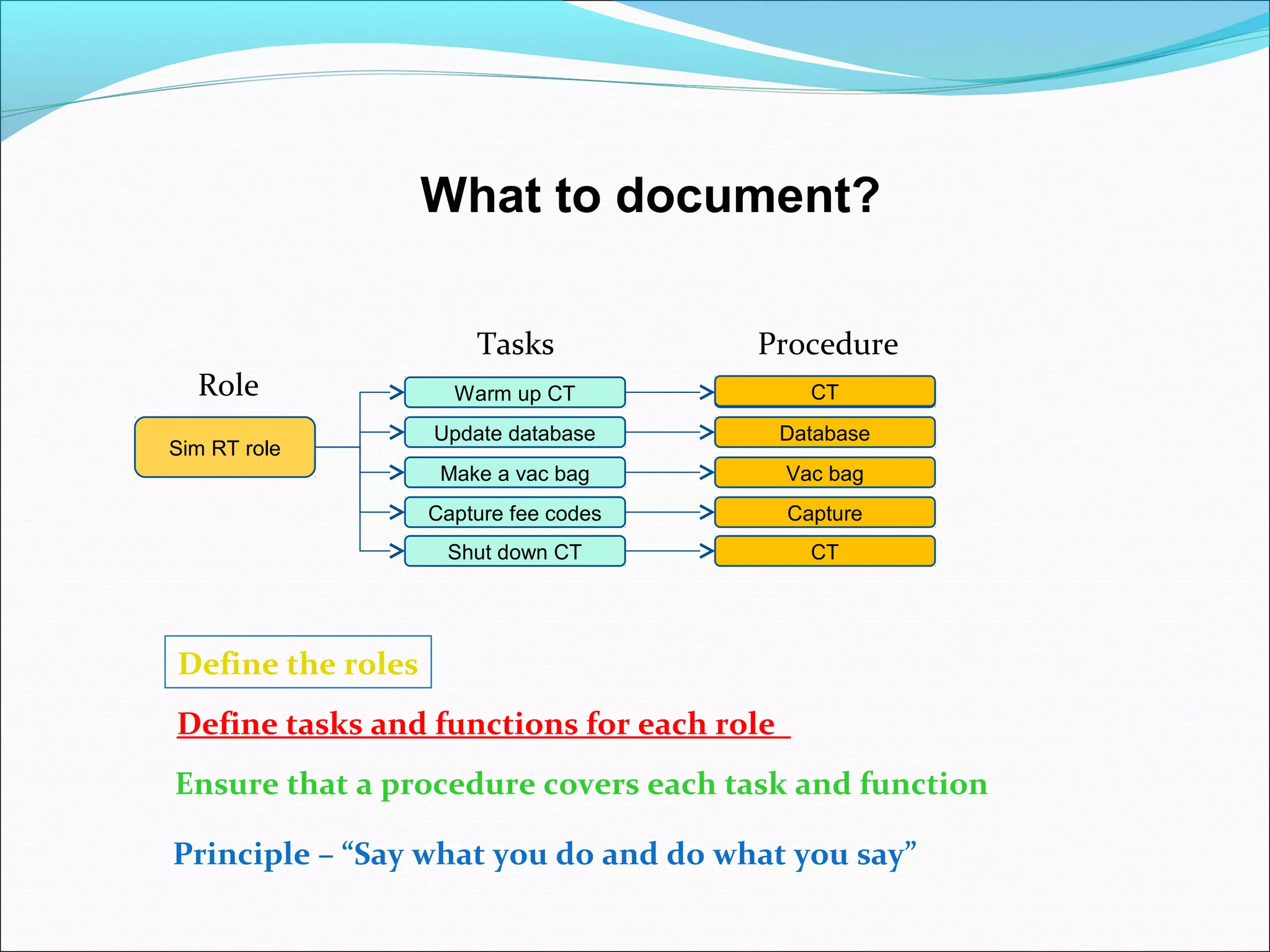
What to document?
Warm up CT
Make a vac bag
Capture fee codes
Sim RT role
Update database
Tasks
Role Warm up CT
Database
Vac bag
Capture
Procedure
Define the roles
Define tasks and functions for each role
Ensure that a procedure covers each task and function
Shut down CT CT
CT
Principle – “Say what you do and do what you say”
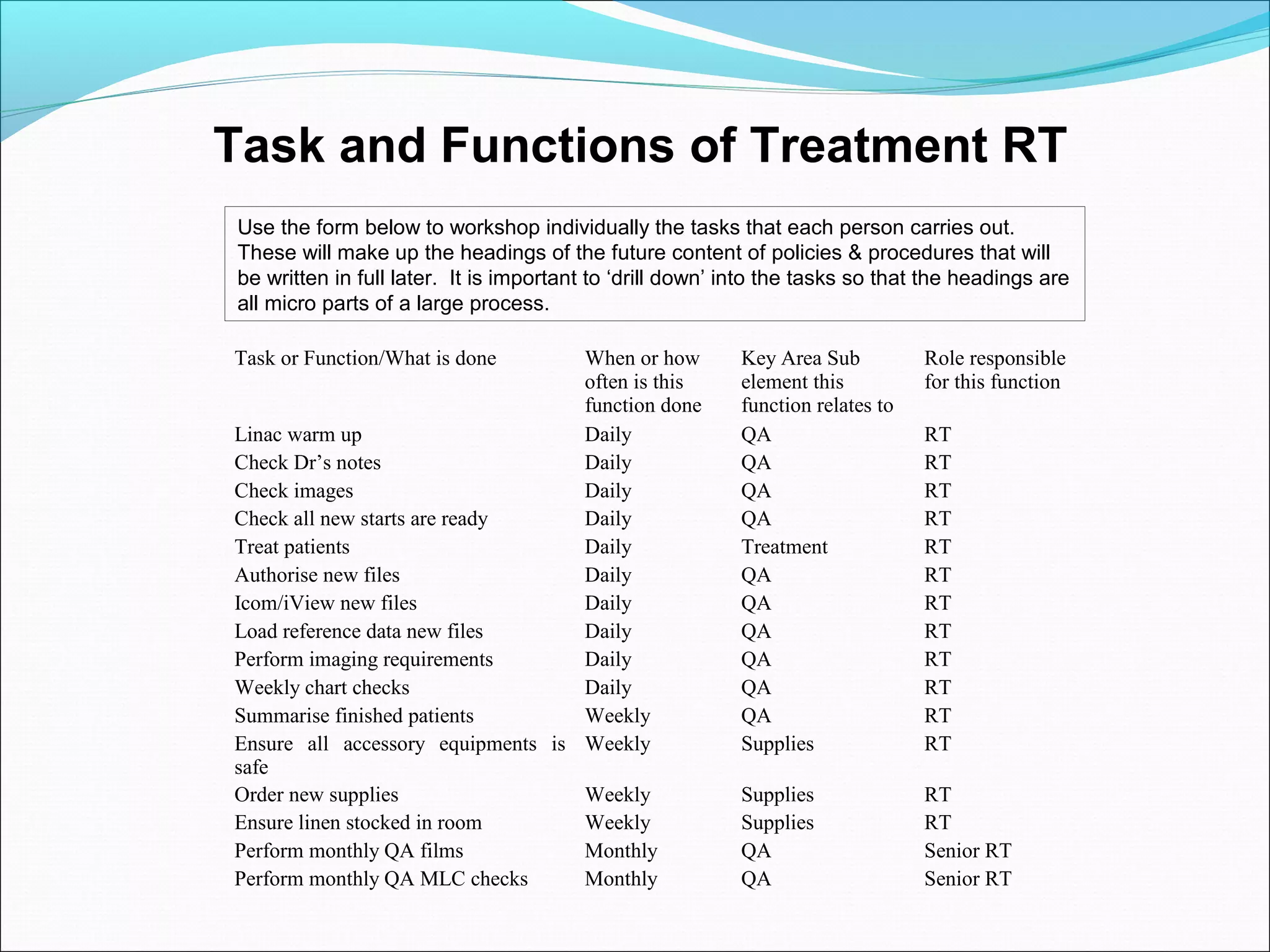
Task and Functions of Treatment RT
Task or Function/What is done When or how
often is this
function done
Key Area Sub
element this
function relates to
Role responsible
for this function
Linac warm up Daily QA RT
Check Dr’s notes Daily QA RT
Check images Daily QA RT
Check all new starts are ready Daily QA RT
Treat patients Daily Treatment RT
Authorise new files Daily QA RT
Icom/iView new files Daily QA RT
Load reference data new files Daily QA RT
Perform imaging requirements Daily QA RT
Weekly chart checks Daily QA RT
Summarise finished patients Weekly QA RT
Ensure all accessory equipments is
safe
Weekly Supplies RT
Order new supplies Weekly Supplies RT
Ensure linen stocked in room Weekly Supplies RT
Perform monthly QA films Monthly QA Senior RT
Perform monthly QA MLC checks Monthly QA Senior RT
Use the form below to workshop individually the tasks that each person carries out.
These will make up the headings of the future content of policies & procedures that will
be written in full later. It is important to ‘drill down’ into the tasks so that the headings are
all micro parts of a large process.
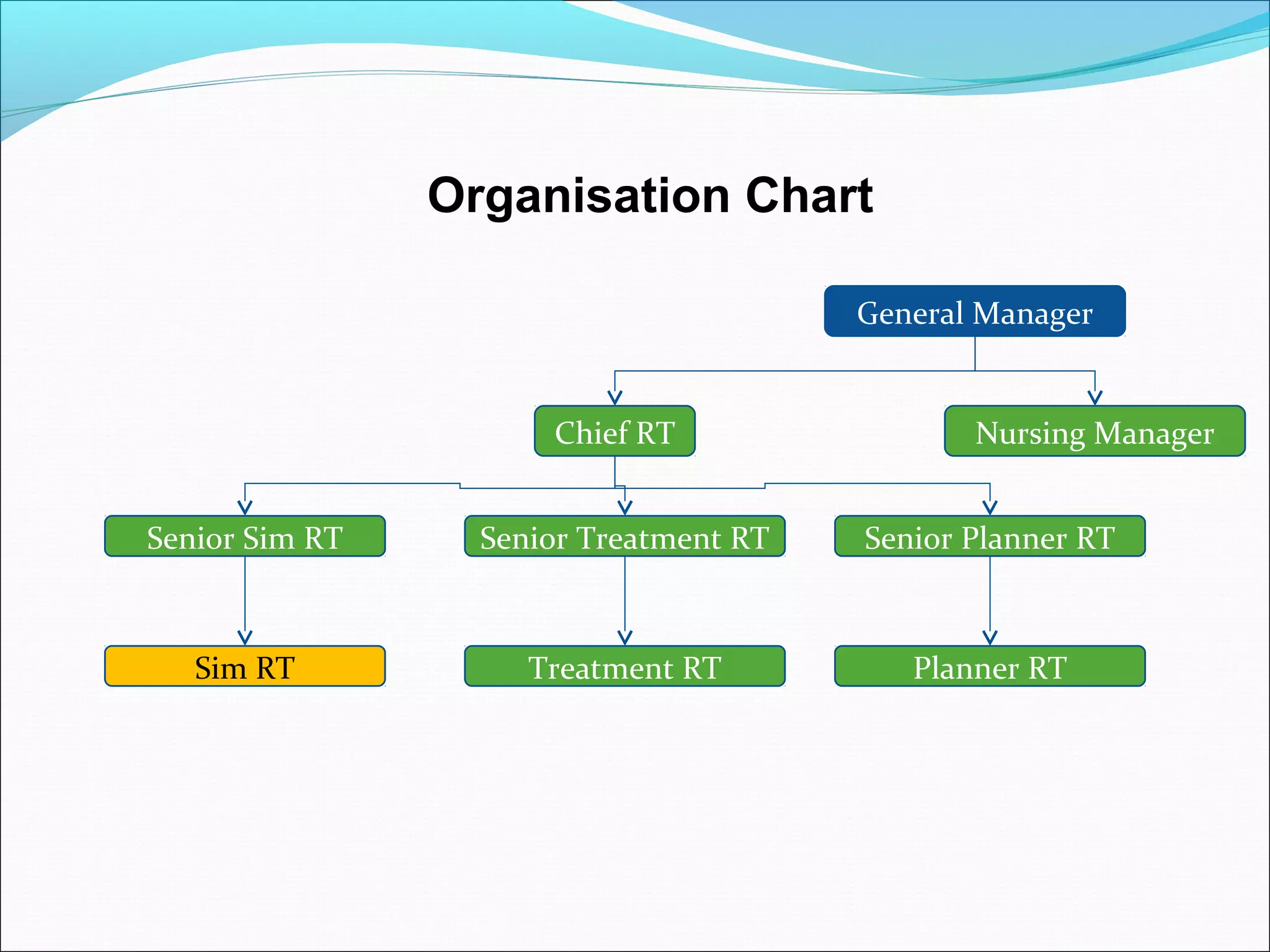
Organisation Chart
Chief RT
Senior Treatment RTSenior Sim RT Senior Planner RT
Sim RT Treatment RT Planner RT
General Manager
Nursing Manager
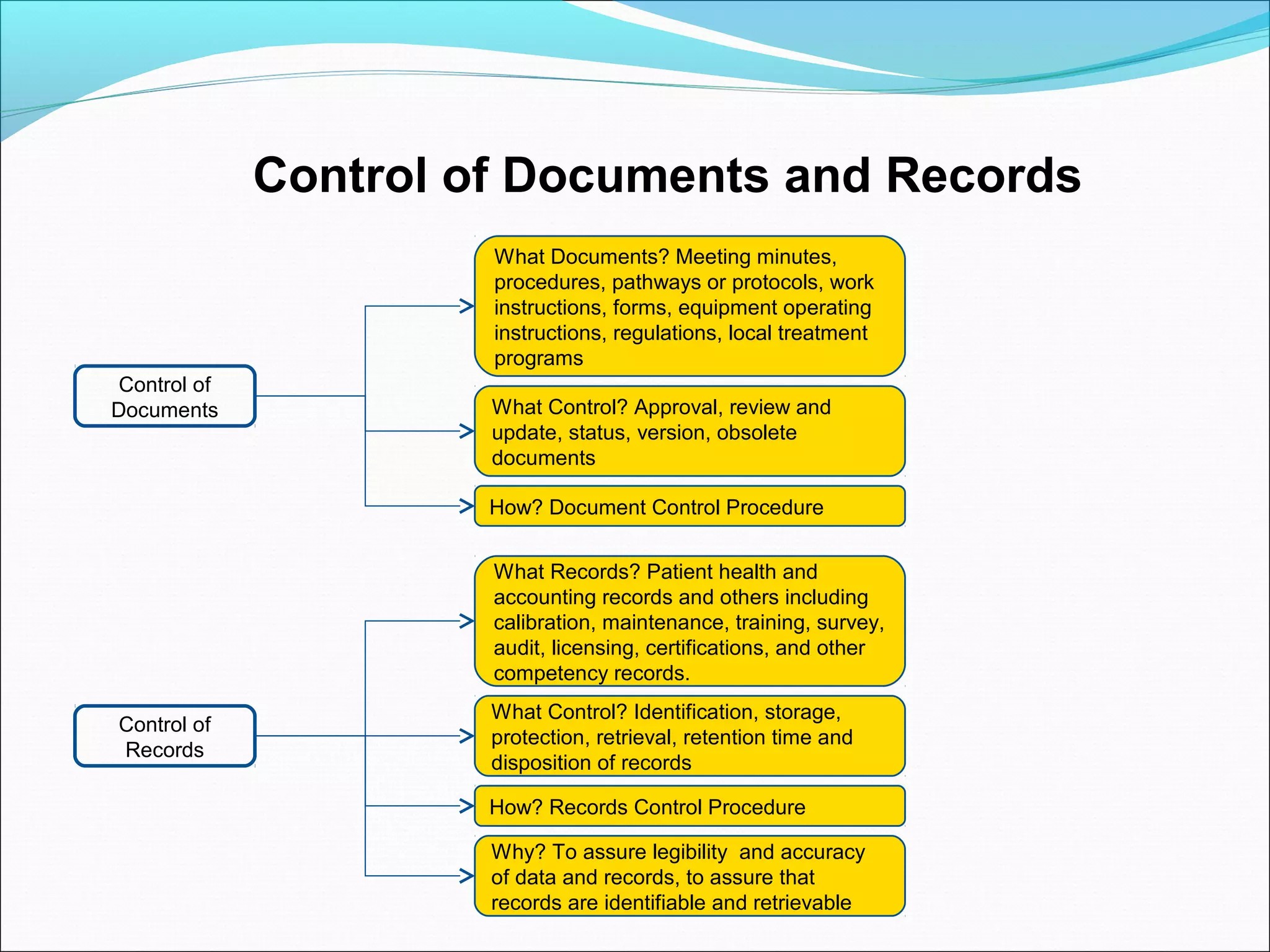
Control of
Documents What Control? Approval, review and
update, status, version, obsolete
documents
How? Document Control Procedure
Control of Documents and Records
Control of
Records
What Control? Identification, storage,
protection, retrieval, retention time and
disposition of records
How? Records Control Procedure
What Records? Patient health and
accounting records and others including
calibration, maintenance, training, survey,
audit, licensing, certifications, and other
competency records.
Why? To assure legibility and accuracy
of data and records, to assure that
records are identifiable and retrievable
What Documents? Meeting minutes,
procedures, pathways or protocols, work
instructions, forms, equipment operating
instructions, regulations, local treatment
programs
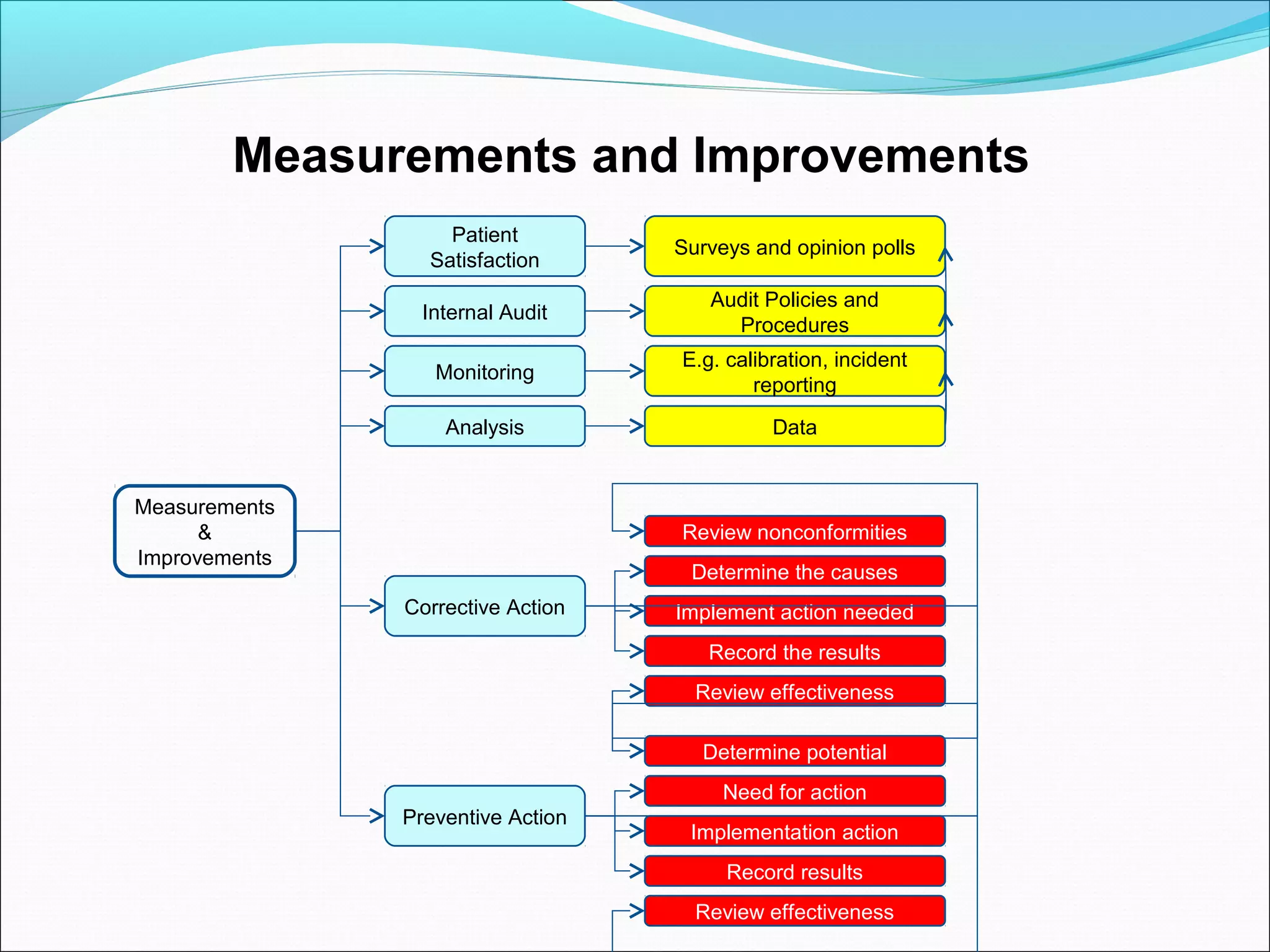
Measurements
&
Improvements
Analysis
Monitoring
Internal Audit
Patient
Satisfaction
Corrective Action
Preventive Action
Measurements and Improvements
Thank you cards,
chocolates, cakes etc
Surveys and opinion polls
Audit Policies and
Procedures
E.g. calibration, incident
reporting
Data
Review nonconformities
Determine the causes
Implement action needed
Record the results
Review effectiveness
Determine potential
Need for action
Implementation action
Record results
Review effectiveness
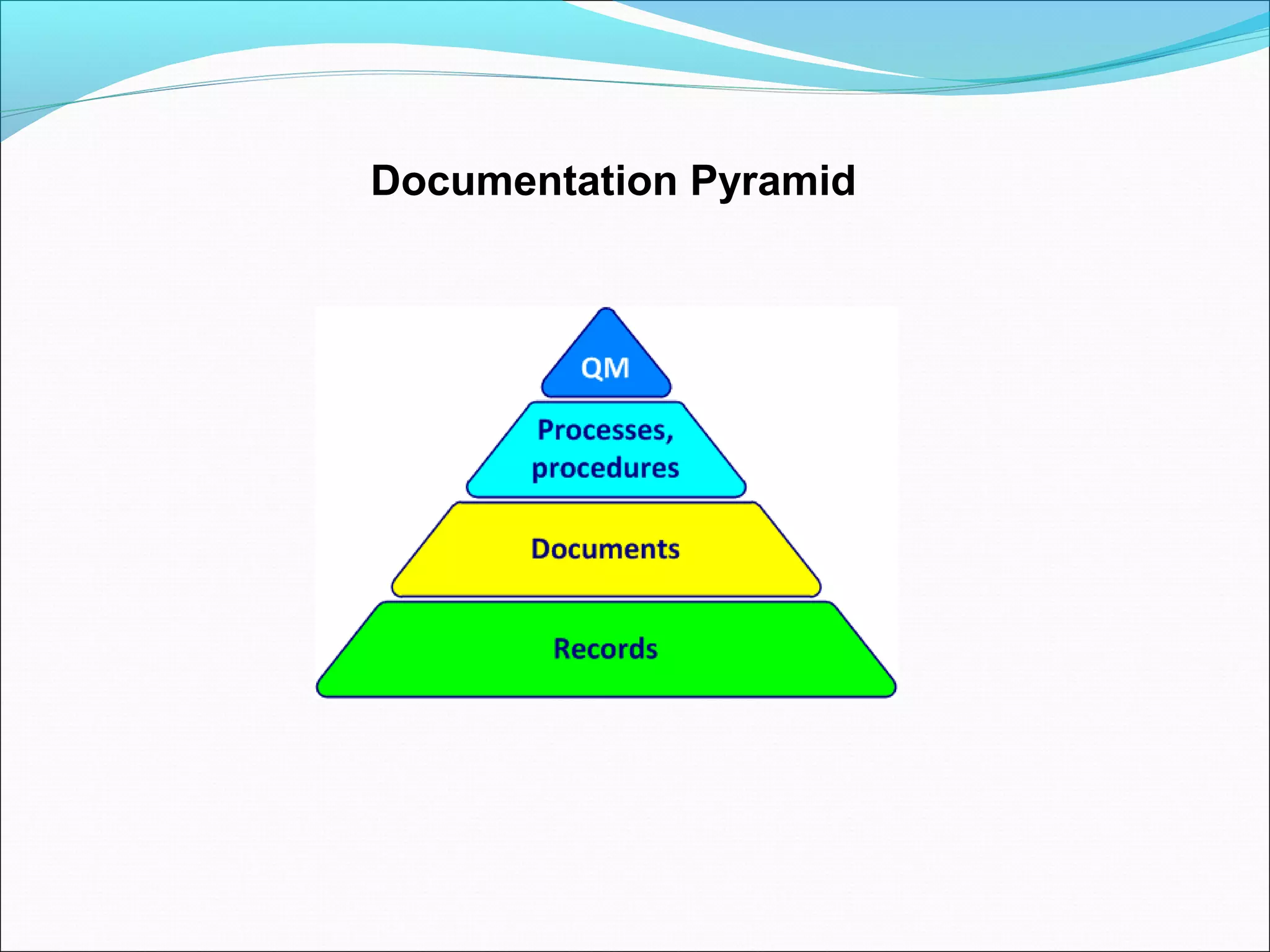
Documentation Pyramid
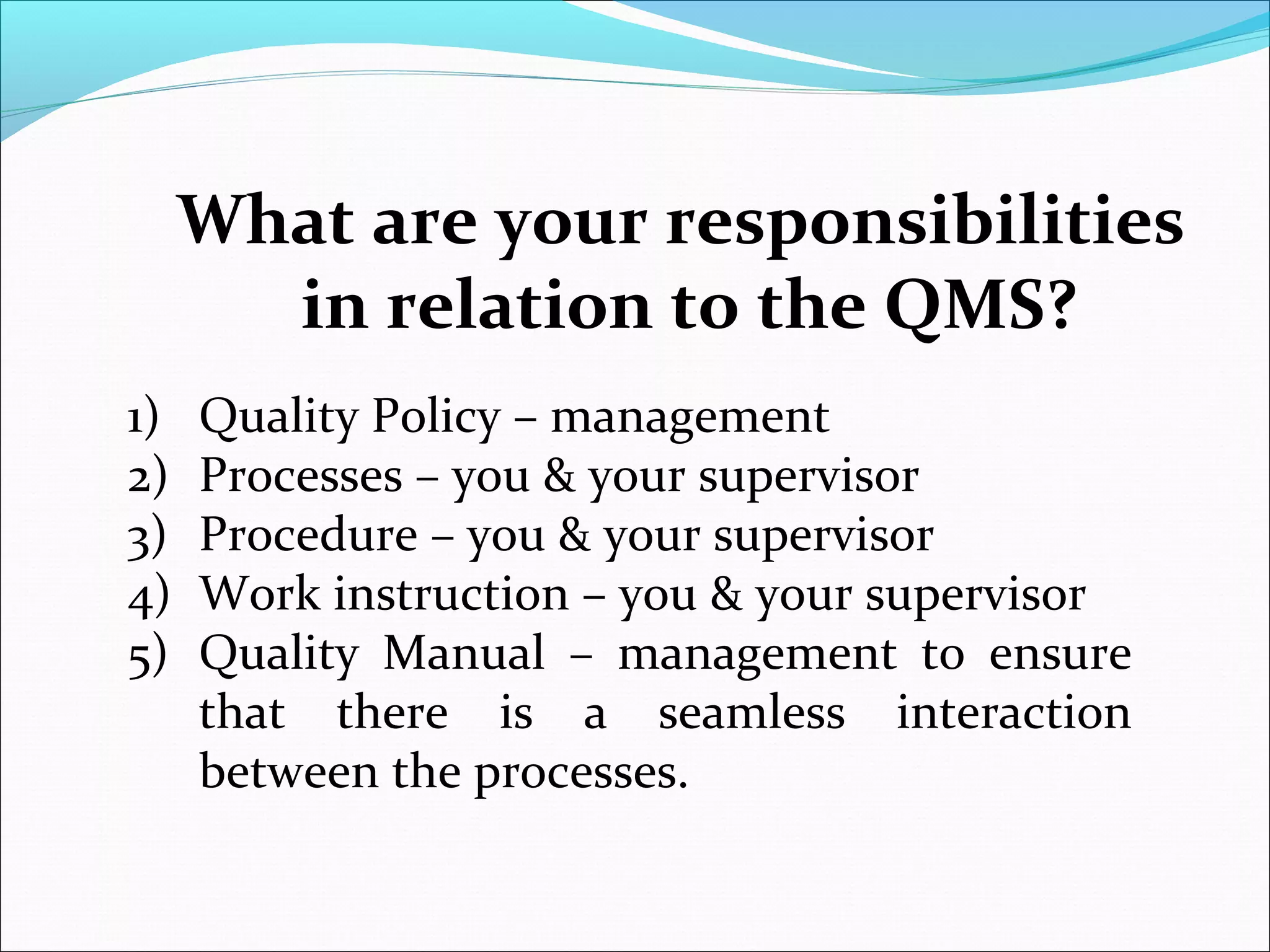
What are your responsibilities
in relation to the QMS?
1) Quality Policy – management
2) Processes – you & your supervisor
3) Procedure – you & your supervisor
4) Work instruction – you & your supervisor
5) Quality Manual – management to ensure
that there is a seamless interaction
between the processes.
A quality management system (QMS) is
the organisational structure, procedures,
processes and resources needed to
implement quality management
What is a QMS?
Summary
• Accreditation will become mandatory from 1 January 2013 –
a QMS is a prerequisite;
• Unless a QMS is documented the procedures that we follow
are only rumours about the way we do things;
• It is essential that every role has a list of tasks and functions
assigned to it;
• The results from the analysis of the measurements and
reporting data are the main indicators for quality;
• Improving the way we do things can be achieved only after
we analyse any nonconformities and take action;
• It is everyone’s responsibility to follow an up-to-date set of
procedures and work instructions and participate in the
maintenance and development of the QMS;

Quality Management Systems in Radiotherapy based on ISO 9001 standard

  • 1.
    Quality Management Systems InRadiotherapy Based on ISO 9001 principles Val Antoff
  • 2.
    Accreditation against theNational Safety and Quality Health Service (NSQHS) Standards will be mandatory for all hospitals and day surgeries from 1 January 2013. In WA this includes both public and private facilities. Why do we need to know about Quality Management Systems (QMS)?
  • 3.
    1. Definitions 2. Documentationrequirements of QMS 3. Importance of organisation chart 4. Measuring quality 5. Making improvements 6. The documentation pyramid 7. Summary Scope of this presentation
  • 4.
    Quality Management System Measurements & Improvements Definitions Documentation Requirements Procedure Process Quality Policy Quality Work Instructions Quality Manual System Documented Controlof Records Control of Documents Analysis Monitoring Internal Audit Patient Satisfaction Corrective Action Preventive Action Non-conformance What to document?
  • 5.
    Quality “Quality is fitnessfor use“, the service should meet its specifications Quality Policy The quality policy is a general statement made by top management that it intends to achieve quality as a result of the company's operation. Process A series of activities, actions or functions designed to bring about a specific result. Definitions Procedure The procedure documents the step-by-step detail for the process activities and actions that must be executed in the same manner in order to always obtain the same result under the same circumstances. They typically include what, when, where, and who should do the activity identified. We are committed to Total Patient Satisfaction by providing services which meet or exceed our patients expectations. It is our policy to ensure that all patients undergoing simulation have a signed treatment consent.
  • 6.
    Definitions Quality Manual The qualitymanual outlines the policies, procedures, work instructions and requirements of the Quality Management System and describes the interaction between the processes. Work instruction Whilst a procedure documents the step-by-step detail for the process, a work instruction defines further details of one or several process step(s) that the business has put in place. Work instructions are for work performed in one area or function and typically tell you “how” to do the activity.
  • 7.
    “Without documentation, allyour tasks, functions, processes, and procedures the way that we habitually do everything – are nothing more than good intentions. Processes that have not been documented are only rumours about the way we do things”. “If the process is not written down, how can you train others to create the same results? How do you ensure that everyone does it the same way? How do you know if that way is the best way? If it is not written down it did not happen”. Michael Gerber www.e-myth.com System Documented Why do we need to document our procedures and work instructions?
  • 8.
    What to document? Warmup CT Make a vac bag Capture fee codes Sim RT role Update database Tasks Role Warm up CT Database Vac bag Capture Procedure Define the roles Define tasks and functions for each role Ensure that a procedure covers each task and function Shut down CT CT CT Principle – “Say what you do and do what you say”
  • 9.
    Task and Functionsof Treatment RT Task or Function/What is done When or how often is this function done Key Area Sub element this function relates to Role responsible for this function Linac warm up Daily QA RT Check Dr’s notes Daily QA RT Check images Daily QA RT Check all new starts are ready Daily QA RT Treat patients Daily Treatment RT Authorise new files Daily QA RT Icom/iView new files Daily QA RT Load reference data new files Daily QA RT Perform imaging requirements Daily QA RT Weekly chart checks Daily QA RT Summarise finished patients Weekly QA RT Ensure all accessory equipments is safe Weekly Supplies RT Order new supplies Weekly Supplies RT Ensure linen stocked in room Weekly Supplies RT Perform monthly QA films Monthly QA Senior RT Perform monthly QA MLC checks Monthly QA Senior RT Use the form below to workshop individually the tasks that each person carries out. These will make up the headings of the future content of policies & procedures that will be written in full later. It is important to ‘drill down’ into the tasks so that the headings are all micro parts of a large process.
  • 10.
    Organisation Chart Chief RT SeniorTreatment RTSenior Sim RT Senior Planner RT Sim RT Treatment RT Planner RT General Manager Nursing Manager
  • 11.
    Control of Documents WhatControl? Approval, review and update, status, version, obsolete documents How? Document Control Procedure Control of Documents and Records Control of Records What Control? Identification, storage, protection, retrieval, retention time and disposition of records How? Records Control Procedure What Records? Patient health and accounting records and others including calibration, maintenance, training, survey, audit, licensing, certifications, and other competency records. Why? To assure legibility and accuracy of data and records, to assure that records are identifiable and retrievable What Documents? Meeting minutes, procedures, pathways or protocols, work instructions, forms, equipment operating instructions, regulations, local treatment programs
  • 12.
    Measurements & Improvements Analysis Monitoring Internal Audit Patient Satisfaction Corrective Action PreventiveAction Measurements and Improvements Thank you cards, chocolates, cakes etc Surveys and opinion polls Audit Policies and Procedures E.g. calibration, incident reporting Data Review nonconformities Determine the causes Implement action needed Record the results Review effectiveness Determine potential Need for action Implementation action Record results Review effectiveness
  • 13.
  • 14.
    What are yourresponsibilities in relation to the QMS? 1) Quality Policy – management 2) Processes – you & your supervisor 3) Procedure – you & your supervisor 4) Work instruction – you & your supervisor 5) Quality Manual – management to ensure that there is a seamless interaction between the processes.
  • 15.
    A quality managementsystem (QMS) is the organisational structure, procedures, processes and resources needed to implement quality management What is a QMS?
  • 16.
    Summary • Accreditation willbecome mandatory from 1 January 2013 – a QMS is a prerequisite; • Unless a QMS is documented the procedures that we follow are only rumours about the way we do things; • It is essential that every role has a list of tasks and functions assigned to it; • The results from the analysis of the measurements and reporting data are the main indicators for quality; • Improving the way we do things can be achieved only after we analyse any nonconformities and take action; • It is everyone’s responsibility to follow an up-to-date set of procedures and work instructions and participate in the maintenance and development of the QMS;

Editor's Notes

  • #2 This is a presentation about the basic components of a quality management system in the context of a radiotherapy department. Radiotherapy department includes all sections such as the radiation therapists team, nursing, ROs, physics, clerical, engineers and management. Before I continue who knows what a quality management system (QMS) is? Not too many people think that they know what a QMS however you will all be very glad to hear that each of you works within the framework of a QMS and that a large part of the QMS is already in place. We just need to define what a QMS is.
  • #3 I guess you may be thinking “Why is Val wasting my time with a talk about quality? A talk about quality is always blurry and vague anyway. All I have to do is to perform my job well and I will get a good quality outcome”. Isn’t that what you are thinking? Well, you are right about doing the job well and getting a good quality outcome. But: What is your job – your job description usually gives a broad overview of what you are expected to do but it rarely lists all your individual tasks and functions. A job description is not supposed to do this anyway. How do you know that you are doing your job well – do you always know what the criteria or the standard is that you are working against? How do you know that you are achieving a good quality outcome? – do you always get to see an analysis of the outcome of your work? Maybe it is not as simple as “I just have to do my work well”. Accreditation against a quality standard will be mandatory from 1 Jan 2013 QMS improves quality QMS reduces risk - injury to patient, injury to self, missing a payment from a patient etc. QMS improves efficiency – a QMS strives to achieve the most effective and efficient way of doing things
  • #4 This presentation is about: Definitions Importance of documenting the system What control of documents is What control of records is What corrective action is What preventive action is The importance of an organisation chart How it all fits together This presentation is not about How to set up a QMS – this is the topic of another conversation.
  • #5 What are the building blocks of a quality management system? At this stage of the presentation the definition of quality management system has been left out on purpose. Present the building blocks of the system and at the hopefully everyone will have a fair idea of what a quality management system is at the end of this presentation. I will offer the definition at the end anyway. Definitions: Quality Quality Policy Process Procedure Work instructions Quality Manual
  • #8 Have you been in a situation when you are trying to find the answer to a radiotherapy planning question and you ask someone? That someone tells you how she does it. A few days later you overhear another person asking the same question and getting a different answer from someone else? It is only human that we want certainty. You know what I am talking about don’t you? What if you are a very experienced professional and you just started work with a new employer? Do you think that the employer expects you to hit the ground running in your new role? Yes they do. However, no matter how experienced you are your new employer most likely does things differently from how you did them before. I am not saying that the outcome is different, but that to get to the final you have to take a different route.
  • #12 Records differ from other forms of documentation in that they prove that required work was performed and record results. Medical records describe the care process for the individual patient. They should allow for an evaluation of how well the process has been carried out, and whether it has produced the desired outcome. Examples of records to support the quality management system, in addition to the patient health record, are: lab results, imaging results, admitting records, pharmacy records, purchase requisitions and purchase orders, calibration records for measuring devices, quality indicator data, forms and checklists once completed, customer/patient/client complaints, corrective and/or preventive action results records, internal and external audit/ survey reports, evidence of management reviews, quality planning records, personnel records (including training and competence) records, records of equipment and facility maintenance, billing and coding records and logs used by various departments.