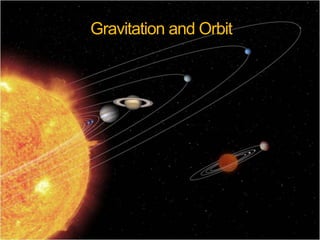
Gravitation and Orbit
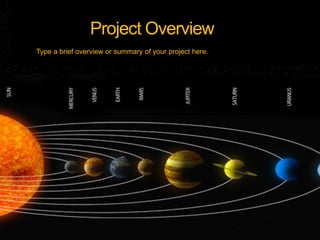
Project OverviewType a brief overview or summary of your project here.
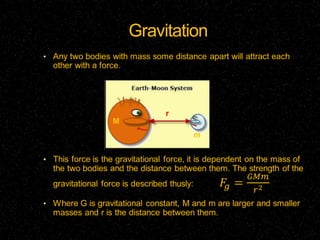
GravitationAny two bodies with mass some distance apart will attract each other with a force.
This force is the gravitational force, it is dependent on the mass of the two bodies and the distance between them. The strength of the gravitational force is described thusly: 	𝐹𝑔=𝐺𝑀𝑚𝑟2
Where G is gravitational constant, M and m are larger and smaller masses and r is the distance between them. rMm
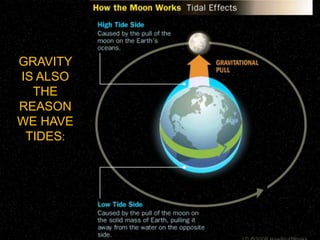
GRAVITY IS ALSO THE REASON WE HAVE TIDES:
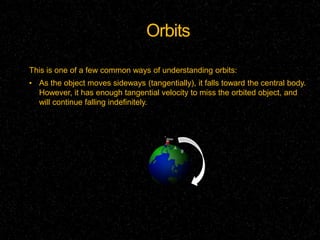
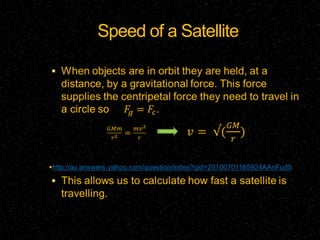
OrbitsThis is one of a few common ways of understanding orbits:As the object moves sideways (tangentially), it falls toward the central body. However, it has enough tangential velocity to miss the orbited object, and will continue falling indefinitely.Speed of a SatelliteWhen objects are in orbit they are held, at a distance, by a gravitational force. This force supplies the centripetal force they need to travel in a circle so     𝐹𝑔=𝐹𝑐. 𝐺𝑀𝑚𝑟2=𝑚𝑣2𝑟𝑣= √(𝐺𝑀𝑟)http://au.answers.yahoo.com/question/index?qid=20100701165924AAnFud5This allows us to calculate how fast a satellite is travelling. 
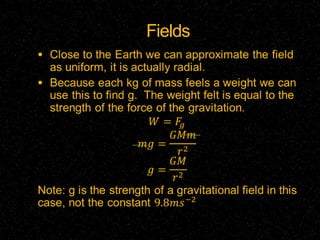
FieldsClose to the Earth we can approximate the field as uniform, it is actually radial.Because each kg of mass feels a weight we can use this to find g.  The weight felt is equal to the strength of the force of the gravitation.		𝑊=𝐹𝑔𝑚𝑔=𝐺𝑀𝑚𝑟2𝑔=𝐺𝑀𝑟2Note: g is the strength of a gravitational field in this case, not the constant 9.8𝑚𝑠−2 
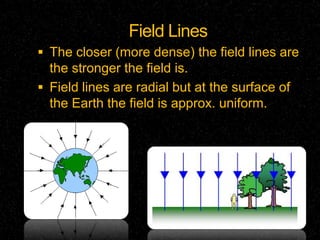
Field LinesThe closer (more dense) the field lines are the stronger the field is.Field lines are radial but at the surface of the Earth the field is approx. uniform.
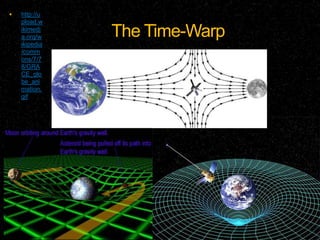
The Time-Warphttp://upload.wikimedia.org/wikipedia/commons/7/78/GRACE_globe_animation.gif

Gravitation and orbit

  • 1.
  • 2.
    Project OverviewType abrief overview or summary of your project here.
  • 3.
    GravitationAny two bodieswith mass some distance apart will attract each other with a force.
  • 4.
    This force isthe gravitational force, it is dependent on the mass of the two bodies and the distance between them. The strength of the gravitational force is described thusly: 𝐹𝑔=𝐺𝑀𝑚𝑟2
  • 5.
    Where G isgravitational constant, M and m are larger and smaller masses and r is the distance between them. rMm
  • 6.
    GRAVITY IS ALSOTHE REASON WE HAVE TIDES:
  • 7.
    OrbitsThis is oneof a few common ways of understanding orbits:As the object moves sideways (tangentially), it falls toward the central body. However, it has enough tangential velocity to miss the orbited object, and will continue falling indefinitely.Speed of a SatelliteWhen objects are in orbit they are held, at a distance, by a gravitational force. This force supplies the centripetal force they need to travel in a circle so 𝐹𝑔=𝐹𝑐. 𝐺𝑀𝑚𝑟2=𝑚𝑣2𝑟𝑣= √(𝐺𝑀𝑟)http://au.answers.yahoo.com/question/index?qid=20100701165924AAnFud5This allows us to calculate how fast a satellite is travelling. 
  • 8.
    FieldsClose to theEarth we can approximate the field as uniform, it is actually radial.Because each kg of mass feels a weight we can use this to find g. The weight felt is equal to the strength of the force of the gravitation. 𝑊=𝐹𝑔𝑚𝑔=𝐺𝑀𝑚𝑟2𝑔=𝐺𝑀𝑟2Note: g is the strength of a gravitational field in this case, not the constant 9.8𝑚𝑠−2 
  • 9.
    Field LinesThe closer(more dense) the field lines are the stronger the field is.Field lines are radial but at the surface of the Earth the field is approx. uniform.
  • 10.