
 SUHAILA MOHAMED
 NOR ADILAH
 SITI SARAH
 SYAZWANI ROSLAN
Gravity
• A Universal Force


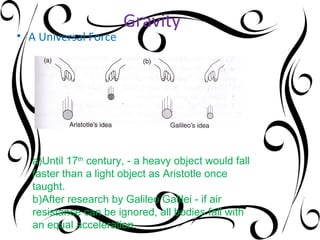
   a)Until 17th century, - a heavy object would fall
   faster than a light object as Aristotle once
   taught.
   b)After research by Galileo Galilei - if air
   resistance can be ignored, all bodies fall with
   an equal acceleration.
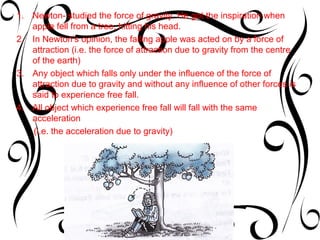
1. Newton- studied the force of gravity. He got the inspiration when
   apple fell from a tree, hitting his head.
2. In Newton’s opinion, the falling apple was acted on by a force of
   attraction (i.e. the force of attraction due to gravity from the centre
   of the earth)
3. Any object which falls only under the influence of the force of
   attraction due to gravity and without any influence of other forces is
   said to experience free fall.
4. All object which experience free fall will fall with the same
   acceleration
   (i.e. the acceleration due to gravity)
Gravitational Field
1. The force of gravity acts through space and can
   cause a body which is not in contact with any
   surface to fall freely to the ground – the earth is
   surrounded by a gravitational field which exerts
   a force on any body in the field.
2. The strength of a gravitational field – the
   gravitational force acting per unit mass on an
   object in the field. It is denoted by the symbol ‘g’
3. On the earth, the gravitational field strength, g is
   9.8 N kg-1
4. Gravitational field strength:
     g = Gravitational force, F
         Mass of body, M
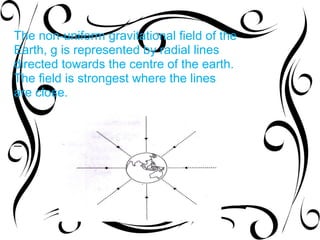
The non-uniform gravitational field of the
Earth, g is represented by radial lines
directed towards the centre of the earth.
The field is strongest where the lines
are close.
Example
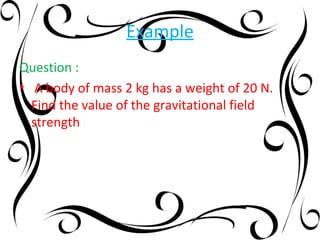
Question :
• A body of mass 2 kg has a weight of 20 N.
  Find the value of the gravitational field
  strength
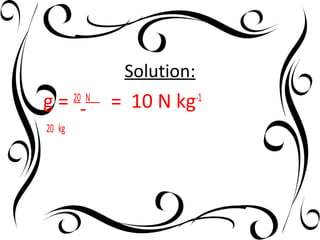
Solution:
g = 20 N = 10 N kg-1
20 kg
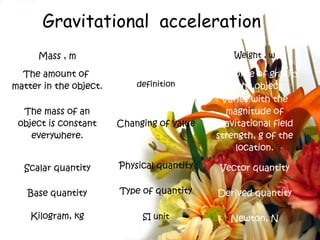
Gravitational acceleration
      Mass , m                                   Weight , w

  The amount of                             The force of gravity
matter in the object.       definition         on the object.
                                              Varies with the
  The mass of an                               magnitude of
 object is constant     Changing of value    gravitational field
    everywhere.                              strength, g of the
                                                 location.

  Scalar quantity       Physical quantity     Vector quantity

   Base quantity        Type of quantity     Derived quantity

    Kilogram, kg             SI unit            Newton, N
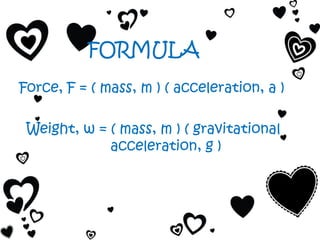
FORMULA
Force, F = ( mass, m ) ( acceleration, a )

 Weight, w = ( mass, m ) ( gravitational
             acceleration, g )
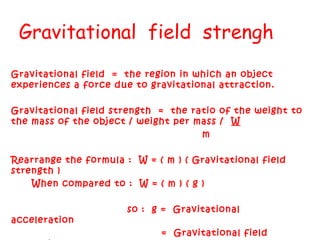
Gravitational field strengh
Gravitational field = the region in which an object
experiences a force due to gravitational attraction.

Gravitational field strength = the ratio of the weight to
the mass of the object / weight per mass / W
                                     m

Rearrange the formula : W = ( m ) ( Gravitational field
strength )
    When compared to : W = ( m ) ( g )

                       so : g = Gravitational
acceleration
                              = Gravitational field
FREE FALLING OBJECT
☻ Is an object falling under
  the force of gravity only
☻ Does not encounter other
  force (example : air
  resistance or friction that
  would oppose its motion
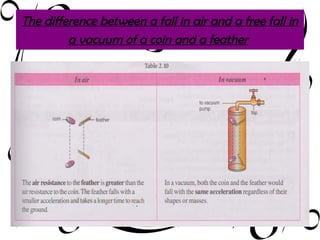
The difference between a fall in air and a free fall in
         a vacuum of a coin and a feather
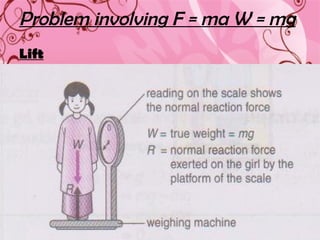
Problem involving F = ma W = mg
Lift
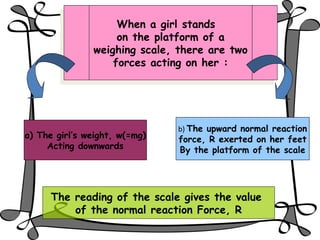
When a girl stands
                    When a girl stands
                     on the platform of a
                    on the platform of a
               weighing scale, there are two
               weighing scale, there are two
                   forces acting on her ::
                    forces acting on her


                               b) The upward normal reaction
a) The girl’s weight, w(=mg)   force, R exerted on her feet
     Acting downwards          By the platform of the scale


      The reading of the scale gives the value
          of the normal reaction Force, R
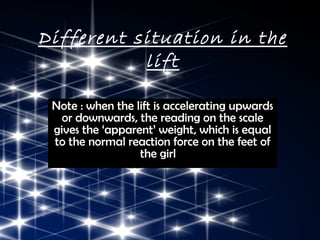
Different situation in the
           lift

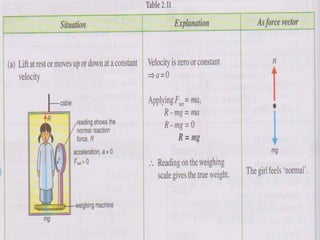
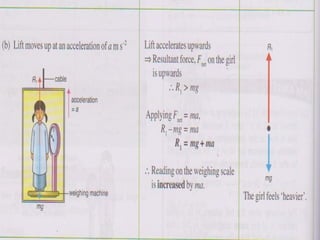
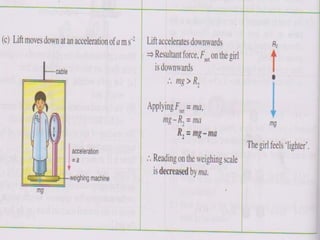
 Note : when the lift is accelerating upwards
   or downwards, the reading on the scale
 gives the ‘apparent’ weight, which is equal
 to the normal reaction force on the feet of
                  the girl
QUESTIONS
1   A box of mass 1.6 kg is suspended from a spring balance
    hanging from the ceiling of a lift


          What is the reading on the spring balace if :
          (a) The lift is stationary
          (b) The lift moves upwards at an acceleration of 2 ms-2?
          (c) The lift moes downwards at an acceleration of 3ms-2
              [take g = 10 ms-2]
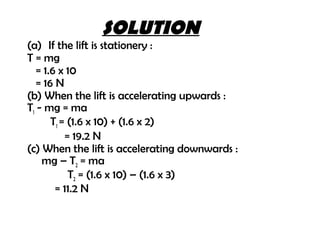
SOLUTION
(a) If the lift is stationery :
T = mg
   = 1.6 x 10
   = 16 N
(b) When the lift is accelerating upwards :
T1 - mg = ma
       T1 = (1.6 x 10) + (1.6 x 2)
           = 19.2 N
(c) When the lift is accelerating downwards :
    mg – T2 = ma
            T2 = (1.6 x 10) – (1.6 x 3)
        = 11.2 N
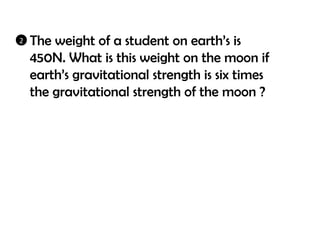
2   The weight of a student on earth’s is
    450N. What is this weight on the moon if
    earth’s gravitational strength is six times
    the gravitational strength of the moon ?
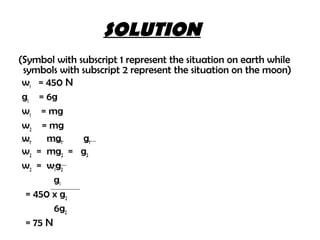
SOLUTION
(Symbol with subscript 1 represent the situation on earth while
 symbols with subscript 2 represent the situation on the moon)
 w1 = 450 N
 g1 = 6g
 w1 = mg
 w2 = mg
 w1    mg1    g1
 w2 = mg2 = g2
 w2 = w 1 g 2
         g1
  = 450 x g2
         6g2
  = 75 N
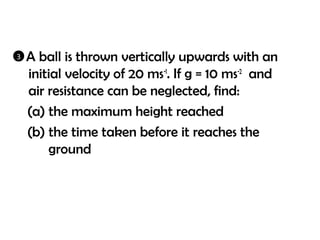
3   A ball is thrown vertically upwards with an
    initial velocity of 20 ms-1. If g = 10 ms-2 and
    air resistance can be neglected, find:
    (a) the maximum height reached
    (b) the time taken before it reaches the
        ground
SOLUTION
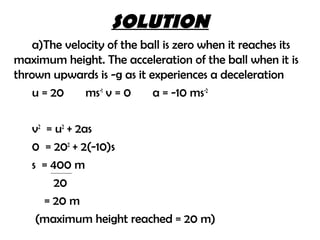
    a)The velocity of the ball is zero when it reaches its
maximum height. The acceleration of the ball when it is
thrown upwards is -g as it experiences a deceleration
    u = 20    ms-1 v = 0    a = -10 ms-2

   v2 = u2 + 2as
   0 = 202 + 2(-10)s
   s = 400 m
        20
      = 20 m
    (maximum height reached = 20 m)
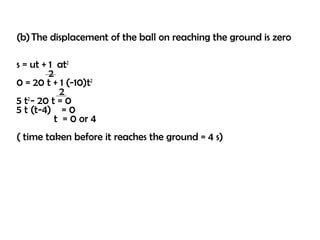
(b) The displacement of the ball on reaching the ground is zero

s = ut + 1 at2
         2
0 = 20 t + 1 (-10)t2
            2
5 t - 20 t = 0
   2
5 t (t-4) = 0
           t = 0 or 4
( time taken before it reaches the ground = 4 s)

Gravity Form 4

  • 1.
     SUHAILA MOHAMED NOR ADILAH  SITI SARAH  SYAZWANI ROSLAN
  • 2.
    Gravity • A UniversalForce a)Until 17th century, - a heavy object would fall faster than a light object as Aristotle once taught. b)After research by Galileo Galilei - if air resistance can be ignored, all bodies fall with an equal acceleration.
  • 3.
    1. Newton- studiedthe force of gravity. He got the inspiration when apple fell from a tree, hitting his head. 2. In Newton’s opinion, the falling apple was acted on by a force of attraction (i.e. the force of attraction due to gravity from the centre of the earth) 3. Any object which falls only under the influence of the force of attraction due to gravity and without any influence of other forces is said to experience free fall. 4. All object which experience free fall will fall with the same acceleration (i.e. the acceleration due to gravity)
  • 4.
    Gravitational Field 1. Theforce of gravity acts through space and can cause a body which is not in contact with any surface to fall freely to the ground – the earth is surrounded by a gravitational field which exerts a force on any body in the field. 2. The strength of a gravitational field – the gravitational force acting per unit mass on an object in the field. It is denoted by the symbol ‘g’ 3. On the earth, the gravitational field strength, g is 9.8 N kg-1 4. Gravitational field strength: g = Gravitational force, F Mass of body, M
  • 5.
    The non-uniform gravitationalfield of the Earth, g is represented by radial lines directed towards the centre of the earth. The field is strongest where the lines are close.
  • 6.
    Example Question : • Abody of mass 2 kg has a weight of 20 N. Find the value of the gravitational field strength
  • 7.
    Solution: g = 20N = 10 N kg-1 20 kg
  • 8.
    Gravitational acceleration Mass , m Weight , w The amount of The force of gravity matter in the object. definition on the object. Varies with the The mass of an magnitude of object is constant Changing of value gravitational field everywhere. strength, g of the location. Scalar quantity Physical quantity Vector quantity Base quantity Type of quantity Derived quantity Kilogram, kg SI unit Newton, N
  • 9.
    FORMULA Force, F =( mass, m ) ( acceleration, a ) Weight, w = ( mass, m ) ( gravitational acceleration, g )
  • 10.
    Gravitational field strengh Gravitationalfield = the region in which an object experiences a force due to gravitational attraction. Gravitational field strength = the ratio of the weight to the mass of the object / weight per mass / W m Rearrange the formula : W = ( m ) ( Gravitational field strength ) When compared to : W = ( m ) ( g ) so : g = Gravitational acceleration = Gravitational field
  • 11.
    FREE FALLING OBJECT ☻Is an object falling under the force of gravity only ☻ Does not encounter other force (example : air resistance or friction that would oppose its motion
  • 12.
    The difference betweena fall in air and a free fall in a vacuum of a coin and a feather
  • 13.
    Problem involving F= ma W = mg Lift
  • 14.
    When a girlstands When a girl stands on the platform of a on the platform of a weighing scale, there are two weighing scale, there are two forces acting on her :: forces acting on her b) The upward normal reaction a) The girl’s weight, w(=mg) force, R exerted on her feet Acting downwards By the platform of the scale The reading of the scale gives the value of the normal reaction Force, R
  • 15.
    Different situation inthe lift Note : when the lift is accelerating upwards or downwards, the reading on the scale gives the ‘apparent’ weight, which is equal to the normal reaction force on the feet of the girl
  • 19.
  • 20.
    1 A box of mass 1.6 kg is suspended from a spring balance hanging from the ceiling of a lift What is the reading on the spring balace if : (a) The lift is stationary (b) The lift moves upwards at an acceleration of 2 ms-2? (c) The lift moes downwards at an acceleration of 3ms-2 [take g = 10 ms-2]
  • 21.
    SOLUTION (a) If thelift is stationery : T = mg = 1.6 x 10 = 16 N (b) When the lift is accelerating upwards : T1 - mg = ma T1 = (1.6 x 10) + (1.6 x 2) = 19.2 N (c) When the lift is accelerating downwards : mg – T2 = ma T2 = (1.6 x 10) – (1.6 x 3) = 11.2 N
  • 22.
    2 The weight of a student on earth’s is 450N. What is this weight on the moon if earth’s gravitational strength is six times the gravitational strength of the moon ?
  • 23.
    SOLUTION (Symbol with subscript1 represent the situation on earth while symbols with subscript 2 represent the situation on the moon) w1 = 450 N g1 = 6g w1 = mg w2 = mg w1 mg1 g1 w2 = mg2 = g2 w2 = w 1 g 2 g1 = 450 x g2 6g2 = 75 N
  • 24.
    3 A ball is thrown vertically upwards with an initial velocity of 20 ms-1. If g = 10 ms-2 and air resistance can be neglected, find: (a) the maximum height reached (b) the time taken before it reaches the ground
  • 25.
    SOLUTION a)The velocity of the ball is zero when it reaches its maximum height. The acceleration of the ball when it is thrown upwards is -g as it experiences a deceleration u = 20 ms-1 v = 0 a = -10 ms-2 v2 = u2 + 2as 0 = 202 + 2(-10)s s = 400 m 20 = 20 m (maximum height reached = 20 m)
  • 26.
    (b) The displacementof the ball on reaching the ground is zero s = ut + 1 at2 2 0 = 20 t + 1 (-10)t2 2 5 t - 20 t = 0 2 5 t (t-4) = 0 t = 0 or 4 ( time taken before it reaches the ground = 4 s)