Lecture Outline
Chapter 9:
Gravity
© 2015 Pearson Education, Inc.
This lecture will help you understand:
• The Newtonian Synthesis
• The Universal Law of Gravity
• The Universal Gravitational Constant
• Gravity and Distance: Inverse-Square Law
• Weight and Weightlessness
• Ocean Tides
• Gravitational Fields
• Einstein's Theory of Gravitation
• Black Holes
• Universal Gravitation
© 2015 Pearson Education, Inc.
The Newtonian Synthesis
• Newton was not the first
to discover gravity.
Newton discovered that
gravity is universal.
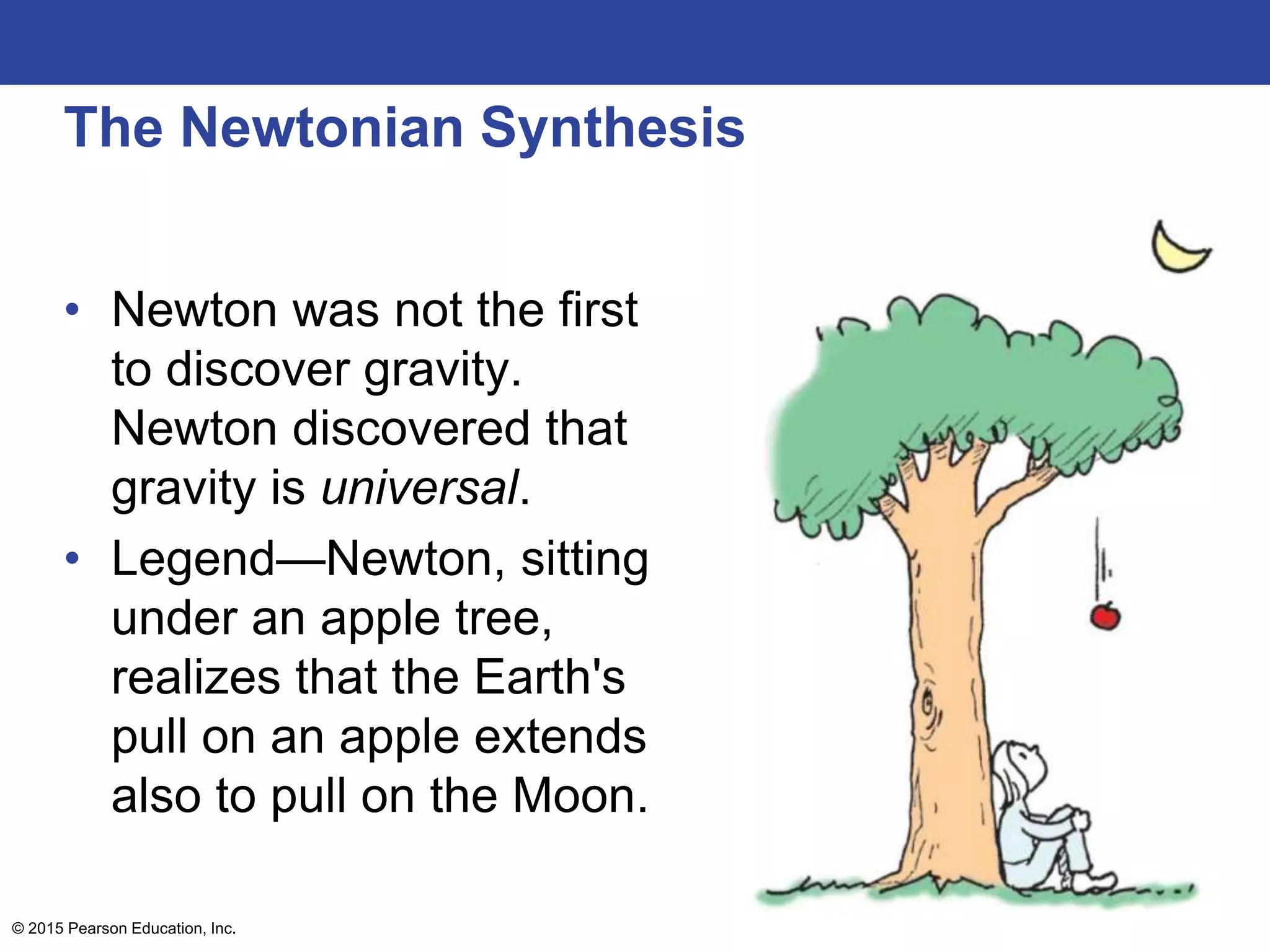
• Legend—Newton, sitting
under an apple tree,
realizes that the Earth's
pull on an apple extends
also to pull on the Moon.
© 2015 Pearson Education, Inc.
The Newtonian Synthesis
• In Aristotle's time, motion of planets and stars
was natural – not governed by the same laws as
objects on Earth.
• Newton recognized that a force directed toward
the Sun must act on planets
– This is similar to force that Earth exerts on an
apple that falls toward it.
• Newtonian synthesis: The same set of laws
apply to both celestial and terrestrial objects.
© 2015 Pearson Education, Inc.
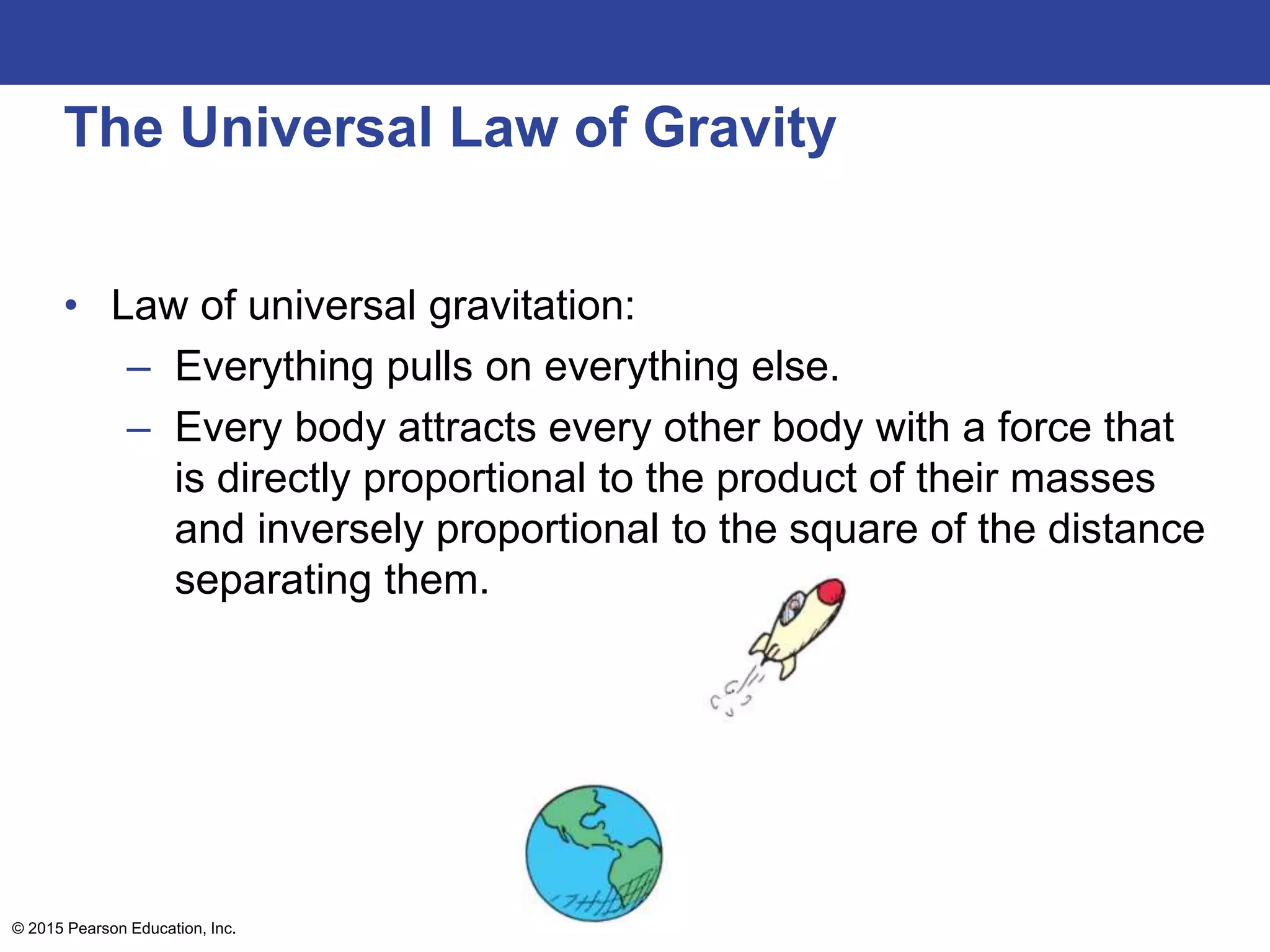
The Universal Law of Gravity
• Law of universal gravitation:
– Everything pulls on everything else.
– Every body attracts every other body with a force that
is directly proportional to the product of their masses
and inversely proportional to the square of the distance
separating them.
© 2015 Pearson Education, Inc.
The Universal Law of Gravity
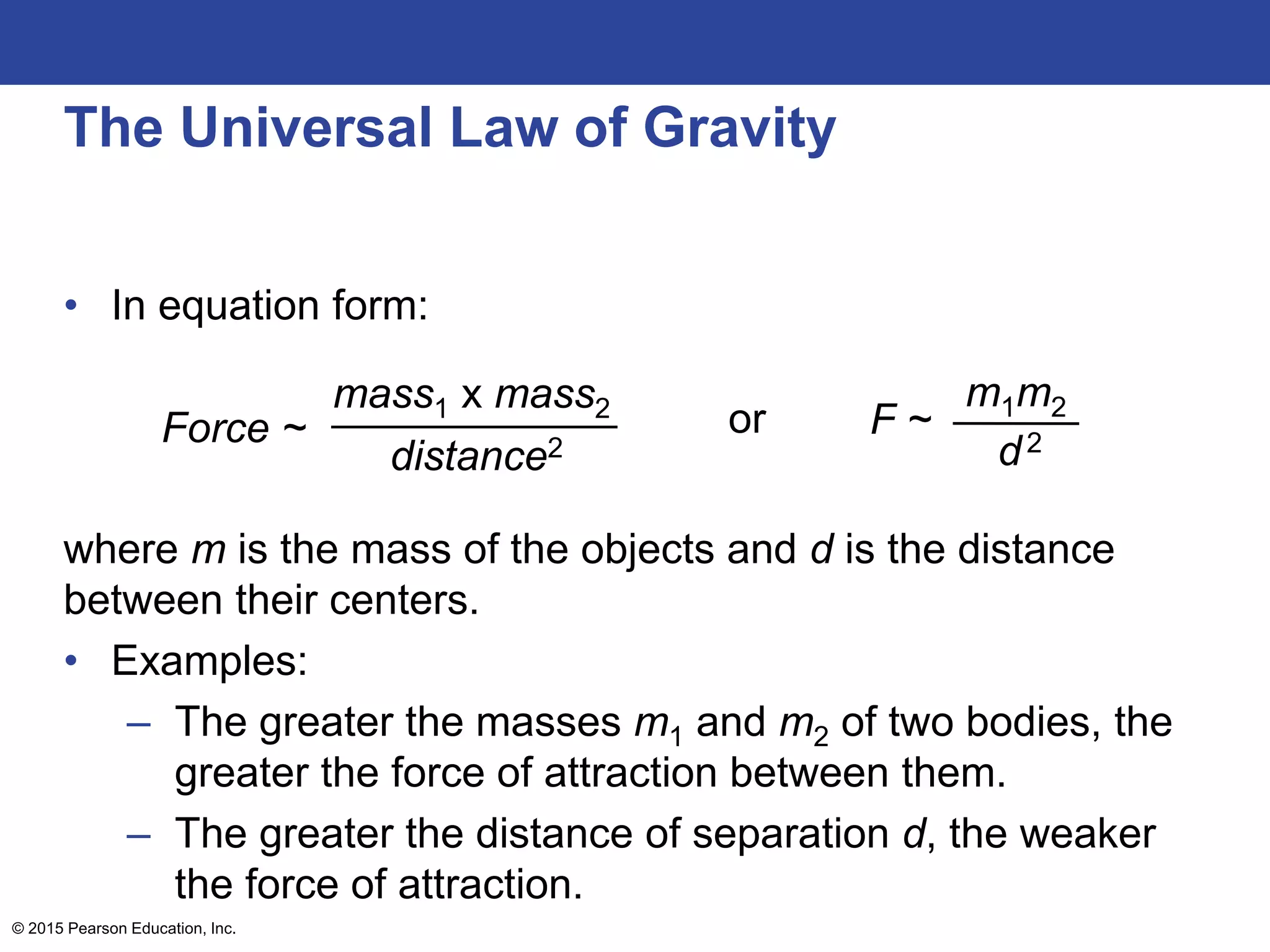
• In equation form:
where m is the mass of the objects and d is the distance
between their centers.
• Examples:
– The greater the masses m1 and m2 of two bodies, the
greater the force of attraction between them.
– The greater the distance of separation d, the weaker
the force of attraction.
distance2 d2
mass1 x mass2
Force ~ or
m1m2
F ~
© 2015 Pearson Education, Inc.
The Universal Law of Gravity
CHECK YOUR NEIGHBOR
Newton's most celebrated synthesis was and is of
A. earthly and heavenly laws.
B. weight on Earth and weightlessness in outer space.
C. masses and distances.
D. the paths of tossed rocks and the paths of satellites.
© 2015 Pearson Education, Inc.
The Universal Law of Gravity
CHECK YOUR ANSWER
Newton's most celebrated synthesis was and is of
A. earthly and heavenly laws.
B. weight on Earth and weightlessness in outer space.
C. masses and distances.
D. the paths of tossed rocks and the paths of satellites.
Comment:
This synthesis provided hope that other natural phenomena
followed universal laws and ushered in the "Age of
Enlightenment."
© 2015 Pearson Education, Inc.
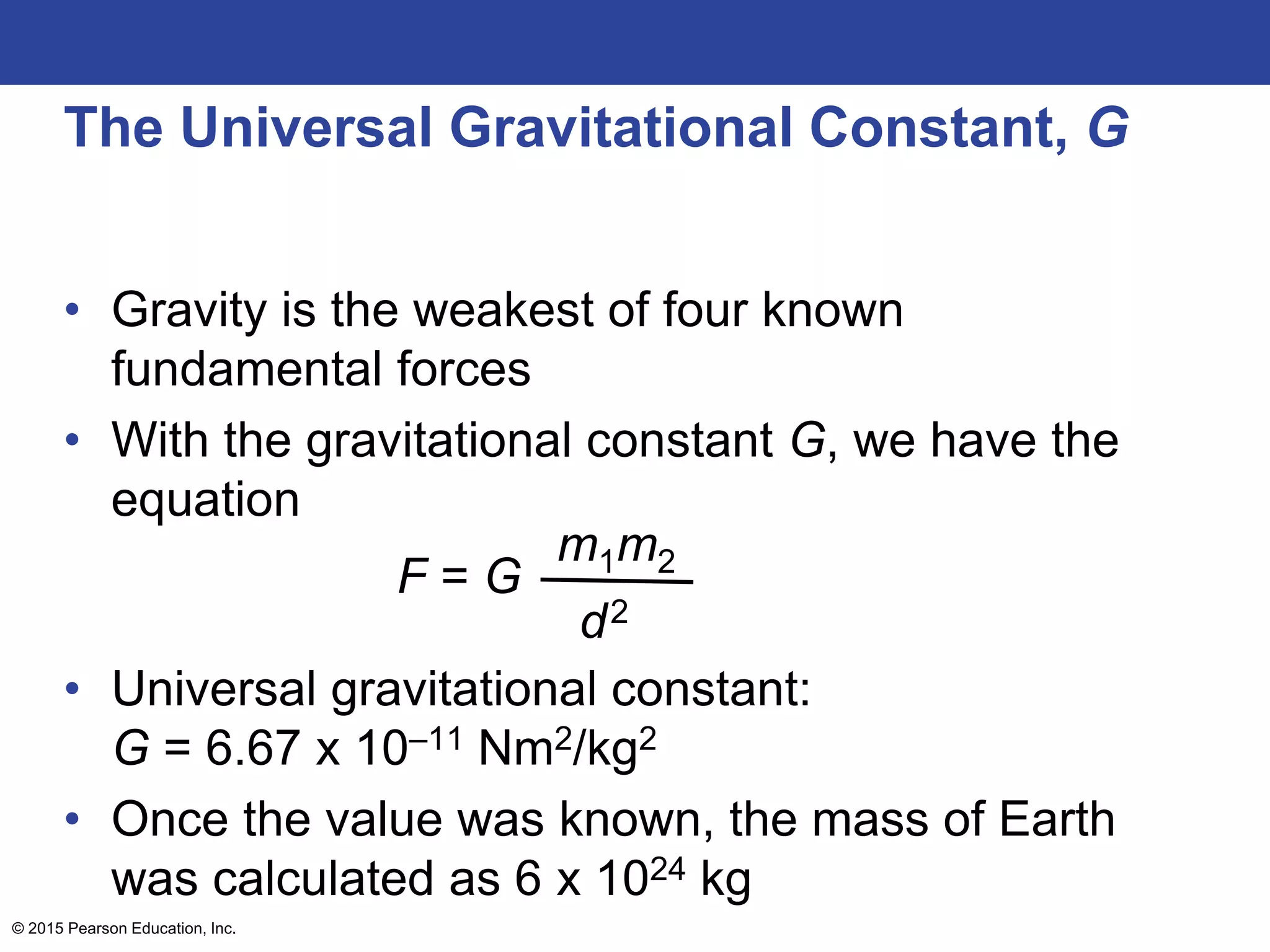
The Universal Gravitational Constant, G
• Gravity is the weakest of four known
fundamental forces
• With the gravitational constant G, we have the
equation
• Universal gravitational constant:
G = 6.67 x 10⁻¹¹ Nm2/kg2
• Once the value was known, the mass of Earth
was calculated as 6 x 1024 kg
© 2015 Pearson Education, Inc.
F = G
m1m2
d2
The Universal Gravitational Constant, G
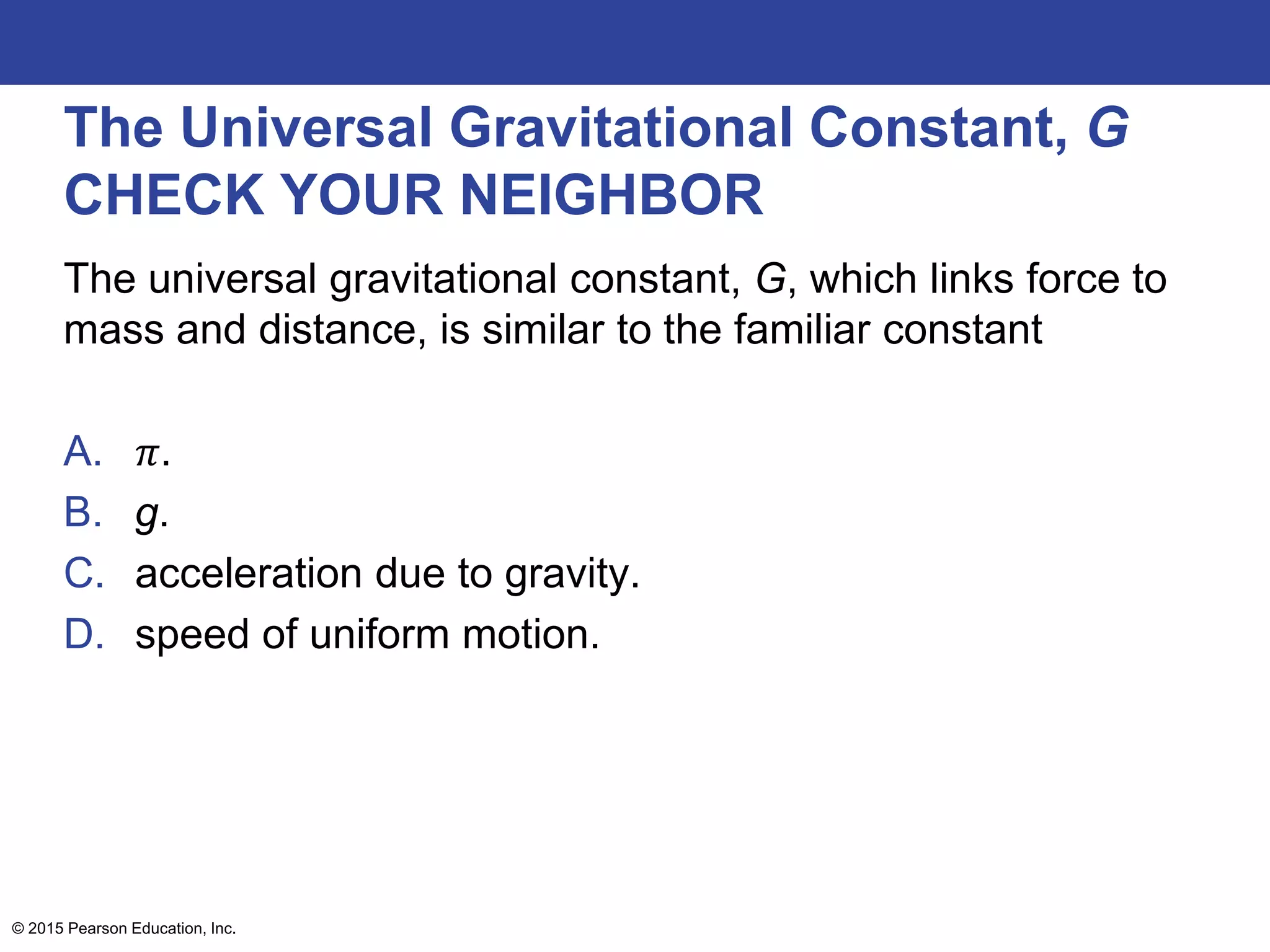
CHECK YOUR NEIGHBOR
The universal gravitational constant, G, which links force to
mass and distance, is similar to the familiar constant
A. 𝜋.
B. g.
C. acceleration due to gravity.
D. speed of uniform motion.
© 2015 Pearson Education, Inc.
The Universal Gravitational Constant, G
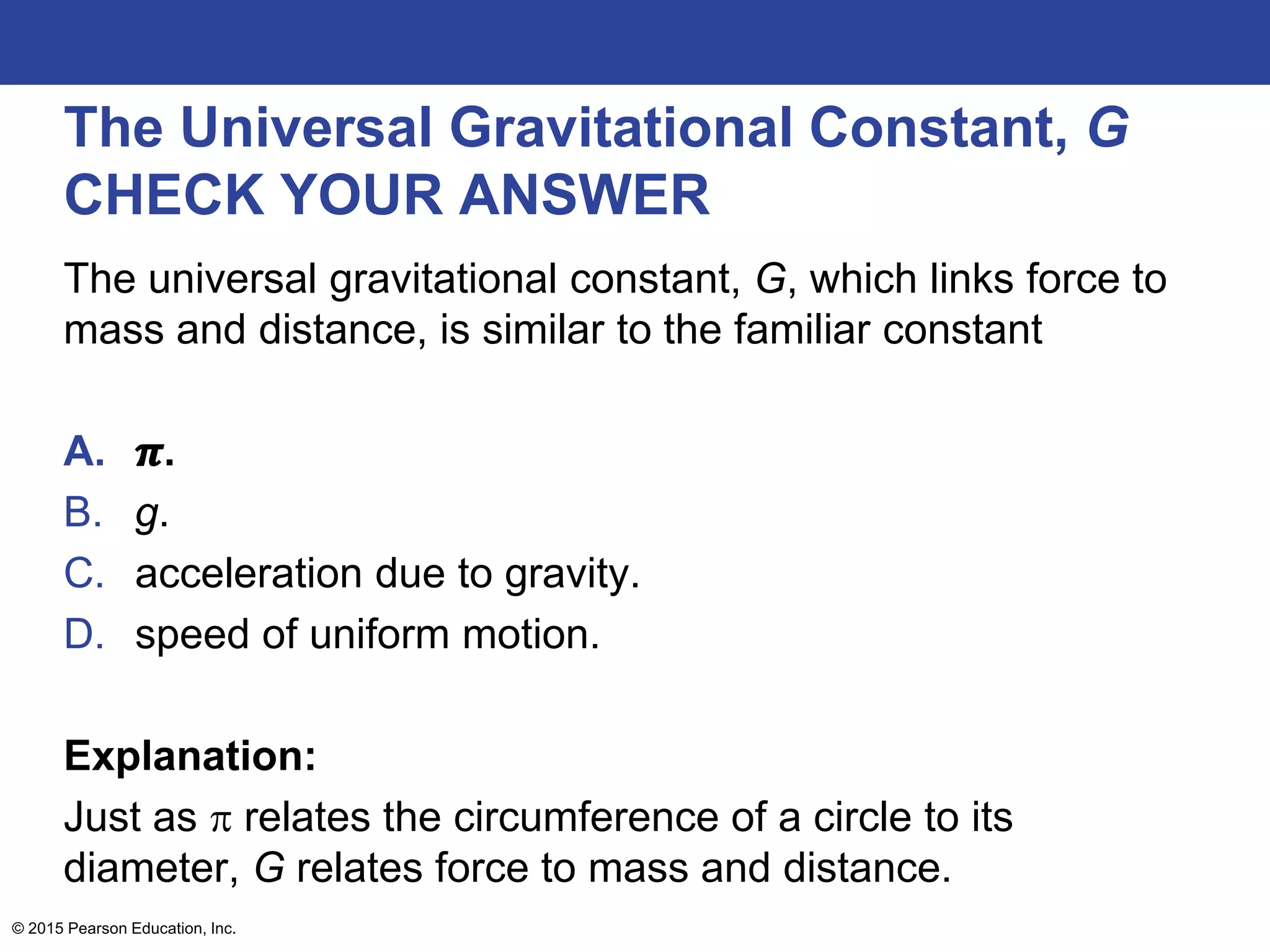
CHECK YOUR ANSWER
The universal gravitational constant, G, which links force to
mass and distance, is similar to the familiar constant
A. 𝝅.
B. g.
C. acceleration due to gravity.
D. speed of uniform motion.
Explanation:
Just as  relates the circumference of a circle to its
diameter, G relates force to mass and distance.
© 2015 Pearson Education, Inc.
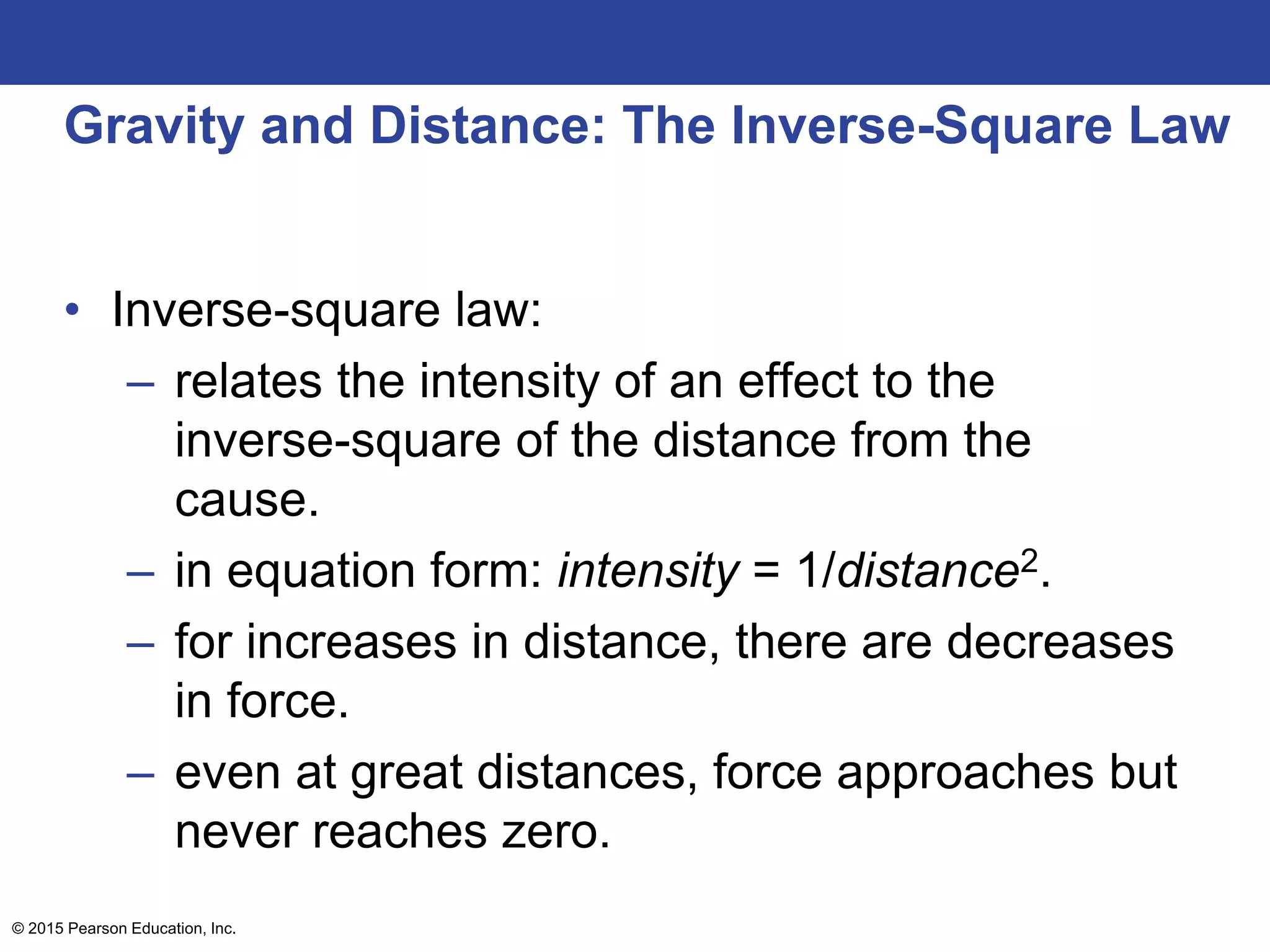
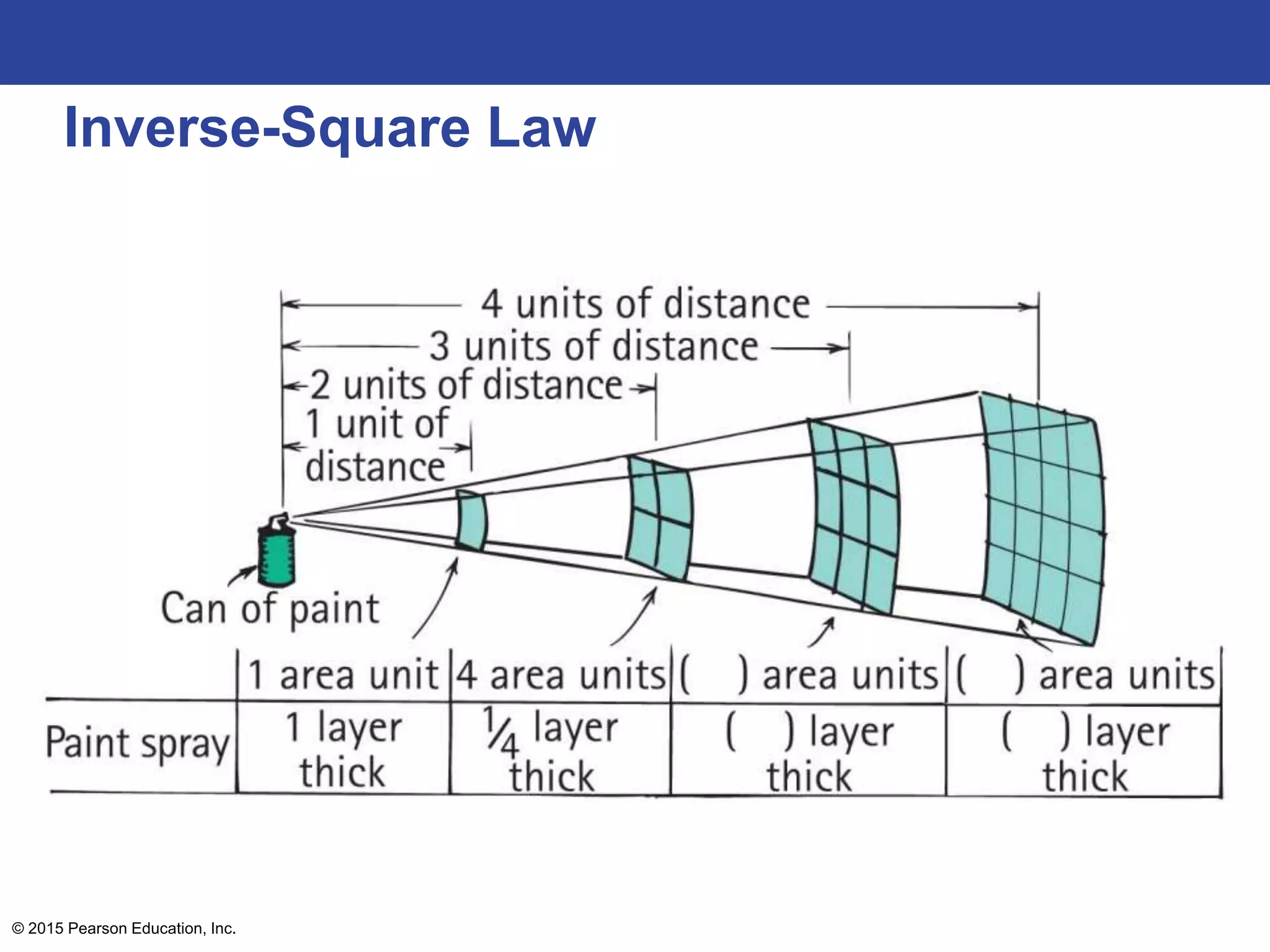
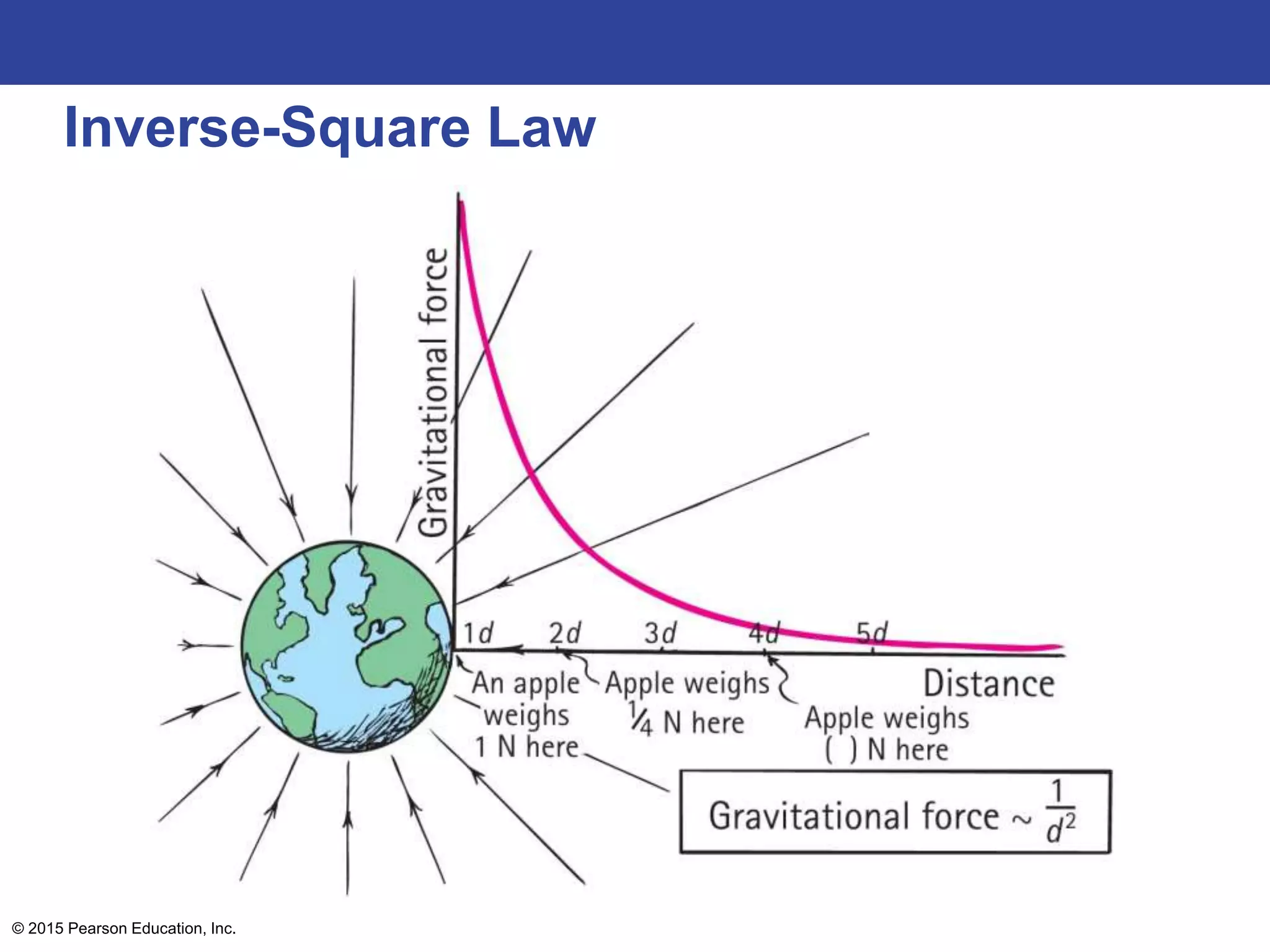
Gravity and Distance: The Inverse-Square Law
• Inverse-square law:
– relates the intensity of an effect to the
inverse-square of the distance from the
cause.
– in equation form: intensity = 1/distance2.
– for increases in distance, there are decreases
in force.
– even at great distances, force approaches but
never reaches zero.
© 2015 Pearson Education, Inc.
Inverse-Square Law
© 2015 Pearson Education, Inc.
Inverse-Square Law
© 2015 Pearson Education, Inc.
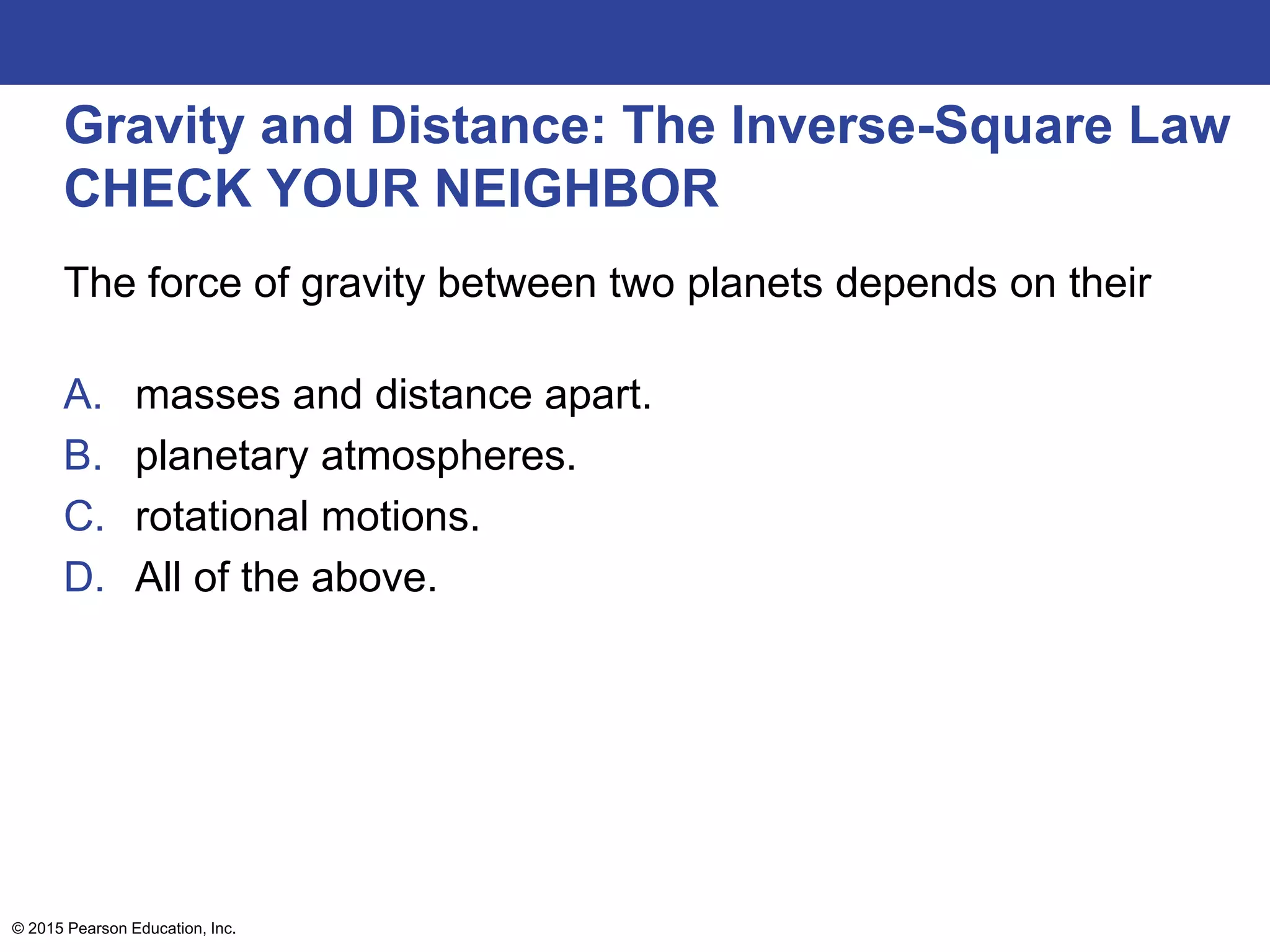
Gravity and Distance: The Inverse-Square Law
CHECK YOUR NEIGHBOR
The force of gravity between two planets depends on their
A. masses and distance apart.
B. planetary atmospheres.
C. rotational motions.
D. All of the above.
© 2015 Pearson Education, Inc.
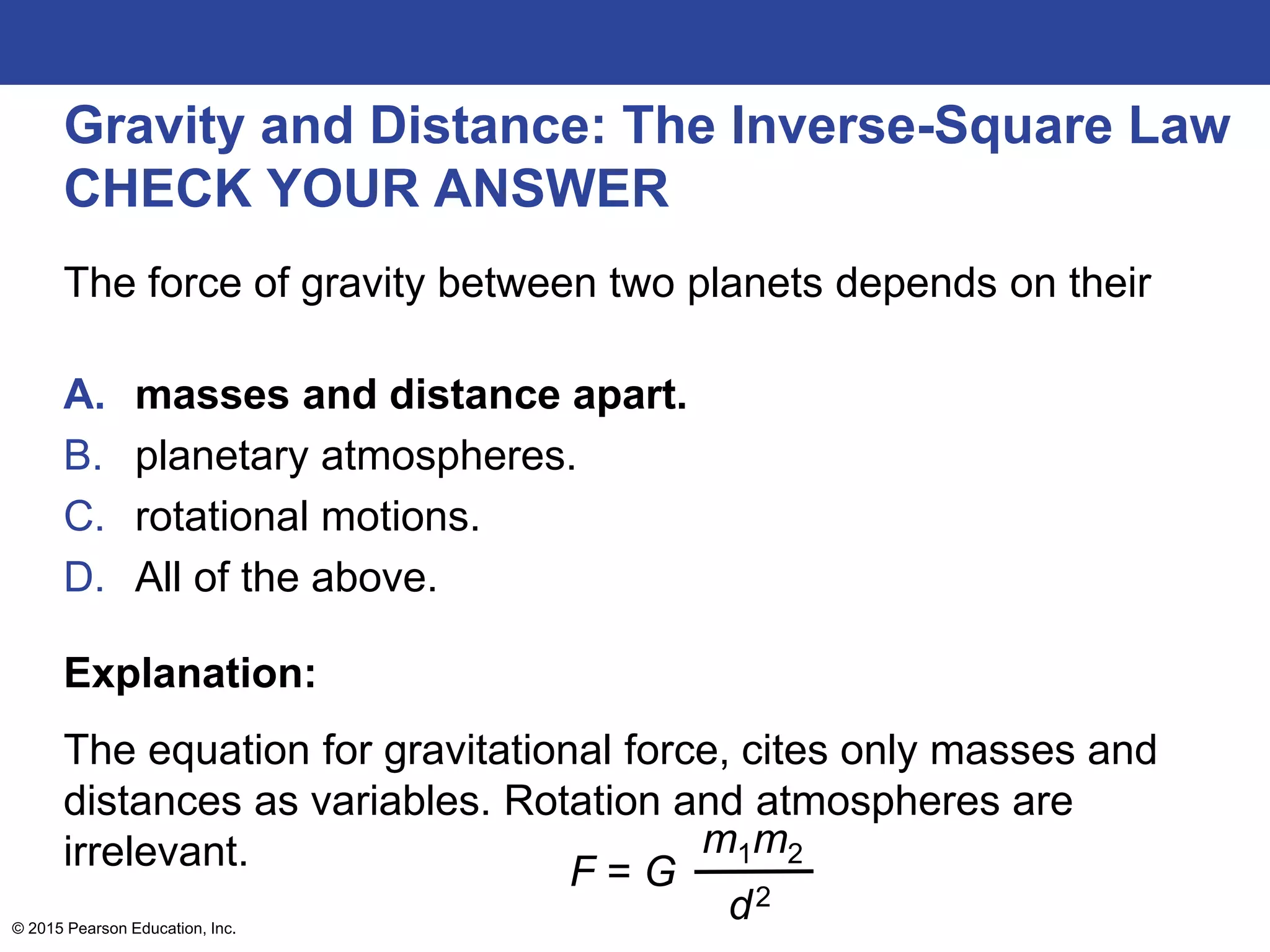
Gravity and Distance: The Inverse-Square Law
CHECK YOUR ANSWER
The force of gravity between two planets depends on their
A. masses and distance apart.
B. planetary atmospheres.
C. rotational motions.
D. All of the above.
Explanation:
The equation for gravitational force, cites only masses and
distances as variables. Rotation and atmospheres are
irrelevant.
© 2015 Pearson Education, Inc.
F = G
m1m2
d2
Gravity and Distance: The Inverse-Square Law
CHECK YOUR NEIGHBOR
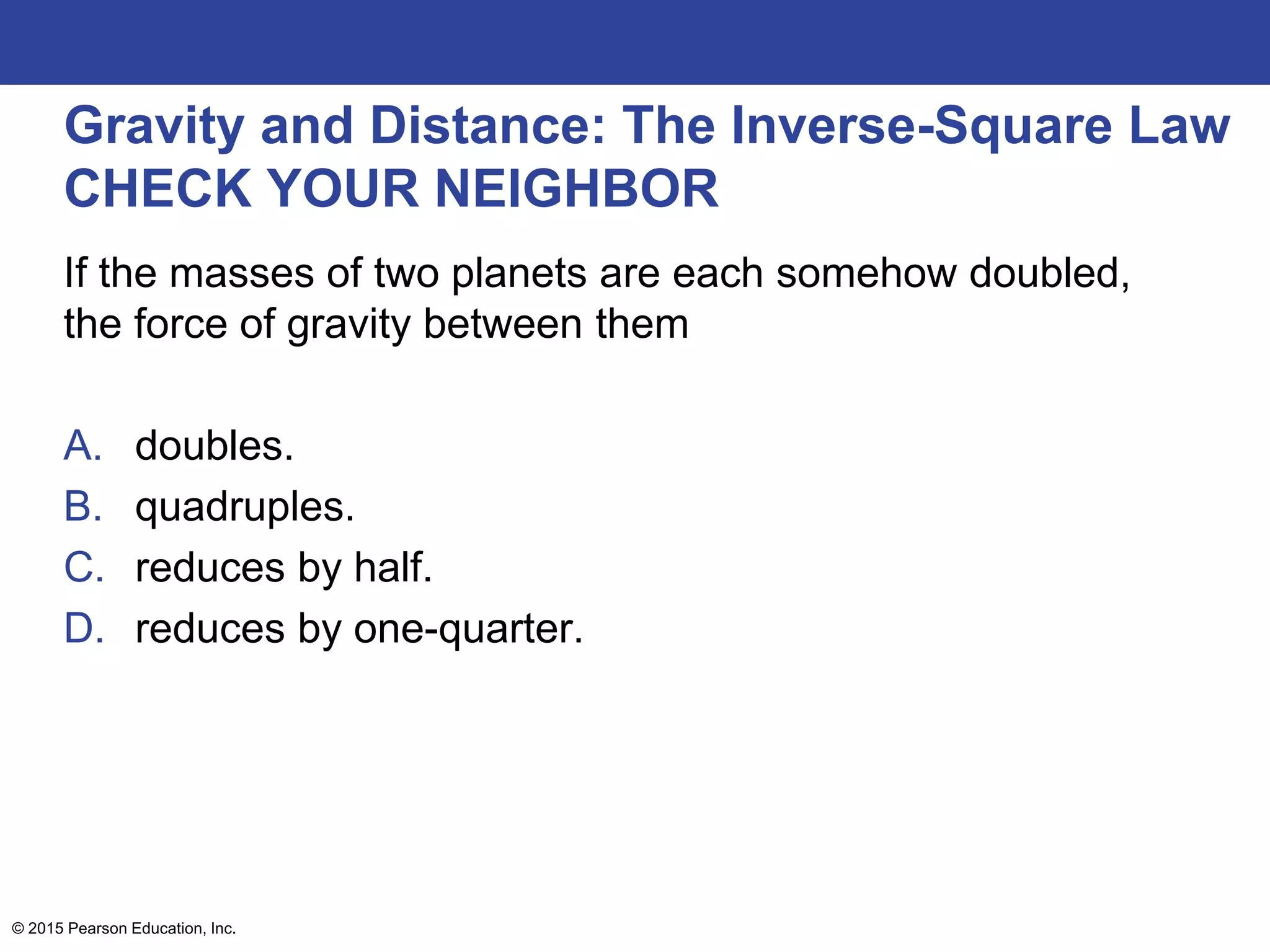
If the masses of two planets are each somehow doubled,
the force of gravity between them
A. doubles.
B. quadruples.
C. reduces by half.
D. reduces by one-quarter.
© 2015 Pearson Education, Inc.
Gravity and Distance: The Inverse-Square Law
CHECK YOUR ANSWER
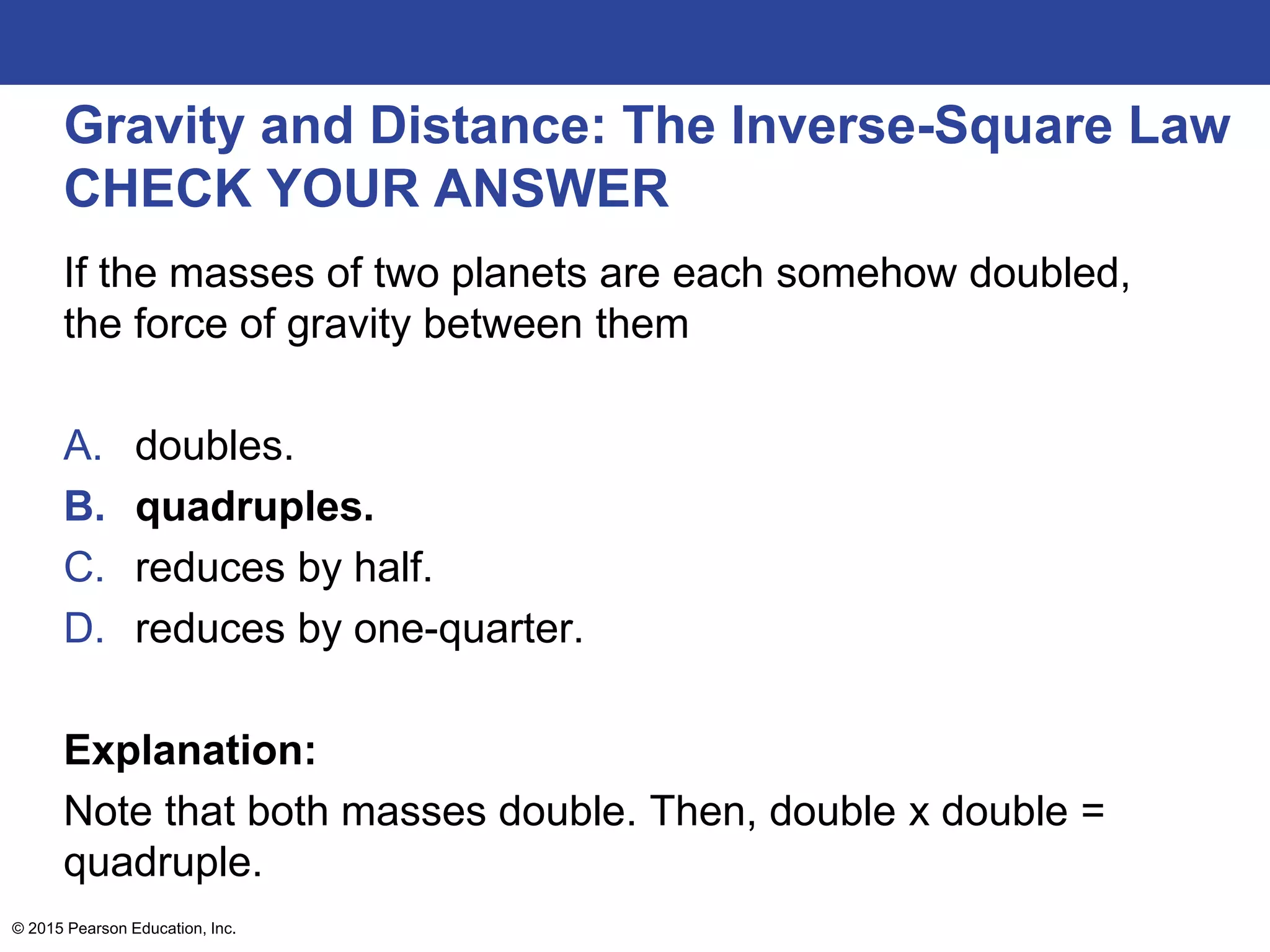
If the masses of two planets are each somehow doubled,
the force of gravity between them
A. doubles.
B. quadruples.
C. reduces by half.
D. reduces by one-quarter.
Explanation:
Note that both masses double. Then, double x double =
quadruple.
© 2015 Pearson Education, Inc.
Gravity and Distance: The Inverse-Square Law
CHECK YOUR NEIGHBOR
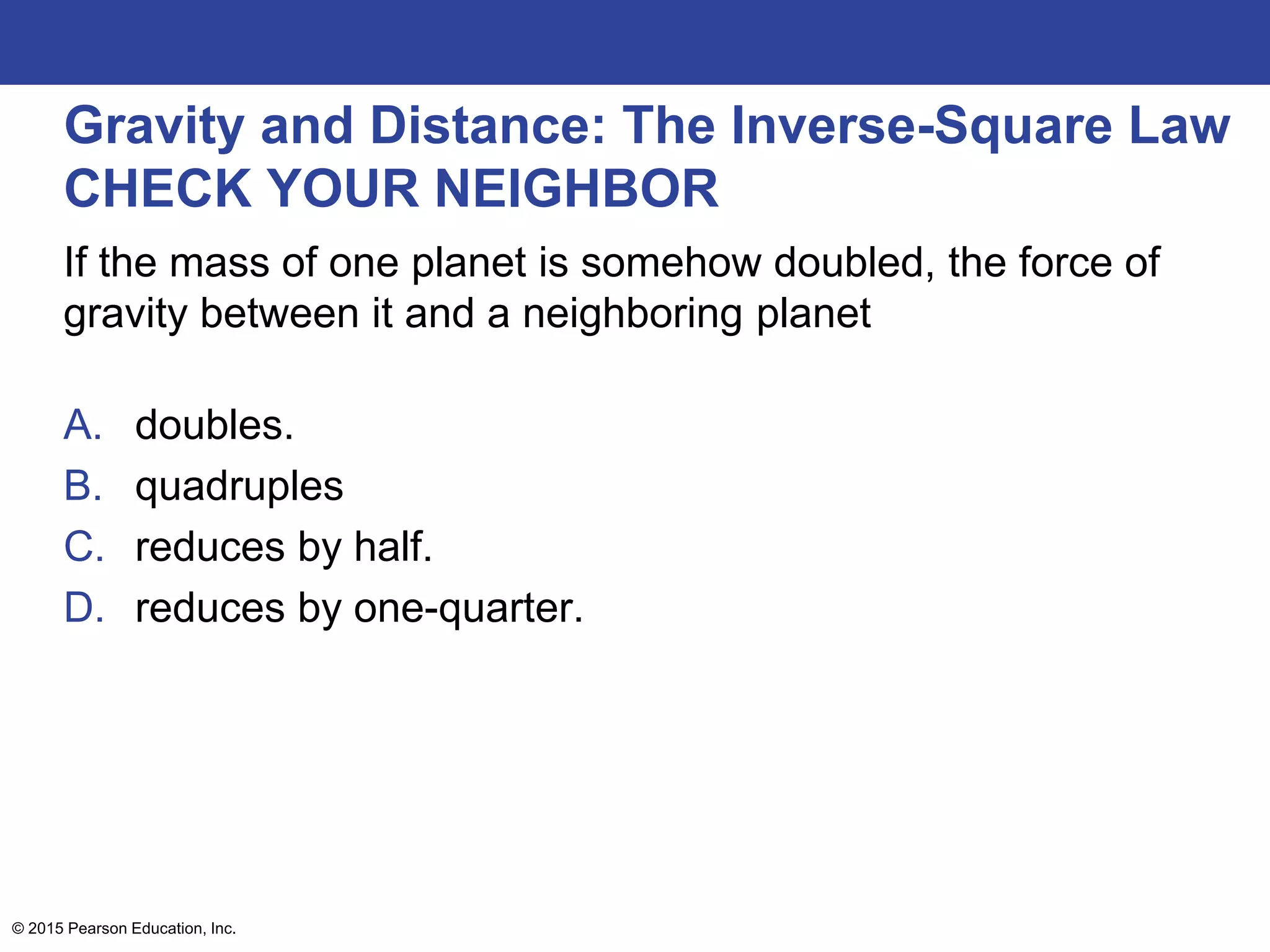
If the mass of one planet is somehow doubled, the force of
gravity between it and a neighboring planet
A. doubles.
B. quadruples
C. reduces by half.
D. reduces by one-quarter.
© 2015 Pearson Education, Inc.
Gravity and Distance: The Inverse-Square Law
CHECK YOUR ANSWER
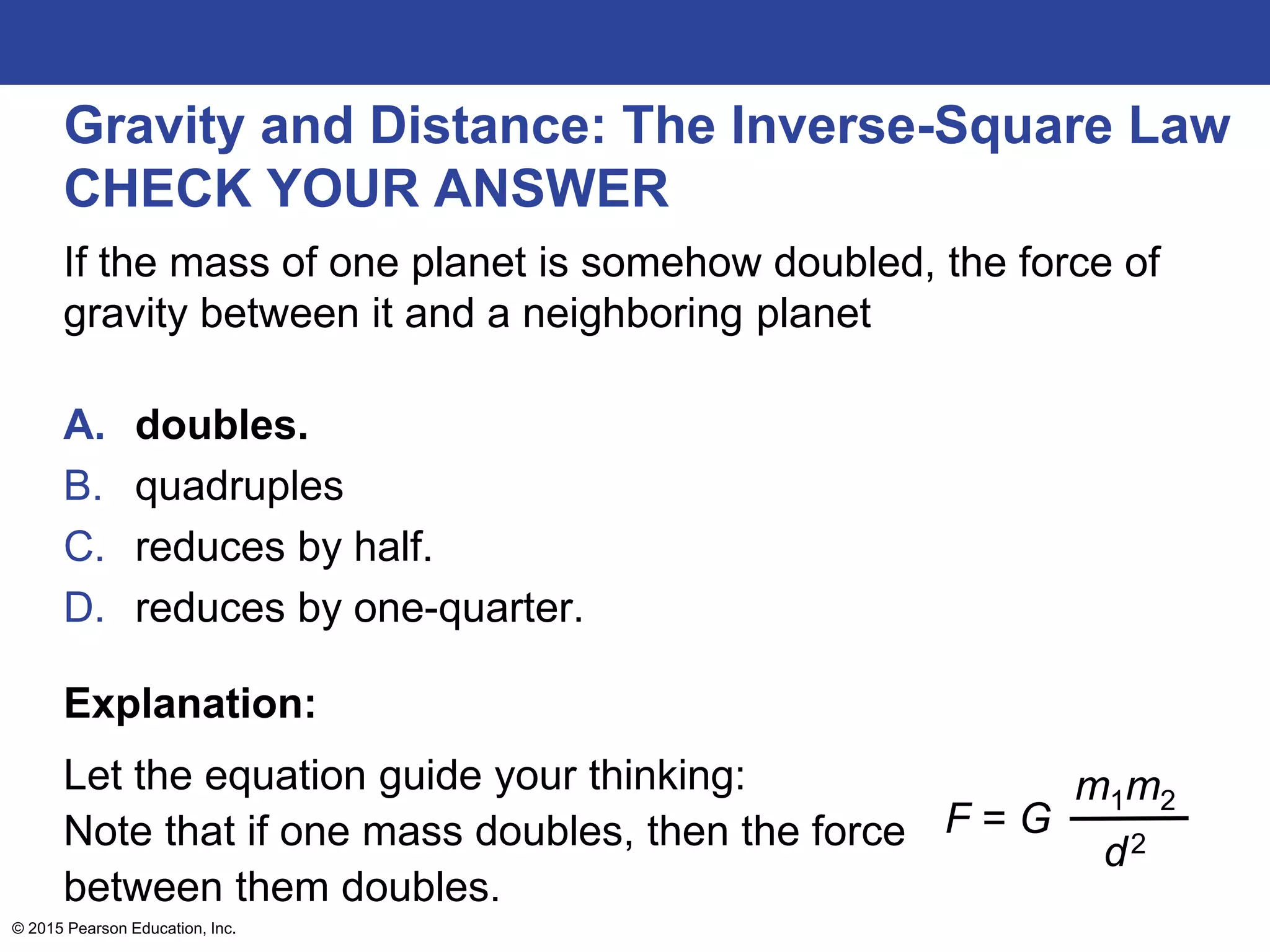
If the mass of one planet is somehow doubled, the force of
gravity between it and a neighboring planet
A. doubles.
B. quadruples
C. reduces by half.
D. reduces by one-quarter.
Explanation:
Let the equation guide your thinking:
Note that if one mass doubles, then the force
between them doubles.
© 2015 Pearson Education, Inc.
F = G
m1m2
d2
Weight and Weightlessness
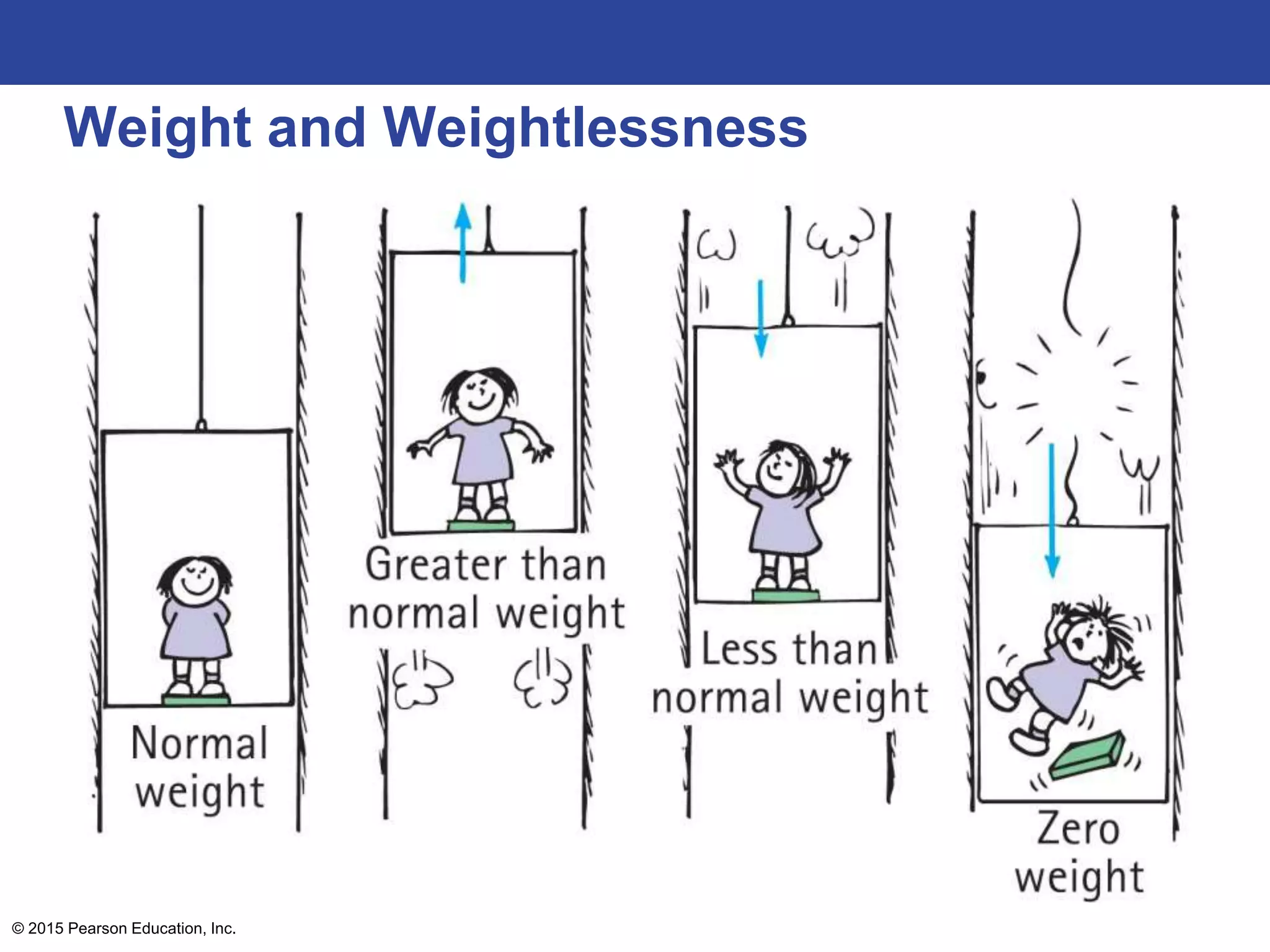
• Weight:
– force an object exerts against a supporting surface
– Examples:
• standing on a scale in an elevator accelerating downward,
less compression in scale springs; weight is less
• standing on a scale in an elevator accelerating upward, more
compression in scale springs; weight is greater
• at constant speed in an elevator, no change in weight
© 2015 Pearson Education, Inc.
Weight and Weightlessness
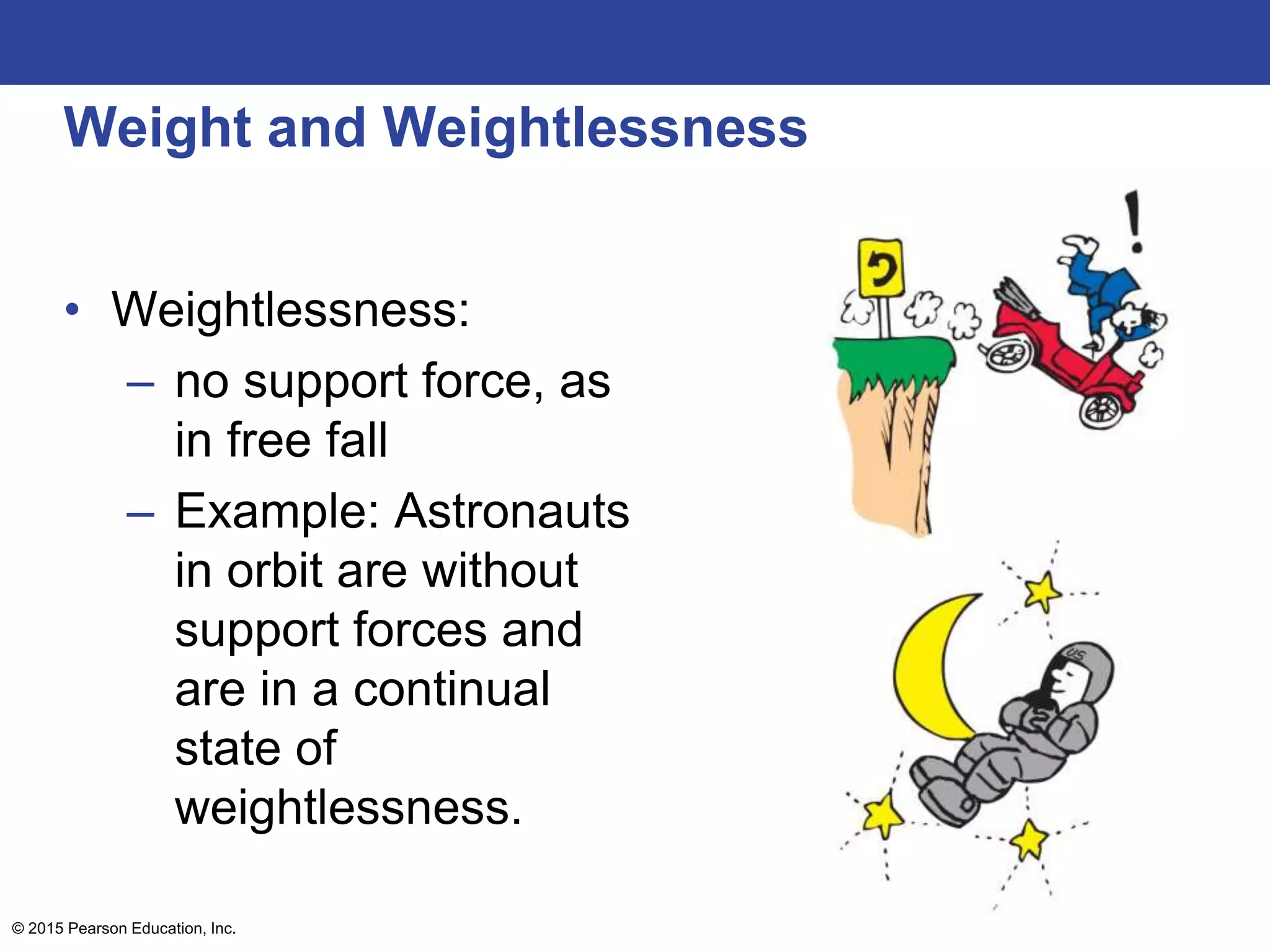
• Weightlessness:
– no support force, as
in free fall
– Example: Astronauts
in orbit are without
support forces and
are in a continual
state of
weightlessness.
© 2015 Pearson Education, Inc.
Weight and Weightlessness
© 2015 Pearson Education, Inc.
Weight and Weightlessness
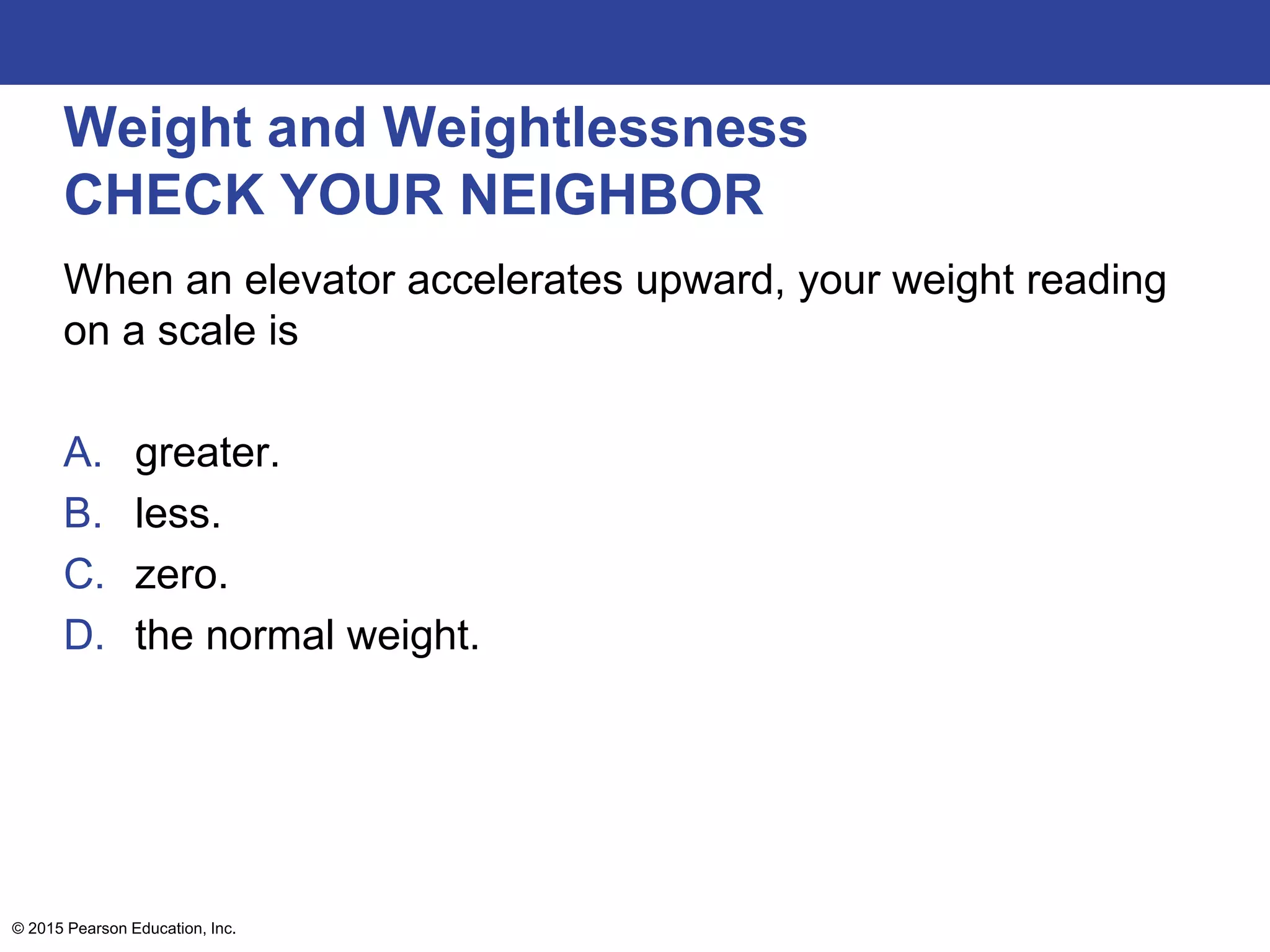
CHECK YOUR NEIGHBOR
When an elevator accelerates upward, your weight reading
on a scale is
A. greater.
B. less.
C. zero.
D. the normal weight.
© 2015 Pearson Education, Inc.
Weight and Weightlessness
CHECK YOUR ANSWER
When an elevator accelerates upward, your weight reading
on a scale is
A. greater.
B. less.
C. zero.
D. the normal weight.
Explanation:
The support force pressing on you is greater, so you weigh
more.
© 2015 Pearson Education, Inc.
Weight and Weightlessness
CHECK YOUR NEIGHBOR
When an elevator accelerates downward, your weight
reading is
A. greater.
B. less.
C. zero.
D. the normal weight.
© 2015 Pearson Education, Inc.
Weight and Weightlessness
CHECK YOUR ANSWER
When an elevator accelerates downward, your weight
reading is
A. greater.
B. less.
C. zero.
D. the normal weight.
Explanation:
The support force pressing on you is less, so you weigh
less. Question: Would you weigh less in an elevator that
moves downward at constant velocity?
© 2015 Pearson Education, Inc.
Weight and Weightlessness
CHECK YOUR NEIGHBOR
When the elevator cable breaks, the elevator falls freely, so
your weight reading is
A. greater.
B. less.
C. zero.
D. the normal weight.
© 2015 Pearson Education, Inc.
Weight and Weightlessness
CHECK YOUR ANSWER
When the elevator cable breaks, the elevator falls freely, so
your weight reading is
A. greater.
B. less.
C. zero.
D. the normal weight.
Explanation:
There is still a downward gravitational force acting on you,
but gravity is not felt as weight because there is no support
force, so your weight is zero.
© 2015 Pearson Education, Inc.
Weight and Weightlessness
CHECK YOUR NEIGHBOR
If you weigh yourself in an elevator, you'll weigh more when
the elevator
A. moves upward.
B. moves downward.
C. accelerates upward.
D. All of the above.
© 2015 Pearson Education, Inc.
Weight and Weightlessness
CHECK YOUR ANSWER
If you weigh yourself in an elevator, you'll weigh more when
the elevator
A. moves upward.
B. moves downward.
C. accelerates upward.
D. All of the above.
Explanation:
The support provided by the floor of an elevator is the
same whether the elevator is at rest or moving at constant
velocity. Only accelerated motion affects weight.
© 2015 Pearson Education, Inc.
Ocean Tides
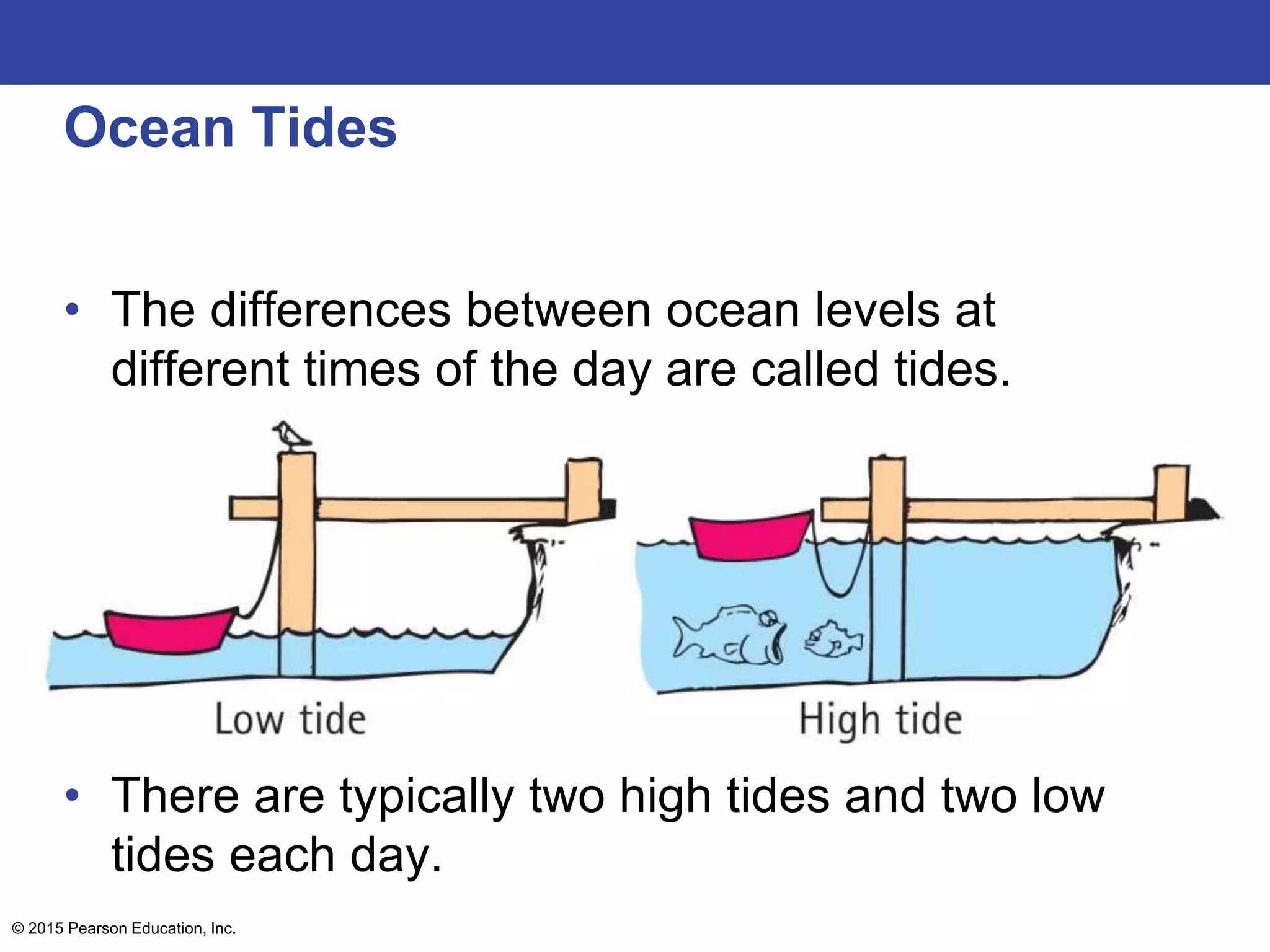
• The differences between ocean levels at
different times of the day are called tides.
• There are typically two high tides and two low
tides each day.
© 2015 Pearson Education, Inc.
Ocean Tides
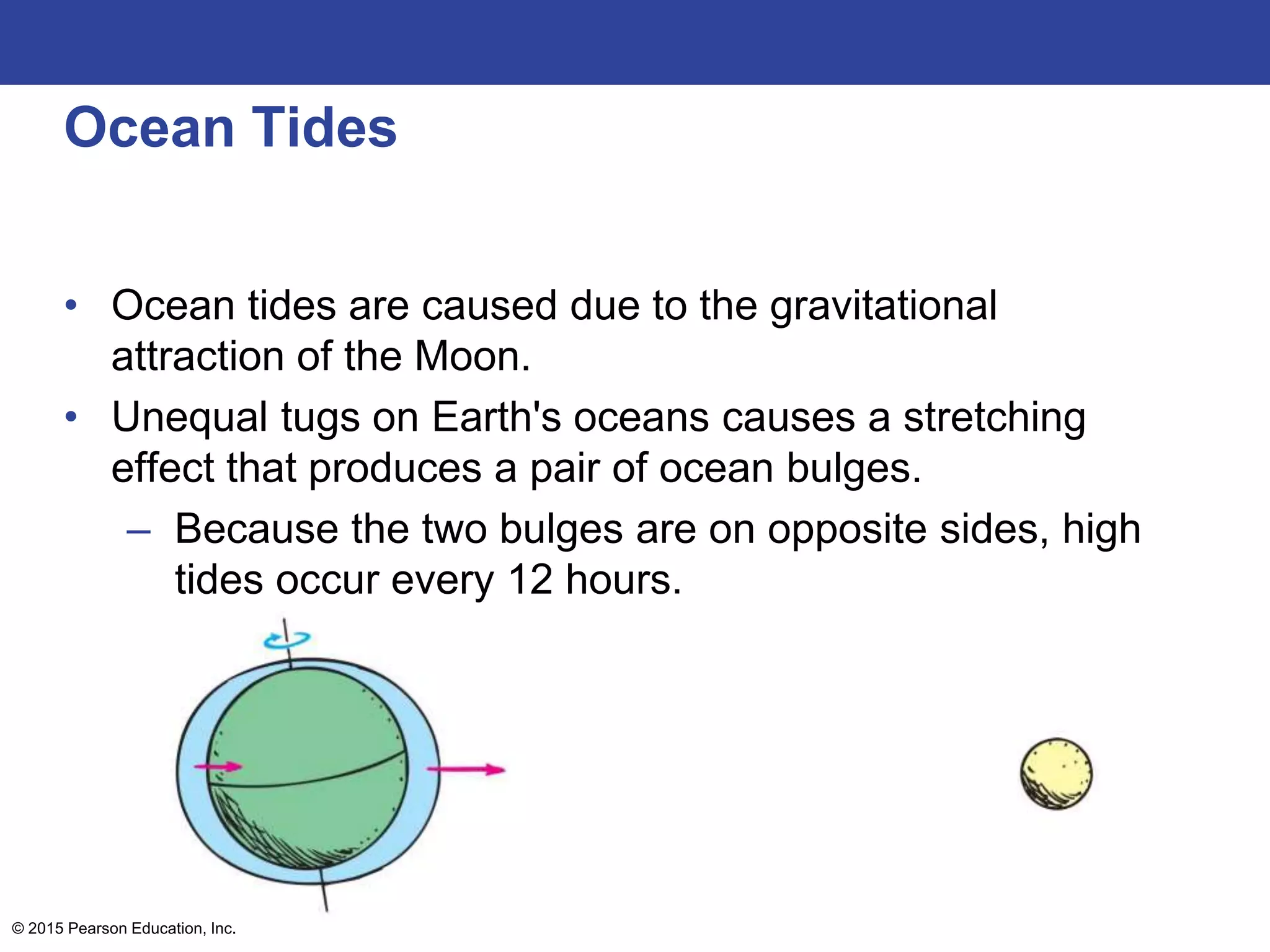
• Ocean tides are caused due to the gravitational
attraction of the Moon.
• Unequal tugs on Earth's oceans causes a stretching
effect that produces a pair of ocean bulges.
– Because the two bulges are on opposite sides, high
tides occur every 12 hours.
© 2015 Pearson Education, Inc.
Ocean Tides
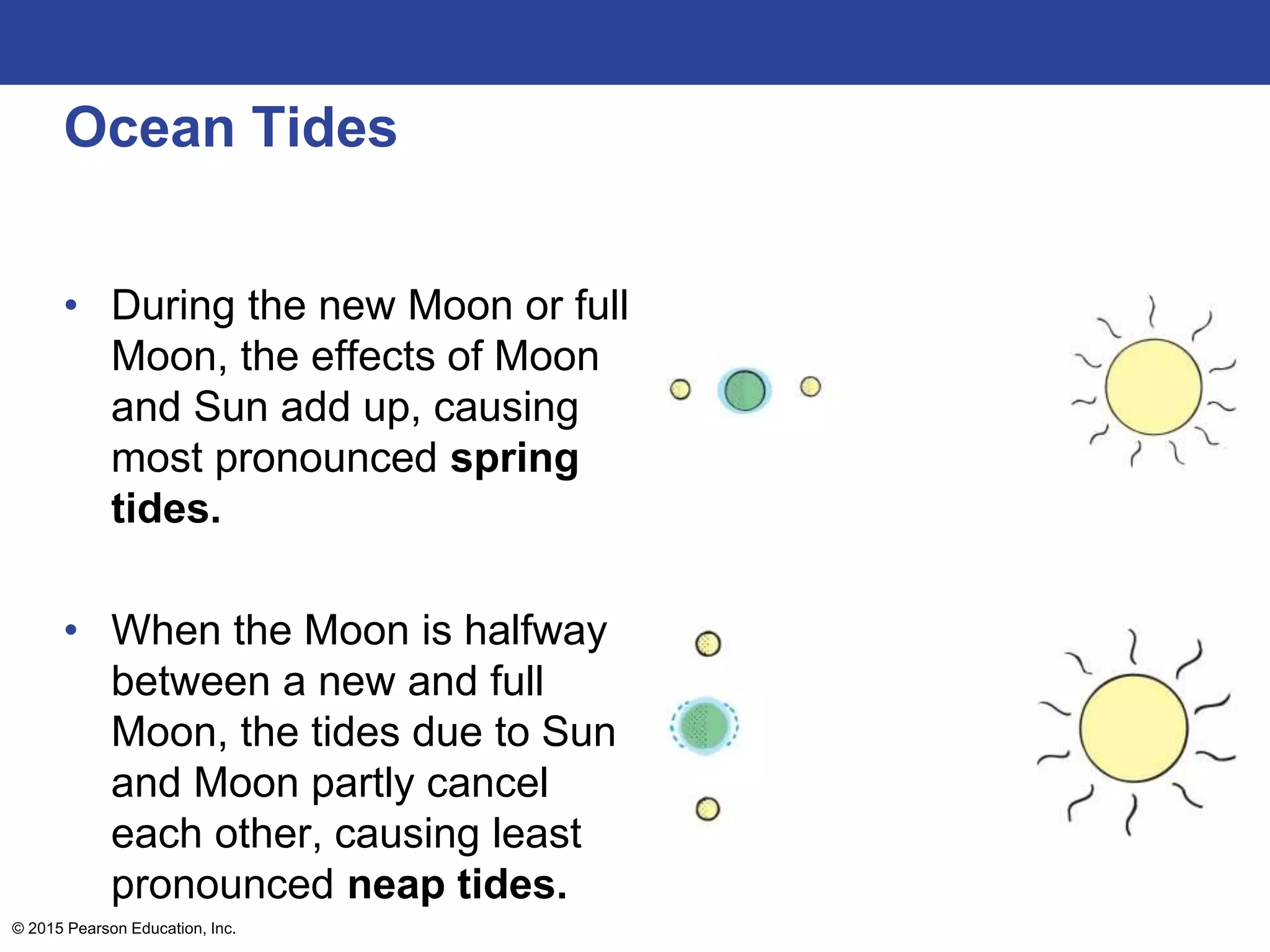
• During the new Moon or full
Moon, the effects of Moon
and Sun add up, causing
most pronounced spring
tides.
• When the Moon is halfway
between a new and full
Moon, the tides due to Sun
and Moon partly cancel
each other, causing least
pronounced neap tides.
© 2015 Pearson Education, Inc.
Gravitational Fields
• Interaction between Earth and Moon is action at a
distance. How do they interact without touching?
• One way to think of this:
– Earth is surrounded by a gravitational field.
– Moon interacts with this gravitational field.
• Gravitational field is an alteration of space
around Earth (or any object with mass).
– Gravitational field is an example of a force
field (another example: magnetic field).
© 2015 Pearson Education, Inc.
Gravitational Fields
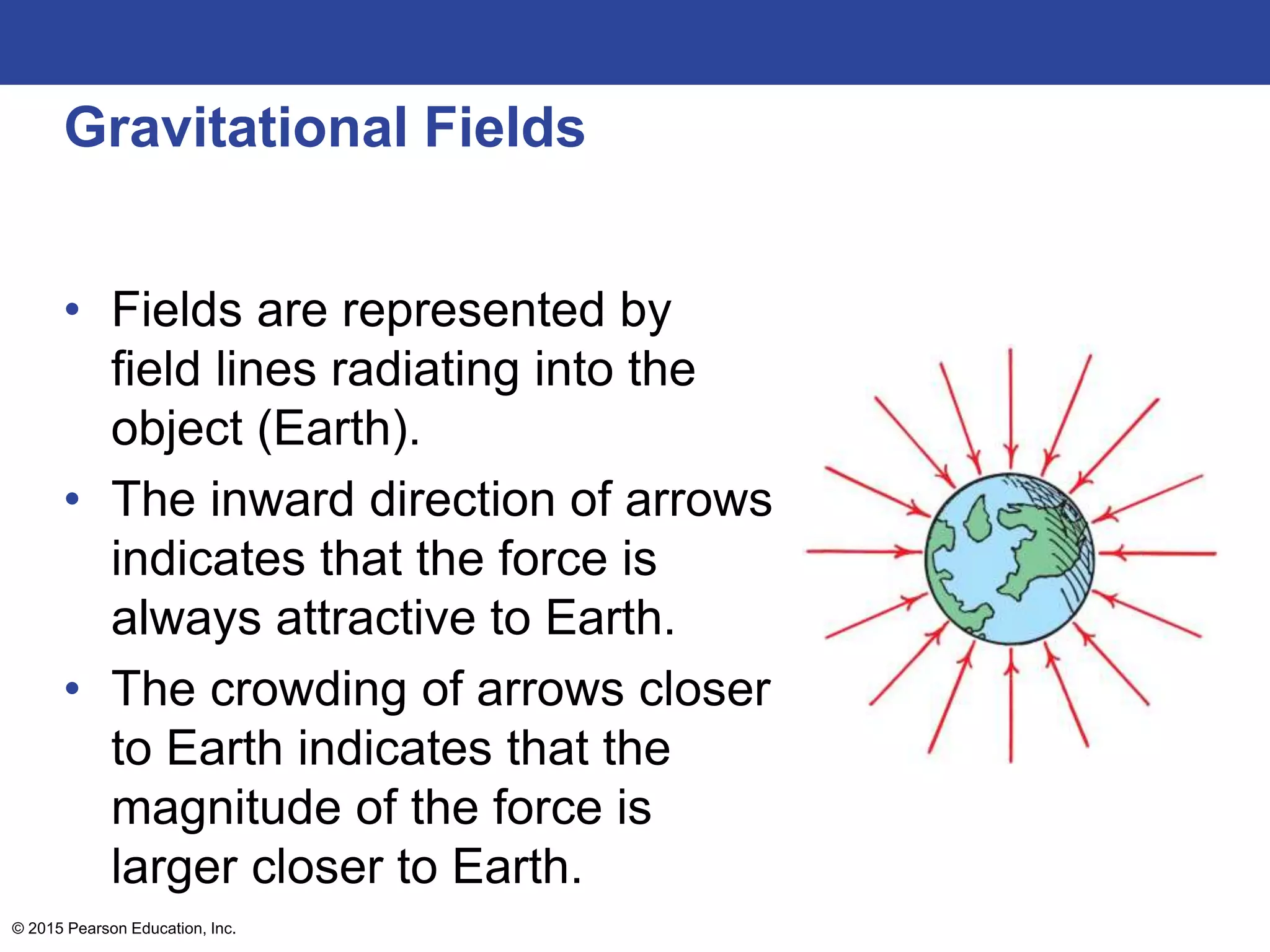
• Fields are represented by
field lines radiating into the
object (Earth).
• The inward direction of arrows
indicates that the force is
always attractive to Earth.
• The crowding of arrows closer
to Earth indicates that the
magnitude of the force is
larger closer to Earth.
© 2015 Pearson Education, Inc.
Gravitational Fields
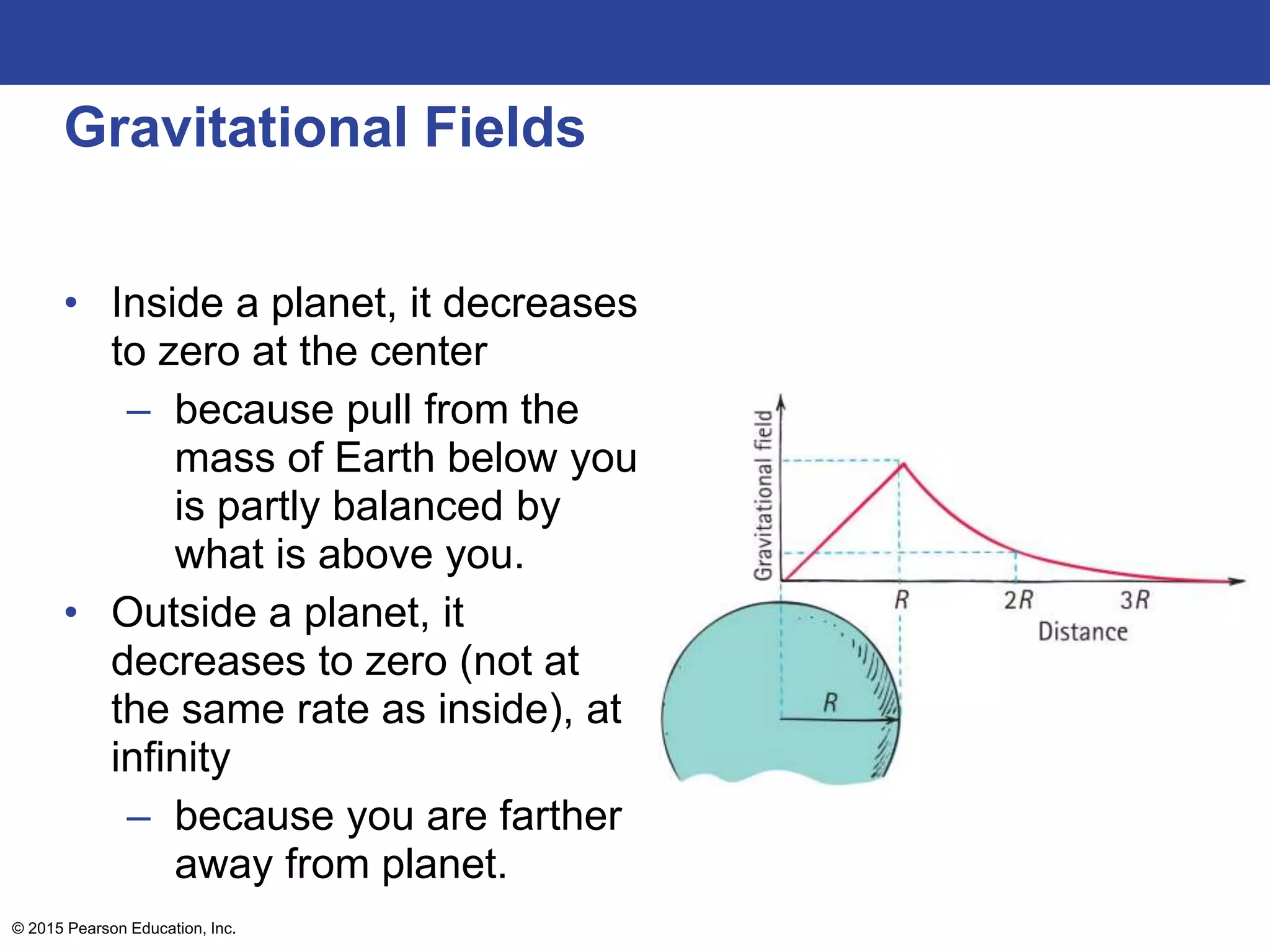
• Inside a planet, it decreases
to zero at the center
– because pull from the
mass of Earth below you
is partly balanced by
what is above you.
• Outside a planet, it
decreases to zero (not at
the same rate as inside), at
infinity
– because you are farther
away from planet.
© 2015 Pearson Education, Inc.
Gravitational Fields
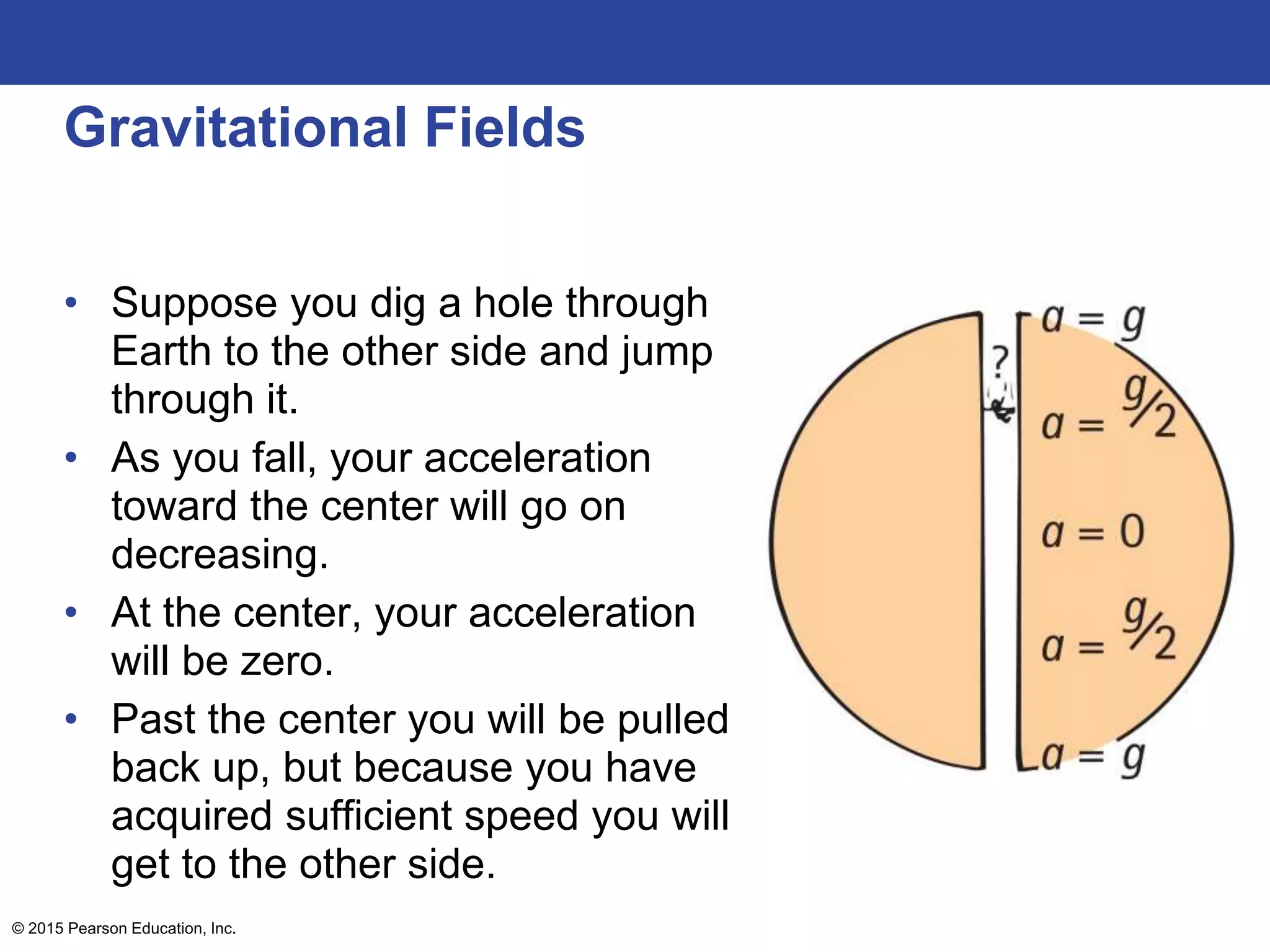
• Suppose you dig a hole through
Earth to the other side and jump
through it.
• As you fall, your acceleration
toward the center will go on
decreasing.
• At the center, your acceleration
will be zero.
• Past the center you will be pulled
back up, but because you have
acquired sufficient speed you will
get to the other side.
© 2015 Pearson Education, Inc.
Einstein's Theory of Gravitation
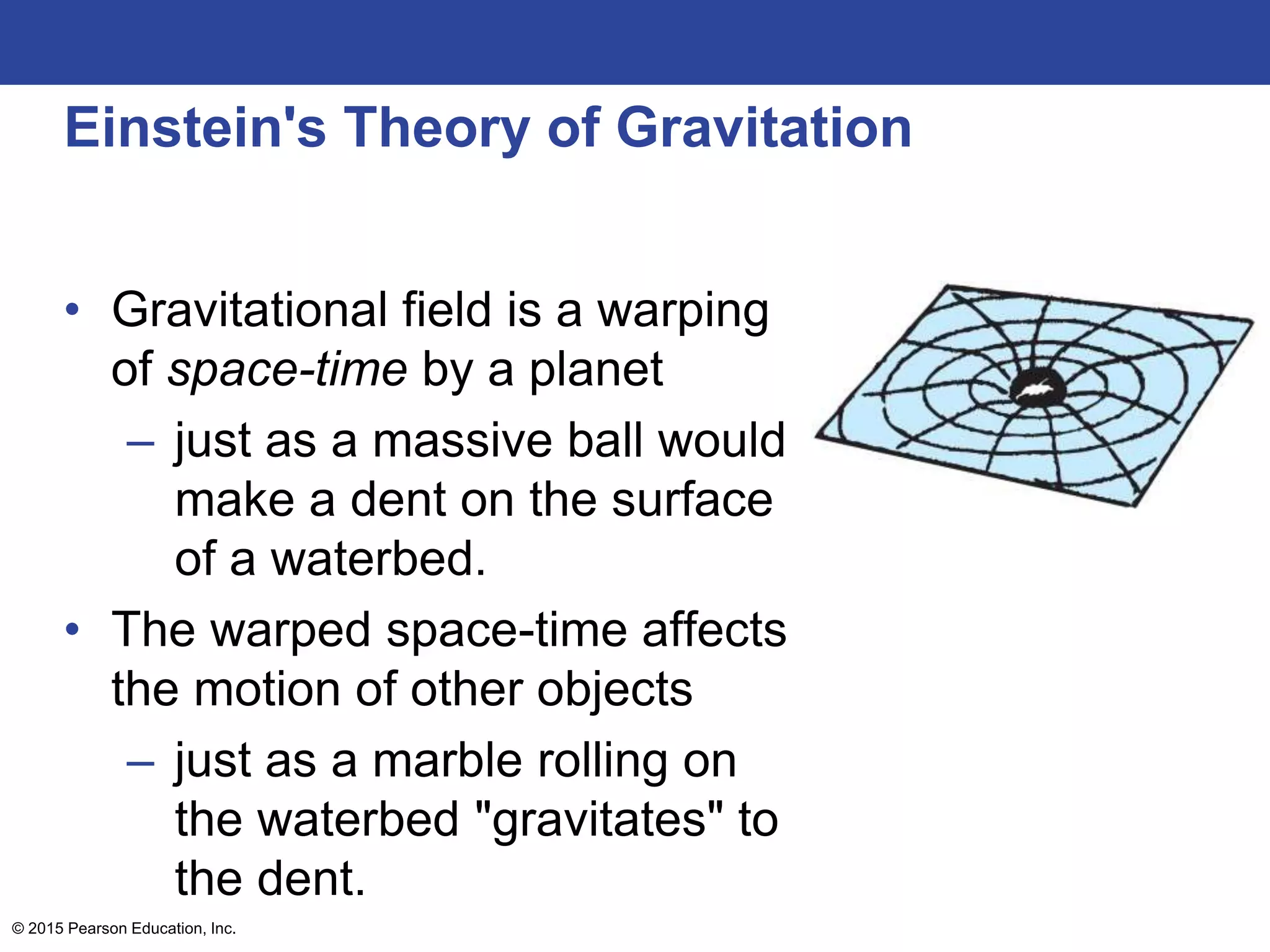
• Gravitational field is a warping
of space-time by a planet
– just as a massive ball would
make a dent on the surface
of a waterbed.
• The warped space-time affects
the motion of other objects
– just as a marble rolling on
the waterbed "gravitates" to
the dent.
© 2015 Pearson Education, Inc.
Black Holes
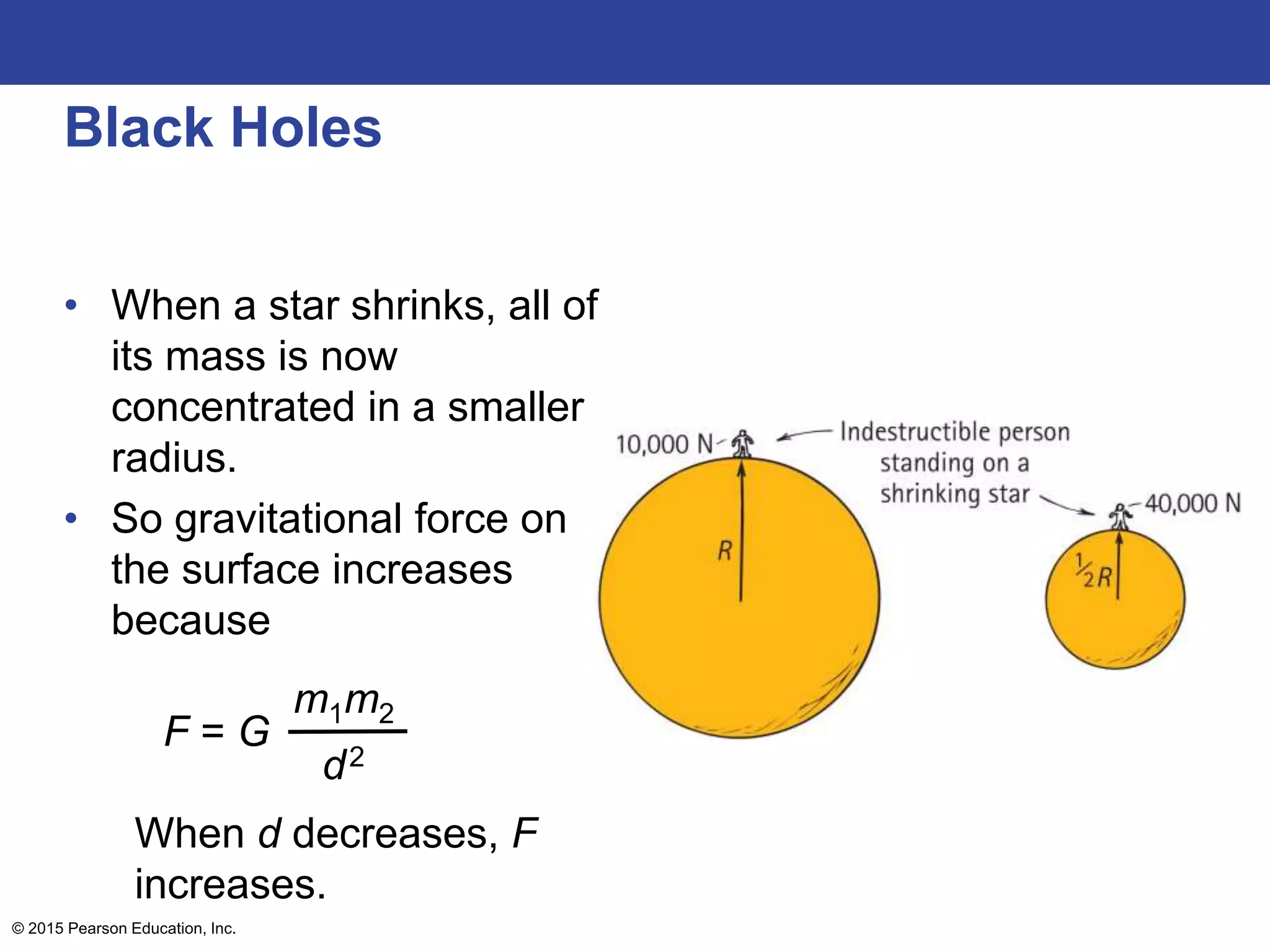
• When a star shrinks, all of
its mass is now
concentrated in a smaller
radius.
• So gravitational force on
the surface increases
because
When d decreases, F
increases.
© 2015 Pearson Education, Inc.
F = G
m1m2
d2
Black Holes
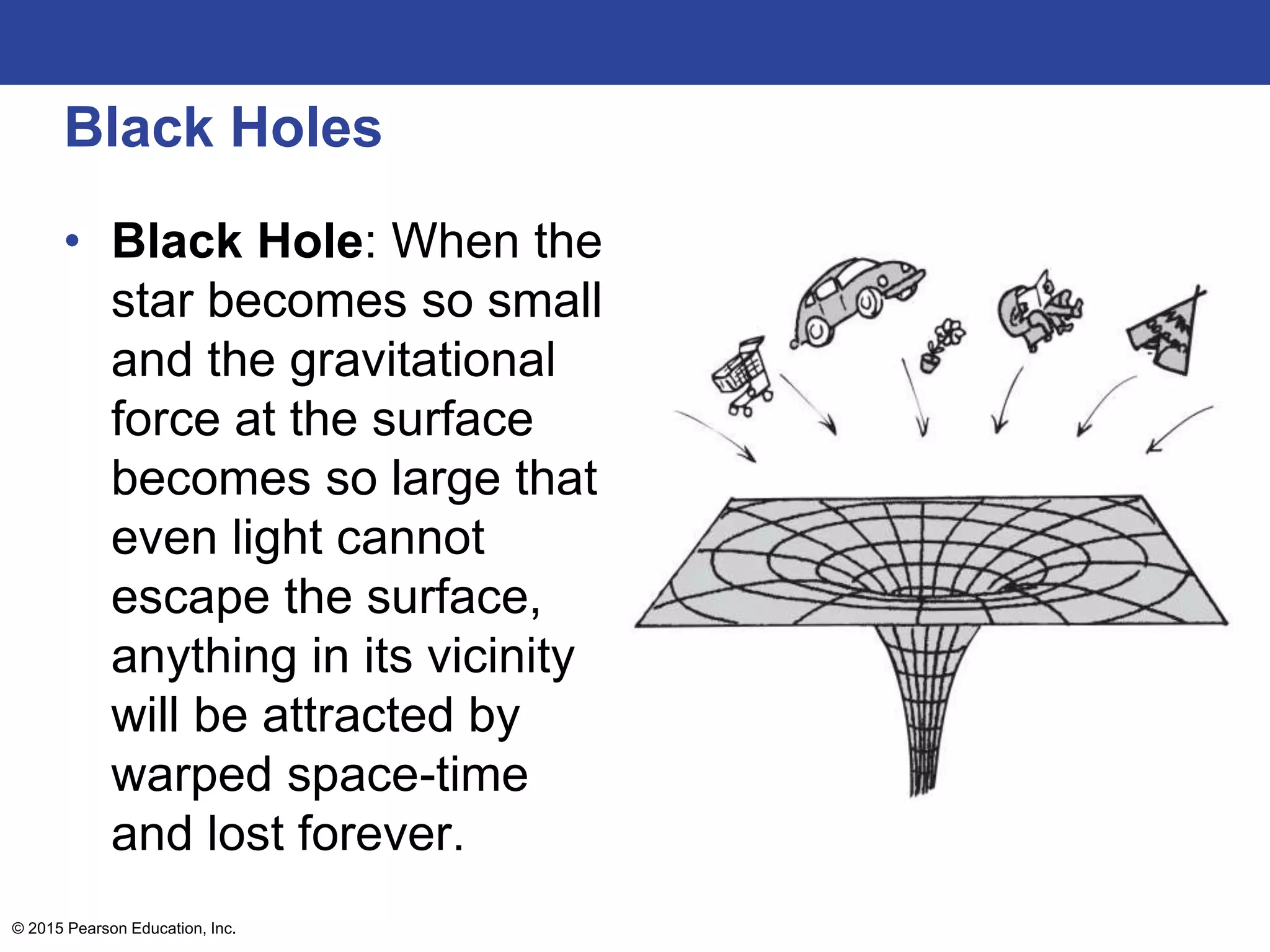
• Black Hole: When the
star becomes so small
and the gravitational
force at the surface
becomes so large that
even light cannot
escape the surface,
anything in its vicinity
will be attracted by
warped space-time
and lost forever.
© 2015 Pearson Education, Inc.
Black Holes
CHECK YOUR NEIGHBOR
What would happen to Earth if the Sun became a black
hole?
A. It would break away from the attraction of the Sun.
B. It would be pulled into the Sun.
C. It would become a black hole too.
D. None of the above.
© 2015 Pearson Education, Inc.
Black Holes
CHECK YOUR ANSWER
What would happen to Earth if the Sun became a black
hole?
A. It would break away from the attraction of the Sun.
B. It would be pulled into the Sun.
C. It would become a black hole too.
D. None of the above.
Explanation:
Letting the equation for gravity guide our thinking, we see that no mass
changes, no distance from center to center changes, so there would be
NO change in force between the shrunken Sun and Earth.
© 2015 Pearson Education, Inc.
Wormhole
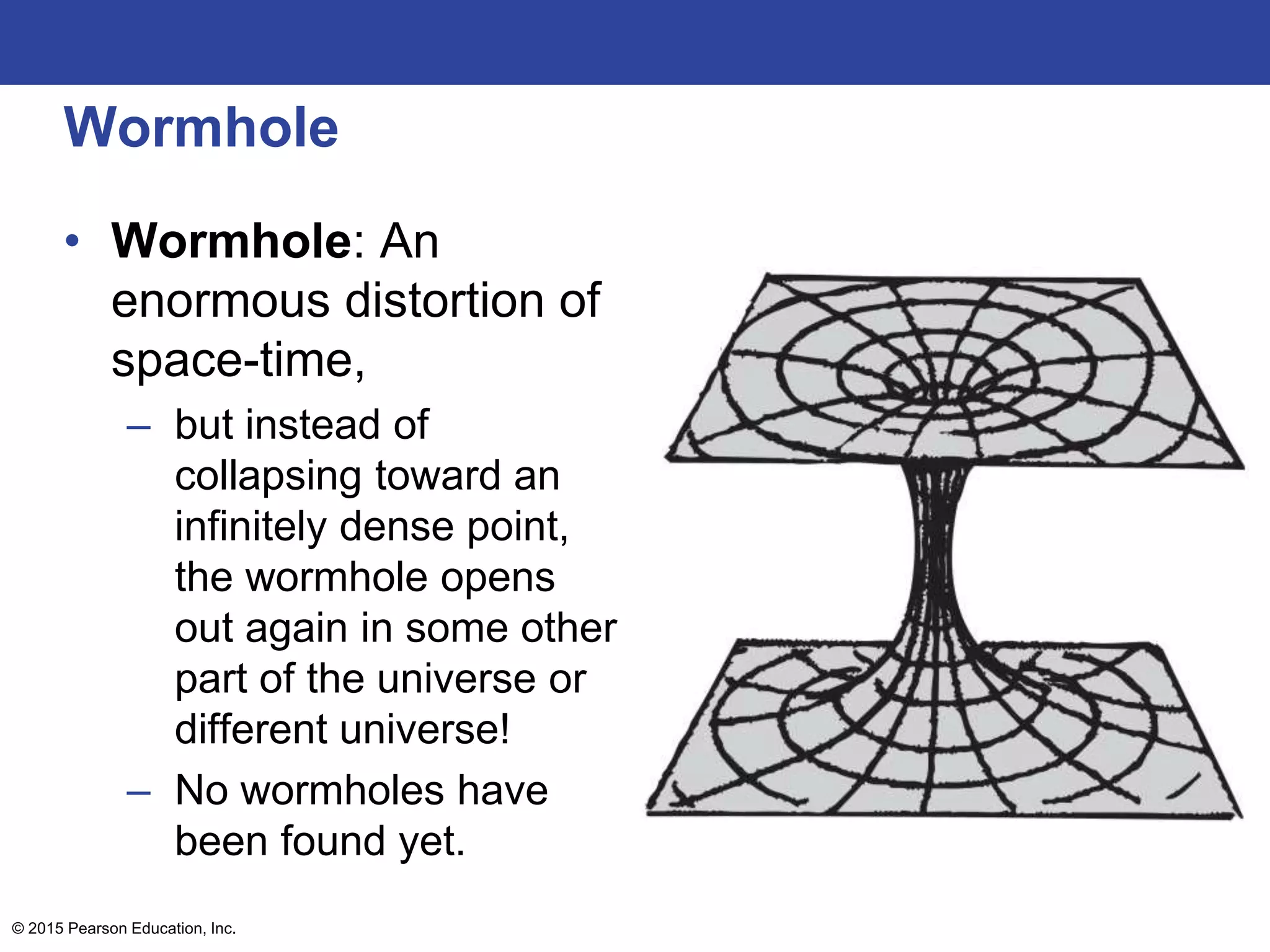
• Wormhole: An
enormous distortion of
space-time,
– but instead of
collapsing toward an
infinitely dense point,
the wormhole opens
out again in some other
part of the universe or
different universe!
– No wormholes have
been found yet.
© 2015 Pearson Education, Inc.
Universal Gravitation
• Universal gravitation
• Everything attracts everything else.
– Example: Earth is round because of
gravitation—all parts of Earth have been
pulled in, making the surface equidistant from
the center.
• The universe is expanding and accelerating
outward.
© 2015 Pearson Education, Inc.

09 lecture outline

  • 1.
    Lecture Outline Chapter 9: Gravity ©2015 Pearson Education, Inc.
  • 2.
    This lecture willhelp you understand: • The Newtonian Synthesis • The Universal Law of Gravity • The Universal Gravitational Constant • Gravity and Distance: Inverse-Square Law • Weight and Weightlessness • Ocean Tides • Gravitational Fields • Einstein's Theory of Gravitation • Black Holes • Universal Gravitation © 2015 Pearson Education, Inc.
  • 3.
    The Newtonian Synthesis •Newton was not the first to discover gravity. Newton discovered that gravity is universal. • Legend—Newton, sitting under an apple tree, realizes that the Earth's pull on an apple extends also to pull on the Moon. © 2015 Pearson Education, Inc.
  • 4.
    The Newtonian Synthesis •In Aristotle's time, motion of planets and stars was natural – not governed by the same laws as objects on Earth. • Newton recognized that a force directed toward the Sun must act on planets – This is similar to force that Earth exerts on an apple that falls toward it. • Newtonian synthesis: The same set of laws apply to both celestial and terrestrial objects. © 2015 Pearson Education, Inc.
  • 5.
    The Universal Lawof Gravity • Law of universal gravitation: – Everything pulls on everything else. – Every body attracts every other body with a force that is directly proportional to the product of their masses and inversely proportional to the square of the distance separating them. © 2015 Pearson Education, Inc.
  • 6.
    The Universal Lawof Gravity • In equation form: where m is the mass of the objects and d is the distance between their centers. • Examples: – The greater the masses m1 and m2 of two bodies, the greater the force of attraction between them. – The greater the distance of separation d, the weaker the force of attraction. distance2 d2 mass1 x mass2 Force ~ or m1m2 F ~ © 2015 Pearson Education, Inc.
  • 7.
    The Universal Lawof Gravity CHECK YOUR NEIGHBOR Newton's most celebrated synthesis was and is of A. earthly and heavenly laws. B. weight on Earth and weightlessness in outer space. C. masses and distances. D. the paths of tossed rocks and the paths of satellites. © 2015 Pearson Education, Inc.
  • 8.
    The Universal Lawof Gravity CHECK YOUR ANSWER Newton's most celebrated synthesis was and is of A. earthly and heavenly laws. B. weight on Earth and weightlessness in outer space. C. masses and distances. D. the paths of tossed rocks and the paths of satellites. Comment: This synthesis provided hope that other natural phenomena followed universal laws and ushered in the "Age of Enlightenment." © 2015 Pearson Education, Inc.
  • 9.
    The Universal GravitationalConstant, G • Gravity is the weakest of four known fundamental forces • With the gravitational constant G, we have the equation • Universal gravitational constant: G = 6.67 x 10⁻¹¹ Nm2/kg2 • Once the value was known, the mass of Earth was calculated as 6 x 1024 kg © 2015 Pearson Education, Inc. F = G m1m2 d2
  • 10.
    The Universal GravitationalConstant, G CHECK YOUR NEIGHBOR The universal gravitational constant, G, which links force to mass and distance, is similar to the familiar constant A. 𝜋. B. g. C. acceleration due to gravity. D. speed of uniform motion. © 2015 Pearson Education, Inc.
  • 11.
    The Universal GravitationalConstant, G CHECK YOUR ANSWER The universal gravitational constant, G, which links force to mass and distance, is similar to the familiar constant A. 𝝅. B. g. C. acceleration due to gravity. D. speed of uniform motion. Explanation: Just as  relates the circumference of a circle to its diameter, G relates force to mass and distance. © 2015 Pearson Education, Inc.
  • 12.
    Gravity and Distance:The Inverse-Square Law • Inverse-square law: – relates the intensity of an effect to the inverse-square of the distance from the cause. – in equation form: intensity = 1/distance2. – for increases in distance, there are decreases in force. – even at great distances, force approaches but never reaches zero. © 2015 Pearson Education, Inc.
  • 13.
    Inverse-Square Law © 2015Pearson Education, Inc.
  • 14.
    Inverse-Square Law © 2015Pearson Education, Inc.
  • 15.
    Gravity and Distance:The Inverse-Square Law CHECK YOUR NEIGHBOR The force of gravity between two planets depends on their A. masses and distance apart. B. planetary atmospheres. C. rotational motions. D. All of the above. © 2015 Pearson Education, Inc.
  • 16.
    Gravity and Distance:The Inverse-Square Law CHECK YOUR ANSWER The force of gravity between two planets depends on their A. masses and distance apart. B. planetary atmospheres. C. rotational motions. D. All of the above. Explanation: The equation for gravitational force, cites only masses and distances as variables. Rotation and atmospheres are irrelevant. © 2015 Pearson Education, Inc. F = G m1m2 d2
  • 17.
    Gravity and Distance:The Inverse-Square Law CHECK YOUR NEIGHBOR If the masses of two planets are each somehow doubled, the force of gravity between them A. doubles. B. quadruples. C. reduces by half. D. reduces by one-quarter. © 2015 Pearson Education, Inc.
  • 18.
    Gravity and Distance:The Inverse-Square Law CHECK YOUR ANSWER If the masses of two planets are each somehow doubled, the force of gravity between them A. doubles. B. quadruples. C. reduces by half. D. reduces by one-quarter. Explanation: Note that both masses double. Then, double x double = quadruple. © 2015 Pearson Education, Inc.
  • 19.
    Gravity and Distance:The Inverse-Square Law CHECK YOUR NEIGHBOR If the mass of one planet is somehow doubled, the force of gravity between it and a neighboring planet A. doubles. B. quadruples C. reduces by half. D. reduces by one-quarter. © 2015 Pearson Education, Inc.
  • 20.
    Gravity and Distance:The Inverse-Square Law CHECK YOUR ANSWER If the mass of one planet is somehow doubled, the force of gravity between it and a neighboring planet A. doubles. B. quadruples C. reduces by half. D. reduces by one-quarter. Explanation: Let the equation guide your thinking: Note that if one mass doubles, then the force between them doubles. © 2015 Pearson Education, Inc. F = G m1m2 d2
  • 21.
    Weight and Weightlessness •Weight: – force an object exerts against a supporting surface – Examples: • standing on a scale in an elevator accelerating downward, less compression in scale springs; weight is less • standing on a scale in an elevator accelerating upward, more compression in scale springs; weight is greater • at constant speed in an elevator, no change in weight © 2015 Pearson Education, Inc.
  • 22.
    Weight and Weightlessness •Weightlessness: – no support force, as in free fall – Example: Astronauts in orbit are without support forces and are in a continual state of weightlessness. © 2015 Pearson Education, Inc.
  • 23.
    Weight and Weightlessness ©2015 Pearson Education, Inc.
  • 24.
    Weight and Weightlessness CHECKYOUR NEIGHBOR When an elevator accelerates upward, your weight reading on a scale is A. greater. B. less. C. zero. D. the normal weight. © 2015 Pearson Education, Inc.
  • 25.
    Weight and Weightlessness CHECKYOUR ANSWER When an elevator accelerates upward, your weight reading on a scale is A. greater. B. less. C. zero. D. the normal weight. Explanation: The support force pressing on you is greater, so you weigh more. © 2015 Pearson Education, Inc.
  • 26.
    Weight and Weightlessness CHECKYOUR NEIGHBOR When an elevator accelerates downward, your weight reading is A. greater. B. less. C. zero. D. the normal weight. © 2015 Pearson Education, Inc.
  • 27.
    Weight and Weightlessness CHECKYOUR ANSWER When an elevator accelerates downward, your weight reading is A. greater. B. less. C. zero. D. the normal weight. Explanation: The support force pressing on you is less, so you weigh less. Question: Would you weigh less in an elevator that moves downward at constant velocity? © 2015 Pearson Education, Inc.
  • 28.
    Weight and Weightlessness CHECKYOUR NEIGHBOR When the elevator cable breaks, the elevator falls freely, so your weight reading is A. greater. B. less. C. zero. D. the normal weight. © 2015 Pearson Education, Inc.
  • 29.
    Weight and Weightlessness CHECKYOUR ANSWER When the elevator cable breaks, the elevator falls freely, so your weight reading is A. greater. B. less. C. zero. D. the normal weight. Explanation: There is still a downward gravitational force acting on you, but gravity is not felt as weight because there is no support force, so your weight is zero. © 2015 Pearson Education, Inc.
  • 30.
    Weight and Weightlessness CHECKYOUR NEIGHBOR If you weigh yourself in an elevator, you'll weigh more when the elevator A. moves upward. B. moves downward. C. accelerates upward. D. All of the above. © 2015 Pearson Education, Inc.
  • 31.
    Weight and Weightlessness CHECKYOUR ANSWER If you weigh yourself in an elevator, you'll weigh more when the elevator A. moves upward. B. moves downward. C. accelerates upward. D. All of the above. Explanation: The support provided by the floor of an elevator is the same whether the elevator is at rest or moving at constant velocity. Only accelerated motion affects weight. © 2015 Pearson Education, Inc.
  • 32.
    Ocean Tides • Thedifferences between ocean levels at different times of the day are called tides. • There are typically two high tides and two low tides each day. © 2015 Pearson Education, Inc.
  • 33.
    Ocean Tides • Oceantides are caused due to the gravitational attraction of the Moon. • Unequal tugs on Earth's oceans causes a stretching effect that produces a pair of ocean bulges. – Because the two bulges are on opposite sides, high tides occur every 12 hours. © 2015 Pearson Education, Inc.
  • 34.
    Ocean Tides • Duringthe new Moon or full Moon, the effects of Moon and Sun add up, causing most pronounced spring tides. • When the Moon is halfway between a new and full Moon, the tides due to Sun and Moon partly cancel each other, causing least pronounced neap tides. © 2015 Pearson Education, Inc.
  • 35.
    Gravitational Fields • Interactionbetween Earth and Moon is action at a distance. How do they interact without touching? • One way to think of this: – Earth is surrounded by a gravitational field. – Moon interacts with this gravitational field. • Gravitational field is an alteration of space around Earth (or any object with mass). – Gravitational field is an example of a force field (another example: magnetic field). © 2015 Pearson Education, Inc.
  • 36.
    Gravitational Fields • Fieldsare represented by field lines radiating into the object (Earth). • The inward direction of arrows indicates that the force is always attractive to Earth. • The crowding of arrows closer to Earth indicates that the magnitude of the force is larger closer to Earth. © 2015 Pearson Education, Inc.
  • 37.
    Gravitational Fields • Insidea planet, it decreases to zero at the center – because pull from the mass of Earth below you is partly balanced by what is above you. • Outside a planet, it decreases to zero (not at the same rate as inside), at infinity – because you are farther away from planet. © 2015 Pearson Education, Inc.
  • 38.
    Gravitational Fields • Supposeyou dig a hole through Earth to the other side and jump through it. • As you fall, your acceleration toward the center will go on decreasing. • At the center, your acceleration will be zero. • Past the center you will be pulled back up, but because you have acquired sufficient speed you will get to the other side. © 2015 Pearson Education, Inc.
  • 39.
    Einstein's Theory ofGravitation • Gravitational field is a warping of space-time by a planet – just as a massive ball would make a dent on the surface of a waterbed. • The warped space-time affects the motion of other objects – just as a marble rolling on the waterbed "gravitates" to the dent. © 2015 Pearson Education, Inc.
  • 40.
    Black Holes • Whena star shrinks, all of its mass is now concentrated in a smaller radius. • So gravitational force on the surface increases because When d decreases, F increases. © 2015 Pearson Education, Inc. F = G m1m2 d2
  • 41.
    Black Holes • BlackHole: When the star becomes so small and the gravitational force at the surface becomes so large that even light cannot escape the surface, anything in its vicinity will be attracted by warped space-time and lost forever. © 2015 Pearson Education, Inc.
  • 42.
    Black Holes CHECK YOURNEIGHBOR What would happen to Earth if the Sun became a black hole? A. It would break away from the attraction of the Sun. B. It would be pulled into the Sun. C. It would become a black hole too. D. None of the above. © 2015 Pearson Education, Inc.
  • 43.
    Black Holes CHECK YOURANSWER What would happen to Earth if the Sun became a black hole? A. It would break away from the attraction of the Sun. B. It would be pulled into the Sun. C. It would become a black hole too. D. None of the above. Explanation: Letting the equation for gravity guide our thinking, we see that no mass changes, no distance from center to center changes, so there would be NO change in force between the shrunken Sun and Earth. © 2015 Pearson Education, Inc.
  • 44.
    Wormhole • Wormhole: An enormousdistortion of space-time, – but instead of collapsing toward an infinitely dense point, the wormhole opens out again in some other part of the universe or different universe! – No wormholes have been found yet. © 2015 Pearson Education, Inc.
  • 45.
    Universal Gravitation • Universalgravitation • Everything attracts everything else. – Example: Earth is round because of gravitation—all parts of Earth have been pulled in, making the surface equidistant from the center. • The universe is expanding and accelerating outward. © 2015 Pearson Education, Inc.