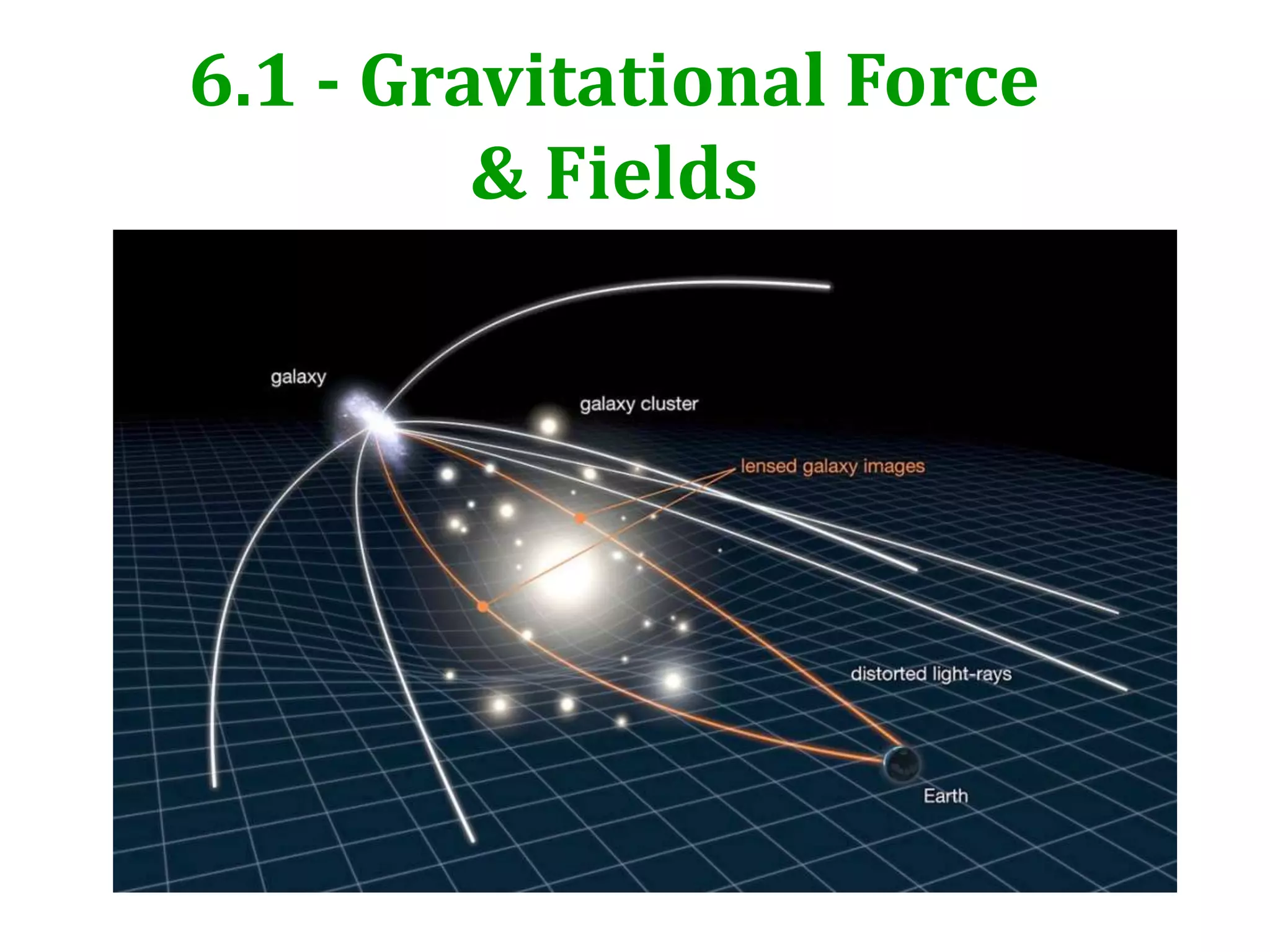
6.1 - Gravitational Force
         & Fields
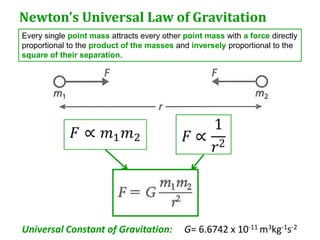
Newton’s Universal Law of Gravitation
Every single point mass attracts every other point mass with a force directly
proportional to the product of the masses and inversely proportional to the
square of their separation.


Universal Constant of Gravitation:           G= 6.6742 x 10⁻¹¹ m3kg-1s-2
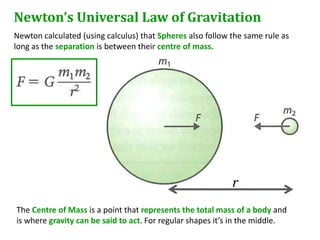
Newton’s Universal Law of Gravitation
Newton calculated (using calculus) that Spheres also follow the same rule as
long as the separation is between their centre of mass.


                                                            r
The Centre of Mass is a point that represents the total mass of a body and
is where gravity can be said to act. For regular shapes it’s in the middle.
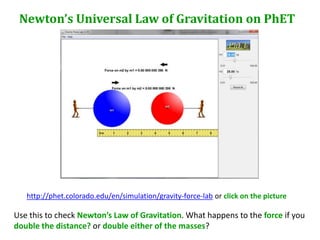
Newton’s Universal Law of Gravitation on PhET


   http://phet.colorado.edu/en/simulation/gravity-force-lab or click on the picture

Use this to check Newton’s Law of Gravitation. What happens to the force if you
double the distance? or double either of the masses?
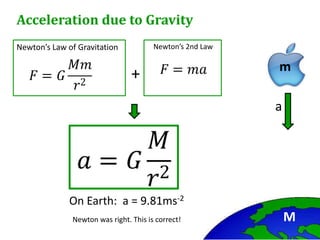
Acceleration due to Gravity
Newton’s Law of Gravitation            Newton’s 2nd Law

                                                          m
                                +
                                                          a


             On Earth: a = 9.81ms-2
              Newton was right. This is correct!              M
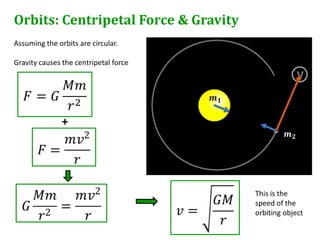
Orbits: Centripetal Force & Gravity
Assuming the orbits are circular.

Gravity causes the centripetal force


               +


                                       This is the
                                       speed of the
                                       orbiting object
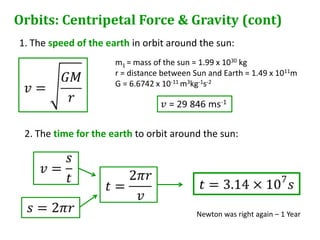
Orbits: Centripetal Force & Gravity (cont)
1. The speed of the earth in orbit around the sun:
                      m1 = mass of the sun = 1.99 x 1030 kg
                      r = distance between Sun and Earth = 1.49 x 10¹¹m
                      G = 6.6742 x 10⁻¹¹ m3kg-1s-2


 2. The time for the earth to orbit around the sun:


                                           Newton was right again – 1 Year
Orbits: Centripetal Force & Gravity
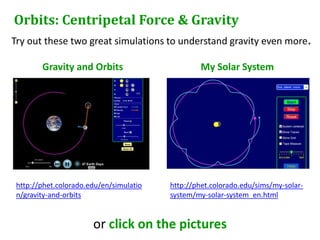
Try out these two great simulations to understand gravity even more.

        Gravity and Orbits                       My Solar System


 http://phet.colorado.edu/en/simulatio   http://phet.colorado.edu/sims/my-solar-
 n/gravity-and-orbits                    system/my-solar-system_en.html


                       or click on the pictures
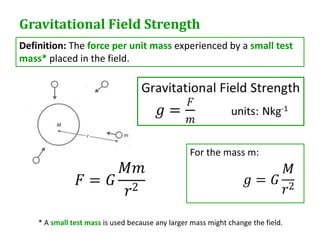
Gravitational Field Strength
Definition: The force per unit mass experienced by a small test
mass* placed in the field.


                                                  For the mass m:


    * A small test mass is used because any larger mass might change the field.
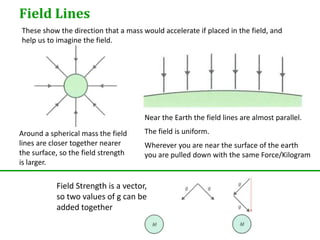
Field Lines
These show the direction that a mass would accelerate if placed in the field, and
help us to imagine the field.


                                      Near the Earth the field lines are almost parallel.
Around a spherical mass the field     The field is uniform.
lines are closer together nearer      Wherever you are near the surface of the earth
the surface, so the field strength    you are pulled down with the same Force/Kilogram
is larger.

           Field Strength is a vector,
           so two values of g can be
           added together

6.1 - Gravitational Force and fields

  • 1.
    6.1 - GravitationalForce & Fields
  • 2.
    Newton’s Universal Lawof Gravitation Every single point mass attracts every other point mass with a force directly proportional to the product of the masses and inversely proportional to the square of their separation. Universal Constant of Gravitation: G= 6.6742 x 10⁻¹¹ m3kg-1s-2
  • 3.
    Newton’s Universal Lawof Gravitation Newton calculated (using calculus) that Spheres also follow the same rule as long as the separation is between their centre of mass. r The Centre of Mass is a point that represents the total mass of a body and is where gravity can be said to act. For regular shapes it’s in the middle.
  • 4.
    Newton’s Universal Lawof Gravitation on PhET http://phet.colorado.edu/en/simulation/gravity-force-lab or click on the picture Use this to check Newton’s Law of Gravitation. What happens to the force if you double the distance? or double either of the masses?
  • 5.
    Acceleration due toGravity Newton’s Law of Gravitation Newton’s 2nd Law m + a On Earth: a = 9.81ms-2 Newton was right. This is correct! M
  • 6.
    Orbits: Centripetal Force& Gravity Assuming the orbits are circular. Gravity causes the centripetal force + This is the speed of the orbiting object
  • 7.
    Orbits: Centripetal Force& Gravity (cont) 1. The speed of the earth in orbit around the sun: m1 = mass of the sun = 1.99 x 1030 kg r = distance between Sun and Earth = 1.49 x 10¹¹m G = 6.6742 x 10⁻¹¹ m3kg-1s-2 2. The time for the earth to orbit around the sun: Newton was right again – 1 Year
  • 8.
    Orbits: Centripetal Force& Gravity Try out these two great simulations to understand gravity even more. Gravity and Orbits My Solar System http://phet.colorado.edu/en/simulatio http://phet.colorado.edu/sims/my-solar- n/gravity-and-orbits system/my-solar-system_en.html or click on the pictures
  • 9.
    Gravitational Field Strength Definition:The force per unit mass experienced by a small test mass* placed in the field. For the mass m: * A small test mass is used because any larger mass might change the field.
  • 10.
    Field Lines These showthe direction that a mass would accelerate if placed in the field, and help us to imagine the field. Near the Earth the field lines are almost parallel. Around a spherical mass the field The field is uniform. lines are closer together nearer Wherever you are near the surface of the earth the surface, so the field strength you are pulled down with the same Force/Kilogram is larger. Field Strength is a vector, so two values of g can be added together