The paradox of timeThe paradox of our time in history is that we have	taller buildings, but shorter tempers;	wider freeways, but narrower viewpoints;	we spend more, but enjoy it less;We have bigger houses, but smaller families;	more conveniences, but less time;We have more degrees, but less sense;	 more knowledge, but less judgment; 	more experts, but more problems;	more medicine, but less wellness
The paradox of timeWe have been all the way to the moon and back, but have trouble crossing the street to meet the new neighbor. We have conquered outer space, but not inner space; we have done larger things, but not better things.We write more, but learn less; we plan more, but accomplish less, we’ve learned to rush, but not to wait; we have higher incomes but lower morals; we have more food, but less appeasement; we build more computers to hold more information to produce more copies than ever, but have less communication; we’ve become long in quantity, but short in quality.
The paradox of timeThese are the times of fast foods and slow  digestion; tall men and short character; steep profits and  shallow relationships. These are the times of world peace, but domestic warfare; more leisure, but less fun; more kinds of food, but less nutrition.These are the days of two incomes, but more divorces; of fancier houses, but broken homes. These are the days of quick trips, disposable diapers, throw away morality, one-night stands, overweight bodies, and pills that do everything from cheer to quiet to kill.
questions1. How would you describe the pacing of life today?2. Do we need to accelerate our pace of life some more or do we need to slow down? Why?3. What drives one to live life so fast?
The Law of AccelerationNewton’s Second Law
Let’s RecallMotionPositionMassWeightForceAcceleration
2 Objects of the same MassFMASSNET FORCEaACCELERATION?2FMASSNET FORCE2aACCELERATION?
Force of the same magnitude on different masses FMASSaNET FORCE, FnetACCELERATION?MASSFMASSNET FORCE, Fnet½aACCELERATION?
THE Experiment SET UPFixed PulleymassWooden planeMetal cartString...Slotted weightWeight hanger
Questions1.  What represents the constant mass in procedure A?  The mass of the metal cart.	How about the varying force?  The slotted weights.2.  How does the time of drop change as the accelerating force (slotted weights) is increased? The time of drops becomes shorter.
Questions3.  What represents the constant force in procedure B?  The weight of the slotted weights.	How about the varying mass?  The mass of the metal cart.4.   How does the time of drop change as the accelerating force (slotted weights) is increased? The time of drop becomes greater or  longer.
The Big QuestionHow does the acceleration of the object (cart) related to the net force acting on the object (cart) and the mass of the object, and how can this relationship be expressed in a single equation?
How do we represent the 2nd law mathematically? a αFnet a α      a αWhen m is constant1mWhen Fnet is constantFnetmThus:
Now, we insert a proportionality constant, k, to create an equation relating all three variables:             a = ka = 		   FnetmIf the units in both sides of the equation are consistent, with newtons for force, meters, kilograms and seconds for the acceleration and mass, the value of k is 1.  Thus the final equation for Newton’s Second Law of Motion isFnetmFnet= maOR
Illustrative Example 1A constant force of 20 N acts on a mass of (a) 2 kg, (b) 4 kg and (c) 6 kg. What are the resulting accelerations?a1= —— = ——— = 10 m/s2F       20Nm12kgF       20Nm2 4 kga2= —— = ——— = 5 m/s2F       20Nm36kga3= —— = ——— = 3.3 m/s2
Acceleration-Mass relationship.10987654321Acceleration in m/s2..      0           1          2           3          4          5           6          7           8      Mass in kg
Illustrative Example 2A 4.0-kg mass is acted on by a resultant force of (a) 4.0N; (b) 8.0 N and (c) 12 N. What are the resulting accelerations?a1= —— = ——— = 1.0 m/s2F       4.0Nm14kgF       8.0Nm2 4 kga2= —— = ——— = 2.0 m/s2F       12Nm34kga3= —— = ——— = 3.0 m/s2
Acceleration-Force relationship54321Acceleration in m/s2...      0     1    2   3    4    5    6    7    8   9    10  11  12 13  14  15  16 Force in N
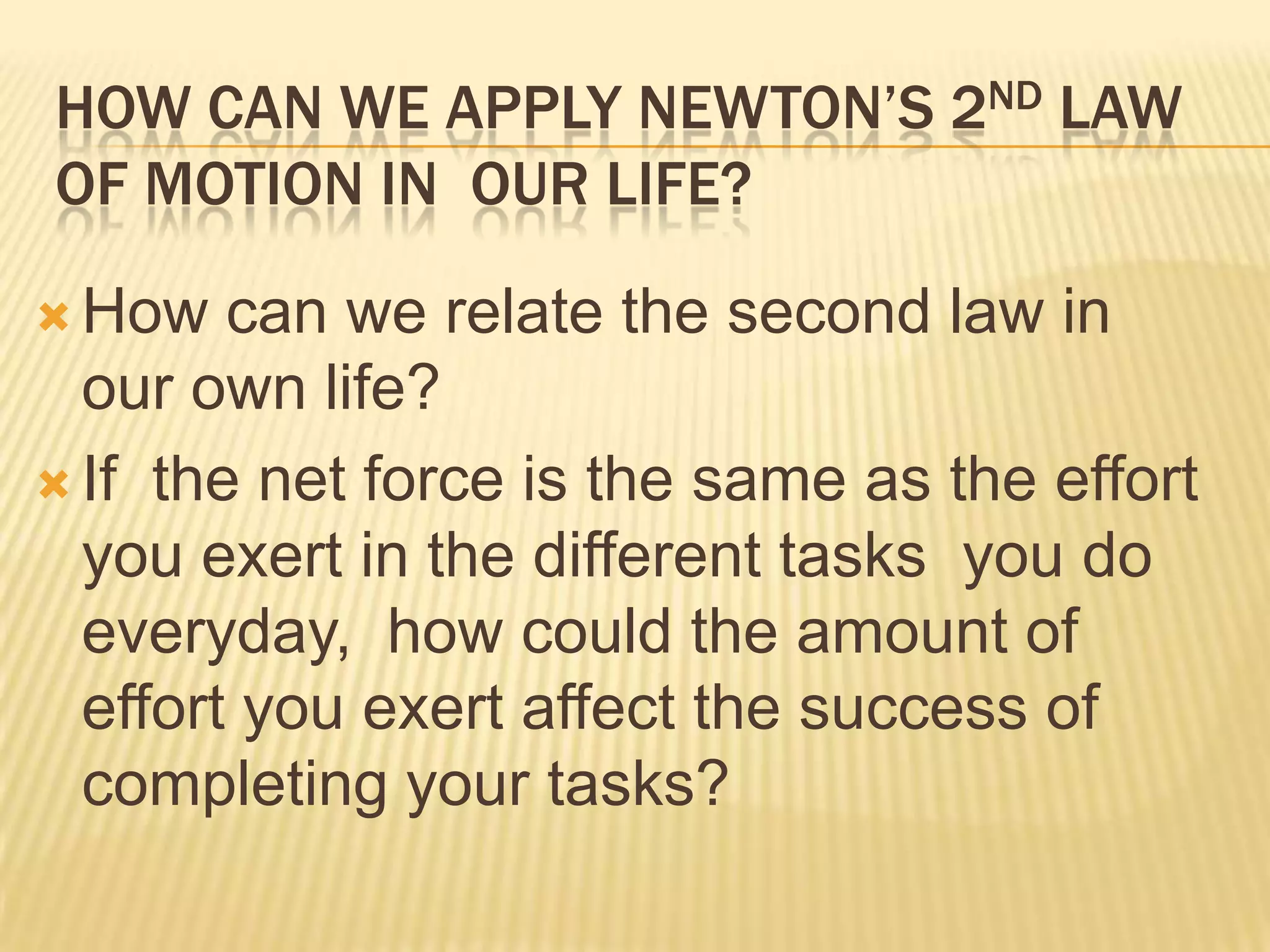
How Can we apply Newton’s 2nd law of motion in  our life?How can we relate the second law in our own life?If  the net force is the same as the effort you exert in the different tasks  you do everyday,  how could the amount of effort you exert affect the success of completing your tasks?
Christian living education:And Jesus said to them, “Suppose one of you has a friend to whom he goes at midnight and says, “Friend lend me three loaves of bread, for a friend of mine has arrived at my house from a journey and I have nothing to offer him,” and he says in reply from within. “Do not bother me; the door has been locked and my children and I are already in bed. I cannot get up to give you anything.” I tell you, If he does not get up to give him the loaves because of their friendship, he will get up to give him whatever he needs because of his persistence.- Luke 11: 5-8
Let’s check what you learned.True or False: (in ¼ sheet of paper)Write T if the statement is true and F if it is not.
1.  As the applied net  force increases the acceleration of the object of constant mass decreases. 2.  If the mass of the object is doubled and the      applied force is kept the same the acceleration produced will be halved.3.  The heavier the person the harder it is for him    or her to change his or her state of motion.4.  An object can accelerate only if force is applied.5.  The law of acceleration applies only to objects     at rest.
Complete the statement:Today, I discovered that ______.The most important thing I learned in this lesson was______.In this activity I find it difficult ______.
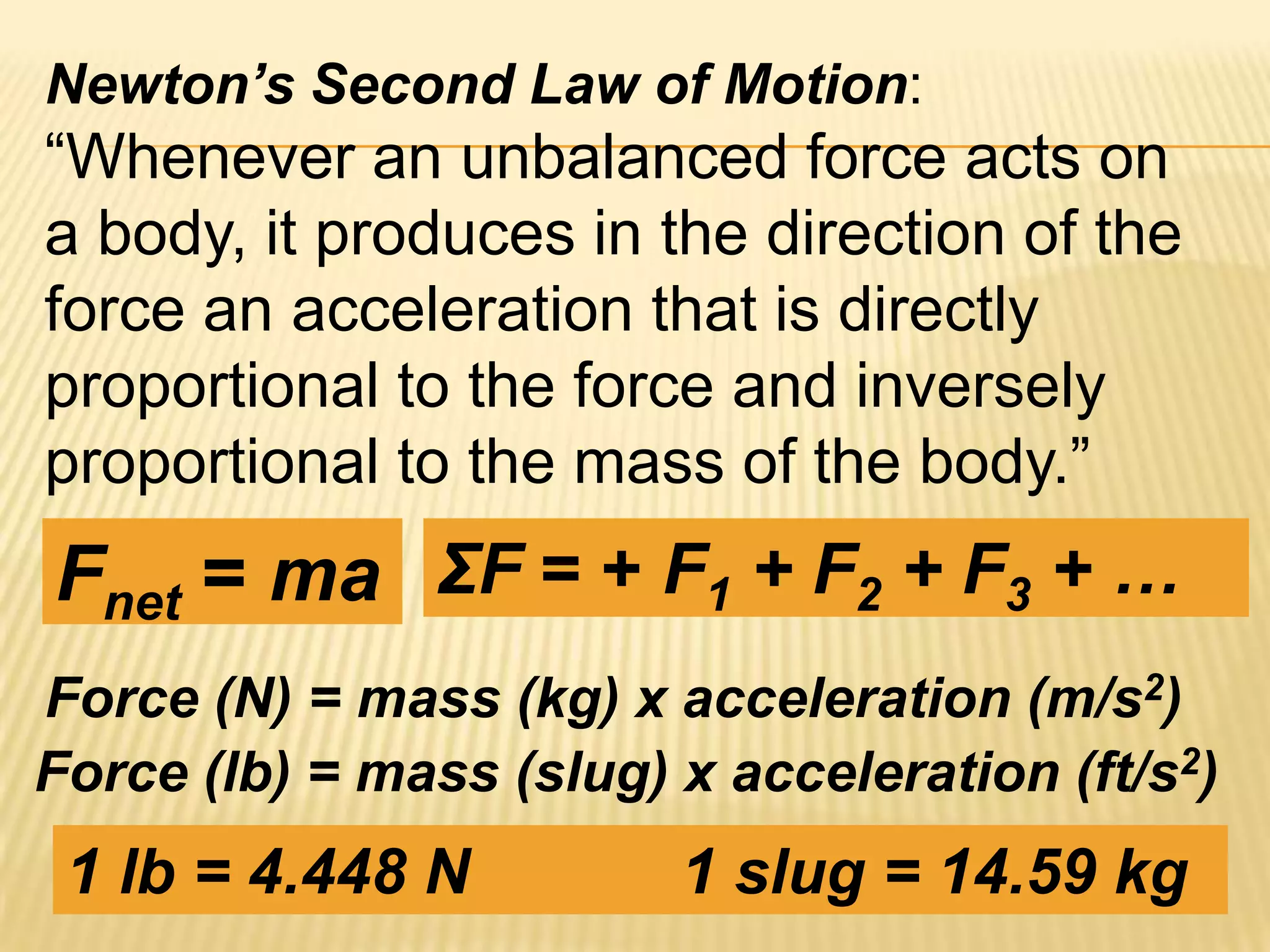
Newton’s Second Law of Motion: “Whenever an unbalanced force acts on a body, it produces in the direction of the force an acceleration that is directly proportional to the force and inversely proportional to the mass of the body.”Fnet = maΣF = + F1 + F2 + F3 + …Force (N) = mass (kg) x acceleration (m/s2)Force (lb) = mass (slug) x acceleration (ft/s2)1 lb = 4.448 N            1 slug = 14.59 kg
Solve:A 1000kg car moving north at 100 km/h brakes to a stop in 50 m. What are the magnitude and direction of the force?
Given: m = 1000kg; vi = 100 km/h = 27.8 m/s;    	 ΔX  = 50m; vf= 0      Find: Fnet = ?  		Formula: Fnet = mavf– viΔta = ————ΔX             50 mv    13.9 m/sΔt =  ——   =    —————  0– 27.8 m/s3.6 sΔt = 3.6 sa = ———————a = – 7.72 m/s2or 7.72 m/s2, S
Given: m = 1000kg; vi = 100 km/h = 27.8 m/s;    	 ΔX  = 50m; vf= 0      Find: Fnet = ?  		Formula: Fnet = maF = ma  = (1000kg)(- 7.72 m/s2)F = 7720 N, South
AssignmentAnswer in your lecture notebook.Does Newton’s second law agree with the first law of motion? Explain.How can the concept of the second law of motion apply in safe driving?

Law of acceleration

  • 1.
    The paradox oftimeThe paradox of our time in history is that we have taller buildings, but shorter tempers; wider freeways, but narrower viewpoints; we spend more, but enjoy it less;We have bigger houses, but smaller families; more conveniences, but less time;We have more degrees, but less sense; more knowledge, but less judgment; more experts, but more problems; more medicine, but less wellness
  • 2.
    The paradox oftimeWe have been all the way to the moon and back, but have trouble crossing the street to meet the new neighbor. We have conquered outer space, but not inner space; we have done larger things, but not better things.We write more, but learn less; we plan more, but accomplish less, we’ve learned to rush, but not to wait; we have higher incomes but lower morals; we have more food, but less appeasement; we build more computers to hold more information to produce more copies than ever, but have less communication; we’ve become long in quantity, but short in quality.
  • 3.
    The paradox oftimeThese are the times of fast foods and slow digestion; tall men and short character; steep profits and shallow relationships. These are the times of world peace, but domestic warfare; more leisure, but less fun; more kinds of food, but less nutrition.These are the days of two incomes, but more divorces; of fancier houses, but broken homes. These are the days of quick trips, disposable diapers, throw away morality, one-night stands, overweight bodies, and pills that do everything from cheer to quiet to kill.
  • 4.
    questions1. How wouldyou describe the pacing of life today?2. Do we need to accelerate our pace of life some more or do we need to slow down? Why?3. What drives one to live life so fast?
  • 5.
    The Law ofAccelerationNewton’s Second Law
  • 6.
  • 7.
    2 Objects ofthe same MassFMASSNET FORCEaACCELERATION?2FMASSNET FORCE2aACCELERATION?
  • 8.
    Force of thesame magnitude on different masses FMASSaNET FORCE, FnetACCELERATION?MASSFMASSNET FORCE, Fnet½aACCELERATION?
  • 9.
    THE Experiment SETUPFixed PulleymassWooden planeMetal cartString...Slotted weightWeight hanger
  • 10.
    Questions1. Whatrepresents the constant mass in procedure A? The mass of the metal cart. How about the varying force? The slotted weights.2. How does the time of drop change as the accelerating force (slotted weights) is increased? The time of drops becomes shorter.
  • 11.
    Questions3. Whatrepresents the constant force in procedure B? The weight of the slotted weights. How about the varying mass? The mass of the metal cart.4. How does the time of drop change as the accelerating force (slotted weights) is increased? The time of drop becomes greater or longer.
  • 12.
    The Big QuestionHowdoes the acceleration of the object (cart) related to the net force acting on the object (cart) and the mass of the object, and how can this relationship be expressed in a single equation?
  • 13.
    How do werepresent the 2nd law mathematically? a αFnet a α a αWhen m is constant1mWhen Fnet is constantFnetmThus:
  • 14.
    Now, we inserta proportionality constant, k, to create an equation relating all three variables: a = ka = FnetmIf the units in both sides of the equation are consistent, with newtons for force, meters, kilograms and seconds for the acceleration and mass, the value of k is 1. Thus the final equation for Newton’s Second Law of Motion isFnetmFnet= maOR
  • 15.
    Illustrative Example 1Aconstant force of 20 N acts on a mass of (a) 2 kg, (b) 4 kg and (c) 6 kg. What are the resulting accelerations?a1= —— = ——— = 10 m/s2F 20Nm12kgF 20Nm2 4 kga2= —— = ——— = 5 m/s2F 20Nm36kga3= —— = ——— = 3.3 m/s2
  • 16.
  • 17.
    Illustrative Example 2A4.0-kg mass is acted on by a resultant force of (a) 4.0N; (b) 8.0 N and (c) 12 N. What are the resulting accelerations?a1= —— = ——— = 1.0 m/s2F 4.0Nm14kgF 8.0Nm2 4 kga2= —— = ——— = 2.0 m/s2F 12Nm34kga3= —— = ——— = 3.0 m/s2
  • 18.
    Acceleration-Force relationship54321Acceleration inm/s2... 0 1 2 3 4 5 6 7 8 9 10 11 12 13 14 15 16 Force in N
  • 19.
    How Can weapply Newton’s 2nd law of motion in our life?How can we relate the second law in our own life?If the net force is the same as the effort you exert in the different tasks you do everyday, how could the amount of effort you exert affect the success of completing your tasks?
  • 20.
    Christian living education:AndJesus said to them, “Suppose one of you has a friend to whom he goes at midnight and says, “Friend lend me three loaves of bread, for a friend of mine has arrived at my house from a journey and I have nothing to offer him,” and he says in reply from within. “Do not bother me; the door has been locked and my children and I are already in bed. I cannot get up to give you anything.” I tell you, If he does not get up to give him the loaves because of their friendship, he will get up to give him whatever he needs because of his persistence.- Luke 11: 5-8
  • 21.
    Let’s check whatyou learned.True or False: (in ¼ sheet of paper)Write T if the statement is true and F if it is not.
  • 22.
    1. Asthe applied net force increases the acceleration of the object of constant mass decreases. 2. If the mass of the object is doubled and the applied force is kept the same the acceleration produced will be halved.3. The heavier the person the harder it is for him or her to change his or her state of motion.4. An object can accelerate only if force is applied.5. The law of acceleration applies only to objects at rest.
  • 23.
    Complete the statement:Today,I discovered that ______.The most important thing I learned in this lesson was______.In this activity I find it difficult ______.
  • 24.
    Newton’s Second Lawof Motion: “Whenever an unbalanced force acts on a body, it produces in the direction of the force an acceleration that is directly proportional to the force and inversely proportional to the mass of the body.”Fnet = maΣF = + F1 + F2 + F3 + …Force (N) = mass (kg) x acceleration (m/s2)Force (lb) = mass (slug) x acceleration (ft/s2)1 lb = 4.448 N 1 slug = 14.59 kg
  • 25.
    Solve:A 1000kg carmoving north at 100 km/h brakes to a stop in 50 m. What are the magnitude and direction of the force?
  • 26.
    Given: m =1000kg; vi = 100 km/h = 27.8 m/s; ΔX = 50m; vf= 0 Find: Fnet = ? Formula: Fnet = mavf– viΔta = ————ΔX 50 mv 13.9 m/sΔt = —— = ————— 0– 27.8 m/s3.6 sΔt = 3.6 sa = ———————a = – 7.72 m/s2or 7.72 m/s2, S
  • 27.
    Given: m =1000kg; vi = 100 km/h = 27.8 m/s; ΔX = 50m; vf= 0 Find: Fnet = ? Formula: Fnet = maF = ma = (1000kg)(- 7.72 m/s2)F = 7720 N, South
  • 28.
    AssignmentAnswer in yourlecture notebook.Does Newton’s second law agree with the first law of motion? Explain.How can the concept of the second law of motion apply in safe driving?