CHAPTER - 10
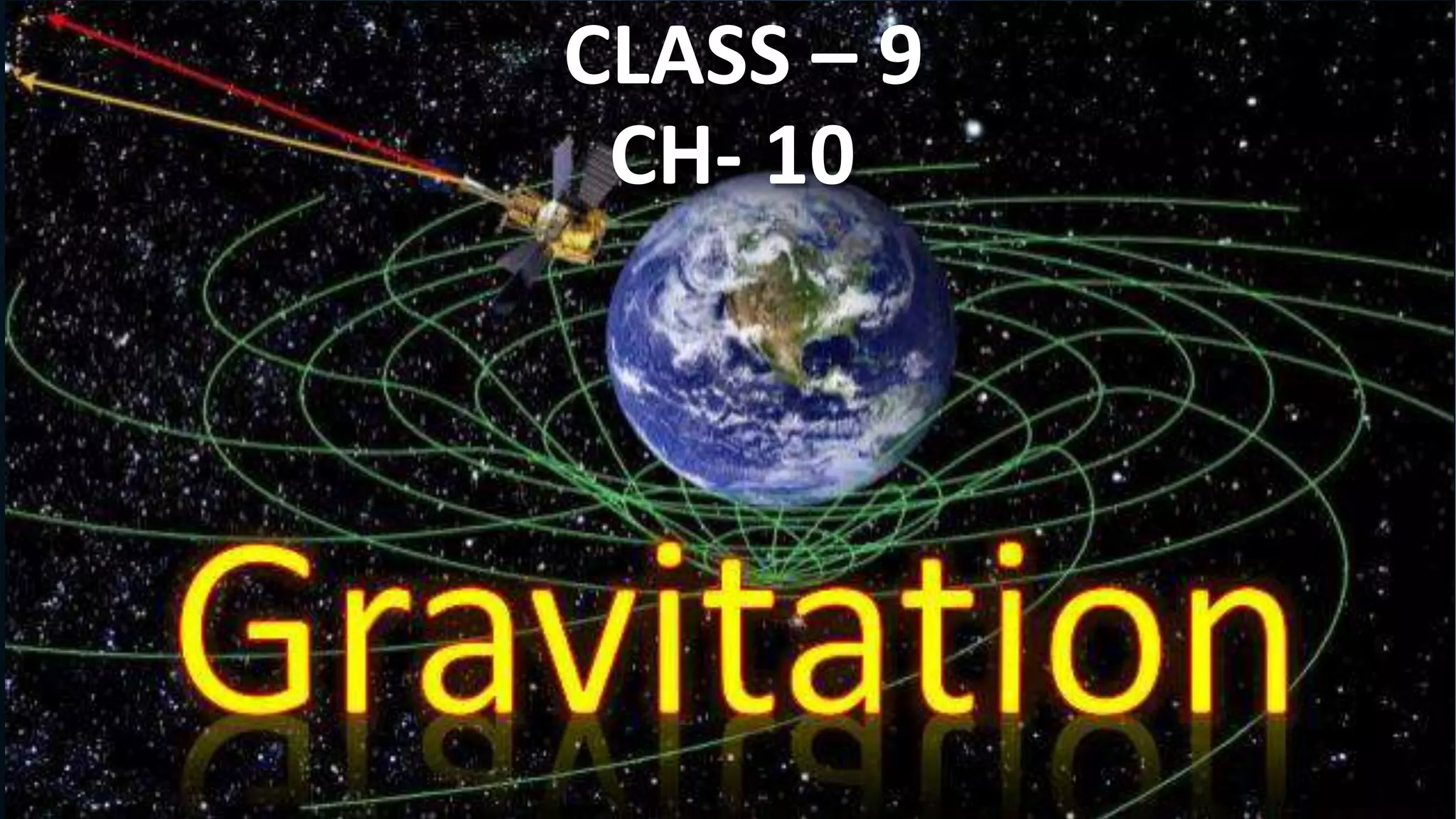
GRAVITATION
CLASS – 9
CH- 10
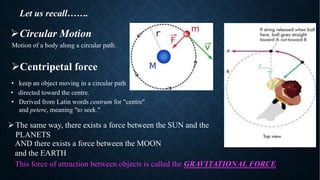
ØCircular Motion
Motion of a body along a circular path.
• Derived from Latin words centrum for "centre"
and petere, meaning "to seek."
ØCentripetal force
• keep an object moving in a circular path
• directed toward the centre.
Let us recall…….
ØThe same way, there exists a force between the SUN and the
PLANETS
AND there exists a force between the MOON
and the EARTH
This force of attraction between objects is called the GRAVITATIONAL FORCE
WHAT REALLY HAPPENED WITH THE APPLE AND
NEWTON BACK IN 1665?
Probably the more correct version of the story is that
newton, upon observing an apple fall from a tree,
began to think along the following lines: the apple is
accelerated, since its velocity changes from zero as it
is hanging on the tree and moves toward the ground.
Thus, by newton's 2nd law there must be a force that
acts on the apple to cause this acceleration. Let's call
this force "gravity", and the associated acceleration
the "acceleration due to gravity". Then imagine the
apple tree is twice as high. Again, we expect the apple
to be accelerated toward the ground, so this suggests
that this force that we call gravity reaches to the top of
the tallest apple tree.
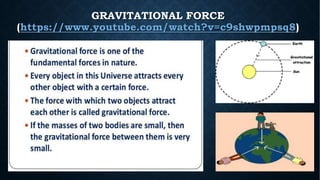
GRAVITATIONAL FORCE
(https://www.youtube.com/watch?v=c9shwpmpsq8)
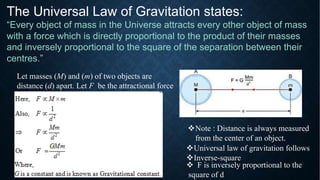
Let masses (M) and (m) of two objects are
distance (d) apart. Let F be the attractional force
between two masses.
vNote : Distance is always measured
from the center of an object.
vUniversal law of gravitation follows
vInverse-square
v F is inversely proportional to the
square of d
The Universal Law of Gravitation states:
“Every object of mass in the Universe attracts every other object of mass
with a force which is directly proportional to the product of their masses
and inversely proportional to the square of the separation between their
centres.”
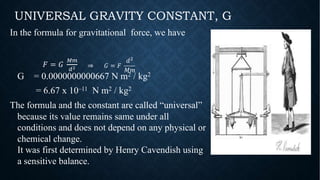
In the formula for gravitational force, we have
G = 0.0000000000667 N m2 / kg2
= 6.67 x 10⁻¹¹ N m2 / kg2
The formula and the constant are called “universal”
because its value remains same under all
conditions and does not depend on any physical or
chemical change.
It was first determined by Henry Cavendish using
a sensitive balance.
UNIVERSAL GRAVITY CONSTANT, G
! = #
$%
&' ⇒ # = !
)*
+,
! = #
$%
&'
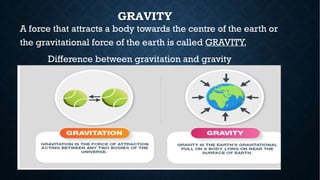
GRAVITY
A force that attracts a body towards the centre of the earth or
the gravitational force of the earth is called GRAVITY.
Difference between gravitation and gravity
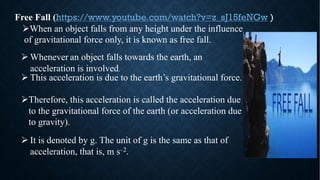
Free Fall (https://www.youtube.com/watch?v=z_sJ15feNGw )
ØWhen an object falls from any height under the influence
of gravitational force only, it is known as free fall.
Ø It is denoted by g. The unit of g is the same as that of
acceleration, that is, m s–2.
Ø Whenever an object falls towards the earth, an
acceleration is involved.
Ø This acceleration is due to the earth’s gravitational force.
ØTherefore, this acceleration is called the acceleration due
to the gravitational force of the earth (or acceleration due
to gravity).
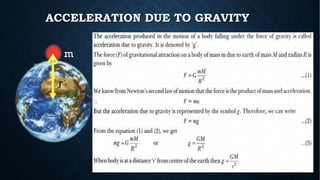
m
r
ACCELERATION DUE TO GRAVITY
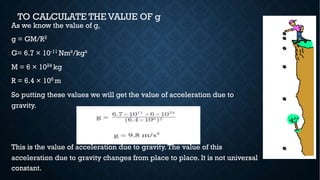
TO CALCULATE THE VALUE OF g
As we know the value of g,
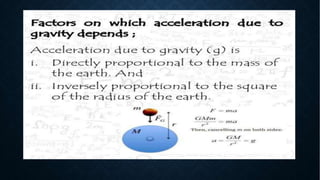
g = GM/R2
G= 6.7 × 10⁻¹¹ Nm²/kg²
M = 6 × 1024 kg
R = 6.4 × 10⁶ m
So putting these values we will get the value of acceleration due to
gravity.
This is the value of acceleration due to gravity.The value of this
acceleration due to gravity changes from place to place. It is not universal
constant.
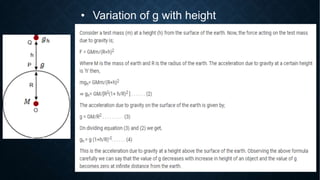
• Variation of g with height
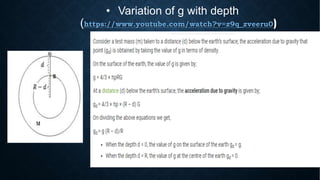
• Variation of g with depth
(https://www.youtube.com/watch?v=z9q_zveeru0)
Important Conclusions on Acceleration due to
Gravity :
•For an object placed at a height h,
the acceleration due to gravity is less as
compared to that placed on the surface.
•As depth increases, the value of acceleration
due to gravity (g) decreases.
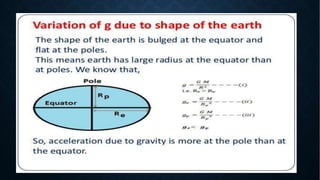
•The value of g is more at equator and less at
poles.
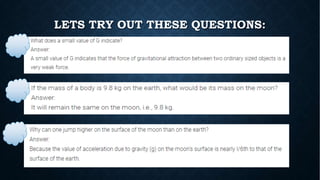
LETS TRY OUT THESE QUESTIONS:
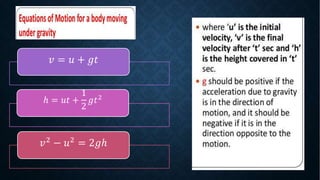
! = # + %&
ℎ = #& +
1
2
%&*
!*
− #*
= 2%ℎ
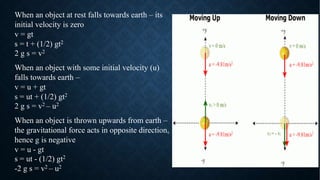
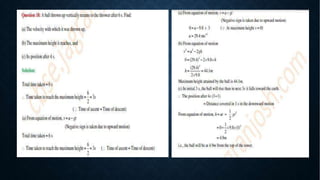
When an object at rest falls towards earth – its
initial velocity is zero
v = gt
s = t + (1/2) gt2
2 g s = v2
When an object with some initial velocity (u)
falls towards earth –
v = u + gt
s = ut + (1/2) gt2
2 g s = v2 – u2
When an object is thrown upwards from earth –
the gravitational force acts in opposite direction,
hence g is negative
v = u - gt
s = ut - (1/2) gt2
-2 g s = v2 – u2
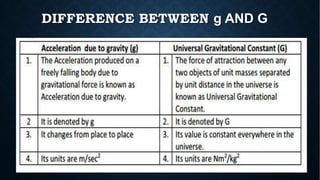
DIFFERENCE BETWEEN g AND G
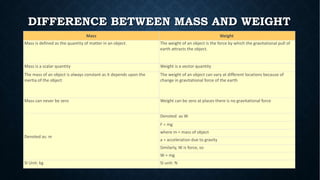
Mass Weight
Mass is defined as the quantity of matter in an object. The weight of an object is the force by which the gravitational pull of
earth attracts the object.
Mass is a scalar quantity Weight is a vector quantity
The mass of an object is always constant as it depends upon the
inertia of the object
The weight of an object can vary at different locations because of
change in gravitational force of the earth
Mass can never be zero Weight can be zero at places there is no gravitational force
Denoted as: m
Denoted as W
F = mg
where m = mass of object
a = acceleration due to gravity
Similarly, W is force, so
W = mg
SI Unit: kg SI unit: N
DIFFERENCE BETWEEN MASS AND WEIGHT
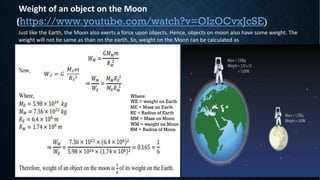
Weight of an object on the Moon
(https://www.youtube.com/watch?v=OIzOCvxJcSE)
Just like the Earth, the Moon also exerts a force upon objects. Hence, objects on moon also have some weight. The
weight will not be same as than on the earth. So, weight on the Moon can be calculated as
!" = $
%"&
'"
2
Where:
WE = weight on Earth
ME = Mass on Earth
RE = Radius of Earth
MM = Mass on Moon
WM = weight on Moon
RM = Radius of Moon
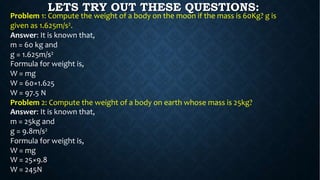
Problem 1: Compute the weight of a body on the moon if the mass is 60Kg? g is
given as 1.625m/s2.
Answer: It is known that,
m = 60 kg and
g = 1.625m/s2
Formula for weight is,
W = mg
W = 60×1.625
W = 97.5 N
Problem 2: Compute the weight of a body on earth whose mass is 25kg?
Answer: It is known that,
m = 25kg and
g = 9.8m/s2
Formula for weight is,
W = mg
W = 25×9.8
W = 245N
LETS TRY OUT THESE QUESTIONS:
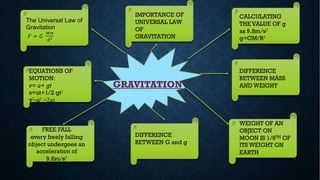
GRAVITATION
The Universal Law of
Gravitation
! = #
$%
&'
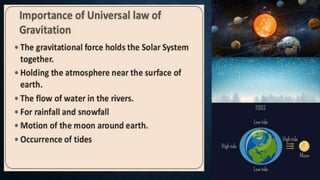
IMPORTANCE OF
UNIVERSAL LAW
OF
GRAVITATION
CALCULATING
THE VALUE OF g
as 9.8m/s2
g=GM/R2
DIFFERENCE
BETWEEN MASS
AND WEIGHT
WEIGHT OF AN
OBJECT ON
MOON IS 1/6TH OF
ITS WEIGHT ON
EARTH
DIFFERENCE
BETWEEN G and g
EQUATIONS OF
MOTION:
v= u+ gt
s=ut+1/2 gt2
v2-u2 =2gs
FREE FALL
every freely falling
object undergoes an
acceleration of
9.8m/s2
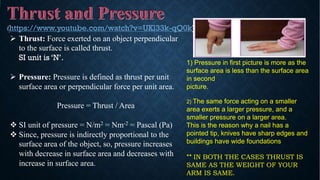
Ø Thrust: Force exerted on an object perpendicular
to the surface is called thrust.
SI unit is ‘N’.
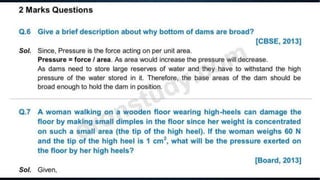
Ø Pressure: Pressure is defined as thrust per unit
surface area or perpendicular force per unit area.
Pressure = Thrust / Area
v SI unit of pressure = N/m2 = Nm-2 = Pascal (Pa)
v Since, pressure is indirectly proportional to the
surface area of the object, so, pressure increases
with decrease in surface area and decreases with
increase in surface area.
1) Pressure in first picture is more as the
surface area is less than the surface area
in second
picture.
2) The same force acting on a smaller
area exerts a larger pressure, and a
smaller pressure on a larger area.
This is the reason why a nail has a
pointed tip, knives have sharp edges and
buildings have wide foundations
** IN BOTH THE CASES THRUST IS
SAME AS THE WEIGHT OF YOUR
ARM IS SAME.
https://www.youtube.com/watch?v=UKl33k-qQ0k)
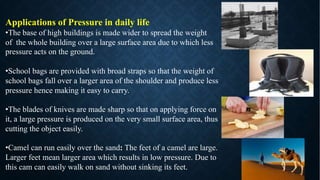
Applications of Pressure in daily life
•The base of high buildings is made wider to spread the weight
of the whole building over a large surface area due to which less
pressure acts on the ground.
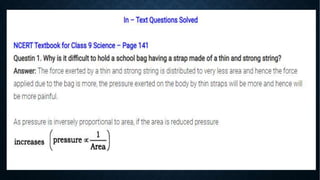
•School bags are provided with broad straps so that the weight of
school bags fall over a larger area of the shoulder and produce less
pressure hence making it easy to carry.
•The blades of knives are made sharp so that on applying force on
it, a large pressure is produced on the very small surface area, thus
cutting the object easily.
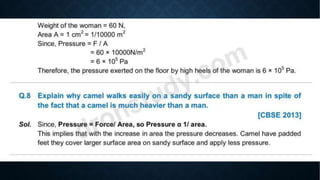
•Camel can run easily over the sand: The feet of a camel are large.
Larger feet mean larger area which results in low pressure. Due to
this cam can easily walk on sand without sinking its feet.
Pressure in Fluids
(https://www.youtube.com/watch?v=Cvp6mLWbgaM)
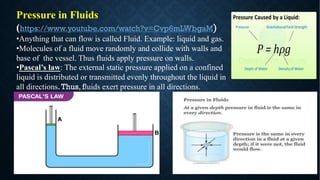
•Anything that can flow is called Fluid. Example: liquid and gas.
•Molecules of a fluid move randomly and collide with walls and
base of the vessel. Thus fluids apply pressure on walls.
•Pascal’s law: The external static pressure applied on a confined
liquid is distributed or transmitted evenly throughout the liquid in
all directions.Thus, fluids exert pressure in all directions.
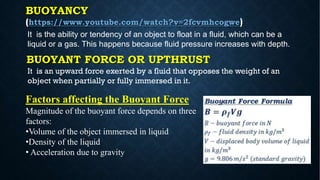
Factors affecting the Buoyant Force
Magnitude of the buoyant force depends on three
factors:
•Volume of the object immersed in liquid
•Density of the liquid
• Acceleration due to gravity
BUOYANCY
(https://www.youtube.com/watch?v=2fcvmhcogwe)
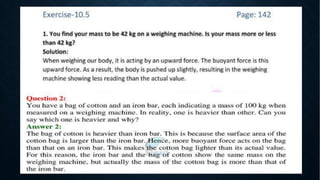
It is the ability or tendency of an object to float in a fluid, which can be a
liquid or a gas. This happens because fluid pressure increases with depth.
BUOYANT FORCE OR UPTHRUST
It is an upward force exerted by a fluid that opposes the weight of an
object when partially or fully immersed in it.
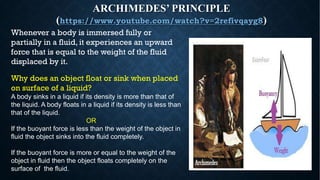
ARCHIMEDES’ PRINCIPLE
(https://www.youtube.com/watch?v=2refivqayg8)
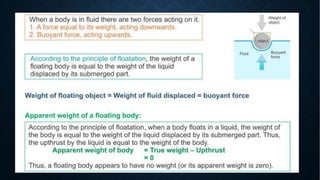
Whenever a body is immersed fully or
partially in a fluid, it experiences an upward
force that is equal to the weight of the fluid
displaced by it.
Why does an object float or sink when placed
on surface of a liquid?
A body sinks in a liquid if its density is more than that of
the liquid. A body floats in a liquid if its density is less than
that of the liquid.
OR
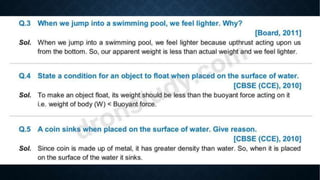
If the buoyant force is less than the weight of the object in
fluid the object sinks into the fluid completely.
If the buoyant force is more or equal to the weight of the
object in fluid then the object floats completely on the
surface of the fluid.
Applications of Archimedes’ Principle:
•It is used in designing ships and submarines.
•It is used in determining relative density of substances.
•Hydrometers used to determine the density of liquids, work on this principle.
•Lactometers used to determine purity of milk, are also based on this
principle
It is because of this principle that ship made of iron and steel floats in water
whereas a small piece of iron like nail, sinks in it.
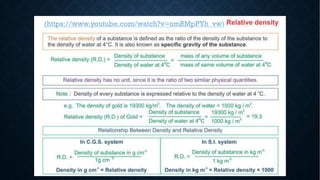
(https://www.youtube.com/watch?v=omRMpPYh_vw)
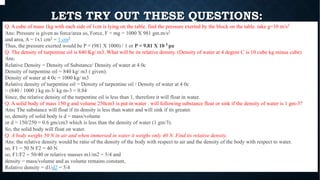
LETS TRY OUT THESE QUESTIONS:
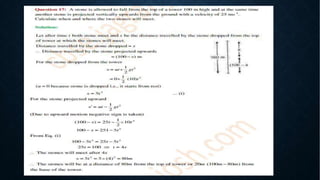
Q. A cube of mass 1kg with each side of 1cm is lying on the table. find the pressure exerted by the block on the table. take g=10 m/s2
Ans: Pressure is given as force/area so, Force, F = mg = 1000 X 981 gm.m/s2
and area, A = 1x1 cm2 = 1 cm2
Thus, the pressure exerted would be P = (981 X 1000) / 1 or P = 9.81 X 10 5 pa
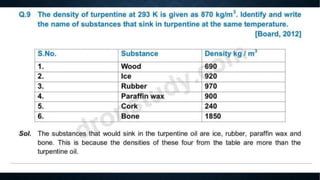
Q. The density of turpentine oil is 840 Kg/ m3. What will be its relative density. (Density of water at 4 degree C is 10 cube kg minus cube)
Ans:
Relative Density = Density of Substance/ Density of water at 4 0c
Density of turpentine oil = 840 kg/ m3 ( given).
Density of water at 4 0c = 1000 kg/ m3
Relative density of turpentine oil = Density of turpentine oil / Density of water at 4 0c
= (840 / 1000 ) kg m-3/ kg m-3 = 0.84
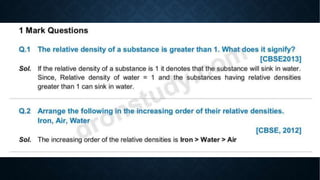
Since, the relative density of the turpentine oil is less than 1, therefore it will float in water.
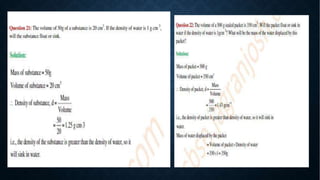
Q. A solid body of mass 150 g and volume 250cm3 is put in water . will following substance float or sink if the density of water is 1 gm-3?
Ans: The substance will float if its density is less than water and will sink if its greater.
so, density of solid body is d = mass/volume
or d = 150/250 = 0.6 gm/cm3 which is less than the density of water (1 gm/3).
So, the solid body will float on water.
Q. A body weighs 50 N in air and when immersed in water it weighs only 40 N. Find its relative density.
Ans: the relative density would be ratio of the density of the body with respect to air and the density of the body with respect to water.
so, F1 = 50 N F2 = 40 N
so, F1/F2 = 50/40 or relative masses m1/m2 = 5/4 and
density = mass/volume and as volume remains constant,
Relative density = d1/d2 = 5/4
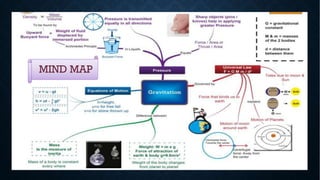
MIND MAP
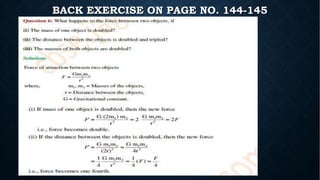
BACK EXERCISE ON PAGE NO. 144-145
 gravitation study material
 gravitation study material
 gravitation study material
 gravitation study material
 gravitation study material
 gravitation study material
 gravitation study material

gravitation study material

  • 1.
  • 2.
    ØCircular Motion Motion ofa body along a circular path. • Derived from Latin words centrum for "centre" and petere, meaning "to seek." ØCentripetal force • keep an object moving in a circular path • directed toward the centre. Let us recall……. ØThe same way, there exists a force between the SUN and the PLANETS AND there exists a force between the MOON and the EARTH This force of attraction between objects is called the GRAVITATIONAL FORCE
  • 3.
    WHAT REALLY HAPPENEDWITH THE APPLE AND NEWTON BACK IN 1665? Probably the more correct version of the story is that newton, upon observing an apple fall from a tree, began to think along the following lines: the apple is accelerated, since its velocity changes from zero as it is hanging on the tree and moves toward the ground. Thus, by newton's 2nd law there must be a force that acts on the apple to cause this acceleration. Let's call this force "gravity", and the associated acceleration the "acceleration due to gravity". Then imagine the apple tree is twice as high. Again, we expect the apple to be accelerated toward the ground, so this suggests that this force that we call gravity reaches to the top of the tallest apple tree.
  • 4.
  • 5.
    Let masses (M)and (m) of two objects are distance (d) apart. Let F be the attractional force between two masses. vNote : Distance is always measured from the center of an object. vUniversal law of gravitation follows vInverse-square v F is inversely proportional to the square of d The Universal Law of Gravitation states: “Every object of mass in the Universe attracts every other object of mass with a force which is directly proportional to the product of their masses and inversely proportional to the square of the separation between their centres.”
  • 6.
    In the formulafor gravitational force, we have G = 0.0000000000667 N m2 / kg2 = 6.67 x 10⁻¹¹ N m2 / kg2 The formula and the constant are called “universal” because its value remains same under all conditions and does not depend on any physical or chemical change. It was first determined by Henry Cavendish using a sensitive balance. UNIVERSAL GRAVITY CONSTANT, G ! = # $% &' ⇒ # = ! )* +,
  • 7.
  • 9.
    GRAVITY A force thatattracts a body towards the centre of the earth or the gravitational force of the earth is called GRAVITY. Difference between gravitation and gravity
  • 10.
    Free Fall (https://www.youtube.com/watch?v=z_sJ15feNGw) ØWhen an object falls from any height under the influence of gravitational force only, it is known as free fall. Ø It is denoted by g. The unit of g is the same as that of acceleration, that is, m s–2. Ø Whenever an object falls towards the earth, an acceleration is involved. Ø This acceleration is due to the earth’s gravitational force. ØTherefore, this acceleration is called the acceleration due to the gravitational force of the earth (or acceleration due to gravity).
  • 11.
  • 12.
    TO CALCULATE THEVALUE OF g As we know the value of g, g = GM/R2 G= 6.7 × 10⁻¹¹ Nm²/kg² M = 6 × 1024 kg R = 6.4 × 10⁶ m So putting these values we will get the value of acceleration due to gravity. This is the value of acceleration due to gravity.The value of this acceleration due to gravity changes from place to place. It is not universal constant.
  • 14.
    • Variation ofg with height
  • 15.
    • Variation ofg with depth (https://www.youtube.com/watch?v=z9q_zveeru0)
  • 17.
    Important Conclusions onAcceleration due to Gravity : •For an object placed at a height h, the acceleration due to gravity is less as compared to that placed on the surface. •As depth increases, the value of acceleration due to gravity (g) decreases. •The value of g is more at equator and less at poles.
  • 18.
    LETS TRY OUTTHESE QUESTIONS:
  • 19.
    ! = #+ %& ℎ = #& + 1 2 %&* !* − #* = 2%ℎ
  • 20.
    When an objectat rest falls towards earth – its initial velocity is zero v = gt s = t + (1/2) gt2 2 g s = v2 When an object with some initial velocity (u) falls towards earth – v = u + gt s = ut + (1/2) gt2 2 g s = v2 – u2 When an object is thrown upwards from earth – the gravitational force acts in opposite direction, hence g is negative v = u - gt s = ut - (1/2) gt2 -2 g s = v2 – u2
  • 21.
  • 22.
    Mass Weight Mass isdefined as the quantity of matter in an object. The weight of an object is the force by which the gravitational pull of earth attracts the object. Mass is a scalar quantity Weight is a vector quantity The mass of an object is always constant as it depends upon the inertia of the object The weight of an object can vary at different locations because of change in gravitational force of the earth Mass can never be zero Weight can be zero at places there is no gravitational force Denoted as: m Denoted as W F = mg where m = mass of object a = acceleration due to gravity Similarly, W is force, so W = mg SI Unit: kg SI unit: N DIFFERENCE BETWEEN MASS AND WEIGHT
  • 23.
    Weight of anobject on the Moon (https://www.youtube.com/watch?v=OIzOCvxJcSE) Just like the Earth, the Moon also exerts a force upon objects. Hence, objects on moon also have some weight. The weight will not be same as than on the earth. So, weight on the Moon can be calculated as !" = $ %"& '" 2 Where: WE = weight on Earth ME = Mass on Earth RE = Radius of Earth MM = Mass on Moon WM = weight on Moon RM = Radius of Moon
  • 24.
    Problem 1: Computethe weight of a body on the moon if the mass is 60Kg? g is given as 1.625m/s2. Answer: It is known that, m = 60 kg and g = 1.625m/s2 Formula for weight is, W = mg W = 60×1.625 W = 97.5 N Problem 2: Compute the weight of a body on earth whose mass is 25kg? Answer: It is known that, m = 25kg and g = 9.8m/s2 Formula for weight is, W = mg W = 25×9.8 W = 245N LETS TRY OUT THESE QUESTIONS:
  • 25.
    GRAVITATION The Universal Lawof Gravitation ! = # $% &' IMPORTANCE OF UNIVERSAL LAW OF GRAVITATION CALCULATING THE VALUE OF g as 9.8m/s2 g=GM/R2 DIFFERENCE BETWEEN MASS AND WEIGHT WEIGHT OF AN OBJECT ON MOON IS 1/6TH OF ITS WEIGHT ON EARTH DIFFERENCE BETWEEN G and g EQUATIONS OF MOTION: v= u+ gt s=ut+1/2 gt2 v2-u2 =2gs FREE FALL every freely falling object undergoes an acceleration of 9.8m/s2
  • 26.
    Ø Thrust: Forceexerted on an object perpendicular to the surface is called thrust. SI unit is ‘N’. Ø Pressure: Pressure is defined as thrust per unit surface area or perpendicular force per unit area. Pressure = Thrust / Area v SI unit of pressure = N/m2 = Nm-2 = Pascal (Pa) v Since, pressure is indirectly proportional to the surface area of the object, so, pressure increases with decrease in surface area and decreases with increase in surface area. 1) Pressure in first picture is more as the surface area is less than the surface area in second picture. 2) The same force acting on a smaller area exerts a larger pressure, and a smaller pressure on a larger area. This is the reason why a nail has a pointed tip, knives have sharp edges and buildings have wide foundations ** IN BOTH THE CASES THRUST IS SAME AS THE WEIGHT OF YOUR ARM IS SAME. https://www.youtube.com/watch?v=UKl33k-qQ0k)
  • 27.
    Applications of Pressurein daily life •The base of high buildings is made wider to spread the weight of the whole building over a large surface area due to which less pressure acts on the ground. •School bags are provided with broad straps so that the weight of school bags fall over a larger area of the shoulder and produce less pressure hence making it easy to carry. •The blades of knives are made sharp so that on applying force on it, a large pressure is produced on the very small surface area, thus cutting the object easily. •Camel can run easily over the sand: The feet of a camel are large. Larger feet mean larger area which results in low pressure. Due to this cam can easily walk on sand without sinking its feet.
  • 28.
    Pressure in Fluids (https://www.youtube.com/watch?v=Cvp6mLWbgaM) •Anythingthat can flow is called Fluid. Example: liquid and gas. •Molecules of a fluid move randomly and collide with walls and base of the vessel. Thus fluids apply pressure on walls. •Pascal’s law: The external static pressure applied on a confined liquid is distributed or transmitted evenly throughout the liquid in all directions.Thus, fluids exert pressure in all directions.
  • 29.
    Factors affecting theBuoyant Force Magnitude of the buoyant force depends on three factors: •Volume of the object immersed in liquid •Density of the liquid • Acceleration due to gravity BUOYANCY (https://www.youtube.com/watch?v=2fcvmhcogwe) It is the ability or tendency of an object to float in a fluid, which can be a liquid or a gas. This happens because fluid pressure increases with depth. BUOYANT FORCE OR UPTHRUST It is an upward force exerted by a fluid that opposes the weight of an object when partially or fully immersed in it.
  • 30.
    ARCHIMEDES’ PRINCIPLE (https://www.youtube.com/watch?v=2refivqayg8) Whenever abody is immersed fully or partially in a fluid, it experiences an upward force that is equal to the weight of the fluid displaced by it. Why does an object float or sink when placed on surface of a liquid? A body sinks in a liquid if its density is more than that of the liquid. A body floats in a liquid if its density is less than that of the liquid. OR If the buoyant force is less than the weight of the object in fluid the object sinks into the fluid completely. If the buoyant force is more or equal to the weight of the object in fluid then the object floats completely on the surface of the fluid.
  • 32.
    Applications of Archimedes’Principle: •It is used in designing ships and submarines. •It is used in determining relative density of substances. •Hydrometers used to determine the density of liquids, work on this principle. •Lactometers used to determine purity of milk, are also based on this principle It is because of this principle that ship made of iron and steel floats in water whereas a small piece of iron like nail, sinks in it.
  • 33.
  • 34.
    LETS TRY OUTTHESE QUESTIONS: Q. A cube of mass 1kg with each side of 1cm is lying on the table. find the pressure exerted by the block on the table. take g=10 m/s2 Ans: Pressure is given as force/area so, Force, F = mg = 1000 X 981 gm.m/s2 and area, A = 1x1 cm2 = 1 cm2 Thus, the pressure exerted would be P = (981 X 1000) / 1 or P = 9.81 X 10 5 pa Q. The density of turpentine oil is 840 Kg/ m3. What will be its relative density. (Density of water at 4 degree C is 10 cube kg minus cube) Ans: Relative Density = Density of Substance/ Density of water at 4 0c Density of turpentine oil = 840 kg/ m3 ( given). Density of water at 4 0c = 1000 kg/ m3 Relative density of turpentine oil = Density of turpentine oil / Density of water at 4 0c = (840 / 1000 ) kg m-3/ kg m-3 = 0.84 Since, the relative density of the turpentine oil is less than 1, therefore it will float in water. Q. A solid body of mass 150 g and volume 250cm3 is put in water . will following substance float or sink if the density of water is 1 gm-3? Ans: The substance will float if its density is less than water and will sink if its greater. so, density of solid body is d = mass/volume or d = 150/250 = 0.6 gm/cm3 which is less than the density of water (1 gm/3). So, the solid body will float on water. Q. A body weighs 50 N in air and when immersed in water it weighs only 40 N. Find its relative density. Ans: the relative density would be ratio of the density of the body with respect to air and the density of the body with respect to water. so, F1 = 50 N F2 = 40 N so, F1/F2 = 50/40 or relative masses m1/m2 = 5/4 and density = mass/volume and as volume remains constant, Relative density = d1/d2 = 5/4
  • 35.
  • 43.
    BACK EXERCISE ONPAGE NO. 144-145