Image Segmentation
Elsayed Hemayed
Overview
• Segmentation
• Thresholding Segmentation Techniques
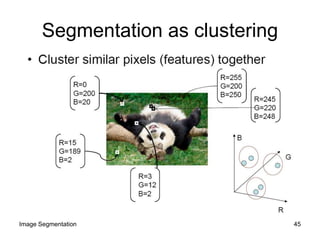
• Segmentation as clustering
• Mean shift segmentation
2Image Segmentation
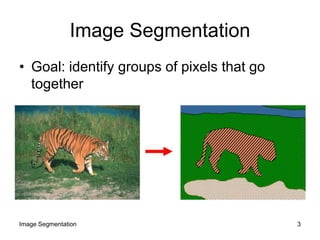
Image Segmentation
• Goal: identify groups of pixels that go
together
3Image Segmentation
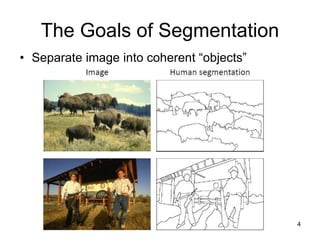
The Goals of Segmentation
• Separate image into coherent “objects”
4
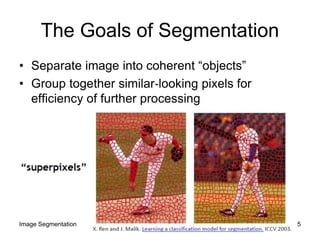
The Goals of Segmentation
• Separate image into coherent “objects”
• Group together similar‐looking pixels for
efficiency of further processing
5Image Segmentation
Segmentation
• Goal: to divide an image into parts that have a
strong correlation with objects or areas of the
real world, mainly objects and background.
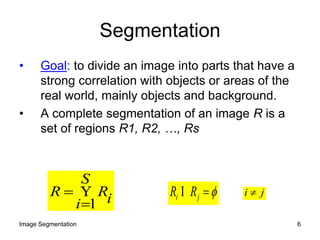
• A complete segmentation of an image R is a
set of regions R1, R2, …, Rs
iR
S
i
R
1
  ji RR  ji 
6Image Segmentation
Thresholding Segmentation
Technique
• Basic, Band, Multi, Semi-Thresholding
• Threshold detection methods
• Algorithms
– Iterative (optimal) Threshold Selection
– Otsu Segmentation Algorithm
– Recursive multi-spectral thresholding
Advantages
• simplest segmentation process since
Many objects or image regions are
characterized by constant reflectivity or
light absorption of their surface.
• computationally inexpensive and fast and
can easily be done in real time
8Image Segmentation
Basic Thresholding
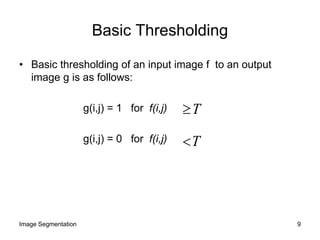
• Basic thresholding of an input image f to an output
image g is as follows:
g(i,j) = 1 for f(i,j)
g(i,j) = 0 for f(i,j)
T
T
9Image Segmentation
Band Thresholding
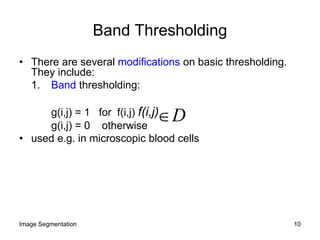
• There are several modifications on basic thresholding.
They include:
1. Band thresholding:
g(i,j) = 1 for f(i,j) f(i,j)
g(i,j) = 0 otherwise
• used e.g. in microscopic blood cells
D
10Image Segmentation
Multi-Thresholding
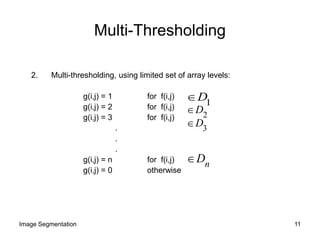
2. Multi-thresholding, using limited set of array levels:
g(i,j) = 1 for f(i,j)
g(i,j) = 2 for f(i,j)
g(i,j) = 3 for f(i,j)
.
.
.
g(i,j) = n for f(i,j)
g(i,j) = 0 otherwise
1
D
2
D
3
D
nD
11Image Segmentation
Semi-Thresholding
3. Semi-thresholding, masks out background
g(i,j) = f(i,j) for f(i,j)
g(i,j) = 0 for f(i,j)
T
T
12Image Segmentation
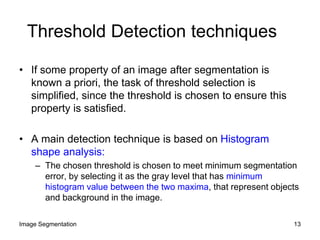
Threshold Detection techniques
• If some property of an image after segmentation is
known a priori, the task of threshold selection is
simplified, since the threshold is chosen to ensure this
property is satisfied.
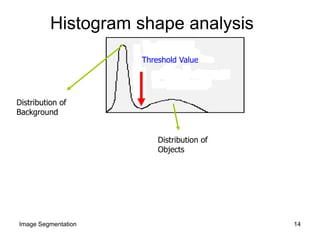
• A main detection technique is based on Histogram
shape analysis:
– The chosen threshold is chosen to meet minimum segmentation
error, by selecting it as the gray level that has minimum
histogram value between the two maxima, that represent objects
and background in the image.
13Image Segmentation
Histogram shape analysis
Distribution of
Background
Distribution of
Objects
Threshold Value
14Image Segmentation
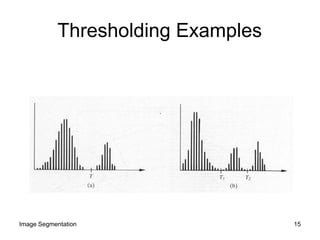
Thresholding Examples
15Image Segmentation
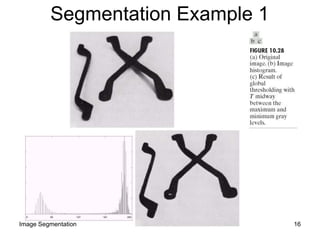
Segmentation Example 1
16Image Segmentation
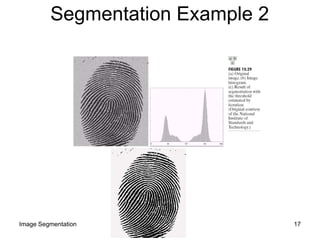
Segmentation Example 2
17Image Segmentation
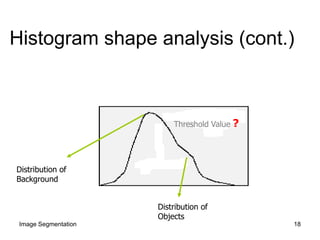
Histogram shape analysis (cont.)
Distribution of
Background
Distribution of
Objects
Threshold Value ?
18Image Segmentation
Histogram shape analysis
• P-tile thresholding
 Weighted histograms
 Optimal thresholding
19Image Segmentation
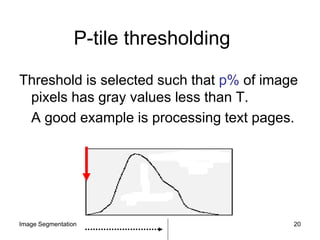
P-tile thresholding
Threshold is selected such that p% of image
pixels has gray values less than T.
A good example is processing text pages.
20Image Segmentation
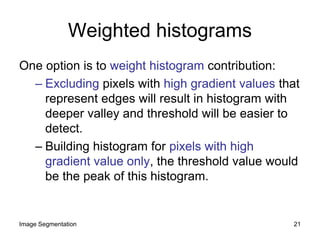
One option is to weight histogram contribution:
– Excluding pixels with high gradient values that
represent edges will result in histogram with
deeper valley and threshold will be easier to
detect.
– Building histogram for pixels with high
gradient value only, the threshold value would
be the peak of this histogram.
Weighted histograms
21Image Segmentation
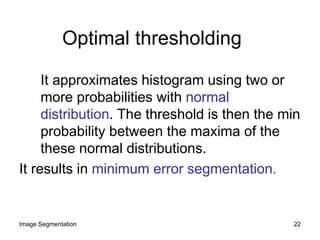
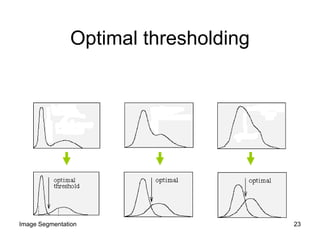
Optimal thresholding
It approximates histogram using two or
more probabilities with normal
distribution. The threshold is then the min
probability between the maxima of the
these normal distributions.
It results in minimum error segmentation.
22Image Segmentation
Optimal thresholding
23Image Segmentation
Threshold Detection techniques
Actual Example
24
Brain MR Image Segmentation
25
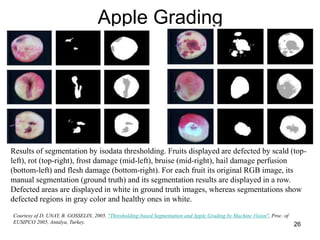
Apple Grading
Results of segmentation by isodata thresholding. Fruits displayed are defected by scald (top-
left), rot (top-right), frost damage (mid-left), bruise (mid-right), hail damage perfusion
(bottom-left) and flesh damage (bottom-right). For each fruit its original RGB image, its
manual segmentation (ground truth) and its segmentation results are displayed in a row.
Defected areas are displayed in white in ground truth images, whereas segmentations show
defected regions in gray color and healthy ones in white.
Courtesy of D. UNAY, B. GOSSELIN, 2005, "Thresholding-based Segmentation and Apple Grading by Machine Vision", Proc. of
EUSIPCO 2005, Antalya, Turkey. 26
Algorithm: Iterative (optimal)
Threshold Selection
1. As first iteration consider that the 4 corners
contain background pixels only and the
remainder contains object pixels.
2. Calculate and as the average
intensity of background and object pixels.
3. At step t+1 segmentation is performed using
the threshold
t
B t
O
27Image Segmentation
Iterative (optimal) Threshold
Selection (cont.)
4. Re-calculate and according to new segmentation
using:
5. Re-calculate
6. Stop if
t
B t
O
)()1( tt
TT 
28Image Segmentation
Otsu’s Image Segmentation
Algorithm
• Find the threshold that minimizes the weighted
within-class variance.
• Equivalent to maximizing the between-class
variance.
• Operates directly on the gray level histogram
[e.g. 256 numbers, P(i)]
• It is fast (once the histogram is computed).
Otsu: Assumptions
• Histogram (and the image) are bimodal.
• No use of spatial coherence, nor any other notion of
object structure.
• Assumes stationary statistics, but can be modified to
be locally adaptive
• Assumes uniform illumination (implicitly), so the
bimodal brightness behavior arises from object
appearance differences only.
The weighted within-class variance is:
w
2
(t)  q1(t)1
2
(t)  q2 (t)2
2
(t)
Where the class probabilities are estimated as:
q1(t)  P(i)
i1
t
 

L
ti
iPtq
1
2 )()(
𝜇1(𝑡) =
1
𝑞1(𝑡)
𝑖=1
𝑡
𝑖𝑃(𝑖) 𝜇2(𝑡) =
1
𝑞2(𝑡)
𝑖=𝑡+1
𝐿
𝑖𝑃(𝑖)
And the class means are given by:
Otsu’s method: Formulation
Finally, the individual class variances are:
1
2
(t)  [i  1(t)]2 P(i)
q1(t)i1
t



L
ti tq
iP
tit
1 2
2
2
2
2
)(
)(
)]([)( 
Run through the full range of t values and pick the value that minimizes w
2
(t)
Otsu’s method: Formulation
w
2
(t)  q1(t)1
2
(t)  q2 (t)2
2
(t)
Example
Input image Histogram
Global
thresholding
Otsu’s
method
Example (in presence of noise)
Input image Histogram Global threshold
Smoothened image Histogram Otsu’s method
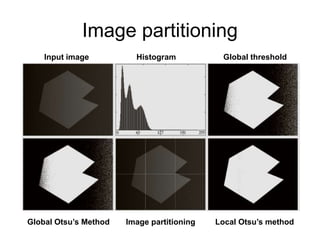
Image partitioning
Input image Histogram Global threshold
Global Otsu’s Method Image partitioning Local Otsu’s method
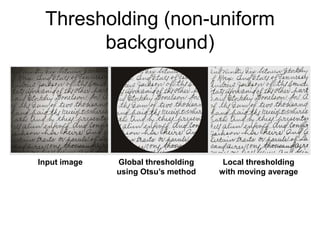
Thresholding (non-uniform
background)
Input image Global thresholding
using Otsu’s method
Local thresholding
with moving average
1. Initiallize the whole image as a single region.
2. Compute a smoothed histogram for each
spectral band.
3. Find the most significant peak in each
histogram and determine two thresholds on
either sides of the peak.
4. Segment each region in each spectral band into
sub-regions according to these thresholds.
Algorithm: Recursive multi-
spectral thresholding
40Image Segmentation
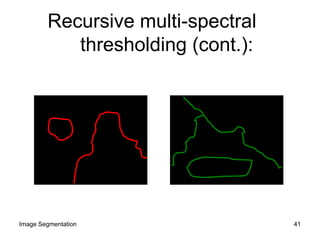
Recursive multi-spectral
thresholding (cont.):
41Image Segmentation
5. Project each segmentation into a multi-
spectral segmentation.
6. Regions for the next processing steps are
those in the multi-spectral image.
7. Repeat 2-6 until each histogram contains
only one significat peak.
Recursive multi-spectral
thresholding (cont.):
42Image Segmentation
Demo: Multi-spectral thresholding
43Image Segmentation
Thresholding Based Segmentation
Summary
• Basic, Band, Multi, Semi-Thresholding
• Threshold detection methods
• Multi-spectral thresholding
• Algorithms
– Iterative (optimal) Threshold Selection
– Recursive multi-spectral thresholding
44Image Segmentation
Segmentation as clustering
45Image Segmentation
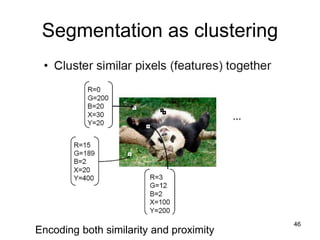
Segmentation as clustering
Encoding both similarity and proximity
46
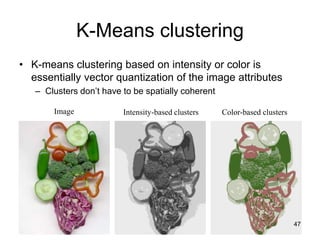
Image Intensity-based clusters Color-based clusters
K-Means clustering
• K-means clustering based on intensity or color is
essentially vector quantization of the image attributes
– Clusters don’t have to be spatially coherent
47
K-Means pros and cons
• Pros
– Simple and fast
– Converges to a local
minimum of the error function
• Cons
– Need to pick K
– Sensitive to initialization
– Sensitive to outliers
– Only finds “spherical”
clusters
48Image Segmentation
http://www.caip.rutgers.edu/~comanici/MSPAMI/msPamiResults.html
Mean shift segmentation
• An advanced and versatile technique for clustering-based
segmentation
D. Comaniciu and P. Meer, Mean Shift: A Robust Approach toward Feature
Space Analysis, PAMI 2002.
49
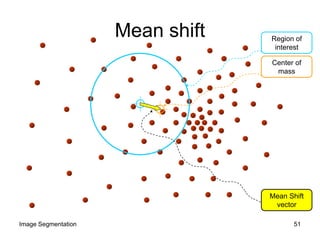
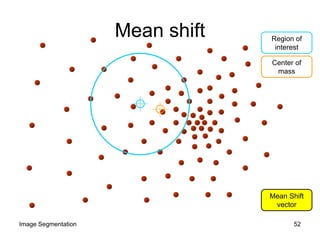
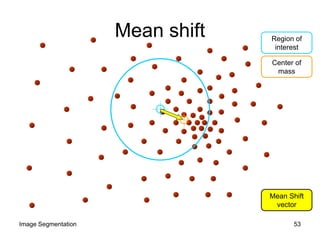
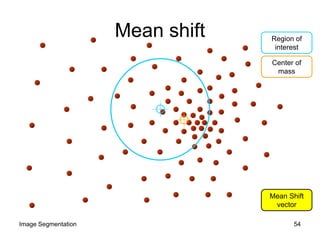
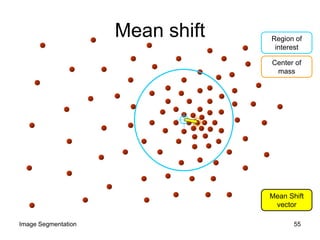
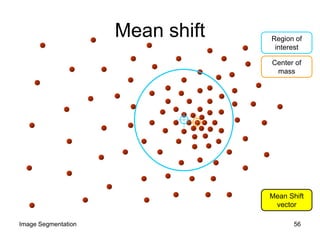
• The mean shift algorithm seeks a mode or local
maximum of density of a given distribution
– Choose a search window (width and location)
– Compute the mean of the data in the search window
– Center the search window at the new mean location
– Repeat until convergence
Mean shift algorithm
50Image Segmentation
Region of
interest
Center of
mass
Mean Shift
vector
Mean shift
51Image Segmentation
Region of
interest
Center of
mass
Mean Shift
vector
Mean shift
52Image Segmentation
Region of
interest
Center of
mass
Mean Shift
vector
Mean shift
53Image Segmentation
Region of
interest
Center of
mass
Mean Shift
vector
Mean shift
54Image Segmentation
Region of
interest
Center of
mass
Mean Shift
vector
Mean shift
55Image Segmentation
Region of
interest
Center of
mass
Mean Shift
vector
Mean shift
56Image Segmentation
Region of
interest
Center of
mass
Mean shift
57Image Segmentation
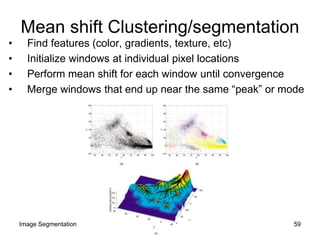
• Cluster: all data points in the attraction basin of a mode
• Attraction basin: the region for which all trajectories lead
to the same mode
Mean shift clustering
58Image Segmentation
• Find features (color, gradients, texture, etc)
• Initialize windows at individual pixel locations
• Perform mean shift for each window until convergence
• Merge windows that end up near the same “peak” or mode
Mean shift Clustering/segmentation
59Image Segmentation
http://www.caip.rutgers.edu/~comanici/MSPAMI/msPamiResults.html
Mean shift segmentation results
60
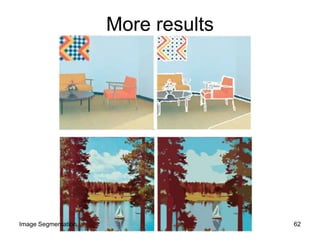
More results
61Image Segmentation
More results
62Image Segmentation
Mean shift pros and cons
• Pros
– Does not assume spherical clusters
– Just a single parameter (window size)
– Finds variable number of modes
– Robust to outliers
• Cons
– Output depends on window size
– Computationally expensive
– Does not scale well with dimension of feature space
63Image Segmentation

08 cie552 image_segmentation

  • 1.
  • 2.
    Overview • Segmentation • ThresholdingSegmentation Techniques • Segmentation as clustering • Mean shift segmentation 2Image Segmentation
  • 3.
    Image Segmentation • Goal:identify groups of pixels that go together 3Image Segmentation
  • 4.
    The Goals ofSegmentation • Separate image into coherent “objects” 4
  • 5.
    The Goals ofSegmentation • Separate image into coherent “objects” • Group together similar‐looking pixels for efficiency of further processing 5Image Segmentation
  • 6.
    Segmentation • Goal: todivide an image into parts that have a strong correlation with objects or areas of the real world, mainly objects and background. • A complete segmentation of an image R is a set of regions R1, R2, …, Rs iR S i R 1   ji RR  ji  6Image Segmentation
  • 7.
    Thresholding Segmentation Technique • Basic,Band, Multi, Semi-Thresholding • Threshold detection methods • Algorithms – Iterative (optimal) Threshold Selection – Otsu Segmentation Algorithm – Recursive multi-spectral thresholding
  • 8.
    Advantages • simplest segmentationprocess since Many objects or image regions are characterized by constant reflectivity or light absorption of their surface. • computationally inexpensive and fast and can easily be done in real time 8Image Segmentation
  • 9.
    Basic Thresholding • Basicthresholding of an input image f to an output image g is as follows: g(i,j) = 1 for f(i,j) g(i,j) = 0 for f(i,j) T T 9Image Segmentation
  • 10.
    Band Thresholding • Thereare several modifications on basic thresholding. They include: 1. Band thresholding: g(i,j) = 1 for f(i,j) f(i,j) g(i,j) = 0 otherwise • used e.g. in microscopic blood cells D 10Image Segmentation
  • 11.
    Multi-Thresholding 2. Multi-thresholding, usinglimited set of array levels: g(i,j) = 1 for f(i,j) g(i,j) = 2 for f(i,j) g(i,j) = 3 for f(i,j) . . . g(i,j) = n for f(i,j) g(i,j) = 0 otherwise 1 D 2 D 3 D nD 11Image Segmentation
  • 12.
    Semi-Thresholding 3. Semi-thresholding, masksout background g(i,j) = f(i,j) for f(i,j) g(i,j) = 0 for f(i,j) T T 12Image Segmentation
  • 13.
    Threshold Detection techniques •If some property of an image after segmentation is known a priori, the task of threshold selection is simplified, since the threshold is chosen to ensure this property is satisfied. • A main detection technique is based on Histogram shape analysis: – The chosen threshold is chosen to meet minimum segmentation error, by selecting it as the gray level that has minimum histogram value between the two maxima, that represent objects and background in the image. 13Image Segmentation
  • 14.
    Histogram shape analysis Distributionof Background Distribution of Objects Threshold Value 14Image Segmentation
  • 15.
  • 16.
  • 17.
  • 18.
    Histogram shape analysis(cont.) Distribution of Background Distribution of Objects Threshold Value ? 18Image Segmentation
  • 19.
    Histogram shape analysis •P-tile thresholding  Weighted histograms  Optimal thresholding 19Image Segmentation
  • 20.
    P-tile thresholding Threshold isselected such that p% of image pixels has gray values less than T. A good example is processing text pages. 20Image Segmentation
  • 21.
    One option isto weight histogram contribution: – Excluding pixels with high gradient values that represent edges will result in histogram with deeper valley and threshold will be easier to detect. – Building histogram for pixels with high gradient value only, the threshold value would be the peak of this histogram. Weighted histograms 21Image Segmentation
  • 22.
    Optimal thresholding It approximateshistogram using two or more probabilities with normal distribution. The threshold is then the min probability between the maxima of the these normal distributions. It results in minimum error segmentation. 22Image Segmentation
  • 23.
  • 24.
  • 25.
    Brain MR ImageSegmentation 25
  • 26.
    Apple Grading Results ofsegmentation by isodata thresholding. Fruits displayed are defected by scald (top- left), rot (top-right), frost damage (mid-left), bruise (mid-right), hail damage perfusion (bottom-left) and flesh damage (bottom-right). For each fruit its original RGB image, its manual segmentation (ground truth) and its segmentation results are displayed in a row. Defected areas are displayed in white in ground truth images, whereas segmentations show defected regions in gray color and healthy ones in white. Courtesy of D. UNAY, B. GOSSELIN, 2005, "Thresholding-based Segmentation and Apple Grading by Machine Vision", Proc. of EUSIPCO 2005, Antalya, Turkey. 26
  • 27.
    Algorithm: Iterative (optimal) ThresholdSelection 1. As first iteration consider that the 4 corners contain background pixels only and the remainder contains object pixels. 2. Calculate and as the average intensity of background and object pixels. 3. At step t+1 segmentation is performed using the threshold t B t O 27Image Segmentation
  • 28.
    Iterative (optimal) Threshold Selection(cont.) 4. Re-calculate and according to new segmentation using: 5. Re-calculate 6. Stop if t B t O )()1( tt TT  28Image Segmentation
  • 29.
    Otsu’s Image Segmentation Algorithm •Find the threshold that minimizes the weighted within-class variance. • Equivalent to maximizing the between-class variance. • Operates directly on the gray level histogram [e.g. 256 numbers, P(i)] • It is fast (once the histogram is computed).
  • 30.
    Otsu: Assumptions • Histogram(and the image) are bimodal. • No use of spatial coherence, nor any other notion of object structure. • Assumes stationary statistics, but can be modified to be locally adaptive • Assumes uniform illumination (implicitly), so the bimodal brightness behavior arises from object appearance differences only.
  • 31.
    The weighted within-classvariance is: w 2 (t)  q1(t)1 2 (t)  q2 (t)2 2 (t) Where the class probabilities are estimated as: q1(t)  P(i) i1 t    L ti iPtq 1 2 )()( 𝜇1(𝑡) = 1 𝑞1(𝑡) 𝑖=1 𝑡 𝑖𝑃(𝑖) 𝜇2(𝑡) = 1 𝑞2(𝑡) 𝑖=𝑡+1 𝐿 𝑖𝑃(𝑖) And the class means are given by: Otsu’s method: Formulation
  • 32.
    Finally, the individualclass variances are: 1 2 (t)  [i  1(t)]2 P(i) q1(t)i1 t    L ti tq iP tit 1 2 2 2 2 2 )( )( )]([)(  Run through the full range of t values and pick the value that minimizes w 2 (t) Otsu’s method: Formulation w 2 (t)  q1(t)1 2 (t)  q2 (t)2 2 (t)
  • 33.
  • 34.
    Example (in presenceof noise) Input image Histogram Global threshold Smoothened image Histogram Otsu’s method
  • 35.
    Image partitioning Input imageHistogram Global threshold Global Otsu’s Method Image partitioning Local Otsu’s method
  • 36.
    Thresholding (non-uniform background) Input imageGlobal thresholding using Otsu’s method Local thresholding with moving average
  • 37.
    1. Initiallize thewhole image as a single region. 2. Compute a smoothed histogram for each spectral band. 3. Find the most significant peak in each histogram and determine two thresholds on either sides of the peak. 4. Segment each region in each spectral band into sub-regions according to these thresholds. Algorithm: Recursive multi- spectral thresholding 40Image Segmentation
  • 38.
  • 39.
    5. Project eachsegmentation into a multi- spectral segmentation. 6. Regions for the next processing steps are those in the multi-spectral image. 7. Repeat 2-6 until each histogram contains only one significat peak. Recursive multi-spectral thresholding (cont.): 42Image Segmentation
  • 40.
  • 41.
    Thresholding Based Segmentation Summary •Basic, Band, Multi, Semi-Thresholding • Threshold detection methods • Multi-spectral thresholding • Algorithms – Iterative (optimal) Threshold Selection – Recursive multi-spectral thresholding 44Image Segmentation
  • 42.
  • 43.
    Segmentation as clustering Encodingboth similarity and proximity 46
  • 44.
    Image Intensity-based clustersColor-based clusters K-Means clustering • K-means clustering based on intensity or color is essentially vector quantization of the image attributes – Clusters don’t have to be spatially coherent 47
  • 45.
    K-Means pros andcons • Pros – Simple and fast – Converges to a local minimum of the error function • Cons – Need to pick K – Sensitive to initialization – Sensitive to outliers – Only finds “spherical” clusters 48Image Segmentation
  • 46.
    http://www.caip.rutgers.edu/~comanici/MSPAMI/msPamiResults.html Mean shift segmentation •An advanced and versatile technique for clustering-based segmentation D. Comaniciu and P. Meer, Mean Shift: A Robust Approach toward Feature Space Analysis, PAMI 2002. 49
  • 47.
    • The meanshift algorithm seeks a mode or local maximum of density of a given distribution – Choose a search window (width and location) – Compute the mean of the data in the search window – Center the search window at the new mean location – Repeat until convergence Mean shift algorithm 50Image Segmentation
  • 48.
    Region of interest Center of mass MeanShift vector Mean shift 51Image Segmentation
  • 49.
    Region of interest Center of mass MeanShift vector Mean shift 52Image Segmentation
  • 50.
    Region of interest Center of mass MeanShift vector Mean shift 53Image Segmentation
  • 51.
    Region of interest Center of mass MeanShift vector Mean shift 54Image Segmentation
  • 52.
    Region of interest Center of mass MeanShift vector Mean shift 55Image Segmentation
  • 53.
    Region of interest Center of mass MeanShift vector Mean shift 56Image Segmentation
  • 54.
    Region of interest Center of mass Meanshift 57Image Segmentation
  • 55.
    • Cluster: alldata points in the attraction basin of a mode • Attraction basin: the region for which all trajectories lead to the same mode Mean shift clustering 58Image Segmentation
  • 56.
    • Find features(color, gradients, texture, etc) • Initialize windows at individual pixel locations • Perform mean shift for each window until convergence • Merge windows that end up near the same “peak” or mode Mean shift Clustering/segmentation 59Image Segmentation
  • 57.
  • 58.
  • 59.
  • 60.
    Mean shift prosand cons • Pros – Does not assume spherical clusters – Just a single parameter (window size) – Finds variable number of modes – Robust to outliers • Cons – Output depends on window size – Computationally expensive – Does not scale well with dimension of feature space 63Image Segmentation