Image Segmentation
Presented by:
Bulbul Agrawal
1
Introduction to image
segmentation
• The purpose of image segmentation is to
partition an image into meaningful regions
with respect to a particular application.
• The segmentation is based on
measurements taken from the image and
might be greylevel, colour, texture, depth
or motion.
• Segmentation refers to the process of
partitioning a digital image into multiple
regions (sets of pixels).
• Image segmentation is typically used to
locate objects and boundaries in images 2
Introduction to image segmentation
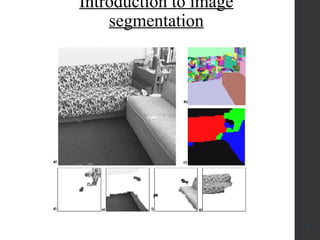
Usually image segmentation pixels in a
region are similar with respect to some
characteristic or computed property, such as
color, intensity, or texture.
Applications of image segmentation
include:
Identifying objects in a scene (size and
shape)
Identifying objects in a moving scene
(dynamic object)
Identifying objects which are at different
distances
Some applications of image
segmentation in medical field includes: –
Locate tumors 3
Introduction to image
segmentation
• Segmentation divides an image into its
constituent parts.
• Level of subdivision depends on the
problem being solved.
4
Introduction to image
segmentation
5
Introduction to image
segmentation
6
Edge detection
• Edge detecting an image significantly
reduces the amount of data and filters out
useless information, while preserving the
important structural properties in an
image.
• Detects discontinuities of the grey level.
• Detection of the edge boundary between
the two regions.
7
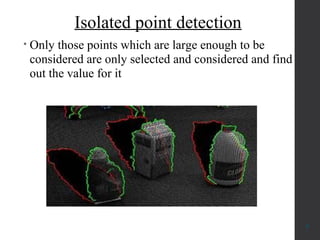
Isolated point detection
• Only those points which are large enough to be
considered are only selected and considered and find
out the value for it
8
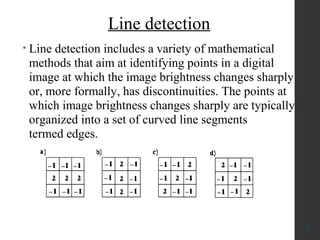
Line detection
• Line detection includes a variety of mathematical
methods that aim at identifying points in a digital
image at which the image brightness changes sharply
or, more formally, has discontinuities. The points at
which image brightness changes sharply are typically
organized into a set of curved line segments
termed edges.
9
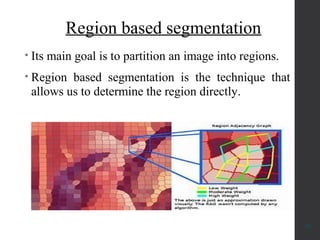
Region based segmentation
• Its main goal is to partition an image into regions.
• Region based segmentation is the technique that
allows us to determine the region directly.
10
Region Growing
• Group pixels or sub-regions into larger
regions when homogeneity criterion is
satisfied.
• Region grows around the seed point based
on similar properties (grey level, texture,
color).
• Select single random pixel to find region
and work on its values.
11
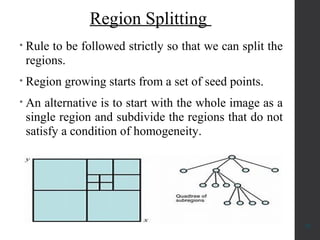
Region Splitting
• Rule to be followed strictly so that we can split the
regions.
• Region growing starts from a set of seed points.
• An alternative is to start with the whole image as a
single region and subdivide the regions that do not
satisfy a condition of homogeneity.
12
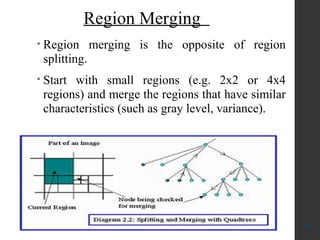
Region Merging
• Region merging is the opposite of region
splitting.
• Start with small regions (e.g. 2x2 or 4x4
regions) and merge the regions that have similar
characteristics (such as gray level, variance).
13
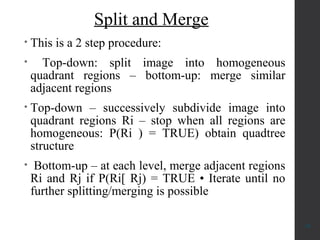
Split and Merge
• This is a 2 step procedure:
• Top-down: split image into homogeneous
quadrant regions – bottom-up: merge similar
adjacent regions
• Top-down – successively subdivide image into
quadrant regions Ri – stop when all regions are
homogeneous: P(Ri ) = TRUE) obtain quadtree
structure
• Bottom-up – at each level, merge adjacent regions
Ri and Rj if P(Ri[ Rj) = TRUE • Iterate until no
further splitting/merging is possible
14
Segmentation Algorithms
• Segmentation algorithms are based on one of
the basic properties of gray level values,
1. Discontinuity: partition in abrupt
discontinuity:
-> Detection of isolated points
->Detection of lines and edges in an image
2. Similarity: detect similar regions
(Discontinuity + Similarity ) = gray level pixel
values static and dynamic
15
Implementation of image
segmentation in fruit disease
detection
16
• Training apple fruit image
• Image segmentation
• Feature extraction
• Result
Conclusion
• Image segmentation is useful to detect the
details of the image
• It is used to find the points of the image which
are important
• Deletes the unnecessary data
17
References
• Digital image processing by Gonzalez and
woods
• Digital image processing by S Jayaraman
• https://www.techopedia.com/definition/26314/
image segmentation
• https://www.slideshare.net/Ayaelshiwi/image-
segmentation-29760056
18

Image segmentation

  • 1.
  • 2.
    Introduction to image segmentation •The purpose of image segmentation is to partition an image into meaningful regions with respect to a particular application. • The segmentation is based on measurements taken from the image and might be greylevel, colour, texture, depth or motion. • Segmentation refers to the process of partitioning a digital image into multiple regions (sets of pixels). • Image segmentation is typically used to locate objects and boundaries in images 2
  • 3.
    Introduction to imagesegmentation Usually image segmentation pixels in a region are similar with respect to some characteristic or computed property, such as color, intensity, or texture. Applications of image segmentation include: Identifying objects in a scene (size and shape) Identifying objects in a moving scene (dynamic object) Identifying objects which are at different distances Some applications of image segmentation in medical field includes: – Locate tumors 3
  • 4.
    Introduction to image segmentation •Segmentation divides an image into its constituent parts. • Level of subdivision depends on the problem being solved. 4
  • 5.
  • 6.
  • 7.
    Edge detection • Edgedetecting an image significantly reduces the amount of data and filters out useless information, while preserving the important structural properties in an image. • Detects discontinuities of the grey level. • Detection of the edge boundary between the two regions. 7
  • 8.
    Isolated point detection •Only those points which are large enough to be considered are only selected and considered and find out the value for it 8
  • 9.
    Line detection • Linedetection includes a variety of mathematical methods that aim at identifying points in a digital image at which the image brightness changes sharply or, more formally, has discontinuities. The points at which image brightness changes sharply are typically organized into a set of curved line segments termed edges. 9
  • 10.
    Region based segmentation •Its main goal is to partition an image into regions. • Region based segmentation is the technique that allows us to determine the region directly. 10
  • 11.
    Region Growing • Grouppixels or sub-regions into larger regions when homogeneity criterion is satisfied. • Region grows around the seed point based on similar properties (grey level, texture, color). • Select single random pixel to find region and work on its values. 11
  • 12.
    Region Splitting • Ruleto be followed strictly so that we can split the regions. • Region growing starts from a set of seed points. • An alternative is to start with the whole image as a single region and subdivide the regions that do not satisfy a condition of homogeneity. 12
  • 13.
    Region Merging • Regionmerging is the opposite of region splitting. • Start with small regions (e.g. 2x2 or 4x4 regions) and merge the regions that have similar characteristics (such as gray level, variance). 13
  • 14.
    Split and Merge •This is a 2 step procedure: • Top-down: split image into homogeneous quadrant regions – bottom-up: merge similar adjacent regions • Top-down – successively subdivide image into quadrant regions Ri – stop when all regions are homogeneous: P(Ri ) = TRUE) obtain quadtree structure • Bottom-up – at each level, merge adjacent regions Ri and Rj if P(Ri[ Rj) = TRUE • Iterate until no further splitting/merging is possible 14
  • 15.
    Segmentation Algorithms • Segmentationalgorithms are based on one of the basic properties of gray level values, 1. Discontinuity: partition in abrupt discontinuity: -> Detection of isolated points ->Detection of lines and edges in an image 2. Similarity: detect similar regions (Discontinuity + Similarity ) = gray level pixel values static and dynamic 15
  • 16.
    Implementation of image segmentationin fruit disease detection 16 • Training apple fruit image • Image segmentation • Feature extraction • Result
  • 17.
    Conclusion • Image segmentationis useful to detect the details of the image • It is used to find the points of the image which are important • Deletes the unnecessary data 17
  • 18.
    References • Digital imageprocessing by Gonzalez and woods • Digital image processing by S Jayaraman • https://www.techopedia.com/definition/26314/ image segmentation • https://www.slideshare.net/Ayaelshiwi/image- segmentation-29760056 18