CSCI 101
Programmer-Defined Functions in
MATLAB
Outline
• Why programmer-defined functions?
• Simple Custom Functions
• Script vs Function
• Modular Programming
Why programmer-defined functions?
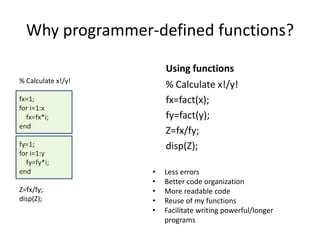
% Calculate x!/y!
fx=1;
for i=1:x
fx=fx*i;
end
fy=1;
for i=1:y
fy=fy*i;
end
Z=fx/fy;
disp(Z);
Using functions
% Calculate x!/y!
fx=fact(x);
fy=fact(y);
Z=fx/fy;
disp(Z);
• Less errors
• Better code organization
• More readable code
• Reuse of my functions
• Facilitate writing powerful/longer
programs
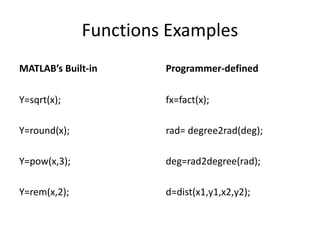
Functions Examples
MATLAB’s Built-in
Y=sqrt(x);
Y=round(x);
Y=pow(x,3);
Y=rem(x,2);
Programmer-defined
fx=fact(x);
rad= degree2rad(deg);
deg=rad2degree(rad);
d=dist(x1,y1,x2,y2);
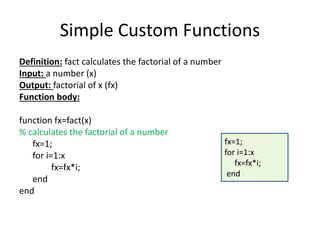
Simple Custom Functions
Definition: fact calculates the factorial of a number
Input: a number (x)
Output: factorial of x (fx)
Function body:
function fx=fact(x)
% calculates the factorial of a number
fx=1;
for i=1:x
fx=fx*i;
end
end
fx=1;
for i=1:x
fx=fx*i;
end
Simple Custom Functions
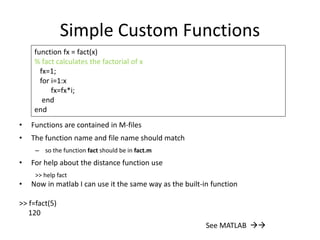
• Functions are contained in M-files
• The function name and file name should match
– so the function fact should be in fact.m
• For help about the distance function use
>> help fact
• Now in matlab I can use it the same way as the built-in function
>> f=fact(5)
120
function fx = fact(x)
% fact calculates the factorial of x
fx=1;
for i=1:x
fx=fx*i;
end
end
See MATLAB 
Simple Custom Functions
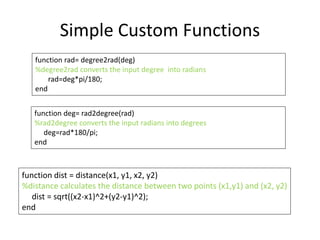
function rad= degree2rad(deg)
%degree2rad converts the input degree into radians
rad=deg*pi/180;
end
function deg= rad2degree(rad)
%rad2degree converts the input radians into degrees
deg=rad*180/pi;
end
function dist = distance(x1, y1, x2, y2)
%distance calculates the distance between two points (x1,y1) and (x2, y2)
dist = sqrt((x2-x1)^2+(y2-y1)^2);
end
Programmer-Defined Functions in
MATLAB
(Part 2)
By
Elsayed Hemayed
Computer Engineering Dept
Faculty of Engineering
Cairo University, Giza, Egypt
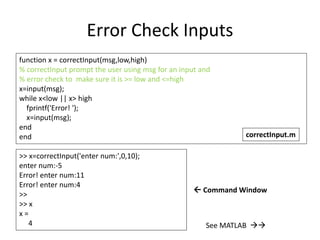
Error Check Inputs
function x = correctInput(msg,low,high)
% correctInput prompt the user using msg for an input and
% error check to make sure it is >= low and <=high
x=input(msg);
while x<low || x> high
fprintf('Error! ');
x=input(msg);
end
end
>> x=correctInput('enter num:',0,10);
enter num:-5
Error! enter num:11
Error! enter num:4
>>
>> x
x =
4
correctInput.m
 Command Window
See MATLAB 
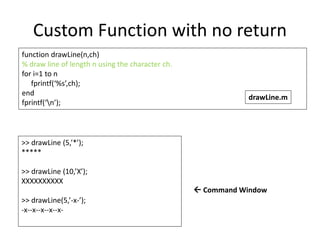
Custom Function with no return
function drawLine(n,ch)
% draw line of length n using the character ch.
for i=1 to n
fprintf(‘%s’,ch);
end
fprintf(‘n’);
>> drawLine (5,’*’);
*****
>> drawLine (10,’X’);
XXXXXXXXXX
>> drawLine(5,’-x-’);
-x--x--x--x--x-
drawLine.m
 Command Window
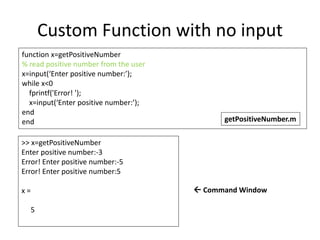
Custom Function with no input
function x=getPositiveNumber
% read positive number from the user
x=input(‘Enter positive number:’);
while x<0
fprintf('Error! ');
x=input(‘Enter positive number:’);
end
end
>> x=getPositiveNumber
Enter positive number:-3
Error! Enter positive number:-5
Error! Enter positive number:5
x =
5
 Command Window
getPositiveNumber.m
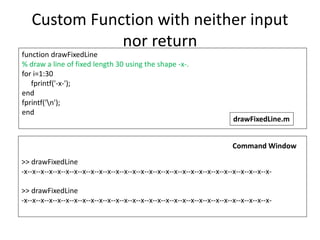
Custom Function with neither input
nor return
function drawFixedLine
% draw a line of fixed length 30 using the shape -x-.
for i=1:30
fprintf('-x-');
end
fprintf('n');
end
>> drawFixedLine
-x--x--x--x--x--x--x--x--x--x--x--x--x--x--x--x--x--x--x--x--x--x--x--x--x--x--x--x--x--x-
>> drawFixedLine
-x--x--x--x--x--x--x--x--x--x--x--x--x--x--x--x--x--x--x--x--x--x--x--x--x--x--x--x--x--x-
Command Window
drawFixedLine.m
Custom Function with more returns
function [large, small] = sort2(x,y)
%sort2 compares the two inputs and return them sorted, larger first.
if x>=y
large=x;
small=y;
else
large=y;
small=x;
end
end
>> [x,w]=sort2(5,10)
x =
10
w =
5
>> [x,w]=sort2(10,5)
x =
10
w =
5
sort2.m
Custom (User-Defined) Functions
function [out_arg1, out_arg2, …]
= fname(in_arg1, in_arg2, …)
• The word function is a keyword.
• [out_arg1, out_arg2, …] is the output
argument list
• fname is the name of the function
• (in_arg1, in_arg2, …) is the input argument
list
– in_arg1, in_arg2, etc. are called “dummy arguments”
because they are filled will values when the function is
called
Programmer-Defined Functions in
MATLAB
(Part 3)
By
Elsayed Hemayed
Computer Engineering Dept
Faculty of Engineering
Cairo University, Giza, Egypt
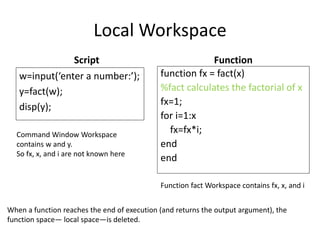
Local Workspace
Script
w=input(‘enter a number:’);
y=fact(w);
disp(y);
Function
function fx = fact(x)
%fact calculates the factorial of x
fx=1;
for i=1:x
fx=fx*i;
end
end
Command Window Workspace
contains w and y.
So fx, x, and i are not known here
Function fact Workspace contains fx, x, and i
When a function reaches the end of execution (and returns the output argument), the
function space— local space—is deleted.
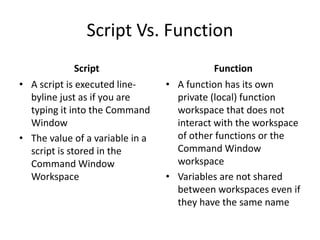
Script Vs. Function
Script
• A script is executed line-
byline just as if you are
typing it into the Command
Window
• The value of a variable in a
script is stored in the
Command Window
Workspace
Function
• A function has its own
private (local) function
workspace that does not
interact with the workspace
of other functions or the
Command Window
workspace
• Variables are not shared
between workspaces even if
they have the same name
Modular Programming
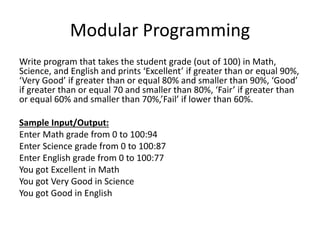
Write program that takes the student grade (out of 100) in Math,
Science, and English and prints ‘Excellent’ if greater than or equal 90%,
‘Very Good’ if greater than or equal 80% and smaller than 90%, ‘Good’
if greater than or equal 70 and smaller than 80%, ‘Fair’ if greater than
or equal 60% and smaller than 70%,’Fail’ if lower than 60%.
Sample Input/Output:
Enter Math grade from 0 to 100:94
Enter Science grade from 0 to 100:87
Enter English grade from 0 to 100:77
You got Excellent in Math
You got Very Good in Science
You got Good in English
Modular Programming
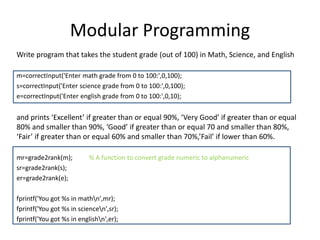
Write program that takes the student grade (out of 100) in Math, Science, and English
m=correctInput('Enter math grade from 0 to 100:',0,100);
s=correctInput('Enter science grade from 0 to 100:',0,100);
e=correctInput('Enter english grade from 0 to 100:',0,10);
and prints ‘Excellent’ if greater than or equal 90%, ‘Very Good’ if greater than or equal
80% and smaller than 90%, ‘Good’ if greater than or equal 70 and smaller than 80%,
‘Fair’ if greater than or equal 60% and smaller than 70%,’Fail’ if lower than 60%.
mr=grade2rank(m); % A function to convert grade numeric to alphanumeric
sr=grade2rank(s);
er=grade2rank(e);
fprintf('You got %s in mathn',mr);
fprintf('You got %s in sciencen',sr);
fprintf('You got %s in englishn',er);
Use Functions for Clean and Organized
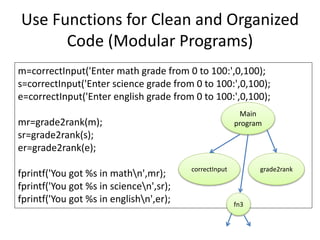
Code (Modular Programs)
m=correctInput('Enter math grade from 0 to 100:',0,100);
s=correctInput('Enter science grade from 0 to 100:',0,100);
e=correctInput('Enter english grade from 0 to 100:',0,100);
mr=grade2rank(m);
sr=grade2rank(s);
er=grade2rank(e);
fprintf('You got %s in mathn',mr);
fprintf('You got %s in sciencen',sr);
fprintf('You got %s in englishn',er);
Main
program
correctInput grade2rank
fn3
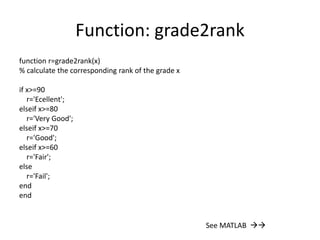
Function: grade2rank
function r=grade2rank(x)
% calculate the corresponding rank of the grade x
if x>=90
r='Ecellent';
elseif x>=80
r='Very Good';
elseif x>=70
r='Good';
elseif x>=60
r='Fair';
else
r='Fail';
end
end
See MATLAB 

Csci101 lect08a matlab_programs

  • 1.
  • 2.
    Outline • Why programmer-definedfunctions? • Simple Custom Functions • Script vs Function • Modular Programming
  • 3.
    Why programmer-defined functions? %Calculate x!/y! fx=1; for i=1:x fx=fx*i; end fy=1; for i=1:y fy=fy*i; end Z=fx/fy; disp(Z); Using functions % Calculate x!/y! fx=fact(x); fy=fact(y); Z=fx/fy; disp(Z); • Less errors • Better code organization • More readable code • Reuse of my functions • Facilitate writing powerful/longer programs
  • 4.
  • 5.
    Simple Custom Functions Definition:fact calculates the factorial of a number Input: a number (x) Output: factorial of x (fx) Function body: function fx=fact(x) % calculates the factorial of a number fx=1; for i=1:x fx=fx*i; end end fx=1; for i=1:x fx=fx*i; end
  • 6.
    Simple Custom Functions •Functions are contained in M-files • The function name and file name should match – so the function fact should be in fact.m • For help about the distance function use >> help fact • Now in matlab I can use it the same way as the built-in function >> f=fact(5) 120 function fx = fact(x) % fact calculates the factorial of x fx=1; for i=1:x fx=fx*i; end end See MATLAB 
  • 7.
    Simple Custom Functions functionrad= degree2rad(deg) %degree2rad converts the input degree into radians rad=deg*pi/180; end function deg= rad2degree(rad) %rad2degree converts the input radians into degrees deg=rad*180/pi; end function dist = distance(x1, y1, x2, y2) %distance calculates the distance between two points (x1,y1) and (x2, y2) dist = sqrt((x2-x1)^2+(y2-y1)^2); end
  • 8.
    Programmer-Defined Functions in MATLAB (Part2) By Elsayed Hemayed Computer Engineering Dept Faculty of Engineering Cairo University, Giza, Egypt
  • 9.
    Error Check Inputs functionx = correctInput(msg,low,high) % correctInput prompt the user using msg for an input and % error check to make sure it is >= low and <=high x=input(msg); while x<low || x> high fprintf('Error! '); x=input(msg); end end >> x=correctInput('enter num:',0,10); enter num:-5 Error! enter num:11 Error! enter num:4 >> >> x x = 4 correctInput.m  Command Window See MATLAB 
  • 10.
    Custom Function withno return function drawLine(n,ch) % draw line of length n using the character ch. for i=1 to n fprintf(‘%s’,ch); end fprintf(‘n’); >> drawLine (5,’*’); ***** >> drawLine (10,’X’); XXXXXXXXXX >> drawLine(5,’-x-’); -x--x--x--x--x- drawLine.m  Command Window
  • 11.
    Custom Function withno input function x=getPositiveNumber % read positive number from the user x=input(‘Enter positive number:’); while x<0 fprintf('Error! '); x=input(‘Enter positive number:’); end end >> x=getPositiveNumber Enter positive number:-3 Error! Enter positive number:-5 Error! Enter positive number:5 x = 5  Command Window getPositiveNumber.m
  • 12.
    Custom Function withneither input nor return function drawFixedLine % draw a line of fixed length 30 using the shape -x-. for i=1:30 fprintf('-x-'); end fprintf('n'); end >> drawFixedLine -x--x--x--x--x--x--x--x--x--x--x--x--x--x--x--x--x--x--x--x--x--x--x--x--x--x--x--x--x--x- >> drawFixedLine -x--x--x--x--x--x--x--x--x--x--x--x--x--x--x--x--x--x--x--x--x--x--x--x--x--x--x--x--x--x- Command Window drawFixedLine.m
  • 13.
    Custom Function withmore returns function [large, small] = sort2(x,y) %sort2 compares the two inputs and return them sorted, larger first. if x>=y large=x; small=y; else large=y; small=x; end end >> [x,w]=sort2(5,10) x = 10 w = 5 >> [x,w]=sort2(10,5) x = 10 w = 5 sort2.m
  • 14.
    Custom (User-Defined) Functions function[out_arg1, out_arg2, …] = fname(in_arg1, in_arg2, …) • The word function is a keyword. • [out_arg1, out_arg2, …] is the output argument list • fname is the name of the function • (in_arg1, in_arg2, …) is the input argument list – in_arg1, in_arg2, etc. are called “dummy arguments” because they are filled will values when the function is called
  • 15.
    Programmer-Defined Functions in MATLAB (Part3) By Elsayed Hemayed Computer Engineering Dept Faculty of Engineering Cairo University, Giza, Egypt
  • 16.
    Local Workspace Script w=input(‘enter anumber:’); y=fact(w); disp(y); Function function fx = fact(x) %fact calculates the factorial of x fx=1; for i=1:x fx=fx*i; end end Command Window Workspace contains w and y. So fx, x, and i are not known here Function fact Workspace contains fx, x, and i When a function reaches the end of execution (and returns the output argument), the function space— local space—is deleted.
  • 17.
    Script Vs. Function Script •A script is executed line- byline just as if you are typing it into the Command Window • The value of a variable in a script is stored in the Command Window Workspace Function • A function has its own private (local) function workspace that does not interact with the workspace of other functions or the Command Window workspace • Variables are not shared between workspaces even if they have the same name
  • 18.
    Modular Programming Write programthat takes the student grade (out of 100) in Math, Science, and English and prints ‘Excellent’ if greater than or equal 90%, ‘Very Good’ if greater than or equal 80% and smaller than 90%, ‘Good’ if greater than or equal 70 and smaller than 80%, ‘Fair’ if greater than or equal 60% and smaller than 70%,’Fail’ if lower than 60%. Sample Input/Output: Enter Math grade from 0 to 100:94 Enter Science grade from 0 to 100:87 Enter English grade from 0 to 100:77 You got Excellent in Math You got Very Good in Science You got Good in English
  • 19.
    Modular Programming Write programthat takes the student grade (out of 100) in Math, Science, and English m=correctInput('Enter math grade from 0 to 100:',0,100); s=correctInput('Enter science grade from 0 to 100:',0,100); e=correctInput('Enter english grade from 0 to 100:',0,10); and prints ‘Excellent’ if greater than or equal 90%, ‘Very Good’ if greater than or equal 80% and smaller than 90%, ‘Good’ if greater than or equal 70 and smaller than 80%, ‘Fair’ if greater than or equal 60% and smaller than 70%,’Fail’ if lower than 60%. mr=grade2rank(m); % A function to convert grade numeric to alphanumeric sr=grade2rank(s); er=grade2rank(e); fprintf('You got %s in mathn',mr); fprintf('You got %s in sciencen',sr); fprintf('You got %s in englishn',er);
  • 20.
    Use Functions forClean and Organized Code (Modular Programs) m=correctInput('Enter math grade from 0 to 100:',0,100); s=correctInput('Enter science grade from 0 to 100:',0,100); e=correctInput('Enter english grade from 0 to 100:',0,100); mr=grade2rank(m); sr=grade2rank(s); er=grade2rank(e); fprintf('You got %s in mathn',mr); fprintf('You got %s in sciencen',sr); fprintf('You got %s in englishn',er); Main program correctInput grade2rank fn3
  • 21.
    Function: grade2rank function r=grade2rank(x) %calculate the corresponding rank of the grade x if x>=90 r='Ecellent'; elseif x>=80 r='Very Good'; elseif x>=70 r='Good'; elseif x>=60 r='Fair'; else r='Fail'; end end See MATLAB 