SEGMENTATION OF
FOREGROUND – BACKGROUND
FROM NATURAL IMAGES
B Y
AJAL.A.J
ASSISTANT PROFESSOR
UNIVERSAL ENGINEERING COLLEGE
OUTLINE
 Introduction
 Types of segmentation algorithms
 Evaluations of RGB Color space
 SEGMENTATION
 EXPERIMENTAL RESULTS
 Summary
 Appendix
ABSTRACT
 This paper presents a part of a more challenging research
project aimed at developing a computer vision system for a
robot capable of identifying all objects from known natural
backgrounds such as forest, sky, ocean, under-water scenes
and etc.
 Segmentation is an import issue in the field of machine vision
for detection and recognition of objects.
 The success of segmentation is solely depends on the
separation of foreground objects from background objects.
 We present a simple framework to extract the foreground
objects from the known natural backgrounds in still and moving
images using pixel based color segmentation in RGB space.
What is an Image?
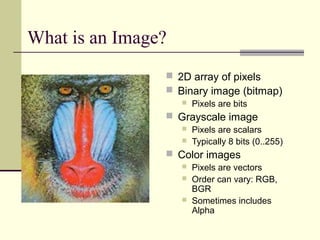
 2D array of pixels
 Binary image (bitmap)
 Pixels are bits
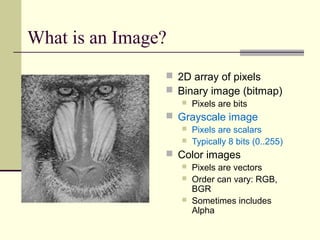
 Grayscale image
 Pixels are scalars
 Typically 8 bits (0..255)
 Color images
 Pixels are vectors
 Order can vary: RGB,
BGR
 Sometimes includes
Alpha
What is an Image?
 2D array of pixels
 Binary image (bitmap)
 Pixels are bits
 Grayscale image
 Pixels are scalars
 Typically 8 bits (0..255)
 Color images
 Pixels are vectors
 Order can vary: RGB,
BGR
 Sometimes includes
Alpha
What is an Image?
 2D array of pixels
 Binary image (bitmap)
 Pixels are bits
 Grayscale image
 Pixels are scalars
 Typically 8 bits (0..255)
 Color images
 Pixels are vectors
 Order can vary: RGB,
BGR
 Sometimes includes
Alpha
What is an Image?
 2D array of pixels
 Binary image (bitmap)
 Pixels are bits
 Grayscale image
 Pixels are scalars
 Typically 8 bits (0..255)
 Color images
 Pixels are vectors
 Order can vary: RGB,
BGR
 Sometimes includes
Alpha
What is an Image?
 2D array of pixels
 Binary image (bitmap)
 Pixels are bits
 Grayscale image
 Pixels are scalars
 Typically 8 bits (0..255)
 Color images
 Pixels are vectors
 Order can vary: RGB,
BGR
 Sometimes includes
Alpha
HSV VS RGB.
 In day to day practice, we'll most likely use
two models:
HSV and RGB.
HSV stands for
Hue,
Saturation, and
Value,
and it uses these three concepts to describe a color.
RGB the three colors that make up an image on a monitor.
RGB Color cube
Color segmentation
 In the problem of segmentation, the goal is to separate spatial regions of
an image on the basis of similarity within each region and distinction
between different regions.
 Approaches to color-based segmentation range from empirical evaluation
of various color spaces, to clustering in feature space , to physics-based
modeling
 The essential difference between color segmentation and color recognition
is that the former uses color to separate objects without a priori
knowledge about specific surfaces; the latter attempts to recognize colors
of known color characteristics
Segmentation: Elephant and
Blind Men Syndrome
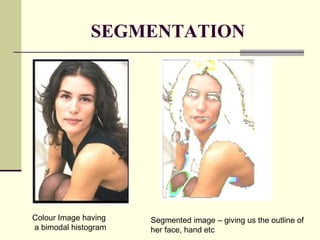
SEGMENTATION
Segmented image – giving us the outline of
her face, hand etc
Colour Image having
a bimodal histogram
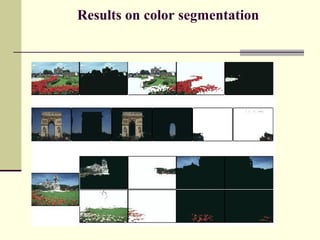
Results on color segmentation
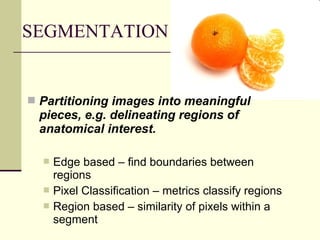
SEGMENTATION
 Partitioning images into meaningful
pieces, e.g. delineating regions of
anatomical interest.
 Edge based – find boundaries between
regions
 Pixel Classification – metrics classify regions
 Region based – similarity of pixels within a
segment
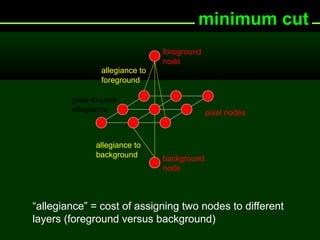
minimum cut
“allegiance” = cost of assigning two nodes to different
layers (foreground versus background)
foreground
node
background
node
pixel nodes
allegiance to
foreground
allegiance to
background
pixel-to-pixel
allegiance
minimum cut
“allegiance” = cost of assigning two nodes to different
layers (foreground versus background)
foreground
node
background
node
pixel nodes
allegiance to
foreground
allegiance to
background
pixel-to-pixel
allegiance
Normalized Cuts
• Graph partitioning technique
• Bi-partitions an edge-weighted graph in an optimal sense
• Normalized cut (Ncut) is the optimizing criterion
i j
wij
Edge weight => Similarity between i and j
A B
Minimize Ncut(A,B)
Nodes
• Image segmentation
• Each pixel is a node
• Edge weight is similarity between pixels
• Similarity based on color, texture and contour cues
21
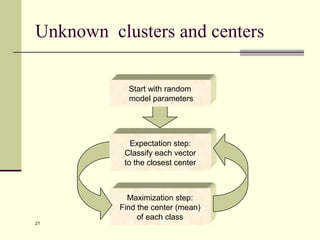
Unknown clusters and centers
Maximization step:
Find the center (mean)
of each class
Start with random
model parameters
Expectation step:
Classify each vector
to the closest center
22
Finding the centers from known
clustering
Segmentation fault
 A segmentation fault (often shortened to
segfault) or access violation is a particular
error condition that can occur during the
operation of computer software.
 A segmentation fault occurs when a program attempts to access
a memory location that it is not allowed to access, or attempts to
access a memory location in a way that is not allowed (for
example, attempting to write to a read-only location, or to
overwrite part of the operating system).
Segmentation Methods
 Thresholding approaches
 Region Growing approaches
 Classifiers
 Clustering approaches
 Markov random fields (MRF) models
 Artificial neural networks
 Deformable models
 Atlas-guided approaches
24
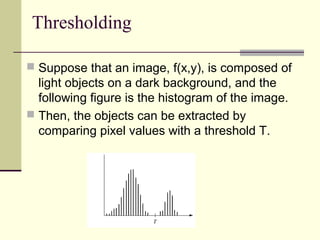
Thresholding
 Suppose that an image, f(x,y), is composed of
light objects on a dark background, and the
following figure is the histogram of the image.
 Then, the objects can be extracted by
comparing pixel values with a threshold T.
25
Region Growing
1. Define seed point
2. Add n-neighbors to list L
3. Get and remove top of L
4. Test n-neighbors p
if p not treated
if P(p,R)=True then p→L
and add p to region
else p marked boundary
5. Go to 2 until L is empty
 Two Regions R and ¬ R
SeedpointsSeedpoints ElementinElementinL
BorderelementBorderelementRegionelementRegionelement
Our approach: The Algorithm
 The left and right images areThe left and right images are
segmented and each areasegmented and each area
identifies a node of a graphidentifies a node of a graph
 A bipartite graph matchingA bipartite graph matching
between the two graphs isbetween the two graphs is
computed in order to match eachcomputed in order to match each
area of the left image with onlyarea of the left image with only
one area of the right imageone area of the right image
 This process yields a list ofThis process yields a list of
reliably matched areas and a listreliably matched areas and a list
of so-called don’t care areas.of so-called don’t care areas.
 The Outputs of the algorithmThe Outputs of the algorithm
are the disparity map and theare the disparity map and the
performance mapperformance map
GPCA
Generalized Principal Component Analysis (GPCA)
method for.
 modeling and segmenting mixed data using a
collection of subspaces
 done by introducing certain algebraic models into
data clustering.
 Unique property (applied to images) is that it
decomposes images into regions with
fundamentally different characteristics and
derives an optimal PCA-based transformation for
each region.
Computing a principal component
analysis
To compute a principal
component analysis in SPSS,
select the Data Reduction |
Factor… command from the
Analyze menu.
Segmentation Example
Intelligent Scissors
 Fully automatic segmentation is an unsolved
problem due to wide variety of images.
 Intelligent Scissors is a semi-automatic
general purpose segmentation tool.
 The efficient and accurate boundary
extraction, which requires minimal user input
with a mouse, is obtained.
 The underlying mechanism for the Intelligent
Scissors is the “live-wire” path selection tool.
More Complex Segmentation
Methods - snakes
One More Thing
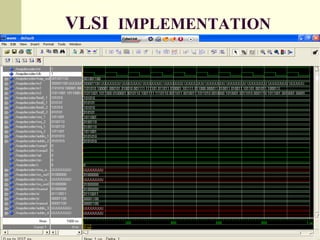
VLSI IMPLEMENTATION
Floor plan of the
prototype chip
Layout of the
encoder module
Pros & Cons
 Very useful for rapid prototyping
 Strongly growing community and code base
 Problems:
 Very complex
 Overhead -> higher run-times
 Still under development
Summary / Closing
Thoughts
 Segmentation is the essential but critical problem in
the field of machine vision. At a stretch, robotics can
not be done with a complete knowledge about
foreground and background objects.
 We have proposed pixel based color segmentation
approach to segment the known backgrounds such
as forest, sky, ocean, underwater scenes and etc.
which will be of unique color generally and the results
obtained were satisfactory.
 This color segmentation process will overcome the
main problems with change of pose and occlusion
and overcomes the limitation occurs in the motion
analysis and background subtraction methods.
Conclusions
 Translation (visual to semantic) model for object recognition
 Identify and evaluate low-level vision processes for recognition
 Feature evaluation
 Color and texture are the most important in that order
 Shape needs better segmentation methods
 Segmentation evaluation
 Performance depends on # regions for annotation
 Mean Shift and modified NCuts do better than original NCuts for # regions < 6
 Color constancy evaluation
 Training with illumination helps
 Color constancy processing helps (scale-by-max better than gray-world)
Reference Reading
 Digital Image Processing
Gonzalez & Woods,
Addison-Wesley 2002
 Computer Vision
Shapiro & Stockman,
Prentice-Hall 2001
 Computer Vision: A Modern Approach
Forsyth & Ponce,
Prentice-Hall 2002
 Introductory Techniques for 3D Computer Vision
Trucco & Verri,
Prentice-Hall 1998
REFERENCES :
 S. Belongie, C. Carson, H. Greenspan, and J. Malik, "Color and
texture-based image segmentation using EM and its application to
content-based image retrieval," 6th International Conference on
Computer Vision, pp.675–682, 1998.
 E. Saber, A.M. Tekalp, R. Eschbach, and K. Knox, "Automatic image
annotation using adaptive color classification," Graph. Models Image
Process., vol.58, no.2, pp.115–126, 1996.
 S.C. Pei and C.M. Cheng, "Extracting color features and dynamic
matching for image data-base retrieval," IEEE Trans. Circuits Syst.
Video Technol., vol.9, no.3, pp.501–512, April 1999.
 T. Pavlidis and Y.-T. Liow, "Integrating region growing and edge
detection," IEEE Trans. Pattern Anal. Mach. Intell., vol.12, no.3,
pp.225–233, March 1990.
 C.-C. Chu and J.K. Aggarwal, "The integration of image
segmentation maps using region and edge information," IEEE Trans.
Pattern Anal. Mach. Intell., vol.15, no.12, pp.1241–1252, Dec. 1993.
 J. Fan, D.K.Y. Yau, A.K. Elmagarmid, and W.G. Aref, "Automatic
image segmentation by integrating color-edge extraction and seeded
region growing," IEEE Trans. Image Process., vol.10, no.10,
pp.1454–1466, Oct. 2001.
QUERRIES ?
Thank you.
AJAL.A.J
ASSISTANT PROFESSOR
UNIVERSAL ENGINEERING
COLLEGE
THRISSURMAIL : ec2reach@gmail.com MOB : 0890 730

Image segmentation ajal

  • 1.
    SEGMENTATION OF FOREGROUND –BACKGROUND FROM NATURAL IMAGES B Y AJAL.A.J ASSISTANT PROFESSOR UNIVERSAL ENGINEERING COLLEGE
  • 2.
    OUTLINE  Introduction  Typesof segmentation algorithms  Evaluations of RGB Color space  SEGMENTATION  EXPERIMENTAL RESULTS  Summary  Appendix
  • 3.
    ABSTRACT  This paperpresents a part of a more challenging research project aimed at developing a computer vision system for a robot capable of identifying all objects from known natural backgrounds such as forest, sky, ocean, under-water scenes and etc.  Segmentation is an import issue in the field of machine vision for detection and recognition of objects.  The success of segmentation is solely depends on the separation of foreground objects from background objects.  We present a simple framework to extract the foreground objects from the known natural backgrounds in still and moving images using pixel based color segmentation in RGB space.
  • 4.
    What is anImage?  2D array of pixels  Binary image (bitmap)  Pixels are bits  Grayscale image  Pixels are scalars  Typically 8 bits (0..255)  Color images  Pixels are vectors  Order can vary: RGB, BGR  Sometimes includes Alpha
  • 5.
    What is anImage?  2D array of pixels  Binary image (bitmap)  Pixels are bits  Grayscale image  Pixels are scalars  Typically 8 bits (0..255)  Color images  Pixels are vectors  Order can vary: RGB, BGR  Sometimes includes Alpha
  • 6.
    What is anImage?  2D array of pixels  Binary image (bitmap)  Pixels are bits  Grayscale image  Pixels are scalars  Typically 8 bits (0..255)  Color images  Pixels are vectors  Order can vary: RGB, BGR  Sometimes includes Alpha
  • 7.
    What is anImage?  2D array of pixels  Binary image (bitmap)  Pixels are bits  Grayscale image  Pixels are scalars  Typically 8 bits (0..255)  Color images  Pixels are vectors  Order can vary: RGB, BGR  Sometimes includes Alpha
  • 8.
    What is anImage?  2D array of pixels  Binary image (bitmap)  Pixels are bits  Grayscale image  Pixels are scalars  Typically 8 bits (0..255)  Color images  Pixels are vectors  Order can vary: RGB, BGR  Sometimes includes Alpha
  • 9.
    HSV VS RGB. In day to day practice, we'll most likely use two models: HSV and RGB. HSV stands for Hue, Saturation, and Value, and it uses these three concepts to describe a color. RGB the three colors that make up an image on a monitor.
  • 10.
  • 11.
    Color segmentation  Inthe problem of segmentation, the goal is to separate spatial regions of an image on the basis of similarity within each region and distinction between different regions.  Approaches to color-based segmentation range from empirical evaluation of various color spaces, to clustering in feature space , to physics-based modeling  The essential difference between color segmentation and color recognition is that the former uses color to separate objects without a priori knowledge about specific surfaces; the latter attempts to recognize colors of known color characteristics
  • 13.
  • 14.
    SEGMENTATION Segmented image –giving us the outline of her face, hand etc Colour Image having a bimodal histogram
  • 15.
    Results on colorsegmentation
  • 17.
    SEGMENTATION  Partitioning imagesinto meaningful pieces, e.g. delineating regions of anatomical interest.  Edge based – find boundaries between regions  Pixel Classification – metrics classify regions  Region based – similarity of pixels within a segment
  • 18.
    minimum cut “allegiance” =cost of assigning two nodes to different layers (foreground versus background) foreground node background node pixel nodes allegiance to foreground allegiance to background pixel-to-pixel allegiance
  • 19.
    minimum cut “allegiance” =cost of assigning two nodes to different layers (foreground versus background) foreground node background node pixel nodes allegiance to foreground allegiance to background pixel-to-pixel allegiance
  • 20.
    Normalized Cuts • Graphpartitioning technique • Bi-partitions an edge-weighted graph in an optimal sense • Normalized cut (Ncut) is the optimizing criterion i j wij Edge weight => Similarity between i and j A B Minimize Ncut(A,B) Nodes • Image segmentation • Each pixel is a node • Edge weight is similarity between pixels • Similarity based on color, texture and contour cues
  • 21.
    21 Unknown clusters andcenters Maximization step: Find the center (mean) of each class Start with random model parameters Expectation step: Classify each vector to the closest center
  • 22.
    22 Finding the centersfrom known clustering
  • 23.
    Segmentation fault  Asegmentation fault (often shortened to segfault) or access violation is a particular error condition that can occur during the operation of computer software.  A segmentation fault occurs when a program attempts to access a memory location that it is not allowed to access, or attempts to access a memory location in a way that is not allowed (for example, attempting to write to a read-only location, or to overwrite part of the operating system).
  • 24.
    Segmentation Methods  Thresholdingapproaches  Region Growing approaches  Classifiers  Clustering approaches  Markov random fields (MRF) models  Artificial neural networks  Deformable models  Atlas-guided approaches 24
  • 25.
    Thresholding  Suppose thatan image, f(x,y), is composed of light objects on a dark background, and the following figure is the histogram of the image.  Then, the objects can be extracted by comparing pixel values with a threshold T. 25
  • 26.
    Region Growing 1. Defineseed point 2. Add n-neighbors to list L 3. Get and remove top of L 4. Test n-neighbors p if p not treated if P(p,R)=True then p→L and add p to region else p marked boundary 5. Go to 2 until L is empty  Two Regions R and ¬ R SeedpointsSeedpoints ElementinElementinL BorderelementBorderelementRegionelementRegionelement
  • 27.
    Our approach: TheAlgorithm  The left and right images areThe left and right images are segmented and each areasegmented and each area identifies a node of a graphidentifies a node of a graph  A bipartite graph matchingA bipartite graph matching between the two graphs isbetween the two graphs is computed in order to match eachcomputed in order to match each area of the left image with onlyarea of the left image with only one area of the right imageone area of the right image  This process yields a list ofThis process yields a list of reliably matched areas and a listreliably matched areas and a list of so-called don’t care areas.of so-called don’t care areas.  The Outputs of the algorithmThe Outputs of the algorithm are the disparity map and theare the disparity map and the performance mapperformance map
  • 28.
    GPCA Generalized Principal ComponentAnalysis (GPCA) method for.  modeling and segmenting mixed data using a collection of subspaces  done by introducing certain algebraic models into data clustering.  Unique property (applied to images) is that it decomposes images into regions with fundamentally different characteristics and derives an optimal PCA-based transformation for each region.
  • 29.
    Computing a principalcomponent analysis To compute a principal component analysis in SPSS, select the Data Reduction | Factor… command from the Analyze menu.
  • 30.
  • 31.
    Intelligent Scissors  Fullyautomatic segmentation is an unsolved problem due to wide variety of images.  Intelligent Scissors is a semi-automatic general purpose segmentation tool.  The efficient and accurate boundary extraction, which requires minimal user input with a mouse, is obtained.  The underlying mechanism for the Intelligent Scissors is the “live-wire” path selection tool.
  • 32.
  • 33.
  • 34.
  • 35.
    Floor plan ofthe prototype chip Layout of the encoder module
  • 36.
    Pros & Cons Very useful for rapid prototyping  Strongly growing community and code base  Problems:  Very complex  Overhead -> higher run-times  Still under development
  • 37.
    Summary / Closing Thoughts Segmentation is the essential but critical problem in the field of machine vision. At a stretch, robotics can not be done with a complete knowledge about foreground and background objects.  We have proposed pixel based color segmentation approach to segment the known backgrounds such as forest, sky, ocean, underwater scenes and etc. which will be of unique color generally and the results obtained were satisfactory.  This color segmentation process will overcome the main problems with change of pose and occlusion and overcomes the limitation occurs in the motion analysis and background subtraction methods.
  • 38.
    Conclusions  Translation (visualto semantic) model for object recognition  Identify and evaluate low-level vision processes for recognition  Feature evaluation  Color and texture are the most important in that order  Shape needs better segmentation methods  Segmentation evaluation  Performance depends on # regions for annotation  Mean Shift and modified NCuts do better than original NCuts for # regions < 6  Color constancy evaluation  Training with illumination helps  Color constancy processing helps (scale-by-max better than gray-world)
  • 39.
    Reference Reading  DigitalImage Processing Gonzalez & Woods, Addison-Wesley 2002  Computer Vision Shapiro & Stockman, Prentice-Hall 2001  Computer Vision: A Modern Approach Forsyth & Ponce, Prentice-Hall 2002  Introductory Techniques for 3D Computer Vision Trucco & Verri, Prentice-Hall 1998
  • 40.
    REFERENCES :  S.Belongie, C. Carson, H. Greenspan, and J. Malik, "Color and texture-based image segmentation using EM and its application to content-based image retrieval," 6th International Conference on Computer Vision, pp.675–682, 1998.  E. Saber, A.M. Tekalp, R. Eschbach, and K. Knox, "Automatic image annotation using adaptive color classification," Graph. Models Image Process., vol.58, no.2, pp.115–126, 1996.  S.C. Pei and C.M. Cheng, "Extracting color features and dynamic matching for image data-base retrieval," IEEE Trans. Circuits Syst. Video Technol., vol.9, no.3, pp.501–512, April 1999.  T. Pavlidis and Y.-T. Liow, "Integrating region growing and edge detection," IEEE Trans. Pattern Anal. Mach. Intell., vol.12, no.3, pp.225–233, March 1990.  C.-C. Chu and J.K. Aggarwal, "The integration of image segmentation maps using region and edge information," IEEE Trans. Pattern Anal. Mach. Intell., vol.15, no.12, pp.1241–1252, Dec. 1993.  J. Fan, D.K.Y. Yau, A.K. Elmagarmid, and W.G. Aref, "Automatic image segmentation by integrating color-edge extraction and seeded region growing," IEEE Trans. Image Process., vol.10, no.10, pp.1454–1466, Oct. 2001.
  • 41.
  • 42.

Editor's Notes