Image Segmentation using Otsu’s
Method
By-
Abhinav Garg (101303004)
Akshit Arora(101303012)
Akul Gupta(101303013)
Anmoldeep Singh(101303027)
Otsu’s Thresholding Method
• Based on a very simple idea: Find the threshold
that minimizes the weighted within-class
variance.
• This turns out to be the same as maximizing the
between-class variance.
• Operates directly on the gray level histogram
[e.g. 256 numbers, P(i)], so it’s fast (once the
histogram is computed).
(1979)
Problem
It is important in picture processing to select an adequate threshold of grey
level for extracting objects from their background. Before Otsu, A variety of
techniques have been proposed in this regard. In an ideal case, the histogram
has a deep and sharp valley between two peaks representing objects and
background, respectively, so that the threshold can be chosen at the bottom
of this valley. However, for most real pictures, it is often difficult to detect
the valley bottom precisely, especially in such cases as when the valley is
flat and broad, imbued with noise, or when the two peaks are extremely
unequal in height, often producing no traceable valley.
Otsu’s: Assumptions
• Histogram (and the image) are bimodal.
• No use of spatial coherence, nor any other notion of
object structure.
• Assumes stationary statistics, but can be modified to be
locally adaptive. (exercises)
• Assumes uniform illumination (implicitly), so the bimodal
brightness behavior arises from object appearance
differences only.
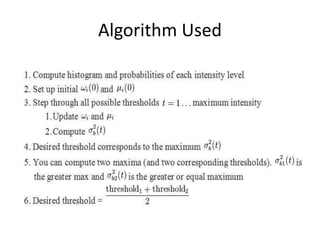
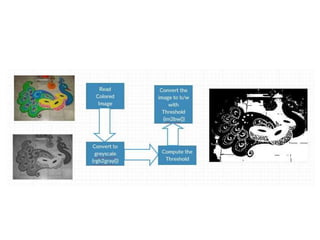
Algorithm Used
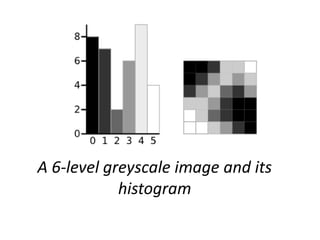
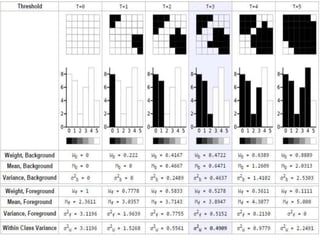
A 6-level greyscale image and its
histogram
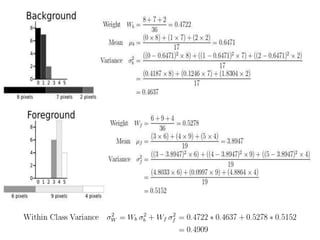
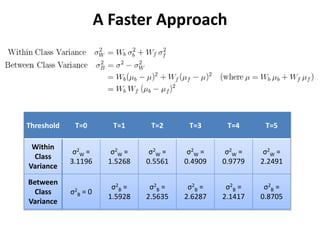
A Faster Approach
Threshold T=0 T=1 T=2 T=3 T=4 T=5
Within
Class
Variance
σ2
W =
3.1196
σ2
W =
1.5268
σ2
W =
0.5561
σ2
W =
0.4909
σ2
W =
0.9779
σ2
W =
2.2491
Between
Class
Variance
σ2
B = 0
σ2
B =
1.5928
σ2
B =
2.5635
σ2
B =
2.6287
σ2
B =
2.1417
σ2
B =
0.8705
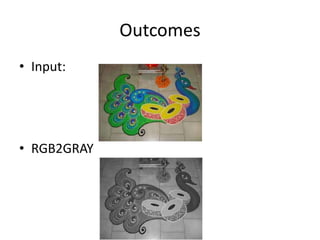
Outcomes
• Input:
• RGB2GRAY
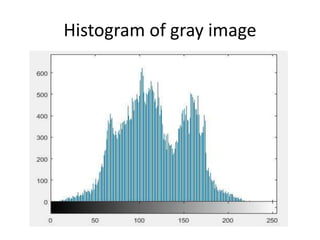
Histogram of gray image
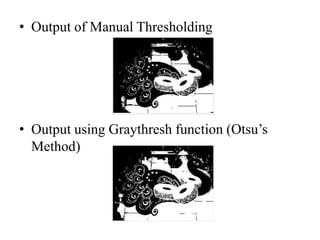
• Output of Manual Thresholding
• Output using Graythresh function (Otsu’s
Method)
Conclusion
A method to select a threshold automatically from a gray level histogram
has been derived from the viewpoint of discriminant analysis. This directly
deals with the problem of evaluating the goodness of thresholds. The range
of its applications is not restricted only to the thresholding of the gray-level
picture, such as specifically described in the foregoing, but it may also
cover other cases of unsupervised classification in which a histogram of
some characteristic (or feature) discriminative for classifying the objects is
available. Taking into account these points, the method suggested in this
correspondence may be recommended as the most simple and standard one
for automatic threshold selection that can be applied to various practical
problems.
Achievements
• Pattern recognition: Pattern recognition involves study from
image processing and from various other fields that includes
machine learning (a branch of artificial intelligence).
• Video processing: A video is nothing but just the very fast
movement of pictures. The quality of the video depends on the
number of frames/pictures per minute and the quality of each
frame being used.
Achievements
• Medical Applications: The need for accurate segmentation tools in medical
applications is driven by the increased capacity of the imaging devices.
Common modalities such as CT and MRI generate images which simply
cannot be examined manually, due to high resolutions and a large number
of image slices.
• Object Detection: Object detection is a computer technology related to
computer vision and image processing that deals with detecting instances
of semantic objects of a certain class (such as humans, buildings, or cars) in
digital images and videos.
References
• http://web-ext.u-
aizu.ac.jp/course/bmclass/documents/otsu19
79.pdf
• https://en.wikipedia.org/wiki/Otsu%27s_met
hod
• http://in.mathworks.com/help/images/examp
les/correcting-nonuniform-illumination.html
• https://youtu.be/i1wAoIDar48

Image Segmentation using Otsu's Method - Computer Graphics (UCS505) Project PPT

  • 1.
    Image Segmentation usingOtsu’s Method By- Abhinav Garg (101303004) Akshit Arora(101303012) Akul Gupta(101303013) Anmoldeep Singh(101303027)
  • 2.
    Otsu’s Thresholding Method •Based on a very simple idea: Find the threshold that minimizes the weighted within-class variance. • This turns out to be the same as maximizing the between-class variance. • Operates directly on the gray level histogram [e.g. 256 numbers, P(i)], so it’s fast (once the histogram is computed). (1979)
  • 3.
    Problem It is importantin picture processing to select an adequate threshold of grey level for extracting objects from their background. Before Otsu, A variety of techniques have been proposed in this regard. In an ideal case, the histogram has a deep and sharp valley between two peaks representing objects and background, respectively, so that the threshold can be chosen at the bottom of this valley. However, for most real pictures, it is often difficult to detect the valley bottom precisely, especially in such cases as when the valley is flat and broad, imbued with noise, or when the two peaks are extremely unequal in height, often producing no traceable valley.
  • 4.
    Otsu’s: Assumptions • Histogram(and the image) are bimodal. • No use of spatial coherence, nor any other notion of object structure. • Assumes stationary statistics, but can be modified to be locally adaptive. (exercises) • Assumes uniform illumination (implicitly), so the bimodal brightness behavior arises from object appearance differences only.
  • 5.
  • 7.
    A 6-level greyscaleimage and its histogram
  • 10.
    A Faster Approach ThresholdT=0 T=1 T=2 T=3 T=4 T=5 Within Class Variance σ2 W = 3.1196 σ2 W = 1.5268 σ2 W = 0.5561 σ2 W = 0.4909 σ2 W = 0.9779 σ2 W = 2.2491 Between Class Variance σ2 B = 0 σ2 B = 1.5928 σ2 B = 2.5635 σ2 B = 2.6287 σ2 B = 2.1417 σ2 B = 0.8705
  • 11.
  • 12.
  • 13.
    • Output ofManual Thresholding • Output using Graythresh function (Otsu’s Method)
  • 14.
    Conclusion A method toselect a threshold automatically from a gray level histogram has been derived from the viewpoint of discriminant analysis. This directly deals with the problem of evaluating the goodness of thresholds. The range of its applications is not restricted only to the thresholding of the gray-level picture, such as specifically described in the foregoing, but it may also cover other cases of unsupervised classification in which a histogram of some characteristic (or feature) discriminative for classifying the objects is available. Taking into account these points, the method suggested in this correspondence may be recommended as the most simple and standard one for automatic threshold selection that can be applied to various practical problems.
  • 15.
    Achievements • Pattern recognition:Pattern recognition involves study from image processing and from various other fields that includes machine learning (a branch of artificial intelligence). • Video processing: A video is nothing but just the very fast movement of pictures. The quality of the video depends on the number of frames/pictures per minute and the quality of each frame being used.
  • 16.
    Achievements • Medical Applications:The need for accurate segmentation tools in medical applications is driven by the increased capacity of the imaging devices. Common modalities such as CT and MRI generate images which simply cannot be examined manually, due to high resolutions and a large number of image slices. • Object Detection: Object detection is a computer technology related to computer vision and image processing that deals with detecting instances of semantic objects of a certain class (such as humans, buildings, or cars) in digital images and videos.
  • 17.
    References • http://web-ext.u- aizu.ac.jp/course/bmclass/documents/otsu19 79.pdf • https://en.wikipedia.org/wiki/Otsu%27s_met hod •http://in.mathworks.com/help/images/examp les/correcting-nonuniform-illumination.html • https://youtu.be/i1wAoIDar48