Image Filtering
(Frequency Domain)
Elsayed Hemayed
Overview
• Thinking in Frequency
– Image Scaling
– Hybrid Image
• Fourier Transform
• Filtering in Spatial/Frequency Domain
• De-convolution
• Image De-blurring
• Image Compression
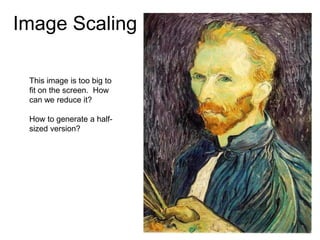
Image Scaling
This image is too big to
fit on the screen. How
can we reduce it?
How to generate a half-
sized version?
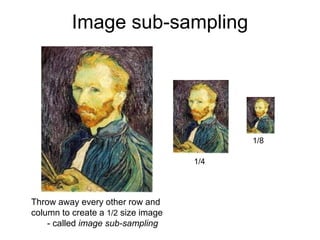
Image sub-sampling
Throw away every other row and
column to create a 1/2 size image
- called image sub-sampling
1/4
1/8
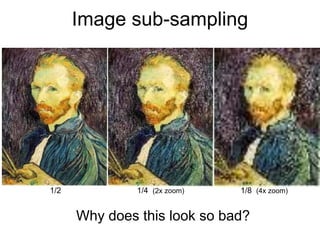
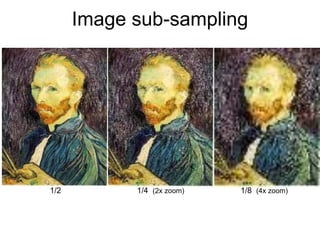
Image sub-sampling
1/4 (2x zoom) 1/8 (4x zoom)
Why does this look so bad?
1/2
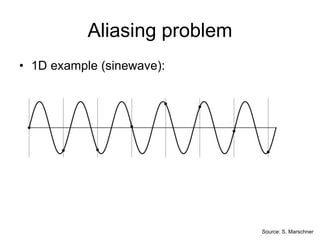
• 1D example (sinewave):
Source: S. Marschner
Aliasing problem
Source: S. Marschner
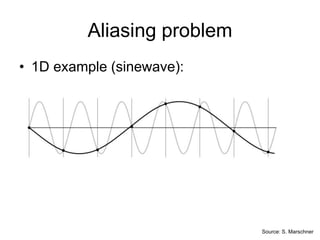
• 1D example (sinewave):
Aliasing problem
Source: A. Efros
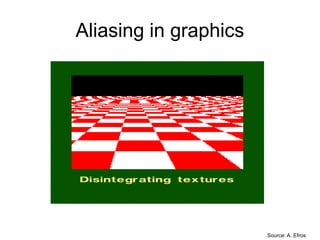
Aliasing in graphics
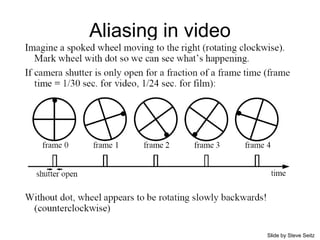
Aliasing in video
Slide by Steve Seitz
Videos
[YouTube; JoinBuzzirk; phrancque]
Helicopter flying with no blades spinning !wheels spinning backwards
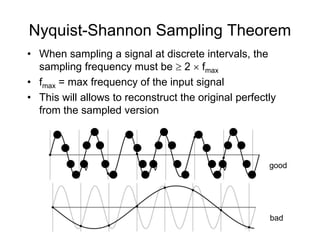
• When sampling a signal at discrete intervals, the
sampling frequency must be  2  fmax
• fmax = max frequency of the input signal
• This will allows to reconstruct the original perfectly
from the sampled version
good
bad
v v v
Nyquist-Shannon Sampling Theorem
Down-sampling
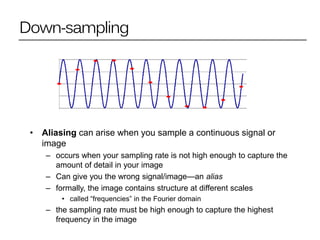
• Aliasing can arise when you sample a continuous signal or
image
– occurs when your sampling rate is not high enough to capture the
amount of detail in your image
– Can give you the wrong signal/image—an alias
– formally, the image contains structure at different scales
• called “frequencies” in the Fourier domain
– the sampling rate must be high enough to capture the highest
frequency in the image
How to fix aliasing?
Solutions?
Better sensors
Solutions:
• Sample more often
Anti-aliasing
Solutions:
• Sample more often
• Get rid of all frequencies that are greater
than half the new sampling frequency
– Will lose information
– But it’s better than aliasing
– Apply a smoothing (low pass) filter
Hays
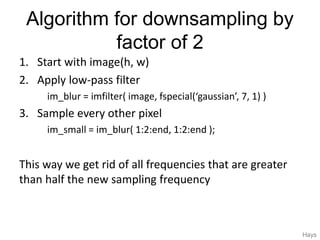
Algorithm for downsampling by
factor of 2
1. Start with image(h, w)
2. Apply low-pass filter
im_blur = imfilter( image, fspecial(‘gaussian’, 7, 1) )
3. Sample every other pixel
im_small = im_blur( 1:2:end, 1:2:end );
This way we get rid of all frequencies that are greater
than half the new sampling frequency
Hays
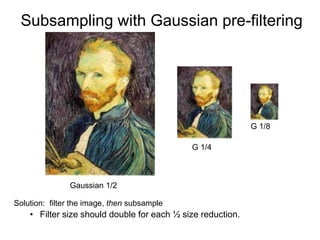
Subsampling with Gaussian pre-filtering
G 1/4
G 1/8
Gaussian 1/2
Solution: filter the image, then subsample
• Filter size should double for each ½ size reduction.
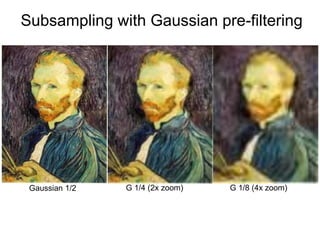
Subsampling with Gaussian pre-filtering
Gaussian 1/2 G 1/4 (2x zoom) G 1/8 (4x zoom)
Image sub-sampling
1/4 (2x zoom) 1/8 (4x zoom)1/2
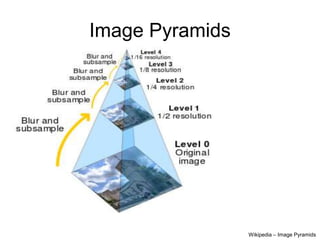
Image Pyramids
Wikipedia – Image Pyramids
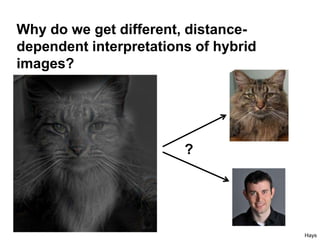
Why do we get different, distance-
dependent interpretations of hybrid
images?
?
Hays
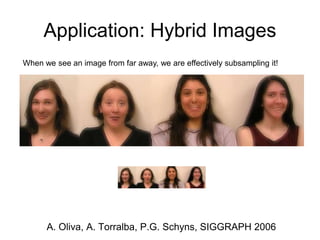
Application: Hybrid Images
A. Oliva, A. Torralba, P.G. Schyns, SIGGRAPH 2006
When we see an image from far away, we are effectively subsampling it!
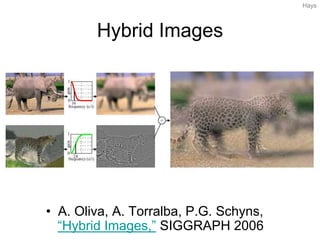
Hybrid Images
• A. Oliva, A. Torralba, P.G. Schyns,
“Hybrid Images,” SIGGRAPH 2006
Hays
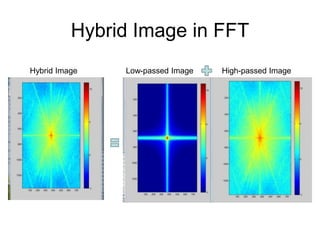
Hybrid Image in FFT
Hybrid Image Low-passed Image High-passed Image
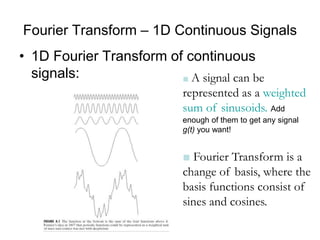
Fourier Transform – 1D Continuous Signals
• 1D Fourier Transform of continuous
signals: ■ A signal can be
represented as a weighted
sum of sinusoids. Add
enough of them to get any signal
g(t) you want!
■ Fourier Transform is a
change of basis, where the
basis functions consist of
sines and cosines.
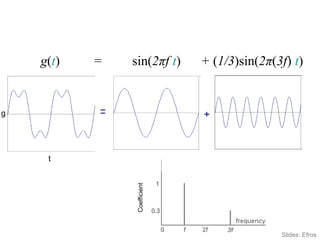
g(t) = sin(2πf t) + (1/3)sin(2π(3f) t)
= +
Slides: Efros
Coefficient
t
g
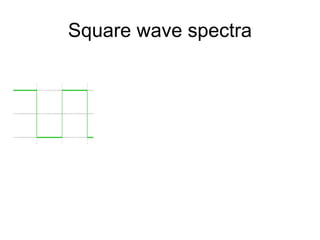
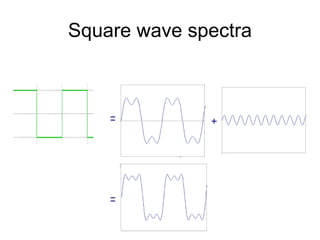
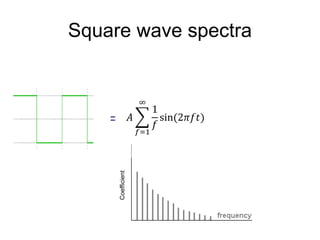
Square wave spectra
= +
=
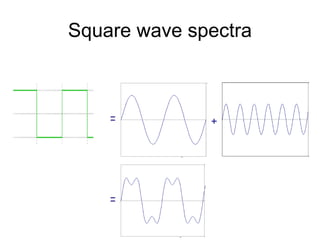
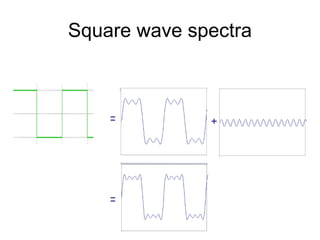
Square wave spectra
= +
=
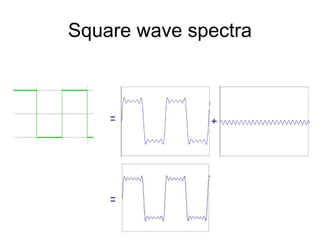
Square wave spectra
= +
=
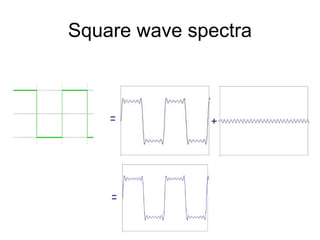
Square wave spectra
= +
=
Square wave spectra
= +
=
Square wave spectra
=
Square wave spectra
Coefficient
𝐴
𝑓=1
∞
1
𝑓
sin(2𝜋𝑓𝑡)
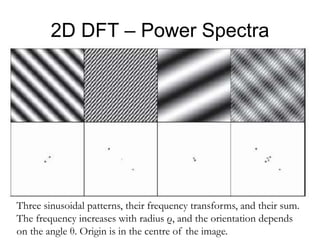
2D DFT – Power Spectra
Three sinusoidal patterns, their frequency transforms, and their sum.
The frequency increases with radius ρ, and the orientation depends
on the angle θ. Origin is in the centre of the image.
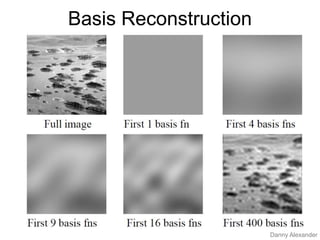
Basis Reconstruction
Danny Alexander
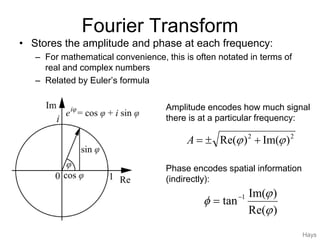
Fourier Transform
• Stores the amplitude and phase at each frequency:
– For mathematical convenience, this is often notated in terms of
real and complex numbers
– Related by Euler’s formula
22
)Im()Re(  A
)Re(
)Im(
tan 1


 

Hays
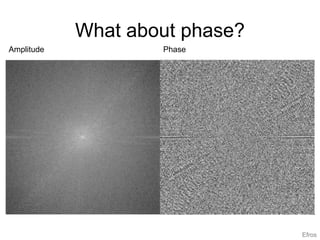
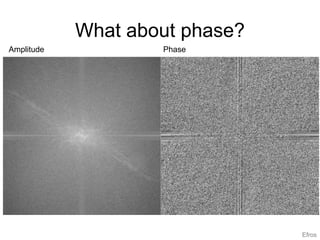
Phase encodes spatial information
(indirectly):
Amplitude encodes how much signal
there is at a particular frequency:
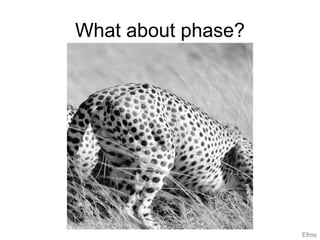
What about phase?
Efros
What about phase?
Amplitude Phase
Efros
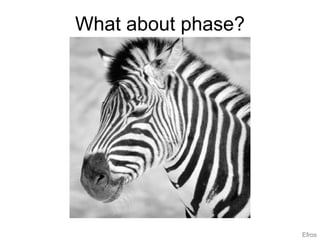
What about phase?
Efros
What about phase?
Amplitude Phase
Efros
Think-Pair-Share
• In Fourier space, where is more of the
information that we see in the visual
world?
– Amplitude
– Phase
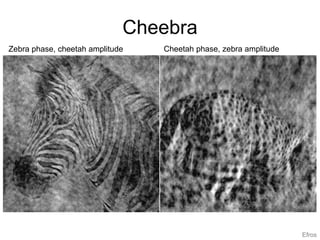
Cheebra
Zebra phase, cheetah amplitude Cheetah phase, zebra amplitude
Efros
• The frequency amplitude of natural images
are quite similar
– Heavy in low frequencies, falling off in high
frequencies
– Will any image be like that, or is it a property
of the world we live in?
• Most information in the image is carried in
the phase, not the amplitude
Efros
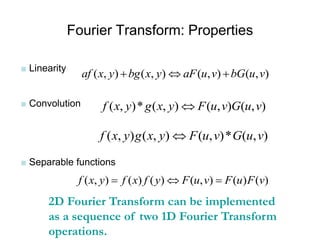
Fourier Transform: Properties
■ Linearity
■ Convolution
■ Separable functions
( , ) ( , ) ( , ) ( , )af x y bg x y aF u v bG u v  
( , )* ( , ) ( , ) ( , )f x y g x y F u v G u v
( , ) ( , ) ( , )* ( , )f x y g x y F u v G u v
( , ) ( ) ( ) ( , ) ( ) ( )f x y f x f y F u v F u F v  
2D Fourier Transform can be implemented
as a sequence of two 1D Fourier Transform
operations.
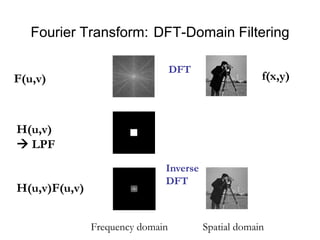
Fourier Transform: DFT-Domain Filtering
Frequency domain Spatial domain
H(u,v)
 LPF
f(x,y)F(u,v)
H(u,v)F(u,v)
DFT
Inverse
DFT
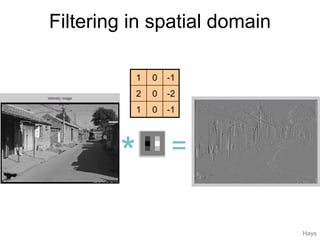
Filtering in spatial domain
-101
-202
-101
* =
Hays
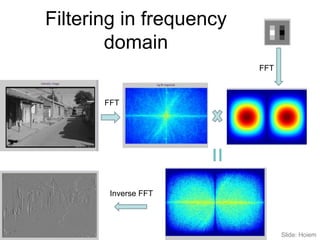
Filtering in frequency
domain
FFT
FFT
Inverse FFT
=
Slide: Hoiem
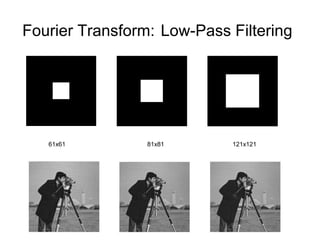
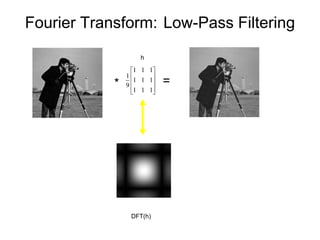
Fourier Transform: Low-Pass Filtering
81x8161x61 121x121
Fourier Transform: Low-Pass Filtering
1 1 1
1
1 1 1
9
1 1 1
 
 
 
  
* =
DFT(h)
h
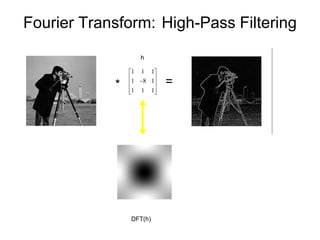
Fourier Transform: High-Pass Filtering
* =
1 1 1
1 8 1
1 1 1
 
  
  
DFT(h)
h
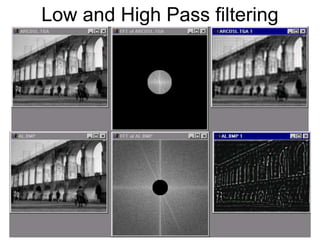
Low and High Pass filtering
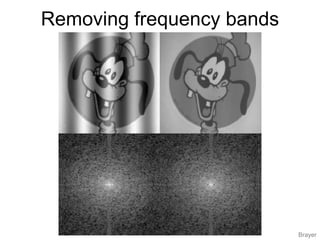
Removing frequency bands
Brayer
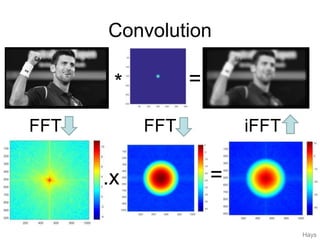
Is convolution invertible?
• If convolution is just multiplication in the
Fourier domain, isn’t deconvolution just
division?
• Sometimes, it clearly is invertible (e.g. a
convolution with an identity filter)
• In one case, it clearly isn’t invertible (e.g.
convolution with an all zero filter)
• What about for common filters like a
Gaussian?
Convolution
* =
FFT FFT
.x =
iFFT
Hays
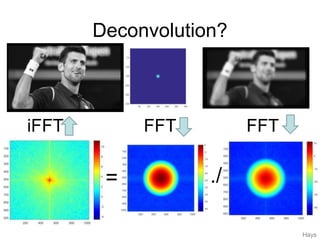
Deconvolution?
iFFT FFT
./=
FFT
Hays
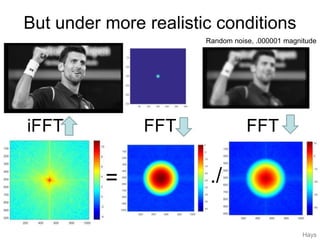
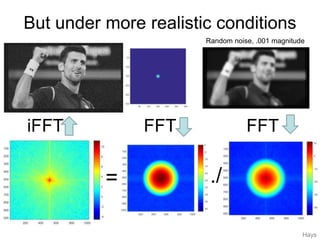
But under more realistic conditions
iFFT FFT
./=
FFT
Random noise, .000001 magnitude
Hays
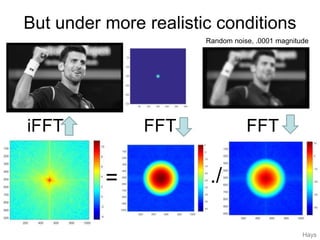
But under more realistic conditions
iFFT FFT
./=
FFT
Random noise, .0001 magnitude
Hays
But under more realistic conditions
iFFT FFT
./=
FFT
Random noise, .001 magnitude
Hays
Image Deblurring
• Where does blur come from?
– Optical blur: camera is out-of-focus
– Motion blur: camera or object is moving
• Why do we need deblurring?
– Visually annoying
– Wrong target for compression
– Bad for analysis
– Numerous applications
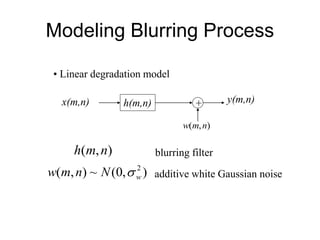
h(m,n) +x(m,n) y(m,n)
),( nmw
• Linear degradation model
),( nmh blurring filter
),0(~),( 2
wNnmw  additive white Gaussian noise
Modeling Blurring Process
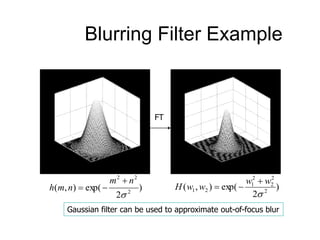
Blurring Filter Example
)
2
exp(),( 2
2
2
2
1
21

ww
wwH

)
2
exp(),( 2
22

nm
nmh


FT
Gaussian filter can be used to approximate out-of-focus blur
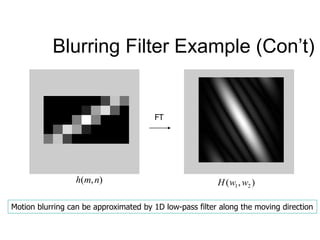
Blurring Filter Example (Con’t)
),( 21 wwH
FT
Motion blurring can be approximated by 1D low-pass filter along the moving direction
),( nmh
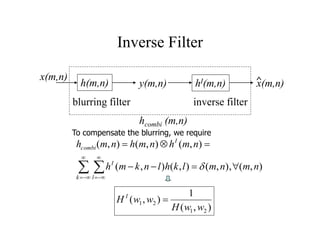
Inverse Filter
h(m,n)
blurring filter
hI(m,n)
x(m,n)
y(m,n)
inverse filter
 






k l
I
I
combi
nmnmlkhlnkmh
nmhnmhnmh
),(),,(),(),(
),(),(),(

),(
1
),(
21
21
wwH
wwH I

To compensate the blurring, we require
hcombi (m,n)
x(m,n)^
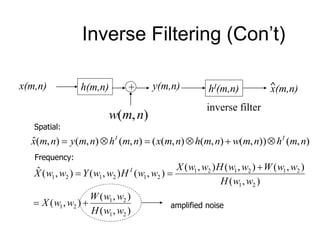
Inverse Filtering (Con’t)
h(m,n) +x(m,n) y(m,n)
),( nmw
hI(m,n)
inverse filter
x(m,n)^
Spatial:
),()),(),(),((),(),(),(ˆ nmhnmwnmhnmxnmhnmynmx II

Frequency:
),(
),(
),(
),(
),(),(),(
),(),(),(ˆ
21
21
21
21
212121
212121
wwH
wwW
wwX
wwH
wwWwwHwwX
wwHwwYwwX I



amplified noise
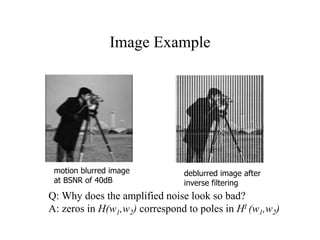
Image Example
Q: Why does the amplified noise look so bad?
A: zeros in H(w1,w2) correspond to poles in HI (w1,w2)
motion blurred image
at BSNR of 40dB
deblurred image after
inverse filtering
Pseudo-inverse Filter
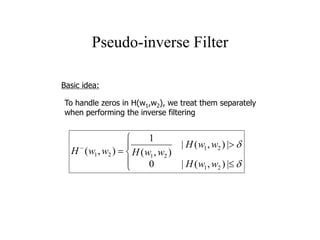
Basic idea:
To handle zeros in H(w1,w2), we treat them separately
when performing the inverse filtering









|),(|0
|),(|
),(
1
),(
21
21
2121
wwH
wwH
wwHwwH
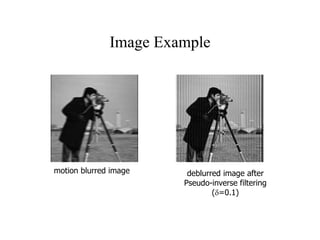
Image Example
motion blurred image deblurred image after
Pseudo-inverse filtering
(=0.1)
Compression
• How is it that a 4MP image can be
compressed to a few hundred KB without
a noticeable change?
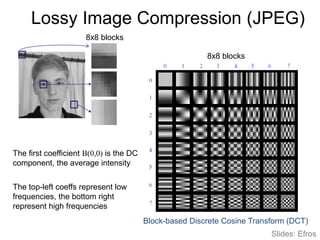
Lossy Image Compression (JPEG)
Block-based Discrete Cosine Transform (DCT)
Slides: Efros
The first coefficient B(0,0) is the DC
component, the average intensity
The top-left coeffs represent low
frequencies, the bottom right
represent high frequencies
8x8 blocks
8x8 blocks
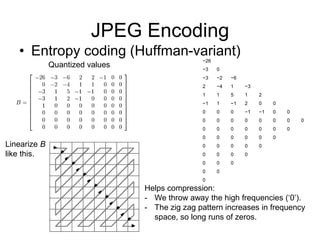
JPEG Encoding
• Entropy coding (Huffman-variant)
Quantized values
Linearize B
like this.
Helps compression:
- We throw away the high frequencies (‘0’).
- The zig zag pattern increases in frequency
space, so long runs of zeros.
−26
−3 0
−3 −2 −6
2 −4 1 −3
1 1 5 1 2
−1 1 −1 2 0 0
0 0 0 −1 −1 0 0
0 0 0 0 0 0 0 0
0 0 0 0 0 0 0
0 0 0 0 0 0
0 0 0 0 0
0 0 0 0
0 0 0
0 0
0
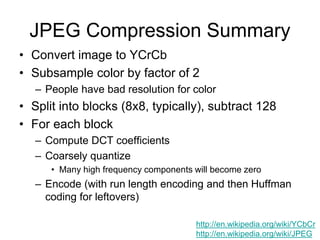
JPEG Compression Summary
• Convert image to YCrCb
• Subsample color by factor of 2
– People have bad resolution for color
• Split into blocks (8x8, typically), subtract 128
• For each block
– Compute DCT coefficients
– Coarsely quantize
• Many high frequency components will become zero
– Encode (with run length encoding and then Huffman
coding for leftovers)
http://en.wikipedia.org/wiki/YCbCr
http://en.wikipedia.org/wiki/JPEG
Summary
• Thinking in Frequency
– Image Scaling
– Hybrid Image
• Fourier Transform
• Filtering in Spatial/Frequency Domain
• De-convolution
• Image De-blurring
• Image Compression

04 cie552 image_filtering_frequency

  • 1.
  • 2.
    Overview • Thinking inFrequency – Image Scaling – Hybrid Image • Fourier Transform • Filtering in Spatial/Frequency Domain • De-convolution • Image De-blurring • Image Compression
  • 3.
    Image Scaling This imageis too big to fit on the screen. How can we reduce it? How to generate a half- sized version?
  • 4.
    Image sub-sampling Throw awayevery other row and column to create a 1/2 size image - called image sub-sampling 1/4 1/8
  • 5.
    Image sub-sampling 1/4 (2xzoom) 1/8 (4x zoom) Why does this look so bad? 1/2
  • 6.
    • 1D example(sinewave): Source: S. Marschner Aliasing problem
  • 7.
    Source: S. Marschner •1D example (sinewave): Aliasing problem
  • 8.
  • 9.
  • 10.
    Videos [YouTube; JoinBuzzirk; phrancque] Helicopterflying with no blades spinning !wheels spinning backwards
  • 11.
    • When samplinga signal at discrete intervals, the sampling frequency must be  2  fmax • fmax = max frequency of the input signal • This will allows to reconstruct the original perfectly from the sampled version good bad v v v Nyquist-Shannon Sampling Theorem
  • 12.
    Down-sampling • Aliasing canarise when you sample a continuous signal or image – occurs when your sampling rate is not high enough to capture the amount of detail in your image – Can give you the wrong signal/image—an alias – formally, the image contains structure at different scales • called “frequencies” in the Fourier domain – the sampling rate must be high enough to capture the highest frequency in the image
  • 13.
    How to fixaliasing? Solutions?
  • 14.
  • 15.
    Anti-aliasing Solutions: • Sample moreoften • Get rid of all frequencies that are greater than half the new sampling frequency – Will lose information – But it’s better than aliasing – Apply a smoothing (low pass) filter Hays
  • 16.
    Algorithm for downsamplingby factor of 2 1. Start with image(h, w) 2. Apply low-pass filter im_blur = imfilter( image, fspecial(‘gaussian’, 7, 1) ) 3. Sample every other pixel im_small = im_blur( 1:2:end, 1:2:end ); This way we get rid of all frequencies that are greater than half the new sampling frequency Hays
  • 17.
    Subsampling with Gaussianpre-filtering G 1/4 G 1/8 Gaussian 1/2 Solution: filter the image, then subsample • Filter size should double for each ½ size reduction.
  • 18.
    Subsampling with Gaussianpre-filtering Gaussian 1/2 G 1/4 (2x zoom) G 1/8 (4x zoom)
  • 19.
    Image sub-sampling 1/4 (2xzoom) 1/8 (4x zoom)1/2
  • 20.
  • 21.
    Why do weget different, distance- dependent interpretations of hybrid images? ? Hays
  • 22.
    Application: Hybrid Images A.Oliva, A. Torralba, P.G. Schyns, SIGGRAPH 2006 When we see an image from far away, we are effectively subsampling it!
  • 23.
    Hybrid Images • A.Oliva, A. Torralba, P.G. Schyns, “Hybrid Images,” SIGGRAPH 2006 Hays
  • 24.
    Hybrid Image inFFT Hybrid Image Low-passed Image High-passed Image
  • 25.
    Fourier Transform –1D Continuous Signals • 1D Fourier Transform of continuous signals: ■ A signal can be represented as a weighted sum of sinusoids. Add enough of them to get any signal g(t) you want! ■ Fourier Transform is a change of basis, where the basis functions consist of sines and cosines.
  • 26.
    g(t) = sin(2πft) + (1/3)sin(2π(3f) t) = + Slides: Efros Coefficient t g
  • 27.
  • 28.
  • 29.
  • 30.
  • 31.
  • 32.
  • 33.
  • 34.
    2D DFT –Power Spectra Three sinusoidal patterns, their frequency transforms, and their sum. The frequency increases with radius ρ, and the orientation depends on the angle θ. Origin is in the centre of the image.
  • 35.
  • 36.
    Fourier Transform • Storesthe amplitude and phase at each frequency: – For mathematical convenience, this is often notated in terms of real and complex numbers – Related by Euler’s formula 22 )Im()Re(  A )Re( )Im( tan 1      Hays Phase encodes spatial information (indirectly): Amplitude encodes how much signal there is at a particular frequency:
  • 37.
  • 38.
  • 39.
  • 40.
  • 41.
    Think-Pair-Share • In Fourierspace, where is more of the information that we see in the visual world? – Amplitude – Phase
  • 42.
    Cheebra Zebra phase, cheetahamplitude Cheetah phase, zebra amplitude Efros
  • 43.
    • The frequencyamplitude of natural images are quite similar – Heavy in low frequencies, falling off in high frequencies – Will any image be like that, or is it a property of the world we live in? • Most information in the image is carried in the phase, not the amplitude Efros
  • 44.
    Fourier Transform: Properties ■Linearity ■ Convolution ■ Separable functions ( , ) ( , ) ( , ) ( , )af x y bg x y aF u v bG u v   ( , )* ( , ) ( , ) ( , )f x y g x y F u v G u v ( , ) ( , ) ( , )* ( , )f x y g x y F u v G u v ( , ) ( ) ( ) ( , ) ( ) ( )f x y f x f y F u v F u F v   2D Fourier Transform can be implemented as a sequence of two 1D Fourier Transform operations.
  • 45.
    Fourier Transform: DFT-DomainFiltering Frequency domain Spatial domain H(u,v)  LPF f(x,y)F(u,v) H(u,v)F(u,v) DFT Inverse DFT
  • 46.
    Filtering in spatialdomain -101 -202 -101 * = Hays
  • 47.
  • 48.
    Fourier Transform: Low-PassFiltering 81x8161x61 121x121
  • 49.
    Fourier Transform: Low-PassFiltering 1 1 1 1 1 1 1 9 1 1 1          * = DFT(h) h
  • 50.
    Fourier Transform: High-PassFiltering * = 1 1 1 1 8 1 1 1 1         DFT(h) h
  • 51.
    Low and HighPass filtering
  • 52.
  • 53.
    Is convolution invertible? •If convolution is just multiplication in the Fourier domain, isn’t deconvolution just division? • Sometimes, it clearly is invertible (e.g. a convolution with an identity filter) • In one case, it clearly isn’t invertible (e.g. convolution with an all zero filter) • What about for common filters like a Gaussian?
  • 54.
  • 55.
  • 56.
    But under morerealistic conditions iFFT FFT ./= FFT Random noise, .000001 magnitude Hays
  • 57.
    But under morerealistic conditions iFFT FFT ./= FFT Random noise, .0001 magnitude Hays
  • 58.
    But under morerealistic conditions iFFT FFT ./= FFT Random noise, .001 magnitude Hays
  • 59.
    Image Deblurring • Wheredoes blur come from? – Optical blur: camera is out-of-focus – Motion blur: camera or object is moving • Why do we need deblurring? – Visually annoying – Wrong target for compression – Bad for analysis – Numerous applications
  • 60.
    h(m,n) +x(m,n) y(m,n) ),(nmw • Linear degradation model ),( nmh blurring filter ),0(~),( 2 wNnmw  additive white Gaussian noise Modeling Blurring Process
  • 61.
    Blurring Filter Example ) 2 exp(),(2 2 2 2 1 21  ww wwH  ) 2 exp(),( 2 22  nm nmh   FT Gaussian filter can be used to approximate out-of-focus blur
  • 62.
    Blurring Filter Example(Con’t) ),( 21 wwH FT Motion blurring can be approximated by 1D low-pass filter along the moving direction ),( nmh
  • 63.
    Inverse Filter h(m,n) blurring filter hI(m,n) x(m,n) y(m,n) inversefilter         k l I I combi nmnmlkhlnkmh nmhnmhnmh ),(),,(),(),( ),(),(),(  ),( 1 ),( 21 21 wwH wwH I  To compensate the blurring, we require hcombi (m,n) x(m,n)^
  • 64.
    Inverse Filtering (Con’t) h(m,n)+x(m,n) y(m,n) ),( nmw hI(m,n) inverse filter x(m,n)^ Spatial: ),()),(),(),((),(),(),(ˆ nmhnmwnmhnmxnmhnmynmx II  Frequency: ),( ),( ),( ),( ),(),(),( ),(),(),(ˆ 21 21 21 21 212121 212121 wwH wwW wwX wwH wwWwwHwwX wwHwwYwwX I    amplified noise
  • 65.
    Image Example Q: Whydoes the amplified noise look so bad? A: zeros in H(w1,w2) correspond to poles in HI (w1,w2) motion blurred image at BSNR of 40dB deblurred image after inverse filtering
  • 66.
    Pseudo-inverse Filter Basic idea: Tohandle zeros in H(w1,w2), we treat them separately when performing the inverse filtering          |),(|0 |),(| ),( 1 ),( 21 21 2121 wwH wwH wwHwwH
  • 67.
    Image Example motion blurredimage deblurred image after Pseudo-inverse filtering (=0.1)
  • 68.
    Compression • How isit that a 4MP image can be compressed to a few hundred KB without a noticeable change?
  • 69.
    Lossy Image Compression(JPEG) Block-based Discrete Cosine Transform (DCT) Slides: Efros The first coefficient B(0,0) is the DC component, the average intensity The top-left coeffs represent low frequencies, the bottom right represent high frequencies 8x8 blocks 8x8 blocks
  • 70.
    JPEG Encoding • Entropycoding (Huffman-variant) Quantized values Linearize B like this. Helps compression: - We throw away the high frequencies (‘0’). - The zig zag pattern increases in frequency space, so long runs of zeros. −26 −3 0 −3 −2 −6 2 −4 1 −3 1 1 5 1 2 −1 1 −1 2 0 0 0 0 0 −1 −1 0 0 0 0 0 0 0 0 0 0 0 0 0 0 0 0 0 0 0 0 0 0 0 0 0 0 0 0 0 0 0 0 0 0 0 0 0 0
  • 71.
    JPEG Compression Summary •Convert image to YCrCb • Subsample color by factor of 2 – People have bad resolution for color • Split into blocks (8x8, typically), subtract 128 • For each block – Compute DCT coefficients – Coarsely quantize • Many high frequency components will become zero – Encode (with run length encoding and then Huffman coding for leftovers) http://en.wikipedia.org/wiki/YCbCr http://en.wikipedia.org/wiki/JPEG
  • 72.
    Summary • Thinking inFrequency – Image Scaling – Hybrid Image • Fourier Transform • Filtering in Spatial/Frequency Domain • De-convolution • Image De-blurring • Image Compression