
BRAIN TUMOUR SEGMENTATION OF
MRI IMAGE USING MATLAB
Contents
1. Preview
2. Flowchart
3. Background theory and/or literature reviewwork
4. Methodology
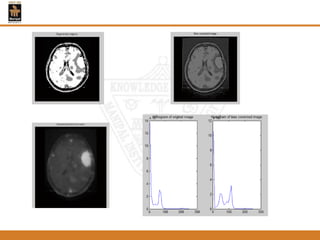
5. Result analysis
6. Conclusion and future work
7. References
Department of Electronics and Communication Engineering, MIT, Manipal
Preview
Department of Electronics and Communication Engineering, MIT, Manipal
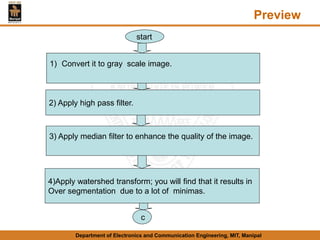
1) Convert it to gray scale image.
2) Apply high pass filter.
3) Apply median filter to enhance the quality of the image.
4)Apply watershed transform; you will find that it results in
Over segmentation due to a lot of minimas.
c
start
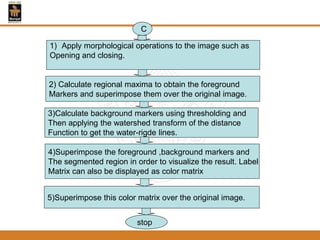
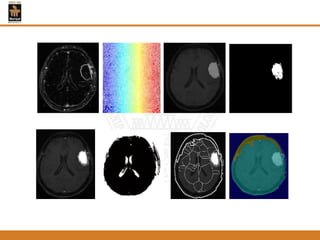
1) Apply morphological operations to the image such as
Opening and closing.
2) Calculate regional maxima to obtain the foreground
Markers and superimpose them over the original image.
3)Calculate background markers using thresholding and
Then applying the watershed transform of the distance
Function to get the water-rigde lines.
4)Superimpose the foreground ,background markers and
The segmented region in order to visualize the result. Label
Matrix can also be displayed as color matrix
stop
C
5)Superimpose this color matrix over the original image.
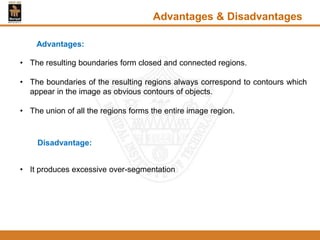
• The resulting boundaries form closed and connected regions.
• The boundaries of the resulting regions always correspond to contours which
appear in the image as obvious contours of objects.
• The union of all the regions forms the entire image region.
Advantages & Disadvantages
Advantages:
Disadvantage:
• It produces excessive over-segmentation
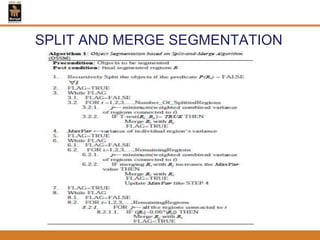
SPLIT AND MERGE SEGMENTATION
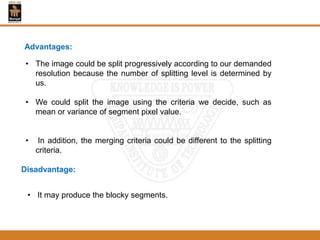
Advantages:
• The image could be split progressively according to our demanded
resolution because the number of splitting level is determined by
us.
• We could split the image using the criteria we decide, such as
mean or variance of segment pixel value.
• In addition, the merging criteria could be different to the splitting
criteria.
Disadvantage:
• It may produce the blocky segments.
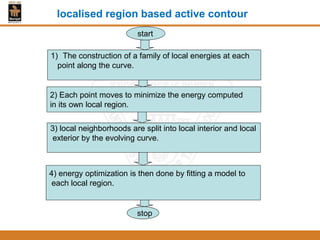
localised region based active contour
1) The construction of a family of local energies at each
point along the curve.
2) Each point moves to minimize the energy computed
in its own local region.
3) local neighborhoods are split into local interior and local
exterior by the evolving curve.
4) energy optimization is then done by fitting a model to
each local region.
stop
start
Advantages:
• lower sensitivity to contour initialisation and noise.
• feasibility of segmentation of color images even in the absence of
gradient-defined boundaries.
• better ability to capture concavities of objects
Disadvantages:
• computational time, sensitive initial boundary, kernel size
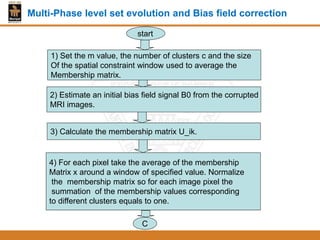
1) Set the m value, the number of clusters c and the size
Of the spatial constraint window used to average the
Membership matrix.
2) Estimate an initial bias field signal B0 from the corrupted
MRI images.
3) Calculate the membership matrix U_ik.
4) For each pixel take the average of the membership
Matrix x around a window of specified value. Normalize
the membership matrix so for each image pixel the
summation of the membership values corresponding
to different clusters equals to one.
C
start
Multi-Phase level set evolution and Bias field correction
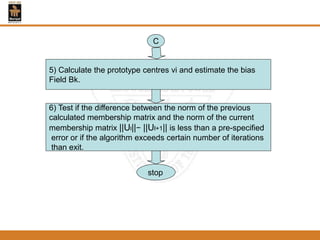
5) Calculate the prototype centres vi and estimate the bias
Field Bk.
C
6) Test if the difference between the norm of the previous
calculated membership matrix and the norm of the current
membership matrix ||Ul||− ||Ul+1|| is less than a pre-specified
error or if the algorithm exceeds certain number of iterations
than exit.
stop
• They are versatile, robust, accurate, and efficient techniques.
• This techniques is able to handle sharp corners and cusps in the propagating
solution, as well as topological changes, and three-dimensional effects.
• By employing fast narrow band adaptive techniques, the computational labor is
the same as other methods, with the advantages of increased accuracy and
robust modeling .
Disadvantages:
• The drawback to level set techniques is that they require considerable thought in
order to construct appropriate velocities for advancing the level set function.
Advantages:
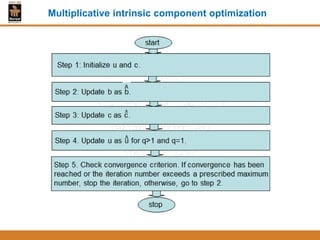
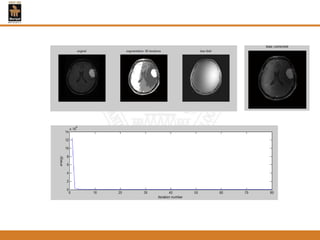
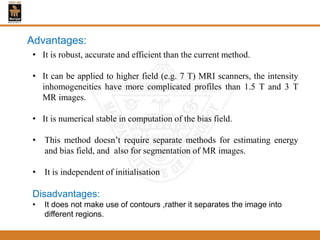
Multiplicative intrinsic component optimization
• It is robust, accurate and efficient than the current method.
• It can be applied to higher field (e.g. 7 T) MRI scanners, the intensity
inhomogeneities have more complicated profiles than 1.5 T and 3 T
MR images.
• It is numerical stable in computation of the bias field.
• This method doesn’t require separate methods for estimating energy
and bias field, and also for segmentation of MR images.
• It is independent of initialisation
Disadvantages:
• It does not make use of contours ,rather it separates the image into
different regions.
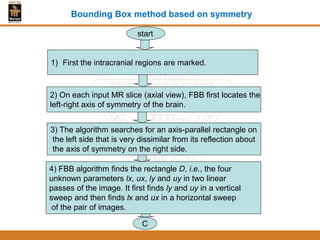
Advantages:
1) First the intracranial regions are marked.
2) On each input MR slice (axial view), FBB first locates the
left-right axis of symmetry of the brain.
3) The algorithm searches for an axis-parallel rectangle on
the left side that is very dissimilar from its reflection about
the axis of symmetry on the right side.
4) FBB algorithm finds the rectangle D, i.e., the four
unknown parameters lx, ux, ly and uy in two linear
passes of the image. It first finds ly and uy in a vertical
sweep and then finds lx and ux in a horizontal sweep
of the pair of images.
C
start
Bounding Box method based on symmetry
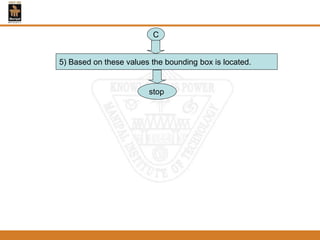
5) Based on these values the bounding box is located.
C
stop
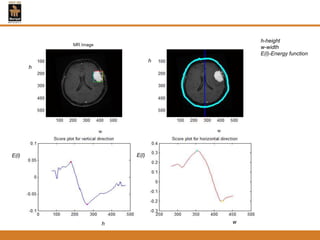
Elapsed time is 1.485019 seconds.
E(l) E(l)
w
ww
h
hh
h
h
h
w w
w
E(l) E(l)
h-height
w-width
E(l)-Energy function
Advantages:
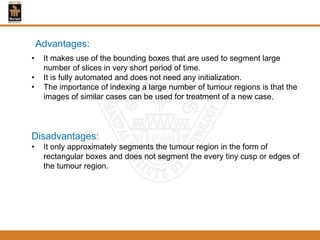
• It makes use of the bounding boxes that are used to segment large
number of slices in very short period of time.
• It is fully automated and does not need any initialization.
• The importance of indexing a large number of tumour regions is that the
images of similar cases can be used for treatment of a new case.
Disadvantages:
• It only approximately segments the tumour region in the form of
rectangular boxes and does not segment the every tiny cusp or edges of
the tumour region.
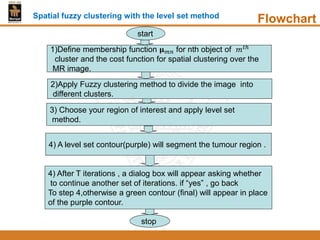
Spatial fuzzy clustering with the level set method
1)Define membership function 𝛍 𝑚𝑛 for nth object of 𝑚 𝑡ℎ
cluster and the cost function for spatial clustering over the
MR image.
2)Apply Fuzzy clustering method to divide the image into
different clusters.
3) Choose your region of interest and apply level set
method.
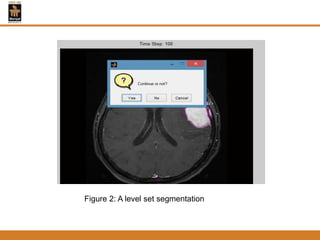
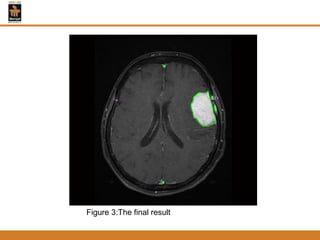
4) A level set contour(purple) will segment the tumour region .
stop
start
4) After T iterations , a dialog box will appear asking whether
to continue another set of iterations. if “yes” , go back
To step 4,otherwise a green contour (final) will appear in place
of the purple contour.
Flowchart
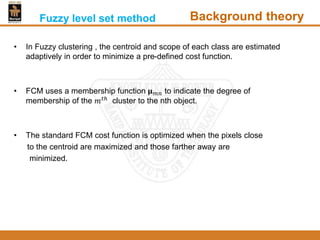
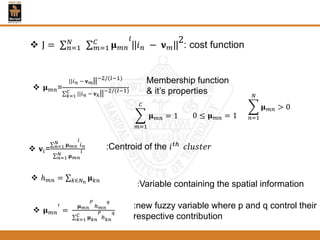
• In Fuzzy clustering , the centroid and scope of each class are estimated
adaptively in order to minimize a pre-defined cost function.
• FCM uses a membership function 𝛍 𝑚𝑛 to indicate the degree of
membership of the 𝑚 𝑡ℎ
cluster to the nth object.
• The standard FCM cost function is optimized when the pixels close
to the centroid are maximized and those farther away are
minimized.
Fuzzy level set method Background theory
 Ј = 𝑛=1
𝑁
𝑚=1
𝐶
𝛍 𝑚𝑛
𝑙
||𝑖 𝑛 − 𝛎 𝑚||
2
: cost function
𝑚=1
𝐶
𝛍 𝑚𝑛 = 1 0 ≤ 𝛍 𝑚𝑛 = 1 𝑛=1
𝑁
𝛍 𝑚𝑛 > 0
 𝛍 𝑚𝑛=
||𝑖 𝑛 − 𝛎 𝑚||−2/(𝑙−1)
𝑘=1
𝐶 ||𝑖 𝑛 − 𝛎 𝑘||−2/(𝑙−1)
 𝛎𝑖= 𝑛=1
𝑁 𝛍 𝑚𝑛
𝑙
𝑖 𝑛
𝑛=1
𝑁 𝛍 𝑚𝑛
𝑙
 𝛍 𝑚𝑛
′
=
𝛍 𝑚𝑛
𝑃
ℎ 𝑚𝑛
𝑞
𝑘=1
𝐶 𝛍 𝑘𝑛
𝑃
ℎ 𝑘𝑛
𝑞
 ℎ 𝑚𝑛 = 𝑘∈𝑁 𝑛
𝛍 𝑘𝑛
Membership function
& it’s properties
:Centroid of the 𝑖 𝑡ℎ 𝑐𝑙𝑢𝑠𝑡𝑒𝑟
:Variable containing the spatial information
:new fuzzy variable where p and q control their
respective contribution
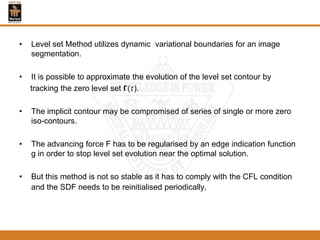
• Level set Method utilizes dynamic variational boundaries for an image
segmentation.
• It is possible to approximate the evolution of the level set contour by
tracking the zero level set 𝝘(𝑡).
• The implicit contour may be compromised of series of single or more zero
iso-contours.
• The advancing force F has to be regularised by an edge indication function
g in order to stop level set evolution near the optimal solution.
• But this method is not so stable as it has to comply with the CFL condition
and the SDF needs to be reinitialised periodically.
𝝓 𝑡, 𝑥, 𝑦 < 0 𝑥, 𝑦 𝑖𝑠 𝑖𝑛𝑠𝑖𝑑𝑒 𝝘(𝑡)
𝝓 𝑡, 𝑥, 𝑦 = 0 𝑥, 𝑦 𝑖𝑠 𝑎𝑡 𝝘(𝑡)
𝝓 𝑡, 𝑥, 𝑦 > 0 𝑖𝑠 𝑜𝑢𝑡𝑠𝑖𝑑𝑒 𝝘(𝑡)
𝜕𝝓
𝜕𝑡
+ 𝐹 𝛻𝝓 = 0
𝝓 0, 𝑥, 𝑦 = 𝝓0(𝑥, 𝑦)
𝑔 =
1
1 + |𝛻( 𝐺 𝝈 ∗ 𝐼)|
𝜕𝝓
𝜕𝑡
= 𝛍𝛇 𝝓 + 𝛏(𝗴, 𝝓)
𝛇 𝝓 = ∆𝝓 − div (
𝛻𝝓
𝛻𝝓
)
𝛏(𝗴, 𝝓)=λ𝛅(𝝓)div ਣ
𝛻𝝓
|𝛻𝝓 |
+ 𝛎ਣ𝛅(𝝓)
𝝓0(𝑥, 𝑦) =
−𝐶, 𝝓0 𝑥, 𝑦 < 0
𝐶, 𝑜𝑡ℎ𝑒𝑟𝑤𝑖𝑠𝑒
𝝓 𝑘+1
𝑥, 𝑦 = 𝝓 𝑘
𝑥, 𝑦 +𝞽[𝛍𝛇(𝝓 𝑘
)+𝛏(ਣ, 𝝓 𝑘
)]
The new level set method:The traditional level set formulation:
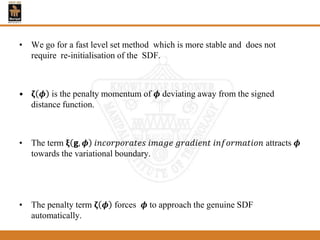
• We go for a fast level set method which is more stable and does not
require re-initialisation of the SDF.
• 𝛇 𝝓 is the penalty momentum of 𝝓 deviating away from the signed
distance function.
• The term 𝛏 𝗴, 𝝓 𝑖𝑛𝑐𝑜𝑟𝑝𝑜𝑟𝑎𝑡𝑒𝑠 𝑖𝑚𝑎𝑔𝑒 𝑔𝑟𝑎𝑑𝑖𝑒𝑛𝑡 𝑖𝑛𝑓𝑜𝑟𝑚𝑎𝑡𝑖𝑜𝑛 attracts 𝝓
towards the variational boundary.
• The penalty term 𝛇 𝝓 forces 𝝓 to approach the genuine SDF
automatically.
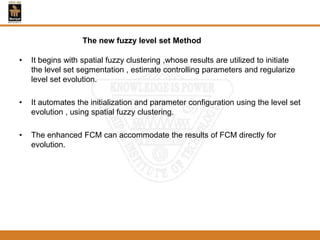
• It begins with spatial fuzzy clustering ,whose results are utilized to initiate
the level set segmentation , estimate controlling parameters and regularize
level set evolution.
• It automates the initialization and parameter configuration using the level set
evolution , using spatial fuzzy clustering.
• The enhanced FCM can accommodate the results of FCM directly for
evolution.
The new fuzzy level set Method
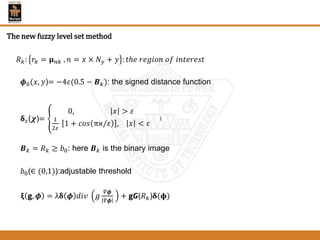
𝑅 𝑘: 𝑟𝑘 = 𝛍 𝑛𝑘 , 𝑛 = 𝑥 × 𝑁 𝑦 + 𝑦 : 𝑡ℎ𝑒 𝑟𝑒𝑔𝑖𝑜𝑛 𝑜𝑓 𝑖𝑛𝑡𝑒𝑟𝑒𝑠𝑡
𝝓0(𝑥, 𝑦)= −4𝜀(0.5 − 𝑩 𝑘): the signed distance function
𝛅 𝜀(𝝌)=
0, 𝑥 > 𝜀
1
2𝜀
1 + 𝑐𝑜𝑠 πϰ/𝜀 , 𝑥 < 𝜀
∶
𝑩 𝑘 = 𝑅 𝑘 ≥ 𝑏0: here 𝑩 𝑘 is the binary image
𝑏0(∈ (0,1)):adjustable threshold
𝛏 𝗴, 𝝓 = λ𝛅 𝝓 𝑑𝑖𝑣 𝑔
𝛻𝝓
𝛻𝝓
+ 𝗴𝙂(𝑅 𝑘)𝛅(𝛟)
The new fuzzy level set method
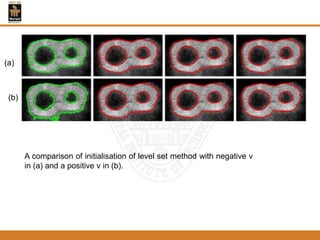
A comparison of initialisation of level set method with negative v
in (a) and a positive v in (b).
(a)
(b)
• The balloon force can now be derived from spatial fuzzy
clustering.
• Once approaching the object, the level set function will
automatically slow down as it comes closer to the object to be
segmented and become totally dependent on the smoothing
term.
Disadvantages:
• Without the proper use of controlling parameter, segmentation
could be excessive or insufficient.
Advantages:
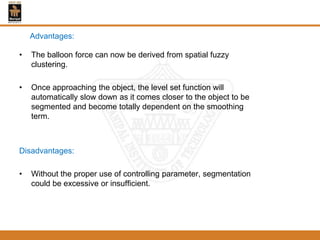
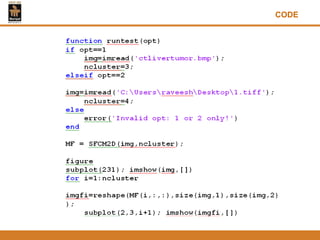
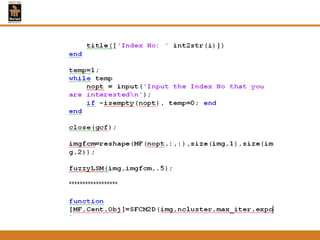
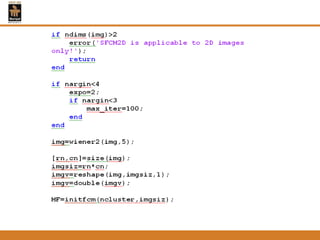
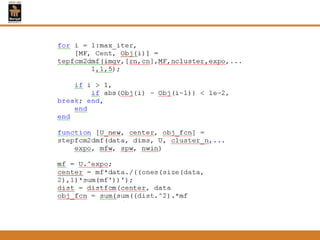
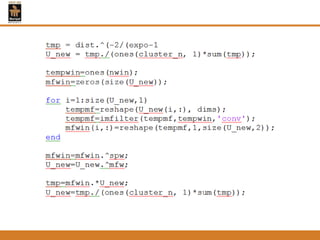
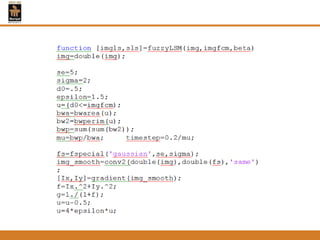
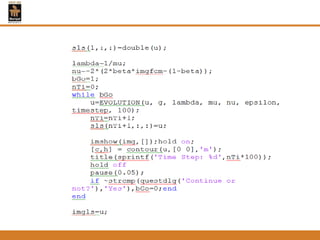
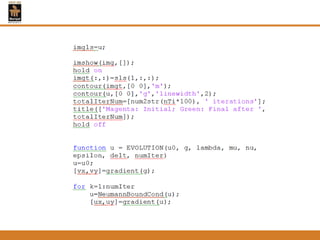
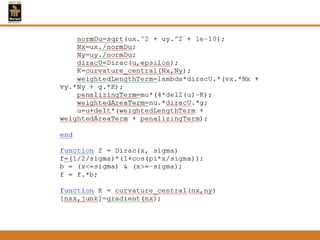
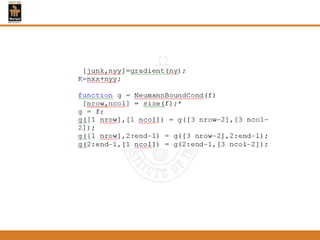
CODE
Result analysis
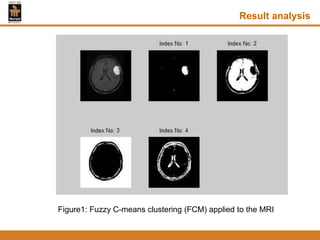
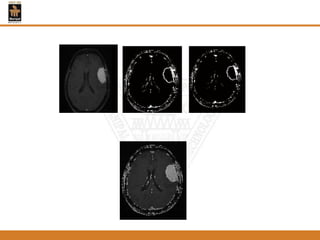
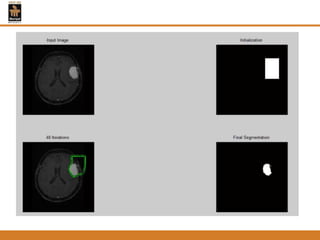
Figure1: Fuzzy C-means clustering (FCM) applied to the MRI
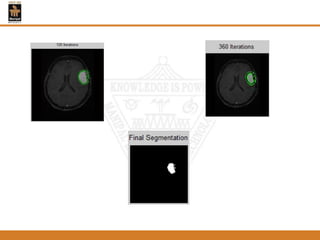
Figure 2: A level set segmentation
Figure 3:The final result
Conclusion and Future work
• Each of the techniques segments the image appropriately. But these
methods cannot be compare on the basis of time and iterations.
• Watershed transform requires a lot of morphological operations for the
image to be properly segmented.
• In our method split-merge gives appropriate results ,but the results
should be post processed.
• Parametric active contours are not able to divide the contours if there
are multiple regions.
• In level set methods , SDF has to be reinitialized again and again.
• Bounding box only approximately segments the regions.
• Fuzzy level set method encounters all these problems. There is no
problem of re-initialization in this method and we can set the time step
large and get faster as well as stable evolution.
Conclusion:
Future work:
• Although these methods are able to give robust and accurate results for
much complex regions in 2-D images ,but there is always a scope of
improvement.
• These methods can be developed to be totally automated without affecting
the stability of the segmentation by reducing the number of parameters.
• But these methods can be extended to segment 3-D tissues.
References
[1] Ammara Masood, Adel Ali Al-Jumaily, Fuzzy C Mean Thresholding based
Level Set for Automated Segmentation of Skin Lesions, Journal of Signal
and Information Processing, 4, 66-71,2013.
[2] A.B.M. Faruquzzaman1, Nafize Rabbani Paiker1, Jahidul Arafat1, Ziaul
Karim1 , and M. Ameer Ali2, Object Segmentation Based on Split and
Merge Algorithm, 978-1-4244-2409-2, 19-21 Nov. 2008.
[3]D. Chaudhuri, B.B. Chaudhuri and C.A. Murthy, A New Split–and-Merge
Clustering Technique, Pattern Recognition Letters 13, pp. 399-409, 1998.
[4]D. Mumford and J. Shah, “Optimal approximation by piecewise smooth
functions and associated variational problems,” Commun. Pure Appl. Math,
vol. 42, pp. 577–685,1989.
[5] Li F, Ng M, Li C. Variational fuzzy Mumford-Shah model for image
segmentation. SIAM J Appl Math 2010;70(7):2750–70,2010.
[6] Lions P, Mercier B. Splitting algorithms for the sum of two nonlinear operators.
SIAM J Numer Anal 1979;16(6):964–79,1979.
[7] M. E. Brummer, R. M. Mersereau, R. L. Eisner, R. J. Lewine, “Automatic
detection of brain contours in MRI data sets”, IEEE Trans. Medical Imaging, vol. 12,
no. 2, pp. 153 -166,1993.
[8] Rachana Rana1, H.S. Bhadauria2, Annapurna Singh, Study of Various Methods
for brain Tumour Segmentation from MRI Images, International Journal of Emerging
Technology and Advanced Engineering, (pp. 2250-2459), Volume 3, Issue 6, June
2013.
[9] Rajesh C. Patil, Dr. A. S. Bhalchandra, Brain Tumour Extraction from MRI Images
Using MATLAB, International Journal of Electronics, Communication & Soft
Computing Science and Engineering, 2277-9477, Volume 2, Issue 1,2011.
[10] Shawn Lankton, Student Member, IEEE, and Allen Tannenbaum, Member,
IEEE, Localizing Region-Based Active Contours,Year of Publication 2008 IEEE
transactions on image processing, vol. 17, no. 11, Nov. 2008.
THANK YOU!!!

various methods for image segmentation

  • 1.
    BRAIN TUMOUR SEGMENTATIONOF MRI IMAGE USING MATLAB
  • 2.
    Contents 1. Preview 2. Flowchart 3.Background theory and/or literature reviewwork 4. Methodology 5. Result analysis 6. Conclusion and future work 7. References Department of Electronics and Communication Engineering, MIT, Manipal
  • 3.
    Preview Department of Electronicsand Communication Engineering, MIT, Manipal 1) Convert it to gray scale image. 2) Apply high pass filter. 3) Apply median filter to enhance the quality of the image. 4)Apply watershed transform; you will find that it results in Over segmentation due to a lot of minimas. c start
  • 4.
    1) Apply morphologicaloperations to the image such as Opening and closing. 2) Calculate regional maxima to obtain the foreground Markers and superimpose them over the original image. 3)Calculate background markers using thresholding and Then applying the watershed transform of the distance Function to get the water-rigde lines. 4)Superimpose the foreground ,background markers and The segmented region in order to visualize the result. Label Matrix can also be displayed as color matrix stop C 5)Superimpose this color matrix over the original image.
  • 5.
    • The resultingboundaries form closed and connected regions. • The boundaries of the resulting regions always correspond to contours which appear in the image as obvious contours of objects. • The union of all the regions forms the entire image region. Advantages & Disadvantages Advantages: Disadvantage: • It produces excessive over-segmentation
  • 7.
    SPLIT AND MERGESEGMENTATION
  • 9.
    Advantages: • The imagecould be split progressively according to our demanded resolution because the number of splitting level is determined by us. • We could split the image using the criteria we decide, such as mean or variance of segment pixel value. • In addition, the merging criteria could be different to the splitting criteria. Disadvantage: • It may produce the blocky segments.
  • 10.
    localised region basedactive contour 1) The construction of a family of local energies at each point along the curve. 2) Each point moves to minimize the energy computed in its own local region. 3) local neighborhoods are split into local interior and local exterior by the evolving curve. 4) energy optimization is then done by fitting a model to each local region. stop start
  • 13.
    Advantages: • lower sensitivityto contour initialisation and noise. • feasibility of segmentation of color images even in the absence of gradient-defined boundaries. • better ability to capture concavities of objects Disadvantages: • computational time, sensitive initial boundary, kernel size
  • 14.
    1) Set them value, the number of clusters c and the size Of the spatial constraint window used to average the Membership matrix. 2) Estimate an initial bias field signal B0 from the corrupted MRI images. 3) Calculate the membership matrix U_ik. 4) For each pixel take the average of the membership Matrix x around a window of specified value. Normalize the membership matrix so for each image pixel the summation of the membership values corresponding to different clusters equals to one. C start Multi-Phase level set evolution and Bias field correction
  • 15.
    5) Calculate theprototype centres vi and estimate the bias Field Bk. C 6) Test if the difference between the norm of the previous calculated membership matrix and the norm of the current membership matrix ||Ul||− ||Ul+1|| is less than a pre-specified error or if the algorithm exceeds certain number of iterations than exit. stop
  • 17.
    • They areversatile, robust, accurate, and efficient techniques. • This techniques is able to handle sharp corners and cusps in the propagating solution, as well as topological changes, and three-dimensional effects. • By employing fast narrow band adaptive techniques, the computational labor is the same as other methods, with the advantages of increased accuracy and robust modeling . Disadvantages: • The drawback to level set techniques is that they require considerable thought in order to construct appropriate velocities for advancing the level set function. Advantages:
  • 18.
  • 20.
    • It isrobust, accurate and efficient than the current method. • It can be applied to higher field (e.g. 7 T) MRI scanners, the intensity inhomogeneities have more complicated profiles than 1.5 T and 3 T MR images. • It is numerical stable in computation of the bias field. • This method doesn’t require separate methods for estimating energy and bias field, and also for segmentation of MR images. • It is independent of initialisation Disadvantages: • It does not make use of contours ,rather it separates the image into different regions. Advantages:
  • 21.
    1) First theintracranial regions are marked. 2) On each input MR slice (axial view), FBB first locates the left-right axis of symmetry of the brain. 3) The algorithm searches for an axis-parallel rectangle on the left side that is very dissimilar from its reflection about the axis of symmetry on the right side. 4) FBB algorithm finds the rectangle D, i.e., the four unknown parameters lx, ux, ly and uy in two linear passes of the image. It first finds ly and uy in a vertical sweep and then finds lx and ux in a horizontal sweep of the pair of images. C start Bounding Box method based on symmetry
  • 22.
    5) Based onthese values the bounding box is located. C stop
  • 23.
    Elapsed time is1.485019 seconds. E(l) E(l) w ww h hh h h h w w w E(l) E(l) h-height w-width E(l)-Energy function
  • 24.
    Advantages: • It makesuse of the bounding boxes that are used to segment large number of slices in very short period of time. • It is fully automated and does not need any initialization. • The importance of indexing a large number of tumour regions is that the images of similar cases can be used for treatment of a new case. Disadvantages: • It only approximately segments the tumour region in the form of rectangular boxes and does not segment the every tiny cusp or edges of the tumour region.
  • 25.
    Spatial fuzzy clusteringwith the level set method 1)Define membership function 𝛍 𝑚𝑛 for nth object of 𝑚 𝑡ℎ cluster and the cost function for spatial clustering over the MR image. 2)Apply Fuzzy clustering method to divide the image into different clusters. 3) Choose your region of interest and apply level set method. 4) A level set contour(purple) will segment the tumour region . stop start 4) After T iterations , a dialog box will appear asking whether to continue another set of iterations. if “yes” , go back To step 4,otherwise a green contour (final) will appear in place of the purple contour. Flowchart
  • 26.
    • In Fuzzyclustering , the centroid and scope of each class are estimated adaptively in order to minimize a pre-defined cost function. • FCM uses a membership function 𝛍 𝑚𝑛 to indicate the degree of membership of the 𝑚 𝑡ℎ cluster to the nth object. • The standard FCM cost function is optimized when the pixels close to the centroid are maximized and those farther away are minimized. Fuzzy level set method Background theory
  • 27.
     Ј =𝑛=1 𝑁 𝑚=1 𝐶 𝛍 𝑚𝑛 𝑙 ||𝑖 𝑛 − 𝛎 𝑚|| 2 : cost function 𝑚=1 𝐶 𝛍 𝑚𝑛 = 1 0 ≤ 𝛍 𝑚𝑛 = 1 𝑛=1 𝑁 𝛍 𝑚𝑛 > 0  𝛍 𝑚𝑛= ||𝑖 𝑛 − 𝛎 𝑚||−2/(𝑙−1) 𝑘=1 𝐶 ||𝑖 𝑛 − 𝛎 𝑘||−2/(𝑙−1)  𝛎𝑖= 𝑛=1 𝑁 𝛍 𝑚𝑛 𝑙 𝑖 𝑛 𝑛=1 𝑁 𝛍 𝑚𝑛 𝑙  𝛍 𝑚𝑛 ′ = 𝛍 𝑚𝑛 𝑃 ℎ 𝑚𝑛 𝑞 𝑘=1 𝐶 𝛍 𝑘𝑛 𝑃 ℎ 𝑘𝑛 𝑞  ℎ 𝑚𝑛 = 𝑘∈𝑁 𝑛 𝛍 𝑘𝑛 Membership function & it’s properties :Centroid of the 𝑖 𝑡ℎ 𝑐𝑙𝑢𝑠𝑡𝑒𝑟 :Variable containing the spatial information :new fuzzy variable where p and q control their respective contribution
  • 28.
    • Level setMethod utilizes dynamic variational boundaries for an image segmentation. • It is possible to approximate the evolution of the level set contour by tracking the zero level set 𝝘(𝑡). • The implicit contour may be compromised of series of single or more zero iso-contours. • The advancing force F has to be regularised by an edge indication function g in order to stop level set evolution near the optimal solution. • But this method is not so stable as it has to comply with the CFL condition and the SDF needs to be reinitialised periodically.
  • 29.
    𝝓 𝑡, 𝑥,𝑦 < 0 𝑥, 𝑦 𝑖𝑠 𝑖𝑛𝑠𝑖𝑑𝑒 𝝘(𝑡) 𝝓 𝑡, 𝑥, 𝑦 = 0 𝑥, 𝑦 𝑖𝑠 𝑎𝑡 𝝘(𝑡) 𝝓 𝑡, 𝑥, 𝑦 > 0 𝑖𝑠 𝑜𝑢𝑡𝑠𝑖𝑑𝑒 𝝘(𝑡) 𝜕𝝓 𝜕𝑡 + 𝐹 𝛻𝝓 = 0 𝝓 0, 𝑥, 𝑦 = 𝝓0(𝑥, 𝑦) 𝑔 = 1 1 + |𝛻( 𝐺 𝝈 ∗ 𝐼)| 𝜕𝝓 𝜕𝑡 = 𝛍𝛇 𝝓 + 𝛏(𝗴, 𝝓) 𝛇 𝝓 = ∆𝝓 − div ( 𝛻𝝓 𝛻𝝓 ) 𝛏(𝗴, 𝝓)=λ𝛅(𝝓)div ਣ 𝛻𝝓 |𝛻𝝓 | + 𝛎ਣ𝛅(𝝓) 𝝓0(𝑥, 𝑦) = −𝐶, 𝝓0 𝑥, 𝑦 < 0 𝐶, 𝑜𝑡ℎ𝑒𝑟𝑤𝑖𝑠𝑒 𝝓 𝑘+1 𝑥, 𝑦 = 𝝓 𝑘 𝑥, 𝑦 +𝞽[𝛍𝛇(𝝓 𝑘 )+𝛏(ਣ, 𝝓 𝑘 )] The new level set method:The traditional level set formulation:
  • 30.
    • We gofor a fast level set method which is more stable and does not require re-initialisation of the SDF. • 𝛇 𝝓 is the penalty momentum of 𝝓 deviating away from the signed distance function. • The term 𝛏 𝗴, 𝝓 𝑖𝑛𝑐𝑜𝑟𝑝𝑜𝑟𝑎𝑡𝑒𝑠 𝑖𝑚𝑎𝑔𝑒 𝑔𝑟𝑎𝑑𝑖𝑒𝑛𝑡 𝑖𝑛𝑓𝑜𝑟𝑚𝑎𝑡𝑖𝑜𝑛 attracts 𝝓 towards the variational boundary. • The penalty term 𝛇 𝝓 forces 𝝓 to approach the genuine SDF automatically.
  • 31.
    • It beginswith spatial fuzzy clustering ,whose results are utilized to initiate the level set segmentation , estimate controlling parameters and regularize level set evolution. • It automates the initialization and parameter configuration using the level set evolution , using spatial fuzzy clustering. • The enhanced FCM can accommodate the results of FCM directly for evolution. The new fuzzy level set Method
  • 32.
    𝑅 𝑘: 𝑟𝑘= 𝛍 𝑛𝑘 , 𝑛 = 𝑥 × 𝑁 𝑦 + 𝑦 : 𝑡ℎ𝑒 𝑟𝑒𝑔𝑖𝑜𝑛 𝑜𝑓 𝑖𝑛𝑡𝑒𝑟𝑒𝑠𝑡 𝝓0(𝑥, 𝑦)= −4𝜀(0.5 − 𝑩 𝑘): the signed distance function 𝛅 𝜀(𝝌)= 0, 𝑥 > 𝜀 1 2𝜀 1 + 𝑐𝑜𝑠 πϰ/𝜀 , 𝑥 < 𝜀 ∶ 𝑩 𝑘 = 𝑅 𝑘 ≥ 𝑏0: here 𝑩 𝑘 is the binary image 𝑏0(∈ (0,1)):adjustable threshold 𝛏 𝗴, 𝝓 = λ𝛅 𝝓 𝑑𝑖𝑣 𝑔 𝛻𝝓 𝛻𝝓 + 𝗴𝙂(𝑅 𝑘)𝛅(𝛟) The new fuzzy level set method
  • 33.
    A comparison ofinitialisation of level set method with negative v in (a) and a positive v in (b). (a) (b)
  • 34.
    • The balloonforce can now be derived from spatial fuzzy clustering. • Once approaching the object, the level set function will automatically slow down as it comes closer to the object to be segmented and become totally dependent on the smoothing term. Disadvantages: • Without the proper use of controlling parameter, segmentation could be excessive or insufficient. Advantages:
  • 35.
  • 45.
    Result analysis Figure1: FuzzyC-means clustering (FCM) applied to the MRI
  • 46.
    Figure 2: Alevel set segmentation
  • 47.
  • 48.
    Conclusion and Futurework • Each of the techniques segments the image appropriately. But these methods cannot be compare on the basis of time and iterations. • Watershed transform requires a lot of morphological operations for the image to be properly segmented. • In our method split-merge gives appropriate results ,but the results should be post processed. • Parametric active contours are not able to divide the contours if there are multiple regions. • In level set methods , SDF has to be reinitialized again and again. • Bounding box only approximately segments the regions. • Fuzzy level set method encounters all these problems. There is no problem of re-initialization in this method and we can set the time step large and get faster as well as stable evolution. Conclusion:
  • 49.
    Future work: • Althoughthese methods are able to give robust and accurate results for much complex regions in 2-D images ,but there is always a scope of improvement. • These methods can be developed to be totally automated without affecting the stability of the segmentation by reducing the number of parameters. • But these methods can be extended to segment 3-D tissues.
  • 50.
    References [1] Ammara Masood,Adel Ali Al-Jumaily, Fuzzy C Mean Thresholding based Level Set for Automated Segmentation of Skin Lesions, Journal of Signal and Information Processing, 4, 66-71,2013. [2] A.B.M. Faruquzzaman1, Nafize Rabbani Paiker1, Jahidul Arafat1, Ziaul Karim1 , and M. Ameer Ali2, Object Segmentation Based on Split and Merge Algorithm, 978-1-4244-2409-2, 19-21 Nov. 2008. [3]D. Chaudhuri, B.B. Chaudhuri and C.A. Murthy, A New Split–and-Merge Clustering Technique, Pattern Recognition Letters 13, pp. 399-409, 1998. [4]D. Mumford and J. Shah, “Optimal approximation by piecewise smooth functions and associated variational problems,” Commun. Pure Appl. Math, vol. 42, pp. 577–685,1989. [5] Li F, Ng M, Li C. Variational fuzzy Mumford-Shah model for image segmentation. SIAM J Appl Math 2010;70(7):2750–70,2010.
  • 51.
    [6] Lions P,Mercier B. Splitting algorithms for the sum of two nonlinear operators. SIAM J Numer Anal 1979;16(6):964–79,1979. [7] M. E. Brummer, R. M. Mersereau, R. L. Eisner, R. J. Lewine, “Automatic detection of brain contours in MRI data sets”, IEEE Trans. Medical Imaging, vol. 12, no. 2, pp. 153 -166,1993. [8] Rachana Rana1, H.S. Bhadauria2, Annapurna Singh, Study of Various Methods for brain Tumour Segmentation from MRI Images, International Journal of Emerging Technology and Advanced Engineering, (pp. 2250-2459), Volume 3, Issue 6, June 2013. [9] Rajesh C. Patil, Dr. A. S. Bhalchandra, Brain Tumour Extraction from MRI Images Using MATLAB, International Journal of Electronics, Communication & Soft Computing Science and Engineering, 2277-9477, Volume 2, Issue 1,2011. [10] Shawn Lankton, Student Member, IEEE, and Allen Tannenbaum, Member, IEEE, Localizing Region-Based Active Contours,Year of Publication 2008 IEEE transactions on image processing, vol. 17, no. 11, Nov. 2008.
  • 52.