Segmentation


           Objective:
Student will learn on how to find
regions that represent objects or
   meaningful part of objects.


                                    1
   Download di http://rumah-belajar.org


                                           2
Introduction
   Segmentation is generally the first stage in any
    attempt to analyze or interpret an image
    automatically.
   Image segmentation is important in many computer
    vision and image processing applications.
   Segmentation partitions an image into distinct
    regions that are meant to correlate strongly with
    objects or features of interest in the image.
   Segmentation can also be regarded as a process of
    grouping together pixels that have similar attributes.
   For segmentation to be useful, the regions or groups
    of pixels that we generate should be meaningful.


                                                        3
   Segmentation bridges the gap between
    low-level image processing, which
    concerns itself with manipulation of pixel
    grey level or color to correct defects or
    enhance certain characteristics of the
    image, and high-level processing, which
    involves the manipulation and analysis of
    groups of pixel that represent particular
    features of interest.


                                           4
   Some kind of segmentation technique
    will be found in any application
    involving the detection, recognition and
    measurement of objects in image.
   Examples
       Industrial inspection
       Optical character recognition (OCR)
       Tracking of objects in a sequence of
        images
       Classification of terrains visible in satellite
        images
       Detection and measurement of bone,
        tissue, etc., in medical images.
                                                      5
   The goal of image segmentation is to
    find regions that represent objects or
    meaningful parts of objects.
   Division of the image into regions
    corresponding to objects of interest is
    necessary before any processing can be
    done at a level higher that that of the
    pixel.
   Identifying real objects, pseudo objects
    and shadows or actually finding
    anything of interest within the image
    requires some form of segmentation.

                                          6
   The role of segmentation is crucial in most tasks requiring
    image analysis.
   The success or failure of the task is often a direct
    consequence of the success or failure of segmentation.
   Segmentation techniques can be classified as either
    contextual or non-contextual.
   Non-contextual technique ignore the relationships that
    exist between features in an image.
       Pixels are simply grouped together on the basis of some global
        attribute, such as grey level.
   Contextual technique exploit the relationships between
    grey image features.
       Group together pixels that have similar grey levels and are close to
        one another.


                                                                         7
Overview
   Image segmentation methods will look for
    objects that either have some measure of
    homogeneity within themselves or have some
    measure of contrast with the objects on their
    border.
   Most image segmentation algorithm are
    modifications, extensions or combinations of
    these two basic concepts.


                                               8
   The homogeneity and contrast
    measures can include features such as
    grey level, color and texture.
   After performed some preliminary
    segmentation, we may incorporate
    higher-level object properties, such as
    perimeter and shape, into the
    segmentation process.
   The major problems are a result of
    noise in the image and digitization of a
    continuous image.

                                           9
   Noise is typically caused by the camera,
    the lenses, the lighting, or the signal
    path and can be reduced by the use of
    the pre-processing methods.
   Spatial digitization can cause problems
    regarding connectivity of objects.
   These problems can be resolved with
    careful connectivity definitions and
    heuristics applicable to the specific
    domain.


                                         10
Connectivity
   Connectivity refers to the way in which we
    define an object.
   After we have segmented an image, which
    segments should be connected to form an
    object?
   Or at lower level, when searching the image
    for homogeneous regions, how do we define
    which pixels are connected?


                                             11
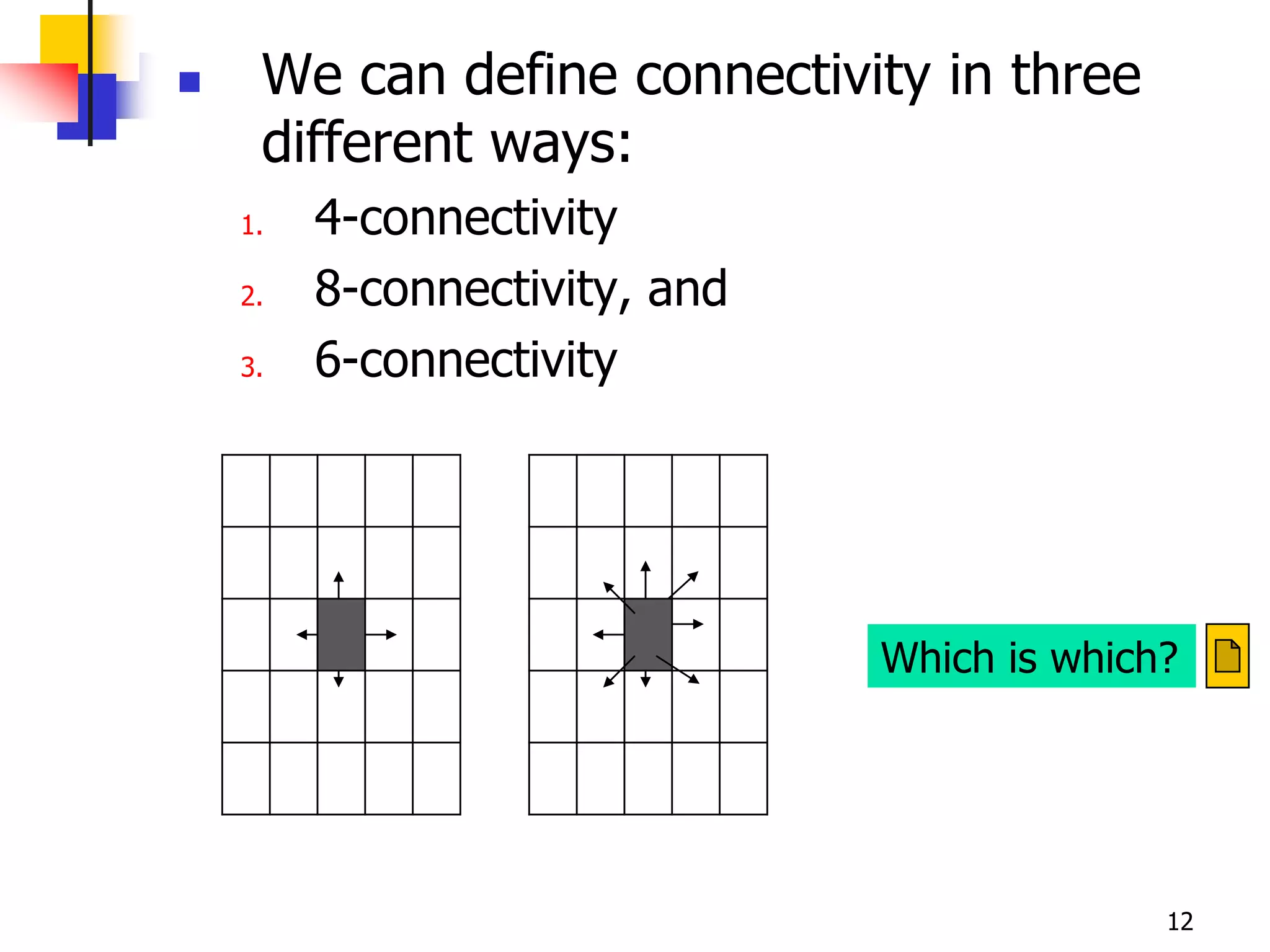
    We can define connectivity in three
     different ways:
    1.   4-connectivity
    2.   8-connectivity, and
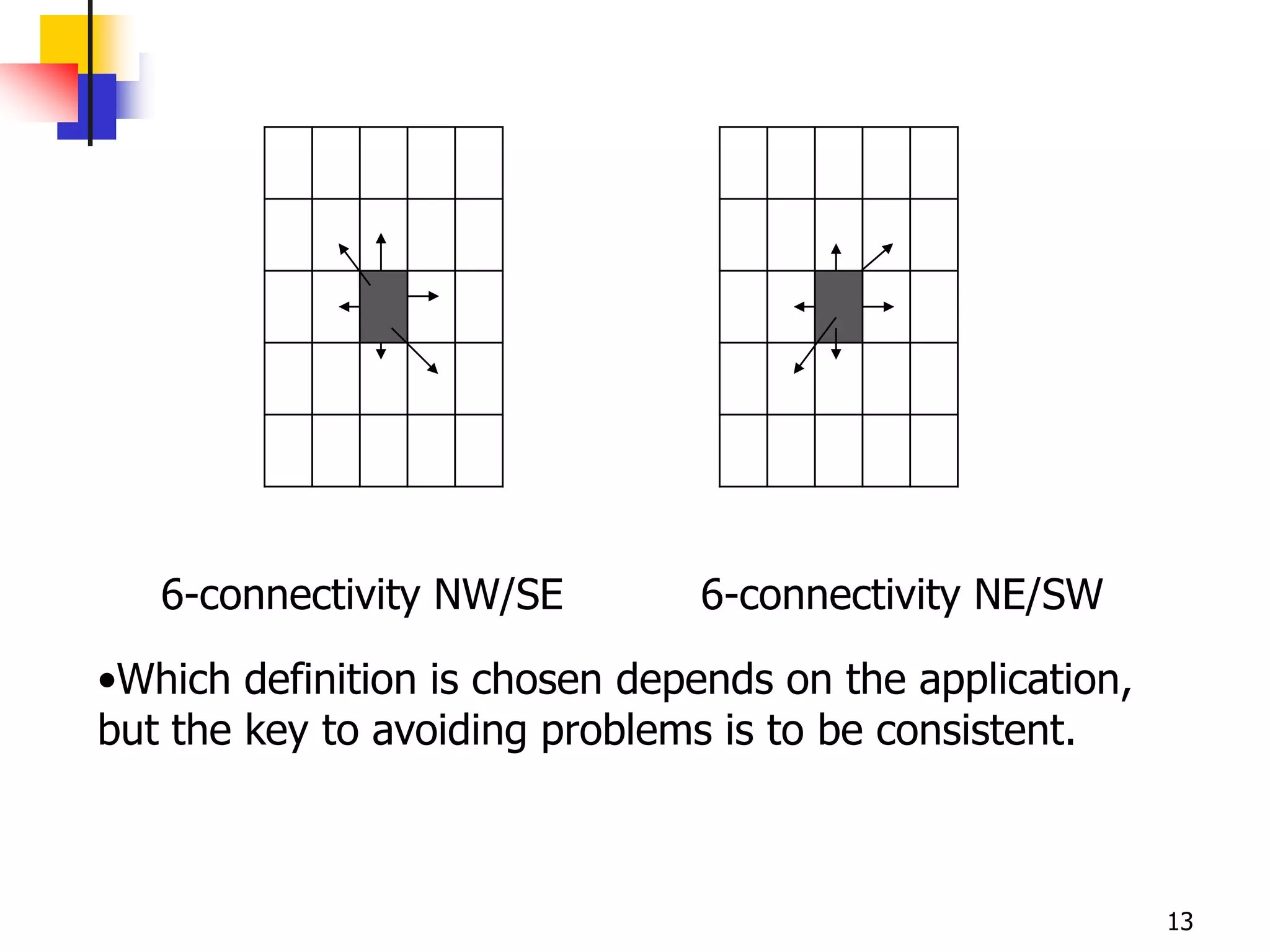
    3.   6-connectivity


                               Which is which?


                                             12
6-connectivity NW/SE         6-connectivity NE/SW

•Which definition is chosen depends on the application,
but the key to avoiding problems is to be consistent.


                                                          13
        We can divide image segmentation
         techniques into 3 main categories:
    1.     Region growing and shrinking
    2.     Clustering methods, and
    3.     Boundary detection.
        The region growing and shrinking methods
         use the row and column or x and y based
         image space.
        Clustering techniques can be applied to any
         domain (spatial domain, color, space,
         feature space, etc.)
        The boundary detection methods are
         extensions of the edge detection
         techniques.

                                                 14
Region Growing and Shrinking
   Segment the image into regions by
    operating principally in rc/xy-based
    image space.
   Some are local, others are global, and
    combine split and merge.


                                         15
   Split and merge technique 
     1.   Define a homogeneity test. A measurement
          which incorporate brightness, color, texture,
          or other application-specific information, and
          determining a criterion the region must meet
          to pass the homogeneity test.
     2.   Split the image into equally sized regions.
     3.   It the homogeneity test is passed for a
          region, then merge is attempted with its
          neighbour (s). If the criterion is not met, the
          region is split.
     4.   Continue this process until all regions pass
          the homogeneity test.
   There are many variations of this algorithm.

                                                      16
   The user defined homogeneity test is
    largely application dependent.
   The general idea is to look for features
    that will be similar within an object and
    different from the surrounding objects.
   In the simplest case  use grey level
    as feature of interest.
   Could use the grey level variance as
    homogeneity measure and define a
    homogeneity test that required the grey
    level variance within a region to be less
    than some threshold.

                                          17
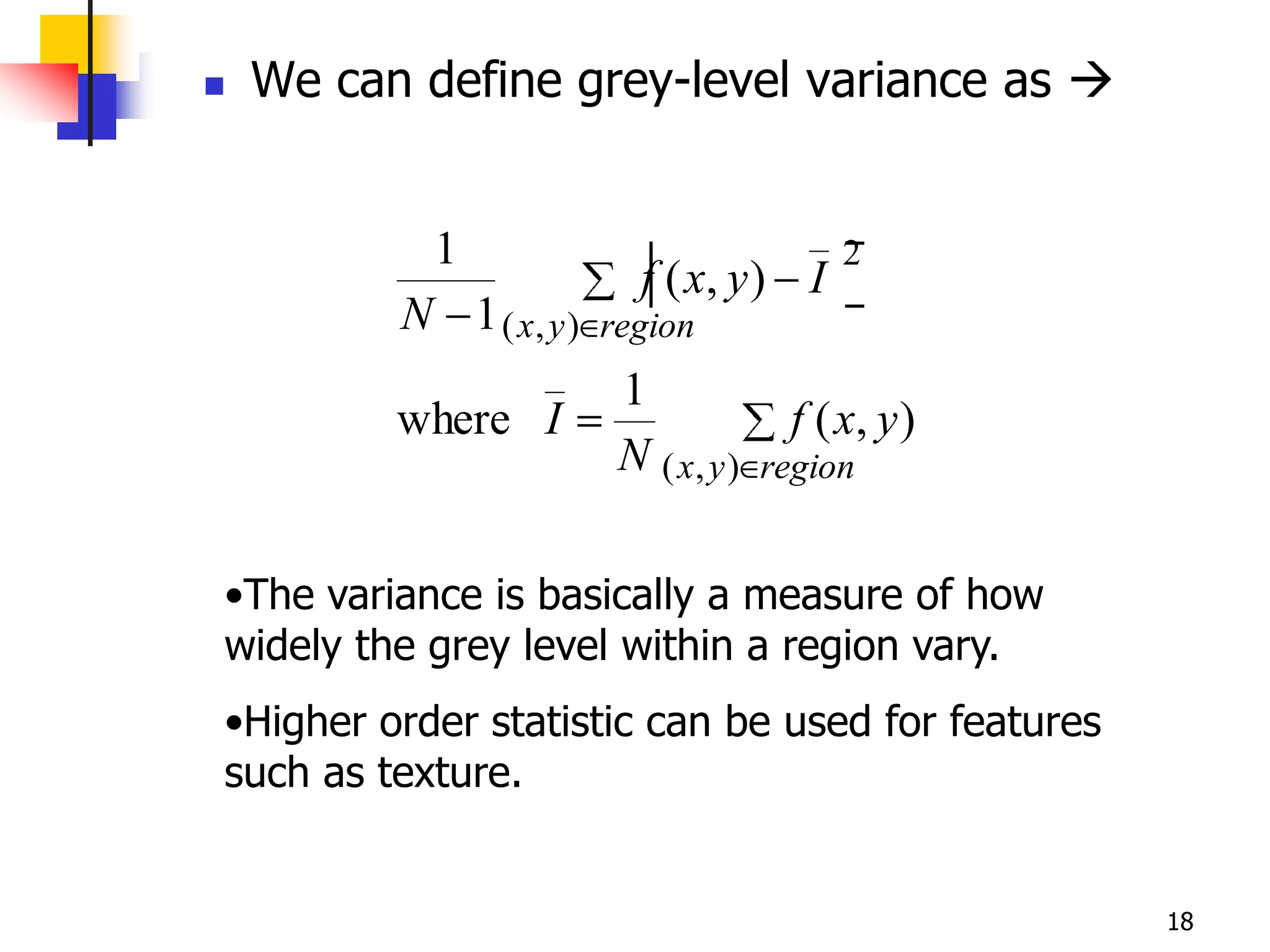
   We can define grey-level variance as 


            1                               2
                           f ( x, y ) I
          N 1 ( x, y )   region
                          1
          where I                       f ( x, y )
                          N ( x, y )   region


•The variance is basically a measure of how
widely the grey level within a region vary.
•Higher order statistic can be used for features
such as texture.


                                                     18
Clustering Technique
   Clustering techniques are image segmentation
    methods which individual elements are placed into
    groups based on some measure of similarity within
    the groups.
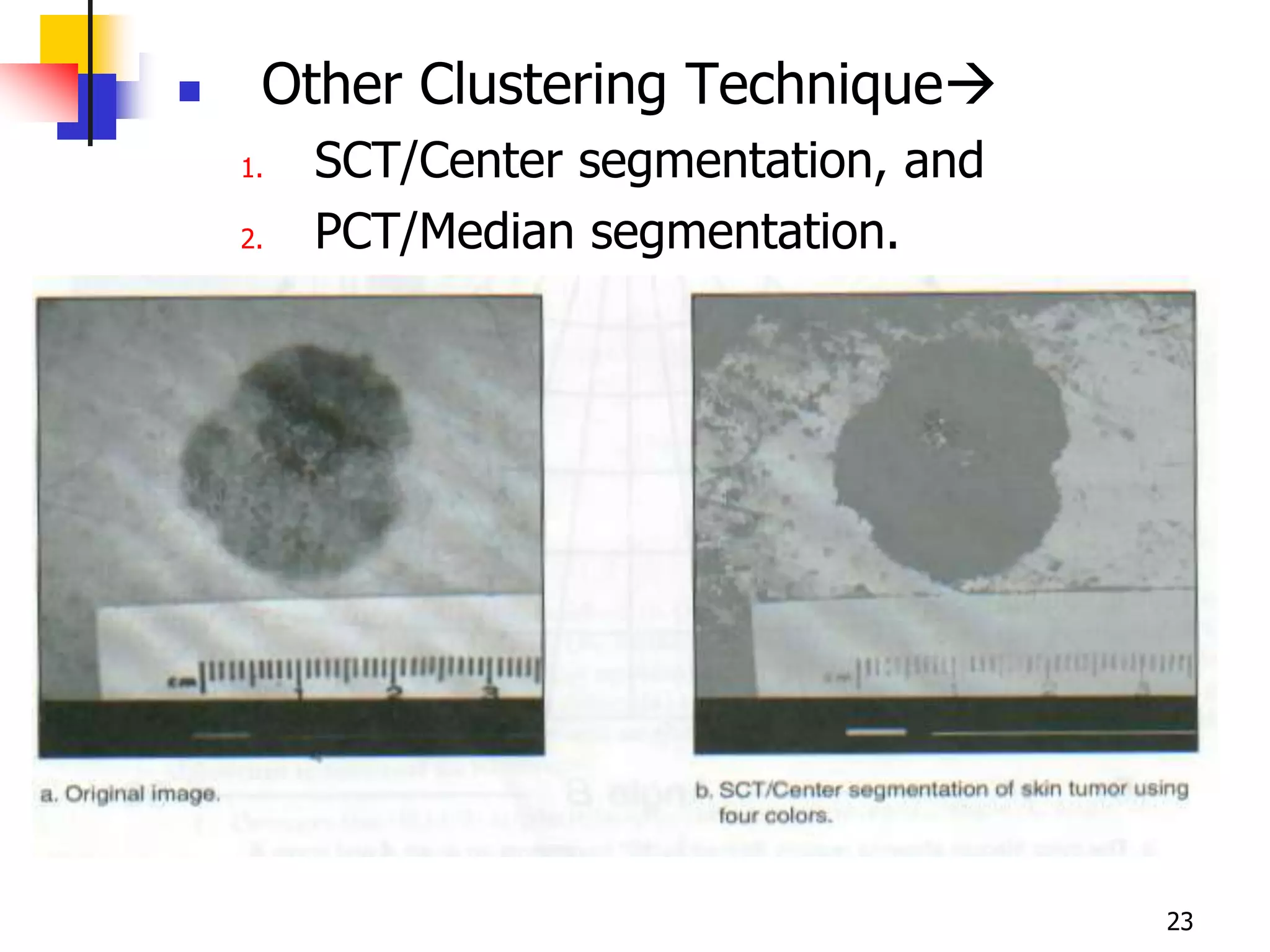
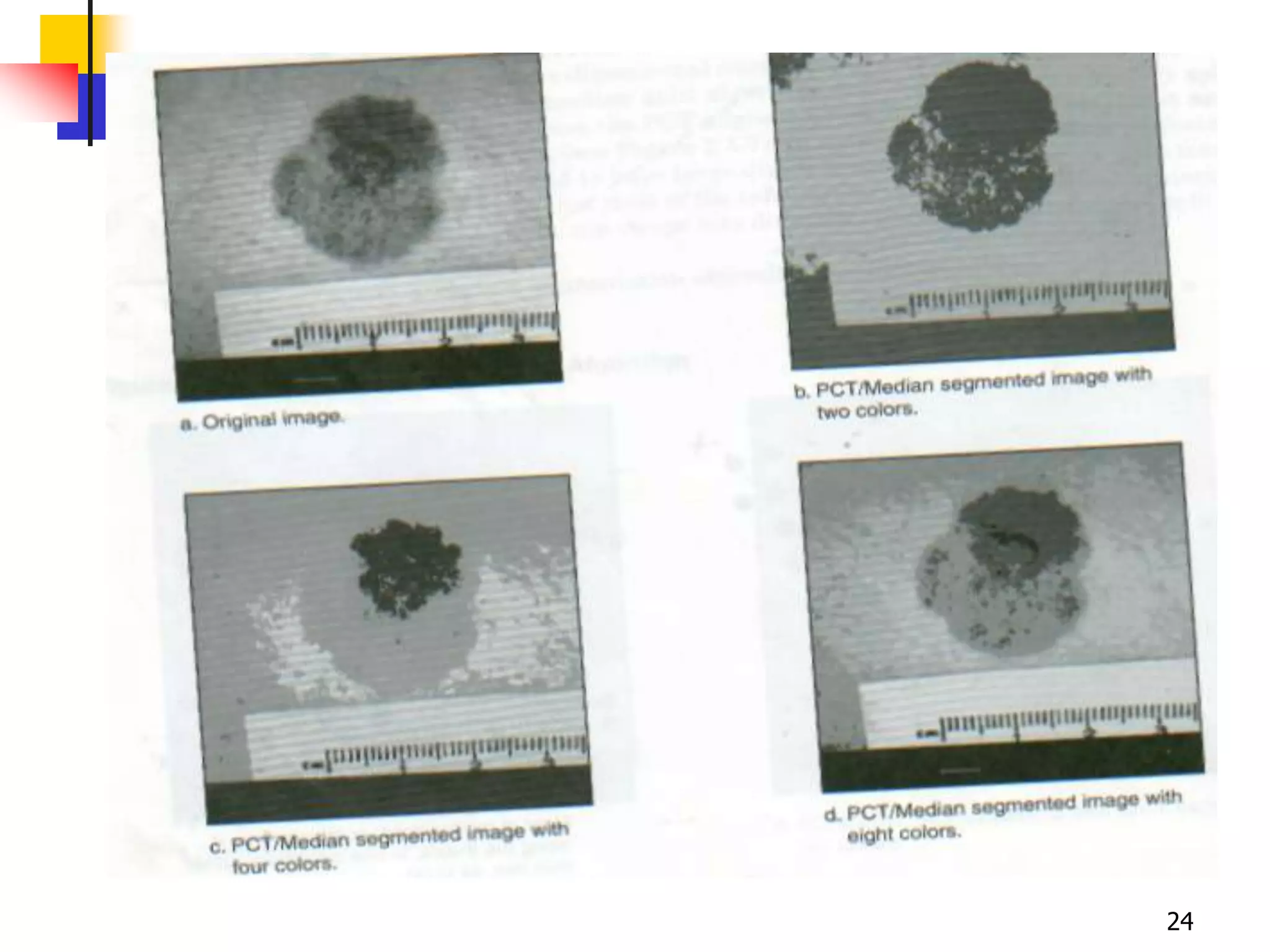
   The simplest method is to divide the space of interest
    into regions by selecting the centre or median along
    each dimension and splitting it.
   Can be done iteratively until the space is divided into
    specific number of regions needed.  used in the
    SCT/Center and PCT/Median segmentation
    algorithms.
    will be effective only if the space and the entire
    algorithm is designed intelligently.

                                                       19
        Recursive region splitting is a clustering
         method that has become a standard
         technique.
        One of the 1st algorithms based on recursive
         region splitting
    1.     Consider the entire image as one region and
           computer histograms for each component of
           interest (red, green and blue for a color image).
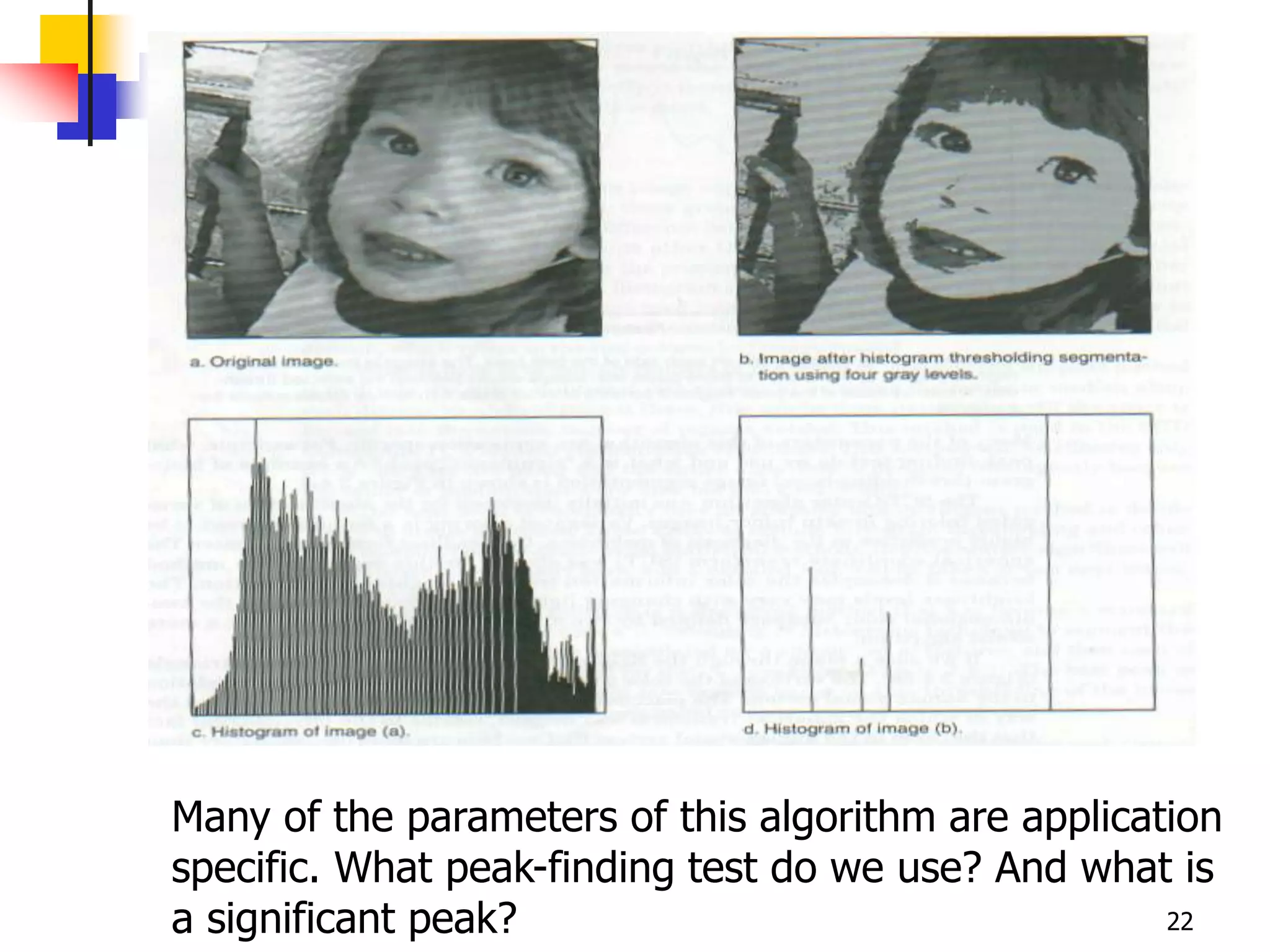
    2.     Apply a peak finding test to each histogram.
           Select the best peak and put thresholds on
           either side of the peak. Segment the image into
           two regions based on this peak.
    3.     Smooth the binary threshold image so that only
           a single connected sub-region is left.
    4.     Repeat step 1-3 for each region until no new
           sub-regions can be created  no histograms
           have significant peaks.

                                                         20
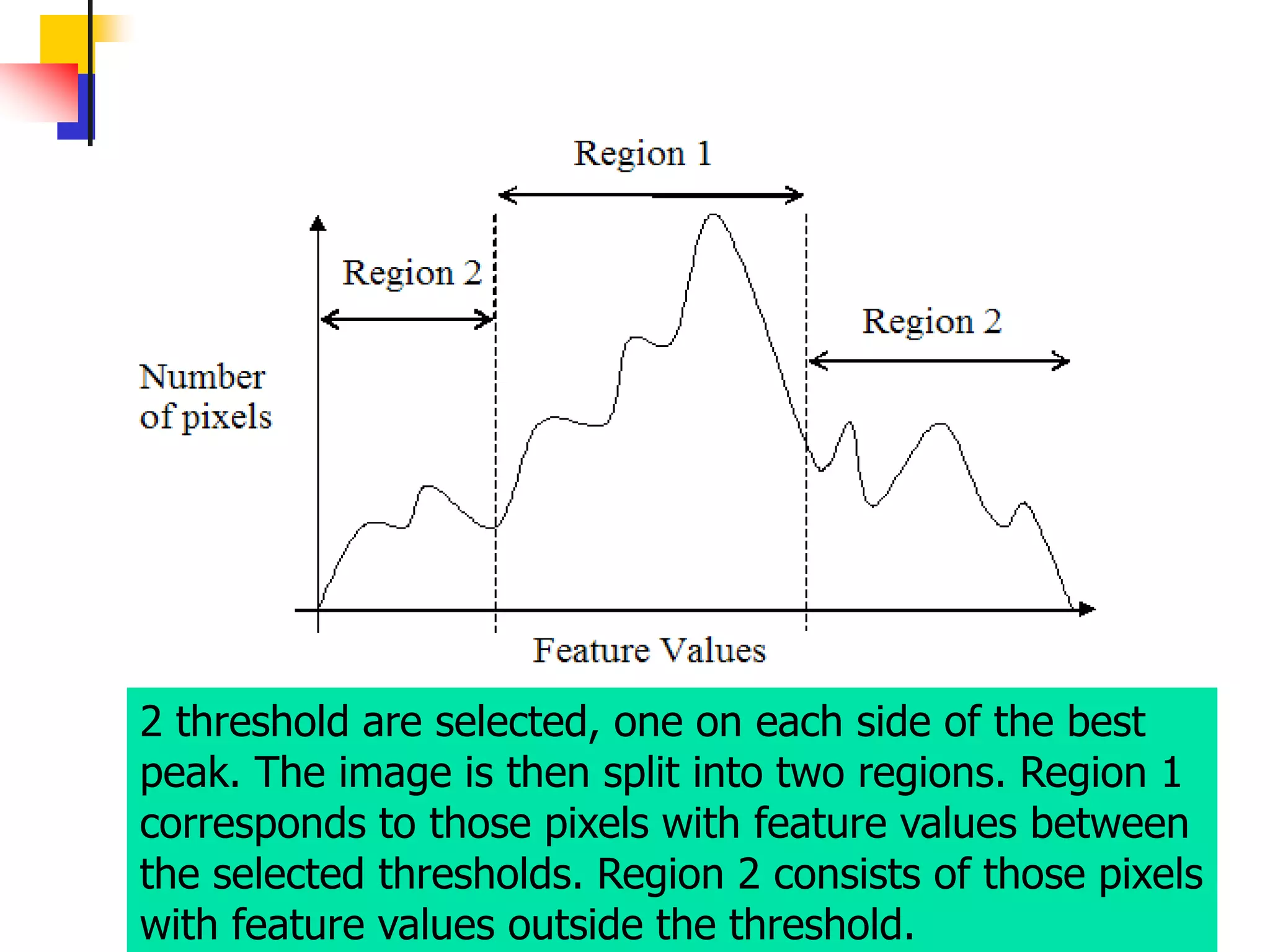
2 threshold are selected, one on each side of the best
peak. The image is then split into two regions. Region 1
corresponds to those pixels with feature values between
the selected thresholds. Region 2 consists of those pixels
with feature values outside the threshold.              21
Many of the parameters of this algorithm are application
specific. What peak-finding test do we use? And what is
a significant peak?                                  22
    Other Clustering Technique
    1.   SCT/Center segmentation, and
    2.   PCT/Median segmentation.


                                        23
24
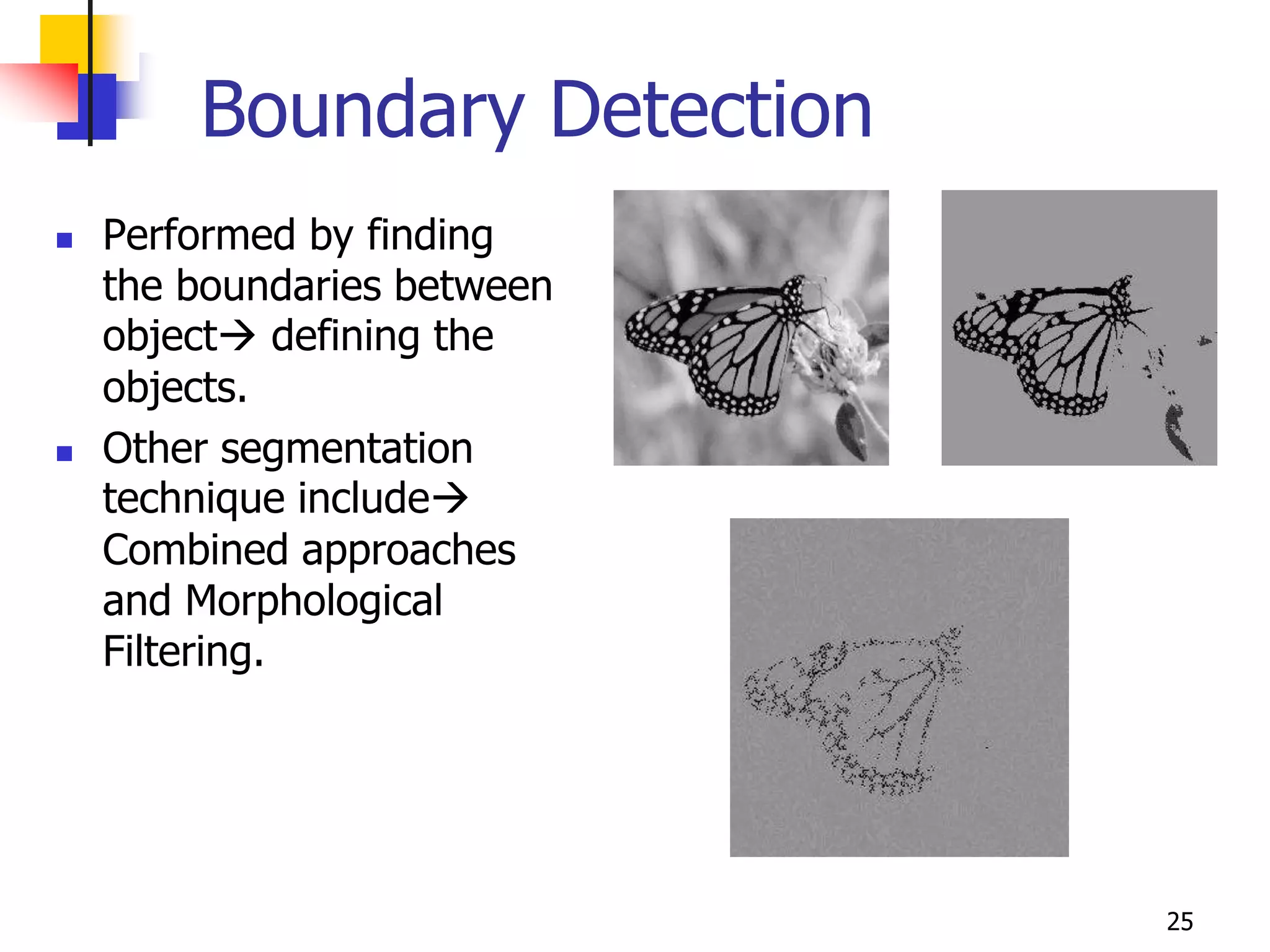
Boundary Detection
   Performed by finding
    the boundaries between
    object defining the
    objects.
   Other segmentation
    technique include
    Combined approaches
    and Morphological
    Filtering.


                             25

Image segmentation 2

  • 1.
    Segmentation Objective: Student will learn on how to find regions that represent objects or meaningful part of objects. 1
  • 2.
    Download di http://rumah-belajar.org 2
  • 3.
    Introduction  Segmentation is generally the first stage in any attempt to analyze or interpret an image automatically.  Image segmentation is important in many computer vision and image processing applications.  Segmentation partitions an image into distinct regions that are meant to correlate strongly with objects or features of interest in the image.  Segmentation can also be regarded as a process of grouping together pixels that have similar attributes.  For segmentation to be useful, the regions or groups of pixels that we generate should be meaningful. 3
  • 4.
    Segmentation bridges the gap between low-level image processing, which concerns itself with manipulation of pixel grey level or color to correct defects or enhance certain characteristics of the image, and high-level processing, which involves the manipulation and analysis of groups of pixel that represent particular features of interest. 4
  • 5.
    Some kind of segmentation technique will be found in any application involving the detection, recognition and measurement of objects in image.  Examples  Industrial inspection  Optical character recognition (OCR)  Tracking of objects in a sequence of images  Classification of terrains visible in satellite images  Detection and measurement of bone, tissue, etc., in medical images. 5
  • 6.
    The goal of image segmentation is to find regions that represent objects or meaningful parts of objects.  Division of the image into regions corresponding to objects of interest is necessary before any processing can be done at a level higher that that of the pixel.  Identifying real objects, pseudo objects and shadows or actually finding anything of interest within the image requires some form of segmentation. 6
  • 7.
    The role of segmentation is crucial in most tasks requiring image analysis.  The success or failure of the task is often a direct consequence of the success or failure of segmentation.  Segmentation techniques can be classified as either contextual or non-contextual.  Non-contextual technique ignore the relationships that exist between features in an image.  Pixels are simply grouped together on the basis of some global attribute, such as grey level.  Contextual technique exploit the relationships between grey image features.  Group together pixels that have similar grey levels and are close to one another. 7
  • 8.
    Overview  Image segmentation methods will look for objects that either have some measure of homogeneity within themselves or have some measure of contrast with the objects on their border.  Most image segmentation algorithm are modifications, extensions or combinations of these two basic concepts. 8
  • 9.
    The homogeneity and contrast measures can include features such as grey level, color and texture.  After performed some preliminary segmentation, we may incorporate higher-level object properties, such as perimeter and shape, into the segmentation process.  The major problems are a result of noise in the image and digitization of a continuous image. 9
  • 10.
    Noise is typically caused by the camera, the lenses, the lighting, or the signal path and can be reduced by the use of the pre-processing methods.  Spatial digitization can cause problems regarding connectivity of objects.  These problems can be resolved with careful connectivity definitions and heuristics applicable to the specific domain. 10
  • 11.
    Connectivity  Connectivity refers to the way in which we define an object.  After we have segmented an image, which segments should be connected to form an object?  Or at lower level, when searching the image for homogeneous regions, how do we define which pixels are connected? 11
  • 12.
    We can define connectivity in three different ways: 1. 4-connectivity 2. 8-connectivity, and 3. 6-connectivity Which is which? 12
  • 13.
    6-connectivity NW/SE 6-connectivity NE/SW •Which definition is chosen depends on the application, but the key to avoiding problems is to be consistent. 13
  • 14.
    We can divide image segmentation techniques into 3 main categories: 1. Region growing and shrinking 2. Clustering methods, and 3. Boundary detection.  The region growing and shrinking methods use the row and column or x and y based image space.  Clustering techniques can be applied to any domain (spatial domain, color, space, feature space, etc.)  The boundary detection methods are extensions of the edge detection techniques. 14
  • 15.
    Region Growing andShrinking  Segment the image into regions by operating principally in rc/xy-based image space.  Some are local, others are global, and combine split and merge. 15
  • 16.
    Split and merge technique  1. Define a homogeneity test. A measurement which incorporate brightness, color, texture, or other application-specific information, and determining a criterion the region must meet to pass the homogeneity test. 2. Split the image into equally sized regions. 3. It the homogeneity test is passed for a region, then merge is attempted with its neighbour (s). If the criterion is not met, the region is split. 4. Continue this process until all regions pass the homogeneity test.  There are many variations of this algorithm. 16
  • 17.
    The user defined homogeneity test is largely application dependent.  The general idea is to look for features that will be similar within an object and different from the surrounding objects.  In the simplest case  use grey level as feature of interest.  Could use the grey level variance as homogeneity measure and define a homogeneity test that required the grey level variance within a region to be less than some threshold. 17
  • 18.
    We can define grey-level variance as  1 2 f ( x, y ) I N 1 ( x, y ) region 1 where I f ( x, y ) N ( x, y ) region •The variance is basically a measure of how widely the grey level within a region vary. •Higher order statistic can be used for features such as texture. 18
  • 19.
    Clustering Technique  Clustering techniques are image segmentation methods which individual elements are placed into groups based on some measure of similarity within the groups.  The simplest method is to divide the space of interest into regions by selecting the centre or median along each dimension and splitting it.  Can be done iteratively until the space is divided into specific number of regions needed.  used in the SCT/Center and PCT/Median segmentation algorithms.   will be effective only if the space and the entire algorithm is designed intelligently. 19
  • 20.
    Recursive region splitting is a clustering method that has become a standard technique.  One of the 1st algorithms based on recursive region splitting 1. Consider the entire image as one region and computer histograms for each component of interest (red, green and blue for a color image). 2. Apply a peak finding test to each histogram. Select the best peak and put thresholds on either side of the peak. Segment the image into two regions based on this peak. 3. Smooth the binary threshold image so that only a single connected sub-region is left. 4. Repeat step 1-3 for each region until no new sub-regions can be created  no histograms have significant peaks. 20
  • 21.
    2 threshold areselected, one on each side of the best peak. The image is then split into two regions. Region 1 corresponds to those pixels with feature values between the selected thresholds. Region 2 consists of those pixels with feature values outside the threshold. 21
  • 22.
    Many of theparameters of this algorithm are application specific. What peak-finding test do we use? And what is a significant peak? 22
  • 23.
    Other Clustering Technique 1. SCT/Center segmentation, and 2. PCT/Median segmentation. 23
  • 24.
  • 25.
    Boundary Detection  Performed by finding the boundaries between object defining the objects.  Other segmentation technique include Combined approaches and Morphological Filtering. 25