The Circulatory System
SBI3U
Interesting Facts
• Your system of blood vessels –
arteries, veins and capillaries – is
over 60,000 miles long. That's long
enough to go around the world more
than twice!
• The adult heart pumps about 5
quarts of blood each minute –
approximately 2,000 gallons of blood
each day – throughout the body.
Interesting Facts
• When attempting to locate their
heart, most people place their hand
on their left chest. Actually, your
heart is located in the center of your
chest between your lungs. The
bottom of the heart is tipped to the
left, so you feel more of your heart
on your left side of your chest.
• The heart beats about 100,000 times
each day.
Interesting Facts
• In a 70-year lifetime, the average human
heart beats more than 2.5 billion times
• An adult woman’s heart weighs about 8
ounces, a man’s about 10 ounces
• A child’s heart is about the size of a
clenched fist; an adult’s heart is about the
size of two fists.
• Blood is about 78 percent water.
• Blood takes about 20 seconds to circulate
throughout the entire vascular system.
Overview of Circulation
• Cardiac circulation:
blood flow within the
heart
• Pulmonary circulation:
blood flow between the
heart and lungs
• Systemic circulation:
blood flow from heart to
rest of the body
The pathway of blood flow
Heart
Vein

Artery

Venule

Arteriole
Capillary
Types of Blood vessels
Vessel

Structure

Artery

Thick elastic walls
Small
circumference

Transports
blood AWAY
from the heart

Vein

Thin, less elastic
walls with valves
Large
circumference

Transports
blood TOWARDS
the heart

Very thin wall
Smallest
circumference

Materials are
exchanged
between the
blood and the
body

Capillary

Function

Diagram
Arteries and veins
A. Cross-section

B. Longitudinal section
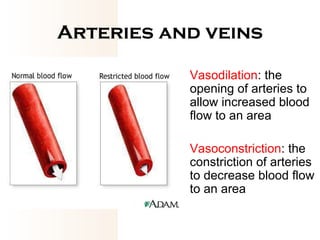
Arteries and veins
Vasodilation: the
opening of arteries to
allow increased blood
flow to an area
Vasoconstriction: the
constriction of arteries
to decrease blood flow
to an area
Capillaries
Walls of blood vessels
are made up of cells
called endothelial cells.
The thin layer of
endothelial cells allows
diffusion to occur more
rapidly.
Capillaries
Red blood cells travel
through the capillary in
single file.
Blood velocity is the
slowest in capillaries
Why blood flows
In arteries:
– Elastic walls expand and contract.
– As they contract, this helps to pump the
blood around the body.
3 structural layers.
Outer layer - covering of connective tissue.
Middle layer (thickest layer) - alternating circular bands of
elastic fibres and smooth muscle
Inner layer - only a single cell thick, contains smooth
endothelial cells that serve to reduce friction as blood
courses through the artery.
Why blood flows
In veins:
– Valves act as one-way doors to prevent
blood from flowing backwards.
– Muscular contractions can “pump” the
blood
Varicose veins

When valves don’t work properly
What is in blood?
-red blood cells (erythrocyte)
 carry oxygen
-white blood cells (leucocytes)
 part of the immune
system
-platelets
 stop bleeding by clotting
blood
-plasma
 contains nutrients like
amino acids and glucose
-water
The human heart
Direction of blood flow
• Oxygenated blood:
Lung  pulmonary vein  left atrium
 bicuspid valve  left ventricle 
aortic semilunar valve  aorta  rest
of body
• Deoxygenated blood:
Vena cava  tricuspid valve  right atrium
right ventricle pulmonary semilunar
valve  pulmonary artery  lungs
Cardiac Circulation
Cardiac Circulation
Comparing atria and
ventricles
Atria

Ventricles

Location Upper half of heart Lower half of heart

Thickness

Thinner walls
(pumps blood to
ventricles below)

Thicker walls
(pumps blood to
lungs or to rest of
the body)
The heartbeat
• The heartbeat is controlled by the
sinoatrial node (also known as the
pacemaker).
• The SA node sends electrical signals
that cause the heart muscle to
contract.
• The heart makes a ‘lup-dup’ sound
as blood flows through and the
valves close.
The SA node and the AV
node
SA node
= sinoatrial node
AV node
= atrioventricular node
Electrocardiographs
(ECGs)
• The electrical signals of the heart can be
measured using a machine called an
electrocardiograph (ECG).
ECG analysis
• P: atria contract (ventricles relax)
• QRS: ventricles contract (atria relax)
• T: both atria and ventricles relax
Cardiovascular disease
AORTIC ANEURYSM
Cardiovascular disease
ATHEROSCLEROSIS
Treatments
CORONARY BYPASS
Treatments

ANGIOPLASTY & STENT
Mammalian Heart
Pericardium
Tricuspid Valve
Bicuspid Valve
Chordae Tendinae “the heart
strings”
Prosthetic Valves

05 circulation

  • 1.
  • 2.
    Interesting Facts • Yoursystem of blood vessels – arteries, veins and capillaries – is over 60,000 miles long. That's long enough to go around the world more than twice! • The adult heart pumps about 5 quarts of blood each minute – approximately 2,000 gallons of blood each day – throughout the body.
  • 3.
    Interesting Facts • Whenattempting to locate their heart, most people place their hand on their left chest. Actually, your heart is located in the center of your chest between your lungs. The bottom of the heart is tipped to the left, so you feel more of your heart on your left side of your chest. • The heart beats about 100,000 times each day.
  • 4.
    Interesting Facts • Ina 70-year lifetime, the average human heart beats more than 2.5 billion times • An adult woman’s heart weighs about 8 ounces, a man’s about 10 ounces • A child’s heart is about the size of a clenched fist; an adult’s heart is about the size of two fists. • Blood is about 78 percent water. • Blood takes about 20 seconds to circulate throughout the entire vascular system.
  • 5.
    Overview of Circulation •Cardiac circulation: blood flow within the heart • Pulmonary circulation: blood flow between the heart and lungs • Systemic circulation: blood flow from heart to rest of the body
  • 6.
    The pathway ofblood flow Heart Vein Artery Venule Arteriole Capillary
  • 7.
    Types of Bloodvessels Vessel Structure Artery Thick elastic walls Small circumference Transports blood AWAY from the heart Vein Thin, less elastic walls with valves Large circumference Transports blood TOWARDS the heart Very thin wall Smallest circumference Materials are exchanged between the blood and the body Capillary Function Diagram
  • 8.
    Arteries and veins A.Cross-section B. Longitudinal section
  • 9.
    Arteries and veins Vasodilation:the opening of arteries to allow increased blood flow to an area Vasoconstriction: the constriction of arteries to decrease blood flow to an area
  • 10.
    Capillaries Walls of bloodvessels are made up of cells called endothelial cells. The thin layer of endothelial cells allows diffusion to occur more rapidly.
  • 11.
    Capillaries Red blood cellstravel through the capillary in single file. Blood velocity is the slowest in capillaries
  • 12.
    Why blood flows Inarteries: – Elastic walls expand and contract. – As they contract, this helps to pump the blood around the body. 3 structural layers. Outer layer - covering of connective tissue. Middle layer (thickest layer) - alternating circular bands of elastic fibres and smooth muscle Inner layer - only a single cell thick, contains smooth endothelial cells that serve to reduce friction as blood courses through the artery.
  • 13.
    Why blood flows Inveins: – Valves act as one-way doors to prevent blood from flowing backwards. – Muscular contractions can “pump” the blood
  • 14.
    Varicose veins When valvesdon’t work properly
  • 15.
    What is inblood? -red blood cells (erythrocyte)  carry oxygen -white blood cells (leucocytes)  part of the immune system -platelets  stop bleeding by clotting blood -plasma  contains nutrients like amino acids and glucose -water
  • 16.
  • 17.
    Direction of bloodflow • Oxygenated blood: Lung  pulmonary vein  left atrium  bicuspid valve  left ventricle  aortic semilunar valve  aorta  rest of body • Deoxygenated blood: Vena cava  tricuspid valve  right atrium right ventricle pulmonary semilunar valve  pulmonary artery  lungs
  • 18.
  • 19.
  • 20.
    Comparing atria and ventricles Atria Ventricles LocationUpper half of heart Lower half of heart Thickness Thinner walls (pumps blood to ventricles below) Thicker walls (pumps blood to lungs or to rest of the body)
  • 21.
    The heartbeat • Theheartbeat is controlled by the sinoatrial node (also known as the pacemaker). • The SA node sends electrical signals that cause the heart muscle to contract. • The heart makes a ‘lup-dup’ sound as blood flows through and the valves close.
  • 22.
    The SA nodeand the AV node SA node = sinoatrial node AV node = atrioventricular node
  • 23.
    Electrocardiographs (ECGs) • The electricalsignals of the heart can be measured using a machine called an electrocardiograph (ECG).
  • 24.
    ECG analysis • P:atria contract (ventricles relax) • QRS: ventricles contract (atria relax) • T: both atria and ventricles relax
  • 25.
  • 26.
  • 27.
  • 28.
  • 29.
  • 30.
  • 31.
  • 32.
  • 33.
    Chordae Tendinae “theheart strings”
  • 34.

Editor's Notes

  • #2 {"11":"When capillaries unite to form venules, and then veins, the area decreases and the blood flow speeds up\n"}