Physiology practical 1
(Heart sounds)
By : Osama Al-Zahrani
@OSAMA_Z96
1st heart sound
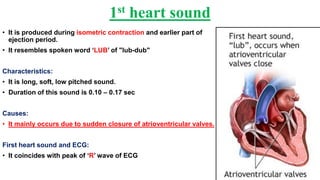
• It is produced during isometric contraction and earlier part of
ejection period.
• It resembles spoken word ‘LUB’ of "lub-dub"
Characteristics:
• It is long, soft, low pitched sound.
• Duration of this sound is 0.10 – 0.17 sec
Causes:
• It mainly occurs due to sudden closure of atrioventricular valves.
First heart sound and ECG:
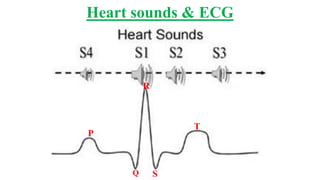
• It coincides with peak of ‘R’ wave of ECG
2nd heart sound
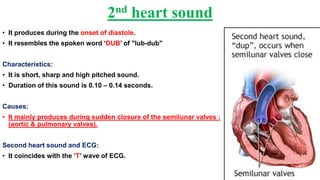
• It produces during the onset of diastole.
• It resembles the spoken word ‘DUB’ of "lub-dub"
Characteristics:
• It is short, sharp and high pitched sound.
• Duration of this sound is 0.10 – 0.14 seconds.
Causes:
• It mainly produces during sudden closure of the semilunar valves :
(aortic & pulmonary valves).
Second heart sound and ECG:
• It coincides with the ‘T’ wave of ECG.
3rd heart sound
• It is produced during rapid filling period of the cardiac cycle.
Characteristics:
• It is short and low pitched sound.
• Duration of this sound is 0.07 – 0.10 seconds.
Causes:
• It is produced due to the vibrations which set up in ventricular wall,
due to rushing of blood in to ventricles during rapid filling phase.
Third heart sound and ECG:
• It appears between ‘T’ and ‘P’ waves of ECG.
4th heart sound
• It is produced during atrial systole and considered as physiologic heart sound.
Characteristics:
• It is short and low pitched sound.
• Duration of the sound is 0.02 – 0.04 seconds.
Causes:
• It occurs due to vibrations which set up in atrial musculature during atrial systole.
Fourth heart sound and ECG:
• It coincides with interval between end of ‘P’ wave and onset of ‘Q’ wave in ECG.
Heart sounds & ECG
P
Q S
R
T
Stethoscope
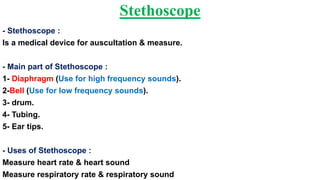
- Stethoscope :
Is a medical device for auscultation & measure.
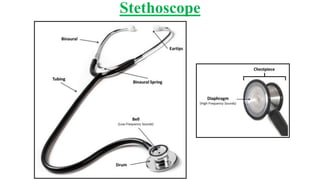
- Main part of Stethoscope :
1- Diaphragm (Use for high frequency sounds).
2-Bell (Use for low frequency sounds).
3- drum.
4- Tubing.
5- Ear tips.
- Uses of Stethoscope :
Measure heart rate & heart sound
Measure respiratory rate & respiratory sound
Stethoscope
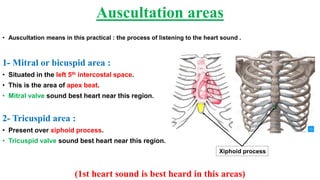
• Auscultation means in this practical : the process of listening to the heart sound .
1- Mitral or bicuspid area :
• Situated in the left 5th intercostal space.
• This is the area of apex beat.
• Mitral valve sound best heart near this region.
2- Tricuspid area :
• Present over xiphoid process.
• Tricuspid valve sound best heart near this region.
(1st heart sound is best heard in this areas)
Auscultation areas
Xiphoid process
3- Pulmonary area :
• Present over the left 2nd intercostal space close to the sternum.
• Semilunar valve sounds are best heard near this region.
4- Aortic area :
• Situated over right 2nd intercostal space near to the sternum.
• Semilunar valve sounds are best heard near this region.
(2nd heart sound is best heard in this areas)
Auscultation areas
Auscultation areas
Auscultation areas

Physiology (heart sounds)

  • 1.
    Physiology practical 1 (Heartsounds) By : Osama Al-Zahrani @OSAMA_Z96
  • 2.
    1st heart sound •It is produced during isometric contraction and earlier part of ejection period. • It resembles spoken word ‘LUB’ of "lub-dub" Characteristics: • It is long, soft, low pitched sound. • Duration of this sound is 0.10 – 0.17 sec Causes: • It mainly occurs due to sudden closure of atrioventricular valves. First heart sound and ECG: • It coincides with peak of ‘R’ wave of ECG
  • 3.
    2nd heart sound •It produces during the onset of diastole. • It resembles the spoken word ‘DUB’ of "lub-dub" Characteristics: • It is short, sharp and high pitched sound. • Duration of this sound is 0.10 – 0.14 seconds. Causes: • It mainly produces during sudden closure of the semilunar valves : (aortic & pulmonary valves). Second heart sound and ECG: • It coincides with the ‘T’ wave of ECG.
  • 4.
    3rd heart sound •It is produced during rapid filling period of the cardiac cycle. Characteristics: • It is short and low pitched sound. • Duration of this sound is 0.07 – 0.10 seconds. Causes: • It is produced due to the vibrations which set up in ventricular wall, due to rushing of blood in to ventricles during rapid filling phase. Third heart sound and ECG: • It appears between ‘T’ and ‘P’ waves of ECG.
  • 5.
    4th heart sound •It is produced during atrial systole and considered as physiologic heart sound. Characteristics: • It is short and low pitched sound. • Duration of the sound is 0.02 – 0.04 seconds. Causes: • It occurs due to vibrations which set up in atrial musculature during atrial systole. Fourth heart sound and ECG: • It coincides with interval between end of ‘P’ wave and onset of ‘Q’ wave in ECG.
  • 6.
    Heart sounds &ECG P Q S R T
  • 7.
    Stethoscope - Stethoscope : Isa medical device for auscultation & measure. - Main part of Stethoscope : 1- Diaphragm (Use for high frequency sounds). 2-Bell (Use for low frequency sounds). 3- drum. 4- Tubing. 5- Ear tips. - Uses of Stethoscope : Measure heart rate & heart sound Measure respiratory rate & respiratory sound
  • 8.
  • 9.
    • Auscultation meansin this practical : the process of listening to the heart sound . 1- Mitral or bicuspid area : • Situated in the left 5th intercostal space. • This is the area of apex beat. • Mitral valve sound best heart near this region. 2- Tricuspid area : • Present over xiphoid process. • Tricuspid valve sound best heart near this region. (1st heart sound is best heard in this areas) Auscultation areas Xiphoid process
  • 10.
    3- Pulmonary area: • Present over the left 2nd intercostal space close to the sternum. • Semilunar valve sounds are best heard near this region. 4- Aortic area : • Situated over right 2nd intercostal space near to the sternum. • Semilunar valve sounds are best heard near this region. (2nd heart sound is best heard in this areas) Auscultation areas
  • 11.
  • 12.