General principals of
circulation
Contin……..
1-Blood flow
 Relationship with Pressure gradient
 Relationship with Resistance
2-velocity of blood
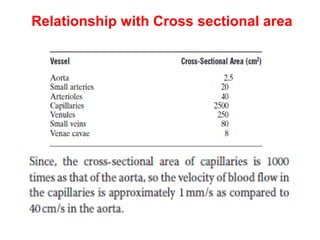
 Relationship with Cross sectional area
 Relationship with Pressure
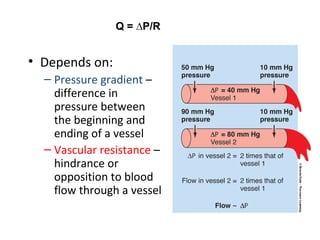
Q = ∆P/R
• Depends on:
– Pressure gradient –
difference in
pressure between
the beginning and
ending of a vessel
– Vascular resistance –
hindrance or
opposition to blood
flow through a vessel
Blood flow and pressure gradient
relationship
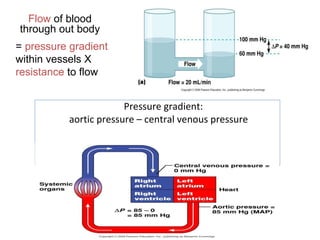
Pressure gradient:
aortic pressure – central venous pressure
Flow of blood
through out body
= pressure gradient
within vessels X
resistance to flow
In hemodynamic,
difference in two Pressure is compared
PB and pressure inside blood vessels
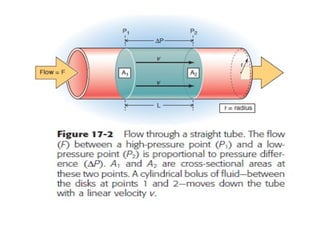
Pressure difference b/w two points separated
by some distance
So, pressure gradient is expressed as
= F/A
= ∆P/ ∆x
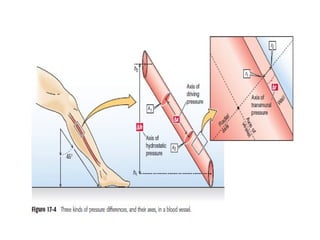
Considering this we can define three different
kinds of pressure differences in the circulation-
1-Driving pressure
-axial pressure difference,
2-Transmural pressure-
Radial pressure difference
3- Hydrostatic pressure
-
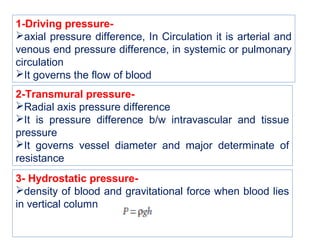
1-Driving pressure-
axial pressure difference, In Circulation it is arterial and
venous end pressure difference, in systemic or pulmonary
circulation
It governs the flow of blood
2-Transmural pressure-
Radial axis pressure difference
It is pressure difference b/w intravascular and tissue
pressure
It governs vessel diameter and major determinate of
resistance
3- Hydrostatic pressure-
density of blood and gravitational force when blood lies
in vertical column
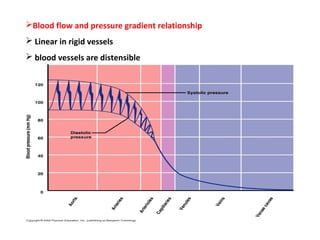
Blood flow and pressure gradient relationship
 Linear in rigid vessels
 blood vessels are distensible
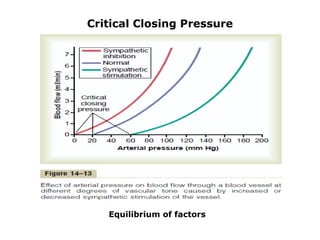
Critical Closing Pressure
Equilibrium of factors
Critical Closing Pressure
1 - vasomotor tone
2 - Intramural pressure
These factors equilibrate and maintain
the blood flow
Can be understand by a physics law
called as Laplace Law
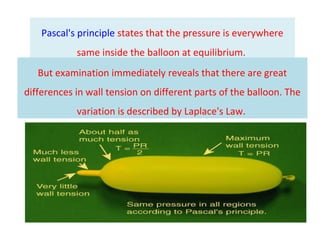
Pascal's principle states that the pressure is everywhere
same inside the balloon at equilibrium.
But examination immediately reveals that there are great
differences in wall tension on different parts of the balloon. The
variation is described by Laplace's Law.
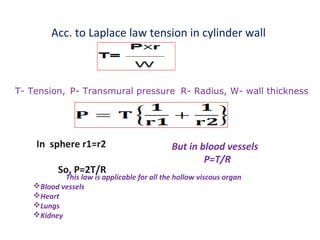
Acc. to Laplace law tension in cylinder wall
T- Tension, P- Transmural pressure R- Radius, W- wall thickness
In sphere r1=r2
So, P=2T/R
But in blood vessels
P=T/R
This law is applicable for all the hollow viscous organ
Blood vessels
Heart
Lungs
Kidney
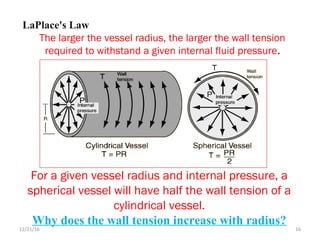
LaPlace's Law
The larger the vessel radius, the larger the wall tension
required to withstand a given internal fluid pressure.
For a given vessel radius and internal pressure, a
spherical vessel will have half the wall tension of a
cylindrical vessel.
Why does the wall tension increase with radius?
12/21/16 16
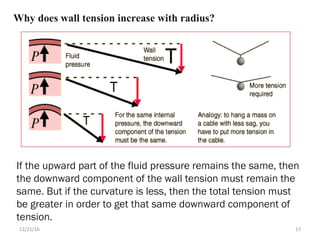
Why does wall tension increase with radius?
If the upward part of the fluid pressure remains the same, then
the downward component of the wall tension must remain the
same. But if the curvature is less, then the total tension must
be greater in order to get that same downward component of
tension.
12/21/16 17
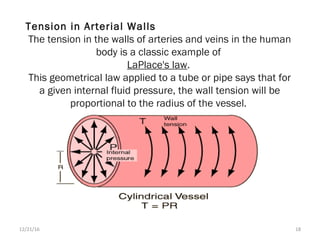
Tension in Arterial Walls
The tension in the walls of arteries and veins in the human
body is a classic example of
LaPlace's law.
This geometrical law applied to a tube or pipe says that for
a given internal fluid pressure, the wall tension will be
proportional to the radius of the vessel.
12/21/16 18
The implication of this law for the large arteries,
which have comparable blood pressures, is that the
larger arteries must have stronger walls since an
artery of twice the radius must be able to withstand
twice the wall tension.
Arteries are reinforced by fibrous bands to
strengthen them against the risks of an aneurysm.
The tiny capillaries rely on their small size.
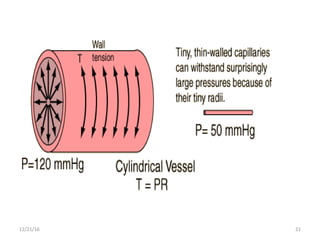
The walls of the capillaries of the human circulatory system
are so thin as to appear transparent under a microscope,
yet they withstand a pressure up to about half of the full
blood pressure.
LaPlace's law gives insight into how they are able to
withstand such pressures: their small size implies that the
wall tension for a given internal pressure is much smaller
than that of the larger arteries.
12/21/16 20
Capillary Walls
12/21/16 21
Blood flow and resistance
relationship
The larger arteries provide much less resistance
to flow than the smaller vessels according to
Poiseuille's law, and thus the drop in pressure
across them is only about half the total drop.
The capillaries offer large resistances to flow,
but don’t required much strength in their walls
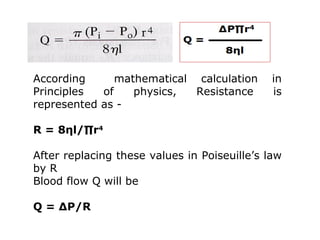
According mathematical calculation in
Principles of physics, Resistance is
represented as -
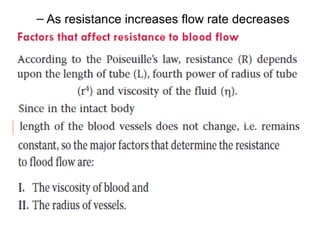
R = 8ηl/∏r4
After replacing these values in Poiseuille’s law
by R
Blood flow Q will be
Q = ∆P/R
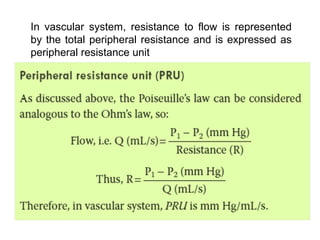
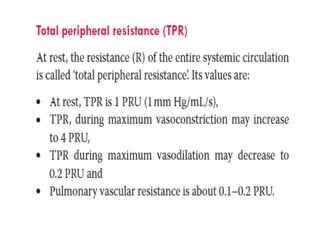
In vascular system, resistance to flow is represented
by the total peripheral resistance and is expressed as
peripheral resistance unit
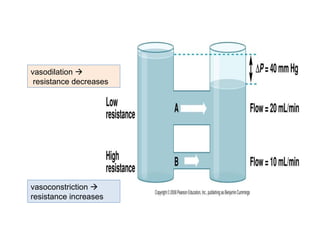
vasodilation 
resistance decreases
vasoconstriction 
resistance increases
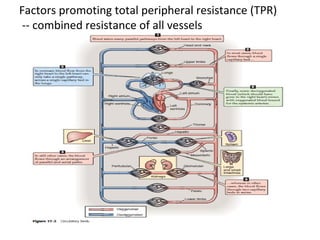
Factors promoting total peripheral resistance (TPR)
-- combined resistance of all vessels
– As resistance increases flow rate decreases
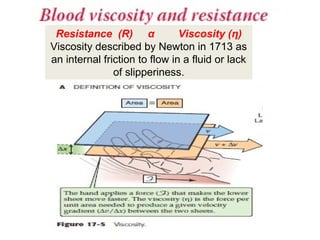
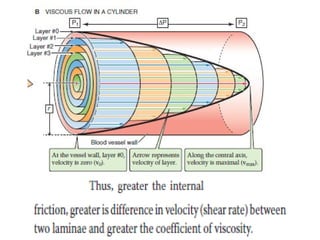
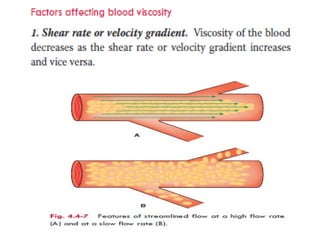
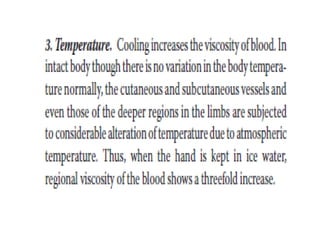
Resistance (R) α Viscosity (η)
Viscosity described by Newton in 1713 as
an internal friction to flow in a fluid or lack
of slipperiness.
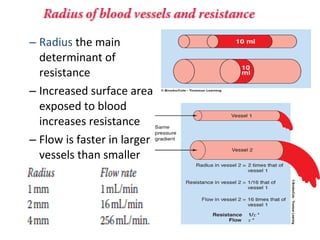
– Radius the main
determinant of
resistance
– Increased surface area
exposed to blood
increases resistance
– Flow is faster in larger
vessels than smaller
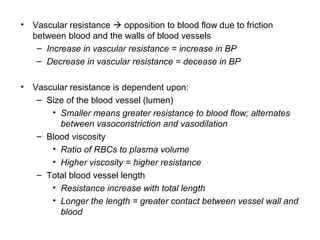
• Vascular resistance  opposition to blood flow due to friction
between blood and the walls of blood vessels
– Increase in vascular resistance = increase in BP
– Decrease in vascular resistance = decease in BP
• Vascular resistance is dependent upon:
– Size of the blood vessel (lumen)
• Smaller means greater resistance to blood flow; alternates
between vasoconstriction and vasodilation
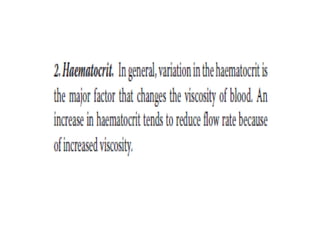
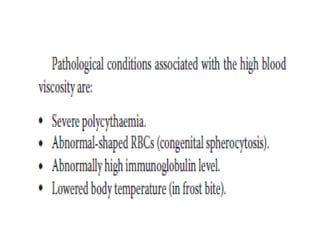
– Blood viscosity
• Ratio of RBCs to plasma volume
• Higher viscosity = higher resistance
– Total blood vessel length
• Resistance increase with total length
• Longer the length = greater contact between vessel wall and
blood
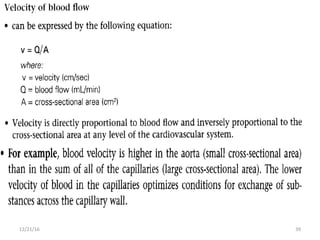
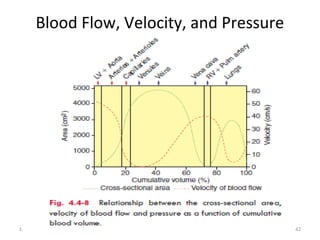
2-velocity of blood
 Relationship with Cross sectional area
 Relationship with Pressure
12/21/16 39
Relationship with Cross sectional area
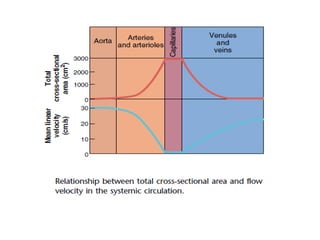
Blood Flow, Velocity, and Pressure
12/21/16 42
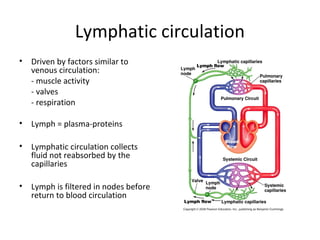
Lymphatic circulation
• Driven by factors similar to
venous circulation:
- muscle activity
- valves
- respiration
• Lymph = plasma-proteins
• Lymphatic circulation collects
fluid not reabsorbed by the
capillaries
• Lymph is filtered in nodes before
return to blood circulation

General principals of circulation

  • 1.
  • 2.
    1-Blood flow  Relationshipwith Pressure gradient  Relationship with Resistance 2-velocity of blood  Relationship with Cross sectional area  Relationship with Pressure
  • 3.
    Q = ∆P/R •Depends on: – Pressure gradient – difference in pressure between the beginning and ending of a vessel – Vascular resistance – hindrance or opposition to blood flow through a vessel
  • 4.
    Blood flow andpressure gradient relationship
  • 5.
    Pressure gradient: aortic pressure– central venous pressure Flow of blood through out body = pressure gradient within vessels X resistance to flow
  • 6.
    In hemodynamic, difference intwo Pressure is compared PB and pressure inside blood vessels Pressure difference b/w two points separated by some distance So, pressure gradient is expressed as = F/A = ∆P/ ∆x
  • 8.
    Considering this wecan define three different kinds of pressure differences in the circulation- 1-Driving pressure -axial pressure difference, 2-Transmural pressure- Radial pressure difference 3- Hydrostatic pressure -
  • 9.
    1-Driving pressure- axial pressuredifference, In Circulation it is arterial and venous end pressure difference, in systemic or pulmonary circulation It governs the flow of blood 2-Transmural pressure- Radial axis pressure difference It is pressure difference b/w intravascular and tissue pressure It governs vessel diameter and major determinate of resistance 3- Hydrostatic pressure- density of blood and gravitational force when blood lies in vertical column
  • 11.
    Blood flow andpressure gradient relationship  Linear in rigid vessels  blood vessels are distensible
  • 12.
  • 13.
    Critical Closing Pressure 1- vasomotor tone 2 - Intramural pressure These factors equilibrate and maintain the blood flow Can be understand by a physics law called as Laplace Law
  • 14.
    Pascal's principle statesthat the pressure is everywhere same inside the balloon at equilibrium. But examination immediately reveals that there are great differences in wall tension on different parts of the balloon. The variation is described by Laplace's Law.
  • 15.
    Acc. to Laplacelaw tension in cylinder wall T- Tension, P- Transmural pressure R- Radius, W- wall thickness In sphere r1=r2 So, P=2T/R But in blood vessels P=T/R This law is applicable for all the hollow viscous organ Blood vessels Heart Lungs Kidney
  • 16.
    LaPlace's Law The largerthe vessel radius, the larger the wall tension required to withstand a given internal fluid pressure. For a given vessel radius and internal pressure, a spherical vessel will have half the wall tension of a cylindrical vessel. Why does the wall tension increase with radius? 12/21/16 16
  • 17.
    Why does walltension increase with radius? If the upward part of the fluid pressure remains the same, then the downward component of the wall tension must remain the same. But if the curvature is less, then the total tension must be greater in order to get that same downward component of tension. 12/21/16 17
  • 18.
    Tension in ArterialWalls The tension in the walls of arteries and veins in the human body is a classic example of LaPlace's law. This geometrical law applied to a tube or pipe says that for a given internal fluid pressure, the wall tension will be proportional to the radius of the vessel. 12/21/16 18
  • 19.
    The implication ofthis law for the large arteries, which have comparable blood pressures, is that the larger arteries must have stronger walls since an artery of twice the radius must be able to withstand twice the wall tension. Arteries are reinforced by fibrous bands to strengthen them against the risks of an aneurysm. The tiny capillaries rely on their small size.
  • 20.
    The walls ofthe capillaries of the human circulatory system are so thin as to appear transparent under a microscope, yet they withstand a pressure up to about half of the full blood pressure. LaPlace's law gives insight into how they are able to withstand such pressures: their small size implies that the wall tension for a given internal pressure is much smaller than that of the larger arteries. 12/21/16 20 Capillary Walls
  • 21.
  • 22.
    Blood flow andresistance relationship
  • 23.
    The larger arteriesprovide much less resistance to flow than the smaller vessels according to Poiseuille's law, and thus the drop in pressure across them is only about half the total drop. The capillaries offer large resistances to flow, but don’t required much strength in their walls
  • 24.
    According mathematical calculationin Principles of physics, Resistance is represented as - R = 8ηl/∏r4 After replacing these values in Poiseuille’s law by R Blood flow Q will be Q = ∆P/R
  • 25.
    In vascular system,resistance to flow is represented by the total peripheral resistance and is expressed as peripheral resistance unit
  • 27.
  • 28.
    Factors promoting totalperipheral resistance (TPR) -- combined resistance of all vessels
  • 29.
    – As resistanceincreases flow rate decreases
  • 30.
    Resistance (R) αViscosity (η) Viscosity described by Newton in 1713 as an internal friction to flow in a fluid or lack of slipperiness.
  • 36.
    – Radius themain determinant of resistance – Increased surface area exposed to blood increases resistance – Flow is faster in larger vessels than smaller
  • 37.
    • Vascular resistance opposition to blood flow due to friction between blood and the walls of blood vessels – Increase in vascular resistance = increase in BP – Decrease in vascular resistance = decease in BP • Vascular resistance is dependent upon: – Size of the blood vessel (lumen) • Smaller means greater resistance to blood flow; alternates between vasoconstriction and vasodilation – Blood viscosity • Ratio of RBCs to plasma volume • Higher viscosity = higher resistance – Total blood vessel length • Resistance increase with total length • Longer the length = greater contact between vessel wall and blood
  • 38.
    2-velocity of blood Relationship with Cross sectional area  Relationship with Pressure
  • 39.
  • 40.
  • 42.
    Blood Flow, Velocity,and Pressure 12/21/16 42
  • 43.
    Lymphatic circulation • Drivenby factors similar to venous circulation: - muscle activity - valves - respiration • Lymph = plasma-proteins • Lymphatic circulation collects fluid not reabsorbed by the capillaries • Lymph is filtered in nodes before return to blood circulation