UNIT IV
THE CIRCULATORY SYSTEM
SUBMITTED TO
MRS. JISHA S.
PRINCIPAL,
ST. CATHERINE’S HOSPITAL
& SCHOOL OF NURSING
SUBMITTED BY
MR. EARNEST LAMUEL
NURSING TUTOR,
ST. CATHERINE’S HOSPITAL
& SCHOOL OF NURSING
HEART : STRUCTURE &
FUNCTIONS INCLUDING
CONDUCTION SYSTEM &
CARDIAC CYCLE
INTRODUCTION
• The cardiovascular system consists of the heart and blood vessels. The system
is responsible for the circulation of the blood through the tissues of the body.
• The heart acts as a pump and provides the force for this circulation. Blood
vessels taking blood from the heart to the tissues are called ‘arteries’.
• The largest artery in the body is called the aorta. Arising from the heart it
divides, like the branches of a tree, into smaller and smaller branches. The
smallest arteries are called ‘arterioles’.
• The arterioles end in a plexus of thin-walled, vessels that permeate the
tissues. These thin-walled vessels are called ‘capillaries’. Oxygen, nutrition,
waste products, etc. can pass through the walls of capillaries from blood to
tissue cells and vice versa.
INTRODUCTION
• Blood from capillaries is collected by another set of vessels that carry it
back to the heart. These are called ‘veins’. The veins adjoining the
capillaries are very small and are called ‘venules’.
• Ultimately, the blood reaches two large veins, the superior vena cave
and the inferior vena cava, which pour it back into the heart.
• This blood reaching the heart through the veins has lost its oxygen.
• A special set of arteries and veins circulate this blood through the lungs
where it is again oxygenated
• This circulation through the lungs, for the purpose of oxygenation of
blood, is called the ‘pulmonary circulation’ to distinguish it from the
main or ‘systemic circulation’.
HEART
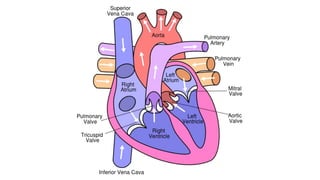
The heart is a hollow muscular organ that pumps blood
throughout the circulatory system. It is present in the
middle mediastinum.
The heart is a muscular organ in most animals, which
pumps blood through the blood vessels of the circulatory
system. Blood provides the body
with oxygen and nutrients, as well as assisting in the
removal of metabolic wastes. In humans, the heart is
located between the lungs, in the middle compartment of
the chest.
MEASUREMENTS
•Anteroposterior diameter – 6 cm
•Widest transverse diameter – 8 - 9 cm
•Length from apex to the base – 12 cm
•Weight (less in females) – 230 - 350 g
CHARACTERISTICS
• The heart is a muscular pump designed to ensure the circulation of
blood through the tissues of the body. Both structurally and
functionally, it consists of two halves, namely right and left.
• The right heart circulates blood only through the lungs for the
purpose of oxygenation.
• The left heart circulates blood to tissues of the entire body.
• Each half of the heart consists of an inflow chamber called the
‘atrium’, and of an outflow chamber called the ‘ventricle’.
• Each chamber of the heart is connected to one or more large blood
vessels.
CHARACTERISTICS
• The right atrium receives deoxygenated blood from tissues of the
entire body through the superior and inferior venae cava.
• This blood passes into the right ventricle. It leaves the right ventricle
through a large outflow vessel called the pulmonary trunk. This trunk
divides into right and left pulmonary arteries that carry blood to the
lungs.
• Blood oxygenated in the lungs is brought back to the heart by four
pulmonary veins that end in the left atrium. This blood passes into a
large outflow vessel called the aorta. The aorta and its branches
distribute blood to tissues of the entire body.
• It is returned to the heart through the venae cava, thus completing
the circuit.
ANATOMICAL POSITION
Heart lies in the middle mediastinum in such a fashion that the
apex of heart faces downward, forward and towards the left just
medial to the midclavicular line, in the fifth intercostal space. Base
of heart lies upward and backward on right side extending to the
right third costal cartilage.
LAYERS
Heart is made up of three layers of tissues
• Outer pericardium
• Middle myocardium
• Inner endocardium
PERICARDIUM
Pericardium is the outer covering of the heart. It is made up of two
layers –
• Outer parietal pericardium which forms a strong protective sac
around the heart
• Inner visceral pericardium or epicardium that covers myocardium
These two layers are separated by a potential space called pericardial
cavity which contains a very thin film of fluid.
MYOCARDIUM
Myocardium is the middle layer of the wall of the heart and it is formed
by muscle fibers. It forms the bulk of the heart and is responsible for
the pumping action of the heart.
Myocardium is formed by three types of cardiac muscle fibers
• Muscle fibers which form the contractile unit of the heart
• Muscle fibers which form pacemaker
• Muscle fibers which form the conductive system
ENDOCARDIUM
Endocardium is the innermost layer of the heart wall. It is a thin,
smooth and glistening membrane. It is formed by a single layer of
endothelial cells lining the inner surface of the heart. Endocardium
continues as endothelium of the blood vessels.
RELATIONS
• Superiorly – the aorta, superior vena cava, pulmonary artery and
pulmonary veins
• Inferiorly – the apex rests on the central tendon of the diaphragm
• Anteriorly – the ribs and the intercostal muscles
• Posteriorly – the esophagus, trachea, left and right bronchus,
descending aorta, inferior vena cava and thoracic vertebrae
• Laterally – the lungs
CONDUCTION SYSTEM
Conductivity is the property by which the rhythmic electrical
impulses generated are conducted throughout the heart, causing
rhythmic contraction of myocardium. Blood is pumped into the
great vessels during rhythmic contractions of heart. It includes
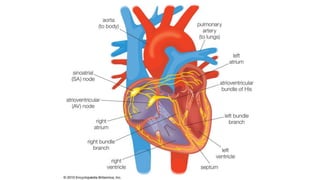
• Sinoatrial node – SA Node (Pacemaker of the heart)
• Internothal pathway
• Atrioventricular node – AV Node
• Bundle of hips
• Purkinje fibres
CONDUCTION SYSTEM
SA node is situated in right atrium just below the opening of
superior vena cava. AV node is situated in right posterior portion
of intra-atrial septum. The impulses from SA node are conducted
throughout the right and left atria. The impulses also reach the AV
node via some specialized fibers called intermodal fibres.
CARDIAC CYCLE
The cardiac cycle refers to a series of electrical and mechanical
events that occur cyclically from the beginning of one heartbeat to
the beginning of the next. This also includes changes in pressure,
blood flow and volume in the heart chambers.
EVENTS OF CARDIAC CYCLE
The events of cardiac cycle are classified into two divisions –
• Atrial events which constitute atrial systole and atrial diastole
• Ventricular events which constitute ventricular systole and ventricular
diastole
Duration of one cardiac cycle is 0.8 seconds (HR – 75b/m) of this,
0.1 second is for atrial systole (atrial contraction)
0.7 seconds for ‘atrial diastole (atrial relaxation)
0.3 seconds for ventricular systole (ventricular contraction)
0.5 seconds for ventricular diastole (ventricular relaxation)
BLOOD VESSELS: TYPES,
STRUCTURE & POSITION
BLOOD VESSELS
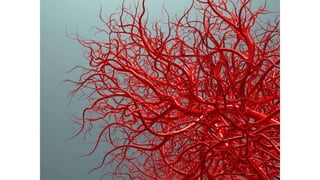
• The blood vessels are the components of the circulatory system that
transport blood throughout the human body. These vessels transport blood
cells, nutrients, and oxygen to the tissues of the body. They also take waste
and carbon dioxide away from the tissues. Blood vessels are needed to
sustain life, because all of the body’s tissues rely on their functionality.
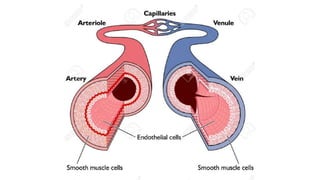
• There are five types of blood vessels: the arteries, which carry the blood away
from the heart; the arterioles; the capillaries, where the exchange of water and
chemicals between the blood and the tissues occurs; the venules; and
the veins, which carry blood from the capillaries back towards the heart.
• The word vascular, meaning relating to the blood vessels, is derived from the
Latin vas, meaning vessel. Some structures – such as cartilage, the epithelium,
and the lens and cornea of the eye – do not contain blood vessels and are
labeled avascular.
CLASSIFICATION
Blood Vessels are classifies into three types
• Arteries
• Veins
• Capillaries
ARTERIES
Arteries are vessels which conduct blood from heart to capillaries.
Arteries branch repeatedly between largest arteries to the capillary
plexus. Because of this repeated branching, the total cross-
sectional area of vascular system increases to 800 times than that
of the aorta. With an increases in the branching, there is a gradual
decrease in the rate of blood flow. This slow flow provides ample
time for exchange of substances through capillaries.
CLASSIFICATION
Arteries are classifies into three types
• Elastic arteries
• Muscular arteries
• Arterioles
ELASTIC ARTERIES
These are also called as conducting vessels as their main function
is to conduct the blood from heart to muscular arteries. The
examples of these arteries are large size arteries like aorta,
pulmonary trunk and their main branches, i.e, branchiocephalic,
common carotid, subclavian and common iliac artery.
MUSCULAR ARTERIES
These are also known as medium sized arteries. Usually the
diameter of the lumen of muscular artery is 2-10 mm. As these
arteries regulate the flow of blood to an organ or tissue these are
also called as distributing arteries. Muscular arteries are of smaller
diameter than the elastic arteries.
ARTERIOLES
When traced distally, muscular arteries progressively decrease in
caliber till they have a diameter of about 100 micrometre. They
then become continuous with arterioles. The larger or muscular
arterioles are 100 to 50 micrometre in diameter. Arterioles less
than 50 micrometre in diameter ae called terminal arterioles.
VEINS
Veins return blood to the heart from the tissues. Their walls are
thinner than arteries. Contracting skeletal muscles compress the
veins, directing the blood towards the heart. The smallest veins are
called venules. These tributaries unite to form larger veins which
sometimes join to form venous plexuses or networks. The veins
that accompany muscular arteries, one on each side are called
venae comitantes (accompanying veins)
CAPILLARIES
Terminal arterioles are continued into a capillary plexus that pervades the
tissue supplied. Capillaries are the smallest blood vessels. The average
diameter of a capillary is 8 micrometre. Exchange of oxygen, carbon dioxide,
fluids and various molecules between blood and tissue takes place through
the walls of the capillary plexus. The arrangement of the capillary plexus and
its density varies from tissue to tissue, the density being greatest in tissues
having high metabolic activity. The wall of a capillary is formed essentially by
endothelial cells.
VITAL BLOOD VESSELS OF
THE BODY
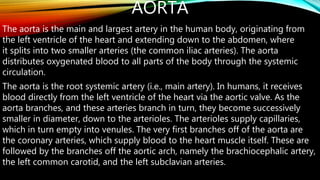
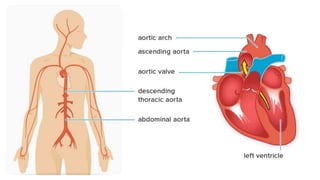
AORTA
The aorta is the main and largest artery in the human body, originating from
the left ventricle of the heart and extending down to the abdomen, where
it splits into two smaller arteries (the common iliac arteries). The aorta
distributes oxygenated blood to all parts of the body through the systemic
circulation.
The aorta is the root systemic artery (i.e., main artery). In humans, it receives
blood directly from the left ventricle of the heart via the aortic valve. As the
aorta branches, and these arteries branch in turn, they become successively
smaller in diameter, down to the arterioles. The arterioles supply capillaries,
which in turn empty into venules. The very first branches off of the aorta are
the coronary arteries, which supply blood to the heart muscle itself. These are
followed by the branches off the aortic arch, namely the brachiocephalic artery,
the left common carotid, and the left subclavian arteries.
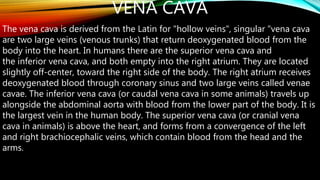
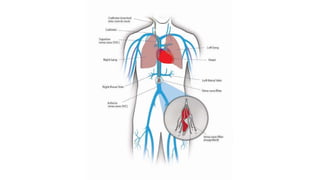
VENA CAVA
The vena cava is derived from the Latin for "hollow veins", singular "vena cava
are two large veins (venous trunks) that return deoxygenated blood from the
body into the heart. In humans there are the superior vena cava and
the inferior vena cava, and both empty into the right atrium. They are located
slightly off-center, toward the right side of the body. The right atrium receives
deoxygenated blood through coronary sinus and two large veins called venae
cavae. The inferior vena cava (or caudal vena cava in some animals) travels up
alongside the abdominal aorta with blood from the lower part of the body. It is
the largest vein in the human body. The superior vena cava (or cranial vena
cava in animals) is above the heart, and forms from a convergence of the left
and right brachiocephalic veins, which contain blood from the head and the
arms.
PULMONARY VEIN
The pulmonary veins are the veins that transfer oxygenated blood from
the lungs to the heart. The largest pulmonary veins are the four main pulmonary
veins, two from each lung that drain into the left atrium of the heart. The
pulmonary veins are part of the pulmonary circulation. Two main pulmonary
veins emerge from each lung hilum, receiving blood from three or four bronchial
veins apiece and draining into the left atrium. An inferior and superior main vein
drains each lung, so there are four main veins in total. At the root of the lung, the
right superior pulmonary vein lies in front of and a little below the pulmonary
artery; the inferior is situated at the lowest part of the lung hilum. Behind the
pulmonary artery is the bronchus. The right main pulmonary veins (contains
oxygenated blood) pass behind the right atrium and superior vena cava; the left in
front of the descending thoracic aorta. The pulmonary veins play an essential role
in respiration, by receiving blood that has been oxygenated in the alveoli and
returning it to the left atrium.
PULMONARY ARTERY
A pulmonary artery is an artery in the pulmonary circulation that
carries deoxygenated blood from the right side of the heart to
the lungs. The largest pulmonary artery is the main pulmonary
artery or pulmonary trunk from the heart, and the smallest ones
are the arterioles, which lead to the capillaries that surround
the pulmonary alveoli. The pulmonary artery carries deoxygenated
blood from the right ventricle to the lungs. The blood here passes
through capillaries adjacent to alveoli and becomes oxygenated as
part of the process of respiration. In contrast to the pulmonary
arteries, the bronchial arteries supply nutrition to the lungs
themselves.
CIRCULATION OF BLOOD
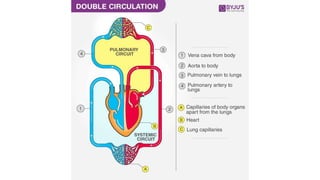
SYSTEMIC CIRCULATION
It is otherwise known as greater circulation. The blood
pumped from left ventricle passes through a series of
blood vessels of arterial system and reaches the tissues.
Exchange of various substances between blood and the
tissues takes place in the capillaries. After the exchange
of substances in the capillaries, the blood enters the
venous system and returns to right atrium and then the
right ventricles. This completes the systemic circulation.
PULMONARY CIRCULATION
It is the otherwise called lesser circulation. Blood is
pumped from right ventricle to lungs through
pulmonary artery. The exchange of gases occurs
between blood and alveoli of the lungs through
pulmonary capillary membrane. The oxygenated blood
returns to left atrium through the pulmonary veins.
Thus, the left side of the heart contains the venous
blood. In contrast to all other arteries of the body,
pulmonary artery has deoxygenated blood and
pulmonary vein has oxygenated blood.
BLOOD PRESSURE
BLOOD PRESSURE
• Blood pressure (BP) is the pressure of circulating blood on the walls of blood
vessels. Most of this pressure is due to work done by the heart by pumping
blood through the circulatory system. Used without further specification, "blood
pressure" usually refers to the pressure in large arteries of the systemic
circulation. Blood pressure is usually expressed in terms of the systolic
pressure (maximum during one heartbeat) over diastolic pressure (minimum in
between two heartbeats) and is measured in millimeters of mercury (mmHg),
above the surrounding atmospheric pressure.
• Blood pressure is one of the vital signs, along with respiratory rate, heart
rate, oxygen saturation, and body temperature. Normal resting blood pressure in
an adult is approximately 120/80 mmHg. Globally, the average blood pressure,
age standardized, has remained about the same since 1975 to the present, at
approx. 127/79 mmHg in men and 122/77 mmHg in women.
BLOOD PRESSURE
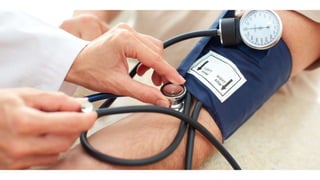
Traditionally, blood pressure was measured non-invasively using
auscultation with a mercury-tube sphygmomanometer. Ausculation is still
generally considered to be the gold standard of accuracy for non-invasive
blood pressure readings in clinic. However, semi-automated methods have
become common, largely due to concerns about potential mercury
toxicity, although cost, ease of use and applicability to ambulatory blood
pressure or home blood pressure measurements have also influenced this
trend. Early automated alternatives to mercury-tube sphygmomanometers
were often seriously inaccurate, but modern devices validated to
international standards achieve an average difference between two
standardized reading methods of 5 mm Hg or less and a standard deviation
of less than 8 mm Hg. Most of these semi-automated methods measure
blood pressure using oscillometry.
BLOOD PRESSURE
• Blood pressure is influenced by cardiac output, total peripheral
resistance and arterial stiffness and varies depending on situation,
emotional state, activity, and relative health/disease states. In the
short term, blood pressure is regulated by baroreceptors which act via
the brain to influence the nervous and the endocrine systems.
• Blood pressure that is too low is called hypotension, and pressure that
is consistently high is hypertension. Both have many causes and may
be of sudden onset or of long duration. Long-term hypertension is a
risk factor for many diseases, including heart
disease, stroke and kidney failure. Long-term hypertension is more
common than long-term hypotension, which is usually only
diagnosed when it causes symptoms.
PULSE
PULSE
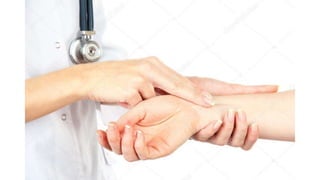
In medicine, a pulse represents the tactile arterial palpation of the heartbeat by
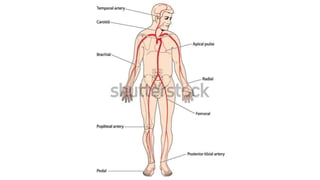
trained fingertips. The pulse may be palpated in any place that allows an artery to
be compressed near the surface of the body, such as at the neck (carotid
artery), wrist (radial artery), at the groin (femoral artery), behind the knee (popliteal
artery), near the ankle joint (posterior tibial artery), and on foot (dorsalis pedis
artery). Pulse (or the count of arterial pulse per minute) is equivalent to measuring
the heart rate. The heart rate can also be measured by listening to the heart beat
by auscultation, traditionally using a stethoscope and counting it for a minute. The
radial pulse is commonly measured using three fingers. This has a reason: the
finger closest to the heart is used to occlude the pulse pressure, the middle finger
is used get a crude estimate of the blood pressure, and the finger most distal to
the heart (usually the ring finger) is used to nullify the effect of the ulnar pulse as
the two arteries are connected via the palmar arches (superficial and deep). The
study of the pulse is known as sphygmology.
COMMON PALPABLE
SITES
UPPER LIMB
• Axillary pulse: located inferiorly of the lateral wall of the axilla
• Brachial pulse: located on the inside of the upper arm near the elbow,
frequently used in place of carotid pulse in infants (brachial artery)
• Radial pulse: located on the lateral of the wrist (radial artery). It can also
be found in the anatomical snuff box.
• Ulnar pulse: located on the medial of the wrist (ulnar artery).
• Chinese medicine has focused on the pulse in the upper limbs for several
centuries. The concept of pulse diagnosis is essentially based on palpation
and observations of the radial and ulnar volar pulses at the readily
accessible wrist.
LOWER LIMB
• Femoral pulse: located in the inner thigh, at the mid-inguinal point,
halfway between the pubic symphysis and anterior superior iliac spine
(femoral artery).
• Popliteal pulse: Above the knee in the popliteal fossa, found by holding
the bent knee. The patient bends the knee at approximately 124°, and the
health care provider holds it in both hands to find the popliteal artery in
the pit behind the knee (Popliteal artery).
• Dorsalis pedis pulse: located on top of the foot, immediately lateral to the
extensor of hallucis longus (dorsalis pedis artery).
• Tibialis posterior pulse: located on the medial side of the ankle, 2 cm
inferior and 2 cm posterior to the medial malleolus (posterior tibial artery).
It is easily palpable over Pimenta's Point.
HEAD AND NECK
• Carotid pulse: located in the neck (carotid artery). The carotid artery should be
palpated gently and while the patient is sitting or lying down. Stimulating its
baroreceptors with low palpitation can provoke severe bradycardia or even stop the
heart in some sensitive persons. Also, a person's two carotid arteries should not be
palpated at the same time. Doing so may limit the flow of blood to the head,
possibly leading to fainting or brain ischemia. It can be felt between the anterior
border of the sternocleidomastoid muscle, above the hyoid bone and lateral to the
thyroid cartilage.
• Facial pulse: located on the mandible (lower jawbone) on a line with the corners of
the mouth (facial artery).
• Temporal pulse: located on the temple directly in front of the ear (superficial
temporal artery).
• Although the pulse can be felt in multiple places in the head, people should not
normally hear their heartbeats within the head. This is called pulsatile tinnitus, and it
can indicate several medical disorders.
TORSO
•Apical pulse: located in the 5th left intercostal space,
1.25 cm lateral to the mid-clavicular line. In contrast with
other pulse sites, the apical pulse site is unilateral, and
measured not under an artery, but below the heart itself
(more specifically, the apex of the heart).
THANK YOU

Unit IV

  • 1.
    UNIT IV THE CIRCULATORYSYSTEM SUBMITTED TO MRS. JISHA S. PRINCIPAL, ST. CATHERINE’S HOSPITAL & SCHOOL OF NURSING SUBMITTED BY MR. EARNEST LAMUEL NURSING TUTOR, ST. CATHERINE’S HOSPITAL & SCHOOL OF NURSING
  • 2.
    HEART : STRUCTURE& FUNCTIONS INCLUDING CONDUCTION SYSTEM & CARDIAC CYCLE
  • 4.
    INTRODUCTION • The cardiovascularsystem consists of the heart and blood vessels. The system is responsible for the circulation of the blood through the tissues of the body. • The heart acts as a pump and provides the force for this circulation. Blood vessels taking blood from the heart to the tissues are called ‘arteries’. • The largest artery in the body is called the aorta. Arising from the heart it divides, like the branches of a tree, into smaller and smaller branches. The smallest arteries are called ‘arterioles’. • The arterioles end in a plexus of thin-walled, vessels that permeate the tissues. These thin-walled vessels are called ‘capillaries’. Oxygen, nutrition, waste products, etc. can pass through the walls of capillaries from blood to tissue cells and vice versa.
  • 5.
    INTRODUCTION • Blood fromcapillaries is collected by another set of vessels that carry it back to the heart. These are called ‘veins’. The veins adjoining the capillaries are very small and are called ‘venules’. • Ultimately, the blood reaches two large veins, the superior vena cave and the inferior vena cava, which pour it back into the heart. • This blood reaching the heart through the veins has lost its oxygen. • A special set of arteries and veins circulate this blood through the lungs where it is again oxygenated • This circulation through the lungs, for the purpose of oxygenation of blood, is called the ‘pulmonary circulation’ to distinguish it from the main or ‘systemic circulation’.
  • 6.
    HEART The heart isa hollow muscular organ that pumps blood throughout the circulatory system. It is present in the middle mediastinum. The heart is a muscular organ in most animals, which pumps blood through the blood vessels of the circulatory system. Blood provides the body with oxygen and nutrients, as well as assisting in the removal of metabolic wastes. In humans, the heart is located between the lungs, in the middle compartment of the chest.
  • 8.
    MEASUREMENTS •Anteroposterior diameter –6 cm •Widest transverse diameter – 8 - 9 cm •Length from apex to the base – 12 cm •Weight (less in females) – 230 - 350 g
  • 9.
    CHARACTERISTICS • The heartis a muscular pump designed to ensure the circulation of blood through the tissues of the body. Both structurally and functionally, it consists of two halves, namely right and left. • The right heart circulates blood only through the lungs for the purpose of oxygenation. • The left heart circulates blood to tissues of the entire body. • Each half of the heart consists of an inflow chamber called the ‘atrium’, and of an outflow chamber called the ‘ventricle’. • Each chamber of the heart is connected to one or more large blood vessels.
  • 10.
    CHARACTERISTICS • The rightatrium receives deoxygenated blood from tissues of the entire body through the superior and inferior venae cava. • This blood passes into the right ventricle. It leaves the right ventricle through a large outflow vessel called the pulmonary trunk. This trunk divides into right and left pulmonary arteries that carry blood to the lungs. • Blood oxygenated in the lungs is brought back to the heart by four pulmonary veins that end in the left atrium. This blood passes into a large outflow vessel called the aorta. The aorta and its branches distribute blood to tissues of the entire body. • It is returned to the heart through the venae cava, thus completing the circuit.
  • 11.
    ANATOMICAL POSITION Heart liesin the middle mediastinum in such a fashion that the apex of heart faces downward, forward and towards the left just medial to the midclavicular line, in the fifth intercostal space. Base of heart lies upward and backward on right side extending to the right third costal cartilage.
  • 12.
    LAYERS Heart is madeup of three layers of tissues • Outer pericardium • Middle myocardium • Inner endocardium
  • 13.
    PERICARDIUM Pericardium is theouter covering of the heart. It is made up of two layers – • Outer parietal pericardium which forms a strong protective sac around the heart • Inner visceral pericardium or epicardium that covers myocardium These two layers are separated by a potential space called pericardial cavity which contains a very thin film of fluid.
  • 14.
    MYOCARDIUM Myocardium is themiddle layer of the wall of the heart and it is formed by muscle fibers. It forms the bulk of the heart and is responsible for the pumping action of the heart. Myocardium is formed by three types of cardiac muscle fibers • Muscle fibers which form the contractile unit of the heart • Muscle fibers which form pacemaker • Muscle fibers which form the conductive system
  • 15.
    ENDOCARDIUM Endocardium is theinnermost layer of the heart wall. It is a thin, smooth and glistening membrane. It is formed by a single layer of endothelial cells lining the inner surface of the heart. Endocardium continues as endothelium of the blood vessels.
  • 16.
    RELATIONS • Superiorly –the aorta, superior vena cava, pulmonary artery and pulmonary veins • Inferiorly – the apex rests on the central tendon of the diaphragm • Anteriorly – the ribs and the intercostal muscles • Posteriorly – the esophagus, trachea, left and right bronchus, descending aorta, inferior vena cava and thoracic vertebrae • Laterally – the lungs
  • 17.
    CONDUCTION SYSTEM Conductivity isthe property by which the rhythmic electrical impulses generated are conducted throughout the heart, causing rhythmic contraction of myocardium. Blood is pumped into the great vessels during rhythmic contractions of heart. It includes • Sinoatrial node – SA Node (Pacemaker of the heart) • Internothal pathway • Atrioventricular node – AV Node • Bundle of hips • Purkinje fibres
  • 18.
    CONDUCTION SYSTEM SA nodeis situated in right atrium just below the opening of superior vena cava. AV node is situated in right posterior portion of intra-atrial septum. The impulses from SA node are conducted throughout the right and left atria. The impulses also reach the AV node via some specialized fibers called intermodal fibres.
  • 19.
    CARDIAC CYCLE The cardiaccycle refers to a series of electrical and mechanical events that occur cyclically from the beginning of one heartbeat to the beginning of the next. This also includes changes in pressure, blood flow and volume in the heart chambers.
  • 20.
    EVENTS OF CARDIACCYCLE The events of cardiac cycle are classified into two divisions – • Atrial events which constitute atrial systole and atrial diastole • Ventricular events which constitute ventricular systole and ventricular diastole Duration of one cardiac cycle is 0.8 seconds (HR – 75b/m) of this, 0.1 second is for atrial systole (atrial contraction) 0.7 seconds for ‘atrial diastole (atrial relaxation) 0.3 seconds for ventricular systole (ventricular contraction) 0.5 seconds for ventricular diastole (ventricular relaxation)
  • 21.
  • 23.
    BLOOD VESSELS • Theblood vessels are the components of the circulatory system that transport blood throughout the human body. These vessels transport blood cells, nutrients, and oxygen to the tissues of the body. They also take waste and carbon dioxide away from the tissues. Blood vessels are needed to sustain life, because all of the body’s tissues rely on their functionality. • There are five types of blood vessels: the arteries, which carry the blood away from the heart; the arterioles; the capillaries, where the exchange of water and chemicals between the blood and the tissues occurs; the venules; and the veins, which carry blood from the capillaries back towards the heart. • The word vascular, meaning relating to the blood vessels, is derived from the Latin vas, meaning vessel. Some structures – such as cartilage, the epithelium, and the lens and cornea of the eye – do not contain blood vessels and are labeled avascular.
  • 25.
    CLASSIFICATION Blood Vessels areclassifies into three types • Arteries • Veins • Capillaries
  • 26.
    ARTERIES Arteries are vesselswhich conduct blood from heart to capillaries. Arteries branch repeatedly between largest arteries to the capillary plexus. Because of this repeated branching, the total cross- sectional area of vascular system increases to 800 times than that of the aorta. With an increases in the branching, there is a gradual decrease in the rate of blood flow. This slow flow provides ample time for exchange of substances through capillaries.
  • 27.
    CLASSIFICATION Arteries are classifiesinto three types • Elastic arteries • Muscular arteries • Arterioles
  • 28.
    ELASTIC ARTERIES These arealso called as conducting vessels as their main function is to conduct the blood from heart to muscular arteries. The examples of these arteries are large size arteries like aorta, pulmonary trunk and their main branches, i.e, branchiocephalic, common carotid, subclavian and common iliac artery.
  • 29.
    MUSCULAR ARTERIES These arealso known as medium sized arteries. Usually the diameter of the lumen of muscular artery is 2-10 mm. As these arteries regulate the flow of blood to an organ or tissue these are also called as distributing arteries. Muscular arteries are of smaller diameter than the elastic arteries.
  • 30.
    ARTERIOLES When traced distally,muscular arteries progressively decrease in caliber till they have a diameter of about 100 micrometre. They then become continuous with arterioles. The larger or muscular arterioles are 100 to 50 micrometre in diameter. Arterioles less than 50 micrometre in diameter ae called terminal arterioles.
  • 31.
    VEINS Veins return bloodto the heart from the tissues. Their walls are thinner than arteries. Contracting skeletal muscles compress the veins, directing the blood towards the heart. The smallest veins are called venules. These tributaries unite to form larger veins which sometimes join to form venous plexuses or networks. The veins that accompany muscular arteries, one on each side are called venae comitantes (accompanying veins)
  • 32.
    CAPILLARIES Terminal arterioles arecontinued into a capillary plexus that pervades the tissue supplied. Capillaries are the smallest blood vessels. The average diameter of a capillary is 8 micrometre. Exchange of oxygen, carbon dioxide, fluids and various molecules between blood and tissue takes place through the walls of the capillary plexus. The arrangement of the capillary plexus and its density varies from tissue to tissue, the density being greatest in tissues having high metabolic activity. The wall of a capillary is formed essentially by endothelial cells.
  • 33.
  • 35.
    AORTA The aorta isthe main and largest artery in the human body, originating from the left ventricle of the heart and extending down to the abdomen, where it splits into two smaller arteries (the common iliac arteries). The aorta distributes oxygenated blood to all parts of the body through the systemic circulation. The aorta is the root systemic artery (i.e., main artery). In humans, it receives blood directly from the left ventricle of the heart via the aortic valve. As the aorta branches, and these arteries branch in turn, they become successively smaller in diameter, down to the arterioles. The arterioles supply capillaries, which in turn empty into venules. The very first branches off of the aorta are the coronary arteries, which supply blood to the heart muscle itself. These are followed by the branches off the aortic arch, namely the brachiocephalic artery, the left common carotid, and the left subclavian arteries.
  • 37.
    VENA CAVA The venacava is derived from the Latin for "hollow veins", singular "vena cava are two large veins (venous trunks) that return deoxygenated blood from the body into the heart. In humans there are the superior vena cava and the inferior vena cava, and both empty into the right atrium. They are located slightly off-center, toward the right side of the body. The right atrium receives deoxygenated blood through coronary sinus and two large veins called venae cavae. The inferior vena cava (or caudal vena cava in some animals) travels up alongside the abdominal aorta with blood from the lower part of the body. It is the largest vein in the human body. The superior vena cava (or cranial vena cava in animals) is above the heart, and forms from a convergence of the left and right brachiocephalic veins, which contain blood from the head and the arms.
  • 39.
    PULMONARY VEIN The pulmonaryveins are the veins that transfer oxygenated blood from the lungs to the heart. The largest pulmonary veins are the four main pulmonary veins, two from each lung that drain into the left atrium of the heart. The pulmonary veins are part of the pulmonary circulation. Two main pulmonary veins emerge from each lung hilum, receiving blood from three or four bronchial veins apiece and draining into the left atrium. An inferior and superior main vein drains each lung, so there are four main veins in total. At the root of the lung, the right superior pulmonary vein lies in front of and a little below the pulmonary artery; the inferior is situated at the lowest part of the lung hilum. Behind the pulmonary artery is the bronchus. The right main pulmonary veins (contains oxygenated blood) pass behind the right atrium and superior vena cava; the left in front of the descending thoracic aorta. The pulmonary veins play an essential role in respiration, by receiving blood that has been oxygenated in the alveoli and returning it to the left atrium.
  • 40.
    PULMONARY ARTERY A pulmonaryartery is an artery in the pulmonary circulation that carries deoxygenated blood from the right side of the heart to the lungs. The largest pulmonary artery is the main pulmonary artery or pulmonary trunk from the heart, and the smallest ones are the arterioles, which lead to the capillaries that surround the pulmonary alveoli. The pulmonary artery carries deoxygenated blood from the right ventricle to the lungs. The blood here passes through capillaries adjacent to alveoli and becomes oxygenated as part of the process of respiration. In contrast to the pulmonary arteries, the bronchial arteries supply nutrition to the lungs themselves.
  • 41.
  • 43.
    SYSTEMIC CIRCULATION It isotherwise known as greater circulation. The blood pumped from left ventricle passes through a series of blood vessels of arterial system and reaches the tissues. Exchange of various substances between blood and the tissues takes place in the capillaries. After the exchange of substances in the capillaries, the blood enters the venous system and returns to right atrium and then the right ventricles. This completes the systemic circulation.
  • 44.
    PULMONARY CIRCULATION It isthe otherwise called lesser circulation. Blood is pumped from right ventricle to lungs through pulmonary artery. The exchange of gases occurs between blood and alveoli of the lungs through pulmonary capillary membrane. The oxygenated blood returns to left atrium through the pulmonary veins. Thus, the left side of the heart contains the venous blood. In contrast to all other arteries of the body, pulmonary artery has deoxygenated blood and pulmonary vein has oxygenated blood.
  • 46.
  • 48.
    BLOOD PRESSURE • Bloodpressure (BP) is the pressure of circulating blood on the walls of blood vessels. Most of this pressure is due to work done by the heart by pumping blood through the circulatory system. Used without further specification, "blood pressure" usually refers to the pressure in large arteries of the systemic circulation. Blood pressure is usually expressed in terms of the systolic pressure (maximum during one heartbeat) over diastolic pressure (minimum in between two heartbeats) and is measured in millimeters of mercury (mmHg), above the surrounding atmospheric pressure. • Blood pressure is one of the vital signs, along with respiratory rate, heart rate, oxygen saturation, and body temperature. Normal resting blood pressure in an adult is approximately 120/80 mmHg. Globally, the average blood pressure, age standardized, has remained about the same since 1975 to the present, at approx. 127/79 mmHg in men and 122/77 mmHg in women.
  • 49.
    BLOOD PRESSURE Traditionally, bloodpressure was measured non-invasively using auscultation with a mercury-tube sphygmomanometer. Ausculation is still generally considered to be the gold standard of accuracy for non-invasive blood pressure readings in clinic. However, semi-automated methods have become common, largely due to concerns about potential mercury toxicity, although cost, ease of use and applicability to ambulatory blood pressure or home blood pressure measurements have also influenced this trend. Early automated alternatives to mercury-tube sphygmomanometers were often seriously inaccurate, but modern devices validated to international standards achieve an average difference between two standardized reading methods of 5 mm Hg or less and a standard deviation of less than 8 mm Hg. Most of these semi-automated methods measure blood pressure using oscillometry.
  • 50.
    BLOOD PRESSURE • Bloodpressure is influenced by cardiac output, total peripheral resistance and arterial stiffness and varies depending on situation, emotional state, activity, and relative health/disease states. In the short term, blood pressure is regulated by baroreceptors which act via the brain to influence the nervous and the endocrine systems. • Blood pressure that is too low is called hypotension, and pressure that is consistently high is hypertension. Both have many causes and may be of sudden onset or of long duration. Long-term hypertension is a risk factor for many diseases, including heart disease, stroke and kidney failure. Long-term hypertension is more common than long-term hypotension, which is usually only diagnosed when it causes symptoms.
  • 51.
  • 53.
    PULSE In medicine, apulse represents the tactile arterial palpation of the heartbeat by trained fingertips. The pulse may be palpated in any place that allows an artery to be compressed near the surface of the body, such as at the neck (carotid artery), wrist (radial artery), at the groin (femoral artery), behind the knee (popliteal artery), near the ankle joint (posterior tibial artery), and on foot (dorsalis pedis artery). Pulse (or the count of arterial pulse per minute) is equivalent to measuring the heart rate. The heart rate can also be measured by listening to the heart beat by auscultation, traditionally using a stethoscope and counting it for a minute. The radial pulse is commonly measured using three fingers. This has a reason: the finger closest to the heart is used to occlude the pulse pressure, the middle finger is used get a crude estimate of the blood pressure, and the finger most distal to the heart (usually the ring finger) is used to nullify the effect of the ulnar pulse as the two arteries are connected via the palmar arches (superficial and deep). The study of the pulse is known as sphygmology.
  • 54.
  • 56.
    UPPER LIMB • Axillarypulse: located inferiorly of the lateral wall of the axilla • Brachial pulse: located on the inside of the upper arm near the elbow, frequently used in place of carotid pulse in infants (brachial artery) • Radial pulse: located on the lateral of the wrist (radial artery). It can also be found in the anatomical snuff box. • Ulnar pulse: located on the medial of the wrist (ulnar artery). • Chinese medicine has focused on the pulse in the upper limbs for several centuries. The concept of pulse diagnosis is essentially based on palpation and observations of the radial and ulnar volar pulses at the readily accessible wrist.
  • 57.
    LOWER LIMB • Femoralpulse: located in the inner thigh, at the mid-inguinal point, halfway between the pubic symphysis and anterior superior iliac spine (femoral artery). • Popliteal pulse: Above the knee in the popliteal fossa, found by holding the bent knee. The patient bends the knee at approximately 124°, and the health care provider holds it in both hands to find the popliteal artery in the pit behind the knee (Popliteal artery). • Dorsalis pedis pulse: located on top of the foot, immediately lateral to the extensor of hallucis longus (dorsalis pedis artery). • Tibialis posterior pulse: located on the medial side of the ankle, 2 cm inferior and 2 cm posterior to the medial malleolus (posterior tibial artery). It is easily palpable over Pimenta's Point.
  • 58.
    HEAD AND NECK •Carotid pulse: located in the neck (carotid artery). The carotid artery should be palpated gently and while the patient is sitting or lying down. Stimulating its baroreceptors with low palpitation can provoke severe bradycardia or even stop the heart in some sensitive persons. Also, a person's two carotid arteries should not be palpated at the same time. Doing so may limit the flow of blood to the head, possibly leading to fainting or brain ischemia. It can be felt between the anterior border of the sternocleidomastoid muscle, above the hyoid bone and lateral to the thyroid cartilage. • Facial pulse: located on the mandible (lower jawbone) on a line with the corners of the mouth (facial artery). • Temporal pulse: located on the temple directly in front of the ear (superficial temporal artery). • Although the pulse can be felt in multiple places in the head, people should not normally hear their heartbeats within the head. This is called pulsatile tinnitus, and it can indicate several medical disorders.
  • 59.
    TORSO •Apical pulse: locatedin the 5th left intercostal space, 1.25 cm lateral to the mid-clavicular line. In contrast with other pulse sites, the apical pulse site is unilateral, and measured not under an artery, but below the heart itself (more specifically, the apex of the heart).
  • 60.