03. Image Transforms


     Tati R. Mengko
2-D Orthogonal and Unitary Transforms
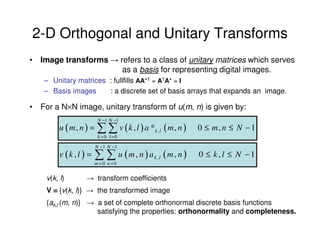
• Image transforms → refers to a class of unitary matrices which serves
                      as a basis for representing digital images.
    – Unitary matrices : fullfills AA*T = ATA* = I
    – Basis images     : a discrete set of basis arrays that expands an image.

• For a N×N image, unitary transform of u(m, n) is given by:
                         N −1 N −1
         u (m, n ) =    ∑ ∑ v (k , l ) a * (m, n )
                         k =0 l =0
                                        k ,l         0 ≤ m, n ≤ N − 1

                        N − 1 N −1
         v (k , l ) =   ∑ ∑ u (m, n ) a (m, n )
                        m =0 n=0
                                        k ,l         0 ≤ k,l ≤ N −1

    v(k, l)        → transform coefficients
    V ≡ {v(k, l)} → the transformed image
    {ak,l (m, n)} → a set of complete orthonormal discrete basis functions
                    satisfying the properties: orthonormality and completeness.
2-D Orthogonal and Unitary Transforms
                              N −1 N −1

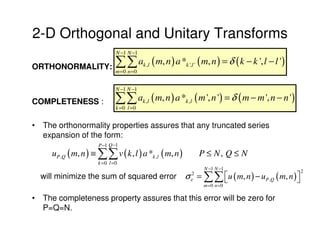
ORTHONORMALITY:               ∑∑ a ( m, n ) a * ( m, n ) = δ ( k − k ', l − l ')
                              m=0 n =0
                                          k ,l           k ',l '


                              N −1 N −1

COMPLETENESS :                ∑∑ a ( m, n ) a * ( m ', n ') = δ ( m − m ', n − n ')
                              k =0 l =0
                                          k ,l           k ,l


• The orthonormality properties assures that any truncated series
  expansion of the form:
                      P −1 Q −1
     u P ,Q ( m, n ) ≡ ∑∑ v ( k , l ) a *k ,l ( m, n )             P ≤ N, Q ≤ N
                      k =0 l =0
                                                                    N −1 N −1
                                                         σ = ∑∑ u ( m, n ) − u P ,Q ( m, n ) 
                                                            2                                     2
  will minimize the sum of squared error                    e                                
                                                                    m =0 n =0

• The completeness property assures that this error will be zero for
  P=Q=N.
Separable Unitary Transforms
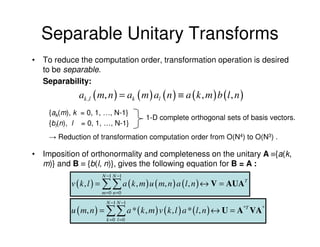
• To reduce the computation order, transformation operation is desired
  to be separable.
  Separability:
             ak ,l ( m, n ) = ak ( m ) al ( n ) ≡ a ( k , m ) b ( l , n )
    {ak(m), k = 0, 1, …, N-1}
                                     1-D complete orthogonal sets of basis vectors.
    {bl(n), l = 0, 1, …, N-1}
    → Reduction of transformation computation order from O(N4) to O(N3) .

• Imposition of orthonormality and completeness on the unitary A ≡{a(k,
  m)} and B ≡ {b(l, n)}, gives the following equation for B = A :
                     N −1 N −1
           v ( k , l ) = ∑∑ a ( k , m ) u ( m, n ) a ( l , n ) ↔ V = AUAT
                     m =0 n =0
                       N −1 N −1
          u ( m, n ) = ∑∑ a * ( k , m ) v ( k , l ) a * ( l , n ) ↔ U = A*T VA*
                       k =0 l =0
Separable Unitary Transforms
• For an M×N rectangular image, the transform pair is:

               V = AMUAN        and    U = A*M V A*TN

• For separable unitary matrix, image transforms can be written as:

                       VT = AUAT = A [AU]T

  Which means transformation process can be performed by first
  transforming each column of U and then transforming each row of
  the result to obtain the rows of V.
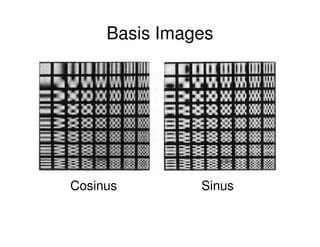
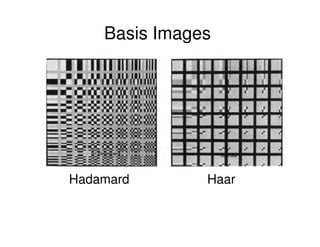
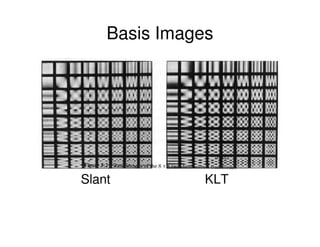
Basis Images
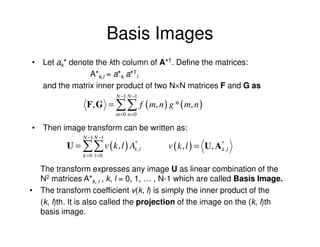
• Let ak* denote the kth column of A*T. Define the matrices:
               A*k,l = a*k a*Tl
  and the matrix inner product of two N×N matrices F and G as
                            N −1 N −1
                F, G = ∑∑ f ( m, n ) g * ( m, n )
                            m =0 n =0

• Then image transform can be written as:
               N −1 N −1
          U = ∑∑ v ( k , l ) Ak ,l
                              *
                                        v ( k , l ) = U , A * ,l
                                                            k
               k =0 l =0

  The transform expresses any image U as linear combination of the
  N2 matrices A*k, l , k, l = 0, 1, … , N-1 which are called Basis Image.
• The transform coefficient v(k, l) is simply the inner product of the
  (k, l)th. It is also called the projection of the image on the (k, l)th
  basis image.
Basis Images


Cosinus        Sinus
Basis Images


Hadamard       Haar
Basis Images


Slant          KLT
Properties of Unitary Transforms
1. Energy conservation and rotation
   In a unitary transform:

       v = Au ||v||2 = ||u||2

   Thus a unitary transformation preserves the signal energy or the
   length of the vector u in the N-dimensional vector space.
   This means every unitary transformation is simply a rotation of the
   vector u in the N-dimensional vector space. [Parseval Theorem!]
   For 2-D unitary transformations, it can be proven that

              N −1 N −1                N −1 N −1

              ∑∑ u ( m, n )          = ∑∑ v ( k , l )
                                 2                      2

              m =0 n =0                k =0 l =0
Properties of Unitary Transforms
2.   Energy Compaction
     Most unitary transforms have a tendency to pack a large fraction of
     the average energy of the image into a relatively few components
     of the transform coefficients. Since the total energy is preserved,
     this means many of the transform coefficients will contain very little
     energy.
3.   Decorrelation
     When the input vector elements are highly correlated, the
     transform coefficients tend to be uncorrelated. This means the off-
     diagonal terms of the covariance matrix R, tend to become small
     compared to the diagonal elements.
4.   Other properties:
     The determinant and the eigenvalues of a unitary matrix have unity
     magnitude.
     The entropy of a random vector is preserved under a unitary
     transformation.
2-D Discrete Fourier Transform (DFT)
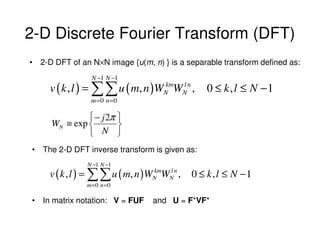
• 2-D DFT of an N×N image {u(m, n) } is a separable transform defined as:
                N −1 N −1
     v ( k , l ) = ∑∑ u ( m, n )WN WN n ,
                                 km l
                                                0 ≤ k, l ≤ N −1
                m =0 n =0

               − j 2π 
     WN ≡ exp         
                 N 
• The 2-D DFT inverse transform is given as:
               N −1 N −1
     v ( k , l ) = ∑∑ u ( m, n ) WN WN n ,
                                  km l
                                             0 ≤ k, l ≤ N −1
               m=0 n =0

• In matrix notation: V = FUF     and U = F*VF*
Properties of 2-D DFT
       [The N2×N2 matrix F represents the N×N 2-D unitary DFT]
• Symmetric and unitary
     F T = F and F –1 = F *
• Periodic extensions
        v(k + N, l + N) = v(k, l)                  ∀k, l
        u(m + N, n+N) = u(m, n)                    ∀m, n
• Sampled Fourier spectrum
  If u ( m, n ) = u ( m, n ) , 0 ≤ m, n ≤ N − 1 ,and u ( m, n ) = 0 otherwise,
  then:
          %  2π k , 2π l  = DFT {u ( m, n )} = v ( k , lx )
          U              
             N N 

    where      %
              U (ω1 ,ω 2 ) is the Fourier transform of u ( m, n )

•   Fast transform
    Since 2-D DFT is separable, it is equivalent to 2N 1-D unitary DFTs, each of
    which can be performed in O(N log2N) via the FFT. Hence the total number of
    operations is O(N2 log2N).
Properties of 2-D DFT
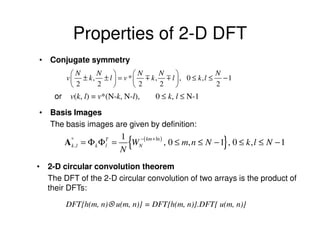
• Conjugate symmetry
           N    N           N    N               N
         v  ± k, ± l  = v *  m k, m l , 0 ≤ k,l ≤ − 1
           2    2           2    2               2
    or     v(k, l) = v*(N-k, N-l),       0 ≤ k, l ≤ N-1

• Basis Images
  The basis images are given by definition:
                              1
         A* , l = Φ k Φ T =
          k             l
                              N
                                {
                                WN (
                                 − km + ln )
                                                               }
                                             , 0 ≤ m, n ≤ N − 1 , 0 ≤ k , l ≤ N − 1

• 2-D circular convolution theorem
  The DFT of the 2-D circular convolution of two arrays is the product of
  their DFTs:

         DFT{h(m, n)⊗ u(m, n)} = DFT{h(m, n)}.DFT{ u(m, n)}
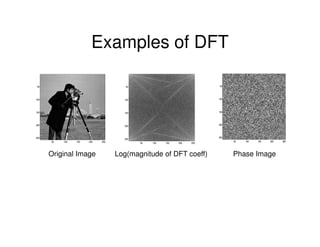
Examples of DFT

50                                    50                                50


100                                  100                                100


150                                  150                                150


200                                                                     200
                                     200


250                                                                     250
                                     250
      50   100   150   200   250                                              50   100   150   200   250
                                           50   100   150   200   250


      Original Image               Log(magnitude of DFT coeff)                Phase Image
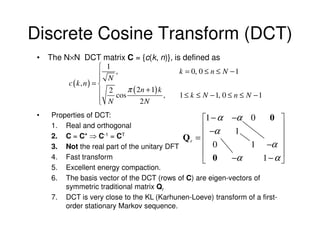
Discrete Cosine Transform (DCT)
 • The N×N DCT matrix C = {c(k, n)}, is defined as
                    1
                    N,                    k = 0, 0 ≤ n ≤ N − 1
                   
        c (k, n) = 
                    2 cos π ( 2n + 1) k , 1 ≤ k ≤ N − 1, 0 ≤ n ≤ N − 1
                    N
                               2N
 •   Properties of DCT:
                                                  1 − α −α 0          0 
     1. Real and orthogonal                        −α      1              
     2. C = C* ⇒ C-1 = CT                    Qr =                         
     3. Not the real part of the unitary DFT       0            1 −α 
                                                                          
     4. Fast transform                              0     −α        1−α 
     5. Excellent energy compaction.
     6. The basis vector of the DCT (rows of C) are eigen-vectors of
         symmetric traditional matrix Qr
     7. DCT is very close to the KL (Karhunen-Loeve) transform of a first-
         order stationary Markov sequence.
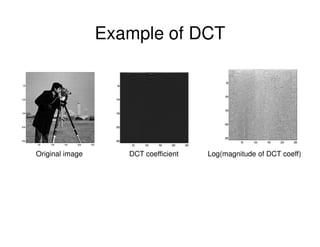
Example of DCT

                                                                             50
50                                   50


                                                                            100
100                                  100


                                                                            150
150                                  150


                                                                            200
200                                  200


                                                                            250
250                                  250                                          50   100   150   200   250
      50   100   150   200   250           50   100   150   200   250


      Original image                       DCT coefficient              Log(magnitude of DCT coeff)
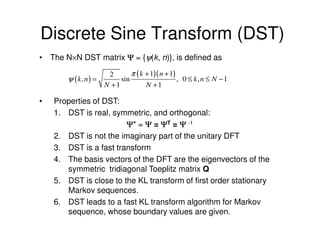
Discrete Sine Transform (DST)
• The N×N DST matrix Ψ = {ψ(k, n)}, is defined as

                       2       π ( k + 1)( n + 1)
        ψ ( k, n) =        sin                    , 0 ≤ k, n ≤ N −1
                      N +1           N +1

•   Properties of DST:
    1. DST is real, symmetric, and orthogonal:
                        Ψ* = Ψ = ΨT = Ψ -1
    2. DST is not the imaginary part of the unitary DFT
    3. DST is a fast transform
    4. The basis vectors of the DFT are the eigenvectors of the
       symmetric tridiagonal Toeplitz matrix Q
    5. DST is close to the KL transform of first order stationary
       Markov sequences.
    6. DST leads to a fast KL transform algorithm for Markov
       sequence, whose boundary values are given.
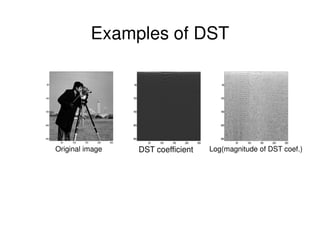
Examples of DST

50                                  50                                      50


100                                 100                                     100


150                                 150                                     150


200                                 200                                     200


250                                 250                                     250
       50   100   150   200   250           50   100   150   200   250            50   100   150   200   250

      Original image                      DST coefficient                Log(magnitude of DST coef.)
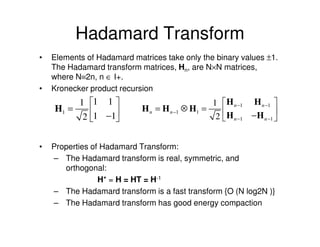
Hadamard Transform
•   Elements of Hadamard matrices take only the binary values ±1.
    The Hadamard transform matrices, Hn, are N×N matrices,
    where N≡2n, n ∈ I+.
•   Kronecker product recursion
         1 1 1                                1  H n −1 H n −1 
    H1 =   1 −1           H n = H n −1 ⊗ H1 =                    
          2                                    2  H n −1 −H n −1 


•   Properties of Hadamard Transform:
    – The Hadamard transform is real, symmetric, and
       orthogonal:
                 H* = H = HT = H-1
    – The Hadamard transform is a fast transform {O (N log2N )}
    – The Hadamard transform has good energy compaction
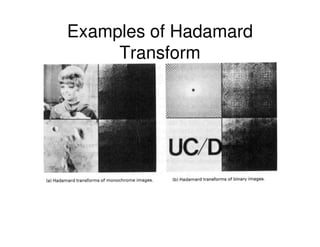
Examples of Hadamard
     Transform
Haar Transform
• The Haar functions hk(x) are defined on a continuous interval,
  x ∈[-1,1] and for k = 0, 1, …, N-1 where N=2n.
• The integer k can be uniquely decomposed as: k = 2p + q -1, where
  0≤ p ≤n-1; q=0,1 for p=0 and 1≤ q ≤2p for p≠0.
• For Example, when N = 4 (or n=2) we have
        k         0         1         2         3
        p         0         0         1         1
        q         0         1         1         2
  Representing k by (p,q), the Haar functions are defined as:
                                  1
          h0 ( x ) ≡ h0,0 ( x ) =    , x ∈ [ 0,1]
                                   N
                                      p2       q −1        q −1 2
                                      2    ,        ≤x<
                                                 2p           2p
                                     
                                  1  p 2 q −1 2               q
         hk ( x ) ≡ hp ,q ( x ) =     −2 ,             ≤x< p
                                  N              2p          2
                                     0      , daerah lain untuk x ∈ [ 0,1]
                                     
                                     
Haar Transform
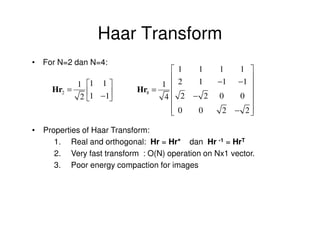
• For N=2 dan N=4:
                                        1    1    1     1 
                                        2    1    −1    −1 
            1    1 1             1                       
      Hr2 =      1 −1      Hr8 =
             2                    4   2   − 2   0     0 
                                                           
                                     
                                        0    0     2   − 2

•   Properties of Haar Transform:
       1. Real and orthogonal: Hr = Hr* dan Hr -1 = HrT
       2. Very fast transform : O(N) operation on Nx1 vector.
       3. Poor energy compaction for images
Slant Transform
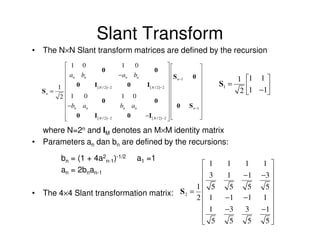
• The N×N Slant transform matrices are defined by the recursion
            1 0                     1         0                                  
           a b           0                               0            
            n n                    − an       bn                       S n −1 0              1    1 1 
         1  0       I ( N / 2)−2          0          I ( N / 2)− 2                       S1 =      1 −1
    Sn =                                                                                       2       
          2 1  0                   1          0                                  
            −b a         0                                0 
                                    bn         an                         0 S n −1 
            n   n                                                                
            0       I ( N / 2)−2          0          −I ( N / 2 ) − 2            
                                                                                 

  where N=2n and IM denotes an M×M identity matrix
• Parameters an dan bn are defined by the recursions:

         bn = (1 + 4a2n-1)-1/2                      a1 =1
                                                                                       1     1    1        1 
         an = 2bnan-1                          
                                                                                       3     1    −1       −3 
                                                                                                               
                                              1                                         5     5    5        5
    The 4×4 Slant transformation matrix: S 2 = 
                                                                                                            1 
•
                                              2                                        1     −1   −1
                                                                                                               
                                                                                       1     −3       3    −1 
                                                                                                              
                                                                                        5     5        5    5
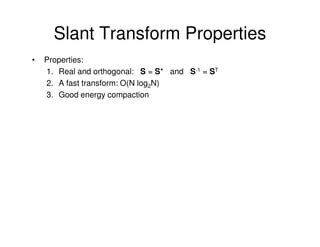
Slant Transform Properties
•   Properties:
    1. Real and orthogonal: S = S* and S-1 = ST
    2. A fast transform: O(N log2N)
    3. Good energy compaction
KL Transform
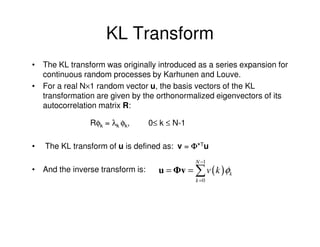
• The KL transform was originally introduced as a series expansion for
  continuous random processes by Karhunen and Louve.
• For a real N×1 random vector u, the basis vectors of the KL
  transformation are given by the orthonormalized eigenvectors of its
  autocorrelation matrix R:

                Rφk = λk φk,      0≤ k ≤ N-1

•   The KL transform of u is defined as: v = Φ*Tu
                                               N −1
• And the inverse transform is:     u = Φv = ∑ v ( k ) φk
                                               k =0

03 image transform

  • 1.
    03. Image Transforms Tati R. Mengko
  • 2.
    2-D Orthogonal andUnitary Transforms • Image transforms → refers to a class of unitary matrices which serves as a basis for representing digital images. – Unitary matrices : fullfills AA*T = ATA* = I – Basis images : a discrete set of basis arrays that expands an image. • For a N×N image, unitary transform of u(m, n) is given by: N −1 N −1 u (m, n ) = ∑ ∑ v (k , l ) a * (m, n ) k =0 l =0 k ,l 0 ≤ m, n ≤ N − 1 N − 1 N −1 v (k , l ) = ∑ ∑ u (m, n ) a (m, n ) m =0 n=0 k ,l 0 ≤ k,l ≤ N −1 v(k, l) → transform coefficients V ≡ {v(k, l)} → the transformed image {ak,l (m, n)} → a set of complete orthonormal discrete basis functions satisfying the properties: orthonormality and completeness.
  • 3.
    2-D Orthogonal andUnitary Transforms N −1 N −1 ORTHONORMALITY: ∑∑ a ( m, n ) a * ( m, n ) = δ ( k − k ', l − l ') m=0 n =0 k ,l k ',l ' N −1 N −1 COMPLETENESS : ∑∑ a ( m, n ) a * ( m ', n ') = δ ( m − m ', n − n ') k =0 l =0 k ,l k ,l • The orthonormality properties assures that any truncated series expansion of the form: P −1 Q −1 u P ,Q ( m, n ) ≡ ∑∑ v ( k , l ) a *k ,l ( m, n ) P ≤ N, Q ≤ N k =0 l =0 N −1 N −1 σ = ∑∑ u ( m, n ) − u P ,Q ( m, n )  2 2 will minimize the sum of squared error e   m =0 n =0 • The completeness property assures that this error will be zero for P=Q=N.
  • 4.
    Separable Unitary Transforms •To reduce the computation order, transformation operation is desired to be separable. Separability: ak ,l ( m, n ) = ak ( m ) al ( n ) ≡ a ( k , m ) b ( l , n ) {ak(m), k = 0, 1, …, N-1} 1-D complete orthogonal sets of basis vectors. {bl(n), l = 0, 1, …, N-1} → Reduction of transformation computation order from O(N4) to O(N3) . • Imposition of orthonormality and completeness on the unitary A ≡{a(k, m)} and B ≡ {b(l, n)}, gives the following equation for B = A : N −1 N −1 v ( k , l ) = ∑∑ a ( k , m ) u ( m, n ) a ( l , n ) ↔ V = AUAT m =0 n =0 N −1 N −1 u ( m, n ) = ∑∑ a * ( k , m ) v ( k , l ) a * ( l , n ) ↔ U = A*T VA* k =0 l =0
  • 5.
    Separable Unitary Transforms •For an M×N rectangular image, the transform pair is: V = AMUAN and U = A*M V A*TN • For separable unitary matrix, image transforms can be written as: VT = AUAT = A [AU]T Which means transformation process can be performed by first transforming each column of U and then transforming each row of the result to obtain the rows of V.
  • 6.
    Basis Images • Letak* denote the kth column of A*T. Define the matrices: A*k,l = a*k a*Tl and the matrix inner product of two N×N matrices F and G as N −1 N −1 F, G = ∑∑ f ( m, n ) g * ( m, n ) m =0 n =0 • Then image transform can be written as: N −1 N −1 U = ∑∑ v ( k , l ) Ak ,l * v ( k , l ) = U , A * ,l k k =0 l =0 The transform expresses any image U as linear combination of the N2 matrices A*k, l , k, l = 0, 1, … , N-1 which are called Basis Image. • The transform coefficient v(k, l) is simply the inner product of the (k, l)th. It is also called the projection of the image on the (k, l)th basis image.
  • 7.
  • 8.
  • 9.
  • 10.
    Properties of UnitaryTransforms 1. Energy conservation and rotation In a unitary transform: v = Au ||v||2 = ||u||2 Thus a unitary transformation preserves the signal energy or the length of the vector u in the N-dimensional vector space. This means every unitary transformation is simply a rotation of the vector u in the N-dimensional vector space. [Parseval Theorem!] For 2-D unitary transformations, it can be proven that N −1 N −1 N −1 N −1 ∑∑ u ( m, n ) = ∑∑ v ( k , l ) 2 2 m =0 n =0 k =0 l =0
  • 11.
    Properties of UnitaryTransforms 2. Energy Compaction Most unitary transforms have a tendency to pack a large fraction of the average energy of the image into a relatively few components of the transform coefficients. Since the total energy is preserved, this means many of the transform coefficients will contain very little energy. 3. Decorrelation When the input vector elements are highly correlated, the transform coefficients tend to be uncorrelated. This means the off- diagonal terms of the covariance matrix R, tend to become small compared to the diagonal elements. 4. Other properties: The determinant and the eigenvalues of a unitary matrix have unity magnitude. The entropy of a random vector is preserved under a unitary transformation.
  • 12.
    2-D Discrete FourierTransform (DFT) • 2-D DFT of an N×N image {u(m, n) } is a separable transform defined as: N −1 N −1 v ( k , l ) = ∑∑ u ( m, n )WN WN n , km l 0 ≤ k, l ≤ N −1 m =0 n =0  − j 2π  WN ≡ exp    N  • The 2-D DFT inverse transform is given as: N −1 N −1 v ( k , l ) = ∑∑ u ( m, n ) WN WN n , km l 0 ≤ k, l ≤ N −1 m=0 n =0 • In matrix notation: V = FUF and U = F*VF*
  • 13.
    Properties of 2-DDFT [The N2×N2 matrix F represents the N×N 2-D unitary DFT] • Symmetric and unitary F T = F and F –1 = F * • Periodic extensions v(k + N, l + N) = v(k, l) ∀k, l u(m + N, n+N) = u(m, n) ∀m, n • Sampled Fourier spectrum If u ( m, n ) = u ( m, n ) , 0 ≤ m, n ≤ N − 1 ,and u ( m, n ) = 0 otherwise, then: %  2π k , 2π l  = DFT {u ( m, n )} = v ( k , lx ) U   N N  where % U (ω1 ,ω 2 ) is the Fourier transform of u ( m, n ) • Fast transform Since 2-D DFT is separable, it is equivalent to 2N 1-D unitary DFTs, each of which can be performed in O(N log2N) via the FFT. Hence the total number of operations is O(N2 log2N).
  • 14.
    Properties of 2-DDFT • Conjugate symmetry N N  N N  N v  ± k, ± l  = v *  m k, m l , 0 ≤ k,l ≤ − 1 2 2  2 2  2 or v(k, l) = v*(N-k, N-l), 0 ≤ k, l ≤ N-1 • Basis Images The basis images are given by definition: 1 A* , l = Φ k Φ T = k l N { WN ( − km + ln ) } , 0 ≤ m, n ≤ N − 1 , 0 ≤ k , l ≤ N − 1 • 2-D circular convolution theorem The DFT of the 2-D circular convolution of two arrays is the product of their DFTs: DFT{h(m, n)⊗ u(m, n)} = DFT{h(m, n)}.DFT{ u(m, n)}
  • 15.
    Examples of DFT 50 50 50 100 100 100 150 150 150 200 200 200 250 250 250 50 100 150 200 250 50 100 150 200 250 50 100 150 200 250 Original Image Log(magnitude of DFT coeff) Phase Image
  • 16.
    Discrete Cosine Transform(DCT) • The N×N DCT matrix C = {c(k, n)}, is defined as  1  N, k = 0, 0 ≤ n ≤ N − 1  c (k, n) =   2 cos π ( 2n + 1) k , 1 ≤ k ≤ N − 1, 0 ≤ n ≤ N − 1  N  2N • Properties of DCT: 1 − α −α 0 0  1. Real and orthogonal  −α 1  2. C = C* ⇒ C-1 = CT Qr =   3. Not the real part of the unitary DFT  0 1 −α    4. Fast transform  0 −α 1−α  5. Excellent energy compaction. 6. The basis vector of the DCT (rows of C) are eigen-vectors of symmetric traditional matrix Qr 7. DCT is very close to the KL (Karhunen-Loeve) transform of a first- order stationary Markov sequence.
  • 17.
    Example of DCT 50 50 50 100 100 100 150 150 150 200 200 200 250 250 250 50 100 150 200 250 50 100 150 200 250 50 100 150 200 250 Original image DCT coefficient Log(magnitude of DCT coeff)
  • 18.
    Discrete Sine Transform(DST) • The N×N DST matrix Ψ = {ψ(k, n)}, is defined as 2 π ( k + 1)( n + 1) ψ ( k, n) = sin , 0 ≤ k, n ≤ N −1 N +1 N +1 • Properties of DST: 1. DST is real, symmetric, and orthogonal: Ψ* = Ψ = ΨT = Ψ -1 2. DST is not the imaginary part of the unitary DFT 3. DST is a fast transform 4. The basis vectors of the DFT are the eigenvectors of the symmetric tridiagonal Toeplitz matrix Q 5. DST is close to the KL transform of first order stationary Markov sequences. 6. DST leads to a fast KL transform algorithm for Markov sequence, whose boundary values are given.
  • 19.
    Examples of DST 50 50 50 100 100 100 150 150 150 200 200 200 250 250 250 50 100 150 200 250 50 100 150 200 250 50 100 150 200 250 Original image DST coefficient Log(magnitude of DST coef.)
  • 20.
    Hadamard Transform • Elements of Hadamard matrices take only the binary values ±1. The Hadamard transform matrices, Hn, are N×N matrices, where N≡2n, n ∈ I+. • Kronecker product recursion 1 1 1  1  H n −1 H n −1  H1 = 1 −1 H n = H n −1 ⊗ H1 =   2  2  H n −1 −H n −1  • Properties of Hadamard Transform: – The Hadamard transform is real, symmetric, and orthogonal: H* = H = HT = H-1 – The Hadamard transform is a fast transform {O (N log2N )} – The Hadamard transform has good energy compaction
  • 21.
  • 22.
    Haar Transform • TheHaar functions hk(x) are defined on a continuous interval, x ∈[-1,1] and for k = 0, 1, …, N-1 where N=2n. • The integer k can be uniquely decomposed as: k = 2p + q -1, where 0≤ p ≤n-1; q=0,1 for p=0 and 1≤ q ≤2p for p≠0. • For Example, when N = 4 (or n=2) we have k 0 1 2 3 p 0 0 1 1 q 0 1 1 2 Representing k by (p,q), the Haar functions are defined as: 1 h0 ( x ) ≡ h0,0 ( x ) = , x ∈ [ 0,1] N  p2 q −1 q −1 2  2 , ≤x< 2p 2p  1  p 2 q −1 2 q hk ( x ) ≡ hp ,q ( x ) =  −2 , ≤x< p N  2p 2 0 , daerah lain untuk x ∈ [ 0,1]  
  • 23.
    Haar Transform • ForN=2 dan N=4:  1 1 1 1   2 1 −1 −1  1 1 1  1   Hr2 = 1 −1 Hr8 = 2   4 2 − 2 0 0      0 0 2 − 2 • Properties of Haar Transform: 1. Real and orthogonal: Hr = Hr* dan Hr -1 = HrT 2. Very fast transform : O(N) operation on Nx1 vector. 3. Poor energy compaction for images
  • 24.
    Slant Transform • TheN×N Slant transform matrices are defined by the recursion  1 0 1 0   a b 0 0   n n − an bn  S n −1 0  1 1 1  1  0 I ( N / 2)−2 0 I ( N / 2)− 2    S1 = 1 −1 Sn =    2   2 1 0 1 0    −b a 0 0  bn an  0 S n −1   n n    0 I ( N / 2)−2 0 −I ( N / 2 ) − 2       where N=2n and IM denotes an M×M identity matrix • Parameters an dan bn are defined by the recursions: bn = (1 + 4a2n-1)-1/2 a1 =1  1 1 1 1  an = 2bnan-1   3 1 −1 −3   1 5 5 5 5 The 4×4 Slant transformation matrix: S 2 =  1  • 2 1 −1 −1   1 −3 3 −1     5 5 5 5
  • 25.
    Slant Transform Properties • Properties: 1. Real and orthogonal: S = S* and S-1 = ST 2. A fast transform: O(N log2N) 3. Good energy compaction
  • 26.
    KL Transform • TheKL transform was originally introduced as a series expansion for continuous random processes by Karhunen and Louve. • For a real N×1 random vector u, the basis vectors of the KL transformation are given by the orthonormalized eigenvectors of its autocorrelation matrix R: Rφk = λk φk, 0≤ k ≤ N-1 • The KL transform of u is defined as: v = Φ*Tu N −1 • And the inverse transform is: u = Φv = ∑ v ( k ) φk k =0