DIGITAL IMAGE PROCESSING
TOPIC: FREQUENCY DOMAIN FILTER
IMAGE SHARPENING
Submitted To -
Mrs.G.Murugeswari M.Tech.,
Assistant Professor
Department of Computer Science & Engineering
M.S.University
Abishekapatti
Submitted By -
T.Arul Raj
A.D.Bibin
M.Kalidass
M.Saravanan
M.Phil (CSE)
M.S University
10/25/16
What Is Image
Enhancement?
Image enhancement is the process of making images more
useful
The reasons for doing this include:
– Highlighting interesting detail in images
– Removing noise from images
– Making images more visually appealing
10/25/16
2
Spatial & Frequency Domains
There are two broad categories of image enhancement
techniques
– Spatial domain techniques
– Direct manipulation of image pixels
– Frequency domain techniques
– Manipulation of Fourier transform or wavelet transform of an image
For the moment we will concentrate on techniques that
operate in the spatial domain
10/25/16
3
Basic steps for filtering in
the frequency domain
4
10/25/16
Basics of filtering in the
frequency domain
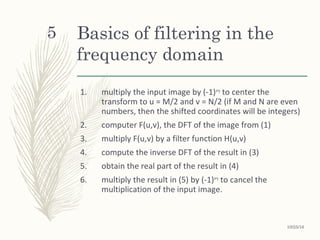
1. multiply the input image by (-1)x+y
to center the
transform to u = M/2 and v = N/2 (if M and N are even
numbers, then the shifted coordinates will be integers)
2. computer F(u,v), the DFT of the image from (1)
3. multiply F(u,v) by a filter function H(u,v)
4. compute the inverse DFT of the result in (3)
5. obtain the real part of the result in (4)
6. multiply the result in (5) by (-1)x+y
to cancel the
multiplication of the input image.
5
10/25/16
Sharpening
– Edges and fine detail characterized by sharp transitions in
image intensity
– Such transitions contribute significantly to high frequency
components of Fourier transform
– Intuitively, attenuating certain low frequency components
and preserving high frequency components result in
sharpening
10/25/16
6
Sharpening Filter Transfer
Function
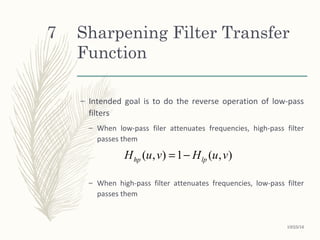
– Intended goal is to do the reverse operation of low-pass
filters
– When low-pass filer attenuates frequencies, high-pass filter
passes them
– When high-pass filter attenuates frequencies, low-pass filter
passes them
( , ) 1 ( , )hp lpH u v H u v= −
10/25/16
7
Blurring masks
A blurring mask has the following properties.
– All the values in blurring masks are positive
– The sum of all the values is equal to 1
– The edge content is reduced by using a blurring mask
– As the size of the mask grow, more smoothing effect will take
place
10/25/16
8
Derivative masks
A derivative mask has the following properties.
– A derivative mask have positive and as well as negative values
– The sum of all the values in a derivative mask is equal to zero
– The edge content is increased by a derivative mask
– As the size of the mask grows , more edge content is increased
10/25/16
9
Relationship between blurring mask and
derivative mask with high pass filters and low
pass filters:
The relationship between blurring mask and derivative mask
with a high pass filter and low pass filter can be defined
simply as.
– Blurring masks are also called as low pass filter
– Derivative masks are also called as high pass filter
10/25/16
10
High pass frequency components
and Low pass frequency components
– High pass frequency
components and Low
pass frequency
components
– the low pass frequency
components denotes
smooth regions.
10/25/16
11
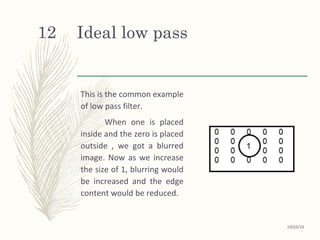
Ideal low pass
This is the common example
of low pass filter.
When one is placed
inside and the zero is placed
outside , we got a blurred
image. Now as we increase
the size of 1, blurring would
be increased and the edge
content would be reduced.
10/25/16
12
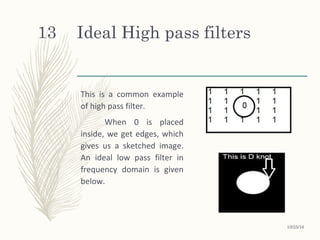
Ideal High pass filters
This is a common example
of high pass filter.
When 0 is placed
inside, we get edges, which
gives us a sketched image.
An ideal low pass filter in
frequency domain is given
below.
10/25/16
13
Butterworth High Pass
Filters
The Butterworth high pass filter is given as:
where n is the order and D0 is the cut off distance as before
n
vuDD
vuH 2
0 )],(/[1
1
),(
+
=
10/25/16
14
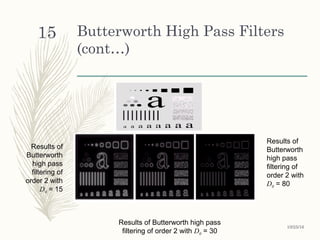
Butterworth High Pass Filters
(cont…)
Results of
Butterworth
high pass
filtering of
order 2 with
D0 = 15
Results of
Butterworth
high pass
filtering of
order 2 with
D0 = 80
Results of Butterworth high pass
filtering of order 2 with D0 = 30
10/25/16
15
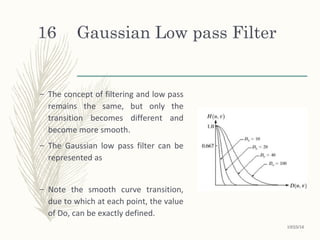
Gaussian Low pass Filter
– The concept of filtering and low pass
remains the same, but only the
transition becomes different and
become more smooth.
– The Gaussian low pass filter can be
represented as
– Note the smooth curve transition,
due to which at each point, the value
of Do, can be exactly defined.
10/25/16
16
Gaussian high pass filter
– Gaussian high pass filter has the same concept as ideal high
pass filter, but again the transition is more smooth as
compared to the ideal one.
10/25/16
17
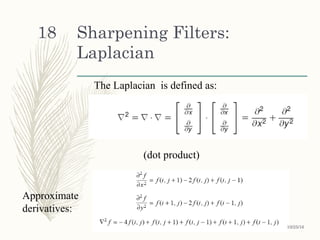
Sharpening Filters:
Laplacian
The Laplacian is defined as:
(dot product)
Approximate
derivatives:
10/25/16
18
Sharpening Filters:
Laplacian (cont’d)
Laplacian Mask
detect zero-crossings
10/25/16
19
20 Conclusion
– The aim of image enhancement is to improve the
information in images for human viewers, or to provide
`better' input for other automated image processing
techniques
– There is no general theory for determining what is `good'
image enhancement when it comes to human perception.
If it looks good, it is good!
10/25/16
REFERENCE VIDEOS
10/25/16
21
References Videos
10/25/16
22
10/25/16
23
THANK YOU

Image enhancement sharpening

  • 1.
    DIGITAL IMAGE PROCESSING TOPIC:FREQUENCY DOMAIN FILTER IMAGE SHARPENING Submitted To - Mrs.G.Murugeswari M.Tech., Assistant Professor Department of Computer Science & Engineering M.S.University Abishekapatti Submitted By - T.Arul Raj A.D.Bibin M.Kalidass M.Saravanan M.Phil (CSE) M.S University 10/25/16
  • 2.
    What Is Image Enhancement? Imageenhancement is the process of making images more useful The reasons for doing this include: – Highlighting interesting detail in images – Removing noise from images – Making images more visually appealing 10/25/16 2
  • 3.
    Spatial & FrequencyDomains There are two broad categories of image enhancement techniques – Spatial domain techniques – Direct manipulation of image pixels – Frequency domain techniques – Manipulation of Fourier transform or wavelet transform of an image For the moment we will concentrate on techniques that operate in the spatial domain 10/25/16 3
  • 4.
    Basic steps forfiltering in the frequency domain 4 10/25/16
  • 5.
    Basics of filteringin the frequency domain 1. multiply the input image by (-1)x+y to center the transform to u = M/2 and v = N/2 (if M and N are even numbers, then the shifted coordinates will be integers) 2. computer F(u,v), the DFT of the image from (1) 3. multiply F(u,v) by a filter function H(u,v) 4. compute the inverse DFT of the result in (3) 5. obtain the real part of the result in (4) 6. multiply the result in (5) by (-1)x+y to cancel the multiplication of the input image. 5 10/25/16
  • 6.
    Sharpening – Edges andfine detail characterized by sharp transitions in image intensity – Such transitions contribute significantly to high frequency components of Fourier transform – Intuitively, attenuating certain low frequency components and preserving high frequency components result in sharpening 10/25/16 6
  • 7.
    Sharpening Filter Transfer Function –Intended goal is to do the reverse operation of low-pass filters – When low-pass filer attenuates frequencies, high-pass filter passes them – When high-pass filter attenuates frequencies, low-pass filter passes them ( , ) 1 ( , )hp lpH u v H u v= − 10/25/16 7
  • 8.
    Blurring masks A blurringmask has the following properties. – All the values in blurring masks are positive – The sum of all the values is equal to 1 – The edge content is reduced by using a blurring mask – As the size of the mask grow, more smoothing effect will take place 10/25/16 8
  • 9.
    Derivative masks A derivativemask has the following properties. – A derivative mask have positive and as well as negative values – The sum of all the values in a derivative mask is equal to zero – The edge content is increased by a derivative mask – As the size of the mask grows , more edge content is increased 10/25/16 9
  • 10.
    Relationship between blurringmask and derivative mask with high pass filters and low pass filters: The relationship between blurring mask and derivative mask with a high pass filter and low pass filter can be defined simply as. – Blurring masks are also called as low pass filter – Derivative masks are also called as high pass filter 10/25/16 10
  • 11.
    High pass frequencycomponents and Low pass frequency components – High pass frequency components and Low pass frequency components – the low pass frequency components denotes smooth regions. 10/25/16 11
  • 12.
    Ideal low pass Thisis the common example of low pass filter. When one is placed inside and the zero is placed outside , we got a blurred image. Now as we increase the size of 1, blurring would be increased and the edge content would be reduced. 10/25/16 12
  • 13.
    Ideal High passfilters This is a common example of high pass filter. When 0 is placed inside, we get edges, which gives us a sketched image. An ideal low pass filter in frequency domain is given below. 10/25/16 13
  • 14.
    Butterworth High Pass Filters TheButterworth high pass filter is given as: where n is the order and D0 is the cut off distance as before n vuDD vuH 2 0 )],(/[1 1 ),( + = 10/25/16 14
  • 15.
    Butterworth High PassFilters (cont…) Results of Butterworth high pass filtering of order 2 with D0 = 15 Results of Butterworth high pass filtering of order 2 with D0 = 80 Results of Butterworth high pass filtering of order 2 with D0 = 30 10/25/16 15
  • 16.
    Gaussian Low passFilter – The concept of filtering and low pass remains the same, but only the transition becomes different and become more smooth. – The Gaussian low pass filter can be represented as – Note the smooth curve transition, due to which at each point, the value of Do, can be exactly defined. 10/25/16 16
  • 17.
    Gaussian high passfilter – Gaussian high pass filter has the same concept as ideal high pass filter, but again the transition is more smooth as compared to the ideal one. 10/25/16 17
  • 18.
    Sharpening Filters: Laplacian The Laplacianis defined as: (dot product) Approximate derivatives: 10/25/16 18
  • 19.
    Sharpening Filters: Laplacian (cont’d) LaplacianMask detect zero-crossings 10/25/16 19
  • 20.
    20 Conclusion – Theaim of image enhancement is to improve the information in images for human viewers, or to provide `better' input for other automated image processing techniques – There is no general theory for determining what is `good' image enhancement when it comes to human perception. If it looks good, it is good! 10/25/16
  • 21.
  • 22.
  • 23.