
A
PRESENTATION ON
SEGMENTATION
USING
MORPHOLOGICAL WATERSHEDS
Prepared by:
Siddiqui Arshad Hussain A.
M.E.(MSA) Part-2
Roll no. 296
Course: Image Processing
Hars10203@gmail.com
Faculty of Technology And Engineering, Maharaja
Sayajirao University Of Baroda
Department of Electrical Engineering
Contains
1) Image Segmentation
2) Historical Background
3) Introduction
4) Basic Concept
I. Different Levels Of Flooding
5) Dam Construction
6) Watershed Segmentation Algorithm
7) Drawback of Watersheds algorithm
8) Gradient of image
9) Use of Marker
 Summery
 References
3hars10203@gmail.com
1. Image Segmentation:
• Let R represent entire spatial image region occupied
by an image. We may view image segmentation as a
process that partition R into n Sub-region
R1,R2,…..,Rn .
4hars10203@gmail.com
5hars10203@gmail.com
2. Historical Background of Watershed
Segmentation.
• In 1975 first algorithm was developed, for Topographical digital
elevation.(US, and 1984/86)
• In 1978/82/90 first algorithm was developed for digital image
processing.(US, and 1982/90)
– focus on elevation (gradient).
– Not accurate,
– because extreme computational demand, Not efficient
• In 1991 L. Vincent and P. Soile make this idea practical.(Make this
concept successful)
– Each minima represent one basin.(Flooding)
– Fill from bottom.
– Algorithm based on sorting the pixel in increasing order of their gray values.
• 1994 modified watershed segmentation. . .
6hars10203@gmail.com
There are two basic approaches to watershed image
segmentation.
1. Flooding.(Catchment Basin)
(Used in Watershed Segmentation)
1. Rainfall (Finding, downstream path from each pixel
to local minima)or gradient.
7hars10203@gmail.com
3. INTRODUCTION OF WATERSED
SEGMENTATION
 Image segmentation is based on three principal concepts
 Detection of discontinuities
 Thresholding
 Region Processing
 Morphological Watershed Image Segmentation embodies
many of the concepts of above three approaches
 Often produces more stable segmentation including
continuous segmentation boundaries
 Provides a simple framework for incorporating knowledge
based constraints
8hars10203@gmail.com
4. BASIC CONCEPT OF WATERSED
SEGMENTATION
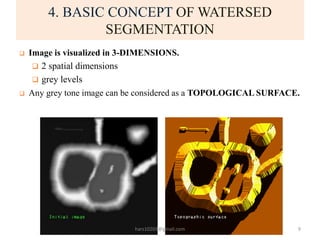
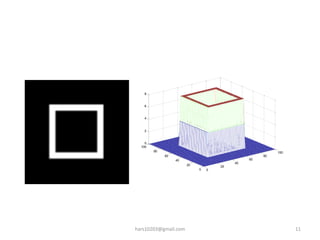
 Image is visualized in 3-DIMENSIONS.
 2 spatial dimensions
 grey levels
 Any grey tone image can be considered as a TOPOLOGICAL SURFACE.
9hars10203@gmail.com
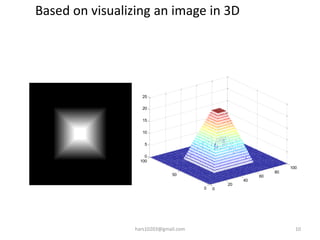
Based on visualizing an image in 3D
0
20
40
60
80
100
0
50
100
0
5
10
15
20
25
10hars10203@gmail.com
0
20
40
60
80
100
0
20
40
60
80
100
0
2
4
6
8
11hars10203@gmail.com
CONTINUED….
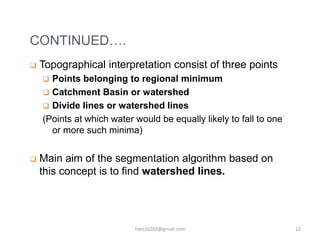
 Topographical interpretation consist of three points
 Points belonging to regional minimum
 Catchment Basin or watershed
 Divide lines or watershed lines
(Points at which water would be equally likely to fall to one
or more such minima)
 Main aim of the segmentation algorithm based on
this concept is to find watershed lines.
12hars10203@gmail.com
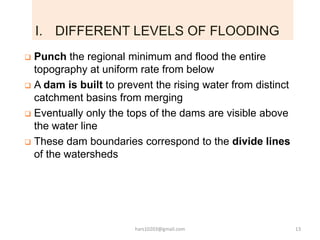
 Punch the regional minimum and flood the entire
topography at uniform rate from below
 A dam is built to prevent the rising water from distinct
catchment basins from merging
 Eventually only the tops of the dams are visible above
the water line
 These dam boundaries correspond to the divide lines
of the watersheds
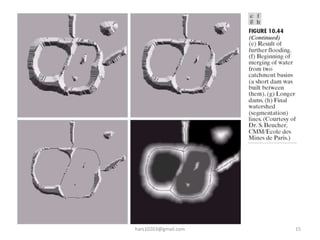
I. DIFFERENT LEVELS OF FLOODING
13hars10203@gmail.com
14hars10203@gmail.com
15hars10203@gmail.com
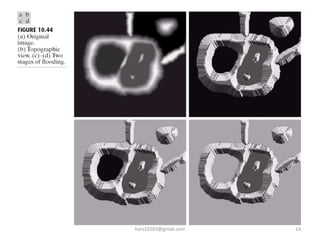
 In topographical view shown earlier the height of the
mountains was proportional to the grey scale value of
the original image
 Water level is rising in consecutive images shown in the
previous slide
 In order to prevent water from spilling out of the
structure we imagine the entire topography to be
enclosed by dams of height greater than highest
possible mountain
 The value of the height is determined by the
highest possible gray-level value in the input image
16hars10203@gmail.com
5. Dam Construction
 Dam construction is based on binary images, which are
members of 2-D integer space
 The dam must be built to keep water from spilling across
the basins.
 Let M1 and M2 be the set of coordinates of the points in the
two regional minima.
 The set of coordinates of the points in the catchment basin
associated with the two minima in the flooding level n be
Cn(M1) and Cn(M2).
 Let the Union of these sets be C[n].
17hars10203@gmail.com
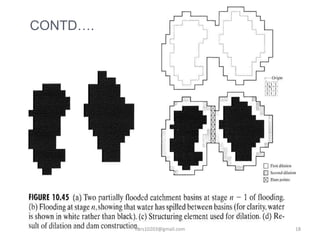
CONTD….
18hars10203@gmail.com
CONTD….
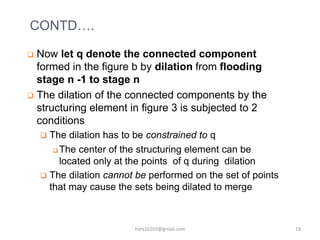
 Now let q denote the connected component
formed in the figure b by dilation from flooding
stage n -1 to stage n
 The dilation of the connected components by the
structuring element in figure 3 is subjected to 2
conditions
 The dilation has to be constrained to q
 The center of the structuring element can be
located only at the points of q during dilation
 The dilation cannot be performed on the set of points
that may cause the sets being dilated to merge
19hars10203@gmail.com
CONTD….
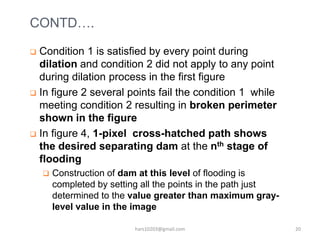
 Condition 1 is satisfied by every point during
dilation and condition 2 did not apply to any point
during dilation process in the first figure
 In figure 2 several points fail the condition 1 while
meeting condition 2 resulting in broken perimeter
shown in the figure
 In figure 4, 1-pixel cross-hatched path shows
the desired separating dam at the nth stage of
flooding
 Construction of dam at this level of flooding is
completed by setting all the points in the path just
determined to the value greater than maximum gray-
level value in the image
20hars10203@gmail.com
6. WATERSHED SEGMENTATION
ALGORITHM
 Let M1, M2, M3….Mn be the sets of coordinates of
points in the regional minima of the image g(x,y)
 C(Mi) be the coordinates of points of the catchment basin
associated with regional minima Mi
 T[n] = { (s,t) | g(s,t) < n }
 T[n] = Set of points in g(x,y) which are lying below the
plane g(x,y) = n
 n = Stage of flooding, varies from min+1 to max+1
 min = minimum gray level value
 max = maximum gray level value
21hars10203@gmail.com
ALGORITHM CONTD….
 Let Cn(M1) be the set of points in the catchment
basin associated with M1 that are flooded at stage
n.

 Cn(Mi) = 1 at location (x,y) if (x,y) Є C(Mi)
 AND (x,y) Є T[n], otherwise it is 0.
 C[n] be the union of flooded catchment basin
portions at the stage n
 =>
 =>
22hars10203@gmail.com
ALGORITHM CONTD….
 Algorithm keeps on increasing the level of flooding,
and during the process Cn(Mi) and T[n] either
increase or remain constant.
 Algorithm initializes C[min +1] = T[min+1], and
then proceeds recursively assuming that at step n
C[n-1] has been constructed.
 Let Q be set of connected components in T[n].
 For each connected component q Є Q[n], there are
three possibilities:
23hars10203@gmail.com
ALGORITHM CONTD….
 Condition (a) occurs when a new minima is
encountered, in this case q is added to set C[n-1] to
form C[n].
 Condition (b) occurs when q lies within a catchment
basin of some regional minima, in that case
 Condition (c) occurs when ridge between two
catchment basins is hit and further flooding will
cause the waters from two basins will merge, so a
dam must be built within q.
24hars10203@gmail.com
DAM CONSTRUCTION
 As shown in the previous images, a one pixel thick
dam can be constructed when needed by dilating
q ∩ C[n-1] with a 3 × 3 Structuring matrix of 1’s
and constraining the dilation to q.
 Algorithm efficiency can be improved by using only
values of n that correspond to existing gray level
values in g(x,y).
 Histogram of g(x,y) can be used to evaluate min,
max and these values.
25hars10203@gmail.com
7. Drawback of Watershed Algorithm
• Drawback of Watershed Algorithm based image
segmentation.
Over Segmentation
Sensitivity to noise
Low contrast boundaries
Poor detection of thin edge
26hars10203@gmail.com
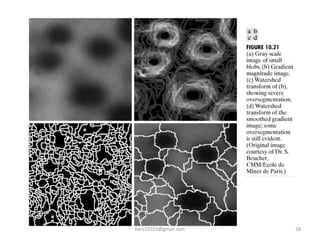
8. GRADIENT OF IMAGE
 Regions of the image characterized by small
variations in gray levels have small gradient
values, so watershed segmentation is applied on
the gradient of the image rather than the actual
image.
 In this way, the regional minima of catchment
basins correlate nicely with the small value of the
gradients corresponding to the objects of interest.
27hars10203@gmail.com
28hars10203@gmail.com
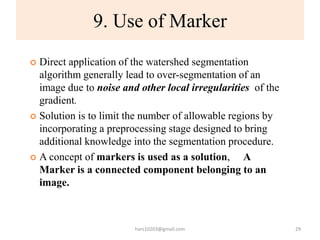
9. Use of Marker
 Direct application of the watershed segmentation
algorithm generally lead to over-segmentation of an
image due to noise and other local irregularities of the
gradient.
 Solution is to limit the number of allowable regions by
incorporating a preprocessing stage designed to bring
additional knowledge into the segmentation procedure.
 A concept of markers is used as a solution, A
Marker is a connected component belonging to an
image.
29hars10203@gmail.com
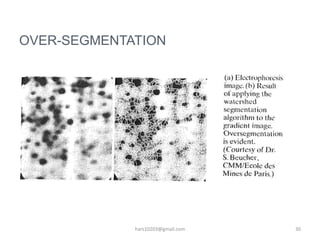
OVER-SEGMENTATION
30hars10203@gmail.com
MARKERS CONTD….
 Selection of markers consists of two principal
steps:
 Preprocessing
 Definition of a set of criteria
 There two types of markers:
 External : associated with the background
 Internal : associated with the objects of interest
 In the previous image due to large number of
potential minima, image is over-segmented.
31hars10203@gmail.com
MARKERS CONTD….
 An effective measure to minimize the effect of small
spatial details is to filter the image with a
smoothing filter.
 i.e. a Preprocessing step.
 For example, we can define the Internal markers
to be :
 region surrounded by the higher altitude points.
 every region should be a connected component
 every point in the region should have same gray level
value.
 External markers can be some regions of particular
background color.
32hars10203@gmail.com
Summery:
• The watershed algorithm Is extremely power full and faster
compare to others. But it is also proved to be more accurate.
Furthermore , it turn out to be very flexible, since it can be
easily adapted to any kind of digital grid and extended to n-
dimensional images and graph.
33hars10203@gmail.com
References:
 M. Sonka, V. Halava and Roger B., “Image Processing Analysis and
Machine Vision”, Second Edition By: PWS Publication, Page no. 590,186.
 R. C. Gonzalez and R. E. Woods, “Digital Image Processing” third edition,
Prentice Hall, 2010.
 William K. Pratt “Digital Image Processing”, Third Edition, Page number
563.
 Sonka, Hlava and Boyle, “Digital Image Processing And Computer Vision”,
Page number-202,549.
 Vincent L. and Soille P. “Watersheds in digital Spaces: An efficient
Algorithm based on immersion Simulations”, IEEE Transaction on
Pattern Analysis and Machine Intelligence, 13(6):583-598-1991.
34hars10203@gmail.com
Thankyou

Watershed Segmentation Image Processing

  • 1.
  • 2.
    Prepared by: Siddiqui ArshadHussain A. M.E.(MSA) Part-2 Roll no. 296 Course: Image Processing Hars10203@gmail.com Faculty of Technology And Engineering, Maharaja Sayajirao University Of Baroda Department of Electrical Engineering
  • 3.
    Contains 1) Image Segmentation 2)Historical Background 3) Introduction 4) Basic Concept I. Different Levels Of Flooding 5) Dam Construction 6) Watershed Segmentation Algorithm 7) Drawback of Watersheds algorithm 8) Gradient of image 9) Use of Marker  Summery  References 3hars10203@gmail.com
  • 4.
    1. Image Segmentation: •Let R represent entire spatial image region occupied by an image. We may view image segmentation as a process that partition R into n Sub-region R1,R2,…..,Rn . 4hars10203@gmail.com
  • 5.
  • 6.
    2. Historical Backgroundof Watershed Segmentation. • In 1975 first algorithm was developed, for Topographical digital elevation.(US, and 1984/86) • In 1978/82/90 first algorithm was developed for digital image processing.(US, and 1982/90) – focus on elevation (gradient). – Not accurate, – because extreme computational demand, Not efficient • In 1991 L. Vincent and P. Soile make this idea practical.(Make this concept successful) – Each minima represent one basin.(Flooding) – Fill from bottom. – Algorithm based on sorting the pixel in increasing order of their gray values. • 1994 modified watershed segmentation. . . 6hars10203@gmail.com
  • 7.
    There are twobasic approaches to watershed image segmentation. 1. Flooding.(Catchment Basin) (Used in Watershed Segmentation) 1. Rainfall (Finding, downstream path from each pixel to local minima)or gradient. 7hars10203@gmail.com
  • 8.
    3. INTRODUCTION OFWATERSED SEGMENTATION  Image segmentation is based on three principal concepts  Detection of discontinuities  Thresholding  Region Processing  Morphological Watershed Image Segmentation embodies many of the concepts of above three approaches  Often produces more stable segmentation including continuous segmentation boundaries  Provides a simple framework for incorporating knowledge based constraints 8hars10203@gmail.com
  • 9.
    4. BASIC CONCEPTOF WATERSED SEGMENTATION  Image is visualized in 3-DIMENSIONS.  2 spatial dimensions  grey levels  Any grey tone image can be considered as a TOPOLOGICAL SURFACE. 9hars10203@gmail.com
  • 10.
    Based on visualizingan image in 3D 0 20 40 60 80 100 0 50 100 0 5 10 15 20 25 10hars10203@gmail.com
  • 11.
  • 12.
    CONTINUED….  Topographical interpretationconsist of three points  Points belonging to regional minimum  Catchment Basin or watershed  Divide lines or watershed lines (Points at which water would be equally likely to fall to one or more such minima)  Main aim of the segmentation algorithm based on this concept is to find watershed lines. 12hars10203@gmail.com
  • 13.
     Punch theregional minimum and flood the entire topography at uniform rate from below  A dam is built to prevent the rising water from distinct catchment basins from merging  Eventually only the tops of the dams are visible above the water line  These dam boundaries correspond to the divide lines of the watersheds I. DIFFERENT LEVELS OF FLOODING 13hars10203@gmail.com
  • 14.
  • 15.
  • 16.
     In topographicalview shown earlier the height of the mountains was proportional to the grey scale value of the original image  Water level is rising in consecutive images shown in the previous slide  In order to prevent water from spilling out of the structure we imagine the entire topography to be enclosed by dams of height greater than highest possible mountain  The value of the height is determined by the highest possible gray-level value in the input image 16hars10203@gmail.com
  • 17.
    5. Dam Construction Dam construction is based on binary images, which are members of 2-D integer space  The dam must be built to keep water from spilling across the basins.  Let M1 and M2 be the set of coordinates of the points in the two regional minima.  The set of coordinates of the points in the catchment basin associated with the two minima in the flooding level n be Cn(M1) and Cn(M2).  Let the Union of these sets be C[n]. 17hars10203@gmail.com
  • 18.
  • 19.
    CONTD….  Now letq denote the connected component formed in the figure b by dilation from flooding stage n -1 to stage n  The dilation of the connected components by the structuring element in figure 3 is subjected to 2 conditions  The dilation has to be constrained to q  The center of the structuring element can be located only at the points of q during dilation  The dilation cannot be performed on the set of points that may cause the sets being dilated to merge 19hars10203@gmail.com
  • 20.
    CONTD….  Condition 1is satisfied by every point during dilation and condition 2 did not apply to any point during dilation process in the first figure  In figure 2 several points fail the condition 1 while meeting condition 2 resulting in broken perimeter shown in the figure  In figure 4, 1-pixel cross-hatched path shows the desired separating dam at the nth stage of flooding  Construction of dam at this level of flooding is completed by setting all the points in the path just determined to the value greater than maximum gray- level value in the image 20hars10203@gmail.com
  • 21.
    6. WATERSHED SEGMENTATION ALGORITHM Let M1, M2, M3….Mn be the sets of coordinates of points in the regional minima of the image g(x,y)  C(Mi) be the coordinates of points of the catchment basin associated with regional minima Mi  T[n] = { (s,t) | g(s,t) < n }  T[n] = Set of points in g(x,y) which are lying below the plane g(x,y) = n  n = Stage of flooding, varies from min+1 to max+1  min = minimum gray level value  max = maximum gray level value 21hars10203@gmail.com
  • 22.
    ALGORITHM CONTD….  LetCn(M1) be the set of points in the catchment basin associated with M1 that are flooded at stage n.   Cn(Mi) = 1 at location (x,y) if (x,y) Є C(Mi)  AND (x,y) Є T[n], otherwise it is 0.  C[n] be the union of flooded catchment basin portions at the stage n  =>  => 22hars10203@gmail.com
  • 23.
    ALGORITHM CONTD….  Algorithmkeeps on increasing the level of flooding, and during the process Cn(Mi) and T[n] either increase or remain constant.  Algorithm initializes C[min +1] = T[min+1], and then proceeds recursively assuming that at step n C[n-1] has been constructed.  Let Q be set of connected components in T[n].  For each connected component q Є Q[n], there are three possibilities: 23hars10203@gmail.com
  • 24.
    ALGORITHM CONTD….  Condition(a) occurs when a new minima is encountered, in this case q is added to set C[n-1] to form C[n].  Condition (b) occurs when q lies within a catchment basin of some regional minima, in that case  Condition (c) occurs when ridge between two catchment basins is hit and further flooding will cause the waters from two basins will merge, so a dam must be built within q. 24hars10203@gmail.com
  • 25.
    DAM CONSTRUCTION  Asshown in the previous images, a one pixel thick dam can be constructed when needed by dilating q ∩ C[n-1] with a 3 × 3 Structuring matrix of 1’s and constraining the dilation to q.  Algorithm efficiency can be improved by using only values of n that correspond to existing gray level values in g(x,y).  Histogram of g(x,y) can be used to evaluate min, max and these values. 25hars10203@gmail.com
  • 26.
    7. Drawback ofWatershed Algorithm • Drawback of Watershed Algorithm based image segmentation. Over Segmentation Sensitivity to noise Low contrast boundaries Poor detection of thin edge 26hars10203@gmail.com
  • 27.
    8. GRADIENT OFIMAGE  Regions of the image characterized by small variations in gray levels have small gradient values, so watershed segmentation is applied on the gradient of the image rather than the actual image.  In this way, the regional minima of catchment basins correlate nicely with the small value of the gradients corresponding to the objects of interest. 27hars10203@gmail.com
  • 28.
  • 29.
    9. Use ofMarker  Direct application of the watershed segmentation algorithm generally lead to over-segmentation of an image due to noise and other local irregularities of the gradient.  Solution is to limit the number of allowable regions by incorporating a preprocessing stage designed to bring additional knowledge into the segmentation procedure.  A concept of markers is used as a solution, A Marker is a connected component belonging to an image. 29hars10203@gmail.com
  • 30.
  • 31.
    MARKERS CONTD….  Selectionof markers consists of two principal steps:  Preprocessing  Definition of a set of criteria  There two types of markers:  External : associated with the background  Internal : associated with the objects of interest  In the previous image due to large number of potential minima, image is over-segmented. 31hars10203@gmail.com
  • 32.
    MARKERS CONTD….  Aneffective measure to minimize the effect of small spatial details is to filter the image with a smoothing filter.  i.e. a Preprocessing step.  For example, we can define the Internal markers to be :  region surrounded by the higher altitude points.  every region should be a connected component  every point in the region should have same gray level value.  External markers can be some regions of particular background color. 32hars10203@gmail.com
  • 33.
    Summery: • The watershedalgorithm Is extremely power full and faster compare to others. But it is also proved to be more accurate. Furthermore , it turn out to be very flexible, since it can be easily adapted to any kind of digital grid and extended to n- dimensional images and graph. 33hars10203@gmail.com
  • 34.
    References:  M. Sonka,V. Halava and Roger B., “Image Processing Analysis and Machine Vision”, Second Edition By: PWS Publication, Page no. 590,186.  R. C. Gonzalez and R. E. Woods, “Digital Image Processing” third edition, Prentice Hall, 2010.  William K. Pratt “Digital Image Processing”, Third Edition, Page number 563.  Sonka, Hlava and Boyle, “Digital Image Processing And Computer Vision”, Page number-202,549.  Vincent L. and Soille P. “Watersheds in digital Spaces: An efficient Algorithm based on immersion Simulations”, IEEE Transaction on Pattern Analysis and Machine Intelligence, 13(6):583-598-1991. 34hars10203@gmail.com
  • 35.