S.Nandhini
II-M Sc(CS&IT),
Nadar Saraswathi College of Arts and Science,
Theni.
ERROR FREE COMPRESSION
 Error free compression is the only acceptable means of data
reduction.
 One such application is the archival of medical or business
documents.
 Need for error free compression is motivated by the intended
use or nature of the images under consideration.
There types in error free compression
 Variable-length coding
 Huffman coding
 Arithmetic coding
 Variable-length coding
 Error-free image compression is to reduce
only coding redundancy.
 coding redundancy normally is present in
any natural binary encoding of the gray level in an image.
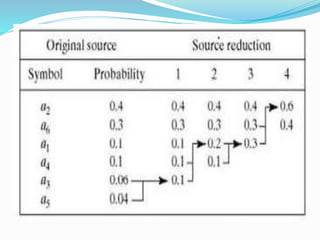
HUFFMAN CODING
 Coding the symbol of an information source individually.
 Huffman coding yields the smallest possible number of
code symbols per sources symbol.
 The constraint that the source symbol be coded one at a
time.
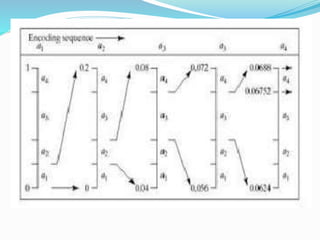
ARITHMETIC CODING
 Arithmetic coding generates non-block codes.
 A one-to-one correspondence between source symbols and
code words does not exist
 Sequence of source symbols is assigned a single arithmetic
code word.
LOSSY COMPRESSION
 Lossy compression encoding is based on the concept of
compromising the accuracy
 The reconstructed image in exchange for increased
compression.
 The resulting distortion can be tolerated
 The increase in compression can be significant.
LOSSY PREDICTIVE CODING
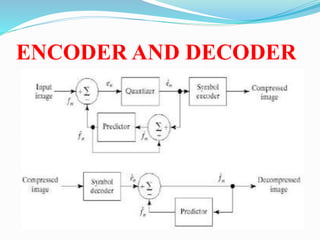
 Add a quantizer to the model introduced examine the
resulting trade-off between reconstruction accuracy and
compression performance.
 Lossy predictive coding model
 A)encoder
 B)decoder
ENCODER AND DECODER
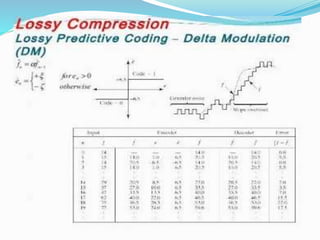
DELTA MODULATION
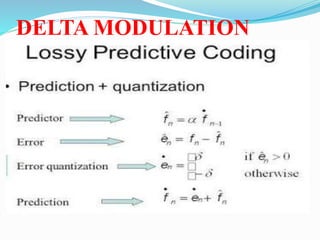
 Delta modulation(DM) is a simple but well-known form of
lossy predictive coding in which the predictor and quantizer
are defined
DELTA MODULATION
TRANSFORM CODING
 Transform coding a reversible, linear transform is used to
map the image into a set of transform coefficients.
 Which are then quantized and coded.
TRANSFORM CODING
Performs four relatively straightforward operations
 DECOMPOSITION
 TRANSFORMATION
 QUANTIZATION
 CODING
An NXN input of image first is subdivided into subimages
of size nXn.
Which are then transformed to generate(N/n)2 sub image
transform arrays.
THANK YOU

digital image processing

  • 1.
    S.Nandhini II-M Sc(CS&IT), Nadar SaraswathiCollege of Arts and Science, Theni.
  • 2.
    ERROR FREE COMPRESSION Error free compression is the only acceptable means of data reduction.  One such application is the archival of medical or business documents.  Need for error free compression is motivated by the intended use or nature of the images under consideration.
  • 3.
    There types inerror free compression  Variable-length coding  Huffman coding  Arithmetic coding  Variable-length coding  Error-free image compression is to reduce only coding redundancy.  coding redundancy normally is present in any natural binary encoding of the gray level in an image.
  • 4.
    HUFFMAN CODING  Codingthe symbol of an information source individually.  Huffman coding yields the smallest possible number of code symbols per sources symbol.  The constraint that the source symbol be coded one at a time.
  • 6.
    ARITHMETIC CODING  Arithmeticcoding generates non-block codes.  A one-to-one correspondence between source symbols and code words does not exist  Sequence of source symbols is assigned a single arithmetic code word.
  • 8.
    LOSSY COMPRESSION  Lossycompression encoding is based on the concept of compromising the accuracy  The reconstructed image in exchange for increased compression.  The resulting distortion can be tolerated  The increase in compression can be significant.
  • 9.
    LOSSY PREDICTIVE CODING Add a quantizer to the model introduced examine the resulting trade-off between reconstruction accuracy and compression performance.  Lossy predictive coding model  A)encoder  B)decoder
  • 10.
  • 11.
    DELTA MODULATION  Deltamodulation(DM) is a simple but well-known form of lossy predictive coding in which the predictor and quantizer are defined
  • 12.
  • 14.
    TRANSFORM CODING  Transformcoding a reversible, linear transform is used to map the image into a set of transform coefficients.  Which are then quantized and coded.
  • 15.
  • 16.
    Performs four relativelystraightforward operations  DECOMPOSITION  TRANSFORMATION  QUANTIZATION  CODING An NXN input of image first is subdivided into subimages of size nXn. Which are then transformed to generate(N/n)2 sub image transform arrays.
  • 17.