02. 2-D Systems and
             Matrix
   Tati R. Mengko
Notation and Definitions
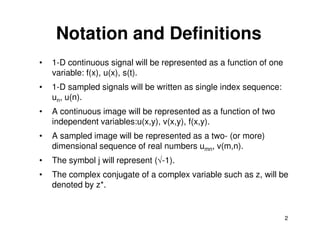
•   1-D continuous signal will be represented as a function of one
    variable: f(x), u(x), s(t).
•   1-D sampled signals will be written as single index sequence:
    un, u(n).
•   A continuous image will be represented as a function of two
    independent variables:u(x,y), v(x,y), f(x,y).
•   A sampled image will be represented as a two- (or more)
    dimensional sequence of real numbers umn, v(m,n).
•   The symbol j will represent (√-1).
•   The complex conjugate of a complex variable such as z, will be
    denoted by z*.


                                                                     2
Some Special Functions
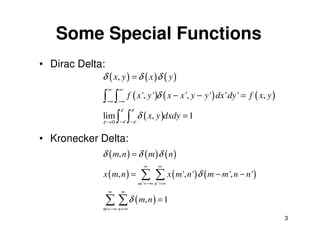
• Dirac Delta:
             δ ( x, y ) = δ ( x ) δ ( y )
                 ∞   ∞
             ∫ ∫ f ( x ', y ')δ ( x − x ', y − y ') dx ' dy ' = f ( x, y )
                 −∞ −∞
                  ε ε
             lim ∫ ∫ δ ( x, y )dxdy = 1
             ε     ε ε
                 →0 −     −


• Kronecker Delta:
             δ ( m, n ) = δ ( m ) δ ( n )
                                ∞       ∞
             x ( m, n ) =      ∑ ∑ x ( m ', n ')δ ( m − m ', n − n ')
                              m ' =−∞ n ' =∞
                 ∞   ∞

                 ∑ ∑ δ ( m, n ) = 1
             m =−∞ n =∞
                                                                             3
Some Special Functions
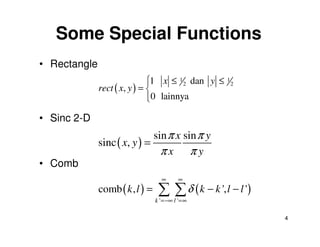
• Rectangle
                              1 x ≤ 1 2 dan y ≤
                                                   1
              rect ( x, y ) = 
                                                        2

                              0 lainnya
                              

• Sinc 2-D
                              sin π x sin π y
              sinc ( x, y ) =
                                πx πy
• Comb
                                   ∞       ∞
              comb ( k , l ) =    ∑ ∑ δ ( k − k ', l − l ')
                                 k ' =−∞ l ' =∞

                                                              4
2-D Linear System

             x(m,n)                       y(m,n) = H [x(m,n)]
                                          y(m,n)
                             H [.]
• Linear system criterion:
          H [a1x1(m,n) + a2x2(m,n)] = a1H [x1(m,n)] + a2H [x2(m,n)]
                                   = a1 y1(m,n) + a2 y2(m,n)
• Impulse response:
   System response (output) given a delta kronecker input:
                       h(m,n; m’,n’) ≡ H [δ(m - m’, n - n’)]
    – PSF (point spread function) → impulse response whose inputs
      and outputs represent a positive quantity, such as intensity.
                                                                      5
The Fourier Transform
• 2-D Fourier/ Inverse Fourier Transform Formulations:
                      ∞       ∞
   F (ξ1 ,ξ 2 ) = ∫       ∫       f ( x, y ) exp  − j 2π ( xξ1 + yξ 2 )  dxdy
                                                                        
                     −∞ −∞
                    ∞ ∞
   f ( x, y ) = ∫     ∫       F (ξ1 ,ξ 2 ) exp  j 2π ( xξ1 + yξ 2 )  dξ1dξ 2
                                                                    
                −∞ −∞


               f(x,y)                                       F(ξ1, ξ2)
               δ(x,y)                                           1
         δ(x ± x0, y ± y0)                      exp(±j2πx0ξ1). exp(±j2πy0ξ2)
  exp(±j2πx0η1). exp(±j2πy0 η2)                       δ(ξ1 -+ η1, ξ2 -+ η2)
         exp[-π(x2 + y2 )]                             exp[-π(ξ12 + ξ22 )]
             rect(x, y)                                    sinc(ξ1, ξ2)
              tri(x, y)                                   sinc2(ξ1, ξ2)
            comb(x, y)                                    comb(ξ1, ξ2)
                                                                                  6
Properties of the Fourier Transform
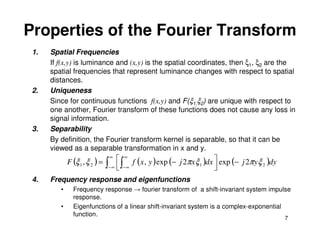
 1.   Spatial Frequencies
      If f(x,y) is luminance and (x,y) is the spatial coordinates, then ξ1, ξ2 are the
      spatial frequencies that represent luminance changes with respect to spatial
      distances.
 2.   Uniqueness
      Since for continuous functions f(x,y) and F(ξ1,ξ2) are unique with respect to
      one another, Fourier transform of these functions does not cause any loss in
      signal information.
 3.   Separability
      By definition, the Fourier transform kernel is separable, so that it can be
      viewed as a separable transformation in x and y.
             F (ξ 1 , ξ 2 ) =
                                 ∞
                                      ∞ f ( x , y ) exp (− j 2π x ξ )dx  exp (− j 2π y ξ )dy
                                ∫− ∞  ∫− ∞
                                                                   1    
                                                                                         2


 4.   Frequency response and eigenfunctions
         •     Frequency response → fourier transform of a shift-invariant system impulse
               response.
         •     Eigenfunctions of a linear shift-invariant system is a complex-exponential
               function.
                                                                                                 7
Properties of the Fourier Tranform
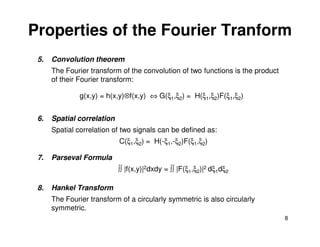
 5.   Convolution theorem
      The Fourier transform of the convolution of two functions is the product
      of their Fourier transform:

               g(x,y) = h(x,y)⊗f(x,y) ⇔ G(ξ1,ξ2) = H(ξ1,ξ2)F(ξ1,ξ2)


 6.   Spatial correlation
      Spatial correlation of two signals can be defined as:
                            C(ξ1,ξ2) = H(-ξ1,-ξ2)F(ξ1,ξ2)

 7.   Parseval Formula
                            ∫∫ |f(x,y)|2dxdy = ∫∫ |F(ξ1,ξ2)|2 dξ1dξ2

 8.   Hankel Transform
      The Fourier transform of a circularly symmetric is also circularly
      symmetric.
                                                                                 8
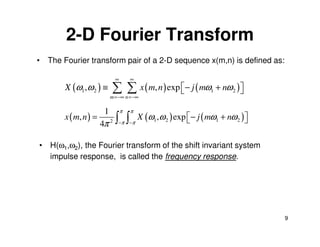
2-D Fourier Transform
• The Fourier transform pair of a 2-D sequence x(m,n) is defined as:

                               ∞       ∞
       X (ω1 ,ω 2 ) ≡      ∑ ∑ x ( m, n ) exp − j ( mω
                           m =−∞ n =−∞
                                                           1   + nω 2 ) 
                                                                         

                       1           π   π
       x ( m, n ) =            ∫ π ∫ π X (ω ,ω ) exp − j ( mω
                                                                   + nω 2 ) 
                                                                             
                      4π   2               1   2                1
                               −       −


• H(ω1,ω2), the Fourier transform of the shift invariant system
  impulse response, is called the frequency response.


                                                                                 9
Matrix Theory
• One- and two-dimensional sequence will be represented by vectors
  and matrices.
                    u (1)                         a (1,1)   a (1, 2 )    ...    a (1, N ) 
                    u (2 )                        a (2 ,1)  a (2 , 2 )   ...    a (2 , N ) 
    u ≡ {u (n )} =            A ≡ {a (m , n )} =                                           
                    ...                           ...          ...       ...       ...     
                                                                                           
                    u (n )                        a (M ,1) a (M , 2 )    ...   a (M , N )


•   Transpose: AT = {a(m,n)}T = {a(n,m)}
•   Transposition and Conjugation Rules
                 1. A*T = [AT]*
                 2. [AB] = BTAT
                 3. [A-1]T = [AT]-1
                 4. [AB]* = A*B*
                                                                                              10
Toeplitz and Circulant Matrices
• A Toeplitz matrix T is a matrix that has constant elements along the
  main diagonal and the subdiagonals.
• A matrix C is called circulant if each of its rows (or columns) is a
  circular shift of the previous row (or columns)

          t0       t −1   ...    ...   t − N +1     c0     c1    c2     ...     c N −1 
          t        t0     t −1   ...   t− N +2     c       c0    c1     ...     cN −2 
          1                                         N −1                               
     T =  t2                     ...      ...  C =  ...    ...   ...    ...      ... 
                                                                                       
          ...      ...    ...    ...      ...       c2     ...   ...    ...      ... 
         
          t N −1   ...    t2     t1       t0       c1
                                                             c2    ...   c N −1    cN   

 •      Note that C is also Toeplitz and:
              c(m,n) = c((m,n) modulo N)
                                                                                          11
Example
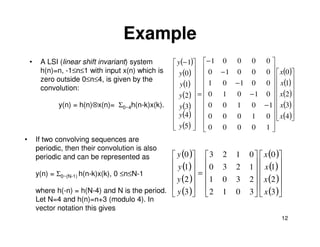
    •    A LSI (linear shift invariant) system      y (− 1) − 1 0 0 0 0 
         h(n)=n, -1≤n≤1 with input x(n) which is    y (0 )   0 − 1 0 0 0   x(0 )
         zero outside 0≤n≤4, is given by the                               
                                                                                      
                                                    y (1)   1 0 − 1 0 0   x(1) 
         convolution:                                       =  0 1 0 − 1 0   x(2 )
                                                    y (2 )                 
                                                                                      
               y(n) = h(n)⊗x(n)= Σ0~4h(n-k)x(k).    y (3)   0 0 1 0 − 1  x(3)
                                                    y (4 )                 
                                                               0 0 0 1 0   x(4 )
                                                                                      
                                                    y (5)   0 0 0 0 1 
                                                                           
•       If two convolving sequences are
        periodic, then their convolution is also
        periodic and can be represented as         y (0 )  3   2   1   0   x (0 )
                                                   y (1)   0   3   2   1   x (1) 
        y(n) = Σ0~(N-1) h(n-k)x(k), 0 ≤n≤N-1             =                       
                                                   y (2 )  1   0   3   2   x (2 )
        where h(-n) = h(N-4) and N is the period.  y (3 )  2
                                                               1   0
                                                                                    
                                                                          3   x (3 )
        Let N=4 and h(n)=n+3 (modulo 4). In
        vector notation this gives
                                                                                      12
Orthogonal and Unitary Matrices
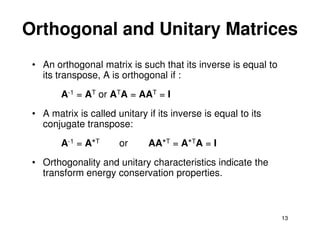
 • An orthogonal matrix is such that its inverse is equal to
   its transpose, A is orthogonal if :
        A-1 = AT or ATA = AAT = I
 • A matrix is called unitary if its inverse is equal to its
   conjugate transpose:
        A-1 = A*T      or     AA*T = A*TA = I
 • Orthogonality and unitary characteristics indicate the
   transform energy conservation properties.


                                                               13
Thank you


            14

02 2d systems matrix

  • 1.
    02. 2-D Systemsand Matrix Tati R. Mengko
  • 2.
    Notation and Definitions • 1-D continuous signal will be represented as a function of one variable: f(x), u(x), s(t). • 1-D sampled signals will be written as single index sequence: un, u(n). • A continuous image will be represented as a function of two independent variables:u(x,y), v(x,y), f(x,y). • A sampled image will be represented as a two- (or more) dimensional sequence of real numbers umn, v(m,n). • The symbol j will represent (√-1). • The complex conjugate of a complex variable such as z, will be denoted by z*. 2
  • 3.
    Some Special Functions •Dirac Delta: δ ( x, y ) = δ ( x ) δ ( y ) ∞ ∞ ∫ ∫ f ( x ', y ')δ ( x − x ', y − y ') dx ' dy ' = f ( x, y ) −∞ −∞ ε ε lim ∫ ∫ δ ( x, y )dxdy = 1 ε ε ε →0 − − • Kronecker Delta: δ ( m, n ) = δ ( m ) δ ( n ) ∞ ∞ x ( m, n ) = ∑ ∑ x ( m ', n ')δ ( m − m ', n − n ') m ' =−∞ n ' =∞ ∞ ∞ ∑ ∑ δ ( m, n ) = 1 m =−∞ n =∞ 3
  • 4.
    Some Special Functions •Rectangle 1 x ≤ 1 2 dan y ≤  1 rect ( x, y ) =  2 0 lainnya  • Sinc 2-D sin π x sin π y sinc ( x, y ) = πx πy • Comb ∞ ∞ comb ( k , l ) = ∑ ∑ δ ( k − k ', l − l ') k ' =−∞ l ' =∞ 4
  • 5.
    2-D Linear System x(m,n) y(m,n) = H [x(m,n)] y(m,n) H [.] • Linear system criterion: H [a1x1(m,n) + a2x2(m,n)] = a1H [x1(m,n)] + a2H [x2(m,n)] = a1 y1(m,n) + a2 y2(m,n) • Impulse response: System response (output) given a delta kronecker input: h(m,n; m’,n’) ≡ H [δ(m - m’, n - n’)] – PSF (point spread function) → impulse response whose inputs and outputs represent a positive quantity, such as intensity. 5
  • 6.
    The Fourier Transform •2-D Fourier/ Inverse Fourier Transform Formulations: ∞ ∞ F (ξ1 ,ξ 2 ) = ∫ ∫ f ( x, y ) exp  − j 2π ( xξ1 + yξ 2 )  dxdy   −∞ −∞ ∞ ∞ f ( x, y ) = ∫ ∫ F (ξ1 ,ξ 2 ) exp  j 2π ( xξ1 + yξ 2 )  dξ1dξ 2   −∞ −∞ f(x,y) F(ξ1, ξ2) δ(x,y) 1 δ(x ± x0, y ± y0) exp(±j2πx0ξ1). exp(±j2πy0ξ2) exp(±j2πx0η1). exp(±j2πy0 η2) δ(ξ1 -+ η1, ξ2 -+ η2) exp[-π(x2 + y2 )] exp[-π(ξ12 + ξ22 )] rect(x, y) sinc(ξ1, ξ2) tri(x, y) sinc2(ξ1, ξ2) comb(x, y) comb(ξ1, ξ2) 6
  • 7.
    Properties of theFourier Transform 1. Spatial Frequencies If f(x,y) is luminance and (x,y) is the spatial coordinates, then ξ1, ξ2 are the spatial frequencies that represent luminance changes with respect to spatial distances. 2. Uniqueness Since for continuous functions f(x,y) and F(ξ1,ξ2) are unique with respect to one another, Fourier transform of these functions does not cause any loss in signal information. 3. Separability By definition, the Fourier transform kernel is separable, so that it can be viewed as a separable transformation in x and y. F (ξ 1 , ξ 2 ) = ∞  ∞ f ( x , y ) exp (− j 2π x ξ )dx  exp (− j 2π y ξ )dy ∫− ∞  ∫− ∞  1   2 4. Frequency response and eigenfunctions • Frequency response → fourier transform of a shift-invariant system impulse response. • Eigenfunctions of a linear shift-invariant system is a complex-exponential function. 7
  • 8.
    Properties of theFourier Tranform 5. Convolution theorem The Fourier transform of the convolution of two functions is the product of their Fourier transform: g(x,y) = h(x,y)⊗f(x,y) ⇔ G(ξ1,ξ2) = H(ξ1,ξ2)F(ξ1,ξ2) 6. Spatial correlation Spatial correlation of two signals can be defined as: C(ξ1,ξ2) = H(-ξ1,-ξ2)F(ξ1,ξ2) 7. Parseval Formula ∫∫ |f(x,y)|2dxdy = ∫∫ |F(ξ1,ξ2)|2 dξ1dξ2 8. Hankel Transform The Fourier transform of a circularly symmetric is also circularly symmetric. 8
  • 9.
    2-D Fourier Transform •The Fourier transform pair of a 2-D sequence x(m,n) is defined as: ∞ ∞ X (ω1 ,ω 2 ) ≡ ∑ ∑ x ( m, n ) exp − j ( mω m =−∞ n =−∞  1 + nω 2 )   1 π π x ( m, n ) = ∫ π ∫ π X (ω ,ω ) exp − j ( mω  + nω 2 )   4π 2 1 2 1 − − • H(ω1,ω2), the Fourier transform of the shift invariant system impulse response, is called the frequency response. 9
  • 10.
    Matrix Theory • One-and two-dimensional sequence will be represented by vectors and matrices.  u (1)   a (1,1) a (1, 2 ) ... a (1, N )   u (2 )  a (2 ,1) a (2 , 2 ) ... a (2 , N )  u ≡ {u (n )} =   A ≡ {a (m , n )} =    ...   ... ... ... ...       u (n )  a (M ,1) a (M , 2 ) ... a (M , N ) • Transpose: AT = {a(m,n)}T = {a(n,m)} • Transposition and Conjugation Rules 1. A*T = [AT]* 2. [AB] = BTAT 3. [A-1]T = [AT]-1 4. [AB]* = A*B* 10
  • 11.
    Toeplitz and CirculantMatrices • A Toeplitz matrix T is a matrix that has constant elements along the main diagonal and the subdiagonals. • A matrix C is called circulant if each of its rows (or columns) is a circular shift of the previous row (or columns)  t0 t −1 ... ... t − N +1   c0 c1 c2 ... c N −1   t t0 t −1 ... t− N +2  c c0 c1 ... cN −2   1   N −1  T =  t2 ... ...  C =  ... ... ... ... ...       ... ... ... ... ...   c2 ... ... ... ...    t N −1 ... t2 t1 t0    c1  c2 ... c N −1 cN   • Note that C is also Toeplitz and: c(m,n) = c((m,n) modulo N) 11
  • 12.
    Example • A LSI (linear shift invariant) system  y (− 1) − 1 0 0 0 0  h(n)=n, -1≤n≤1 with input x(n) which is  y (0 )   0 − 1 0 0 0   x(0 ) zero outside 0≤n≤4, is given by the        y (1)   1 0 − 1 0 0   x(1)  convolution:   =  0 1 0 − 1 0   x(2 )  y (2 )      y(n) = h(n)⊗x(n)= Σ0~4h(n-k)x(k).  y (3)   0 0 1 0 − 1  x(3)  y (4 )       0 0 0 1 0   x(4 )    y (5)   0 0 0 0 1      • If two convolving sequences are periodic, then their convolution is also periodic and can be represented as  y (0 )  3 2 1 0   x (0 )  y (1)   0 3 2 1   x (1)  y(n) = Σ0~(N-1) h(n-k)x(k), 0 ≤n≤N-1  =    y (2 )  1 0 3 2   x (2 ) where h(-n) = h(N-4) and N is the period.  y (3 )  2    1 0   3   x (3 ) Let N=4 and h(n)=n+3 (modulo 4). In vector notation this gives 12
  • 13.
    Orthogonal and UnitaryMatrices • An orthogonal matrix is such that its inverse is equal to its transpose, A is orthogonal if : A-1 = AT or ATA = AAT = I • A matrix is called unitary if its inverse is equal to its conjugate transpose: A-1 = A*T or AA*T = A*TA = I • Orthogonality and unitary characteristics indicate the transform energy conservation properties. 13
  • 14.