Fourier Transform


Naveen Sihag
Mathematical Background:
                Complex Numbers
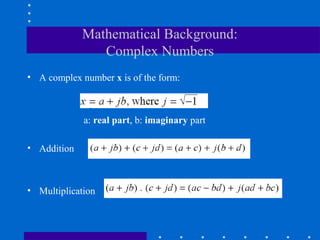
• A complex number x is of the form:


             a: real part, b: imaginary part

• Addition


• Multiplication
Mathematical Background:
            Complex Numbers (cont’d)
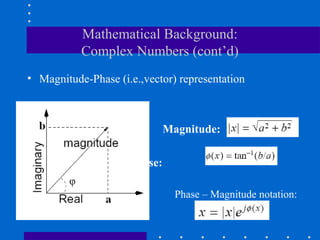
• Magnitude-Phase (i.e.,vector) representation


                              Magnitude:

                     Phase:
        φ
                                Phase – Magnitude notation:
Mathematical Background:
           Complex Numbers (cont’d)
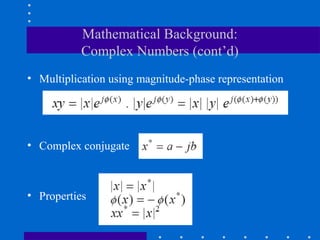
• Multiplication using magnitude-phase representation


• Complex conjugate


• Properties
Mathematical Background:
           Complex Numbers (cont’d)
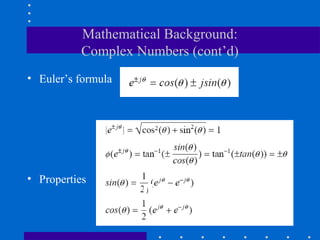
• Euler’s formula


• Properties
                    j
Mathematical Background:
           Sine and Cosine Functions
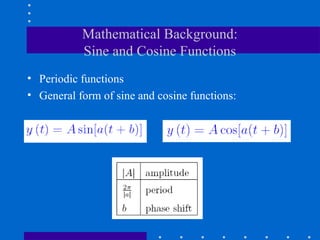
• Periodic functions
• General form of sine and cosine functions:
Mathematical Background:
Sine and Cosine Functions
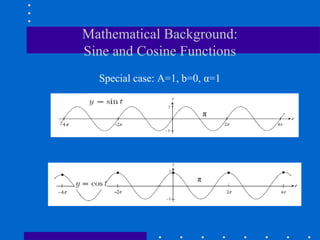
  Special case: A=1, b=0, α=1


                           π


                       π
Mathematical Background:
    Sine and Cosine Functions (cont’d)

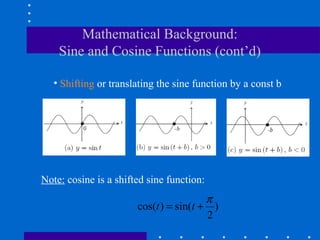
   • Shifting or translating the sine function by a const b


Note: cosine is a shifted sine function:
                                        π
                       cos(t ) = sin(t + )
                                        2
Mathematical Background:
      Sine and Cosine Functions (cont’d)
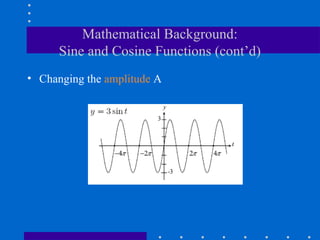
• Changing the amplitude A
Mathematical Background:
      Sine and Cosine Functions (cont’d)
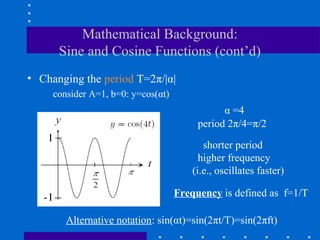
• Changing the period T=2π/|α|
     consider A=1, b=0: y=cos(αt)
                                               α =4
                                         period 2π/4=π/2

                                           shorter period
                                          higher frequency
                                        (i.e., oscillates faster)

                                    Frequency is defined as f=1/T

        Alternative notation: sin(αt)=sin(2πt/T)=sin(2πft)
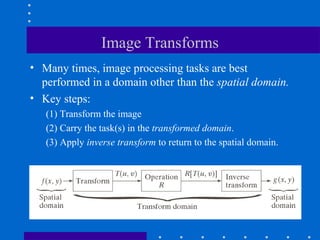
Image Transforms
• Many times, image processing tasks are best
  performed in a domain other than the spatial domain.
• Key steps:
   (1) Transform the image
   (2) Carry the task(s) in the transformed domain.
   (3) Apply inverse transform to return to the spatial domain.
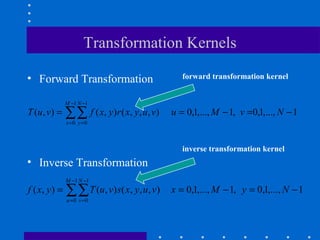
Transformation Kernels

• Forward Transformation                        forward transformation kernel


               M −1 N −1
T (u , v) =    ∑∑ f ( x, y)r ( x, y, u, v)
               x =0 y =0
                                             u = 0,1,..., M − 1, v =0,1,..., N − 1


                                                inverse transformation kernel
• Inverse Transformation
               M −1 N −1
f ( x, y ) =   ∑∑ T (u, v)s( x, y, u, v)
               u =0 v =0
                                             x = 0,1,..., M − 1, y = 0,1,..., N − 1
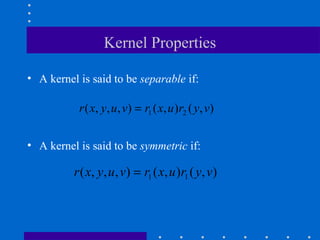
Kernel Properties

• A kernel is said to be separable if:

           r ( x, y, u, v) = r1 ( x, u )r2 ( y, v)

• A kernel is said to be symmetric if:

          r ( x, y, u , v) = r1 ( x, u )r1 ( y, v)
Notation

• Continuous Fourier Transform (FT)

• Discrete Fourier Transform (DFT)

• Fast Fourier Transform (FFT)
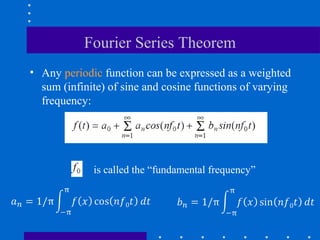
Fourier Series Theorem
• Any periodic function can be expressed as a weighted
  sum (infinite) of sine and cosine functions of varying
  frequency:


             is called the “fundamental frequency”
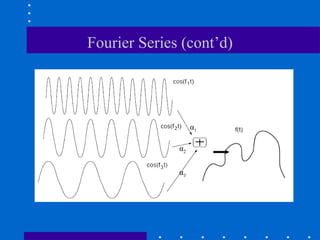
Fourier Series (cont’d)


                   α1

              α2


              α3
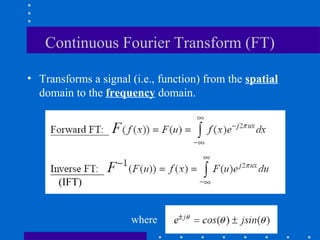
Continuous Fourier Transform (FT)

• Transforms a signal (i.e., function) from the spatial
  domain to the frequency domain.


      (IFT)


                      where
Why is FT Useful?

• Easier to remove undesirable frequencies.

• Faster perform certain operations in the frequency
  domain than in the spatial domain.
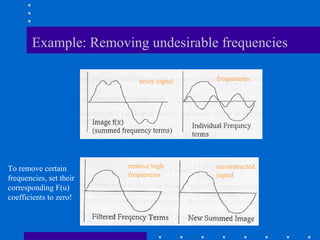
Example: Removing undesirable frequencies

                            noisy signal   frequencies


To remove certain        remove high       reconstructed
                         frequencies       signal
frequencies, set their
corresponding F(u)
coefficients to zero!
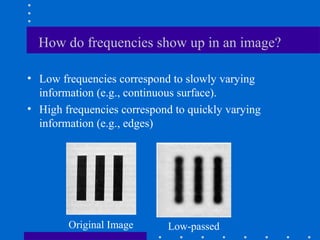
How do frequencies show up in an image?

• Low frequencies correspond to slowly varying
  information (e.g., continuous surface).
• High frequencies correspond to quickly varying
  information (e.g., edges)


        Original Image      Low-passed
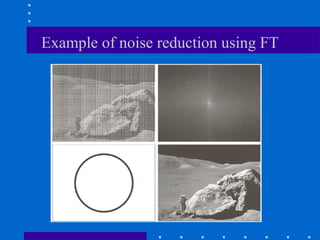
Example of noise reduction using FT
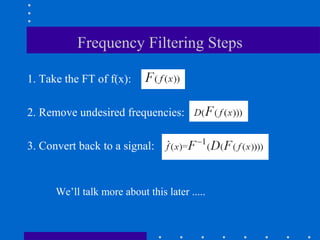
Frequency Filtering Steps

1. Take the FT of f(x):

2. Remove undesired frequencies:

3. Convert back to a signal:


      We’ll talk more about this later .....
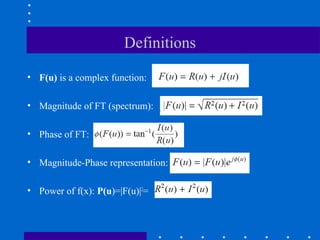
Definitions

• F(u) is a complex function:

• Magnitude of FT (spectrum):

• Phase of FT:

• Magnitude-Phase representation:

• Power of f(x): P(u)=|F(u)|2=
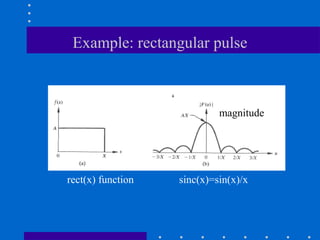
Example: rectangular pulse


                            magnitude


rect(x) function   sinc(x)=sin(x)/x
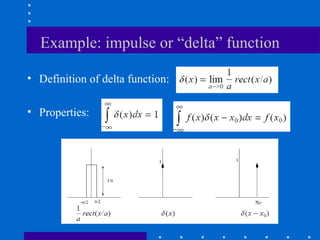
Example: impulse or “delta” function

• Definition of delta function:

• Properties:
Example: impulse or “delta” function (cont’d)

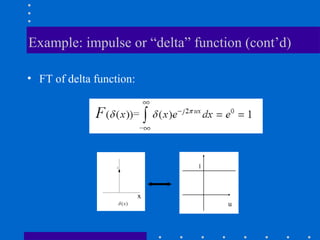
• FT of delta function:


                              1


                          x
                                  u
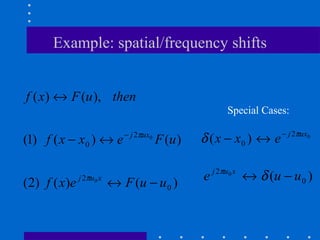
Example: spatial/frequency shifts


f ( x) ↔ F (u ), then
                                                             Special Cases:

                                                                          − j 2πux0
(1) f ( x − x0 ) ↔ e           − j 2πux0
                                           F (u )   δ ( x − x0 ) ↔ e

                                                        j 2πu0 x
( 2) f ( x ) e   j 2πu0 x
                            ↔ F (u − u 0 )          e              ↔ δ (u − u 0 )
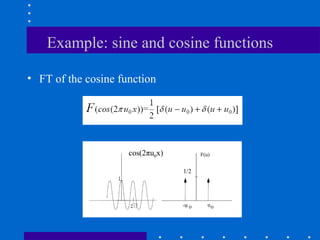
Example: sine and cosine functions

• FT of the cosine function


                     cos(2πu0x)         F(u)


                                  1/2
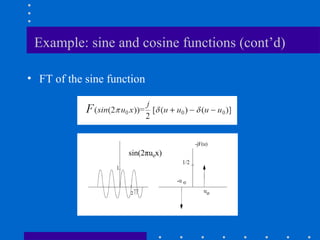
Example: sine and cosine functions (cont’d)

• FT of the sine function


                                  -jF(u)
                     sin(2πu0x)
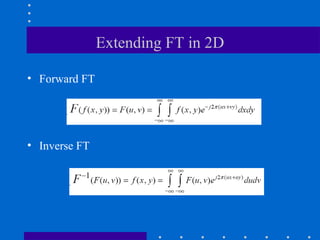
Extending FT in 2D

• Forward FT


• Inverse FT
Example: 2D rectangle function
• FT of 2D rectangle function


                                2D sinc()
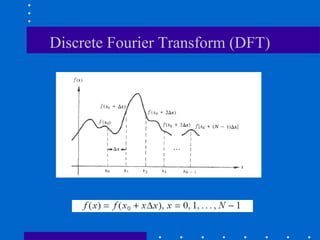
Discrete Fourier Transform (DFT)
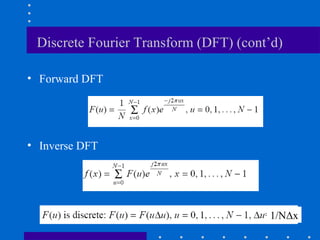
Discrete Fourier Transform (DFT) (cont’d)

• Forward DFT


• Inverse DFT


                                       1/NΔx
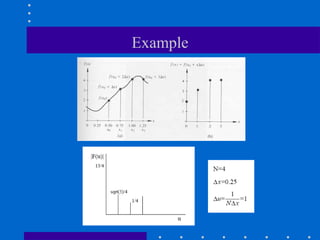
Example
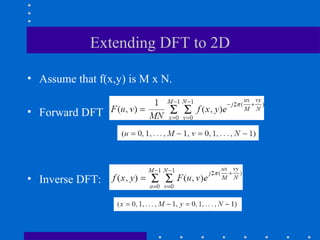
Extending DFT to 2D

• Assume that f(x,y) is M x N.

• Forward DFT


• Inverse DFT:
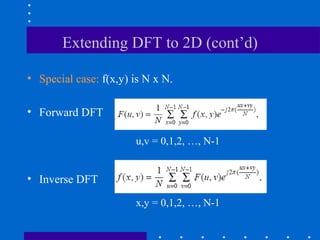
Extending DFT to 2D (cont’d)

• Special case: f(x,y) is N x N.

• Forward DFT

                       u,v = 0,1,2, …, N-1


• Inverse DFT

                       x,y = 0,1,2, …, N-1
Visualizing DFT

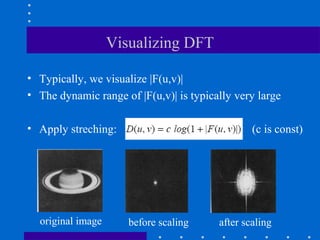
• Typically, we visualize |F(u,v)|
• The dynamic range of |F(u,v)| is typically very large

• Apply streching:                               (c is const)


  original image      before scaling     after scaling
DFT Properties: (1) Separability

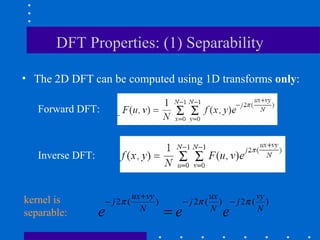
• The 2D DFT can be computed using 1D transforms only:

   Forward DFT:


   Inverse DFT:


kernel is                      ux + vy                   ux         vy
                      − j 2π (         )        − j 2 π ( ) − j 2π ( )
separable:        e              N
                                           =e            N
                                                          e         N
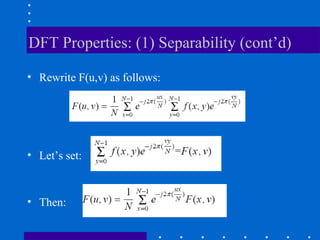
DFT Properties: (1) Separability (cont’d)

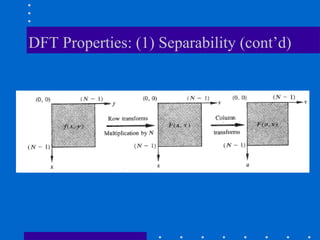
• Rewrite F(u,v) as follows:


• Let’s set:


• Then:
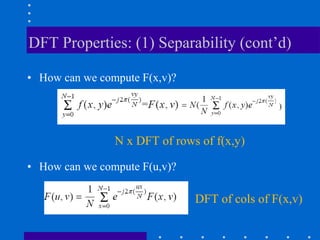
DFT Properties: (1) Separability (cont’d)

• How can we compute F(x,v)?

                                               )


                N x DFT of rows of f(x,y)

• How can we compute F(u,v)?

                               DFT of cols of F(x,v)
DFT Properties: (1) Separability (cont’d)
DFT Properties: (2) Periodicity

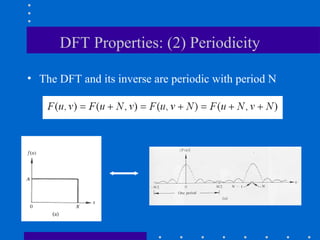
• The DFT and its inverse are periodic with period N
DFT Properties: (3) Symmetry

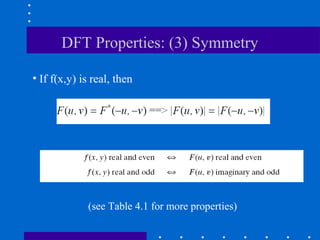
• If f(x,y) is real, then


             (see Table 4.1 for more properties)
DFT Properties: (4) Translation

            f(x,y)            F(u,v)

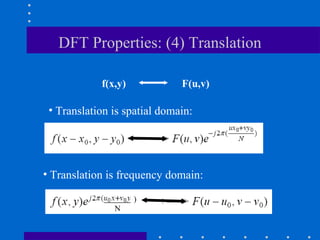
 • Translation is spatial domain:


• Translation is frequency domain:

                     )
               N
DFT Properties: (4) Translation (cont’d)

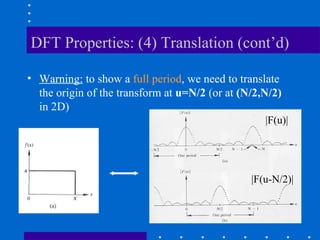
• Warning: to show a full period, we need to translate
  the origin of the transform at u=N/2 (or at (N/2,N/2)
  in 2D)
                                                   |F(u)|


                                                |F(u-N/2)|
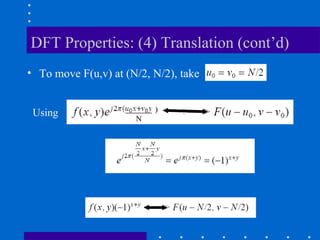
DFT Properties: (4) Translation (cont’d)
• To move F(u,v) at (N/2, N/2), take


 Using                    )
                      N
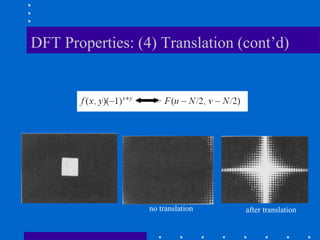
DFT Properties: (4) Translation (cont’d)


                  no translation   after translation
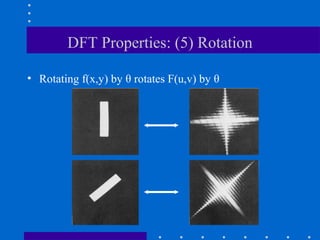
DFT Properties: (5) Rotation

• Rotating f(x,y) by θ rotates F(u,v) by θ
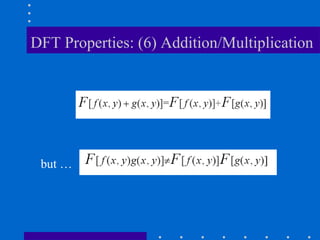
DFT Properties: (6) Addition/Multiplication


 but …
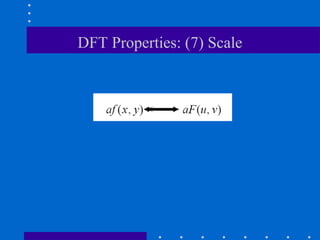
DFT Properties: (7) Scale
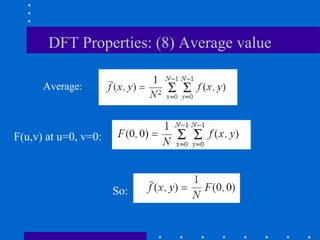
DFT Properties: (8) Average value

      Average:


F(u,v) at u=0, v=0:


                      So:
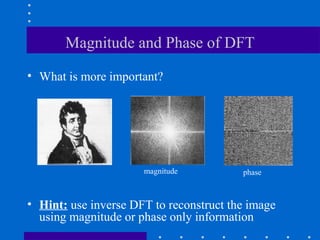
Magnitude and Phase of DFT
• What is more important?


                      magnitude          phase


• Hint: use inverse DFT to reconstruct the image
  using magnitude or phase only information
Magnitude and Phase of DFT (cont’d)
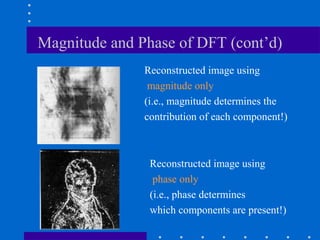
               Reconstructed image using
                magnitude only
               (i.e., magnitude determines the
               contribution of each component!)


                Reconstructed image using
                 phase only
                (i.e., phase determines
                which components are present!)
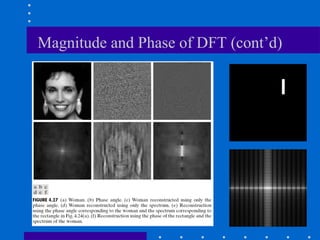
Magnitude and Phase of DFT (cont’d)

Fourier transform

  • 1.
  • 2.
    Mathematical Background: Complex Numbers • A complex number x is of the form: a: real part, b: imaginary part • Addition • Multiplication
  • 3.
    Mathematical Background: Complex Numbers (cont’d) • Magnitude-Phase (i.e.,vector) representation Magnitude: Phase: φ Phase – Magnitude notation:
  • 4.
    Mathematical Background: Complex Numbers (cont’d) • Multiplication using magnitude-phase representation • Complex conjugate • Properties
  • 5.
    Mathematical Background: Complex Numbers (cont’d) • Euler’s formula • Properties j
  • 6.
    Mathematical Background: Sine and Cosine Functions • Periodic functions • General form of sine and cosine functions:
  • 7.
    Mathematical Background: Sine andCosine Functions Special case: A=1, b=0, α=1 π π
  • 8.
    Mathematical Background: Sine and Cosine Functions (cont’d) • Shifting or translating the sine function by a const b Note: cosine is a shifted sine function: π cos(t ) = sin(t + ) 2
  • 9.
    Mathematical Background: Sine and Cosine Functions (cont’d) • Changing the amplitude A
  • 10.
    Mathematical Background: Sine and Cosine Functions (cont’d) • Changing the period T=2π/|α| consider A=1, b=0: y=cos(αt) α =4 period 2π/4=π/2 shorter period higher frequency (i.e., oscillates faster) Frequency is defined as f=1/T Alternative notation: sin(αt)=sin(2πt/T)=sin(2πft)
  • 11.
    Image Transforms • Manytimes, image processing tasks are best performed in a domain other than the spatial domain. • Key steps: (1) Transform the image (2) Carry the task(s) in the transformed domain. (3) Apply inverse transform to return to the spatial domain.
  • 12.
    Transformation Kernels • ForwardTransformation forward transformation kernel M −1 N −1 T (u , v) = ∑∑ f ( x, y)r ( x, y, u, v) x =0 y =0 u = 0,1,..., M − 1, v =0,1,..., N − 1 inverse transformation kernel • Inverse Transformation M −1 N −1 f ( x, y ) = ∑∑ T (u, v)s( x, y, u, v) u =0 v =0 x = 0,1,..., M − 1, y = 0,1,..., N − 1
  • 13.
    Kernel Properties • Akernel is said to be separable if: r ( x, y, u, v) = r1 ( x, u )r2 ( y, v) • A kernel is said to be symmetric if: r ( x, y, u , v) = r1 ( x, u )r1 ( y, v)
  • 14.
    Notation • Continuous FourierTransform (FT) • Discrete Fourier Transform (DFT) • Fast Fourier Transform (FFT)
  • 15.
    Fourier Series Theorem •Any periodic function can be expressed as a weighted sum (infinite) of sine and cosine functions of varying frequency: is called the “fundamental frequency”
  • 16.
  • 17.
    Continuous Fourier Transform(FT) • Transforms a signal (i.e., function) from the spatial domain to the frequency domain. (IFT) where
  • 18.
    Why is FTUseful? • Easier to remove undesirable frequencies. • Faster perform certain operations in the frequency domain than in the spatial domain.
  • 19.
    Example: Removing undesirablefrequencies noisy signal frequencies To remove certain remove high reconstructed frequencies signal frequencies, set their corresponding F(u) coefficients to zero!
  • 20.
    How do frequenciesshow up in an image? • Low frequencies correspond to slowly varying information (e.g., continuous surface). • High frequencies correspond to quickly varying information (e.g., edges) Original Image Low-passed
  • 21.
    Example of noisereduction using FT
  • 22.
    Frequency Filtering Steps 1.Take the FT of f(x): 2. Remove undesired frequencies: 3. Convert back to a signal: We’ll talk more about this later .....
  • 23.
    Definitions • F(u) isa complex function: • Magnitude of FT (spectrum): • Phase of FT: • Magnitude-Phase representation: • Power of f(x): P(u)=|F(u)|2=
  • 24.
    Example: rectangular pulse magnitude rect(x) function sinc(x)=sin(x)/x
  • 25.
    Example: impulse or“delta” function • Definition of delta function: • Properties:
  • 26.
    Example: impulse or“delta” function (cont’d) • FT of delta function: 1 x u
  • 27.
    Example: spatial/frequency shifts f( x) ↔ F (u ), then Special Cases: − j 2πux0 (1) f ( x − x0 ) ↔ e − j 2πux0 F (u ) δ ( x − x0 ) ↔ e j 2πu0 x ( 2) f ( x ) e j 2πu0 x ↔ F (u − u 0 ) e ↔ δ (u − u 0 )
  • 28.
    Example: sine andcosine functions • FT of the cosine function cos(2πu0x) F(u) 1/2
  • 29.
    Example: sine andcosine functions (cont’d) • FT of the sine function -jF(u) sin(2πu0x)
  • 30.
    Extending FT in2D • Forward FT • Inverse FT
  • 31.
    Example: 2D rectanglefunction • FT of 2D rectangle function 2D sinc()
  • 32.
  • 33.
    Discrete Fourier Transform(DFT) (cont’d) • Forward DFT • Inverse DFT 1/NΔx
  • 34.
  • 35.
    Extending DFT to2D • Assume that f(x,y) is M x N. • Forward DFT • Inverse DFT:
  • 36.
    Extending DFT to2D (cont’d) • Special case: f(x,y) is N x N. • Forward DFT u,v = 0,1,2, …, N-1 • Inverse DFT x,y = 0,1,2, …, N-1
  • 37.
    Visualizing DFT • Typically,we visualize |F(u,v)| • The dynamic range of |F(u,v)| is typically very large • Apply streching: (c is const) original image before scaling after scaling
  • 38.
    DFT Properties: (1)Separability • The 2D DFT can be computed using 1D transforms only: Forward DFT: Inverse DFT: kernel is ux + vy ux vy − j 2π ( ) − j 2 π ( ) − j 2π ( ) separable: e N =e N e N
  • 39.
    DFT Properties: (1)Separability (cont’d) • Rewrite F(u,v) as follows: • Let’s set: • Then:
  • 40.
    DFT Properties: (1)Separability (cont’d) • How can we compute F(x,v)? ) N x DFT of rows of f(x,y) • How can we compute F(u,v)? DFT of cols of F(x,v)
  • 41.
    DFT Properties: (1)Separability (cont’d)
  • 42.
    DFT Properties: (2)Periodicity • The DFT and its inverse are periodic with period N
  • 43.
    DFT Properties: (3)Symmetry • If f(x,y) is real, then (see Table 4.1 for more properties)
  • 44.
    DFT Properties: (4)Translation f(x,y) F(u,v) • Translation is spatial domain: • Translation is frequency domain: ) N
  • 45.
    DFT Properties: (4)Translation (cont’d) • Warning: to show a full period, we need to translate the origin of the transform at u=N/2 (or at (N/2,N/2) in 2D) |F(u)| |F(u-N/2)|
  • 46.
    DFT Properties: (4)Translation (cont’d) • To move F(u,v) at (N/2, N/2), take Using ) N
  • 47.
    DFT Properties: (4)Translation (cont’d) no translation after translation
  • 48.
    DFT Properties: (5)Rotation • Rotating f(x,y) by θ rotates F(u,v) by θ
  • 49.
    DFT Properties: (6)Addition/Multiplication but …
  • 50.
  • 51.
    DFT Properties: (8)Average value Average: F(u,v) at u=0, v=0: So:
  • 52.
    Magnitude and Phaseof DFT • What is more important? magnitude phase • Hint: use inverse DFT to reconstruct the image using magnitude or phase only information
  • 53.
    Magnitude and Phaseof DFT (cont’d) Reconstructed image using magnitude only (i.e., magnitude determines the contribution of each component!) Reconstructed image using phase only (i.e., phase determines which components are present!)
  • 54.
    Magnitude and Phaseof DFT (cont’d)