EVOLUTIONARY
EXPLANATION OF
RELATIONSHIPS
Sexual Selection
Sexual Selection
◦The process through which males and females
attempt to maximise their chances of
reproductive success
Sexual Selection
◦There are 2 different types of Sexual Selection
◦1. Intrasexual Selection
◦2. Intersexual Selection
Intrasexual Selection
◦ Mate Competition
◦ Members of one sex compete against each other to attract
members of the opposite sex
◦ Usually this is between 2 or more males
Intersexual Selection
◦Mate Choice
◦Females choose between male mates.
◦‘Between sexes’
Gender differences in Reproductive
Behaviour in humans
◦Differences in Quantity of mates
◦Differences in Longevity of mates
◦Differences in Sexual Jealousy
◦Differences in Sexual Fantasies
Intersexual Selection
◦ In most Mammal species, the female invests heavily in the offspring
◦ Especially in species where females have limited reproductive
opportunities
◦ Thus females need to be picky and make the right selection of male
◦ A wrong choice for a female is much more serious than for a male –
this leads to intersexual selection
Females Choosiness
For a female it pays to be choosey due to investment
◦The genetic quality of your mate will determine half the
genetic quality of your offspring
◦Selection for ‘Good Genes’ and ‘Good Parents’
◦Will the mate survive and be able to provide for, protect and
support their offspring?
TASK: Intersexual selection
What characteristics
would indicate good
resources?
What characteristics
would indicate good
genes?
What characteristics
would indicate good
parents?
Economic & financial security, good
job, well educated, interpersonal
skills, status, etc
Good health i.e. skin, hair, weight,
facial symmetry, BUT also traits that
are disadvantaged (peacock’s tail)
Good skills, caring, affectionate,
strong, protective, ability to provide,
nurture, etc
Short & Long term mating strategies
◦ Males:
◦ Short term strategy = casual sex sought as early as possible in the
relationship
◦ Explains why males may lower their standards prior to sex then lose interest
quickly after sex
◦ Females:
◦ Long term strategy = men who are resourceful and protective are preferred.
◦ Males who show potential to be a good parent (caring, affectionate)
Short Term vs. Long Term strategies
◦ Clear differences have been found in the behaviour of men and women in
terms of short term strategies.
◦ Clark and Hatfield (1990) conducted a study where male and female
experimenters approached members of the opposite sex with the following
statement:
◦ ‘Hi, I’ve noticed you around campus and I find you very attractive’. They then
asked them either:
◦ (1) ‘Would you go on a date with me?’
◦ (2) ‘Would you go back to my apartment with me?’
◦ (3) ‘Would you have sex with me’.
Clark & Hatfield (1990)
◦ 50% of both men and women agreed to go on a date
◦ Of the females asked, 0% agreed to have sex, compared to…
◦ 75% of males approached!
◦ Demonstrates intersexual sexual selection differences in males and
females
Mate Preference
◦ Males are also picky as they will ultimately have to provide
many resources to the female and offspring
◦ Men have evolved to prefer females who display fertility
◦ Optimum waist-hip ratio
◦ Large breasts
◦ Youthfulness
◦ Baby-faced features (large eyes/small nose)
Buss (1989)
◦Demonstrated gender differences in modern
relationships
◦37 cultures in 6 continents
◦10,000+ participants
◦Questionnaire on mate preferences
Buss (1989)
◦ Across all cultures…
◦ Women showed a preference for males with resources or possessing
characteristics that would translate to resources
(intelligence/ambition)
◦ Women preferred a high-status male on average 5 years older than
themselves
Buss (1989)
◦ Across all cultures…
◦ Men placed more emphasis on physical attractiveness (indication of
woman’s health/fertility)
◦ Men desired a partner who was younger than themselves
◦ Both sexes wanted kind, dependable partners
Buss (1989)
◦Findings represent a clear illustration of evolved sex
differences based on sexual selection
◦Show cultural universals = likely to have evolved
across the human species as a whole
Buss (1989) – Criticisms…
◦  Self – report data
◦  Lacks Validity…
◦  Buss conducted a study on marriages in 29 cultures and
found men do marry younger women… and remarry even
younger ones!
AO2 – Mate preferences
◦Waynforth and Dunbar (1995)
◦Analysed Lonely Heart adverts
◦Found that adverts reflected evolutionary pressure to
promote reproductive success
Waynforth and Dunbar (1995)
◦ Found that men indicated material wealth in their descriptions of
themselves twice as often as women
◦ Women demanded wealth in a potential parter 4.5 times more often
than men
◦ Females twice as likely to provide information about their physical
appearance
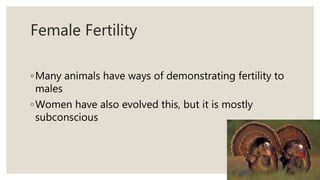
Female Fertility
◦Many animals have ways of demonstrating fertility to
males
◦Women have also evolved this, but it is mostly
subconscious
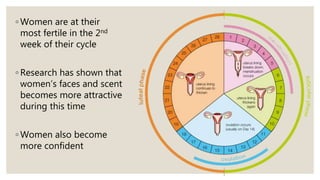
◦ Women are at their
most fertile in the 2nd
week of their cycle
◦ Research has shown that
women’s faces and scent
becomes more attractive
during this time
◦ Women also become
more confident
Miller et al (2007)
◦Measured lap dancer’s tips of dancers on and off the pill
(fertile/infertile)
◦During non-fertile stages, both sets earned similar tips
◦During ‘fertile’ stages, the non-pill dancers received
significantly more in tips
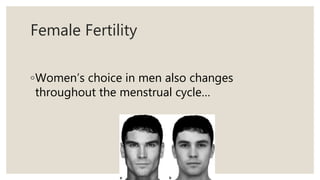
Female Fertility
◦Women’s choice in men also changes
throughout the menstrual cycle…
Penton et al (1999)
◦Women attracted to more masculine looking men
during their most fertile time
◦Preference for more feminine looking men during less
fertile times
Penton et al (1999)
◦Less-masculine men = better long term partner
(kinder/cooperative)
◦But women may benefit from being unfaithful during the
fertile phase with a strong/healthy child with a more
masculine looking man
AO3
Gender
Reductionist
Ethical Guidelines?
Nature vs. Nurture
Animal Studies
Determinsm vs. Free Will
Ethnocentricism
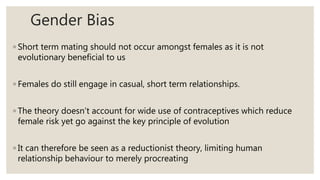
Gender Bias
◦ Short term mating should not occur amongst females as it is not
evolutionary beneficial to us
◦ Females do still engage in casual, short term relationships.
◦ The theory doesn’t account for wide use of contraceptives which reduce
female risk yet go against the key principle of evolution
◦ It can therefore be seen as a reductionist theory, limiting human
relationship behaviour to merely procreating
AO3
Gender
Reductionist
Ethical Guidelines?
Nature vs. Nurture
Animal Studies
Determinsm vs. Free Will
Ethnocentricism
Deterministic
◦ All evolutionary theories assume that human behaviour is driven by
primitive forces that we have no free will to change
◦ The theory doesn’t account for individuals who do not want to
procreate
◦ It also does not account for homosexuality
AO3
Gender
Reductionist
Ethical Guidelines?
Nature vs. Nurture
Animal Studies
Determinsm vs. Free Will
Ethnocentricism
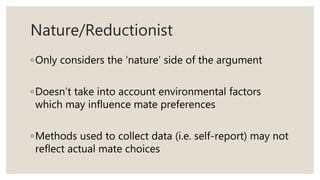
Nature/Reductionist
◦Only considers the ‘nature’ side of the argument
◦Doesn’t take into account environmental factors
which may influence mate preferences
◦Methods used to collect data (i.e. self-report) may not
reflect actual mate choices
AO1
◦ Sexual Selection
◦ Intrasexual selection – Mate Competition
◦ Intersexual selection – Female Choice
◦ Reproductive Behaviour
◦ Short/Long term mating strategies
AO2
◦Buss (1989)
◦Clark & Hatfield
◦Waynforth & Dunbar
◦Miller
◦Penton
AO3
Gender
Reductionist
Ethical Guidelines?
Nature vs. Nurture
Animal Studies
Determinsm vs. Free Will
Ethnocentricism

Sexual selection

  • 1.
  • 2.
    Sexual Selection ◦The processthrough which males and females attempt to maximise their chances of reproductive success
  • 3.
    Sexual Selection ◦There are2 different types of Sexual Selection ◦1. Intrasexual Selection ◦2. Intersexual Selection
  • 4.
    Intrasexual Selection ◦ MateCompetition ◦ Members of one sex compete against each other to attract members of the opposite sex ◦ Usually this is between 2 or more males
  • 5.
    Intersexual Selection ◦Mate Choice ◦Femaleschoose between male mates. ◦‘Between sexes’
  • 6.
    Gender differences inReproductive Behaviour in humans ◦Differences in Quantity of mates ◦Differences in Longevity of mates ◦Differences in Sexual Jealousy ◦Differences in Sexual Fantasies
  • 7.
    Intersexual Selection ◦ Inmost Mammal species, the female invests heavily in the offspring ◦ Especially in species where females have limited reproductive opportunities ◦ Thus females need to be picky and make the right selection of male ◦ A wrong choice for a female is much more serious than for a male – this leads to intersexual selection
  • 8.
    Females Choosiness For afemale it pays to be choosey due to investment ◦The genetic quality of your mate will determine half the genetic quality of your offspring ◦Selection for ‘Good Genes’ and ‘Good Parents’ ◦Will the mate survive and be able to provide for, protect and support their offspring?
  • 9.
    TASK: Intersexual selection Whatcharacteristics would indicate good resources? What characteristics would indicate good genes? What characteristics would indicate good parents? Economic & financial security, good job, well educated, interpersonal skills, status, etc Good health i.e. skin, hair, weight, facial symmetry, BUT also traits that are disadvantaged (peacock’s tail) Good skills, caring, affectionate, strong, protective, ability to provide, nurture, etc
  • 10.
    Short & Longterm mating strategies ◦ Males: ◦ Short term strategy = casual sex sought as early as possible in the relationship ◦ Explains why males may lower their standards prior to sex then lose interest quickly after sex ◦ Females: ◦ Long term strategy = men who are resourceful and protective are preferred. ◦ Males who show potential to be a good parent (caring, affectionate)
  • 11.
    Short Term vs.Long Term strategies ◦ Clear differences have been found in the behaviour of men and women in terms of short term strategies. ◦ Clark and Hatfield (1990) conducted a study where male and female experimenters approached members of the opposite sex with the following statement: ◦ ‘Hi, I’ve noticed you around campus and I find you very attractive’. They then asked them either: ◦ (1) ‘Would you go on a date with me?’ ◦ (2) ‘Would you go back to my apartment with me?’ ◦ (3) ‘Would you have sex with me’.
  • 12.
    Clark & Hatfield(1990) ◦ 50% of both men and women agreed to go on a date ◦ Of the females asked, 0% agreed to have sex, compared to… ◦ 75% of males approached! ◦ Demonstrates intersexual sexual selection differences in males and females
  • 13.
    Mate Preference ◦ Malesare also picky as they will ultimately have to provide many resources to the female and offspring ◦ Men have evolved to prefer females who display fertility ◦ Optimum waist-hip ratio ◦ Large breasts ◦ Youthfulness ◦ Baby-faced features (large eyes/small nose)
  • 14.
    Buss (1989) ◦Demonstrated genderdifferences in modern relationships ◦37 cultures in 6 continents ◦10,000+ participants ◦Questionnaire on mate preferences
  • 15.
    Buss (1989) ◦ Acrossall cultures… ◦ Women showed a preference for males with resources or possessing characteristics that would translate to resources (intelligence/ambition) ◦ Women preferred a high-status male on average 5 years older than themselves
  • 16.
    Buss (1989) ◦ Acrossall cultures… ◦ Men placed more emphasis on physical attractiveness (indication of woman’s health/fertility) ◦ Men desired a partner who was younger than themselves ◦ Both sexes wanted kind, dependable partners
  • 17.
    Buss (1989) ◦Findings representa clear illustration of evolved sex differences based on sexual selection ◦Show cultural universals = likely to have evolved across the human species as a whole
  • 18.
    Buss (1989) –Criticisms… ◦  Self – report data ◦  Lacks Validity… ◦  Buss conducted a study on marriages in 29 cultures and found men do marry younger women… and remarry even younger ones!
  • 19.
    AO2 – Matepreferences ◦Waynforth and Dunbar (1995) ◦Analysed Lonely Heart adverts ◦Found that adverts reflected evolutionary pressure to promote reproductive success
  • 20.
    Waynforth and Dunbar(1995) ◦ Found that men indicated material wealth in their descriptions of themselves twice as often as women ◦ Women demanded wealth in a potential parter 4.5 times more often than men ◦ Females twice as likely to provide information about their physical appearance
  • 21.
    Female Fertility ◦Many animalshave ways of demonstrating fertility to males ◦Women have also evolved this, but it is mostly subconscious
  • 22.
    ◦ Women areat their most fertile in the 2nd week of their cycle ◦ Research has shown that women’s faces and scent becomes more attractive during this time ◦ Women also become more confident
  • 23.
    Miller et al(2007) ◦Measured lap dancer’s tips of dancers on and off the pill (fertile/infertile) ◦During non-fertile stages, both sets earned similar tips ◦During ‘fertile’ stages, the non-pill dancers received significantly more in tips
  • 24.
    Female Fertility ◦Women’s choicein men also changes throughout the menstrual cycle…
  • 26.
    Penton et al(1999) ◦Women attracted to more masculine looking men during their most fertile time ◦Preference for more feminine looking men during less fertile times
  • 27.
    Penton et al(1999) ◦Less-masculine men = better long term partner (kinder/cooperative) ◦But women may benefit from being unfaithful during the fertile phase with a strong/healthy child with a more masculine looking man
  • 28.
    AO3 Gender Reductionist Ethical Guidelines? Nature vs.Nurture Animal Studies Determinsm vs. Free Will Ethnocentricism
  • 29.
    Gender Bias ◦ Shortterm mating should not occur amongst females as it is not evolutionary beneficial to us ◦ Females do still engage in casual, short term relationships. ◦ The theory doesn’t account for wide use of contraceptives which reduce female risk yet go against the key principle of evolution ◦ It can therefore be seen as a reductionist theory, limiting human relationship behaviour to merely procreating
  • 30.
    AO3 Gender Reductionist Ethical Guidelines? Nature vs.Nurture Animal Studies Determinsm vs. Free Will Ethnocentricism
  • 31.
    Deterministic ◦ All evolutionarytheories assume that human behaviour is driven by primitive forces that we have no free will to change ◦ The theory doesn’t account for individuals who do not want to procreate ◦ It also does not account for homosexuality
  • 32.
    AO3 Gender Reductionist Ethical Guidelines? Nature vs.Nurture Animal Studies Determinsm vs. Free Will Ethnocentricism
  • 33.
    Nature/Reductionist ◦Only considers the‘nature’ side of the argument ◦Doesn’t take into account environmental factors which may influence mate preferences ◦Methods used to collect data (i.e. self-report) may not reflect actual mate choices
  • 34.
    AO1 ◦ Sexual Selection ◦Intrasexual selection – Mate Competition ◦ Intersexual selection – Female Choice ◦ Reproductive Behaviour ◦ Short/Long term mating strategies
  • 35.
    AO2 ◦Buss (1989) ◦Clark &Hatfield ◦Waynforth & Dunbar ◦Miller ◦Penton
  • 36.
    AO3 Gender Reductionist Ethical Guidelines? Nature vs.Nurture Animal Studies Determinsm vs. Free Will Ethnocentricism

Editor's Notes

  • #19 Validity – ideal vs realistic choice