Presented by : Abdul Qahar
Buneri
Animal Behavior types
AWKUM (BUNER CAMPUS)
The first type is innate behavior.
From Latin . innatus "inborn,“
Innate behaviors are those you develop on your own,
which do not need to be taught or learned.
Innate behavior is something the animal is born knowing
how to do.
Examples include fish swimming and geese migrating.
What other examples can you think of?
Innate behavior
 Behavior determined by the "hard-wiring" of the nervous
system is Innate behavior .
 It is usually inflexible, a given stimulus triggering a given
response.
Example: A salamander raised away from water until long
after its siblings begin swimming successfully will swim
every bit as well as they the very first time it is placed in the
water.
Clearly this rather elaborate response is "built in" in the
species and not something that must be acquired by practice.
Types of innate behavior
1:irratibity
2:tropisam
3:nasties
4:taxes
5:kinesisi
6:reflex action
7:instinct
8:motivation
 let study detail
Types if innate behavior
1: Irritability
def.: Irritability is an excessive response to stimuli.
Conditions
Irritability can occur in people experiencing any of a variety
of conditions, including:
Anxiety
Alcoholism
Fever
Examples of irritability
Protozoans lack nervosa system but protoplasm is capable of
receiving the stimuli.
They can distinguished between edible and non edible
particles.
2:  tropism :
Cause of name: (from Greek  trope, "a turning")
Def: it is a biological phenomenon, indicating growth or
turning movement of a biological organism, usually a plant, in
response to an environmental stimulus.or
involuntary orientation by an organism or one of its parts that
involves turning or curving by movement or by differential
growth and is a positive or negative response to a source of
stimulation
In tropisms, this response is dependent on the direction of
the stimulus
Tropisms are typically associated with plants.
Types of tropism
Chemotropism, movement or growth in response to 
chemicals
Geotropism (or gravitropism), movement or growth in
response to gravity
Heliotropism, movement or growth in response to sunlight
Sonotropism, movement or growth in response to sound.
Hydrotropism, movement or growth in response to water
Phototropism, movement or growth in response to lights or 
colors of light (e.g.- the sunflower)
Types of tropism
Thermotropism, movement or growth in response to 
temperature
Electrotropism, movement or growth in response to an 
electric field
Thigmotropism, movement or growth in response to touch
 or contact
3:nasties
Def:
these Are non directional responses to stimuli (e.g. 
temperature, humidity, light irradiance), and are usually
associated with plants
The movement can be due to changes in turgor or changes in
growth. 
Nastic movements differ from tropic movements in that the
direction of tropic responses depends on the direction of the
stimulus, whereas the direction of nastic movements is
independent of the stimulus' position. 
Types of nasties
Epinasty: downward-bending from growth at the top, for
example, the bending down of a heavy flower.
Photonasty: response to light
Nyctinasty: movements at night or in the dark
Chemonasty: response to chemicals or nutrients
Hydronasty: response to water
Thermonasty: response to temperature
Geonasty/gravinasty: response to gravity
Thigmonasty/seismonasty/haptonasty: response to contact
Examples of nasties
4:Taxis
Cause of name: A taxis from ancient Greek  meaning
arrangement
Def.:
it is an innate behavioral response by an organism to a
directional stimulus or gradient of stimulus intensity.
A taxis differs from a tropism (turning response, often
growth towards or away from a stimulus) in that the
organism has motility and demonstrates guided movement
towards or away from the stimulus source
Examples
For example, flagellate protozoans of the genus Euglena move
towards a light source. Here the directional stimulus is light,
and the orientation movement is towards the light. This
reaction or behaviour is a positive one to light and
specifically termed "positive phototaxis", since phototaxis is
a response to a light stimulus, and the organism is moving
towards the stimulus. If the organism moves away from the
stimulus, then the taxis is negative.
Types of taxis
Aerotaxis
Aerotaxis is the response of an organism to variation in oxygen
concentration, and is mainly found in aerobic bacteria.
Chemotaxis
Chemotaxis is a migratory response that is elicited by chemicals:
that is, a response to a chemical concentration gradient.[
For
example, chemotaxis in response to a sugar gradient has been
observed in motile bacteria such as E. Coli.Chemotaxis also
occurs in the antherozoids of liverworts, ferns, and mosses in
response to chemicals secreted by the archegonia.
Energy taxis
Energy taxis is the orientation of bacteria towards conditions
of optimal metabolic activity by sensing the internal
energetic conditions of cell. Therefore in contrast to
chemotaxis (taxis towards or away from a specific
extracellular compound), energy taxis responds on an
intracellular stimulus (e.g. proton motive force, activity of
NDH- 1) and requires metabolic activity.
Phototaxis
Phototaxis is the movement of an organism in response to
light: that is, the response to variation in light intensity and
direction.Negative phototaxis, or movement away from a
light source, is demonstrated in some insects, such as
cockroaches.Positive phototaxis, or movement towards a
light source, is advantageous for phototrophic organisms as
they can orient themselves most efficiently to receive light
for photosynthesis. Many phytoflagellates, e.g. Euglena, and
the chloroplasts of higher plants positively phototactic,
moving towards a light source.[
Thermotaxis
Thermotaxis is a migration along a gradient of
temperature. Some slime molds and small nematodes can
migrate along amazingly small temperature gradients of less
than 0.1C/cm.
They apparently use this behavior to move to an optimal
level in so
Phonotaxis
Phonotaxis is the movement of an organism in response to
sound.
Gravitaxis
Gravitaxis (known historically as geotaxis) is a response to
the attraction due to gravity. The planktonic larvae of the
king crab Lithodes aequispinus use a combination of positive
phototaxis (movement towards the light) and negative
gravitaxis (upward movement) Both positive and negative
gravitaxes are found in a variety of protozoans
Magnetotaxis
Logically, magnetotaxis is the ability to sense a
magnetic field and coordinate movement in response.
However, the term is commonly applied to bacteria that
contain magnets and are physically rotated by the force of the
Earth's magnetic field. In this case, the "behavior" has
nothing to do with sensation, and the bacteria are more
accurately described as "magnetic bacteria
Galvanotaxis / electrotaxis
Galvanotaxis or electrotaxis is directional movement of
motile cells in response to an electric field. It has been suggested
that by detecting and orientating themselves toward the electric
fields, cells are able to direct their movement towards the
damages or wounds to repair the defect. It also is suggested that
such a movement may contribute to directional growth of cells
and tissues during development and regeneration. This notion is
based on 1) the existence of measurable electric fields that
naturally occur during wound healing, development and
regeneration; and 2) cells in cultures respond to applied electric
fields by directional cell migration – electrotaxis / galvanotaxis.
Rheotaxis
Rheotaxis is a response to a current in a fluid. Positive rheotaxis
is shown by fish turning to face against the current. In a flowing
stream, this behavior leads them to hold their position in a stream
rather than being swept downstream. Some fish will exhibit
negative rheotaxis where they will avoid currents.
Thigmotaxis
Thigmotaxis is the response of an organism to physical contact,
or to the proximity of a physical discontinuity in the environment
(e.g. rats preferring to swim near the edge of a water maze).
Lateral-line sense organs and
rheotactic responses of the torrent
fish
rat at the end of a maze arm
Klinotaxis
Klinotaxis occur in organisms with receptor cells but no
paired receptor organs. The cells for reception are located all
over the body, particularly towards the anterior side. The
organisms detect the stimuli by turning their head sideways
and compare the intensity. When the intensity of stimuli is
balanced equally from all sides then the organisms move in a
straight line.
 Examples: movement of larva of blowfly and butterfly.
Tropotaxis
Tropotaxis are displayed by organisms with paired
receptor cells. When the stimuli coming from a source is
balanced equally the organisms show movement. In this
animals are capable of showing sideways movement unlike
klinotaxis where the organisms show movement in a straight
line. Example: movement of Greyling butterfly, fish louse
The dorsal light reaction is another important form of a taxis
dependent on bilateral receptor organs that is exhibited by many aerial
and aquatic organisms. This reaction functions to keep the animal's
dorsal surface uppermost and oriented toward the natural light source.
Again, this is accomplished by maintaining equal stimulation of bilateral
photoreceptor organs.
Argulus, a marine crustacean, normally swims with its dorsal surface
toward light. In a natural situation, the light always comes from above.
However, if an artificial light is presented from below, the animal will
swim about upside-down. If one eye is removed, it makes the
characteristic continuous circling movements.
Many fish show the dorsal light reaction, but in most it is modified by
information on gravity detected by the labyrinth organ of the inner ear.
Thus, the orientation of labyrinthectomized fish is determined only by
the position of the light, whereas normal intact fish orient using both the
direction of light and the pull of gravity
Menotaxis
Menotaxis In this constant angular orientation of the
organisms takes place. Example: Bees returning to their hive
at night, movement of ant with response to the sun
Mnemotaxis
Mnemotaxis are a complex type of stimuli. In this the
organisms pick up the trails left by them when traveling back
to their home. Thus this is a memory response of an
organisms
e.g the hunting digger wasp uses a number of land marks
simultinslly while returning to there nest.
Telotaxis
Teleotaxis require paired receptors. The
movement occurs along the direction
where the intensity of the stimuli is
stronger. For example: when bees move
from their hive for food they balance the
stimuli from the sun as well as flower but
reside on the flower whose intensity is
higher for them.
5:Kinesis
Kinesis, like a taxis, is a movement or activity of a cell or an
organism in response to a stimulus. However, unlike taxis,
the response to the stimulus provided (such as gas exposure,
light intensity or ambient temperature) is non-directional.
Kinesis is an animals non-directional response to a stimulus,
for example humidity. The animal does not move toward or
away the stimulus but moves at either a slow or fast rate
depending on its "comfort zone." In this case a fast
movement(non random) means that the animal is searching
for its comfort zone but a slow movement indicates that it
has found it.
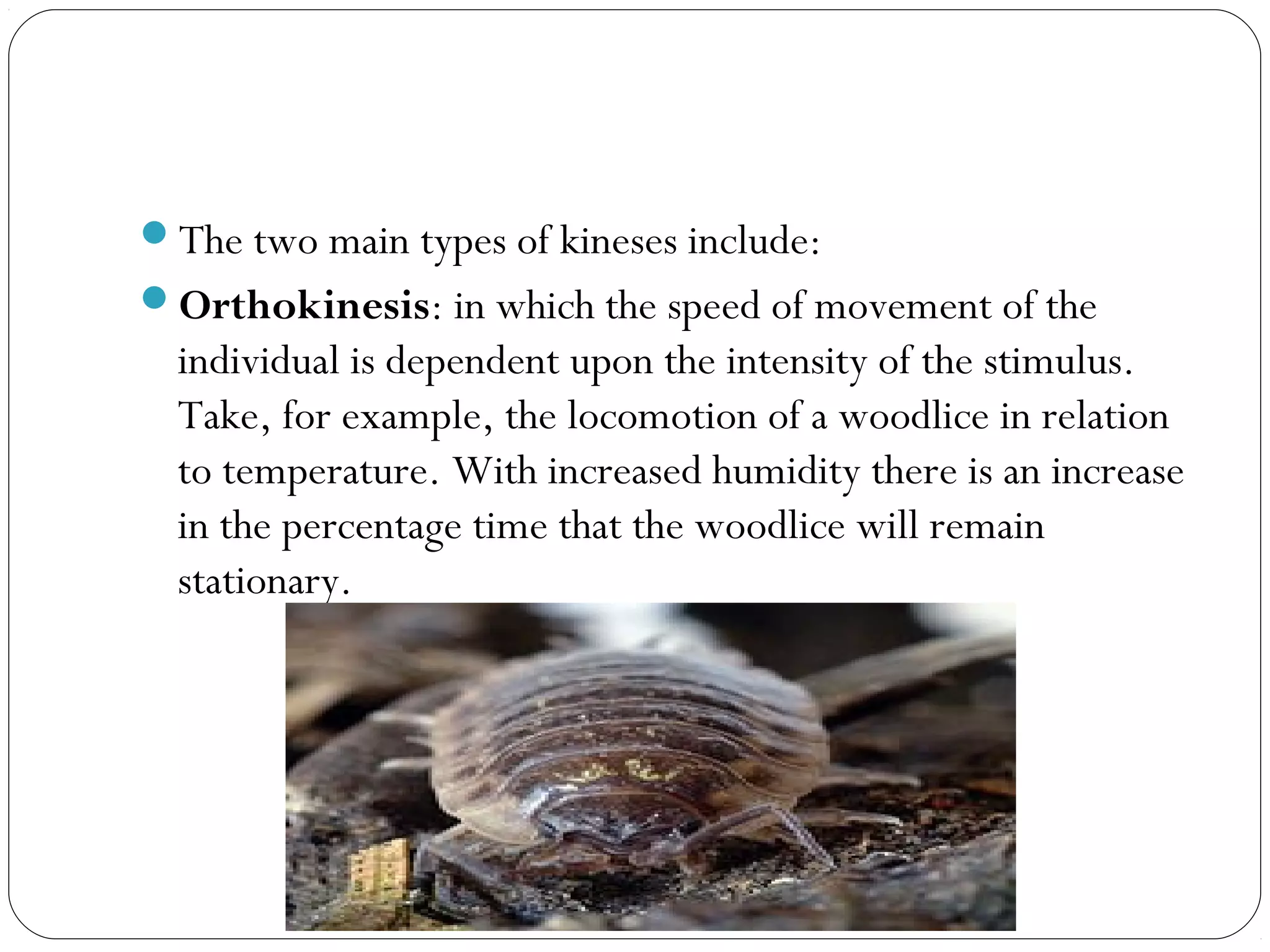
The two main types of kineses include:
Orthokinesis: in which the speed of movement of the
individual is dependent upon the intensity of the stimulus.
Take, for example, the locomotion of a woodlice in relation
to temperature. With increased humidity there is an increase
in the percentage time that the woodlice will remain
stationary.
Klinokinesis:
in which the frequency or rate of turning is proportional to stimulus
intensity.
e.g planaira changes its direction of movement according to the intensity
of light. in dim light it turns oaccsaionsliy but in bright light the rate of
turning increase.
Both orthokinesis and klinokineses result in aggregations. However, the
stimulus does not act to attract or repel individuals
7: Reflex actions
Of the many kinds of neural activity, there is one simple kind in
which a stimulus leads to an immediate action. This is reflex activity.
The word reflex (from Latin reflexus, “reflection”) was introduced
into biology by a 19th-century English neurologist, Marshall Hall,
who fashioned the word because he thought of the muscles as
reflecting a stimulus much as a wall reflects a ball thrown against it.
By reflex, Hall meant the automatic response of a muscle or several
muscles to a stimulus that excites an afferent nerve. The term is now
used to describe an action that is an inborn central nervous system
activity, not involving consciousness, in which a particular stimulus,
by exciting an afferent nerve, produces a stereotyped, immediate
response of muscle or gland
The anatomical pathway of a reflex is called the reflex arc. It consists of
an afferent (or sensory) nerve, usually one or more interneurons within
the central nervous system, and an efferent (motor, secretory, or
secreto-motor) nerve. Probably the best-known reflex is the pupillary
light reflex.
 If a light is flashed near one eye, the pupils of both eyes contract. Light
is the stimulus; impulses reach the brain via the optic nerve; and the
response is conveyed to the pupillary musculature by autonomic nerves
that supply the eye. Another reflex involving the eye is known as the
lacrimal reflex. When something irritates the conjunctiva or cornea of
the eye, the lacrimal reflex causes nerve impulses to pass along the fifth
cranial nerve (trigeminal) and reach the midbrain. The efferent limb of
this reflex arc is autonomic and mainly parasympathetic. These nerve
fibers stimulate the lacrimal glands of the orbit, causing the outpouring
of tears.
Example of reflex action:
7:Instinct
Instinct is the inherent inclination of a living organism
toward a particular complex behavior.
Any behavior is instinctive if it is performed without being
based upon prior experience
An instinct should be distinguished from a reflex, which is a
simple response of an organism to a specific stimulus
such as the contraction of the pupil in response to bright light
or the spasmodic movement of the lower leg when the knee
is tapped
The behavior in fixed way is called fixed action pattern.
Fixed Action Patterns
A fixed action pattern (FAP) is a sequence of unlearned,
innate behaviors that is unchangeable.
Once initiated, it is usually carried to completion.
Fixed Action Patterns
A FAP is triggered by an external sensory stimulus known as
a sign stimulus.
The egg, for example.
Lorenz andTinbergen (1938) examined egg-rolling
behavior in the greylag goose.
If the egg slipped away, she continued the motion.
Once started, the behavior must be completed in a specific
way.
Fixed Action Patterns
In male sticklebacks, the sign stimulus for attack behavior, is
the red underside of an intruder.
(a) A male three-spined stickleback fish shows its red underside.
Fixed Action Patterns
When presented with unrealistic models, as long as some
red is present, the attack behavior occurs.
No attack occurs with the realistic model that lacks red.
Fixed Action Patterns
An instinctive behavior of shaking
water from wet fur.
Fixed Action Patterns
Male English robins will
attack a bundle of red
feathers placed in their
territory, but will ignore a
stuffed juvenile (no red).
Fixed Action Patterns
There are costs involved with attack behavior.
Inappropriate attack responses can be costly.
Red items are not common in the environment.
8:Motivation
Motivation is the psychological feature that arouses an
organism to action toward a desired goal and elicits,
controls, and sustains certain goal directed behaviors. For
instance: An individual has not eaten, he or she feels hungry,
and as a response he or she eats and diminishes feelings of
hunger. There are many approaches to motivation:
physiological, behavioural, cognitive, and social
Motivation may be rooted in a basic need to minimize
physical pain and maximize pleasure, or it may include
specific needs such as eating and resting, or for a desired
object. Conceptually, motivation is related to, but distinct
from, emotion.
Intrinsic motivation
Intrinsic motivation refers to motivation that is driven by an
interest or enjoyment in the task itself, and exists within the
individual rather than relying on any external pressure. Intrinsic
motivation is based on taking pleasure in an activity rather than
working towards an external reward. Intrinsic motivation has
been studied since the early 1970s.
Students who are intrinsically motivated are more likely to engage
in the task willingly as well as work to improve their skills, which
will increase their capabilities.Students are likely to be
intrinsically motivated if they:
attribute their educational results to factors under their own
control, also known as autonomy,
learning to achieve good grades.
Extrinsic motivation
Extrinsic motivation refers to the performance of an activity
in order to attain an outcome, which then contradicts
intrinsic motivation. It is widely believed that motivation
performs two functions. The first is often referred to as the
energetic activation component of the motivation construct.
The second is directed at a specific behavior and makes
reference to the orientation directional component.
Common extrinsic motivations are rewards like money and
grades, and threat of punishment.
The other type is learned behavior.
Ensha Allha in next
class.
THANX

Animal behavior powerpoint

  • 1.
    Presented by :Abdul Qahar Buneri Animal Behavior types AWKUM (BUNER CAMPUS)
  • 2.
    The first typeis innate behavior. From Latin . innatus "inborn,“ Innate behaviors are those you develop on your own, which do not need to be taught or learned. Innate behavior is something the animal is born knowing how to do. Examples include fish swimming and geese migrating. What other examples can you think of?
  • 3.
    Innate behavior  Behavior determinedby the "hard-wiring" of the nervous system is Innate behavior .  It is usually inflexible, a given stimulus triggering a given response. Example: A salamander raised away from water until long after its siblings begin swimming successfully will swim every bit as well as they the very first time it is placed in the water. Clearly this rather elaborate response is "built in" in the species and not something that must be acquired by practice.
  • 4.
    Types of innatebehavior 1:irratibity 2:tropisam 3:nasties 4:taxes 5:kinesisi 6:reflex action 7:instinct 8:motivation  let study detail
  • 5.
    Types if innatebehavior 1: Irritability def.: Irritability is an excessive response to stimuli. Conditions Irritability can occur in people experiencing any of a variety of conditions, including: Anxiety Alcoholism Fever
  • 6.
    Examples of irritability Protozoanslack nervosa system but protoplasm is capable of receiving the stimuli. They can distinguished between edible and non edible particles.
  • 7.
    2:  tropism : Cause ofname: (from Greek  trope, "a turning") Def: it is a biological phenomenon, indicating growth or turning movement of a biological organism, usually a plant, in response to an environmental stimulus.or involuntary orientation by an organism or one of its parts that involves turning or curving by movement or by differential growth and is a positive or negative response to a source of stimulation In tropisms, this response is dependent on the direction of the stimulus Tropisms are typically associated with plants.
  • 8.
    Types of tropism Chemotropism,movement or growth in response to  chemicals Geotropism (or gravitropism), movement or growth in response to gravity Heliotropism, movement or growth in response to sunlight Sonotropism, movement or growth in response to sound. Hydrotropism, movement or growth in response to water Phototropism, movement or growth in response to lights or  colors of light (e.g.- the sunflower)
  • 9.
    Types of tropism Thermotropism,movement or growth in response to  temperature Electrotropism, movement or growth in response to an  electric field Thigmotropism, movement or growth in response to touch  or contact
  • 11.
    3:nasties Def: these Are nondirectional responses to stimuli (e.g.  temperature, humidity, light irradiance), and are usually associated with plants The movement can be due to changes in turgor or changes in growth.  Nastic movements differ from tropic movements in that the direction of tropic responses depends on the direction of the stimulus, whereas the direction of nastic movements is independent of the stimulus' position. 
  • 12.
    Types of nasties Epinasty:downward-bending from growth at the top, for example, the bending down of a heavy flower. Photonasty: response to light Nyctinasty: movements at night or in the dark Chemonasty: response to chemicals or nutrients Hydronasty: response to water Thermonasty: response to temperature Geonasty/gravinasty: response to gravity Thigmonasty/seismonasty/haptonasty: response to contact
  • 13.
  • 14.
    4:Taxis Cause of name:A taxis from ancient Greek  meaning arrangement Def.: it is an innate behavioral response by an organism to a directional stimulus or gradient of stimulus intensity. A taxis differs from a tropism (turning response, often growth towards or away from a stimulus) in that the organism has motility and demonstrates guided movement towards or away from the stimulus source
  • 15.
    Examples For example, flagellateprotozoans of the genus Euglena move towards a light source. Here the directional stimulus is light, and the orientation movement is towards the light. This reaction or behaviour is a positive one to light and specifically termed "positive phototaxis", since phototaxis is a response to a light stimulus, and the organism is moving towards the stimulus. If the organism moves away from the stimulus, then the taxis is negative.
  • 16.
    Types of taxis Aerotaxis Aerotaxisis the response of an organism to variation in oxygen concentration, and is mainly found in aerobic bacteria. Chemotaxis Chemotaxis is a migratory response that is elicited by chemicals: that is, a response to a chemical concentration gradient.[ For example, chemotaxis in response to a sugar gradient has been observed in motile bacteria such as E. Coli.Chemotaxis also occurs in the antherozoids of liverworts, ferns, and mosses in response to chemicals secreted by the archegonia.
  • 17.
    Energy taxis Energy taxisis the orientation of bacteria towards conditions of optimal metabolic activity by sensing the internal energetic conditions of cell. Therefore in contrast to chemotaxis (taxis towards or away from a specific extracellular compound), energy taxis responds on an intracellular stimulus (e.g. proton motive force, activity of NDH- 1) and requires metabolic activity.
  • 18.
    Phototaxis Phototaxis is themovement of an organism in response to light: that is, the response to variation in light intensity and direction.Negative phototaxis, or movement away from a light source, is demonstrated in some insects, such as cockroaches.Positive phototaxis, or movement towards a light source, is advantageous for phototrophic organisms as they can orient themselves most efficiently to receive light for photosynthesis. Many phytoflagellates, e.g. Euglena, and the chloroplasts of higher plants positively phototactic, moving towards a light source.[
  • 19.
    Thermotaxis Thermotaxis is amigration along a gradient of temperature. Some slime molds and small nematodes can migrate along amazingly small temperature gradients of less than 0.1C/cm. They apparently use this behavior to move to an optimal level in so Phonotaxis Phonotaxis is the movement of an organism in response to sound.
  • 20.
    Gravitaxis Gravitaxis (known historicallyas geotaxis) is a response to the attraction due to gravity. The planktonic larvae of the king crab Lithodes aequispinus use a combination of positive phototaxis (movement towards the light) and negative gravitaxis (upward movement) Both positive and negative gravitaxes are found in a variety of protozoans
  • 21.
    Magnetotaxis Logically, magnetotaxis isthe ability to sense a magnetic field and coordinate movement in response. However, the term is commonly applied to bacteria that contain magnets and are physically rotated by the force of the Earth's magnetic field. In this case, the "behavior" has nothing to do with sensation, and the bacteria are more accurately described as "magnetic bacteria
  • 22.
    Galvanotaxis / electrotaxis Galvanotaxisor electrotaxis is directional movement of motile cells in response to an electric field. It has been suggested that by detecting and orientating themselves toward the electric fields, cells are able to direct their movement towards the damages or wounds to repair the defect. It also is suggested that such a movement may contribute to directional growth of cells and tissues during development and regeneration. This notion is based on 1) the existence of measurable electric fields that naturally occur during wound healing, development and regeneration; and 2) cells in cultures respond to applied electric fields by directional cell migration – electrotaxis / galvanotaxis.
  • 23.
    Rheotaxis Rheotaxis is aresponse to a current in a fluid. Positive rheotaxis is shown by fish turning to face against the current. In a flowing stream, this behavior leads them to hold their position in a stream rather than being swept downstream. Some fish will exhibit negative rheotaxis where they will avoid currents. Thigmotaxis Thigmotaxis is the response of an organism to physical contact, or to the proximity of a physical discontinuity in the environment (e.g. rats preferring to swim near the edge of a water maze).
  • 24.
    Lateral-line sense organsand rheotactic responses of the torrent fish
  • 25.
    rat at theend of a maze arm
  • 26.
    Klinotaxis Klinotaxis occur inorganisms with receptor cells but no paired receptor organs. The cells for reception are located all over the body, particularly towards the anterior side. The organisms detect the stimuli by turning their head sideways and compare the intensity. When the intensity of stimuli is balanced equally from all sides then the organisms move in a straight line.  Examples: movement of larva of blowfly and butterfly.
  • 27.
    Tropotaxis Tropotaxis are displayedby organisms with paired receptor cells. When the stimuli coming from a source is balanced equally the organisms show movement. In this animals are capable of showing sideways movement unlike klinotaxis where the organisms show movement in a straight line. Example: movement of Greyling butterfly, fish louse
  • 28.
    The dorsal lightreaction is another important form of a taxis dependent on bilateral receptor organs that is exhibited by many aerial and aquatic organisms. This reaction functions to keep the animal's dorsal surface uppermost and oriented toward the natural light source. Again, this is accomplished by maintaining equal stimulation of bilateral photoreceptor organs. Argulus, a marine crustacean, normally swims with its dorsal surface toward light. In a natural situation, the light always comes from above. However, if an artificial light is presented from below, the animal will swim about upside-down. If one eye is removed, it makes the characteristic continuous circling movements. Many fish show the dorsal light reaction, but in most it is modified by information on gravity detected by the labyrinth organ of the inner ear. Thus, the orientation of labyrinthectomized fish is determined only by the position of the light, whereas normal intact fish orient using both the direction of light and the pull of gravity
  • 30.
    Menotaxis Menotaxis In thisconstant angular orientation of the organisms takes place. Example: Bees returning to their hive at night, movement of ant with response to the sun Mnemotaxis Mnemotaxis are a complex type of stimuli. In this the organisms pick up the trails left by them when traveling back to their home. Thus this is a memory response of an organisms e.g the hunting digger wasp uses a number of land marks simultinslly while returning to there nest.
  • 31.
    Telotaxis Teleotaxis require pairedreceptors. The movement occurs along the direction where the intensity of the stimuli is stronger. For example: when bees move from their hive for food they balance the stimuli from the sun as well as flower but reside on the flower whose intensity is higher for them.
  • 32.
    5:Kinesis Kinesis, like ataxis, is a movement or activity of a cell or an organism in response to a stimulus. However, unlike taxis, the response to the stimulus provided (such as gas exposure, light intensity or ambient temperature) is non-directional. Kinesis is an animals non-directional response to a stimulus, for example humidity. The animal does not move toward or away the stimulus but moves at either a slow or fast rate depending on its "comfort zone." In this case a fast movement(non random) means that the animal is searching for its comfort zone but a slow movement indicates that it has found it.
  • 33.
    The two maintypes of kineses include: Orthokinesis: in which the speed of movement of the individual is dependent upon the intensity of the stimulus. Take, for example, the locomotion of a woodlice in relation to temperature. With increased humidity there is an increase in the percentage time that the woodlice will remain stationary.
  • 34.
    Klinokinesis: in which thefrequency or rate of turning is proportional to stimulus intensity. e.g planaira changes its direction of movement according to the intensity of light. in dim light it turns oaccsaionsliy but in bright light the rate of turning increase. Both orthokinesis and klinokineses result in aggregations. However, the stimulus does not act to attract or repel individuals
  • 35.
    7: Reflex actions Ofthe many kinds of neural activity, there is one simple kind in which a stimulus leads to an immediate action. This is reflex activity. The word reflex (from Latin reflexus, “reflection”) was introduced into biology by a 19th-century English neurologist, Marshall Hall, who fashioned the word because he thought of the muscles as reflecting a stimulus much as a wall reflects a ball thrown against it. By reflex, Hall meant the automatic response of a muscle or several muscles to a stimulus that excites an afferent nerve. The term is now used to describe an action that is an inborn central nervous system activity, not involving consciousness, in which a particular stimulus, by exciting an afferent nerve, produces a stereotyped, immediate response of muscle or gland
  • 36.
    The anatomical pathwayof a reflex is called the reflex arc. It consists of an afferent (or sensory) nerve, usually one or more interneurons within the central nervous system, and an efferent (motor, secretory, or secreto-motor) nerve. Probably the best-known reflex is the pupillary light reflex.  If a light is flashed near one eye, the pupils of both eyes contract. Light is the stimulus; impulses reach the brain via the optic nerve; and the response is conveyed to the pupillary musculature by autonomic nerves that supply the eye. Another reflex involving the eye is known as the lacrimal reflex. When something irritates the conjunctiva or cornea of the eye, the lacrimal reflex causes nerve impulses to pass along the fifth cranial nerve (trigeminal) and reach the midbrain. The efferent limb of this reflex arc is autonomic and mainly parasympathetic. These nerve fibers stimulate the lacrimal glands of the orbit, causing the outpouring of tears.
  • 37.
  • 39.
    7:Instinct Instinct is theinherent inclination of a living organism toward a particular complex behavior. Any behavior is instinctive if it is performed without being based upon prior experience An instinct should be distinguished from a reflex, which is a simple response of an organism to a specific stimulus such as the contraction of the pupil in response to bright light or the spasmodic movement of the lower leg when the knee is tapped The behavior in fixed way is called fixed action pattern.
  • 40.
    Fixed Action Patterns Afixed action pattern (FAP) is a sequence of unlearned, innate behaviors that is unchangeable. Once initiated, it is usually carried to completion.
  • 41.
    Fixed Action Patterns AFAP is triggered by an external sensory stimulus known as a sign stimulus. The egg, for example.
  • 42.
    Lorenz andTinbergen (1938)examined egg-rolling behavior in the greylag goose. If the egg slipped away, she continued the motion. Once started, the behavior must be completed in a specific way.
  • 43.
    Fixed Action Patterns Inmale sticklebacks, the sign stimulus for attack behavior, is the red underside of an intruder. (a) A male three-spined stickleback fish shows its red underside.
  • 44.
    Fixed Action Patterns Whenpresented with unrealistic models, as long as some red is present, the attack behavior occurs. No attack occurs with the realistic model that lacks red.
  • 45.
  • 46.
    An instinctive behaviorof shaking water from wet fur.
  • 47.
    Fixed Action Patterns MaleEnglish robins will attack a bundle of red feathers placed in their territory, but will ignore a stuffed juvenile (no red).
  • 48.
    Fixed Action Patterns Thereare costs involved with attack behavior. Inappropriate attack responses can be costly. Red items are not common in the environment.
  • 49.
    8:Motivation Motivation is thepsychological feature that arouses an organism to action toward a desired goal and elicits, controls, and sustains certain goal directed behaviors. For instance: An individual has not eaten, he or she feels hungry, and as a response he or she eats and diminishes feelings of hunger. There are many approaches to motivation: physiological, behavioural, cognitive, and social Motivation may be rooted in a basic need to minimize physical pain and maximize pleasure, or it may include specific needs such as eating and resting, or for a desired object. Conceptually, motivation is related to, but distinct from, emotion.
  • 50.
    Intrinsic motivation Intrinsic motivationrefers to motivation that is driven by an interest or enjoyment in the task itself, and exists within the individual rather than relying on any external pressure. Intrinsic motivation is based on taking pleasure in an activity rather than working towards an external reward. Intrinsic motivation has been studied since the early 1970s. Students who are intrinsically motivated are more likely to engage in the task willingly as well as work to improve their skills, which will increase their capabilities.Students are likely to be intrinsically motivated if they: attribute their educational results to factors under their own control, also known as autonomy, learning to achieve good grades.
  • 51.
    Extrinsic motivation Extrinsic motivationrefers to the performance of an activity in order to attain an outcome, which then contradicts intrinsic motivation. It is widely believed that motivation performs two functions. The first is often referred to as the energetic activation component of the motivation construct. The second is directed at a specific behavior and makes reference to the orientation directional component. Common extrinsic motivations are rewards like money and grades, and threat of punishment.
  • 53.
    The other typeis learned behavior. Ensha Allha in next class. THANX