Natural Selection and Selective Breeding: Understanding
Evolutionary Processes
Introduction to Natural
Selection
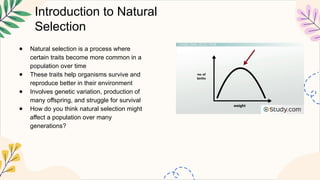
● Natural selection is a process where
certain traits become more common in a
population over time
● These traits help organisms survive and
reproduce better in their environment
● Involves genetic variation, production of
many offspring, and struggle for survival
● How do you think natural selection might
affect a population over many
generations?
Key Elements of Natural Selection
● Genetic variation within a population
● Production of many offspring
● Competition for resources and survival
● Better adapted individuals have higher chance of reproducing
● Advantageous traits are passed on to next generations
● What might be an example of an advantageous trait in your local
environment?
Example: Natural
Selection in Beetles
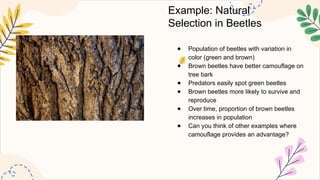
● Population of beetles with variation in
color (green and brown)
● Brown beetles have better camouflage on
tree bark
● Predators easily spot green beetles
● Brown beetles more likely to survive and
reproduce
● Over time, proportion of brown beetles
increases in population
● Can you think of other examples where
camouflage provides an advantage?
Adaptation through Natural Selection
● Adaptation: Process by which populations become more suited
to their environment
● Results from natural selection over many generations
● Helps organisms survive and thrive in specific environments
● What adaptations have you observed in local wildlife?
Antibiotic Resistance:
Natural Selection in Action
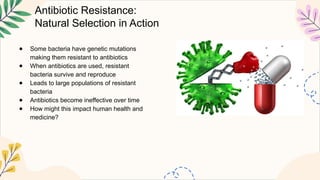
● Some bacteria have genetic mutations
making them resistant to antibiotics
● When antibiotics are used, resistant
bacteria survive and reproduce
● Leads to large populations of resistant
bacteria
● Antibiotics become ineffective over time
● How might this impact human health and
medicine?
Introduction to Selective Breeding
● Also known as artificial selection
● Process where humans choose individuals with desirable
features to breed
● Selected individuals produce next generation
● Offspring with desired features are chosen for further breeding
● How is this different from natural selection?
Selective Breeding in
Plants
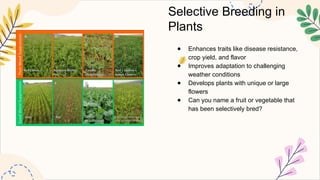
● Enhances traits like disease resistance,
crop yield, and flavor
● Improves adaptation to challenging
weather conditions
● Develops plants with unique or large
flowers
● Can you name a fruit or vegetable that
has been selectively bred?
Example: Breeding Disease-Resistant Crops
● Identify plants with disease resistance
● Cross-breed resistant plants
● Select offspring with increased resistance
● Continue breeding and selection over generations
● Develop new, more resilient varieties
● What might be the potential drawbacks of this process?
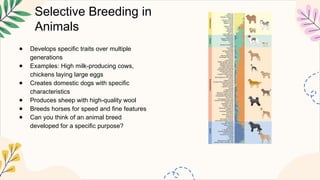
Selective Breeding in
Animals
● Develops specific traits over multiple
generations
● Examples: High milk-producing cows,
chickens laying large eggs
● Creates domestic dogs with specific
characteristics
● Produces sheep with high-quality wool
● Breeds horses for speed and fine features
● Can you think of an animal breed
developed for a specific purpose?
Natural vs. Artificial Selection: Key Differences
● Natural selection occurs without human intervention; artificial
selection is human-driven
● Natural selection enhances survival in specific environments;
artificial selection focuses on human-desired traits
● Natural selection typically occurs over long periods; artificial
selection can produce rapid changes
● How might artificial selection impact biodiversity? Discuss
potential pros and cons.

Presentation - university.pptxdahbdajdbadba

  • 1.
    Natural Selection andSelective Breeding: Understanding Evolutionary Processes
  • 2.
    Introduction to Natural Selection ●Natural selection is a process where certain traits become more common in a population over time ● These traits help organisms survive and reproduce better in their environment ● Involves genetic variation, production of many offspring, and struggle for survival ● How do you think natural selection might affect a population over many generations?
  • 3.
    Key Elements ofNatural Selection ● Genetic variation within a population ● Production of many offspring ● Competition for resources and survival ● Better adapted individuals have higher chance of reproducing ● Advantageous traits are passed on to next generations ● What might be an example of an advantageous trait in your local environment?
  • 4.
    Example: Natural Selection inBeetles ● Population of beetles with variation in color (green and brown) ● Brown beetles have better camouflage on tree bark ● Predators easily spot green beetles ● Brown beetles more likely to survive and reproduce ● Over time, proportion of brown beetles increases in population ● Can you think of other examples where camouflage provides an advantage?
  • 5.
    Adaptation through NaturalSelection ● Adaptation: Process by which populations become more suited to their environment ● Results from natural selection over many generations ● Helps organisms survive and thrive in specific environments ● What adaptations have you observed in local wildlife?
  • 6.
    Antibiotic Resistance: Natural Selectionin Action ● Some bacteria have genetic mutations making them resistant to antibiotics ● When antibiotics are used, resistant bacteria survive and reproduce ● Leads to large populations of resistant bacteria ● Antibiotics become ineffective over time ● How might this impact human health and medicine?
  • 7.
    Introduction to SelectiveBreeding ● Also known as artificial selection ● Process where humans choose individuals with desirable features to breed ● Selected individuals produce next generation ● Offspring with desired features are chosen for further breeding ● How is this different from natural selection?
  • 8.
    Selective Breeding in Plants ●Enhances traits like disease resistance, crop yield, and flavor ● Improves adaptation to challenging weather conditions ● Develops plants with unique or large flowers ● Can you name a fruit or vegetable that has been selectively bred?
  • 9.
    Example: Breeding Disease-ResistantCrops ● Identify plants with disease resistance ● Cross-breed resistant plants ● Select offspring with increased resistance ● Continue breeding and selection over generations ● Develop new, more resilient varieties ● What might be the potential drawbacks of this process?
  • 10.
    Selective Breeding in Animals ●Develops specific traits over multiple generations ● Examples: High milk-producing cows, chickens laying large eggs ● Creates domestic dogs with specific characteristics ● Produces sheep with high-quality wool ● Breeds horses for speed and fine features ● Can you think of an animal breed developed for a specific purpose?
  • 11.
    Natural vs. ArtificialSelection: Key Differences ● Natural selection occurs without human intervention; artificial selection is human-driven ● Natural selection enhances survival in specific environments; artificial selection focuses on human-desired traits ● Natural selection typically occurs over long periods; artificial selection can produce rapid changes ● How might artificial selection impact biodiversity? Discuss potential pros and cons.

Editor's Notes

  • #1 Created from: https://www.youtube.com/watch?v=hMLuAzzVNrU