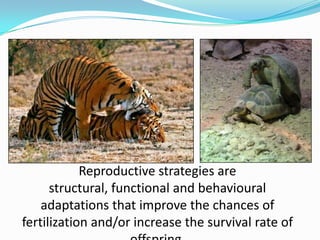
Reproductive strategies are
      structural, functional and behavioural
    adaptations that improve the chances of
fertilization and/or increase the survival rate of
Asexual Reproduction
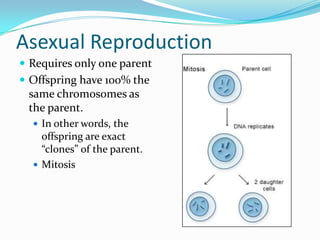
 Requires only one parent
 Offspring have 100% the
 same chromosomes as
 the parent.
   In other words, the
    offspring are exact
    “clones” of the parent.
   Mitosis
Types of Asexual Reproduction
 There are several different types of asexual
  reproduction they are:
   Binary Fission
   Budding
   Fragmentation
   Regeneration
   Parthenogenesis
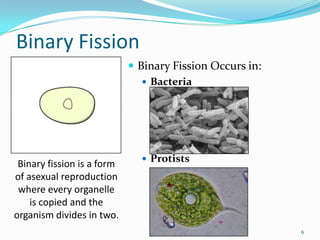
Binary Fission
                             Binary Fission Occurs in:
                                Bacteria


                               Protists
 Binary fission is a form
of asexual reproduction
 where every organelle
    is copied and the
organism divides in two.
                                                          6
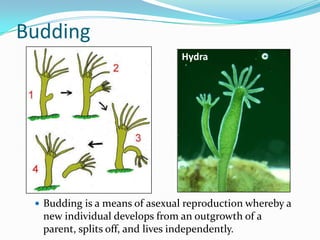
Budding
                               Hydra


  Budding is a means of asexual reproduction whereby a
  new individual develops from an outgrowth of a
  parent, splits off, and lives independently.
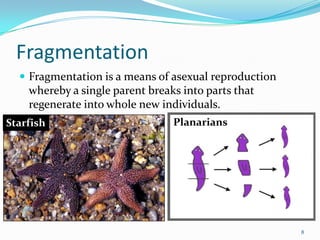
Fragmentation
   Fragmentation is a means of asexual reproduction
    whereby a single parent breaks into parts that
    regenerate into whole new individuals.
Starfish                         Planarians


                                                       8
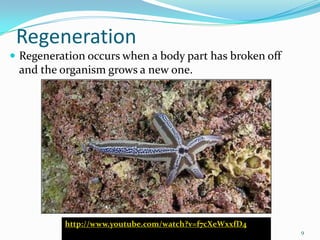
Regeneration
 Regeneration occurs when a body part has broken off
 and the organism grows a new one.


          http://www.youtube.com/watch?v=f7cXeWxxfD4
                                                        9
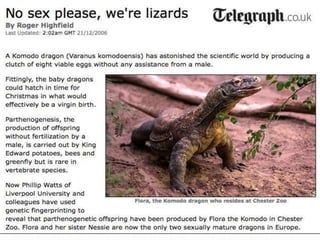
Parthenogenesis
 This type of reproduction involves the development of
  an egg that has not been fertilized into an individual.
 Animals like most kinds of wasps, bees, and ants that
  have no sex chromosomes reproduce by this process.
  Some reptiles and fish are also capable of reproducing
  in this manner.
Sexual Reproduction
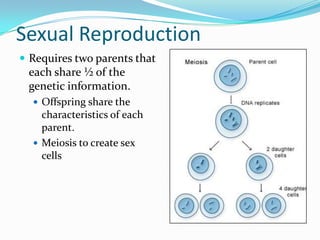
 Requires two parents that
 each share ½ of the
 genetic information.
   Offspring share the
    characteristics of each
    parent.
   Meiosis to create sex
    cells
Sexual Reproduction
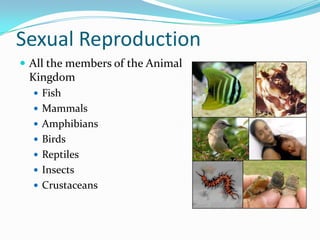
 All the members of the Animal
 Kingdom
   Fish
   Mammals
   Amphibians
   Birds
   Reptiles
   Insects
   Crustaceans
Sexual Reproduction in plants
 Plant Kingdom
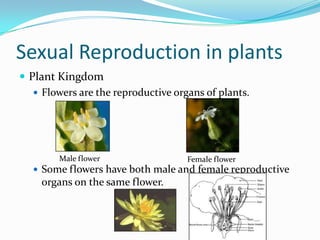
    Flowers are the reproductive organs of plants.


        Male flower                  Female flower
    Some flowers have both male and female reproductive
    organs on the same flower.
Sexual Reproduction
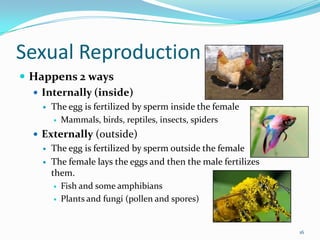
 Happens 2 ways
   Internally (inside)
       The egg is fertilized by sperm inside the female
         Mammals, birds, reptiles, insects, spiders

   Externally (outside)
       The egg is fertilized by sperm outside the female
       The female lays the eggs and then the male fertilizes
        them.
          Fish and some amphibians

          Plants and fungi (pollen and spores)


                                                                16
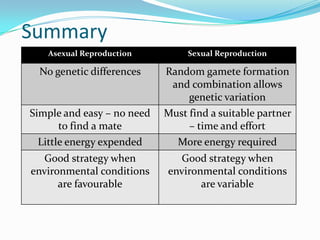
Summary
   Asexual Reproduction          Sexual Reproduction

  No genetic differences    Random gamete formation
                             and combination allows
                                 genetic variation
Simple and easy – no need   Must find a suitable partner
       to find a mate            – time and effort
  Little energy expended      More energy required
  Good strategy when          Good strategy when
environmental conditions    environmental conditions
      are favourable               are variable
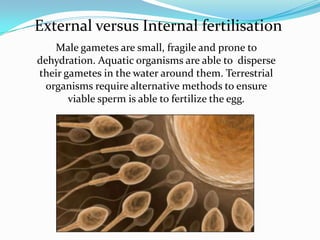
External versus Internal fertilisation
    Male gametes are small, fragile and prone to
dehydration. Aquatic organisms are able to disperse
their gametes in the water around them. Terrestrial
  organisms require alternative methods to ensure
       viable sperm is able to fertilize the egg.
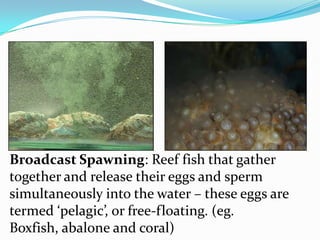
Broadcast Spawning: Reef fish that gather
together and release their eggs and sperm
simultaneously into the water – these eggs are
termed ‘pelagic’, or free-floating. (eg.
Boxfish, abalone and coral)
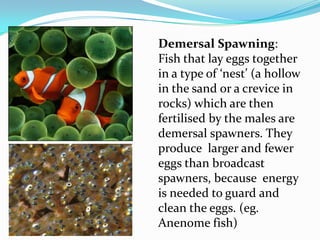
Demersal Spawning:
Fish that lay eggs together
in a type of ‘nest’ (a hollow
in the sand or a crevice in
rocks) which are then
fertilised by the males are
demersal spawners. They
produce larger and fewer
eggs than broadcast
spawners, because energy
is needed to guard and
clean the eggs. (eg.
Anenome fish)
ONE mating partner vs. MANY mating partners
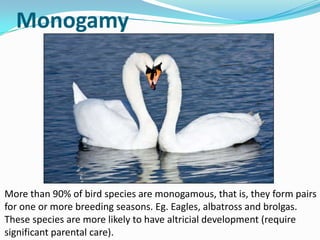
Monogamy


More than 90% of bird species are monogamous, that is, they form pairs
for one or more breeding seasons. Eg. Eagles, albatross and brolgas.
These species are more likely to have altricial development (require
significant parental care).
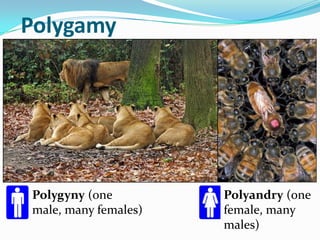
Polygamy


Polygyny (one         Polyandry (one
male, many females)   female, many
                      males)
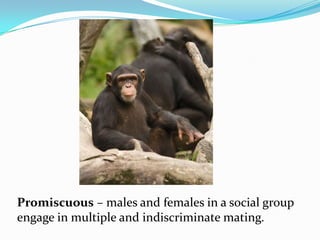
Promiscuous – males and females in a social group
engage in multiple and indiscriminate mating.
Fast versus slow
 Fast reproductive strategies are known as R-strategies


 Slow Reproductive strategies are called the K-strategy
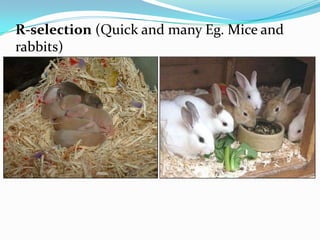
R-selection (Quick and many Eg. Mice and
rabbits)
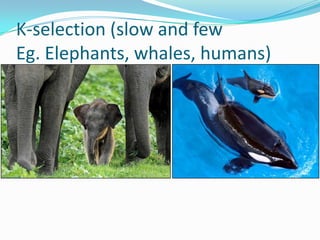
K-selection (slow and few
Eg. Elephants, whales, humans)
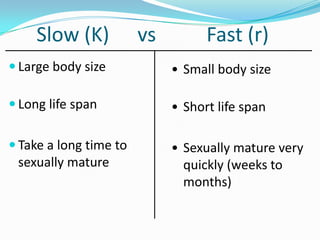
Slow (K)           vs         Fast (r)
 Large body size            • Small body size

 Long life span             • Short life span

 Take a long time to        • Sexually mature very
 sexually mature               quickly (weeks to
                               months)
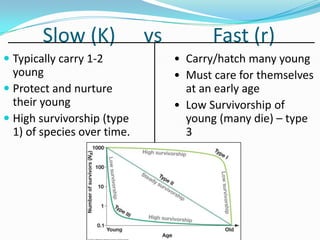
Slow (K)             vs          Fast (r)
 Typically carry 1-2            • Carry/hatch many young
  young                          • Must care for themselves
 Protect and nurture              at an early age
  their young                    • Low Survivorship of
 High survivorship (type          young (many die) – type
 1) of species over time.          3
Eggs or live born young?
 Oviparity – eggs released by the mother so embryos
  develop outside mother’s body with nutrients for the
  embryo coming from the egg yolk
 Viviparity – embryos develop within the mother’s
  body and are born as miniature copies of the adult.
  Nutrition of the developing embryo within the mother
  occurs in different ways.
Oviparity
             Oviparous animals lay hard-
              shelled eggs that act as a
              ‘pond’ for the developing
              embryo.
             The yolk of the egg acts as a
              source of nutrients.
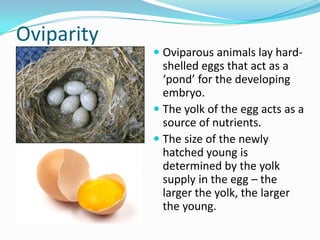
             The size of the newly
              hatched young is
              determined by the yolk
              supply in the egg – the
              larger the yolk, the larger
              the young.
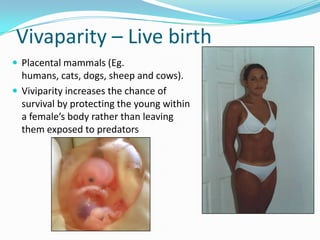
Vivaparity – Live birth
 Placental mammals (Eg.
  humans, cats, dogs, sheep and cows).
 Viviparity increases the chance of
  survival by protecting the young within
  a female’s body rather than leaving
  them exposed to predators
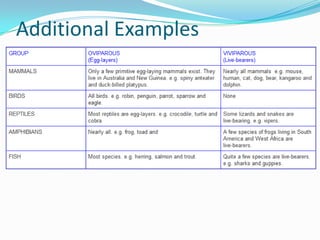
Additional Examples
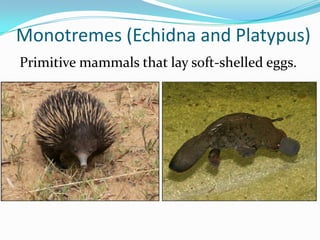
Monotremes (Echidna and Platypus)
Primitive mammals that lay soft-shelled eggs.

Reproductive strategies (bd)

  • 2.
    Reproductive strategies are structural, functional and behavioural adaptations that improve the chances of fertilization and/or increase the survival rate of
  • 4.
    Asexual Reproduction  Requiresonly one parent  Offspring have 100% the same chromosomes as the parent.  In other words, the offspring are exact “clones” of the parent.  Mitosis
  • 5.
    Types of AsexualReproduction  There are several different types of asexual reproduction they are:  Binary Fission  Budding  Fragmentation  Regeneration  Parthenogenesis
  • 6.
    Binary Fission  Binary Fission Occurs in:  Bacteria  Protists Binary fission is a form of asexual reproduction where every organelle is copied and the organism divides in two. 6
  • 7.
    Budding Hydra  Budding is a means of asexual reproduction whereby a new individual develops from an outgrowth of a parent, splits off, and lives independently.
  • 8.
    Fragmentation Fragmentation is a means of asexual reproduction whereby a single parent breaks into parts that regenerate into whole new individuals. Starfish Planarians 8
  • 9.
    Regeneration  Regeneration occurswhen a body part has broken off and the organism grows a new one. http://www.youtube.com/watch?v=f7cXeWxxfD4 9
  • 11.
    Parthenogenesis  This typeof reproduction involves the development of an egg that has not been fertilized into an individual.  Animals like most kinds of wasps, bees, and ants that have no sex chromosomes reproduce by this process. Some reptiles and fish are also capable of reproducing in this manner.
  • 13.
    Sexual Reproduction  Requirestwo parents that each share ½ of the genetic information.  Offspring share the characteristics of each parent.  Meiosis to create sex cells
  • 14.
    Sexual Reproduction  Allthe members of the Animal Kingdom  Fish  Mammals  Amphibians  Birds  Reptiles  Insects  Crustaceans
  • 15.
    Sexual Reproduction inplants  Plant Kingdom  Flowers are the reproductive organs of plants. Male flower Female flower  Some flowers have both male and female reproductive organs on the same flower.
  • 16.
    Sexual Reproduction  Happens2 ways  Internally (inside)  The egg is fertilized by sperm inside the female  Mammals, birds, reptiles, insects, spiders  Externally (outside)  The egg is fertilized by sperm outside the female  The female lays the eggs and then the male fertilizes them.  Fish and some amphibians  Plants and fungi (pollen and spores) 16
  • 17.
    Summary Asexual Reproduction Sexual Reproduction No genetic differences Random gamete formation and combination allows genetic variation Simple and easy – no need Must find a suitable partner to find a mate – time and effort Little energy expended More energy required Good strategy when Good strategy when environmental conditions environmental conditions are favourable are variable
  • 19.
    External versus Internalfertilisation Male gametes are small, fragile and prone to dehydration. Aquatic organisms are able to disperse their gametes in the water around them. Terrestrial organisms require alternative methods to ensure viable sperm is able to fertilize the egg.
  • 20.
    Broadcast Spawning: Reeffish that gather together and release their eggs and sperm simultaneously into the water – these eggs are termed ‘pelagic’, or free-floating. (eg. Boxfish, abalone and coral)
  • 21.
    Demersal Spawning: Fish thatlay eggs together in a type of ‘nest’ (a hollow in the sand or a crevice in rocks) which are then fertilised by the males are demersal spawners. They produce larger and fewer eggs than broadcast spawners, because energy is needed to guard and clean the eggs. (eg. Anenome fish)
  • 22.
    ONE mating partnervs. MANY mating partners
  • 23.
    Monogamy More than 90%of bird species are monogamous, that is, they form pairs for one or more breeding seasons. Eg. Eagles, albatross and brolgas. These species are more likely to have altricial development (require significant parental care).
  • 24.
    Polygamy Polygyny (one Polyandry (one male, many females) female, many males)
  • 25.
    Promiscuous – malesand females in a social group engage in multiple and indiscriminate mating.
  • 27.
    Fast versus slow Fast reproductive strategies are known as R-strategies  Slow Reproductive strategies are called the K-strategy
  • 28.
    R-selection (Quick andmany Eg. Mice and rabbits)
  • 29.
    K-selection (slow andfew Eg. Elephants, whales, humans)
  • 30.
    Slow (K) vs Fast (r)  Large body size • Small body size  Long life span • Short life span  Take a long time to • Sexually mature very sexually mature quickly (weeks to months)
  • 31.
    Slow (K) vs Fast (r)  Typically carry 1-2 • Carry/hatch many young young • Must care for themselves  Protect and nurture at an early age their young • Low Survivorship of  High survivorship (type young (many die) – type 1) of species over time. 3
  • 33.
    Eggs or liveborn young?  Oviparity – eggs released by the mother so embryos develop outside mother’s body with nutrients for the embryo coming from the egg yolk  Viviparity – embryos develop within the mother’s body and are born as miniature copies of the adult. Nutrition of the developing embryo within the mother occurs in different ways.
  • 34.
    Oviparity  Oviparous animals lay hard- shelled eggs that act as a ‘pond’ for the developing embryo.  The yolk of the egg acts as a source of nutrients.  The size of the newly hatched young is determined by the yolk supply in the egg – the larger the yolk, the larger the young.
  • 35.
    Vivaparity – Livebirth  Placental mammals (Eg. humans, cats, dogs, sheep and cows).  Viviparity increases the chance of survival by protecting the young within a female’s body rather than leaving them exposed to predators
  • 36.
  • 37.
    Monotremes (Echidna andPlatypus) Primitive mammals that lay soft-shelled eggs.
Editor's Notes